Formulation Development Outsourcing Market Report by Service, Formulation, Therapeutic Area, End Use, Countries and Companies Analysis 2026-2034
Buy NowFormulation Development Outsourcing Market Size and Forecast
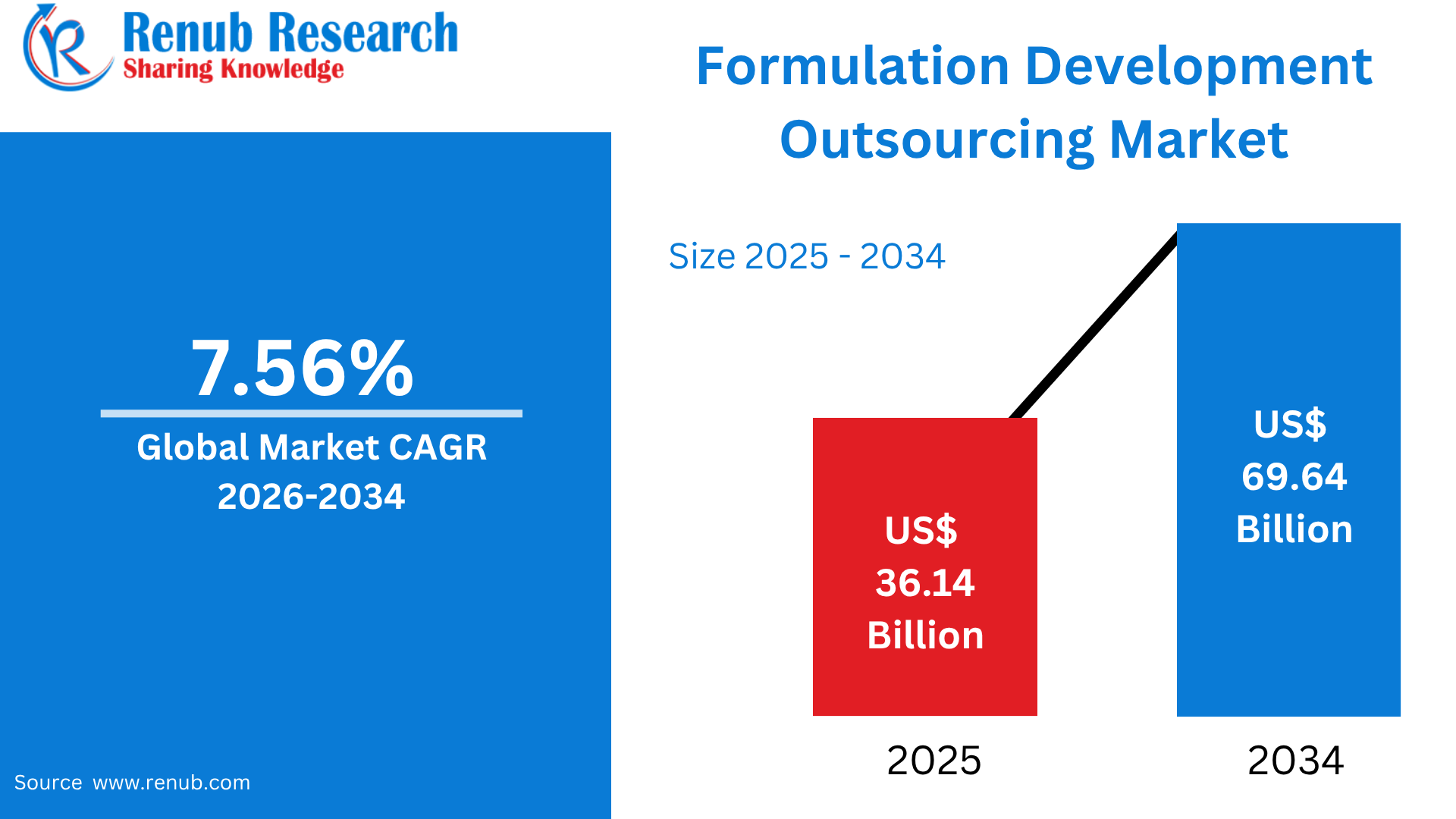
Formulation Development Outsourcing Market is projected to expand from US$ 36.14 billion in 2025 to US$ 69.64 billion by 2034, registering a CAGR of 7.56% during 2026–2034. Market growth is being supported by increasing pharmaceutical research and development activities, rising demand for specialized formulation development capabilities, and the expanding pipeline of biologic and complex drug products. Pharmaceutical companies are increasingly outsourcing formulation development activities to access advanced technologies, specialized expertise, and scalable development capabilities while optimizing operational costs.
What is Formulation Development Outsourcing and its Uses & Popularity Worldwide
Formulation development outsourcing refers to the practice of pharmaceutical and biotechnology companies contracting external specialized organizations to develop, optimize, and characterize drug formulations rather than performing all formulation activities internally. These services may cover preformulation studies, excipient selection, dosage-form development, process optimization, stability testing, analytical support, scale-up, and technology transfer. Outsourcing providers support a broad range of dosage forms, including tablets, capsules, injectables, oral liquids, topical formulations, and complex drug-delivery systems. The model is increasingly used to access specialized scientific expertise, advanced equipment, manufacturing capabilities, and regulatory knowledge while controlling development costs and timelines. Its global relevance is supported by continued pharmaceutical innovation and the increasing complexity of drug pipelines. For example, the FDA approved 50 novel drugs in 2024, while 26, or 52%, were approved for rare diseases, creating demand for specialized development capabilities. Formulation outsourcing is particularly valuable for emerging biotechnology companies and virtual drug developers that may lack extensive internal formulation infrastructure.
Growth Drivers of the Formulation Development Outsourcing Market
Rising Pharmaceutical R&D and Drug Development Activity
Increasing pharmaceutical research and development activity is a major driver of formulation development outsourcing worldwide. Drug developers are advancing increasingly diverse pipelines covering small molecules, biologics, rare-disease therapies, oncology products, and complex drug-delivery systems. Each candidate requires appropriate formulation development to achieve stability, bioavailability, manufacturability, dosage accuracy, and patient usability. The scale of ongoing innovation can be illustrated by the FDA’s approval activity: 50 novel drugs were approved in the United States in 2024, compared with 55 in 2023. In addition, 26 of the 50 novel drugs approved in 2024 were for rare diseases, highlighting the need for specialized development approaches for therapies serving relatively small patient populations. Pharmaceutical companies increasingly engage contract development organizations to perform formulation screening, optimization, analytical testing, stability studies, and scale-up. Outsourcing allows sponsors to access specialized scientists and facilities without making equivalent investments in permanent infrastructure. As the number and complexity of drug-development programs increase, demand for external formulation expertise is expected to strengthen.
Expanding Biologics and Complex Drug Pipelines
The growing development of biologics and other complex therapies is creating additional demand for specialized formulation development services. Unlike many conventional small-molecule medicines, biologics can be highly sensitive to factors such as temperature, pH, aggregation, oxidation, and mechanical stress, requiring sophisticated formulation strategies to maintain product stability and quality. The FDA’s 2024 activity demonstrates the continuing importance of biological products: CDER approved a record 18 biosimilars for eight reference products in 2024, taking the cumulative number of biosimilars approved since 2015 to 60. The FDA also recorded numerous biological license application approvals across areas including cell and gene therapies and other advanced products. These developments increase the need for specialized formulation capabilities, including excipient selection, protein stabilization, lyophilization, delivery-device compatibility, and high-concentration formulations. Outsourcing providers can offer specialized laboratories, analytical platforms, process-development expertise, and regulatory experience. As pharmaceutical pipelines increasingly incorporate biologics, biosimilars, and other complex modalities, companies are using external formulation partners to address technical challenges and accelerate development.
Demand to Reduce Development Costs and Accelerate Time-to-Market
The need to control pharmaceutical development expenses and shorten timelines is encouraging companies to outsource formulation activities to specialized service providers. Establishing and maintaining internal formulation laboratories requires significant investments in scientists, analytical equipment, manufacturing facilities, quality systems, and regulatory capabilities. Contract development organizations allow pharmaceutical companies to access these resources on a project basis, potentially improving resource utilization and reducing the need for large fixed infrastructure. Outsourcing can also provide access to experienced formulation scientists and established development workflows, helping companies move candidates from laboratory studies toward clinical development and commercialization more efficiently. The importance of development speed is reflected in FDA regulatory activity: in 2024, 37 of the 50 novel drugs approved by CDER, or 74%, received approval during the first review cycle, while 33 of 50, or 66%, used at least one expedited development or review program. Although these figures describe regulatory programs rather than outsourcing itself, they demonstrate the broader pharmaceutical industry’s emphasis on efficient development and review. Consequently, formulation outsourcing is increasingly used to obtain specialized capabilities, improve scalability, support regulatory readiness, and potentially accelerate the transition from formulation research to clinical and commercial stages.
Challenges of the Formulation Development Outsourcing Market
Regulatory Complexity and Quality-Control Requirements
Regulatory compliance and stringent quality requirements represent significant challenges for formulation development outsourcing. Pharmaceutical formulations must satisfy extensive requirements covering raw materials, excipients, manufacturing processes, analytical methods, stability, documentation, data integrity, and product quality. When development activities are distributed between pharmaceutical sponsors and external providers, maintaining consistent quality systems and clear responsibilities becomes particularly important. Different markets may also impose varying regulatory expectations, increasing complexity for organizations conducting global development programs. The FDA maintains separate approval and reporting pathways for new drugs, biologics, generics, and other products, reflecting the breadth of regulatory requirements across pharmaceutical development. Complex products can require additional characterization and specialized testing, increasing both development time and costs. Outsourcing relationships therefore require effective technical agreements, documentation controls, audit processes, data-transfer systems, and oversight mechanisms. Any deficiencies in formulation development, analytical testing, documentation, or technology transfer can lead to delays in clinical development or regulatory submissions. As pharmaceutical formulations become more sophisticated, outsourcing providers must continuously invest in quality systems, skilled personnel, regulatory expertise, and compliant infrastructure.
Intellectual Property, Data Security, and Coordination Risks
Intellectual property protection and coordination between pharmaceutical sponsors and external formulation providers present another challenge. Formulation development can involve proprietary information concerning drug substances, excipients, delivery technologies, manufacturing processes, analytical methods, and product specifications. Companies must therefore protect confidential information while sharing sufficient technical data with outsourcing partners to enable effective development. Coordination can also become complicated when multiple organizations participate in preformulation, formulation, analytical development, clinical manufacturing, and technology transfer. Differences in operating procedures, communication practices, project-management systems, and technical capabilities may create delays or inconsistencies. These challenges are particularly relevant for innovative therapies because formulation knowledge can represent an important component of a product’s competitive advantage. The growing complexity of pharmaceutical development further increases the amount of technical information exchanged between sponsors and contractors. Regulatory documentation must also remain accurate and traceable throughout the development process. Effective contracts, confidentiality agreements, intellectual-property provisions, data-access controls, defined responsibilities, and regular technical reviews are therefore important for managing outsourcing relationships. Companies must balance the benefits of external expertise and infrastructure with the need to retain control over critical formulation knowledge and development data.
Recent Developments in the Formulation Development Outsourcing Market
- GBI Biomanufacturing and NanoRetinal Collaboration – September 2025: GBI Biomanufacturing entered into a partnership with NanoRetinal, Inc. to support the development and manufacturing of NAR-001, an investigational nanoparticle-based therapy for inherited retinal disorders. The collaboration highlights the increasing demand for specialized outsourcing providers capable of supporting advanced therapies and complex formulation requirements.
- Strides Pharma Science and Kenox Agreement – September 2025: Strides Pharma Science, through its subsidiary Strides Pharma Global Pte. Limited, signed a strategic product development agreement with Kenox. The collaboration focuses on joint pharmaceutical product development and portfolio expansion. Such partnerships demonstrate the growing use of external development expertise to improve resource efficiency, accelerate innovation, and support faster market entry.
- CoreRx Acquisition of Societal CDMO – April 2024: CoreRx Inc. acquired Societal CDMO Inc. in a transaction valued at approximately US$130 million. The acquisition expanded CoreRx’s capabilities in complex small-molecule formulation development, clinical manufacturing, and early-stage drug development. Industry consolidation of this nature strengthens the range of specialized services available to pharmaceutical companies while reducing the need for extensive internal infrastructure.
- Aenova Group and Galvita Collaboration – July 2023: Aenova Group established a strategic partnership with Galvita to support the development and manufacturing of oral dosage formulations. The collaboration provides access to specialized formulation technologies and manufacturing capabilities, including formulation optimization, bioavailability enhancement, and scale-up. Such outsourcing partnerships enable pharmaceutical companies to access technical expertise and streamline development activities from early formulation stages toward commercialization.
Advancing Drug Development and Complex Formulations
The formulation development market is a fundamental component of pharmaceutical development, converting active pharmaceutical ingredients into safe, stable, effective, and patient-friendly drug products. Services and activities include preformulation studies, excipient screening, dosage-form selection, formulation optimization, process development, analytical testing, and stability evaluation. Market expansion is supported by increasing pharmaceutical R&D activity and the growing complexity of drug candidates. The FDA approved 50 novel drugs in 2024, including 26 medicines for rare diseases, demonstrating continued development of innovative therapies requiring specialized formulation approaches. Biologics, poorly soluble compounds, targeted therapies, and advanced drug-delivery systems often require specialized technologies to improve bioavailability, stability, and patient compliance. Pharmaceutical companies are also increasingly using external formulation specialists to access advanced equipment and scientific expertise while controlling infrastructure requirements. Growth in personalized medicine, complex dosage forms, and sophisticated delivery platforms is further creating opportunities for formulation developers. As drug pipelines become more technically demanding, formulation development remains an essential stage connecting pharmaceutical discovery with clinical and commercial manufacturing.
Demand for Convenient and Cost-Effective Drug Delivery
The oral formulation development outsourcing market continues to benefit from the widespread use of tablets, capsules, powders, and oral liquids, which remain convenient and familiar dosage forms for patients. Pharmaceutical companies increasingly outsource oral formulation activities to obtain specialized expertise in solubility enhancement, bioavailability improvement, controlled release, taste masking, and excipient selection. This is particularly important because poorly water-soluble drug candidates can present significant development challenges. Outsourcing providers can apply technologies such as amorphous solid dispersions, lipid-based formulations, nanoparticles, and modified-release systems to improve drug performance. The generic pharmaceutical segment also creates sustained demand because developers must demonstrate quality, performance, and manufacturability while maintaining competitive costs. In addition, complex oral medicines and patient-centric formulations are encouraging companies to seek specialized external capabilities. Contract development organizations provide access to formulation laboratories, analytical infrastructure, pilot-scale equipment, and regulatory expertise without requiring sponsors to build equivalent internal resources. As pharmaceutical pipelines expand and companies prioritize faster development, outsourced oral formulation services are expected to remain an important component of the global formulation development industry.
Increasing Complexity of Cancer Therapies
The oncology formulation development outsourcing market is expanding alongside the growing pipeline of cancer medicines and increasingly complex therapeutic modalities. Oncology development includes small molecules, biologics, targeted therapies, antibody-drug conjugates, immunotherapies, and personalized treatments, many of which require specialized formulation strategies. The FDA approved 50 novel drugs in 2024, with oncology continuing to represent an important area of innovative drug development. Formulation developers help optimize drug stability, solubility, bioavailability, dosing, and patient administration while supporting scale-up and clinical manufacturing. Oncology medicines may require specialized delivery technologies to improve therapeutic exposure while managing toxicity and formulation constraints. Biotechnology companies, particularly those with limited internal infrastructure, increasingly collaborate with contract development organizations to access specialized analytical and formulation capabilities. Outsourcing can also provide access to facilities capable of handling highly potent compounds and complex manufacturing requirements. Increasing investment in targeted cancer treatments and precision medicine is expected to sustain demand for specialized formulation development. As oncology pipelines become more diversified, formulation outsourcing providers with expertise in complex molecules and advanced delivery systems are positioned to support pharmaceutical sponsors throughout development.
United States Strong Pharmaceutical R&D and Advanced Therapy Investments
United States remains a major market for formulation development outsourcing because of its large pharmaceutical and biotechnology industry, substantial research investment, and concentration of advanced drug-development companies. Demand is increasing as developers work on biologics, gene therapies, targeted medicines, and personalized treatments that require specialized formulation and manufacturing capabilities. Recent industry activity illustrates continued investment in outsourced development infrastructure. In May 2026, Catalent and Elpida Therapeutics announced a collaboration involving late-phase manufacturing of an AAV9 gene therapy, while Catalent also obtained exclusive rights to Elpida’s AAV programs. In another development, GI Partners acquired Charles River Laboratories’ CDMO and Cell Solutions businesses in 2026, creating Rose Biosolutions, which reported approximately US$143 million in 2025 revenue from the acquired operations. Such transactions demonstrate continued consolidation and capacity expansion in the U.S. contract development and manufacturing sector. Pharmaceutical companies increasingly use external providers for formulation optimization, analytical development, clinical manufacturing, and technology transfer. The country’s sophisticated regulatory environment and extensive advanced-therapy pipeline are expected to continue supporting demand for specialized formulation outsourcing services.
Germany Advanced Pharmaceutical Infrastructure Supports Outsourcing
Germany is an important European market for formulation development outsourcing, supported by its established pharmaceutical manufacturing industry, research institutions, engineering capabilities, and biotechnology ecosystem. Pharmaceutical companies increasingly seek external formulation expertise to access specialized technologies while improving development efficiency and controlling infrastructure requirements. Demand is particularly relevant for biologics, specialty medicines, complex oral formulations, and advanced drug-delivery systems. Germany also benefits from a strong industrial base and established collaboration between pharmaceutical companies, research organizations, and specialized service providers. In July 2025, the “Made for Germany” initiative brought together 61 companies to announce programs and investments aimed at strengthening Germany’s investment environment, including digitalization, innovation, and workforce development. These broader industrial initiatives can support technological development and competitiveness across the life sciences sector. Pharmaceutical outsourcing providers can benefit from Germany’s concentration of specialized scientific and manufacturing capabilities. As companies seek flexible development models and access to advanced formulation technologies, partnerships with German CDMOs and specialized formulation organizations are expected to remain important for both domestic and international pharmaceutical developers.
China Expanding Biopharmaceutical Capabilities and CDMO Investment
China has developed into an important center for pharmaceutical and biopharmaceutical outsourcing, supported by expanding R&D capabilities, a large scientific workforce, growing domestic drug development, and investment in advanced manufacturing technologies. Pharmaceutical companies increasingly collaborate with Chinese CDMOs to access formulation development, analytical testing, process development, and manufacturing capabilities. The country’s growing biologics sector is creating additional demand for specialized development platforms. In August 2025, WuXi Biologics introduced the WuXia293Stable cell-line platform, designed to support the development and manufacturing of difficult-to-express molecules. Such technology platforms can improve development efficiency and expand the ability of outsourcing providers to address complex biologic products. China’s combination of scientific talent, manufacturing infrastructure, and expanding pharmaceutical innovation ecosystem continues to strengthen its position in global outsourcing. Domestic pharmaceutical companies are also increasing investments in innovative medicines, creating additional demand for specialized development services. Continued advancement in biologics, complex formulations, and process technologies is expected to support the country’s formulation development outsourcing market over the coming years.
Saudi Arabia Pharmaceutical Localization and Vision 2030 Support Market Development
Saudi Arabia’s formulation development outsourcing market is developing as the country increases investment in pharmaceutical manufacturing, biotechnology, and healthcare infrastructure. Under Saudi Vision 2030, the government is seeking to strengthen domestic pharmaceutical capabilities, increase local manufacturing, improve supply-chain resilience, and attract international life-sciences investment. These initiatives are creating opportunities for formulation developers, CDMOs, technology providers, and pharmaceutical companies. A major milestone occurred in June 2023, when the Public Investment Fund established Lifera, a commercial-scale pharmaceutical manufacturing and development company intended to strengthen Saudi Arabia’s life-sciences ecosystem. Lifera focuses on areas including innovative medicines, biologics, vaccines, and other pharmaceutical products. Development of domestic manufacturing capabilities can increase demand for formulation optimization, analytical development, scale-up, technology transfer, and regulatory support. International pharmaceutical companies may also seek local partnerships as Saudi Arabia expands its pharmaceutical manufacturing base. As the country’s healthcare and life-sciences infrastructure develops, outsourcing providers can play a role in transferring technical expertise and supporting local drug-development capabilities.
Formulation Development Outsourcing Market Segments
Service
- Formulation Development
- Preformulation
Formulation
- Oral
- Injectable
- Others
Therapeutic Area
- Oncology
- Infectious Diseases
- Neurology
- Hematology
- Respiratory
- Cardiovascular
- Dermatology
- Others
End Use
- Pharmaceutical and Biopharmaceutical Companies
- Government and Academics Institutes
- Others
Countries
North America
- United States
- Canada
Europe
- France
- Germany
- Italy
- Spain
- United Kingdom
- Belgium
- Netherlands
- Turkey
Asia Pacific
- China
- Japan
- India
- Australia
- South Korea
- Thailand
- Malaysia
- Indonesia
- New Zealand
Latin America
- Brazil
- Mexico
- Argentina
Middle East & Africa
- South Africa
- Saudi Arabia
- United Arab Emirates
All the Key players have been covered with 5 Viewpoints
- Overviews
- Key Person
- Recent Developments
- SWOT Analysis
- Revenue Analysis
Key Players Analysis
- SGS S.A.
- Intertek Group plc
- Recipharm
- Lonza
- Charles River Laboratories International, Inc
- Eurofins Scientific SE
- Labcorp
- Thermo Fisher Scientific, Inc.
Report Details:
| Report Features | Details |
| Base Year |
2025 |
| Historical Period |
2022 - 2025 |
| Forecast Period |
2026 - 2034 |
| Market |
US$ Billion |
| Segment Covered |
Service, Formulation, Therapeutic Area, End Use and Countries |
| Countries Covered |
|
| Companies Covered |
|
| Customization Scope |
20% Free Customization |
| Post-Sale Analyst Support |
1 Year (52 Weeks) |
| Delivery Format |
PDF and Excel through Email (We can also provide the editable version of the report in PPT/Word format on request) |
Customization Services available
- Analysis of Market Size and Its Segments
- More Company Profiles (Upto 10 without any additional cost):
- Additional Countries (Other than mentioned Countries):
- Region/Country Specific Reports:
- Market Entry Strategy:
- Region-Specific Market Dynamics:
- Regional Market Share Analysis:
- Trade Analysis:
- Production Insights:
- Others Customized Requests:
For more information contact our analysts.
Need More Assistance?
- Talk to our analysts to get more precious information on the current market trends.
- Include more countries and segments and customize the report based on the final requirement.
- Get a competitive advantage in your industry by knowing the report findings and making a positive impact on your revenues and operations.
- Our analysts are always ready to provide more help and pertinent information if you need any additional assistance.