Digital Payment Market Report by Type, Offering, End User, Countries and Companies Analysis 2026-2034
Buy NowDigital Payment Market Size and Forecast
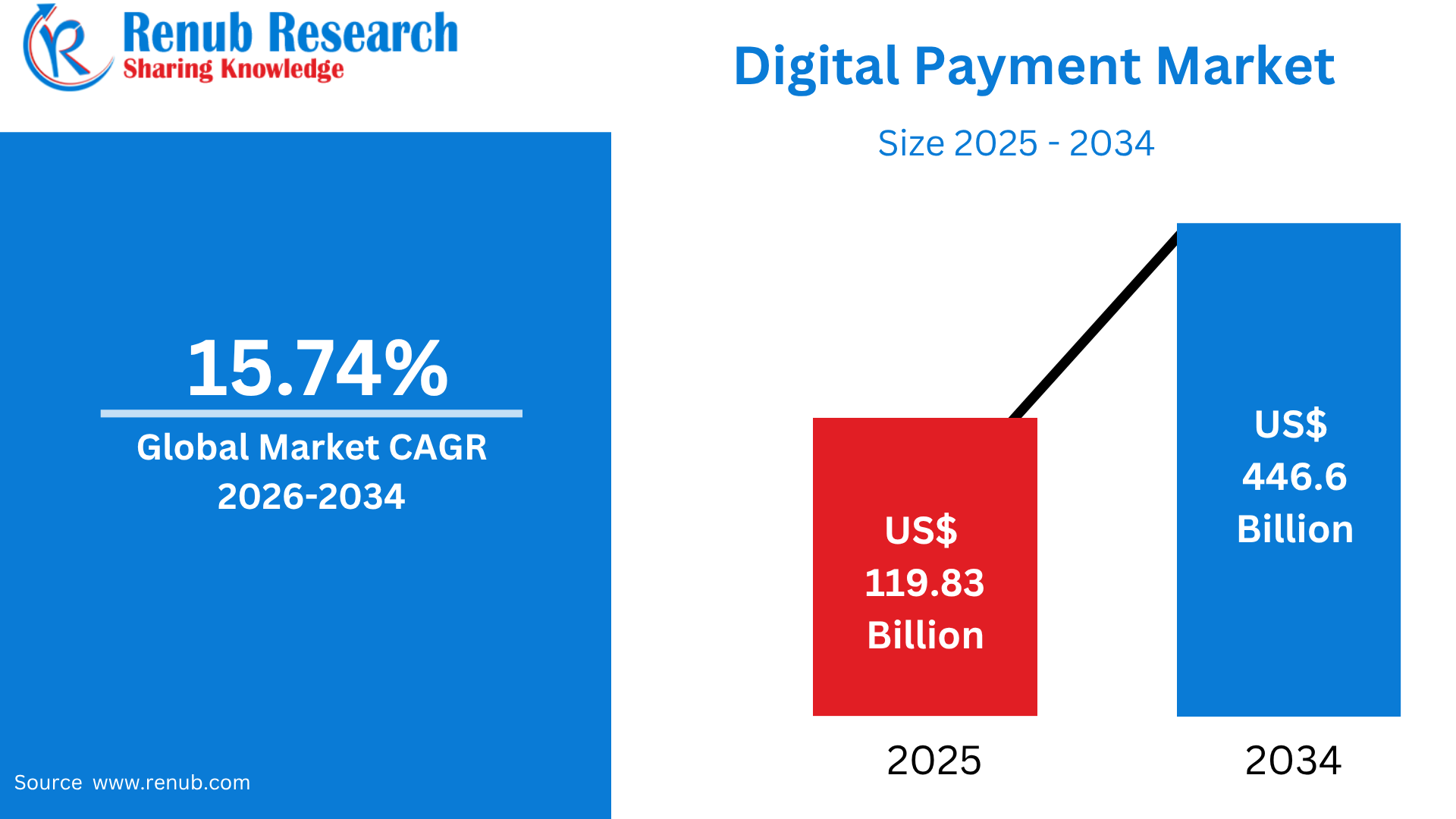
Digital Payment Market is projected to grow from US$ 119.83 Billion in 2025 to US$ 446.6 Billion by 2034, registering a CAGR of 15.74% during 2026–2034. Market expansion is being driven by rapid smartphone penetration, increasing e-commerce activity, the growing adoption of contactless transactions, and supportive government initiatives promoting cashless economies. Furthermore, continuous innovations by leading companies such as PayPal Holdings Inc. and Visa Inc. are enhancing payment security, convenience, speed, and interoperability.
What is Digital Payment and Its Uses & Popularity Worldwide
Digital payment refers to the electronic transfer of money between individuals, businesses, governments, or financial institutions without the physical exchange of cash. It includes credit and debit cards, mobile wallets, internet banking, bank transfers, QR-code payments, contactless payments, and real-time payment systems. Digital payments are widely used for e-commerce purchases, utility bills, retail transactions, transportation, subscriptions, remittances, and government services. Their popularity has increased as consumers seek faster, convenient, and secure ways to complete transactions using smartphones and connected devices. The expansion of e-commerce and mobile banking has further accelerated adoption across developed and emerging economies. Real-time payment infrastructure is also transforming everyday transactions by enabling funds to move within seconds. According to the World Bank, 79% of adults worldwide had an account at a financial institution or mobile-money provider in 2021, compared with 51% in 2011. Growing smartphone ownership, expanding internet connectivity, improved payment security, and financial-inclusion initiatives are therefore strengthening the global digital payment ecosystem.
Global Revenue Growth Overview
·Historical Expansion:
- 2014: Global payments revenue stood at $1.3 trillion, accounting for 37% of total banking revenues.
- 2014–2019 Growth: Expanded at +7% per year, reaching $1.8 trillion (39% share of banking revenues) in 2019.
- 2019–2023 Growth: Accelerated at +8% per year despite a slight dip in 2020 ($1.7 trillion), reaching $2.4 trillion by 2023.
·2024 Performance:
- Total revenue reached $2.5 trillion, growing at a decelerated rate of +4% year-over-year.
- Payments accounted for 41% of total banking revenues (down slightly from 42% in 2023).
·2029 Outlook:
- Projected to continue growing at +4% per year, reaching $3.0 trillion by 2029.
Regional Breakdown (2024 vs. 2014)
- Asia–Pacific:
- Remains the largest single regional market, rising from $0.6 trillion in 2014 to $1.0 trillion in 2024 (peaking at $1.1T in 2023).
- North America:
- Grew steadily from $0.4 trillion in 2014 to $0.7 trillion in 2024.
- EMEA (Europe, Middle East, Africa):
- Doubled from $0.3 trillion in 2014 to $0.6 trillion in 2024 (projections exclude Russia).
- Latin America:
- Doubled from $0.1 trillion in 2014 to $0.2 trillion in 2024.
Source: McKinsey Global Payments Map, featured in The 2025 McKinsey Global Payments Report
Growth Drivers of the Digital Payment Market
Rapid Smartphone and Internet Penetration
The widespread availability of smartphones and mobile internet is a major factor accelerating digital payment adoption worldwide. Smartphones enable consumers to access mobile banking applications, digital wallets, QR-code payments, and peer-to-peer transfer services without requiring traditional banking infrastructure. According to the International Telecommunication Union, approximately 5.5 billion people, or about 68% of the global population, were online in 2024. Increasing connectivity is particularly important in emerging economies, where mobile-first financial services can expand access to formal payment systems. The World Bank reported that 79% of adults globally had an account with a financial institution or mobile-money provider in 2021, up from 51% in 2011. Mobile money has been especially significant in regions with limited conventional banking access. As smartphone capabilities, mobile broadband coverage, biometric authentication, and app-based financial services improve, consumers are increasingly able to make payments anytime and from almost anywhere. This expanding digital infrastructure creates a larger addressable user base for payment providers and supports continued market growth.
Expansion of E-Commerce and Digital Commerce
The rapid expansion of online shopping is increasing demand for convenient electronic payment methods. Consumers purchasing products and services through websites, mobile applications, social-commerce platforms, and digital marketplaces increasingly expect payment experiences that are fast, seamless, and secure. According to the United Nations Conference on Trade and Development, business e-commerce sales across 43 economies reached nearly US$25 trillion in 2021, demonstrating the enormous scale of digitally enabled commerce. Digital payments are essential to this ecosystem because they facilitate instant authorization, automated settlements, recurring billing, and cross-border transactions. The growth of subscription services, food delivery, online travel, gaming, streaming, and digital services is further increasing transaction volumes. Payment providers are also integrating tokenization, one-click checkout, biometric authentication, and alternative payment methods to reduce friction during online purchases. As merchants increasingly adopt omnichannel strategies combining physical stores with websites and applications, digital payment acceptance is becoming a core component of modern commerce, supporting sustained expansion of the global digital payment market.
Government Initiatives and Real-Time Payment Infrastructure
Government policies promoting financial inclusion, cashless transactions, digital identification, and real-time payment infrastructure are supporting the development of digital payments. Many countries are investing in interoperable payment networks that allow consumers and businesses to transfer money rapidly between participating banks and payment applications. The World Bank’s Global Findex data show that account ownership increased substantially worldwide between 2011 and 2021, reflecting broader participation in formal financial systems. Real-time payment systems have also gained momentum, with countries developing national or regional infrastructures designed to make electronic transfers faster and more accessible. In India, for example, the Unified Payments Interface has become a major component of the country’s digital payment ecosystem, supporting instant bank-to-bank transactions through participating applications. Similar initiatives across Asia, Europe, Latin America, and Africa are encouraging merchants and consumers to transition from cash toward electronic methods. Regulatory efforts focused on interoperability, consumer protection, digital identity, and cybersecurity are also helping create an environment in which payment innovation can scale while maintaining trust in digital financial services.
Challenges of the Digital Payment Market
Cybersecurity, Fraud, and Data Privacy Risks
Increasing digital payment volumes also create greater exposure to cyberattacks, fraud, identity theft, phishing, account takeovers, and payment-data breaches. Payment providers process sensitive financial and personal information, making them attractive targets for cybercriminals. The increasing use of mobile wallets, online banking, QR payments, and connected devices expands the number of potential attack points across the payment ecosystem. According to the Federal Trade Commission, consumers reported losing more than US$12.5 billion to fraud in 2024, highlighting the broader financial impact of fraudulent activity in increasingly digital transactions. Payment companies therefore need sophisticated fraud-detection systems, tokenization, encryption, multifactor authentication, behavioral analytics, and continuous monitoring. At the same time, stricter data-protection requirements can increase compliance costs for financial institutions and technology providers operating across multiple jurisdictions. Consumers may also hesitate to adopt unfamiliar digital payment services when concerns about privacy, unauthorized transactions, or misuse of personal information remain. Maintaining strong cybersecurity while preserving transaction speed and convenience is consequently a significant challenge for market participants.
Digital Divide and Unequal Access to Financial Services
Unequal access to smartphones, reliable internet connectivity, digital skills, bank accounts, and secure financial infrastructure can limit the adoption of digital payments in certain populations. Although global account ownership has increased considerably, financial exclusion remains significant in lower-income communities and some rural or underserved regions. The World Bank reported that approximately 1.4 billion adults remained unbanked worldwide in 2021. Barriers include inadequate telecommunications infrastructure, limited digital literacy, affordability constraints, lack of identification documents, and insufficient access to formal financial institutions. Older consumers and individuals unfamiliar with mobile applications may also require additional support when transitioning from cash to digital payment methods. In developing economies, inconsistent internet connectivity and limited merchant acceptance can further restrict usage. Digital payment providers and governments therefore need to expand affordable connectivity, strengthen financial education, improve interoperability, and develop accessible interfaces. Without addressing these structural barriers, digital payment adoption may remain uneven across regions and socioeconomic groups, limiting the ability of the market to achieve broad-based financial inclusion.
Digital Payment Product Launches Worldwide
- Visa Payment Passkey – India, 2026
Visa launched Visa Payment Passkey in India with IDFC FIRST Bank, enabling cardholders to authenticate online payments through device-native biometrics, PINs, passwords, or patterns instead of relying primarily on OTPs. The solution is available across participating merchants and fintech platforms. - Flex by Google Pay – India, 2025
Google Pay introduced Flex, a UPI-powered digital co-branded credit card developed initially with Axis Bank and built on the RuPay network. The product enables digital application, mobile-based card management, rewards, and flexible repayment options. - Visa Intelligent Commerce – Global, 2025
Visa unveiled Visa Intelligent Commerce as an AI-focused payment initiative designed to enable AI agents to support product discovery and purchasing while incorporating payment security and authentication capabilities. - Mastercard One Credential – Global, 2025
Mastercard expanded its One Credential initiative through a partnership with PayPal. The solution is designed to provide consumers with multiple payment choices through a single credential across online and physical commerce environments. - Visa Click to Pay with noon payments – Middle East, 2025
noon payments and Visa launched Visa Click to Pay across the Middle East, providing a simplified online checkout experience based on EMV Secure Remote Commerce standards and reducing the need for consumers to repeatedly enter payment details. - Visa Payment Passkey with noon payments – Middle East, 2025
noon payments became the first global payment service provider to offer Visa Payment Passkey to its merchants and customers. The product uses FIDO-based authentication and device biometrics to support password-free e-commerce payments. - Google Wallet and Google Pay – Philippines, 2025
Visa, Google, and FinTech Alliance launched Google Wallet and Google Pay capabilities in the Philippines. Visa cardholders can add eligible cards to Google Wallet and make contactless payments through compatible terminals using their smartphones. - Visa Fleet Cards with Google Pay Tokenization – Global, 2025
Visa introduced Google Pay tokenization and push-to-wallet capabilities for fleet cards, allowing fleet payment credentials and associated data tags to be provisioned digitally and used through compatible mobile wallets. - Tap to P2P – United States, 2025
Visa introduced Tap to P2P capabilities that allow participating users to send or receive money by tapping a card or phone against another compatible device. Visa partnered with Samsung to introduce Tap to P2P Send for Samsung Galaxy users in the United States. - Bharat BillPay B2B Payments and Collections – India, 2024
NPCI introduced business-to-business payment and collection capabilities through Bharat BillPay, supporting functions such as business onboarding, invoice management, purchase-order creation, automated reminders, settlement, financing, and accounts-receivable/payable dashboards.
Rapid Expansion of Online Commerce
The digital commerce market is expanding as consumers and businesses increasingly shift purchasing, ordering, and service transactions to online channels. According to UN Trade and Development (UNCTAD), business e-commerce sales across 45 developed and developing economies reached approximately US$28 trillion in 2024, representing a 4.4% increase from 2023. This expansion encompasses retail products, travel bookings, food delivery, digital subscriptions, professional services, and other digitally ordered transactions. The growth of digital commerce is closely connected with advances in payment infrastructure. Mobile wallets, QR-based payments, one-click checkout, tokenized cards, and account-to-account transfers allow customers to complete purchases with fewer steps. BIS reported in 2026 that cashless payments continue to increase globally, supported by fast payments and growing consumer demand for convenience and speed. Businesses are therefore integrating payment gateways directly into websites, applications, marketplaces, and social-commerce platforms. Technology is further changing digital commerce through AI-powered recommendations, automated customer support, digital invoicing, embedded lending, fraud detection, and personalized promotions. Retailers increasingly combine physical stores, websites, mobile applications, and social-commerce channels into unified purchasing journeys. Improvements in logistics, order tracking, digital identity, and payment security are also strengthening consumer confidence. As e-commerce infrastructure matures, merchants increasingly require scalable payment gateways, fraud-prevention technologies, subscription billing systems, and real-time transaction capabilities to support higher online sales volumes.
Continued Importance of Card-Based Payments
The cards market, covering credit, debit, prepaid, and related payment cards, remains an important component of the global cashless payment ecosystem. Although mobile wallets and account-to-account payments are expanding, cards continue to support retail purchases, e-commerce transactions, travel spending, recurring payments, and international commerce. BIS payment statistics track cards by functions including debit, credit, e-money, contactless capability, and device-not-present transactions, highlighting the continuing importance of card infrastructure in modern payment systems. Contactless functionality has become an increasingly important feature of card payments as consumers seek faster checkout experiences. NFC-enabled cards allow customers to complete transactions through tap-to-pay functionality, while tokenization enables card credentials to be securely represented within mobile devices and online environments. BIS reported in 2026 that card payments were a major driver of increasing cashless-payment activity in advanced economies. Issuers are consequently investing in virtual cards, instant issuance, tokenized credentials, biometric authentication, rewards programs, and enhanced transaction controls. Banks, fintech companies, merchants, and global card networks are increasingly collaborating to improve payment security and functionality. Advanced fraud monitoring, transaction authentication, tokenization, and device-based verification help protect cardholders during both physical and online transactions. The BIS Red Book framework tracks card issuance, contactless cards, device-not-present capabilities, and cashless transaction volumes across participating jurisdictions, reflecting the broad evolution of card infrastructure. As e-commerce and cross-border transactions expand, cards are expected to remain an important payment option alongside digital wallets and real-time payment systems.
Increasing Digitalization of Retail Transactions
The retail and e-commerce market is undergoing significant transformation as consumers increasingly combine online discovery, digital ordering, electronic payment, and flexible fulfillment. UNCTAD estimates that business e-commerce sales across 45 economies reached US$28 trillion in 2024, demonstrating the substantial economic scale of digital ordering. Retailers are responding by developing websites, mobile applications, marketplace storefronts, and social-commerce channels that allow consumers to purchase products across multiple digital touchpoints. Digital payments are becoming central to omnichannel retail strategies. Customers can browse products online, purchase through an application, use digital wallets or contactless cards, and select home delivery or store pickup. QR payments, tokenized cards, buy-now-pay-later services, and one-click checkout further reduce transaction friction. BIS data show that cashless payment use continues to rise, with fast payments gaining ground and card payments remaining particularly important in advanced economies. These developments encourage retailers to integrate payment processing more closely with inventory, loyalty, billing, and customer-management systems. As transaction volumes increase, retailers are investing in fraud detection, payment tokenization, identity verification, and secure authentication. AI and data analytics are also being applied to personalize product recommendations, identify purchasing patterns, optimize promotions, and improve customer retention. Digital marketplaces increasingly combine embedded payments, subscription billing, loyalty programs, and financing options within a single platform. Consequently, payment technology has evolved beyond a basic checkout function into an important component of retail operations and customer engagement, supporting faster transactions while helping merchants manage security, conversion, and long-term customer relationships.
United States Strong Card and Mobile Payment Adoption
United States digital payment market is supported by widespread card usage, expanding mobile payments, e-commerce, and rapid fintech innovation. Federal Reserve data show that U.S. consumers made an average of 47 payments per month in 2025, including 16 credit-card, 15 debit-card, and six cash payments. Credit and debit cards together continued to represent about two-thirds of consumer payments. Mobile payments are also becoming increasingly important, with consumers using smartphones for both in-store and remote transactions. Digital wallets, peer-to-peer platforms, account-to-account transfers, and faster-payment services are expanding the range of payment options available to consumers and businesses. Federal Reserve research indicates that 78% of consumers preferred faster payments, while approximately six in ten considered instant-payment availability important from their financial institution. In October 2023, Square launched an AI-powered marketing-copy feature that helped sellers create personalized campaigns; by August 2024, campaigns using the feature had generated more than US$45 million in attributable sales.
Germany Growing Cashless and Contactless Transactions
Germany’s digital payment market is gradually shifting toward cards, mobile payments, and instant transfers while cash remains an important payment method. Deutsche Bundesbank reported that card payments reached approximately 13 billion transactions in 2024, an increase of 11% from the previous year. Card payments accounted for around 40% of payments made by non-banks. The Bundesbank also reported that mobile-initiated card payments increased from 5% in 2022 to 16% in 2024, demonstrating stronger adoption of smartphone-based payment experiences. Real-time payment infrastructure is also gaining importance. SEPA instant credit transfers increased 37% in 2024 to 337 million transactions, reflecting rising demand for faster electronic transfers. Although cash continues to account for a substantial proportion of everyday transactions, the Bundesbank found that cashless payment usage increased by seven percentage points to 49% in 2023, while mobile-payment usage tripled from 2021 to reach 6%. Regulatory requirements, data-protection expectations, and increasing competition among banks and fintech providers continue to shape Germany’s digital payment ecosystem.
India UPI-Driven Digital Payment Expansion
India’s digital payment market is characterized by rapid adoption of real-time payments, mobile applications, QR codes, and digital banking services. The Unified Payments Interface (UPI) has become a major component of the country’s payment infrastructure. According to the National Payments Corporation of India (NPCI), UPI processed approximately 24.51 billion transactions in August 2026, with transaction value reaching about ₹29.82 trillion. The number of banks live on UPI increased to 752 during the same month. This scale demonstrates the growing integration of instant payments into everyday retail, peer-to-peer, bill-payment, and merchant transactions. QR-based payments and smartphone-enabled transactions have helped extend digital payments beyond major metropolitan areas to smaller cities and merchants. Banks, fintech companies, payment gateways, and digital-wallet providers are also expanding services around merchant acceptance, credit, fraud prevention, and embedded financial products. The continued development of UPI infrastructure, interoperability, and mobile connectivity is supporting broader digital-payment participation. Consequently, India is evolving from a primarily card- and cash-oriented ecosystem toward one where real-time account-to-account payments are central to consumer and merchant transactions.
Saudi Arabia Rapid Shift Toward Electronic Payments
Saudi Arabia’s digital payment market is expanding rapidly under the country’s Vision 2030 and Financial Sector Development Program. The Saudi Central Bank (SAMA) reported that electronic payments accounted for 85% of total retail payments in 2025, up from 79% in 2024. Electronic payment transactions increased from 12.6 billion in 2024 to 14.6 billion in 2025, reflecting strong adoption of digital payment infrastructure. The growth has been supported by increased activity through the national mada payment system, particularly across point-of-sale and e-commerce channels. The Kingdom is also expanding mobile-payment capabilities and fintech infrastructure. In September 2025, SAMA launched Google Pay through the mada national payment system, allowing users to add and manage mada and credit cards through Google Wallet for payments in stores, applications, and online. Earlier, SAMA reported that electronic payments represented 79% of retail payments in 2024, compared with 70% in 2023. Continued investment in payment infrastructure, cybersecurity, fintech regulation, and digital commerce is supporting the Kingdom’s transition toward a less cash-dependent economy.
Digital Payment Market Segmentation
Type
- Digital Commerce
- Digital Remittances
- Mobile POS Payments
Offering
- Cards
- ACH Transfer
- Digital Wallet
- Other Payment Modes
End User
- BFSI
- Retail & e-Commerce
- Transportation & Logistics
- Healthcare
- Telecom & IT
- Media & Entertainment
- Others
Countries
North America
- United States
- Canada
Europe
- France
- Germany
- Italy
- Spain
- United Kingdom
- Belgium
- Netherlands
- Turkey
Asia Pacific
- China
- Japan
- India
- Australia
- South Korea
- Thailand
- Malaysia
- Indonesia
- New Zealand
Latin America
- Brazil
- Mexico
- Argentina
Middle East & Africa
- South Africa
- Saudi Arabia
- United Arab Emirates
All companies have been covered with 5 Viewpoints
- Overviews
- Key Person
- Recent Developments
- SWOT Analysis
- Revenue Analysis
Company Analysis:
- ACI Worldwide Inc.
- Aliant Payment Systems Inc.
- Amazon.com Inc.
- American Express Company
- Apple Inc.
- Fiserv Inc.
- Mastercard Incorporated
- Novetti Group Limited
- Paypal Holdings Inc.
- Visa Inc.
Report Details:
| Report Features | Details |
| Base Year |
2025 |
| Historical Period |
2022 - 2025 |
| Forecast Period |
2026 - 2034 |
| Market |
US$ Billion |
| Segment Covered |
Type, Offering, End Use and Country |
| Countries Covered |
|
| Companies Covered |
|
| Customization Scope |
20% Free Customization |
| Post-Sale Analyst Support |
1 Year (52 Weeks) |
| Delivery Format |
PDF and Excel through Email (We can also provide the editable version of the report in PPT/Word format on request) |
Key Questions Answered in Report:
- What are the primary factors driving the growth of the global digital payment market?
- How do government policies and initiatives influence the adoption of digital payments globally?
- What role does the increasing penetration of smartphones and internet connectivity play in the expansion of digital payments?
- How does consumer preference for speed and convenience contribute to the market growth?
- What challenges do businesses face when integrating digital payment systems with legacy infrastructure?
- What are the key cybersecurity and fraud risks associated with digital payment solutions?
- How are blockchain and digital currencies reshaping the digital payment landscape?
- What is the impact of the rise of e-commerce on the digital payment market?
- Which regions are expected to see the most significant growth in digital payments in the coming years?
- How do key players like Visa, PayPal, and Apple Pay influence the competitive landscape of the digital payment market?
Customization Services available
- Analysis of Market Size and Its Segments
- More Company Profiles (Upto 10 without any additional cost):
- Additional Countries (Other than mentioned Countries):
- Region/Country Specific Reports:
- Market Entry Strategy:
- Region-Specific Market Dynamics:
- Regional Market Share Analysis:
- Trade Analysis:
- Production Insights:
- Others Customized Requests:
For more information contact our analysts.
Need More Assistance?
- Talk to our analysts to get more precious information on the current market trends.
- Include more countries and segments and customize the report based on the final requirement.
- Get a competitive advantage in your industry by knowing the report findings and making a positive impact on your revenues and operations.
- Our analysts are always ready to provide more help and pertinent information if you need any additional assistance.