North America Digital Marketing Software Market Report by Solution, Service, Deployment Mode, End Use, Countries and Companies Analysis 2026-2034
Buy NowNorth America Digital Marketing Software Market Size and Forecast
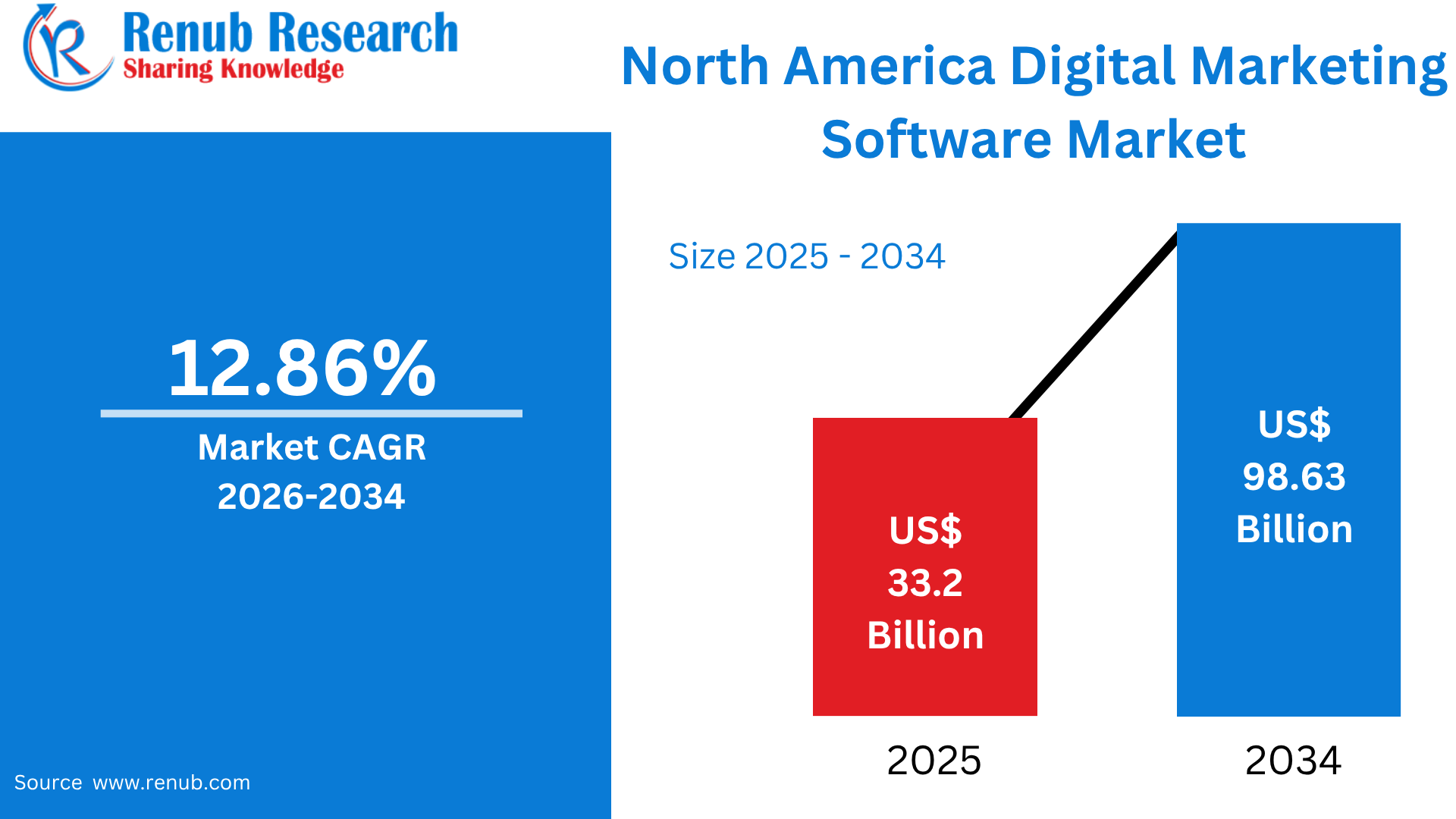
North America Digital Marketing Software Market is projected to expand from US$ 33.20 billion in 2025 to US$ 98.63 billion by 2034, registering a CAGR of 12.86% during 2026–2034. Market growth is being driven by the increasing adoption of cloud-based marketing platforms, rising investments in data-driven advertising, and the growing need for effective customer engagement across digital channels. The integration of artificial intelligence, marketing automation, advanced analytics, and personalized marketing capabilities is enabling businesses to optimize campaigns, improve customer experiences, and achieve more measurable marketing outcomes.
What is the Digital Marketing Software Market and Its Uses & Popularity in North America
North America Digital Marketing Software Market comprises software platforms that help businesses plan, execute, automate, measure, and optimize marketing activities across digital channels. These solutions include customer relationship management (CRM), marketing automation, email marketing, social media management, search engine optimization, content management, advertising analytics, customer data platforms, and personalization tools. Businesses use digital marketing software to identify target audiences, manage campaigns, analyze customer behavior, generate leads, improve engagement, and measure return on marketing investment. North America is a particularly important market because of its high level of digital adoption and strong concentration of technology companies. The U.S. also demonstrates strong demand for digital marketing solutions, with digital advertising and U.S. media spending in 2025.
Digital Transformation by Major US Organizations
·Netflix
- Digital Transformation: Shifted from traditional video rental and physical distribution models to a digital streaming platform using online content delivery and data analytics.
- Result: Enabled on-demand entertainment, changed consumer viewing habits, and transformed the way movies and television content are consumed globally.
·NIKE
- Digital Transformation: Introduced the SNKRS App, incorporating digital technologies and leg-scanning capabilities to help customers identify suitable footwear.
- Result: Generated valuable customer data to support future product development and design decisions while contributing to significant sales growth, particularly in markets such as Japan.
·Starbucks
- Digital Transformation: Adopted artificial intelligence and digital technologies to enhance customer engagement, ordering, personalization, and operational processes.
- Result: Cloud-based platforms improved ordering capabilities, personalized recommendations, tipping options, inventory management, and production planning, supporting overall customer satisfaction.
·AUDI
- Digital Transformation: Developed Audi City, a digital showroom concept using interactive technologies and virtual displays to showcase its complete vehicle portfolio.
- Result: Reportedly achieved approximately 60% higher sales than traditional showrooms while reducing operating costs by limiting the number of physical vehicles required and presenting the broader catalog digitally.
·Adobe
- Digital Transformation: Transitioned from traditional software licensing to a Software-as-a-Service (SaaS) model, expanded cloud capabilities, and strengthened its digital ecosystem through acquisitions including Magento and Omniture.
- Result: Developed into a leading cloud-based software provider through Creative Cloud, Document Cloud, and Experience Cloud, while establishing recurring revenue streams and expanding its digital experience capabilities.
Growth Drivers in the Market
Rapid Shift Toward Digital Advertising and Omnichannel Marketing
The continuing migration of advertising budgets from traditional media toward digital channels is a major growth driver for digital marketing software across North America. Businesses increasingly use search, social media, online video, programmatic advertising, mobile platforms, retail media, and connected television to reach consumers at different stages of the purchasing journey. This fragmented environment increases the need for software that can coordinate campaigns, manage customer data, automate workflows, and measure performance across multiple channels. In the United States, advertisers were expected to allocate 82% of their media budgets to digital channels in 2025, with mobile receiving approximately 66% of digital spending. U.S. digital advertising has also maintained strong growth, with eMarketer reporting that digital ad revenues were expected to increase at double-digit rates in 2025. These trends encourage organizations to invest in integrated platforms capable of managing increasingly complex digital campaigns.
Increasing Adoption of Artificial Intelligence and Marketing Automation
The rapid adoption of artificial intelligence (AI), machine learning, predictive analytics, and automation is creating significant opportunities for digital marketing software providers. AI-enabled platforms can automate customer segmentation, content creation, campaign optimization, lead scoring, personalization, predictive recommendations, and performance analysis. The growing availability of customer and behavioral data is further increasing the value of AI-driven marketing tools. According to the U.S. Federal Reserve, approximately 18% of U.S. firms had adopted AI by the end of 2025, while an employment-weighted measure indicated that around 32% of firms used AI during the November 2025–January 2026 period. Adoption is considerably higher among large organizations, with 37% of firms employing at least 250 people reporting AI use in Census Bureau data through May 2026. Digital marketing software vendors are incorporating these capabilities to help marketers analyze large datasets and deliver more relevant customer experiences. As businesses seek greater efficiency and measurable campaign performance, AI-powered automation is expected to remain an important source of market expansion.
Growing Demand for Data-Driven Customer Personalization
The increasing importance of personalized customer experiences is encouraging North American organizations to adopt digital marketing software capable of collecting, integrating, and analyzing customer information. Businesses increasingly expect marketing platforms to combine first-party data, behavioral information, transaction history, and engagement signals to create targeted campaigns. Personalization can be applied across email, websites, mobile applications, social media, advertising, and e-commerce platforms, allowing marketers to tailor communications to specific customer segments. eMarketer reported that digital advertising continued to grow strongly in 2025, supported by AI-driven optimization, richer first-party data, and expanding digital video investment. In Canada, search remained the largest digital advertising category in 2025, while social media remained the second-largest, demonstrating the breadth of digital channels requiring coordinated marketing strategies. Digital marketing software enables organizations to connect these channels, automate customer journeys, monitor campaign results, and improve targeting. Consequently, demand is increasing for customer data platforms, marketing automation systems, analytics solutions, and AI-powered personalization tools throughout North America.
Challenges in the Market
Data Privacy, Security, and Regulatory Complexity
Data privacy and cybersecurity requirements represent an important challenge for the North America digital marketing software market because many platforms depend on collecting and processing large volumes of consumer information. Marketing software can handle personally identifiable information, browsing behavior, purchase histories, location information, and customer interactions, increasing the consequences of data breaches or inappropriate data use. Businesses must therefore ensure that marketing technologies comply with applicable privacy requirements while maintaining effective personalization and targeting. The challenge becomes more complex because privacy regulations and consumer expectations can differ across jurisdictions. Organizations also need appropriate consent management, data governance, security controls, access policies, and mechanisms for handling customer data requests. At the same time, the growing use of AI introduces additional concerns surrounding data quality, transparency, and the handling of sensitive information. These requirements can increase implementation costs and create additional compliance responsibilities for businesses and software vendors. As digital marketing becomes increasingly data-driven, vendors must balance personalization and automation with robust privacy, security, and governance capabilities.
High Competition and Integration Complexity
Intense competition and the complexity of integrating multiple marketing technologies can constrain market expansion despite strong demand. North American businesses have access to a broad ecosystem of CRM platforms, marketing automation systems, advertising technologies, analytics tools, social media solutions, customer data platforms, and specialized AI applications. Companies must often integrate several systems to create a unified marketing environment, which can increase implementation costs, training requirements, and technical complexity. The rapid evolution of AI also requires businesses to continuously update their technology infrastructure and employee capabilities. U.S. Census Bureau data show that AI adoption varies considerably by company size: in data collected through May 2026, 37% of firms with at least 250 employees reported using AI, compared with less than 20% among firms with four or fewer employees. This gap highlights the difficulty smaller businesses can face in adopting sophisticated technologies. Vendors therefore need to offer scalable, interoperable, user-friendly, and cost-effective solutions. Strong competition among established marketing technology providers and emerging AI-focused companies further increases pressure on vendors to innovate while demonstrating measurable business value.
Digital Marketing Software Launches in North America
- 2024 – Adobe: Adobe GenStudio for Performance Marketing
- Launched as a generative AI-powered application for creating, managing, activating, and measuring marketing content across channels.
- Supports paid social, display advertising, banners, marketing emails, and other campaign formats.
- 2024 – Adobe: Adobe GenStudio Enterprise Platform
- Introduced as an enterprise-focused generative AI content supply chain solution.
- Helps marketing teams plan, create, manage, activate, and measure content and personalized customer experiences.
- 2025 – HubSpot: Breeze AI Agents
- Introduced new and enhanced AI agents through the Spring 2025 Spotlight.
- Supports marketing, sales, customer service, content creation, prospect research, and customer engagement automation.
- 2025 – HubSpot: Knowledge Base Agent
- AI-powered agent designed to identify knowledge gaps and expand support resources using incoming customer-service interactions.
- Works with Customer Agent to improve self-service capabilities.
- 2025 – HubSpot: CRM Deep Research Connector for ChatGPT
- Connects CRM information with AI-powered research and customer insights.
- Supports data-driven research and analysis within the HubSpot ecosystem.
- 2025 – HubSpot: Loop Marketing Framework Platform
- Introduced an AI-era marketing approach designed to help businesses engage customers across fragmented digital channels.
- Focuses on continuous customer engagement, personalization, and AI-enabled marketing workflows.
- 2025 – HubSpot: Data Hub
- Provides a centralized customer-data foundation within HubSpot’s broader AI-powered ecosystem.
- Supports unified customer information and data-driven marketing and customer engagement.
- 2025 – HubSpot: Breeze Marketplace & Studio
- Expands HubSpot’s AI ecosystem by enabling businesses to discover, customize, and activate AI agents and assistants.
- Supports AI-driven automation across marketing, sales, and service workflows.
- 2025 – Salesforce: Agentforce 2.0
- Introduced an enhanced AI-agent platform capable of supporting multiple departments and business workflows.
- Provides improved reasoning, data retrieval, and orchestration of complex, multi-step tasks.
- 2026 – Freshworks: Command Center
- Designed as an omnichannel customer-engagement and management platform.
- Centralizes customer communications, workflows, and analytics to support more connected digital engagement.
Growing Adoption of Customer-Centric Marketing Platforms
North America Digital Marketing CRM Software Market is expanding as organizations increasingly use customer relationship management platforms to centralize customer information and improve digital engagement. CRM software integrates data from websites, email, social media, sales interactions, and other touchpoints, allowing marketers to create more targeted campaigns. According to Salesforce, 83% of customers expect companies to understand their needs and expectations, highlighting the importance of connected customer data and personalized engagement. Businesses in retail, banking, healthcare, technology, and professional services are increasingly combining CRM with marketing automation, analytics, and artificial intelligence. AI-enabled CRM systems can support customer segmentation, lead scoring, predictive analytics, and automated communication. The continued growth of omnichannel marketing is also encouraging companies to connect sales and marketing data within unified platforms. As customer acquisition costs rise and businesses focus more heavily on retention and lifetime value, CRM software is becoming an important component of North American digital marketing strategies. AI-powered CRM platforms can analyze large volumes of customer information to identify behavioral patterns and support more relevant communications. Marketing teams are also using predictive analytics to identify potential buyers, determine optimal communication timing, and evaluate campaign performance. Integration with advertising platforms and customer-data systems further improves the ability of businesses to coordinate marketing activities across channels. As organizations seek greater productivity from marketing teams while maintaining personalized interactions, investments in AI-enabled CRM software are expected to remain an important growth factor across North America.
Rising Competition for Search Visibility
North America Digital Search Marketing Software Market is benefiting from businesses’ increasing dependence on search engines to attract consumers actively researching products and services. Search marketing platforms provide capabilities such as keyword research, SEO analysis, competitor monitoring, content optimization, paid-search management, and campaign measurement. According to StatCounter, Google accounted for more than 90% of worldwide search-engine market share in 2025, demonstrating the continued importance of search as a digital discovery channel. North American businesses are therefore investing in specialized software to improve organic rankings and manage paid search campaigns more efficiently. E-commerce companies, service providers, technology firms, and local businesses use search marketing tools to identify high-value keywords and understand changes in consumer search behavior. Increasing competition for online visibility is also encouraging marketers to combine SEO with paid advertising and content strategies. The continued expansion of digital commerce is expected to sustain demand for sophisticated search marketing software. Google’s advertising ecosystem, for example, increasingly uses machine learning to optimize campaign performance based on advertiser objectives. Meanwhile, the growing use of AI-generated search experiences is changing how consumers discover information, products, and services. This is encouraging marketers to broaden their optimization strategies beyond traditional keyword rankings and focus on structured content, authority, relevance, and user intent. As search environments become more automated and competitive, businesses are expected to increase spending on software capable of combining SEO intelligence, paid-search management, analytics, and AI-driven optimization.
Growing Demand for Specialized Marketing Expertise
North America Digital Marketing Managed Services Software Market is developing as businesses increasingly outsource portions of their digital marketing operations to specialized agencies and service providers. Organizations often need expertise across search advertising, social media, content marketing, marketing automation, analytics, and customer engagement, but maintaining specialized teams internally can be expensive. Managed-service platforms enable agencies to coordinate campaigns, monitor performance, manage customer data, and provide reporting through integrated technology environments. According to the U.S. Bureau of Labor Statistics, employment of advertising, promotions, and marketing managers is projected to grow 8% from 2024 to 2034, indicating continued demand for marketing expertise. Businesses are also increasingly using external providers to gain access to specialized talent and technology without building every capability internally. The combination of agency expertise and marketing software enables companies to improve campaign execution while maintaining centralized visibility into performance. This trend is supporting demand for managed digital marketing solutions throughout North America. Small and medium-sized businesses can particularly benefit because managed providers offer access to specialized marketing capabilities without requiring large internal departments. Continued growth in digital advertising complexity is therefore expected to support adoption of managed digital marketing software and related services across North America.
Cloud Adoption Enables Scalable Marketing Operations
North America Cloud Digital Marketing Software Market is expanding as organizations transition from traditional on-premise applications toward scalable cloud-based platforms. Cloud marketing solutions allow companies to access campaign management, customer analytics, email marketing, content management, advertising, and reporting capabilities through internet-connected systems. According to the U.S. Census Bureau, approximately half of U.S. businesses reported using cloud-based computing in recent years, illustrating the broad integration of cloud technologies across the business environment. Cloud platforms can reduce the need for dedicated hardware and allow companies to scale software usage according to business requirements. They also support collaboration among geographically distributed marketing teams and external agencies. Small and medium-sized businesses can particularly benefit because subscription-based platforms provide access to sophisticated marketing capabilities without large upfront infrastructure investments. As organizations continue modernizing their technology environments, cloud deployment is expected to remain a major component of digital marketing software adoption across North America.
United States Mature Digital Economy Supports Technology Adoption
United States represents the largest and most technologically mature market for digital marketing software in North America. High internet usage, extensive e-commerce activity, sophisticated advertising infrastructure, and the presence of major technology providers create a strong environment for marketing technology adoption. According to the U.S. Census Bureau, U.S. retail e-commerce sales reached approximately $1.23 trillion in 2025, demonstrating the substantial scale of digital commerce. Businesses therefore require software capable of managing online customer journeys, advertising campaigns, CRM data, content, and performance analytics. Retailers, financial institutions, healthcare organizations, technology companies, and professional services firms are increasingly adopting integrated platforms to coordinate customer engagement across digital channels. The country’s strong startup ecosystem and technology investment environment are also encouraging development of AI-enabled marketing applications. Increasing emphasis on first-party customer data, personalization, automation, and measurable advertising performance is expected to sustain demand for advanced digital marketing software in the United States. According to the U.S. Census Bureau’s Business Trends and Outlook Survey, AI use among U.S. businesses increased during 2025, reflecting broader adoption of AI across commercial activities. Marketing departments are using these technologies to process large customer datasets and identify behavioral patterns that can support more targeted campaigns. At the same time, companies are investing in customer-data platforms and analytics solutions to improve measurement and attribution. Growing privacy requirements and changes in digital advertising ecosystems are also encouraging businesses to develop stronger first-party data capabilities. These developments are creating demand for marketing software that combines AI, analytics, CRM integration, automation, and data governance within unified platforms.
Canada Digital Commerce and Consumer Connectivity Support Growth
Canada’s Digital Marketing Software Market is benefiting from widespread internet connectivity, growing digital commerce, and increasing use of social and mobile channels. Businesses are adopting marketing technology to manage customer relationships, automate campaigns, analyze consumer behavior, and coordinate communication across multiple platforms. Statistics Canada reported that Canadian retail e-commerce sales reached billions of dollars annually, reflecting the increasing importance of online purchasing and digital customer journeys. Retailers and service providers are therefore investing in software that supports search marketing, email campaigns, social media management, customer analytics, and personalized communication. Cloud-based platforms are particularly attractive because they allow businesses to deploy marketing applications without maintaining extensive technology infrastructure. The country’s developed telecommunications infrastructure and digitally connected consumer base provide favorable conditions for continued marketing technology adoption. As businesses seek measurable returns from digital advertising and improved customer retention, demand for integrated digital marketing software is expected to increase across Canadian industries. Canadian businesses are increasingly using marketing automation and analytics to deliver more personalized customer experiences while improving operational efficiency. CRM-integrated platforms enable organizations to combine customer information from websites, email, mobile applications, and purchase histories, supporting more targeted communication.
Mexico Internet and E-Commerce Expansion Create New Opportunities
Mexico represents an expanding market for digital marketing software, supported by increasing internet connectivity, smartphone adoption, social media engagement, and e-commerce activity. According to DataReportal, Mexico had approximately 110 million internet users in early 2025, representing a substantial addressable digital audience for businesses. Companies are increasingly using digital channels to reach consumers, promote products, generate leads, and build brand awareness. Marketing software enables organizations to manage social campaigns, email marketing, search advertising, customer data, content, and campaign analytics from centralized platforms. E-commerce growth is also increasing demand for technologies that can track customer journeys and personalize digital interactions. Retail, financial services, telecommunications, travel, and consumer goods companies are among the sectors using digital marketing tools to strengthen online engagement. As more consumers conduct product research and transactions through digital channels, businesses are expected to increase investments in software that supports customer acquisition, analytics, automation, and omnichannel marketing. The high use of social media and mobile devices in Mexico is creating significant demand for marketing software capable of managing mobile-first customer engagement. Businesses increasingly use social platforms for brand communication, customer service, influencer campaigns, lead generation, and product promotion. Marketing platforms provide tools for scheduling content, analyzing engagement, segmenting audiences, monitoring campaigns, and measuring conversion performance.
North America Digital Marketing Software Market Segments
Solution
- CRM Software
- Email Marketing
- Social Media
- Search Marketing
- Content Management
- Marketing Automation
- Campaign Management
- Others
Service
- Professional Services
- Managed Services
Deployment Mode
- Cloud
- On-Premise
- Enterprise Size
- Large Enterprises
- Small & Medium Sized Enterprises
End Use
- Automotive
- BFSI
- Education
- Government
- Healthcare
- Manufacturing
- Media & Entertainment
- Others
Countries
- United States
- Canada
- Mexico
- Rest of North America
Companies have been covered from 5 viewpoints
- Overviews
- Key Person
- Recent Developments
- SWOT Analysis
- Revenue Analysis
Key Players Analysis
- Adobe, Inc.
- Teradata Corp
- Hewlett Packard Enterprise Company
- Microsoft Corporation
- HubSpot, Inc.
- Oracle Corporation
- Salesforce, Inc.
- IBM Corporation
Report Details:
| Report Features | Details |
| Base Year |
2025 |
| Historical Period |
2022 - 2025 |
| Forecast Period |
2026 - 2034 |
| Market |
US$ Billion |
| Segment Covered |
Solution, Service, Deployment Mode, Enterprise Size, End Use and Countries |
| Countries Covered |
|
| Companies Covered |
|
| Customization Scope |
20% Free Customization |
| Post-Sale Analyst Support |
1 Year (52 Weeks) |
| Delivery Format |
PDF and Excel through Email (We can also provide the editable version of the report in PPT/Word format on request) |
Customization Services available
- Analysis of Market Size and Its Segments
- More Company Profiles (Upto 10 without any additional cost):
- Additional Countries (Other than mentioned Countries):
- Region/Country Specific Reports:
- Market Entry Strategy:
- Region-Specific Market Dynamics:
- Regional Market Share Analysis:
- Trade Analysis:
- Production Insights:
- Others Customized Requests:
For more information contact our analysts.
Need More Assistance?
- Talk to our analysts to get more precious information on the current market trends.
- Include more countries and segments and customize the report based on the final requirement.
- Get a competitive advantage in your industry by knowing the report findings and making a positive impact on your revenues and operations.
- Our analysts are always ready to provide more help and pertinent information if you need any additional assistance.