Circuit Breaker Market Size, Share, Trends & Forecast by Product Type, Voltage, Technology, End User and Country, 2026–2034
Buy NowCircuit Breaker Market Size and Forecast
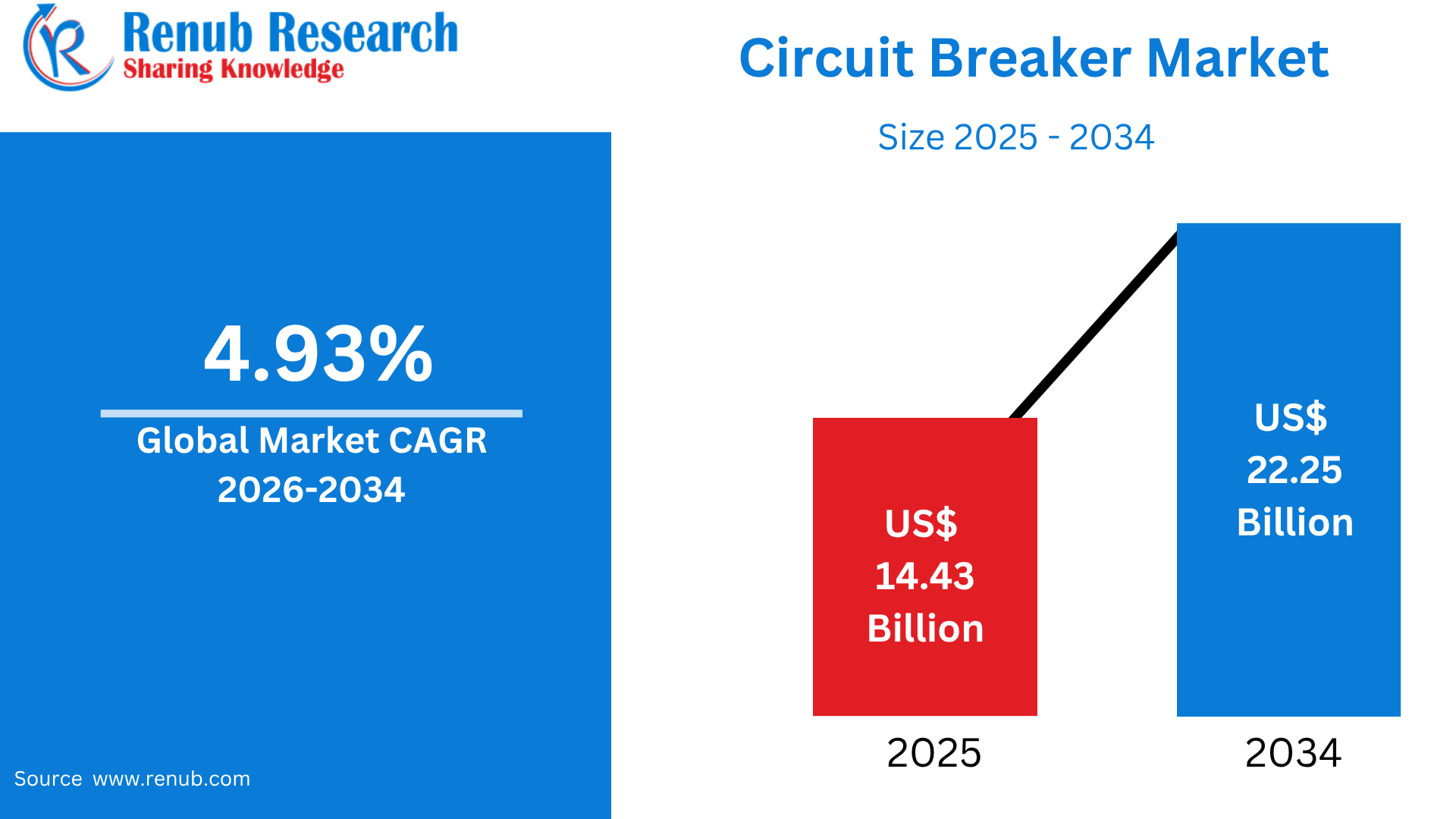
Circuit Breaker Market is projected to grow from US$ 14.43 billion in 2025 to US$ 22.25 billion by 2034, registering a CAGR of 4.93% during 2026-2034. Market expansion is expected to be driven by rising electricity demand, grid modernization, infrastructure development, and increasing investments in renewable energy projects. Growing adoption of advanced electrical protection systems across residential, commercial, and industrial applications is also supporting market growth.
What is a Circuit Breaker and Its Uses & Popularity Worldwide
A circuit breaker is an electrical protection device designed to automatically interrupt the flow of electricity when it detects abnormal conditions such as overcurrent, short circuits, or electrical faults. Unlike a fuse, a circuit breaker can generally be reset after tripping, allowing the electrical circuit to resume operation once the fault has been addressed. Circuit breakers are available in various types, including miniature circuit breakers (MCBs), molded case circuit breakers (MCCBs), air circuit breakers (ACBs), vacuum circuit breakers, and high-voltage circuit breakers.
Circuit breakers are widely used in residential buildings, commercial facilities, industrial plants, power generation stations, transmission networks, and distribution systems to protect electrical equipment, wiring, and people from electrical hazards. Their ability to provide reliable protection and improve electrical-system safety has made them essential components of modern power infrastructure. Worldwide demand is increasing with expanding electricity consumption, urbanization, industrialization, renewable energy deployment, and grid modernization. The growing installation of data centers, manufacturing facilities, renewable-energy projects, and smart-grid infrastructure is further increasing the need for advanced circuit protection solutions. Product innovation and automation are also strengthening their global popularity.
Top 10 Manufacturers Shaping the Future of Circuit Breakers
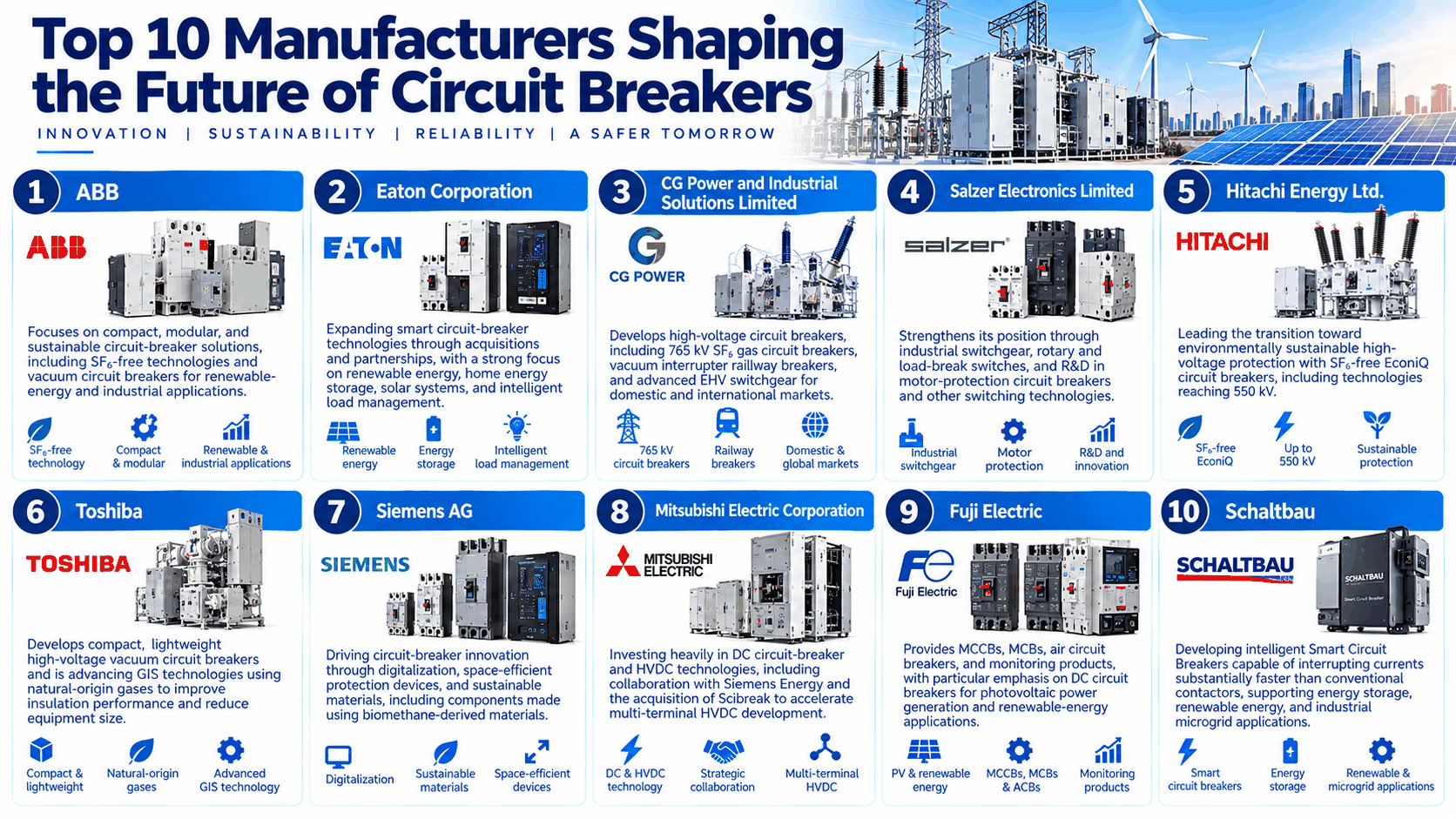
- ABB – Focuses on compact, modular, and sustainable circuit-breaker solutions, including SF₆-free technologies and vacuum circuit breakers for renewable-energy and industrial applications.
- Eaton Corporation – Expanding smart circuit-breaker technologies through acquisitions and partnerships, with a strong focus on renewable energy, home energy storage, solar systems, and intelligent load management.
- CG Power and Industrial Solutions Limited – Develops high-voltage circuit breakers, including 765 kV SF₆ gas circuit breakers, vacuum interrupter railway breakers, and advanced EHV switchgear for domestic and international markets.
- Salzer Electronics Limited – Strengthens its position through industrial switchgear, rotary and load-break switches, and R&D in motor-protection circuit breakers and other switching technologies.
- Hitachi Energy Ltd. – Leading the transition toward environmentally sustainable high-voltage protection with SF₆-free EconiQ circuit breakers, including technologies reaching 550 kV.
- Toshiba – Develops compact, lightweight high-voltage vacuum circuit breakers and is advancing GIS technologies using natural-origin gases to improve insulation performance and reduce equipment size.
- Siemens AG – Driving circuit-breaker innovation through digitalization, space-efficient protection devices, and sustainable materials, including components made using biomethane-derived materials.
- Mitsubishi Electric Corporation – Investing heavily in DC circuit-breaker and HVDC technologies, including collaboration with Siemens Energy and the acquisition of Scibreak to accelerate multi-terminal HVDC development.
- Fuji Electric – Provides MCCBs, MCBs, air circuit breakers, and monitoring products, with particular emphasis on DC circuit breakers for photovoltaic power generation and renewable-energy applications.
- Schaltbau – Developing intelligent Smart Circuit Breakers capable of interrupting currents substantially faster than conventional contactors, supporting energy storage, renewable energy, and industrial microgrid applications.
Growth Drivers of the Circuit Breaker Market
Rising Global Electricity Demand and Grid Expansion
The increasing consumption of electricity across residential, commercial, industrial, and infrastructure sectors is a major driver of the global circuit breaker market. The International Energy Agency (IEA) reported that global electricity demand increased by 3% in 2025 and is forecast to grow at an average annual rate of 3.6% between 2026 and 2030. This growth is expected to add approximately 1,100 TWh of electricity demand annually through 2030. Rising electricity consumption requires utilities to expand transmission and distribution networks, while aging infrastructure must also be modernized to improve reliability and safety. Circuit breakers are essential components in these networks because they automatically interrupt abnormal currents, protect electrical equipment, and reduce the risk of system failures. Increasing industrialization, urbanization, electrification, electric vehicle adoption, and data-center development are further increasing demand for reliable power infrastructure. Consequently, utilities and infrastructure developers are investing in new substations, distribution systems, and protection equipment, creating sustained opportunities for low-, medium-, and high-voltage circuit breaker manufacturers.
Rapid Expansion of Renewable Energy Projects
The global transition toward renewable energy is creating significant opportunities for circuit breaker manufacturers because solar and wind installations require sophisticated electrical protection and switching equipment. According to the IEA, global renewable power capacity is projected to increase by almost 4,600 GW between 2025 and 2030, with solar PV accounting for nearly 80% of worldwide renewable capacity expansion. In addition, global renewable capacity additions reached approximately 800 GW in 2025, representing a 16% year-on-year increase, while solar PV accounted for more than three-quarters of new renewable capacity. The rapid deployment of utility-scale solar farms, wind parks, battery storage facilities, and distributed generation systems requires circuit breakers to protect generators, transformers, inverters, substations, and transmission connections. Renewable projects also introduce more variable power flows into electricity networks, increasing the importance of advanced protection and switching technologies. As countries expand clean-energy capacity and upgrade grids to accommodate decentralized generation, demand for reliable and intelligent circuit breakers is expected to rise.
Growing Data Centers, Electrification, and Industrial Automation
The expansion of data centers, electric vehicles, industrial automation, and electrified manufacturing is strengthening demand for dependable electrical protection equipment. The IEA expects global electricity demand to grow strongly through 2030, supported by industry, electric vehicles, air conditioning, and data centers. Data centers are particularly important because artificial intelligence and cloud-computing infrastructure require large amounts of continuously available electricity. In the United States, data-center energy demand is projected to reach around 110 GW by 2030, according to a 2026 Reuters report, increasing pressure on utilities and electrical equipment supply chains. Circuit breakers are critical in data centers and industrial facilities because they provide overload and short-circuit protection while helping maintain operational continuity. The growth of automated factories, semiconductor facilities, EV charging networks, and high-performance computing infrastructure is consequently creating demand for high-performance and digitally enabled protection systems. Manufacturers are responding with smart circuit breakers featuring remote monitoring, communication capabilities, and predictive maintenance functions.
Challenges of the Circuit Breaker Market
Supply Chain Constraints and Long Equipment Lead Times
Supply-chain disruptions and shortages of critical electrical equipment represent a major challenge for circuit breaker manufacturers and customers. The rapid expansion of power grids, renewable projects, and data centers has increased demand for transformers, switchgear, cables, circuit breakers, and other grid components faster than manufacturing capacity can expand. Reuters reported in 2026 that shortages of critical grid equipment were causing extended procurement periods, with some transformer lead times exceeding 160 weeks. Transformer prices were also expected to increase by 4%–10% over the following year. Although these figures specifically concern transformers, they demonstrate the broader supply pressure affecting electrical infrastructure. Circuit breaker manufacturers can face similar challenges related to metals, electronic components, insulation materials, semiconductors, and specialized manufacturing capacity. Longer lead times can delay grid modernization, renewable-energy connections, industrial projects, and data-center construction. Manufacturers therefore need to diversify suppliers, increase production capacity, maintain strategic inventories, and strengthen regional manufacturing networks. These measures, however, can increase operating costs and place pressure on product prices and project margins.
High Investment Costs and Complex Grid Integration
The high capital requirements associated with advanced circuit breakers and modern grid infrastructure can restrict adoption, particularly in developing economies and cost-sensitive applications. Modern electrical networks increasingly require sophisticated protection systems capable of handling renewable generation, distributed energy resources, fluctuating loads, and bidirectional power flows. Integrating these technologies often requires utilities to upgrade substations, protection systems, monitoring equipment, and communication infrastructure alongside conventional circuit breakers. The challenge becomes more significant as electricity networks face rapidly increasing demand and aging infrastructure. The IEA forecasts that global electricity consumption will increase from approximately 28,200 TWh in 2025 to 33,600 TWh by 2030, highlighting the scale of infrastructure expansion required. Advanced circuit breakers can involve higher purchase, installation, testing, and maintenance costs than conventional equipment. Utilities with limited budgets may therefore postpone modernization projects or prioritize lower-cost solutions. Additionally, differences in technical standards, grid architectures, and regulatory requirements across countries can increase engineering complexity, certification expenses, and time-to-market for manufacturers.
Circuit Breaker Product Launches Worldwide
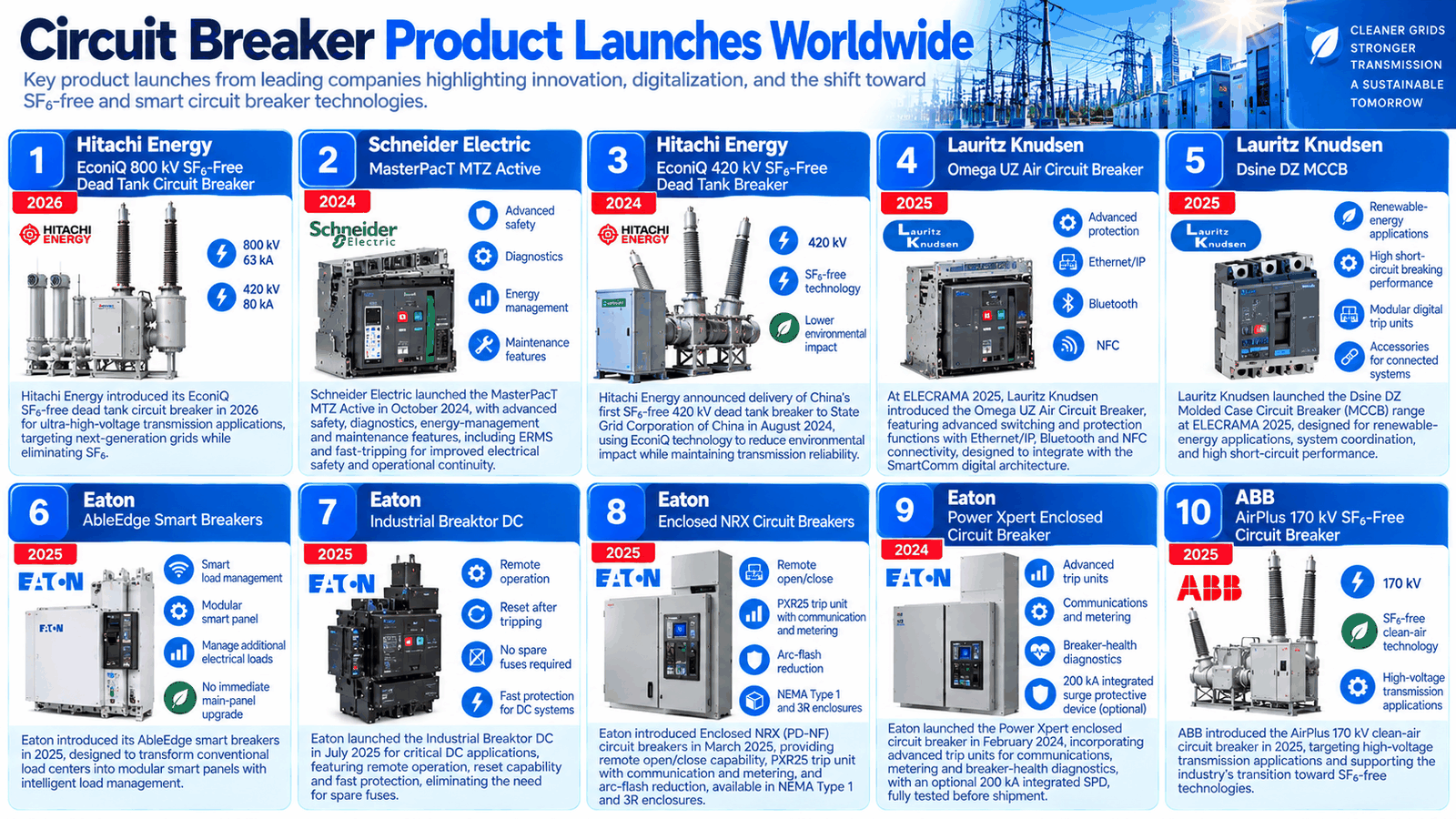
- Hitachi Energy – EconiQ 800 kV SF₆-Free Dead Tank Circuit Breaker, 2026
Hitachi Energy introduced its EconiQ SF₆-free dead tank circuit breaker in 2026 for ultra-high-voltage transmission applications. The new technology is rated at 800 kV and 63 kA, alongside a 420 kV, 80 kA variant, targeting next-generation transmission grids while eliminating SF₆. - Schneider Electric – MasterPacT MTZ Active, 2024
Schneider Electric launched the MasterPacT MTZ Active in October 2024, incorporating advanced safety, diagnostics, energy-management, and maintenance features. The breaker includes Energy Reduction Maintenance Settings (ERMS) and fast-tripping capabilities for improved electrical safety and operational continuity. - Hitachi Energy – EconiQ 420 kV SF₆-Free Dead Tank Breaker, 2024
Hitachi Energy announced delivery of China’s first SF₆-free 420 kV dead tank breaker to State Grid Corporation of China in August 2024. The breaker uses EconiQ technology to reduce the environmental impact of high-voltage grid equipment while maintaining transmission reliability. - Lauritz Knudsen – Omega UZ Air Circuit Breaker, 2025
At ELECRAMA 2025, Lauritz Knudsen introduced the Omega UZ Air Circuit Breaker, featuring advanced switching and protection functions. It supports Ethernet/IP, Bluetooth, and NFC connectivity and is designed to integrate with the company’s SmartComm digital architecture. - Lauritz Knudsen – Dsine DZ MCCB, 2025
Lauritz Knudsen launched the Dsine DZ Molded Case Circuit Breaker (MCCB) range at ELECRAMA 2025. The product is designed for renewable-energy applications, system coordination, and high short-circuit breaking performance, with modular digital trip units and accessories for connected electrical systems. - Eaton – AbleEdge Smart Breakers, 2025
Eaton introduced its AbleEdge smart breakers, designed to transform conventional load centers into modular smart electrical panels. The technology provides intelligent load management and can help customers manage additional electrical loads without immediately requiring a main-panel upgrade. - Eaton – Industrial Breaktor DC, 2025
Eaton launched the Industrial Breaktor DC in July 2025 for critical DC applications. The product supports remote operation, can be reset after a triggering event, eliminates the need for spare fuses, and provides fast protection for electrical systems. - Eaton – Enclosed NRX Circuit Breakers, 2025
Eaton introduced Enclosed NRX (PD-NF) circuit breakers in March 2025. The solution provides remote open/close capability and incorporates the PXR25 trip unit with communication and metering functions. It also supports arc-flash reduction and is available in NEMA Type 1 and 3R enclosures. - Eaton – Power Xpert Enclosed Circuit Breaker, 2024
Eaton launched the Power Xpert enclosed circuit breaker in February 2024, incorporating advanced trip units for communications, metering, and breaker-health diagnostics. The system includes an optional 200 kA integrated surge protective device and is fully tested before shipment. - ABB – AirPlus 170 kV SF₆-Free Circuit Breaker, 2025
ABB introduced the AirPlus 170 kV clean-air circuit breaker in 2025, targeting high-voltage transmission applications. The product reflects the industry’s shift toward SF₆-free technologies as utilities and grid operators seek lower-environmental-impact alternatives for high-voltage switching equipment.
Growing Demand for Compact and Reliable Electrical Protection
The indoor circuit breaker market is expanding as commercial buildings, residential complexes, industrial facilities, data centers, and urban substations increasingly require compact and reliable electrical protection systems. Indoor circuit breakers are installed in controlled environments where protection from rain, dust, humidity, and extreme outdoor conditions can improve equipment life and maintenance performance. Rapid urbanization and increasing construction of high-rise buildings are supporting demand for indoor switchgear and circuit protection equipment. The growing electricity requirement of data centers is another important opportunity because these facilities require continuous power availability and highly reliable protection against overloads and short circuits. The expansion of renewable-energy connections and battery storage within buildings is also increasing the need for modern indoor switching equipment. Digitalization is further transforming the segment, with intelligent breakers incorporating sensors, remote monitoring, fault diagnostics, and communication capabilities. These features allow facility operators to identify abnormal electrical conditions quickly and reduce downtime. As commercial and industrial customers increasingly prioritize safety, space efficiency, energy management, and predictive maintenance, demand for advanced indoor circuit breakers is expected to remain strong.
Expansion of Transmission and Distribution Infrastructure
The outdoor circuit breaker market is benefiting from the continued expansion and modernization of transmission and distribution infrastructure. Outdoor breakers are widely used in substations, utility networks, renewable-energy plants, industrial power systems, and high-voltage transmission facilities because they are designed to operate under changing environmental conditions. The rapid increase in renewable generation is creating additional demand as solar and wind projects require protection equipment at generation sites, substations, and grid-connection points. Global renewable capacity additions reached approximately 800 GW in 2025, with solar PV representing more than three-quarters of new capacity, creating significant requirements for grid protection equipment. The development of high-voltage transmission corridors and grid interconnections is also supporting demand for outdoor high-voltage breakers. Utilities are increasingly replacing aging equipment with systems offering improved interruption capability, remote operation, condition monitoring, and reduced maintenance requirements. Outdoor circuit breakers are particularly important in large-scale substations where space availability is greater than in indoor installations. Continued investment in grid resilience, renewable integration, and electricity infrastructure is therefore expected to sustain the segment’s growth.
Industrial Electrification and Distribution Network Upgrades
The medium-voltage circuit breaker market is experiencing steady expansion because medium-voltage networks form an important link between electricity generation, distribution substations, commercial facilities, and industrial consumers. Demand is being driven by industrial automation, urban infrastructure development, renewable-energy projects, electric-vehicle charging infrastructure, and modernization of aging distribution networks. Medium-voltage breakers are commonly deployed in factories, commercial complexes, utilities, mining operations, data centers, and renewable-energy installations to protect transformers, motors, feeders, and other electrical equipment. The increasing complexity of electricity networks is also encouraging utilities and industrial users to adopt breakers with digital monitoring and intelligent protection functions. Vacuum technology is becoming increasingly important because it offers reliable interruption performance and reduced environmental impact compared with some conventional insulation and interruption technologies. As electricity demand rises and industries increasingly electrify their operations, investments in medium-voltage distribution infrastructure are expected to increase, supporting sustained demand for advanced circuit breakers.
Shift Toward Safer and Environmentally Preferable Switching Technology
The vacuum circuit breaker market is gaining momentum because of its strong electrical performance, compact design, low maintenance requirements, and suitability for medium-voltage applications. Vacuum breakers interrupt electrical arcs inside sealed vacuum interrupters, eliminating the need for certain conventional arc-extinguishing media and reducing maintenance requirements. Their ability to provide reliable switching over a long operating life makes them particularly attractive for utilities, industrial plants, commercial buildings, rail infrastructure, and renewable-energy installations. Increasing environmental awareness is also encouraging utilities and industrial customers to evaluate technologies with lower environmental impacts. Vacuum breakers can be integrated with intelligent switchgear systems, allowing remote operation, condition monitoring, and predictive maintenance. The growing use of renewable generation, distributed energy resources, and modern substations is further increasing demand for dependable switching equipment. As utilities replace aging installations and prioritize operational efficiency, vacuum circuit breakers are positioned to gain a larger share of medium-voltage protection applications.
Rapid Growth of Solar and Wind Power Installations
The renewable circuit breaker market is expanding rapidly alongside the global deployment of solar, wind, battery storage, and other clean-energy technologies. Global renewable capacity additions reached a record 800 GW in 2025, increasing 16% year over year, while solar PV additions surpassed 600 GW for the first time. Renewable capacity is also projected to increase by almost 4,600 GW between 2025 and 2030, with solar PV expected to account for nearly 80% of the expansion. This enormous investment creates significant demand for circuit breakers used to protect solar arrays, wind turbines, inverters, transformers, collection systems, substations, and grid interconnections. Renewable projects have variable and bidirectional power flows, making reliable fault interruption and switching increasingly important for grid stability. Battery energy-storage projects are also expanding rapidly, creating another application for specialized protection equipment. In 2025, global battery-storage capacity additions increased by approximately 40%, reaching nearly 110 GW. Manufacturers are therefore developing breakers capable of handling renewable generation and storage requirements while supporting digital monitoring and remote control. Continued clean-energy investment, grid integration, and energy-storage deployment are expected to make renewable applications one of the strongest long-term demand areas for circuit breaker technologies.
Grid Modernization and Rising Electricity Demand in the USA
United States circuit breaker market is benefiting from substantial investment in electricity infrastructure, grid modernization, and power-generation capacity. According to the U.S. Energy Information Administration (EIA), U.S. electricity consumption is expected to continue increasing, supported by data centers, manufacturing, electric vehicles, and building electrification. Data centers are emerging as a particularly important demand source, with U.S. data-center electricity consumption projected to approximately double from 2024 levels by 2030. This expansion requires new substations, distribution equipment, switchgear, and circuit breakers to protect increasingly complex electrical systems. Aging transmission and distribution infrastructure also creates replacement demand for modern protection equipment. Federal initiatives, including the Bipartisan Infrastructure Law, have allocated US$65 billion for improving the reliability and resilience of the U.S. power grid. Renewable-energy expansion is another important factor, as solar and wind projects require circuit breakers across generation, collection, transmission, and storage systems. Manufacturers such as Schneider Electric and Mitsubishi Electric are developing digitally enabled protection solutions with remote monitoring and improved fault detection, supporting the modernization of U.S. electrical networks.
Germany Renewable Expansion and Advanced Transmission Infrastructure
Germany’s circuit breaker market is being supported by rapid renewable-energy deployment, grid expansion, industrial electrification, and the country’s long-term energy-transition strategy. Renewable sources accounted for approximately 59% of Germany’s gross electricity consumption in 2024, demonstrating the increasing importance of variable solar and wind generation in the national power system. Germany is targeting an 80% renewable share of electricity consumption by 2030, creating significant requirements for grid reinforcement and advanced electrical protection equipment. The expansion of offshore wind and distributed solar generation increases the complexity of power flows and strengthens demand for reliable medium- and high-voltage circuit breakers. Germany is also developing major HVDC transmission corridors to transport renewable electricity from northern regions toward industrial centers in the south. In August 2024, Siemens Energy and Mitsubishi Electric announced cooperation on HVDC circuit-breaker technologies, reflecting broader industry efforts to improve high-voltage DC grid management. Industrial automation, electric-vehicle adoption, battery storage, and smart-grid investments further contribute to demand. Germany’s strong engineering ecosystem and emphasis on energy efficiency are expected to accelerate adoption of intelligent and next-generation circuit breakers.
UHV Grid Development and Renewable Energy Growth in China
China represents one of the most significant growth markets for circuit breakers because of its enormous electricity infrastructure, renewable-energy expansion, industrialization, and ultra-high-voltage (UHV) grid investments. China added approximately 373 GW of renewable-energy capacity in 2024, including around 277 GW of solar and 79 GW of wind capacity, according to the International Energy Agency. The country’s massive renewable-energy bases require sophisticated protection equipment to connect remote generation resources with major electricity-consuming regions. China is simultaneously expanding UHV AC and UHV DC transmission networks, which enable electricity to travel over thousands of kilometers with lower transmission losses. These projects create strong demand for high-voltage and specialized circuit breakers capable of managing large fault currents and complex transmission conditions. Rapid urbanization, industrial automation, semiconductor manufacturing, and electric-vehicle production further increase electricity consumption and protection requirements. China is also promoting digitalization of its power infrastructure, encouraging utilities to deploy intelligent substations, automated monitoring, and digitally connected protection equipment. International manufacturers such as Mitsubishi Electric and Siemens Energy, alongside strong domestic suppliers, continue developing technologies aligned with China’s expanding transmission and distribution infrastructure.
Saudi Arabia Vision 2030, Renewable Energy, and Smart Infrastructure
Saudi Arabia’s circuit breaker market is expanding as the Kingdom invests heavily in electricity infrastructure, industrial diversification, renewable energy, and smart-city development under Saudi Vision 2030. The country has established ambitious renewable-energy objectives, with Saudi Arabia targeting 100–130 GW of renewable-energy capacity by 2030, depending on electricity demand growth. Large solar projects, including utility-scale developments in the Kingdom’s renewable-energy program, require extensive medium- and high-voltage protection equipment across generation facilities, substations, and transmission networks. At the same time, Saudi Arabia is upgrading its transmission and distribution infrastructure to accommodate growing electricity demand from residential development, industrial facilities, tourism projects, and new economic zones. Projects associated with NEOM and other large-scale developments are increasing demand for reliable and digitally managed electrical systems. Petrochemical plants, manufacturing facilities, desalination plants, and oil and gas operations also require high-performance circuit breakers capable of operating under demanding conditions. Grid interconnection projects and interest in advanced transmission technologies are further supporting market development. Companies such as Schneider Electric and Siemens Energy are contributing smart-grid, switchgear, and electrical-protection solutions as Saudi Arabia moves toward a more resilient and technologically advanced power network.
Recent Developments in Circuit Breaker Market
- July 2025: ABB reported an all-time high in Q2 orders, reaching USD 9.8 billion, and introduced the SACE Emax 3—its first air circuit breaker certified to SL2 cybersecurity standards. The device is engineered for highly sensitive infrastructure, offering enhanced digital protection and operational resilience.
- May 2025: Hitachi Energy delivered the world’s first 550 kV gas-insulated switchgear using an SF₆-free insulating medium to State Grid Corporation of China. This milestone marks a major step toward reducing greenhouse-gas-intensive equipment in ultra-high-voltage networks.
- April 2025: Hitachi Energy committed over USD 70 million to expand its Pennsylvania facility, boosting manufacturing of its EconiQ line of SF₆-free circuit breakers. The investment supports rising North American demand for environmentally responsible high-voltage equipment.
- March 2025: Hitachi Energy announced an additional USD 250 million investment to scale up global production of transformer components, strengthening its supply capacity for utilities undergoing grid modernization and renewable integration.
- October 2024: Schneider Electric launched the MasterPacT MTZ Active, a next-generation low-voltage air circuit breaker designed for critical environments such as data centers. The solution provides real-time energy monitoring to enhance efficiency, supports better decision-making, and incorporates features like ERMS for personnel protection and QR-code access for quick optimization guidance. It aims to improve uptime, reduce energy waste, and advance digital operational excellence.
Circuit Breaker Market Segments
Product Type
- Indoor Circuit Breakers
- Outdoor Circuit Breakers
Voltage
- Low Voltage
- Medium Voltage
- High Voltage
Technology
- Air
- Vacuum
- Oil
- SF6
End User
- Transmission and Distribution
- Renewable
- Power Generation
- Railways
Countries
North America
- United States
- Canada
Europe
- France
- Germany
- Italy
- Spain
- United Kingdom
- Belgium
- Netherlands
- Turkey
Asia Pacific
- China
- Japan
- India
- Australia
- South Korea
- Thailand
- Malaysia
- Indonesia
- New Zealand
Latin America
- Brazil
- Mexico
- Argentina
Middle East & Africa
- South Africa
- Saudi Arabia
- United Arab Emirates
All the Key players have been covered from 5 Viewpoints:
- Overviews
- Key Person
- Recent Developments
- SWOT Analysis
- Revenue Analysis
Key Players Analysis
- ABB
- Alstom
- Eaton Corporation
- General Electric Company
- Schneider Electric
- Siemens
- Camsco Electric
- G&W Electric
- Kirloskar Electric
- Larsen & Toubro Limited
Report Details:
| Report Features | Details |
| Base Year |
2025 |
| Historical Period |
2022 - 2025 |
| Forecast Period |
2026 - 2034 |
| Market |
US$ Billion |
| Segment Covered |
Product Type, Voltage, Technology, End User and Countries |
| Countries Covered |
|
| Companies Covered |
|
| Customization Scope |
20% Free Customization |
| Post-Sale Analyst Support |
1 Year (52 Weeks) |
| Delivery Format |
PDF and Excel through Email (We can also provide the editable version of the report in PPT/Word format on request) |
Customization Services available
- Analysis of Market Size and Its Segments
- More Company Profiles (Upto 10 without any additional cost):
- Additional Countries (Other than mentioned Countries):
- Region/Country Specific Reports:
- Market Entry Strategy:
- Region-Specific Market Dynamics:
- Regional Market Share Analysis:
- Trade Analysis:
- Production Insights:
- Others Customized Requests:
For more information contact our analysts.
Need More Assistance?
- Talk to our analysts to get more precious information on the current market trends.
- Include more countries and segments and customize the report based on the final requirement.
- Get a competitive advantage in your industry by knowing the report findings and making a positive impact on your revenues and operations.
- Our analysts are always ready to provide more help and pertinent information if you need any additional assistance.