China Agriculture Equipment Market Report by Equipment, Tractor, Harvesting, Planting, Spraying, Cities and Companies Analysis 2026-2034
Buy NowChina Agriculture Equipment Market Size and Forecast 2026-2034
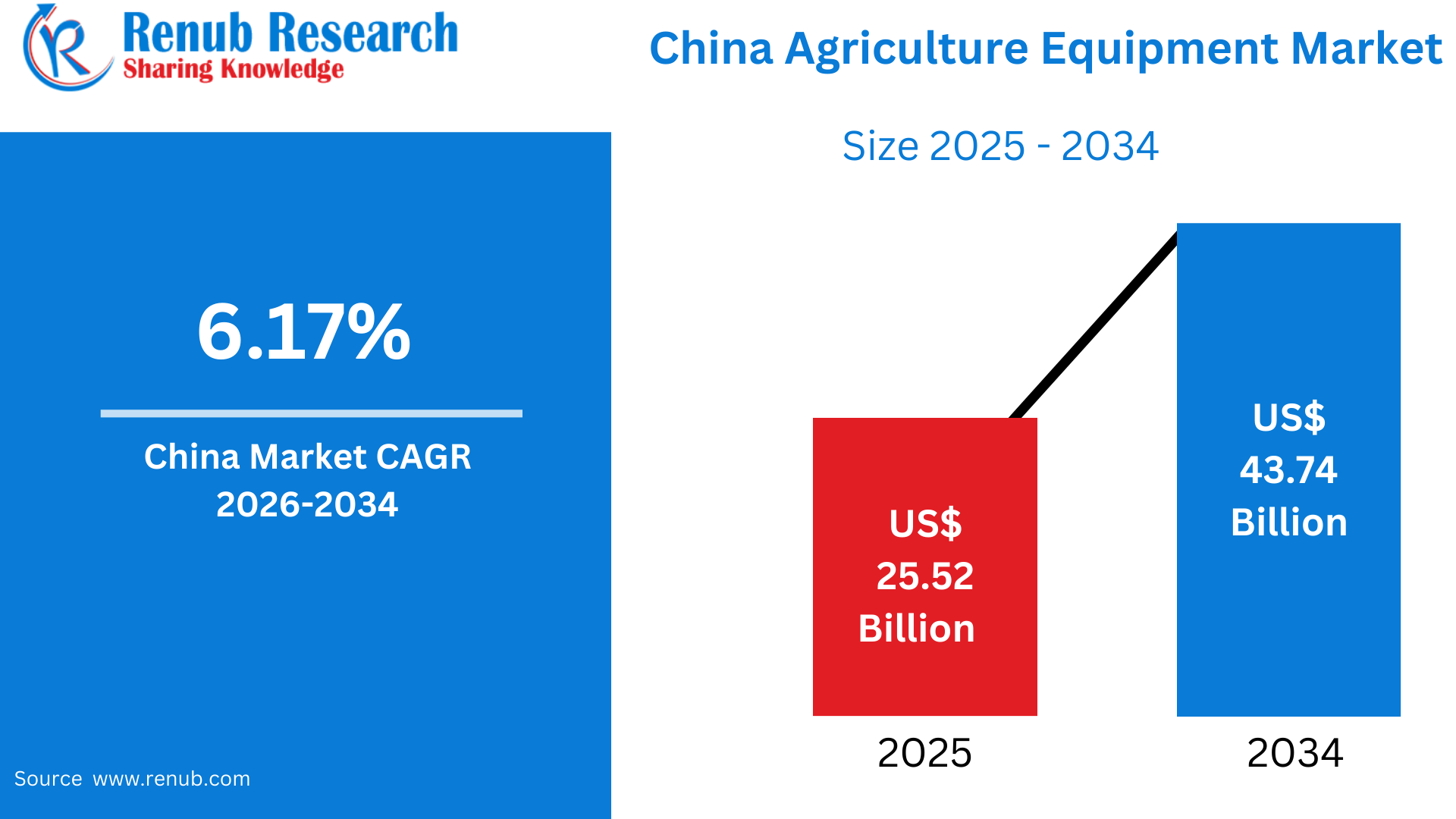
China Agriculture Equipment Market is expected to reach US$ 43.74 billion by 2034 from US$ 25.52 billion in 2025, with a CAGR of 6.17% from 2026 to 2034. Rapid urbanization, rising labor costs, and government initiatives promoting mechanization are driving China’s agriculture equipment market. Increasing demand for precision farming, higher crop yields, and efficiency in large-scale farms encourages investment in modern tractors, harvesters, and planting machinery.
China Agriculture Equipment Industry Overview
China agriculture equipment refers to machinery and tools used in farming operations, including planting, spraying, harvesting, and soil preparation. It includes tractors, seed drills, combine harvesters, sprayers, and other mechanized equipment designed to improve productivity, efficiency, and crop yields. The market is driven by large-scale commercial farms, rising labor costs, and government support for agricultural modernization. Precision agriculture technologies, such as GPS-guided machinery and automated systems, are increasingly adopted to optimize operations and reduce resource waste. With the shift from traditional labor-intensive farming to mechanized solutions, agriculture equipment is essential for ensuring food security, supporting rural economies, and sustaining China’s growing agricultural output.
The agriculture equipment market in China is growing due to increasing mechanization and the need to enhance farm productivity and efficiency. Rising labor costs in rural areas encourage farmers to adopt tractors, seed drills, sprayers, and combine harvesters. Government policies and subsidies support the purchase of modern machinery and encourage precision agriculture practices. The demand for higher crop yields, reduction of manual labor, and sustainable resource use further drives equipment adoption. Technological advancements, including GPS-enabled machinery, automation, and smart farming solutions, are expanding capabilities and applications. Large-scale commercial farms and agri-tech investments are accelerating the transition from traditional farming to mechanized, data-driven agriculture.
Growth Drivers for the China Agriculture Equipment Market
Government Support and Mechanization Incentives
China’s government plays a pivotal role in promoting agricultural mechanization, providing subsidies, low-interest loans, and incentives for farmers to purchase modern equipment. Policies supporting large-scale farming, rural modernization, and precision agriculture encourage the adoption of tractors, combine harvesters, and planting machinery. Subsidies reduce financial barriers for small- and medium-sized farms, enabling the replacement of labor-intensive methods with mechanized solutions. Investments in infrastructure, such as storage facilities and logistics networks, complement equipment adoption by improving farm efficiency. Programs promoting sustainable agriculture also encourage the use of spraying and planting equipment to optimize resource utilization, reduce pesticide overuse, and increase yields. As government initiatives continue to emphasize modernization, farmers are more likely to invest in advanced machinery, driving steady market growth in both traditional and precision agriculture segments.
Technological Advancements in Agricultural Machinery
Innovation in agriculture equipment is a key growth driver in China. Modern tractors, precision seed drills, and GPS-enabled combine harvesters allow farmers to maximize efficiency, reduce input waste, and improve productivity. Smart spraying equipment and automated planting systems enhance accuracy, reduce labor dependency, and minimize environmental impact. Integration with IoT and AI technologies enables real-time monitoring of soil, crop health, and machinery performance. Manufacturers are also producing lighter, energy-efficient machines suitable for small and medium-sized farms while maintaining output. Technological advancements allow adoption across diverse farm types and sizes, catering to both commercial and emerging smallholder operations. As China increasingly prioritizes digital agriculture and precision farming, investment in advanced, connected equipment continues to grow, enhancing operational efficiency and supporting sustainable agricultural development.
Rising Demand for Higher Crop Yields and Labor Efficiency
The need to improve productivity amid rising labor costs and shrinking rural labor forces drives the adoption of agriculture equipment. Farmers require machinery capable of handling larger areas efficiently, from combine harvesters to seed drills and sprayers. Equipment ensures timely planting, fertilization, and harvesting, which is critical for maximizing yields. Additionally, mechanization reduces labor dependency and operational delays during peak seasons. Large-scale commercial farms and emerging agribusinesses are investing in automated and high-capacity machinery to meet domestic and export demand for crops. Growing awareness of sustainable practices, such as precise pesticide application and optimized planting patterns, further supports machinery adoption. As crop yield requirements increase due to population growth and urbanization, mechanized solutions become indispensable, driving consistent growth in China’s agricultural equipment market.
Challenges in the China Agriculture Equipment Market
High Equipment Costs and Financing Constraints
Despite government subsidies, the high upfront cost of modern agricultural machinery remains a barrier for small-scale farmers. Tractors, combine harvesters, and precision equipment require significant investment, often beyond the reach of individual farmers. Financing options may be limited or involve complex approval processes, slowing adoption rates. Maintenance and repair costs further increase the total cost of ownership. Smallholder farmers may struggle to justify the investment if farm output does not generate sufficient returns, limiting the penetration of advanced machinery in rural areas. Balancing affordability with technology adoption is a key challenge for manufacturers and policymakers, as financial constraints continue to restrict widespread mechanization across the country.
Infrastructure and Skill Gaps
The adoption of modern agricultural equipment is limited by inadequate rural infrastructure and a shortage of skilled operators. Poorly maintained roads, insufficient storage, and lack of service centers reduce machinery efficiency and lifespan. Additionally, farmers require technical training to operate and maintain complex equipment such as GPS-enabled tractors, combine harvesters, and automated seed drills. Without adequate support and education, equipment underutilization and operational errors can reduce productivity gains. Bridging these gaps through training programs, extension services, and improved rural logistics is essential to maximize the benefits of mechanization. Infrastructure limitations and skill shortages remain critical challenges for accelerating equipment adoption in China.
China Planting Equipment Market
The planting equipment segment in China, including seed drills and precision planters, is experiencing growth as farmers adopt mechanized methods for timely and efficient sowing. Mechanized planting improves seed placement, reduces wastage, and ensures uniform crop emergence, directly impacting yields. Government incentives and subsidies encourage the adoption of automated and GPS-enabled seed drills, particularly for large-scale commercial farms. Technological integration, such as adjustable seeding rates and real-time soil monitoring, enhances planting efficiency and supports precision agriculture. The segment benefits from rising demand for cereals, vegetables, and cash crops, coupled with labor shortages in rural areas. Improved accessibility through rural dealerships and e-commerce platforms further drives planting equipment adoption, making it a critical component of China’s agricultural mechanization efforts.
China Spraying Equipment Market
China’s spraying equipment market is expanding as precision agriculture and crop protection practices gain prominence. Sprayers, including boom sprayers, drones, and automated systems, ensure accurate pesticide, herbicide, and fertilizer application, reducing chemical waste and environmental impact. Rising labor costs and the need for efficient pest management encourage mechanized solutions over manual spraying. Technological advancements, such as drone-assisted spraying and GPS-guided boom sprayers, allow precise targeting, improve productivity, and reduce operational risk. Government policies promoting sustainable farming and efficient chemical use further support adoption. The market growth is also fueled by increased crop intensity, larger farm sizes, and heightened awareness of crop health, positioning spraying equipment as a vital tool for modern, high-yield agricultural practices.
China Combine Harvesters Market
The combine harvester segment in China is growing rapidly due to mechanization in grain production and rising labor costs. These machines streamline harvesting operations, combining reaping, threshing, and winnowing in a single process, increasing efficiency and reducing manual labor requirements. Large-scale farms are increasingly investing in high-capacity harvesters to manage cereals such as rice, wheat, and maize efficiently. Technological upgrades, including GPS-enabled navigation, yield monitoring, and automated adjustments, optimize performance and minimize losses. Government subsidies and support for modern machinery purchases accelerate adoption, particularly in northern and eastern agricultural regions. As China continues to modernize its farming operations and pursue higher crop yields, combine harvesters remain essential for efficient, large-scale grain production.
China Seed Drills Market
The seed drills segment in China is experiencing growth as farmers shift to mechanized, precision planting to improve crop productivity. Seed drills provide accurate seed placement, consistent spacing, and optimized depth, ensuring uniform germination and higher yields. Modern seed drills incorporate adjustable seeding rates, GPS guidance, and compatibility with various seed types, catering to large-scale and commercial farms. Rising labor costs and the need for timely sowing during narrow planting windows drive adoption. Government subsidies, rural mechanization programs, and training initiatives further encourage investment. As demand for cereals, vegetables, and commercial crops rises, seed drills play a critical role in improving efficiency, reducing manual labor, and supporting China’s agricultural modernization and precision farming objectives.
Shanghai Agriculture Equipment Market
Shanghai’s agriculture equipment market is shaped by the city’s role as a major commercial and logistics hub rather than a large farming base. Demand is driven mainly by surrounding peri-urban agricultural zones and by companies using Shanghai as a distribution center for eastern China. The market focuses heavily on smart farming solutions, greenhouse automation, hydroponic systems, and high-efficiency small machinery suited for limited land. International brands often enter China through Shanghai because of its strong regulatory services, infrastructure, and trade platforms. Local buyers prioritize technology-forward equipment that supports urban farming, safe food production, and environmentally friendly practices. As a result, suppliers offering precision tools, digital monitoring systems, and compact multifunctional machines find strong traction.
Beijing Agriculture Equipment Market
Beijing’s agriculture equipment market is influenced by its policy-driven environment and proximity to large farming areas in northern China. The city acts as a center for agricultural research, innovation pilots, and government-led modernization initiatives. Local buyers often look for advanced machinery that supports large-scale grain cultivation, mechanized field operations, and sustainability goals. Demand includes intelligent tractors, planting and harvesting equipment, and digital tools that enhance land efficiency and environmental management. Many companies in Beijing focus on integrating equipment with agricultural IoT platforms, remote sensing, and automation technologies. Because of strong institutional involvement, the market often emphasizes reliability, long-term service, and alignment with national modernization strategies, making it attractive for suppliers with high-tech or specialized solutions.
Shenzhen Agriculture Equipment Market
Shenzhen’s agriculture equipment market is shaped by its technology-driven economy and strong innovation ecosystem. Although the city itself has limited farmland, it is a major center for developing and commercializing smart agriculture solutions. Local companies focus on sensors, robotics, drones, and AI-powered management systems designed for high-tech agriculture across China and abroad. Buyers often include agritech startups, urban farming operators, and technology integrators seeking advanced components or complete systems. The market favors lightweight, automated, and interconnected equipment tailored to precision agriculture, vertical farms, and controlled-environment production. Shenzhen’s rapid product development cycles and global supply-chain links make it an ideal place for suppliers targeting cutting-edge applications and collaborations with technology-oriented agricultural enterprises.
Recent Developments in China Agriculture Equipment Market
- October 2024, ComNav Technology showcased its agricultural machinery solutions at the China International Agricultural Machinery Exhibition. The company highlighted autosteering systems designed to improve field efficiency and reduce labor requirements, supporting large-scale precision farming and reflecting China’s growing investment in automated agricultural equipment.
- May 2024, LiuGong launched the S935TA sugarcane harvester, featuring a precision harvesting system that optimizes cutting height and angle. The machine is engineered to efficiently harvest mature cane while minimizing crop loss, enhancing productivity for commercial sugarcane operations.
- May 2024, Ricardo plc and Wuzheng Group announced a multi-year strategic partnership to develop electric agricultural machinery, including smart and hybrid tractors. This collaboration addresses workforce shortages and environmental considerations while supporting China’s push toward sustainable and technologically advanced farming equipment.
Market Segmentation
Equipment
- Tractor
- Harvesting
- Planting Equipment
- Hay & Forage Equipment
- Irrigation & Crop Processing Equipment
- Spraying Equipment
- Others
Horsepower
- Agriculture Tractors < 40 hp
- Agriculture Tractors 41-100 hp
- Agriculture Tractors > 100 hp
Harvesting
- Combine Harvesters
- Forage Harvesters
- Others
Planting Equipment
- Seed Drills
- Air Seeders
- Planters
- Others
Spraying Equipment
- Tractor-mounted
- Self-propelled
- Trailed
- Handheld
- Aerial
Cities
- Shanghai
- Beijing
- Shenzhen
- Chongqing
- Guangzhou
- Suzhou
- Chengdu
- Hangzhou
- Tianjin
- Rest of Others
All companies have been covered from 5 viewpoints:
- Overview
- Key Persons
- Recent Development
- SWO Analysis
- Revenue Analysis
Company Analysis:
- John Deere
- AGCO
- CLAAS KGaA
- First Tractor Company Limited
- Kubota Corporation
- CNH Industrial N.V.
- Valmont Industries Inc
Report Details:
| Report Features | Details |
| Base Year |
2025 |
| Historical Period |
2022 - 2025 |
| Forecast Period |
2026 - 2034 |
| Segment Covered |
Equipment, Tractor, Harvesting, Planting, Spraying and Cities |
| Cities Covered |
|
| Companies Covered |
|
| Customization Scope |
20% Free Customization |
| Post-Sale Analyst Support |
1 Year (52 Weeks) |
| Delivery Format |
PDF and Excel through Email (We can also provide the editable version of the report in PPT/Word format on request) |
Customization Services available
- Analysis of Market Size and Its Segments
- More Company Profiles (Upto 10 without any additional cost):
- Additional Countries (Other than mentioned Countries):
- Region/Country Specific Reports:
- Market Entry Strategy:
- Region-Specific Market Dynamics:
- Regional Market Share Analysis:
- Trade Analysis:
- Production Insights:
- Others Customized Requests:
For more information contact our analysts.
Need More Assistance?
- Talk to our analysts to get more precious information on the current market trends.
- Include more countries and segments and customize the report based on the final requirement.
- Get a competitive advantage in your industry by knowing the report findings and making a positive impact on your revenues and operations.
- Our analysts are always ready to provide more help and pertinent information if you need any additional assistance.