United States Agricultural Machinery Market Report by Machinery Type, Irrigation Machinery, Tractor by Power Engine, Ploughing and Cultivation, Harvesting Machinery, Haying and Forage Machinery, States and Company Analysis 2026-2034
Buy NowUnited States Agricultural Machinery Market Size and Forecast 2026-2034
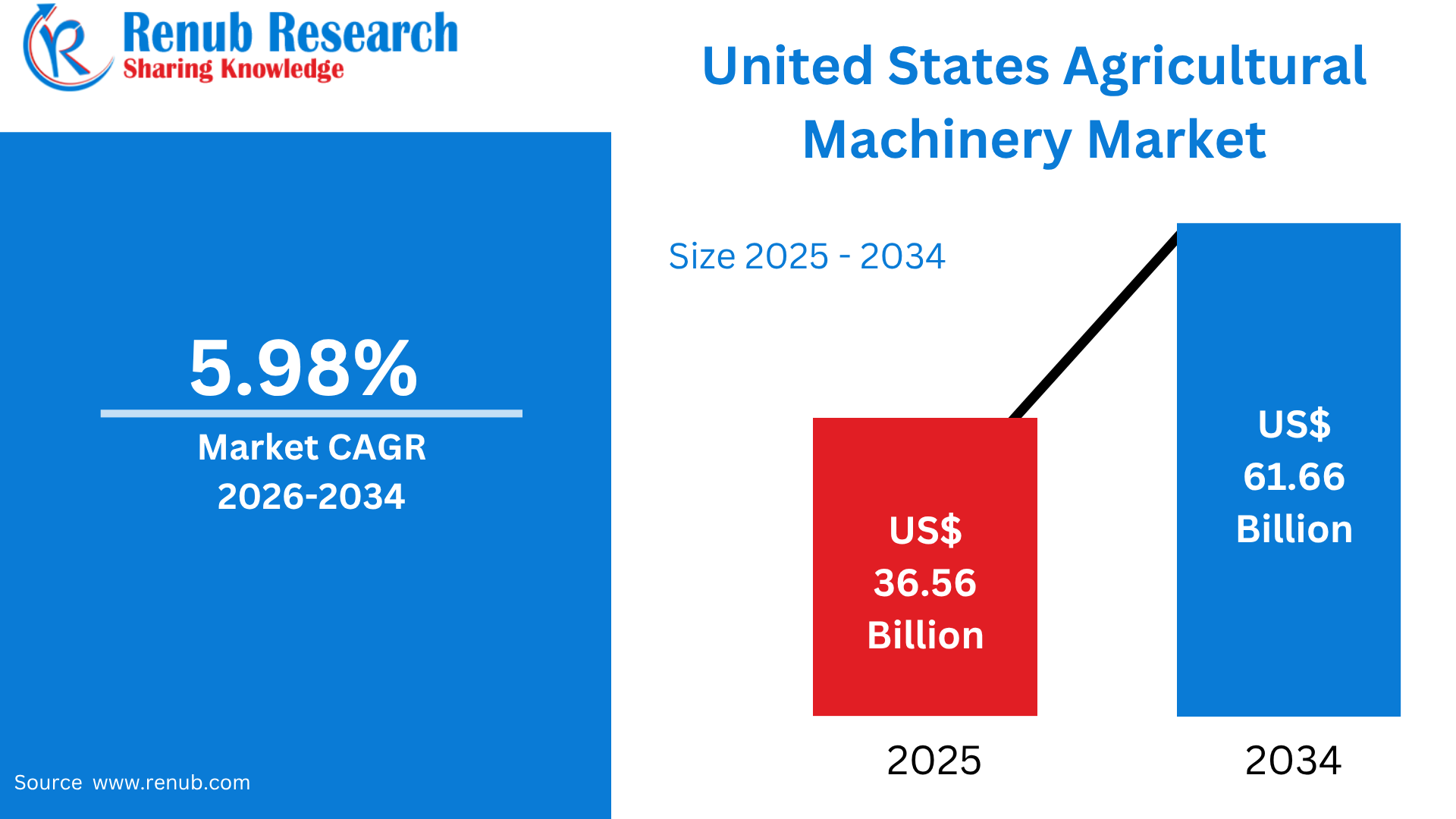
US Agriculture Equipment Market is poised to grow steadily, growing from US$ 36.56 Billion in 2025 to US$ 61.66 Billion in 2034, at a CAGR of 5.98% from 2026 to 2034. The increasing requirement for farm mechanization, the shortage of workers in the agriculture industry, and the increasing use of precision agriculture techniques are some of the driving factors behind the growth of the market.
United States Agricultural Machinery Market Outlooks
The term agricultural machinery means that kind of machines and mechanical tools which are used during the process of cultivation for the purpose of increasing productivity, decreasing manpower, and making the process more efficient. These can be represented by different types of tractors, harvesters, plows, drills for seeding, irrigation machinery, spray apparatuses, balers, and other types of machinery that can be applied for various farming activities, such as soil preparation, seeding, fertilization, irrigation, harvesting, and other activities.
Talking about the usage of agricultural machinery in the USA, one needs to note that they are extremely popular in this state due to the presence of commercial big-scale farming practice and the necessity to improve the productivity level. Agricultural machinery plays an important role in helping farmers deal with extensive agricultural lands, while decreasing the dependence on manual work, which is becoming increasingly difficult to ensure. Nowadays precision agriculture and its tools like GPS-guided machinery are also becoming more widespread.
Growth Drivers of the United States Agricultural Machinery Market
Rising Adoption of Precision Farming Technologies
The United States Agricultural Machinery Market is fueled by the growing implementation of precision farming techniques. The farmers in the region are using technologically advanced agricultural equipment that incorporates GPS, sensors, drones, and other data analysis systems. Precision farming technology improves the efficiency of operations and production on the farm. The system enables effective allocation of seed, fertilizer, pesticides, and water, among other resources. In addition, there is minimal wastage when implementing precision farming practices. There is an increase in production since the use of the technology minimizes waste during the process. Tractors, harvesters, and sprayers that have automated guidance systems help farmers manage their farms effectively. With the agriculture industry increasingly adopting smart farming and environmentally friendly practices, the demand for technologically advanced equipment will continue to grow. In February 2025, Yamaha Motor Co., Ltd. launched its latest subsidiary called Yamaha Agriculture, Inc., with the aim of creating automation and Artificial Intelligence-driven digital technologies focused on specialty crops. One more initiative of this company is that they will integrate their autonomous robots with the vast amounts of data analysis that they have to revolutionize precision agriculture technology.
Labor Shortages and Need for Farm Automation
There is a huge labor shortage problem in the agriculture industry which greatly contributes to the high demand for innovative agricultural machinery in America. Farmers face difficulties in recruiting sufficient workforce needed to plant, harvest, and maintain the fields especially during the prime agricultural periods. Labor cost increase and scarcity of farm workers encourage farmers to turn to agricultural machinery to decrease reliance on manpower. Tractors, combine harvesters, robotic dairies, and automated machines are effective solutions capable of performing repetitive duties much more quickly and effectively. In addition, automation allows one to ensure greater efficiency without delay problems. Continuous work performed by big farms is possible with automated equipment since they do not need many human operators. Thus, automation becomes an important factor due to labor issues that will keep influencing the industry. It greatly supports the further development of the market in America. May 2025, AutoStore is operating efficiently in a giant, colorful structure reminiscent of Rubik’s Cube. This is Opollo Farm – a completely automated vertical farming system developed by AutoStore and OnePointOne. Robots transport crops around, automatically adjusting their positions to provide ideal amounts of water and minerals.
Government Support and Demand for Higher Agricultural Productivity
Some of the government policies and the increased importance of improving the agriculture sector's productivity have contributed significantly to the growth in the US Agricultural Machinery market. With increasing demand for food arising out of the growing population and export activities, there is an increasing need for farmers to produce crops efficiently. Governments at both federal and state levels are offering grants, low-interest rate loans, and other financial assistance programmes aimed at encouraging farmers to acquire equipment. These efforts have helped farmers acquire high-end machinery including tractors, irrigation equipment, and harvesting equipment. Moreover, there are various programmes in agriculture extension and agricultural universities that emphasize the adoption of modern agricultural practices and technologies. Modern machinery helps farmers to cultivate a bigger land mass with minimal wastage while making the harvesting process more effective. Due to the country's emphasis on food security and agriculture, the investments in farm equipment are continually growing. December 2024, the American Relief Act, 2025 (Pub. L. 118-158) was enacted. The act extended various agricultural programs authorized by the Farm Bill of 2018 and offered USD 30.78 billion for disaster relief in the agricultural sector.
Challenges of the United States Agricultural Machinery Market
High Initial Investment and Maintenance Costs
Affordability is one of the most pressing problems in the US Agricultural Machinery Market. Modern farming equipment, including tractors with GPS, combine harvesters, robotic sprayers, and other innovative machines, involves considerable investments that not all farmers can afford. The price of new agricultural machinery also includes expenses for regular servicing, repair, fuel, and updating software. Besides, farmers need to hire specialists who can operate sophisticated technology, resulting in additional expenditures. Large farms have no difficulties paying for such machinery; however, medium and small businesses cannot spend a lot of money on new technology without risking bankruptcy. Moreover, farmers may become involved in debt, as buying agricultural machinery requires taking loans. The problem of affordability increases the risks of losses when crop prices are low or crops are not profitable.
Supply Chain Disruptions and Equipment Availability Issues
Disruption of supply chains and the lack of availability of equipment are other serious problems facing the United States Agricultural Machinery Market. Agricultural machinery industries rely greatly on steel, semiconductors, engines, and tires in their processes. Consequently, any disruptions in the supply of raw materials can disrupt the process of agricultural machinery manufacturing, resulting in delayed deliveries. The availability of farming equipment takes much longer because farmers may need the equipment urgently when planting or harvesting. Moreover, inflation has made agricultural equipment costly due to the increased cost of transportation and raw materials. Another problem with the use of agricultural equipment is that the industries depend on imports from other countries for some components. It makes the industries vulnerable during global crises.
United States Agricultural Tractors Market
The United States Agricultural Tractors Market has continued to be among the largest segments in the farm machinery industry, owing to the importance of tractors in modern-day agricultural practices. Tractors are involved in activities such as plowing, tillage, seeding, hauling, spraying, and running various farm equipment, thus forming the core component of modern mechanized farming. In the United States, large commercial farms require high-powered tractors in order to increase efficiency and manage their vast agricultural lands. Furthermore, the rising trend of GPS-enabled tractors has resulted in a paradigm shift in the industry, which can increase the level of efficiency in farming practices. Farmers are becoming increasingly aware about the need for fuel-efficient and environmentally friendly tractors, as a way of ensuring that their farming operations remain sustainable and cost-effective. With labor being increasingly scarce and the need for improved levels of productivity in farms growing, the U.S. agricultural tractors market is expected to experience steady growth. Deere & Company is set to release its first electric and autonomous-ready tractor by 2026 while investing in Kreisel Electric to source batteries for this technology. AGCO launched the Fendt e100 Vario for trial fleets in 2024, with its investments in R&D being increased by 60%, emphasizing electric powertrains. Existing
United States Agricultural Micro-Irrigation Machinery Market
US Agricultural Micro-Irrigation Machinery market is expanding rapidly due to the increasing need for efficiency in crop cultivation. Micro-irrigation equipment like drip irrigation, sprinkler irrigation, and precision irrigation equipment assists in controlling water supply to the crops effectively. This ensures efficient utilization of available resources and improved productivity in the process. This type of machinery proves extremely useful in agricultural areas that experience drought frequently because water usage can be kept to a minimum. Farmers who farm fruits, vegetables, and other valuable crops find it extremely beneficial and efficient to use micro-irrigation methods. Government initiatives aimed at sustainable agriculture have helped the market grow further, while technological improvements have made the system even more effective. It is likely that there will be an upsurge in demand for advanced agricultural micro-irrigation machinery owing to changing weather conditions.
United States Agricultural Cultivators and Tillers Market
There is an increasing need for cultivators and tillers in agricultural applications in the U.S. since modern farmers are always in search of efficient tools which would help to improve soil preparation and make crops more productive. Indeed, cultivators and tillers play a crucial role in breaking up the soil, weeding, aerating the soil, and creating favorable conditions for planting. In turn, such agricultural practices increase the effectiveness of seedbed creation and help in developing healthy roots and making work more effective in general. Small and medium-sized farms in the USA tend to make use of cultivators and tillers while preparing fields for growing different types of crops including vegetables, horticulture, and row crops. Nowadays, there is a growing need for advanced mechanical tillers and cultivators due to their higher efficiency and better performance.
United States Combine Harvesters Market
US Combine Harvesters Market is showing a robust market trend, owing to increased demand for high-performance crop harvesting equipment. Combine harvesters can complete many functions at once in harvesting crops, such as harvesting, threshing, and winnowing. With these capabilities, less manual effort and harvesting time are required for effective results. Combine harvesters have several applications, which include harvesting wheat, corn, soybeans, and rice, especially in commercial farming businesses throughout the Midwest. Farmers will need to buy advanced combine harvesters as labor shortage prevails. Combine harvesters equipped with technologies like GPS, harvesting sensors, and automation systems will enable better performance while minimizing any wastage from harvesting activities. To achieve higher productivity and efficiency, farmers will use energy-saving and capacity-enhanced combine harvesters.
United States Agricultural Mowers Market
There has been a rise in the growth of the United States Agricultural Mowers Market, owing to the high demand for forage harvesters and efficient agricultural machinery used for field maintenance purposes. Agricultural mowers are used extensively in the cutting of grass, hay, forage crops, and pasture maintenance. They have a critical importance for livestock farming and dairy industry. Mowers help farmers to ensure the quality of feed and cut a wide range of fields quickly. Demand for agricultural mowers has been increasing from cattle farms, hay farms, and other farms that require field maintenance. Technological developments like disc mowers, rotary mowers, and mower conditioners have resulted in faster cutting operations, lower fuel consumption, and better preservation of crop quality. Tractor and self-propelled mowers are proving to be useful in reducing the need for labor and increasing productivity.
California Agricultural Machinery Market
The California Agricultural Machinery Market is considered one of the most important markets in the USA owing to its significant agricultural production capacity and emphasis on cultivating high-value crops. The state of California is known for its production of fresh produce like fruits and vegetables, along with specialty crops like nuts, making it a significant player in this segment. Precision agriculture tools including GPS technology, automated harvesters, and irrigation systems are becoming common practice among farmers, and there is increasing adoption of mechanized systems to make up for labor shortage and escalating costs of human labor in agriculture. Environmental laws in California ensure that fuel-efficient and sustainable equipment is used for farming, and technological advancements are being continuously made in this sector.
Texas Agricultural Machinery Market
The Texas Agricultural Machinery Market is experiencing steady growth as a result of the extensive amount of farmland available in the state as well as high levels of farming activity. Texas has very good output in agriculture in products like cotton, corn, wheat, sorghum, and hay. Also, the state has good livestock farming activity which involves intensive usage of agricultural machinery in terms of manufacturing feed and managing the land. Tractors, combines, balers, irrigation, and tillage machines are all essential in the management of the extensive farmland in the state. Increasing labor costs and the shortage of labor are driving farmers to adopt advanced forms of farming technology including precision farming techniques. This can be attributed to the increasing adoption of GPS enabled tractors and modern irrigation methods which increase yields while conserving resources.
New York Agricultural Machinery Market
The New York Agricultural Machinery Market is fueled by the diversity of agriculture practiced in New York and the need to ensure efficient agriculture. There are diverse forms of agriculture in New York ranging from dairy farming to the cultivation of fruits and vegetables. Farmers need specific machines to increase their efficiency, and such machines include tractors, mowers, harvesters, milking machines, and irrigation machines. New York’s vibrant dairy sector plays a critical role in enhancing the demand for machinery used in harvesting forages and preparing feeds, while some are used to maintain land. Small-scale farmers are increasingly adopting smaller machinery that is versatile in its functionality and increases labor efficiency. Other technological innovations such as precision farm machines and intelligent irrigation systems are becoming increasingly popular.
Florida Agricultural Machinery Market
The Florida Agriculture Machinery market is growing due to the extensive specialty crop farming that exists in Florida and the growing need for irrigation machinery. Florida has extensive citrus crop farming, sugarcane, vegetable, and ornamental crops that call for specialized farm machinery to cultivate, harvest, and take care of the crops. Tractors, sprayers, harvesters, and micro-irrigation technology are common machines for farming purposes. Advanced irrigation technology is required due to Florida’s favorable weather conditions that promote irrigation machinery. Precision agriculture technologies are also adopted in order to conserve resources and minimize the cost of production. Farm labor shortages are driving the adoption of farm machinery. The presence of extensive horticulture and export-oriented agriculture is further contributing to machinery needs.
United States Agricultural Machinery Market Segments:
Machinery Type
- Irrigation Machinery
- Tractors
- Ploughing and Cultivation Machinery
- Harvesting Machinery
- Haying and Forage Machinery
- Planting Machinery
- Sprayer
Irrigation Machinery
- Gravity Irrigation
- Miro-Irrigation
- Sprinkler
Tractors of Engine Power
- Less than 40 HP
- 41 to 100 HP
- More than 100 HP
Ploughing and Cultivation Machinery
- Cultivators and Tillers
- Harrows
- Ploughs
- Others
Harvesting Machinery
- Combine Harvesters
- Harvesting Robots
- Self-Propelled Forage Harvesters
Haying and Forage Machinery
- Mowers
- Balers
- Tedders and Rakes
- Forage Harvesters
Top States
- California
- Texas
- New York
- Florida
- Illinois
- Pennsylvania
- Ohio
- Georgia
- New Jersey
- Washington
- North Carolina
- Massachusetts
- Virginia
- Michigan
- Maryland
- Colorado
- Tennessee
- Indiana
- Arizona
- Minnesota
- Wisconsin
- Missouri
- Connecticut
- South Carolina
- Oregon
- Louisiana
- Alabama
- Kentucky
- Rest of United States
All companies have been covered with 5 Viewpoints
- Overviews
- Key Person
- Recent Developments
- SWOT Analysis
- Revenue Analysis
Company Analysis
- John Deere's
- CNH Industrial
- AGCO Corporation.
- KUBOTA Corporation.
- Titan Machinery Inc.
- CLASS
- Lindsay Corporation
- Alamo Group Inc.
Report Details:
| Report Features | Details |
| Base Year |
2025 |
| Historical Period |
2022 - 2025 |
| Forecast Period |
2026 - 2034 |
| Market |
US$ Billion |
| Segment Covered |
Machinery Type, Irrigation Machinery, Tractor by Power Engine, Ploughing and Cultivation, Harvesting Machinery, Haying and Forage Machinery and States |
| States Covered |
|
| Companies Covered |
|
| Customization Scope |
20% Free Customization |
| Post-Sale Analyst Support |
1 Year (52 Weeks) |
| Delivery Format |
PDF and Excel through Email (We can also provide the editable version of the report in PPT/Word format on request) |
Customization Services available
- Analysis of Market Size and Its Segments
- More Company Profiles (Upto 10 without any additional cost):
- Additional Countries (Other than mentioned Countries):
- Region/Country Specific Reports:
- Market Entry Strategy:
- Region-Specific Market Dynamics:
- Regional Market Share Analysis:
- Trade Analysis:
- Production Insights:
- Others Customized Requests:
For more information contact our analysts.
Need More Assistance?
- Talk to our analysts to get more precious information on the current market trends.
- Include more countries and segments and customize the report based on the final requirement.
- Get a competitive advantage in your industry by knowing the report findings and making a positive impact on your revenues and operations.
- Our analysts are always ready to provide more help and pertinent information if you need any additional assistance.