Cell and Gene Therapy Third-Party Logistics Market Report by Type, Product, Therapeutic Area, End Use, Countries and Companies Analysis 2026-2034
Buy NowCell and Gene Therapy Third-Party Logistics Market Size and Forecast
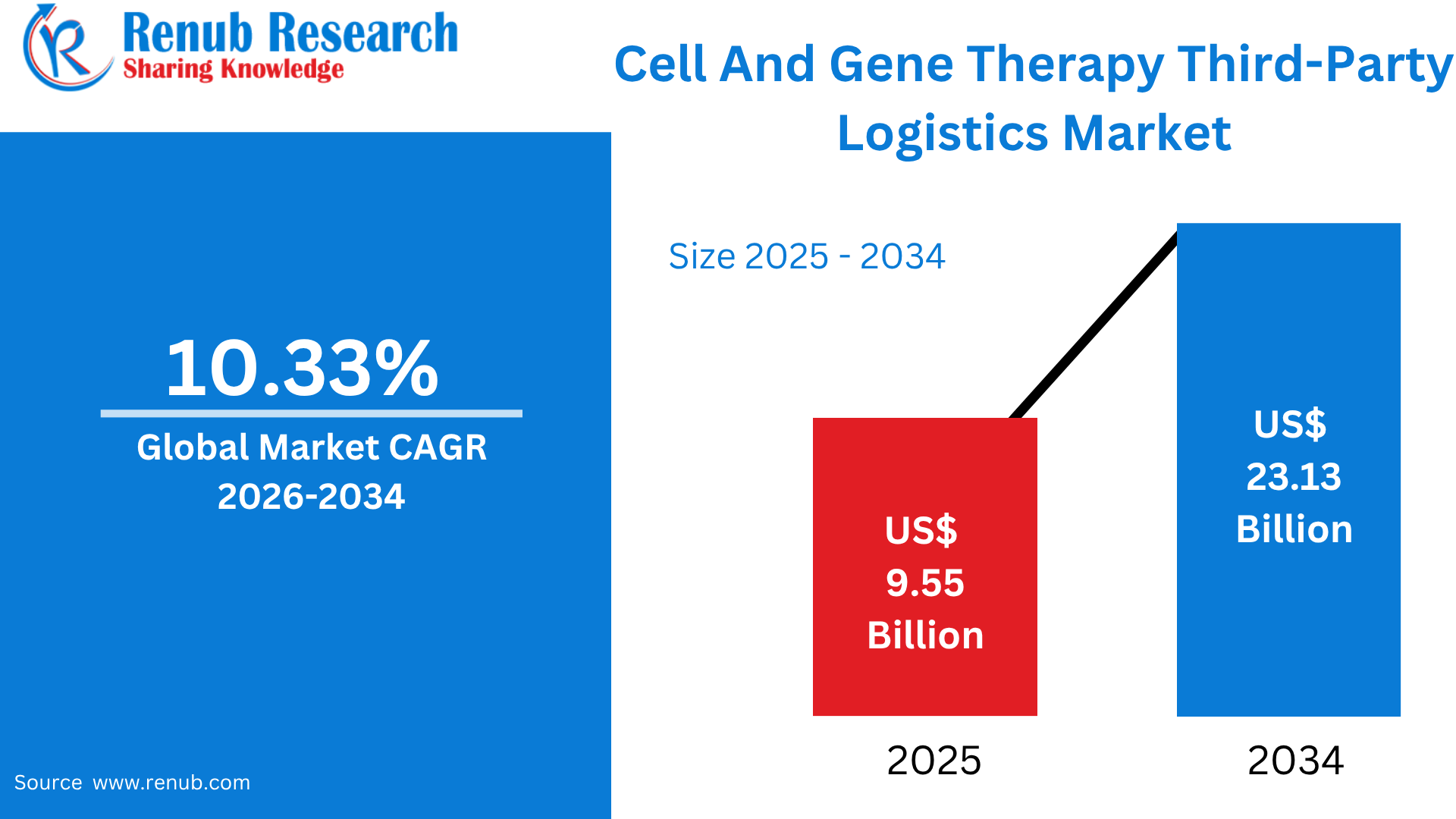
Cell and Gene Therapy Third-Party Logistics Market is projected to grow from US$ 9.55 billion in 2025 to US$ 23.13 billion by 2034, registering a CAGR of 10.33% during 2026–2034. Market expansion is being supported by the increasing commercialization of cell and gene therapies, rising demand for specialized temperature-controlled logistics, and the growing complexity of global biopharmaceutical supply chains. As advanced therapies require precise handling, stringent temperature management, traceability, and time-sensitive transportation, pharmaceutical and biotechnology companies are increasingly relying on specialized third-party logistics providers.
What is Cell and Gene Therapy Third-Party Logistics and Its Uses & Popularity Worldwide?
Cell and gene therapy (CGT) third-party logistics refers to specialized logistics services that manage the transportation, storage, packaging, tracking, and distribution of cellular and genetic therapeutic products. Unlike conventional pharmaceuticals, CGTs can be highly sensitive to temperature, time, handling conditions, and chain-of-custody requirements. Third-party logistics providers support activities such as cryogenic transportation, ultra-low-temperature storage, clinical trial shipments, manufacturing-to-treatment-center distribution, reverse logistics, and real-time shipment monitoring. These services are particularly important for autologous therapies, where a patient’s cells may need to be collected, transported to a manufacturing facility, modified, returned to a healthcare facility, and administered within tightly controlled timelines. The worldwide popularity of CGT logistics is increasing alongside the expanding therapy pipeline and commercialization of advanced treatments. The International Society for Cell & Gene Therapy reported 322 active clinical trials in its 2025 global regulatory report, while the FDA maintains an expanding list of approved cellular and gene therapy products. Specialized logistics therefore plays an increasingly important role in maintaining product integrity and enabling global access to these therapies.
CAR-T Cell Therapy Pipeline Report Highlights
Collaboration Between CARsgen Therapeutics and Huadong Medicine: In January 2023, CARsgen Therapeutics announced a strategic collaboration with Huadong Medicine for the commercialization of zevorcabtagene autoleucel (zevor-cel), also known as CT053, in mainland China. Under the agreement, Huadong Medicine received exclusive commercialization rights for CT053 in the Chinese mainland market. CARsgen was set to receive an upfront payment of US$29.7 million (RMB 200 million), with the potential to earn an additional US$152.4 million (RMB 1.025 billion) through regulatory and commercial milestone payments.
Arcellx and Kite Strategic Collaboration: In December 2022, Arcellx, Inc. entered into a global strategic collaboration with Kite to co-develop and co-commercialize CART-ddBCMA for patients with relapsed or refractory multiple myeloma. At the time, CART-ddBCMA was undergoing Phase II clinical development. The investigational therapy consists of autologous T cells genetically modified to target multiple myeloma and incorporates Arcellx’s proprietary D-Domain binder technology. Under the collaboration, Kite and Arcellx agreed to jointly advance the CART-ddBCMA program.
Zevor-cel Phase I/II Clinical Results: In December 2022, CARsgen Therapeutics Holdings Limited presented clinical findings from the Phase I/II LUMMICAR STUDY 1 at the 2022 American Society of Hematology (ASH) Annual Meeting. Among the 14 patients treated during Phase I, zevorcabtagene autoleucel demonstrated a favorable and well-tolerated safety profile, along with deep and durable clinical responses. The study reported an objective response rate (ORR) of 100%, while the complete response/stringent complete response (CR/sCR) rate reached 78.6%.
NMPA Acceptance of Zevor-cel NDA: In October 2022, CARsgen Therapeutics Holdings Limited announced that China’s National Medical Products Administration (NMPA) had accepted the New Drug Application (NDA) for zevorcabtagene autoleucel for the treatment of relapsed or refractory multiple myeloma. The application was supported by results from the open-label, single-arm Phase I/II LUMMICAR STUDY 1 (Protocol CT053-MM-01) conducted in China. The reported findings indicated encouraging safety and efficacy outcomes and highlighted zevor-cel as a potential treatment option for patients with high-risk disease.
Poseida Therapeutics and Roche Collaboration: In August 2022, Poseida Therapeutics, Inc. announced a broad strategic collaboration and licensing agreement with Roche focused on the development of allogeneic CAR-T therapies for hematologic malignancies. The global agreement covered the research and development of both existing and newly developed “off-the-shelf” cell therapy candidates targeting multiple myeloma, B-cell lymphomas, and other hematologic cancers.
Growth Drivers of the Cell and Gene Therapy Third-Party Logistics Market
Expanding Cell and Gene Therapy Pipeline and Commercialization
The growing development and commercialization of cell and gene therapies is creating sustained demand for specialized third-party logistics services. These therapies require supply chains that differ considerably from conventional pharmaceutical distribution because products may be patient-specific, highly time-sensitive, temperature-sensitive, or dependent on specialized manufacturing processes. The International Society for Cell & Gene Therapy’s 2025 Global Regulatory Report identified 322 active clinical trials in its global pipeline, with genetically modified cell therapies accounting for 53% of clinical trials and gene therapies representing 25%. The U.S. market also demonstrates increasing commercialization: research examining FDA approvals found that 38 cell and gene therapies had been approved through December 2025, with 29, or 76.3%, receiving approval during 2021–2025. As more therapies progress from clinical development to commercial distribution, manufacturers increasingly require logistics partners capable of managing specialized packaging, controlled storage, chain-of-identity documentation, customs coordination, and time-critical delivery. This expansion of clinical and commercial activity is therefore strengthening demand for outsourced CGT logistics solutions worldwide.
Increasing Demand for Cryogenic and Temperature-Controlled Logistics
The highly temperature-sensitive nature of many cell and gene therapies is a major factor driving specialized third-party logistics demand. Certain therapies require ultra-low or cryogenic conditions to maintain cellular viability and product quality during storage and transportation. Industry estimates indicate that cryogenic logistics represented approximately 57% of the global cell and gene therapy cold-chain logistics market in 2025, while ultra-low-temperature logistics accounted for about 28%. These requirements encourage pharmaceutical companies and biotechnology developers to partner with logistics specialists that possess validated packaging, specialized storage facilities, temperature-monitoring technologies, and qualified transportation networks. Modern logistics systems increasingly incorporate real-time monitoring and digital tracking to identify temperature excursions and shipment delays. The broader biopharmaceutical logistics market also illustrates the importance of temperature-controlled distribution, with cold-chain services accounting for 68.4% of the market in 2025 according to Mordor Intelligence. As the number of advanced therapies requiring frozen and cryogenic handling increases, demand is expected to rise for specialized 3PL providers capable of maintaining uninterrupted temperature control across international supply chains.
Growing Complexity of Global Biopharmaceutical Supply Chains
The increasing geographic complexity of cell and gene therapy manufacturing and treatment networks is encouraging companies to outsource logistics activities to specialized third-party providers. CGT supply chains can involve patients, hospitals, collection centers, manufacturing facilities, testing laboratories, distribution hubs, and treatment centers across multiple locations. Managing these interconnected stages requires precise scheduling, documentation, chain-of-custody control, regulatory compliance, and visibility throughout transportation. Industry research estimates that more than 3,000 cell and gene therapy clinical trials are active globally, demonstrating the scale and geographic breadth of the development ecosystem. Third-party logistics providers can integrate transportation, warehousing, packaging, monitoring, customs support, and delivery coordination into a single supply-chain framework. This is particularly valuable for companies expanding into international markets without building dedicated logistics infrastructure in every region. Increasing cross-border commercialization, decentralized clinical trials, and global manufacturing networks are consequently creating additional opportunities for specialized CGT logistics providers. The ability to provide validated infrastructure and end-to-end visibility is becoming increasingly important as therapy developers seek to reduce supply-chain complexity while maintaining product quality and regulatory compliance.
Challenges of the Cell and Gene Therapy Third-Party Logistics Market
High Cost and Complexity of Specialized Logistics Infrastructure
The requirement for specialized infrastructure creates a significant challenge for cell and gene therapy third-party logistics providers. CGTs can require cryogenic or ultra-low-temperature storage and transportation, specialized packaging, validated handling procedures, continuous monitoring, and highly trained personnel. These requirements increase operating expenses compared with conventional pharmaceutical logistics. Industry estimates indicate that cryogenic logistics accounted for nearly 57% of the CGT cold-chain logistics market in 2025, highlighting the substantial role of specialized temperature-control infrastructure. Providers may need to invest in cryogenic storage systems, dry shippers, temperature-monitoring devices, backup power, qualified facilities, and specialized transportation networks. In addition, patient-specific therapies can require highly coordinated collection and delivery schedules, increasing labor and operational complexity. Smaller logistics companies may therefore face barriers to entering the market because of the capital expenditure and technical expertise required to meet stringent quality standards. Rising demand can encourage infrastructure investment, but the need to balance high service costs with affordability for pharmaceutical and biotechnology customers remains an important market challenge.
Risk of Temperature Excursions, Delays, and Supply-Chain Disruptions
Maintaining product integrity throughout transportation is another major challenge because many cell and gene therapies have narrow temperature and time tolerances. A temperature excursion, shipment delay, packaging failure, or disruption at a transportation hub can potentially compromise a high-value therapy. Industry analysis identifies stringent temperature stability across complex international supply chains as a significant challenge, particularly where ultra-low-temperature transportation and last-mile delivery are involved. The risk becomes more complex for autologous therapies because patient-derived material and the final therapeutic product may need to move between collection, manufacturing, and treatment locations according to precisely coordinated schedules. Logistics providers therefore require validated packaging, continuous temperature monitoring, contingency planning, shipment visibility, and rapid intervention capabilities. International transportation can add customs procedures, differing regulatory requirements, weather-related disruptions, and infrastructure limitations. As CGT commercialization expands across regions, logistics providers must maintain consistent service quality while managing these operational risks, making reliability and end-to-end visibility critical factors in the development of the global CGT third-party logistics market.
Cell and Gene Therapy Third-Party Logistics Launches Worldwide
- Cryoport Systems – Global Supply Chain Hub, Stevenage, UK (2024)
Cryoport Systems officially launched its Global Supply Chain Hub in Stevenage, UK, in June 2024. The GMP-compliant facility provides end-to-end logistics services for advanced therapy manufacturers, including Cryoport Express shipping systems, Smartpak II technology, and Cryoshuttle first- and last-mile services. - Cryoport Systems & Cell and Gene Therapy Catapult – UK Logistics Center (2023)
In October 2023, Cryoport and Cell and Gene Therapy Catapult announced a strategic collaboration to establish Cryoport Systems’ first UK logistics center within the Stevenage Manufacturing Innovation Centre. The facility was designed to provide integrated supply-chain services for advanced therapy developers. - DHL Health Logistics – CRYOPDP Integration (2025)
DHL Group announced the acquisition of 100% of CRYOPDP in March 2025, strengthening DHL Health Logistics with specialized courier capabilities for clinical trials, biopharma, and cell and gene therapies. CRYOPDP operates in 15 countries and handles more than 600,000 shipments annually across more than 135 countries. - DHL–Cryoport Strategic Supply-Chain Partnership (2025)
Alongside the CRYOPDP acquisition, DHL and Cryoport established a strategic partnership to combine DHL’s global healthcare logistics capabilities with Cryoport’s specialized life-science supply-chain expertise. The collaboration supports integrated logistics solutions for advanced therapies and specialized pharmaceutical shipments. - Cryoport Systems – Pont-du-Château, France Expansion (2024)
Cryoport expanded its European logistics infrastructure through its facility in Pont-du-Château, France, supporting the growing requirements of the cell and gene therapy industry. The facility works alongside Cryoport’s Stevenage and Amsterdam operations to provide broader end-to-end European supply-chain coverage. - Cryoport Systems – Global Supply Chain Centers, USA (2022)
Cryoport Systems launched Global Supply Chain Centers in Houston, Texas, and Morris Plains, New Jersey. These facilities integrated logistics and bioservices capabilities, including controlled-temperature storage, fulfillment, kit production, secondary packaging, labeling, and GMP raw-material storage for cell and gene therapies. - UPS Healthcare – Global Cold-Chain Freight Forwarding Expansion (2025)
UPS Healthcare expanded its global pharmaceutical cold-chain freight-forwarding capabilities in August 2025. The expansion included advanced cross-dock facilities, additional IATA CEIV Pharma certifications, and real-time shipment visibility through the UPS Healthcare Control Tower, supporting temperature-sensitive pharmaceutical and advanced-therapy logistics. - World Courier – Advanced Cell and Gene Therapy Logistics Platform
World Courier has expanded its specialized CGT logistics capabilities through cryogenic transportation, global temperature and location monitoring, regulatory support, and specialized packaging. Its network includes more than 120 company-owned facilities and cryogenic charging locations supporting advanced-therapy programs across more than 50 countries. - Cryoport–World Courier Global CGT Logistics Partnership
Cryoport and World Courier established a global logistics partnership integrating Cryoport’s temperature-controlled logistics technology with World Courier’s international specialty-logistics network. The collaboration was designed to provide greater traceability and temperature-controlled logistics support for cell and gene therapy supply chains. - Cryoport Systems – Elevidys Commercial Distribution Support
Cryoport Systems was selected to manage shipment logistics for Elevidys, a gene therapy, demonstrating the company’s expansion into commercial gene-therapy distribution. Its logistics infrastructure supports temperature-controlled transportation from controlled room temperature through −80°C solutions while maintaining GMP and GDP requirements.
Growing Clinical Trial Activity Drives Specialized Logistics Demand
The clinical segment represents a major application area for the cell and gene therapy third-party logistics market because investigational therapies require highly controlled transportation between manufacturing facilities, laboratories, clinical trial sites, hospitals, and collection centers. More than 1,975 cell and gene therapy clinical trials were ongoing globally as of Q4 2024, creating substantial requirements for temperature-controlled transportation, sample collection, packaging, tracking, and chain-of-custody management. Clinical logistics are particularly complex for autologous cell therapies because patient-derived material must often be transported to a manufacturing facility and the finished therapy returned to the treatment site within carefully controlled timelines. Third-party logistics providers therefore offer specialized cryogenic shipping containers, real-time temperature monitoring, validated packaging, inventory management, and time-critical delivery services. As the global clinical pipeline expands, increasing numbers of trial sites and cross-border studies are expected to sustain demand for reliable and specialized CGT logistics infrastructure.
Personalized Cell Therapies Increase Cold-Chain and Time-Critical Requirements
Cell therapies are an important product category within the cell and gene therapy third-party logistics market, supported by the increasing development and commercialization of autologous and allogeneic treatments. Oncology represented 56.1% of global cell therapy trials, while immune cell therapies accounted for approximately 5,167 trials and stem cell therapies for about 4,796 trials. CAR-T therapy alone represented approximately 2,409 trials, highlighting the importance of personalized cellular medicines. These therapies create specialized logistics requirements because many products must be maintained within strict temperature ranges and transported according to patient-specific schedules. Autologous therapies can involve collection of cells from an individual patient, shipment to a manufacturing facility, processing, quality testing, and subsequent delivery back to the treatment center. Third-party logistics providers support this process through cryogenic transportation, temperature monitoring, chain-of-identity management, scheduling, storage, and last-mile delivery. Continued expansion of cell therapy research is therefore increasing demand for dedicated logistics solutions worldwide.
Oncology Remains the Largest Therapeutic Application
Oncology represents a major therapeutic area for cell and gene therapy third-party logistics because cancer has become the leading focus of advanced-therapy research and commercialization. Cell therapies are particularly significant in oncology, with CAR-T and other genetically modified immune-cell treatments requiring highly coordinated transportation between collection centers, manufacturing facilities, testing laboratories, and hospitals. Earlier global clinical-development data also showed that oncology accounted for approximately 80% of gene therapy trials and 68% of cell therapy trials, demonstrating the concentration of advanced-therapy research in cancer treatment. These therapies frequently require stringent temperature management, real-time shipment monitoring, validated packaging, and precise delivery schedules. As more oncology therapies progress from clinical trials toward commercial availability, third-party logistics providers are increasingly required to manage patient-specific shipments, cryogenic storage, chain-of-custody documentation, and specialized last-mile delivery.
Expansion of Ocular Gene Therapies Supports Specialized Logistics
The ophthalmology segment is developing as an important application area for cell and gene therapy third-party logistics, supported by increasing research into inherited retinal diseases, optic nerve disorders, and other ophthalmic conditions. The underlying clinical pipeline also demonstrates considerable activity. A worldwide review identified 159 ophthalmic gene therapy clinical trials through 2022, involving approximately 7,130 patients. About 96% of these trials targeted retinal and optic nerve disorders, while 65% used gene augmentation approaches involving viral vectors. Ophthalmic therapies can require specialized handling, controlled temperatures, validated packaging, and precise delivery to specialized treatment centers. The growing geographic distribution of clinical trials is increasing the need for logistics providers capable of coordinating shipments among manufacturers, clinical research organizations, hospitals, and treatment centers. As ophthalmic cell and gene therapies advance through development and commercialization, demand for specialized transportation, storage, monitoring, and time-sensitive distribution services is expected to increase.
United States Expanding Patient Base and Advanced Therapy Infrastructure
United States represents a major market for cell and gene therapy third-party logistics (3PL), supported by a mature biotechnology ecosystem, advanced healthcare infrastructure, and a large pipeline of innovative therapies. Demand for specialized logistics is increasing as manufacturers and healthcare institutions require temperature-controlled transportation, cryogenic storage, real-time shipment monitoring, chain-of-identity management, and regulatory compliance. An important indicator of future logistics demand is the projected expansion in the number of patients receiving advanced therapies. A peer-reviewed U.S. analysis estimated that approximately 12,000 Americans could receive gene or stem cell therapies in 2020, increasing to more than 340,000 by 2030. Although later research has produced different projections, including an estimate of approximately 93,000 U.S. patients treated in 2030, the direction of growth remains significant. Increasing commercialization, clinical research, and personalized medicine are therefore strengthening requirements for reliable specialized 3PL networks across the country.
United Kingdom Strong Life Sciences Ecosystem Supporting Specialized Logistics
United Kingdom is developing an increasingly sophisticated ecosystem for cell and gene therapies, creating opportunities for specialized third-party logistics providers. Government information highlights 22 GMP facilities, representing a 50% increase since 2013, alongside expanding commercial contract manufacturing and supply-chain capabilities. The UK also benefits from expertise in cell and tissue collection and logistics through NHS Blood and Transplant and the Scottish National Blood Transfusion Service. These capabilities support demand for temperature-controlled transportation, cryogenic shipment, chain-of-custody management, and digitally monitored distribution between manufacturing sites, clinical centers, research organizations, and hospitals. Cell therapies can require multiple cryogenic transportation stages, from collection of cellular starting material through manufacturing and final clinical administration, with strict traceability throughout the process. As advanced therapies move from clinical development toward broader commercialization, UK logistics providers are expected to increasingly integrate specialized packaging, monitoring, documentation, and regulatory services.
China Growing Clinical Activity and Regulatory Development
China’s cell and gene therapy 3PL market is expanding alongside the country’s rapidly developing advanced-therapy ecosystem. A 2025 review based on China’s National Medical Products Administration data identified 206 cell therapy clinical trials conducted between 2014 and 2024. T-cell therapies accounted for 51.4%, stem-cell therapies for 34.0%, and progenitor-cell therapies for 4.9% of these trials. Moreover, 64.1% were Phase I, 32.5% Phase II, and 3.4% Phase III, demonstrating substantial clinical-development activity. China is also implementing regulatory changes intended to strengthen standards for cell and gene therapy trials, including greater oversight and requirements involving scientific and ethics review. These developments are increasing the importance of specialized logistics capable of maintaining cryogenic or controlled-temperature conditions, ensuring traceability, and coordinating time-sensitive movements among hospitals, research centers, manufacturers, and clinical sites. As domestic development and commercialization progress, demand for specialized 3PL infrastructure is expected to increase.
Abu Dhabi Emerging as a Regional Advanced-Therapy Hub
The UAE, particularly Abu Dhabi, is strengthening its advanced-therapy ecosystem through investments in genomics, precision medicine, clinical research, and manufacturing infrastructure. In July 2025, the Department of Health – Abu Dhabi, M42, PureHealth, and GEMMABio Therapeutics announced plans to establish dedicated manufacturing and research centers within Abu Dhabi’s academic health institutions. The collaboration includes a clinical trial for a next-generation gene therapy targeting spinal muscular atrophy type 1 (SMA1) and aims to improve access to advanced therapies for patients across the MENA region. Abu Dhabi’s genomics infrastructure is also substantial, with the Emirati Genome Programme having sequenced more than 800,000 genome samples by July 2025. In 2026, Abu Dhabi further expanded its advanced-therapy ambitions through a partnership involving M42 and Mammoth Biosciences focused on gene-editing therapies, clinical research, and future manufacturing capabilities. These developments can support demand for specialized 3PL services involving cryogenic transportation, secure storage, chain-of-custody management, and regional distribution of sensitive cell and gene therapies.
Recent Developments in Cell and Gene Therapy Third-Party Logistics Market
- In In order to expand its skills in the life sciences and healthcare industry, DHL announced in March 2025 that it would be acquiring CryoPDP, a pharmaceutical logistics company situated in the United States. For pharmaceutical and biotech businesses, CryoPDP specializes in temperature-controlled logistics solutions, including shipping, storage, and packaging services. The goal of this acquisition is to improve DHL's supply chain services for the pharmaceutical sector.
- Advanced Therapy Connect, an industry-first integrated ordering platform created especially for cell and gene therapies under the Advanced Therapy Solutions division, was unveiled by Cardinal Health in January 2025.
Cell and Gene Therapy Third-Party Logistics Market Segments
Type
- Clinical
- Commercial
Product
- Cell Therapies
- Gene Therapies
Therapeutic Area
- Oncology
- Neurology
- Cardiovascular Diseases
- Ophthalmology
- Infectious Diseases
- Others
End Use
- Biopharmaceutical Companies
- CDMOs/CMOs
- Others
Countries
North America
- United States
- Canada
Europe
- France
- Germany
- Italy
- Spain
- United Kingdom
- Belgium
- Netherlands
- Turkey
Asia Pacific
- China
- Japan
- India
- Australia
- South Korea
- Thailand
- Malaysia
- Indonesia
- New Zealand
Latin America
- Brazil
- Mexico
- Argentina
Middle East & Africa
- South Africa
- Saudi Arabia
- United Arab Emirates
All the Key players have been covered with 5 Viewpoints
- Overviews
- Key Person
- Recent Developments
- SWOT Analysis
- Revenue Analysis
Key Players Analysis
- Cencora Corporation
- Cardinal Health
- McKesson Corporation
- EVERSANA
- Knipper Health
- Arvato SE
- DHL
- Kuehne+Nagel
Report Details:
| Report Features | Details |
| Base Year |
2025 |
| Historical Period |
2022 - 2025 |
| Forecast Period |
2024 - 2034 |
| Market |
US$ Billion |
| Segment Covered |
Type, Product, Therapeutic Area, End Use and Countries |
| Countries Covered |
|
| Companies Covered |
|
| Customization Scope |
20% Free Customization |
| Post-Sale Analyst Support |
1 Year (52 Weeks) |
| Delivery Format |
PDF and Excel through Email (We can also provide the editable version of the report in PPT/Word format on request) |
Customization Services available
- Analysis of Market Size and Its Segments
- More Company Profiles (Upto 10 without any additional cost):
- Additional Countries (Other than mentioned Countries):
- Region/Country Specific Reports:
- Market Entry Strategy:
- Region-Specific Market Dynamics:
- Regional Market Share Analysis:
- Trade Analysis:
- Production Insights:
- Others Customized Requests:
For more information contact our analysts.
Need More Assistance?
- Talk to our analysts to get more precious information on the current market trends.
- Include more countries and segments and customize the report based on the final requirement.
- Get a competitive advantage in your industry by knowing the report findings and making a positive impact on your revenues and operations.
- Our analysts are always ready to provide more help and pertinent information if you need any additional assistance.