Casino Gambling Market Report by Player Type, Game Type, Gaming Location, Payment Method, Countries and Companies Analysis 2026-2034
Buy NowCasino Gambling Market Size and Forecast
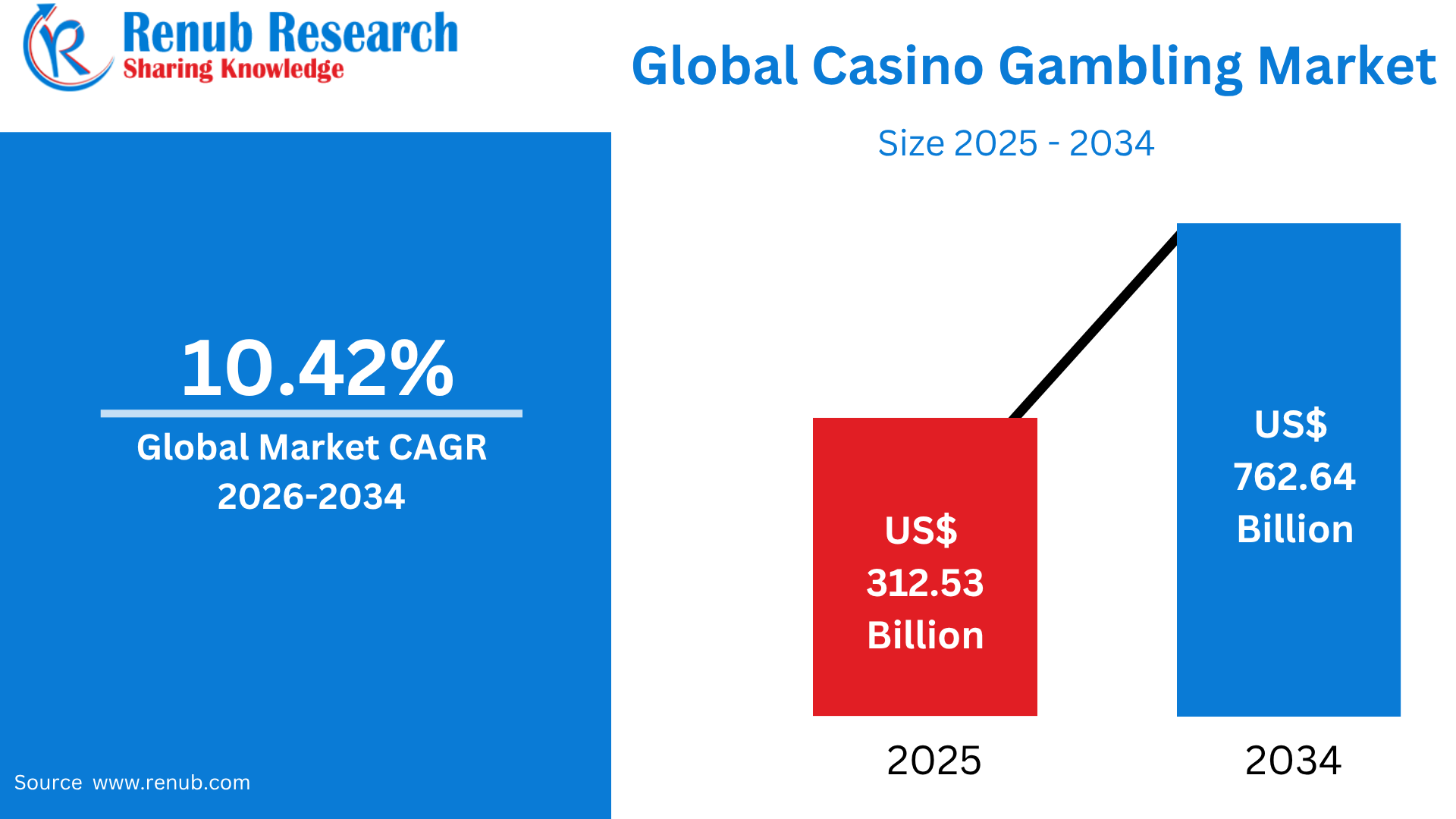
Casino Gambling Market is projected to grow from US$ 312.63 billion in 2025 to US$ 762.64 billion by 2034, registering a Compound Annual Growth Rate (CAGR) of 10.42% during the forecast period from 2026 to 2034. The market is anticipated to witness significant expansion, driven by increasing international and domestic tourism, the growing adoption of digital and online gambling platforms, and rising investments in large-scale integrated casino resorts. Expanding entertainment and hospitality offerings, including hotels, restaurants, retail outlets, and live events, are enhancing the overall appeal of casino destinations.
What is Casino Gambling and Its Uses & Popularity Worldwide
The casino gambling market comprises land-based and digital casino activities in which consumers wager money on games such as slot machines, blackjack, roulette, baccarat, poker, and other casino-style games. Land-based casinos are commonly integrated with hotels, restaurants, entertainment venues, retail outlets, and tourism facilities, while online casinos provide access through websites and mobile applications. Casino gambling is used primarily as a form of entertainment and leisure, while integrated casino resorts also contribute to tourism, hospitality, employment, and destination development. Worldwide popularity is supported by increasing consumer access to digital platforms, expanding tourism, and the development of large-scale integrated resorts. Statista estimates that the global casino and online gambling sector was valued at approximately US$287.8 billion in 2025, while 8,108 gambling properties were operating worldwide in 2024. Digital gambling is also becoming increasingly important: H2 Gambling Capital estimates that online gambling generated US$293 billion in global gross gaming revenue in 2024, representing 41% of total global GGR, compared with 20% in 2015.
Casino & Gambling Statistics 2026 (Top Picks)
- Global gambling participation: More than 4.2 billion people are estimated to gamble annually, while approximately 1.6 billion participate regularly. Overall, gambling activity is estimated to involve around 26% of the global population, highlighting the extensive reach of the worldwide gambling industry.
- Leading European casino markets: Europe remains one of the world’s most important gambling regions. Based on the cited market statistics, Italy leads European casino followed by the United Kingdom, Germany, and France.
- Macao casino recovery: Macao’s mass-market Gross Gaming Revenue (GGR) in 2025 was expected to reach approximately 15–20% above pre-pandemic levels, reflecting the continuing recovery of tourism, entertainment, and casino activity in the region. The shift toward mass-market and premium-mass customers remains an important structural trend in Macao’s casino industry.
- UK online gambling scale: Recent UK Gambling Commission data shows the continuing scale of online gambling participation. In March 2026, major operators covering approximately 70% of the online market reported 4.98 million active slot players, 2.64 million active players in other gaming including casino, 6.23 million real-event betting players, and 195,531 poker players.
- Online casino’s rising importance: H2 Gambling Capital estimates that online gambling represented 41% of global GGR in 2024, compared with only 20% in 2015, and forecasts that online gambling will exceed half of global GGR by 2029. Within the broader casino market, Evolution’s 2025 annual report, citing H2GC, estimates that online casino represented approximately 44% of the total casino market in 2025, underlining the rapid shift toward digital gaming.
- Leading gambling companies: Major international companies shaping the competitive landscape include Flutter Entertainment, bet365, Entain, Caesars Entertainment, and MGM Resorts, with competition increasingly focused on online casino platforms, sports betting, mobile applications, live-dealer gaming, loyalty programs, and integrated land-based and digital experiences.
- Unregulated gambling remains significant: Regulatory compliance remains a major industry issue. Gaming Compliance International estimated unregulated online gambling wagering. Its analysis estimated that unregulated operators accounted for around 78% of global online gaming GGR, although these figures measure the unregulated market using GCI’s methodology and should not be directly compared with conventional licensed-market GGR estimates.
- Digital casino engagement: UK operator data illustrates the intensity of online activity. In March 2026, major operators reported approximately 8.73 billion slot bets and 260.83 million bets in other gaming, including casino. Online casino and gaming therefore represent not only a growing revenue category but also a high-frequency component of the broader digital gambling ecosystem.
Growth Drivers
Expansion of Online Casino Platforms and Smartphone Access
The rapid development of online casino platforms is one of the strongest growth drivers for the global casino gambling market. Internet-connected devices allow consumers to access casino games without visiting a physical gambling venue, increasing convenience, availability, and frequency of engagement. Mobile applications, digital wallets, live-dealer games, personalized promotions, and real-time gaming features are further improving the online casino experience. Mobile and tablet platforms accounted for 58% of online gambling revenue in 2025, demonstrating the growing importance of mobile accessibility. Regulatory liberalization is also helping convert previously offshore activity into licensed markets. H2 Gambling Capital estimates that regulated onshore online GGR reached US$132 billion in 2024, accounting for 45% of global online GGR.
Growing Tourism and Integrated Casino Resort Investments
Increasing international tourism and investments in integrated casino resorts are supporting casino gambling demand by combining gaming with accommodation, dining, entertainment, shopping, conventions, and leisure activities. These developments transform casinos into broader tourism destinations and attract both domestic and international visitors. Macau provides a strong example of this relationship, with 40.07 million visitor arrivals recorded in 2025, representing a 14.7% year-on-year increase, according to recent industry research. Integrated resorts can generate additional spending beyond casino floors through hotels, restaurants, entertainment, retail, and events, increasing their overall economic contribution. Asia-Pacific remains particularly important because of established gaming destinations and continued development of large-scale hospitality projects. As governments and private operators invest in tourism infrastructure and destination entertainment, casino resorts are expected to remain an important growth avenue.
Regulatory Liberalization and Expansion of Licensed Gambling Markets
Regulatory liberalization is creating new opportunities for casino operators by allowing additional jurisdictions to establish licensed online and land-based gambling markets. Governments can view regulated casino gambling as a source of tax revenue, tourism investment, employment, and consumer protection when appropriate safeguards are implemented. The expansion of regulated markets also enables consumers to move from unlicensed operators toward licensed platforms that operate under formal compliance requirements. H2 Gambling Capital estimates that onshore online gambling represented 45% of global online GGR in 2024, compared with only 27% in 2015, demonstrating the long-term shift toward regulated channels. Recent industry analysis also highlights regulatory liberalization in markets such as the United States and Latin America as an important contributor to online gambling expansion. In the United States, the legalization of online casino gambling remains state-specific, leaving additional opportunities for market expansion where new jurisdictions introduce licensing frameworks. Continued regulatory modernization, licensing, taxation, and digital compliance can therefore broaden the addressable customer base and encourage further investment in casino infrastructure and technology.
Challenges
Regulatory Restrictions and Market Fragmentation
Regulatory restrictions represent a major challenge because casino gambling laws vary substantially between countries and, in some cases, between individual states or provinces. Operators must comply with licensing requirements, taxation rules, advertising restrictions, age-verification procedures, anti-money-laundering requirements, responsible-gambling measures, and data-protection regulations. These differences can increase operating costs and make international expansion more complex. The online market is particularly affected because operators may be permitted in one jurisdiction while prohibited or heavily restricted in another. Recent market analysis indicates that regulated onshore online GGR accounted for only 45% of global online GGR in 2024, while offshore activity still represented the majority of the online market. This demonstrates the difficulty of transitioning consumers into regulated channels. In addition, tightening advertising and player-protection rules can affect customer acquisition and promotional strategies. Operators must therefore continuously adapt technology, compliance systems, marketing practices, and responsible-gambling programs to meet changing regulatory requirements, creating additional costs and uncertainty across international markets.
Responsible Gambling Concerns and Unregulated Market Activity
Responsible gambling concerns represent another significant challenge for the casino gambling industry, particularly as digital platforms make gambling available continuously through smartphones and computers. Easy access, frequent promotional offers, and rapid digital transactions can increase the risk of excessive gambling among vulnerable consumers. Operators and regulators therefore face growing pressure to implement age verification, spending controls, self-exclusion tools, identity checks, advertising standards, and player-monitoring systems. At the same time, unregulated operators create additional challenges because they may operate outside local licensing and consumer-protection frameworks. A 2026 Gaming Compliance International analysis estimated that unregulated online gambling generated approximately US$5.9 trillion in wagering value in 2025, with unregulated operators accounting for an estimated 78% of global online gaming GGR. Although estimates of the unregulated market vary depending on methodology, the scale illustrates the challenge faced by licensed operators and regulators. Strengthening responsible-gambling measures while making regulated platforms competitive and accessible will remain important for sustainable market development.
Casino Gambling Product/Platform Launches Worldwide
- 1. Borgata Online Reimagined Platform – BetMGM (United States, 2026): BetMGM announced the relaunch of its redesigned Borgata Online platform in June 2026, with the new experience scheduled to go live on July 3, 2026. The platform introduces a unified Rewards Hub and access to more than 4,000 games, representing a major modernization of one of New Jersey’s established regulated online casino platforms.
- 2. DraftKings Sports & Casino Super App – DraftKings (United States, 2026): DraftKings announced plans in March 2026 to introduce its DraftKings Sports & Casino super app, integrating Sportsbook, Predictions, Casino, and Lottery into a unified experience using a single account and wallet. The initiative is designed to strengthen cross-product engagement and create a more integrated digital gaming ecosystem.
- 3. EvenBet iGaming Platform and Aggregator – EvenBet Gaming (Global, 2026): EvenBet Gaming launched a new turnkey iGaming platform and aggregation solution in May 2026. The platform houses more than 15,000 online casino games from over 230 providers, alongside payment infrastructure, KYC tools, promotional features, affiliate functionality, and other operator-support services.
- 4. Golden Nugget Online Gaming Casino – DraftKings (Canada, 2025): Golden Nugget Online Gaming launched its online and mobile casino in Ontario in August 2025 after receiving regulatory approval. Powered by DraftKings’ technology platform, the casino offers more than 2,000 slot titles together with classic games such as blackjack, roulette, and craps, supported by loyalty and customer-service features.
- 5. FanDuel Casino Jackpots – FanDuel (United States, 2025): FanDuel introduced its Casino Jackpots progressive jackpot system in 2025, initially expanding across New Jersey, Michigan, and Pennsylvania. The feature allows eligible games to participate in four jackpot levels—Mini, Minor, Major, and Mega. By November 2025, FanDuel reported that more than 450,000 jackpots had been won, totaling over US$300 million.
- 6. Signature American Roulette – Caesars Entertainment (United States, 2025): Caesars launched Signature American Roulette in August 2025 as its third proprietary online casino title of the year. Developed in-house through Empire Creative, the game debuted in New Jersey across Caesars Palace Online Casino, Caesars Sportsbook & Casino, and Horseshoe Online Casino, highlighting the growing emphasis on proprietary digital casino content.
- 7. Dual Play Baccarat – BetMGM and Borgata (United States, 2025): BetMGM and Borgata launched Dual Play Baccarat in New Jersey in February 2025. Developed by Evolution, the product connects a physical baccarat table with online players, allowing digital participants to join the same live game as players at the land-based casino. It represented the first Dual Play Baccarat offering in a regulated U.S. market.
- 8. NBA Super Slam – FanDuel Casino (United States/Canada, 2024): FanDuel Casino launched NBA Super Slam in December 2024 as its first co-branded slot game with the National Basketball Association. Developed by White Hat Studios, the basketball-themed game was introduced in Michigan, Pennsylvania, New Jersey, and Ontario, combining sports entertainment branding with online casino gaming.
- 9. Ace Ventura: Pet Detective and Cheers Casino Games – BetMGM (North America, 2024): BetMGM introduced casino games based on Ace Ventura: Pet Detective and Cheers in June 2024 through a partnership with Atlantic Digital. The titles debuted in Michigan and were planned for additional BetMGM iGaming jurisdictions subject to regulatory approvals, demonstrating the use of recognizable entertainment intellectual property to differentiate online casino offerings.
- 10. Boldplay iGaming Content – BetMGM (United States, 2024): BetMGM introduced Boldplay’s iGaming content to the U.S. market in April 2024 through an exclusive partnership. Initial offerings in Michigan included Toro Bravo, Gold Metal Ox, and Cyborg City, alongside Boldplay Spins and Superpot products. The launch expanded BetMGM’s casino content portfolio with slots, table games, virtual scratch games, and keno titles.
Strategic Participation and Skill-Based Gambling
The professional gamblers market represents a specialized segment of the broader casino and betting industry, comprising individuals who treat gambling activities as a significant income-generating pursuit rather than solely as entertainment. Professional participants commonly concentrate on poker, blackjack, sports betting, and other activities where probability, bankroll management, statistical analysis, and strategic decision-making can influence outcomes. The expansion of regulated online platforms has increased access to tournaments, sportsbooks, and digital gaming environments, allowing experienced players to participate without relying exclusively on physical casinos. Recent UK Gambling Commission data illustrates the scale of online participation: major operators reported approximately 195,531 active poker players in March 2026 and more than 6.22 million active real-event betting players during the same month. Professional gamblers increasingly use real-time odds, historical datasets, tracking software, probability models, and bankroll-management tools to support decision-making. Online platforms also provide faster access to tournaments and international betting opportunities. However, professional gambling remains highly competitive and subject to market volatility, regulatory restrictions, taxation, and responsible-gambling requirements. As regulated digital ecosystems become more sophisticated, professional players are likely to benefit from greater access to data-driven tools and diversified gaming opportunities.
Blackjack, Roulette, Baccarat, and Other Casino Classics
The table games market remains a fundamental component of the global casino gambling industry, encompassing blackjack, roulette, baccarat, craps, poker, and related games. Their popularity is supported by a combination of strategic decision-making, relatively simple game mechanics, social interaction, and the immersive environment of traditional casino floors. The digital transformation of gambling has further expanded table-game accessibility through live-dealer platforms that combine online convenience with real-time dealers and physical gaming tables. Current online casino offerings continue to emphasize blackjack, roulette, and baccarat in both random-number-generator and live-dealer formats. High-definition video streaming, multiple camera angles, interactive interfaces, and real-time communication have made digital table games increasingly similar to physical casino experiences. The UK Gambling Commission reported 2.64 million active players in the “other gaming, including casino” category in March 2026, with approximately 260.8 million bets placed during the month among major operators covering about 70% of the online market. Casinos are also introducing premium tables, VIP rooms, faster gameplay formats, and personalized experiences to increase engagement. Consequently, table games are expected to remain an important revenue and customer-retention category across land-based and online casinos.
Mobile Accessibility and Expanding Digital Participation
The online casinos market has become a major growth segment within the broader gambling industry as consumers increasingly seek convenient, mobile-accessible entertainment. Online platforms provide games such as slots, blackjack, roulette, baccarat, poker, and live-dealer casino products without requiring customers to visit a physical casino. Smartphone adoption, improved connectivity, digital payments, cloud infrastructure, and increasingly sophisticated mobile applications are strengthening this transition. In the UK, major operators reported 4.98 million active slot players and 2.64 million active players in other gaming, including casino, in March 2026. The same month recorded approximately 8.73 billion slot bets and 260.8 million bets in other gaming across operators representing about 70% of the online market. Operators are investing in live streaming, artificial intelligence, personalized recommendations, secure payment systems, identity verification, and responsible-gambling controls to improve the digital experience. Licensed markets are also benefiting from clearer regulatory frameworks that establish requirements for age verification, consumer protection, advertising, and financial controls.
Alternative Payments and Faster Transactions
Cryptocurrency is increasingly being explored within the online casino ecosystem as an alternative payment mechanism for deposits, withdrawals, and digital rewards. Bitcoin, Ethereum, stablecoins, and other digital assets can potentially enable faster cross-border transactions and reduce dependence on conventional banking channels. This can be particularly relevant for internationally oriented online platforms serving customers across multiple payment jurisdictions. Blockchain-based transactions can also provide an auditable transaction record, although the transparency of a blockchain transaction does not automatically guarantee that an individual gambling platform is trustworthy or properly regulated. The use of cryptocurrency in casino gambling remains closely connected to regulatory developments involving digital assets, anti-money-laundering requirements, taxation, consumer protection, and know-your-customer procedures. Operators must increasingly balance payment innovation with compliance obligations. The wider digital casino ecosystem is already demonstrating substantial transaction volumes: UK major operators recorded 48.08 million poker bets and 275.16 million bets in other gaming, including casino, in December 2025. Cryptocurrency-enabled gambling may therefore develop alongside broader digital-payment adoption rather than independently from it. Future opportunities are likely to center on regulated crypto payments, stablecoins, blockchain-based transaction verification, and loyalty applications, while volatility, regulatory uncertainty, cybersecurity risks, and responsible-gambling concerns remain important barriers to wider adoption.
United States Record Gaming Revenue and Expanding Digital Gambling
United States represents one of the world’s largest and most developed casino gambling markets, supported by an extensive land-based casino network, strong tourism activity, sports betting, and rapidly expanding internet gaming. The market continues to benefit from investments in integrated resorts, digital platforms, mobile betting applications, and advanced customer-engagement technologies. According to the American Gaming Association, U.S. commercial gaming generated a record US$78.72 billion in gross gaming revenue in 2025, representing a 9.2% increase from 2024. Legal, state-regulated gaming also generated approximately US$18.09 billion in gaming tax revenue. Traditional casino gaming remained particularly important, with 493 commercial casino locations across 27 states generating US$51.06 billion from traditional casino games in 2025. The legalization and expansion of online casino gaming and sports betting across individual states are creating additional opportunities for operators. In April 2025, Caesars Entertainment expanded WSOP Online to pool player liquidity across four jurisdictions, creating a major multi-state poker network in the United States. Such developments demonstrate the increasing integration of digital and land-based gaming ecosystems. At the same time, regulatory fragmentation remains a market consideration because gambling authorization differs by state. The American Gaming Association estimated in 2025 that illegal and unregulated gambling still represented 31.9% of the total U.S. gaming market, highlighting both the size of the opportunity and the importance of regulated platforms.
United Kingdom Mature Regulatory Environment and Strong Online Participation
The United Kingdom casino gambling market is characterized by a mature regulatory framework, established land-based gaming infrastructure, high internet penetration, and substantial online gambling participation. Licensed operators offer online casinos, poker, betting, bingo, and live-dealer gaming, while traditional casinos and betting establishments continue to serve consumers across the country. According to the UK Gambling Commission, the gambling industry generated £16.8 billion in Gross Gambling Yield (GGY) during the year to March 2025, an increase of 7.3% year over year. Online gambling accounted for approximately £7.8 billion, with the Remote Casino, Betting and Bingo sector representing 46% of total market GGY. Online casino participation continues to be supported by smartphones, digital payments, live-dealer platforms, personalized promotions, and increasingly sophisticated responsible-gambling technologies. During January–March 2026, online GGY from major operators increased 7% year over year to approximately £1.55 billion. Strategic corporate activity is also shaping the market. In December 2024, Allwyn International acquired a 51% stake in Novibet for US$349.89 million (EUR 327 million), strengthening its iGaming capabilities and international positioning. Going forward, the UK market is expected to emphasize regulated digital growth, player protection, technology-driven personalization, and compliance as operators compete within a mature environment.
China Large Digital Consumer Base and Regional Casino Influence
China remains an influential participant in the wider Asian casino gambling ecosystem because of its enormous consumer population, extensive smartphone adoption, and significant outbound tourism. However, casino gambling is highly restricted within mainland China, meaning that the country’s influence on the casino industry is primarily associated with tourism, digital entertainment, and demand generated in permitted overseas and regional gaming destinations. China’s large mobile user base provides a substantial digital ecosystem for entertainment services and demonstrates the country’s technological readiness for mobile-based consumer platforms. In 2023, China recorded approximately 974.69 million smartphone users, equivalent to around 68.4% of the population, providing a strong technological foundation for mobile entertainment and digital services. The country’s highly connected population supports the development of online entertainment ecosystems where legally permitted, although gambling operators must comply with China’s restrictive regulatory environment. Chinese tourists also represent an important customer segment for casinos in destinations such as Macau and other Asian gaming hubs. Consequently, tourism flows, premium gaming, digital payment adoption, and mobile connectivity remain important factors influencing the broader regional casino gambling industry. Market opportunities therefore exist primarily through legally permitted destinations and tourism-related gaming rather than unrestricted domestic casino operations.
Brazil Regulatory Liberalization and Online Gambling Expansion
Brazil is emerging as an important Latin American gambling market following the establishment of a regulated framework for online betting and gaming. The country’s large population, expanding internet connectivity, widespread smartphone adoption, and growing use of digital payments provide favorable conditions for online gambling platforms. A major regulatory milestone occurred in January 2025, when Brazil launched its regulated online gambling market under Law No. 14,790/2023. The framework introduced licensing and compliance requirements intended to establish greater transparency and consumer protection within the sector. Brazil’s regulatory framework requires operators to comply with measures covering authorization, identity verification, financial controls, and responsible gambling. These requirements are helping shift activity toward licensed operators while creating a clearer environment for domestic and international companies to invest in the market. The regulated framework is particularly important because it provides greater oversight of digital gambling transactions and player activity. As the market develops, competition is expected to increase across online casino games, sports betting, mobile applications, and digital payment services. Brazil’s combination of population scale, digital connectivity, and regulatory modernization makes it one of the more significant emerging opportunities in the Latin American casino gambling ecosystem. At the same time, taxation, compliance costs, responsible-gambling requirements, and enforcement against unauthorized operators will remain important factors influencing market development.
Casino Gambling Market Segments
Player Type
- Recreational Gamblers
- Professional Gamblers
- High Rollers
- Casual Gamblers
Game Type
- Table Games
- Slot Machines
- Electronic Gaming Machines (EGMs)
- Sports Betting
Gaming Location
- Land-based Casinos
- Online Casinos
- Virtual Reality Casinos
Payment Method
- Cash
- Credit/Debit Cards
- E-Wallets
- Cryptocurrency
Countries
North America
- United States
- Canada
Europe
- France
- Germany
- Italy
- Spain
- United Kingdom
- Belgium
- Netherlands
- Turkey
Asia Pacific
- China
- Japan
- India
- Australia
- South Korea
- Thailand
- Malaysia
- Indonesia
- New Zealand
Latin America
- Brazil
- Mexico
- Argentina
Middle East & Africa
- South Africa
- Saudi Arabia
- United Arab Emirates
Companies have been covered from 5 viewpoints
- Overviews
- Key Person
- Recent Developments
- SWOT Analysis
- Revenue Analysis
Key Players Analysis
- Las Vegas Sands
- MGM Resorts International
- Caesars Entertainment
- SJM Holdings
- Wynn Resorts
- Galaxy Entertainment
- Hard Rock International
- Palms Casino Resort
- Boyd Gaming
Report Details:
| Report Features | Details |
| Base Year |
2025 |
| Historical Period |
2022 - 2025 |
| Forecast Period |
2026 - 2034 |
| Market |
US$ Billion |
| Segment Covered |
Player Type, Game Type, Gaming Location, Payment Method and Countries |
| Countries Covered |
|
| Companies Covered |
|
| Customization Scope |
20% Free Customization |
| Post-Sale Analyst Support |
1 Year (52 Weeks) |
| Delivery Format |
PDF and Excel through Email (We can also provide the editable version of the report in PPT/Word format on request) |
Customization Services available
- Analysis of Market Size and Its Segments
- More Company Profiles (Upto 10 without any additional cost):
- Additional Countries (Other than mentioned Countries):
- Region/Country Specific Reports:
- Market Entry Strategy:
- Region-Specific Market Dynamics:
- Regional Market Share Analysis:
- Trade Analysis:
- Production Insights:
- Others Customized Requests:
For more information contact our analysts.
Need More Assistance?
- Talk to our analysts to get more precious information on the current market trends.
- Include more countries and segments and customize the report based on the final requirement.
- Get a competitive advantage in your industry by knowing the report findings and making a positive impact on your revenues and operations.
- Our analysts are always ready to provide more help and pertinent information if you need any additional assistance.