Bicycle Market Report by Type, Distribution Channel, Countries and Companies Analysis 2026-2034
Buy NowBicycle Market Size and Forecast
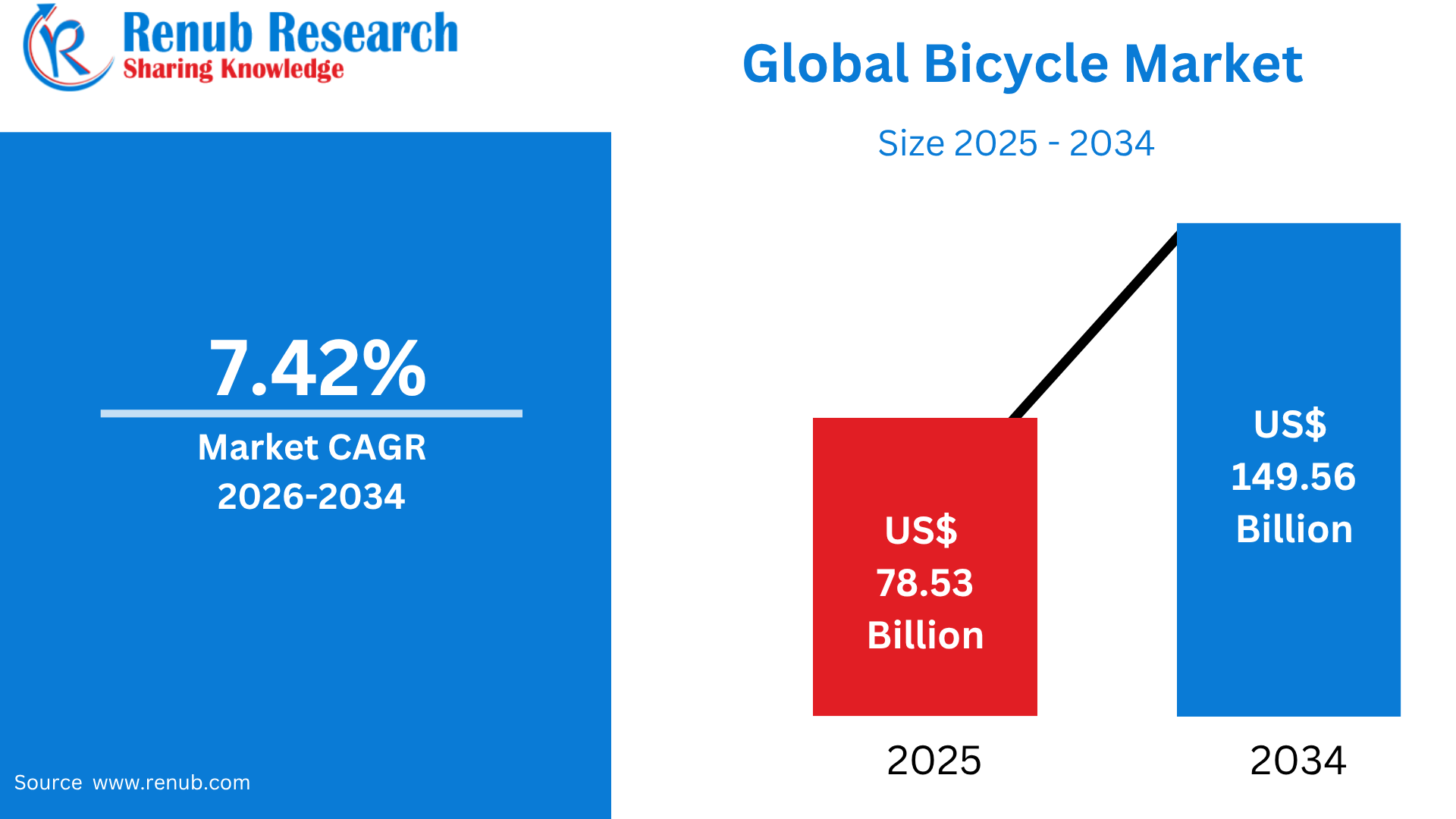
The global bicycle market is projected to grow from US$ 78.53 billion in 2025 to US$ 149.56 billion by 2034, expanding at a CAGR of 7.42% during the forecast period from 2026 to 2034. Market growth is expected to remain strong, supported by increasing health and fitness awareness, growing demand for sustainable urban transportation, rising environmental concerns, technological advancements in bicycle design, and the expanding popularity of recreational and leisure cycling activities.
What is the Bicycle Market and What are Its Uses and Popularity?
The bicycle market comprises the manufacturing, distribution, and sale of conventional bicycles, electric bicycles, mountain bikes, road bikes, hybrid bicycles, children's bicycles, and specialized models designed for commuting, sports, recreation, and fitness. Bicycles are increasingly used as an affordable and sustainable transportation option, particularly in densely populated cities where traffic congestion and environmental pollution are major concerns. They are also widely adopted for physical fitness, recreational activities, competitive cycling, tourism, and last-mile transportation. Rising awareness of the health benefits of regular cycling is encouraging consumers to incorporate bicycles into their daily routines. In addition, governments and municipalities worldwide are investing in dedicated cycling lanes, bike-sharing programs, and cycling-friendly urban infrastructure. The growing popularity of electric bicycles is further expanding the market by making cycling accessible to commuters seeking longer-distance and lower-effort transportation. Increasing concerns about carbon emissions and fuel costs are also strengthening consumer interest in bicycles as an environmentally friendly mobility solution.
Bicycles Launches Worldwide
- Giant Propel Advanced SL – Global, 2026
Giant introduced the new Propel aero road bike range with a lighter, smoother and more aerodynamic design. The flagship Propel Advanced SL delivers a claimed 18.4-watt aerodynamic advantage over the previous generation. - Trek Domane – Global, 2026
Trek launched the fifth-generation Domane, its endurance road-bike platform. The new generation focuses on lower weight, increased tire clearance and a more conventional seatpost design, replacing the previous IsoSpeed-based configuration. - Canyon Strive:ON – Global, 2026
Canyon launched an updated Strive:ON electric mountain bike with substantially increased performance, including 750W power and 120Nm torque, alongside a stronger chassis and refinements aimed at durability and easier maintenance. - Canyon Lux World Cup CFR – Global, 2026
Canyon introduced the new Lux World Cup CFR cross-country racing bike, emphasizing a lighter and faster platform. The model incorporates an adjustable anti-squat flip chip to provide greater suspension and race setup flexibility. - Canyon Exceed CFR & Exceed CFR Gravel – Global, 2026
Canyon expanded its Exceed family with new high-performance cross-country and gravel models. The Exceed CFR uses a RockShox SID SL Ultimate fork and SRAM XX SL AXS drivetrain, while the CFR Gravel uses a 60mm Fox fork and SRAM S1000 AXS Rival drivetrain. Both launched on July 2026. - Giant TCR, Defy, Trinity & Contend 2026 Models – Japan/Global, 2025–2026
Giant introduced its 2026 road-bike portfolio, including the TCR, Defy, Trinity and Contend families. The launch covered 20 models, including 10 TCR models, six Defy models, one Trinity and one Contend model. - Canyon Torque AL – Global, 2026
Canyon unveiled the new Torque AL long-travel mountain bike, designed for gravity riding and demanding trails. The aluminum platform combines durability with versatility while targeting riders looking for a capable downhill-oriented mountain bike. - Canyon Spectral: ON & Torque:ON – Global, 2026
Canyon refreshed its electric mountain-bike lineup with new versions of the Spectral:ON and Torque:ON featuring an 800Wh battery housed in an aluminum casing. The update targets riders seeking longer-range e-MTB performance. - Enve Melee v2 – Global, 2026
Enve launched the Melee v2 as a more race-focused road bike, shifting emphasis toward aerodynamics and low weight. Testing of a build recorded a weight of approximately 6.73 kg, while its aerodynamic performance closely challenged leading aero road bikes. - Canyon Predict – Global, 2026
Canyon debuted the futuristic Predict road-bike prototype at Eurobike 2026. The concept integrates Edge AI, radar, cameras and an in-handlebar display, with a 360-degree sensor architecture designed to identify hazards, monitor surrounding riders and improve road-cycling safety.
Bicycle Market Growth Drivers
Rising Health and Fitness Awareness
Growing awareness regarding the physical and mental health benefits of cycling is a major factor supporting bicycle market growth. Regular cycling provides cardiovascular exercise, helps improve muscular strength, supports weight management, and can reduce the risks associated with sedentary lifestyles. The World Health Organization recommends that adults undertake at least 150–300 minutes of moderate-intensity physical activity per week, creating greater awareness of accessible forms of exercise such as cycling. Bicycles provide an opportunity to combine transportation and physical activity, particularly for urban commuters. Increasing obesity rates and lifestyle-related health concerns are encouraging consumers to participate in recreational and fitness-oriented cycling. Cycling clubs, organized races, fitness applications, and social cycling communities are also contributing to greater participation. Furthermore, the availability of road, mountain, hybrid, and fitness bicycles allows consumers to select products according to their specific exercise requirements. As health-conscious consumers increasingly prioritize active lifestyles, demand for bicycles for commuting, exercise, and leisure activities is expected to increase throughout the forecast period.
Growing Demand for Sustainable Urban Mobility
The shift toward environmentally sustainable transportation is another important growth driver for the bicycle market. Conventional transportation systems based on gasoline and diesel contribute substantially to urban air pollution and greenhouse-gas emissions, encouraging governments and consumers to consider low-emission alternatives. Bicycles produce no direct tailpipe emissions and require considerably fewer resources for operation and maintenance than automobiles. Rapid urbanization is also increasing traffic congestion, making bicycles an attractive option for short-distance commuting. Cities across Europe, Asia, and North America are expanding bicycle lanes, bicycle parking facilities, bike-sharing programs, and other cycling infrastructure. In addition, increasing fuel prices and the relatively low operating cost of bicycles encourage consumers to substitute short automobile trips with cycling. Electric bicycles are strengthening this trend by extending the practical commuting range while requiring less physical effort. The combination of environmental policies, urban congestion, infrastructure investment, and consumer demand for economical transportation is expected to support sustained bicycle adoption.
Technological Advancements and Growing E-Bike Adoption
Technological innovation is transforming the bicycle industry and creating new opportunities for market expansion. Manufacturers are incorporating lightweight carbon-fiber frames, improved braking systems, advanced suspension technologies, electronic shifting, connected devices, GPS tracking, and integrated safety features into modern bicycles. The rapid development of electric bicycles has been particularly significant. E-bikes combine conventional cycling with battery-powered electric assistance, allowing users to travel longer distances and navigate hills with less physical exertion. Improvements in lithium-ion batteries, electric motors, charging systems, and energy-management technologies are increasing e-bike performance and usability. According to industry estimates, the global e-bike market is already worth tens of billions of dollars annually, reflecting strong consumer adoption across Europe, China, and other markets. Smartphone connectivity and companion applications are also enabling consumers to monitor speed, distance, battery status, routes, and fitness performance. Continued technological innovation is expected to increase the functionality and attractiveness of bicycles, supporting premium product demand and overall market expansion.
Bicycle Market Challenges
High Cost of Premium and Electric Bicycles
The relatively high purchase price of premium bicycles and electric bicycles remains a significant challenge to wider adoption. While basic conventional bicycles can be relatively affordable, high-performance road bikes, mountain bikes, cargo bicycles, and e-bikes can cost substantially more because of advanced frames, motors, batteries, electronic components, and specialized materials. Battery replacement and maintenance can further increase the total cost of ownership for electric bicycles. Price sensitivity is particularly important in emerging markets, where consumers may have limited disposable income and may prioritize lower-cost transportation alternatives. Although financing programs, government incentives, and declining battery costs can improve affordability, the initial investment remains a barrier for some consumers. Manufacturers therefore need to balance technological sophistication with competitive pricing. Expanding entry-level product portfolios and introducing more affordable e-bike models could help companies reach price-sensitive consumers and increase penetration in developing markets.
Inadequate Cycling Infrastructure and Safety Concerns
Insufficient cycling infrastructure and road-safety concerns can restrict bicycle adoption, particularly for daily commuting. Many cities still lack continuous dedicated bicycle lanes, secure bicycle parking, appropriate intersections, and infrastructure that safely separates cyclists from motor vehicles. Concerns about traffic accidents can discourage potential users from choosing bicycles as a primary transportation mode. The issue becomes particularly important as bicycle and e-bike usage increases in densely populated urban areas. Governments are consequently investing in protected cycle lanes, traffic-calming measures, bicycle-sharing systems, and safer road designs. However, infrastructure development varies significantly between countries and cities. Weather conditions, limited parking facilities, theft, and seasonal cycling patterns can create additional barriers. Greater investment in cycling infrastructure, stronger road-safety regulations, public awareness campaigns, and integration between bicycles and public transportation will be important for achieving broader adoption.
Road Bicycles Market
Road bicycles are designed primarily for paved surfaces, long-distance cycling, fitness, commuting, and competitive racing. They typically feature lightweight frames, narrow tires, drop handlebars, and aerodynamic designs that allow riders to achieve higher speeds with less rolling resistance. Demand for road bicycles is supported by growing participation in cycling events, recreational road riding, and fitness activities. The increasing popularity of organized cycling races and amateur competitions is encouraging enthusiasts to invest in performance-oriented bicycles. Technological advancements are also improving this segment through the adoption of carbon-fiber frames, electronic shifting systems, hydraulic disc brakes, and aerodynamic components. Premium road bicycles can command prices ranging from several hundred dollars to several thousand dollars, depending on specifications and materials. Growing health awareness is another important factor, as cycling provides an accessible cardiovascular workout. In developed markets, consumers increasingly seek lightweight and technologically advanced models, while emerging markets offer opportunities through expanding cycling communities and greater disposable incomes.
Mountain Bicycles Market
Mountain bicycles are engineered for off-road environments, including trails, rocky terrain, forests, and mountainous areas. They generally incorporate suspension systems, wider tires, reinforced frames, and powerful braking systems to provide stability and control on uneven surfaces. Mountain biking has become increasingly popular as both a recreational activity and an adventure sport, particularly among younger consumers and outdoor enthusiasts. Demand is supported by growing interest in adventure tourism, outdoor recreation, and fitness-oriented lifestyles. The availability of different categories, including hardtail and full-suspension mountain bikes, allows consumers to select products according to terrain and riding preferences. Premium models increasingly use lightweight aluminum and carbon-fiber frames, advanced suspension systems, and hydraulic disc brakes. Mountain biking events, trail development, cycling tourism, and social media exposure are also increasing consumer interest. In addition, manufacturers are introducing electric mountain bikes that combine conventional off-road cycling with motor-assisted power, creating a rapidly developing premium subsegment.
Electric Bicycles Market
Electric bicycles, or e-bikes, represent one of the fastest-growing categories within the global bicycle industry. These products integrate an electric motor and rechargeable battery with conventional bicycle components to provide pedal assistance or, depending on the design and regulations, motorized propulsion. E-bikes are increasingly being adopted for commuting because they allow users to travel longer distances while reducing physical effort. Improvements in lithium-ion battery technology have increased riding ranges while reducing charging times and battery weight. Governments in several markets are also supporting low-emission transportation and micromobility, creating a favorable environment for e-bike adoption. E-bikes are used for commuting, recreation, delivery services, tourism, and cargo transportation. Cargo e-bikes are particularly attractive for last-mile deliveries and family transportation in urban areas. Smart connectivity, GPS tracking, mobile applications, integrated displays, and improved safety systems are further enhancing product functionality. As urban congestion, fuel costs, and environmental concerns increase, e-bikes are expected to become an increasingly important component of sustainable urban mobility.
Children’s Bicycles Market
Children’s bicycles represent an important segment supported by parental spending on outdoor recreation, physical activity, and early development. These bicycles are generally designed with smaller frames, wheels, adjustable components, and safety-oriented features suitable for different age groups. Products range from balance bikes and beginner bicycles to specialized children’s mountain and recreational models. Parents increasingly view cycling as an effective way to encourage children to participate in outdoor physical activity and reduce sedentary screen time. Bicycle riding can also contribute to the development of balance, coordination, confidence, and basic road-safety awareness. Demand is supported by birthday purchases, seasonal sales, school-related activities, family recreation, and cycling programs. Manufacturers are focusing on lightweight frames and adjustable designs that can accommodate children’s growth. Safety features such as enclosed chains, reflectors, training wheels, and reliable braking systems are also important purchasing considerations. Increasing interest in family-oriented outdoor recreation and active lifestyles is expected to support continued demand for children’s bicycles.
Specialty Bicycle Stores Market
Specialty bicycle stores remain a major distribution channel because bicycles often require product fitting, assembly, demonstrations, technical advice, and after-sales maintenance. Consumers purchasing premium road bikes, mountain bikes, electric bicycles, and performance-oriented models frequently prefer specialized retailers because staff can provide guidance on frame size, components, riding position, and accessories. Specialty stores also provide repair and maintenance services, creating recurring revenue opportunities beyond initial bicycle sales. Many retailers offer test rides that allow consumers to evaluate comfort and performance before purchasing. E-bike customers may also require assistance with battery systems, motors, software, and maintenance, increasing the importance of knowledgeable retail personnel. Local cycling communities and clubs often interact with specialty stores through events, training programs, and promotions. Although online retail is expanding rapidly, specialty stores remain important for consumers seeking personalized service and technical support. Retailers that combine physical stores with online ordering, digital product information, financing, and service packages can strengthen customer engagement and compete effectively in an increasingly omnichannel market.
Online Retail Bicycle Market
Online retail is becoming increasingly important in the bicycle market as consumers become more comfortable researching and purchasing bicycles through digital platforms. E-commerce allows buyers to compare prices, specifications, brands, components, customer reviews, and accessories from multiple manufacturers without visiting physical stores. Digital platforms also provide access to a broader product selection, including specialized and international bicycle brands that may not be available locally. Manufacturers and retailers are increasingly investing in direct-to-consumer sales channels to improve customer reach and reduce distribution barriers. Online sales are particularly relevant for accessories, replacement components, entry-level bicycles, and standardized products, although premium bicycle purchases may still involve physical fitting and test rides. Virtual sizing tools, video demonstrations, augmented-reality features, and online consultations are helping address some of the traditional limitations of bicycle e-commerce. The expansion of digital payment systems, home delivery, financing options, and omnichannel retail strategies is expected to further increase the contribution of online channels to global bicycle sales.
Growing Demand for Fitness, Recreation, and Sustainable Mobility in United States
United States bicycle market is supported by rising health awareness, recreational cycling, active lifestyles, and growing demand for sustainable transportation. Bicycles are increasingly used for commuting, exercise, leisure, sports, and short-distance mobility, while electric bicycles are attracting consumers seeking convenient alternatives to automobiles. Government investment in cycling infrastructure is further improving market conditions. The U.S. Active Transportation Infrastructure Investment Program provides approximately US$44.5 million annually to support interconnected bicycle and pedestrian networks, improving accessibility and cyclist safety. California has also committed approximately US$930 million over four years toward projects expected to deliver around 265 miles of new bicycle routes, highlighting the scale of infrastructure development. These investments encourage manufacturers to expand production and retailers to maintain broader inventories. E-commerce has also increased consumer access to bicycles, components, and accessories. Continued investment in infrastructure, combined with increasing interest in wellness and environmentally responsible transportation, is expected to sustain bicycle demand across the United States.
Active Travel Policies and Rising E-Bike Adoption in United Kingdom
United Kingdom bicycle market is benefiting from increasing participation in cycling, government support for active transportation, and growing consumer interest in environmentally sustainable mobility. Cycling is widely used for commuting, leisure, fitness, and sports, while electric bicycles are expanding the addressable consumer base by providing assisted mobility for longer distances and urban travel. Government investment has strengthened the country’s cycling infrastructure, particularly through active-travel initiatives designed to encourage walking and cycling. The UK’s Cycling and Walking Investment Strategy established a long-term framework for increasing cycling and improving infrastructure, while local authorities continue to develop dedicated routes and safer road environments. London remains an important cycling market, with Transport for London reporting over 4 million cycle journeys on an average weekday in 2023, demonstrating strong urban cycling activity. Consumer demand is increasingly shifting toward lightweight, durable, comfortable, and technologically advanced bicycles. Online retail and specialist bicycle stores further improve product availability, supporting continued market development.
China Manufacturing Strength and Expansion of Urban Cycling
China represents one of the world’s most important bicycle markets, supported by extensive manufacturing capabilities, large-scale urban mobility requirements, and increasing interest in electric and conventional bicycles. Bicycles remain an important component of daily transportation, particularly for short-distance commuting and last-mile mobility. China is also a major global manufacturing and export center for bicycles and electric two-wheelers, providing manufacturers with significant economies of scale and established supply chains. Electric bicycles have become particularly important because they offer convenient, relatively affordable transportation for urban consumers. According to China’s Ministry of Industry and Information Technology, the country produces more than 30 million electric bicycles annually, illustrating the scale of its two-wheeler manufacturing ecosystem. Government policies promoting green transportation and low-carbon urban mobility are also supporting cycling adoption. In addition, China’s large urban population and growing emphasis on health and outdoor recreation are creating opportunities for performance, recreational, and premium bicycles. Continued technological innovation, including connected features and improved batteries, is expected to strengthen market competitiveness.
Fitness Culture, Cycling Infrastructure, and Premium Bicycle Demand in United Arab Emirates
United Arab Emirates bicycle market is expanding as cycling becomes increasingly associated with fitness, recreation, tourism, and sustainable urban mobility. The country’s investment in dedicated cycling infrastructure has created more opportunities for residents and visitors to participate in cycling. Dubai and Abu Dhabi have developed extensive cycling facilities, supporting both recreational riders and regular commuters. Dubai’s cycling network has expanded significantly, with the emirate targeting approximately 1,000 kilometers of cycling tracks by 2030, demonstrating the government’s long-term commitment to active transportation. The UAE also hosts major cycling events and attracts professional and amateur riders, strengthening consumer awareness of high-performance bicycles and related equipment. Demand is increasing for road bikes, mountain bikes, premium bicycles, and electric models that provide convenient transportation and recreational benefits. Specialty bicycle stores, sporting-goods retailers, and online channels are improving product accessibility. Rising disposable incomes, tourism activity, health awareness, and government sustainability initiatives are expected to support continued development of the UAE bicycle market.
Recent Developments in Bicycle Market
- June A 20-inch mountain bike for children six years of age and older was introduced by Batch Bicycles in June 2025. It has an 8-speed Microshift Acolyte drivetrain, mechanical disc brakes, 2.6-inch tires, and a 6061-alloy frame. The bike costs USD 520 and comes in holographic silver or chameleon.
- The Stryder Zeeta Plus e-cycle, which has a 100 km range, a 250W motor, and a 3-hour charging time, was introduced by Tata in June 2025 for INR 39,999. It is designed for urban commuters and has a waterproof battery, digital display, and pedal assistance. The e-bike bolsters Tata's position in India's electric transportation market and promotes green mobility.
- In April 2025, Nextbike acquired Nextbike Polska S.A., making it one of the biggest bike-sharing companies in Europe. Its presence in nations like Poland, France, and Belgium is strengthened by the combination. Nextbike seeks to assist local economies and sustainable transportation systems while improving urban mobility through MaaS integration, cutting-edge technology, and customized services.
Bicycle Market Segments
Type
- Road Bicycle
- Hybrid Bicycle
- All Terrain Bicycle
- E-Bicycle
- Other Types
Distribution Channel
- Online Stores
- Offline Stores
Countries
North America
- United States
- Canada
Europe
- France
- Germany
- Italy
- Spain
- United Kingdom
- Belgium
- Netherlands
- Turkey
Asia Pacific
- China
- Japan
- India
- Australia
- South Korea
- Thailand
- Malaysia
- Indonesia
- New Zealand
Latin America
- Brazil
- Mexico
- Argentina
Middle East & Africa
- South Africa
- Saudi Arabia
- United Arab Emirates
All companies have been covered with 5 Viewpoints
- Overviews
- Key Person
- Recent Developments
- SWOT Analysis
- Revenue Analysis
Key Players Analysis
- Accell Group NV
- Trek Bicycle Corporation
- Pon Holdings BV
- Giant Manufacturing Co. Ltd
- Bulls Bikes
- Pedego Inc.
- Benno Bikes LLC
- Hero Cycles Limited
- Ribble Cycles
- Riese Und Muller Gmbh
Report Details:
| Report Features | Details |
| Base Year |
2025 |
| Historical Period |
2022 - 2025 |
| Forecast Period |
2026 - 2034 |
| Market |
US$ Billion |
| Segment Covered |
Type, Distribution Channels and Countries |
| Countries Covered |
|
| Companies Covered |
|
| Customization Scope |
20% Free Customization |
| Post-Sale Analyst Support |
1 Year (52 Weeks) |
| Delivery Format |
PDF and Excel through Email (We can also provide the editable version of the report in PPT/Word format on request) |
Customization Services available
- Analysis of Market Size and Its Segments
- More Company Profiles (Upto 10 without any additional cost):
- Additional Countries (Other than mentioned Countries):
- Region/Country Specific Reports:
- Market Entry Strategy:
- Region-Specific Market Dynamics:
- Regional Market Share Analysis:
- Trade Analysis:
- Production Insights:
- Others Customized Requests:
For more information contact our analysts.
Need More Assistance?
- Talk to our analysts to get more precious information on the current market trends.
- Include more countries and segments and customize the report based on the final requirement.
- Get a competitive advantage in your industry by knowing the report findings and making a positive impact on your revenues and operations.
- Our analysts are always ready to provide more help and pertinent information if you need any additional assistance.