Electric Kick Scooter Market Size, Share, Growth & Forecast Report by Battery Type, Drive Type, Voltage, Application, Region and Company Analysis 2026-2034
Buy NowElectric Kick Scooter Market Size and Forecast 2026–2034
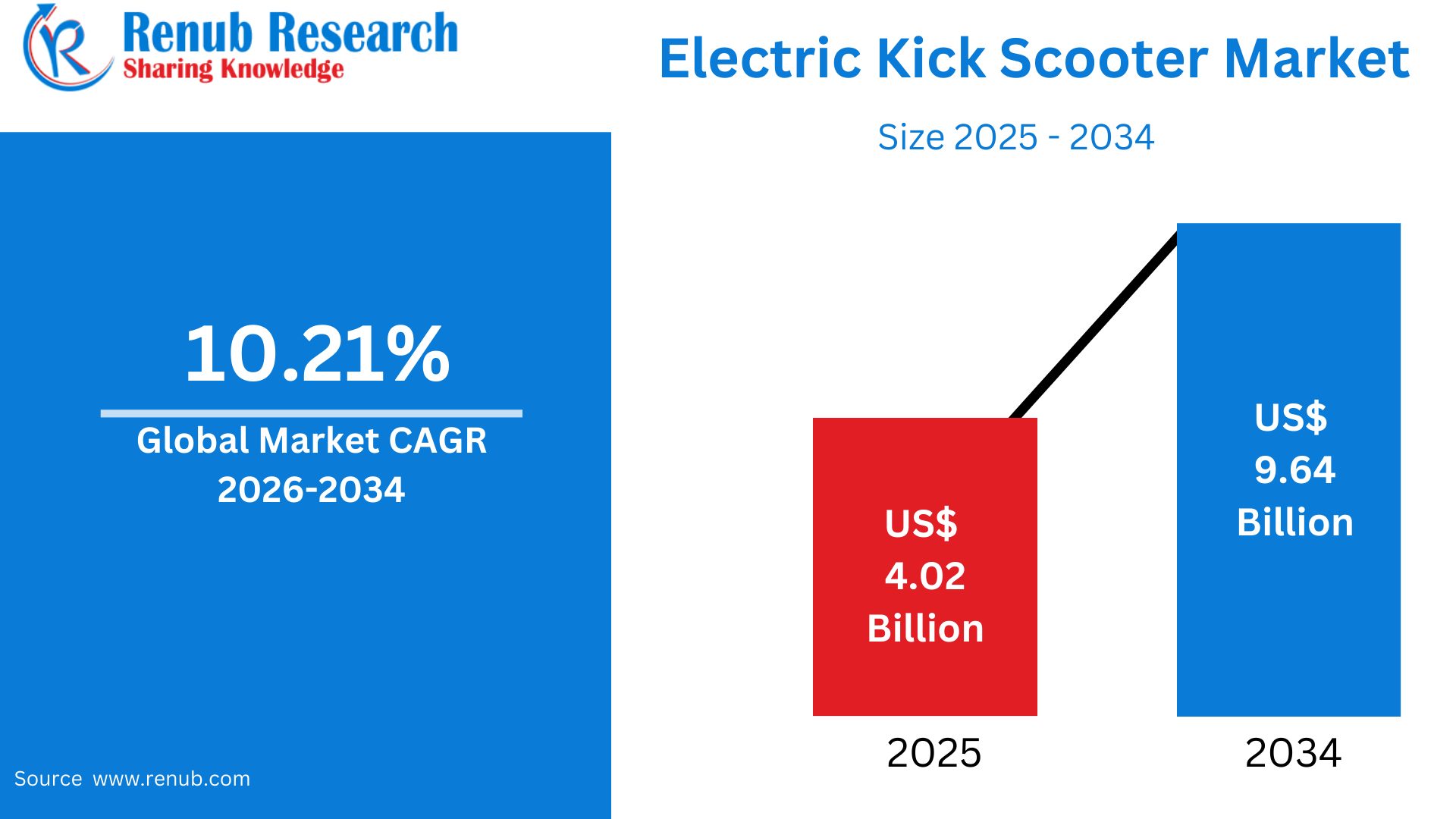
The Electric Kick Scooter Market is on track to exhibit significant growth, the market will witness growth from its initial value of US$ 4.02 Billion in 2025 to reach US$ 9.64 Billion in 2034, registering a CAGR of 10.21% from 2026 to 2034. This can be attributed to factors such as urbanization, increase in micro-mobility usage, government policies, and development of battery technology. The heightened need for environment-friendly transport solutions, shared mobility, and connectivity can also propel the Electric Kick Scooter Market further.
Electric Kick Scooter Market Overview
An electric kick scooter is a light, battery-powered two-wheeled vehicle intended for short-distance transportation. The scooter consists of a standing platform, handlebars for steering, an electric motor embedded in one of the wheels, and a rechargeable lithium-ion battery. The scooter reaches its speed via throttle, and the braking system was designed to be non-challenging and safe. These scooters are foldable and low-maintenance.
With the ever-increasing levels of traffic congestion, surging fuel prices, and increased awareness related to environmental sustainability, electric kick scooters have been in high demand on account of their affordability, eco-friendly features, and ease of use. Since electric scooters provide an affordable last-mile connectivity solution, many cities in North America, Europe, and the Asia-Pacific region have already accepted the usage of electric scooters. The concept of shared mobility services has further improved the adoption of electric scooters, which can be easily availed through mobile applications for short distances. Favorable governmental regulations, improvements in battery life, and enhanced safety features have made electric kick scooters more dependable and accessible. Owing to these factors, electric kick scooters have been increasingly accepted globally owing to their affordability, eco-friendly features, and ease of use.
Growth Driver of the Electric Kick Scooter Market
Rising Urbanization and Traffic Congestion
Over half of the population of the world, i.e., over 4 billion people, reside in urban areas. This trend is further likely to be sustained, and it is anticipated that the population living in urban areas will increase by more than double by 2050. At this time, almost 7 out of 10 people will be living in urban areas. The rapid urbanization of both developed and developing countries has resulted in a manifold increase in traffic congestion, travel time, and the burden faced by public transportation. With the world becoming more and more urbanized, consumers need alternative and convenient mobility options, like electric kick scooters, which can easily commute through the highly congested streets of the world. With the trend of urbanization, parking space constraints, and the enhancement of restrictions imposed on the usage of personal vehicles, electric kick scooters have become a promising option for consumers to minimize the usage of personal vehicles. With the electric kick scooters capable of beating traffic congestion, this alternative mode of transportation has become more popular with consumers for their daily commute to work, studying, and other gigs.
Increasing Demand for Eco-Friendly Transportation
Due to a growing awareness of climate changes, pollution, and carbon emissions, a rapid shift is taking place toward eco-friendly transportation solutions. Electric kick scooters, being a pollution-free mode of transportation, require less energy compared to other transportation vehicles fueled by fuels. Governments and administrations have been promoting the usage of eco-friendly transportation solutions through the offer of various incentives and subsidies, such as the development of bike and scooter lanes. People are becoming more socially responsible toward environmental issues, showing a high affinity toward eco-friendly products and transportation solutions that support sustainability. The electric kick scooters align well with this cause, and using them for transportation can help mitigate traffic pollution, ensuring a smart city initiative, owing to their growing popularity worldwide. The KQi Air X, weighing just 25.8 pounds with a 100 percent carbon fiber body, and the KQi Air, weighing 26.2 pounds with a carbon fiber (70 percent) and magnesium (30 percent) body, offer a top speed of 20 mph, going for a distance of 31 miles, and a maximum power of 700 watts. These lightweight scooters offer not only a fun but an efficient ride for a city commute, going uphill with a 20 percent gradient, or exploring the surroundings.
Expansion of Shared Mobility and Technological Advancements
The proliferation of shared mobility service platforms has contributed significantly to the popularity of electric kick scooters. In this mode of transportation, people can use the scooters immediately without the need for purchasing or any cost with the help of shared mobility service platforms. Technology has also contributed significantly towards popularizing electric kick scooters. Today, the batteries used in kick scooters are efficient for longer periods due to improvements in technology. Also, safety features are excellent. The light weight of the scooters makes them portable. In addition, the usage of GPS, IoT, and mobile app solutions has enabled the real-time tracking of the scooters. Aug 2025. Currently ranked No. 1 in the world for Electric Kick-Scooter (eKickScooter) sales with over 13 million sold globally, the American technology firm, Segway today announces the availability of the GT3 Pro SuperScooter – the fastest GT3 eKickscooter released by the company thus far, at store.segway.com in Canada.
Challenges of the Electric Kick Scooter Market
Safety Concerns and Accident Risks
Safety is one of the major concerns for the electric kick scooter market. It mainly occurs in urban areas where the population is dense in nature. Due to the high usage of these products and lack of experience among users, accidents happen frequently. Issues like helmets, speeding, usage of sidewalks, and road conditions increase the possibilities of accidents with people or automobiles. Lack of infrastructure like lanes meant for these scooters is another major factor affecting safety. The image of the product is also affected by accidents that take place during usage.
Regulatory Uncertainty and Infrastructure Limitations
One of the major challenges affecting the electric kick scooter business is the level of inconsistency of regulations in various geographic regions. In various cities across the world, different regulations govern the speed of the scooter, parking of the scooter, as well as the area of utilization of the scooter. This level of inconsistency of regulations makes it difficult for electric kick scooter businesses. At the same time, the lack of charging mechanisms for the electric kick scooters as well as the nature of the road infrastructure in cities presents a challenge for the usage of the electric kick scooters. In most cities across the world, it has been realized that the land utilized by the electric kick scooters is also used by pedestrians as well as cyclists.
Lithium-Ion Battery Electric Kick Scooter Market
The lithium-ion battery electric kick scooter market is the dominant and growing market within the industry. This is because the lithium-ion battery is considered the best battery for use in electric kick scooters over other options. The reasons for its preference over other batteries are that the lithium-ion battery has high energy density and weighs less than the other batteries. Additionally, the battery lasts for an extended period and charges fast. The lithium-ion battery has the capability to travel long distances and accelerate fast. With its long lifespan and quick charging capabilities, the lithium-ion battery is comfortable for the rider. The lithium-ion battery has the capability to be recharged and used repeatedly without any reduction in its capabilities. This capability makes the lithium-ion battery the best battery for an electric kick scooter. However, the lithium-ion battery is costing less today as battery management system technology continues to advance.
Electric Kick Scooter Belt Drive Market
The belt drive electric kick scooter market is seeing growing acceptance on account of its smooth functionality, ease of maintenance, and noise-free performance. Compared to chain-driven scooters, belt drives do not require any lubrication and last longer, making them perfect for deployment in the urban mobility segment. Belt drive scooters assure effective power transmission at minimal vibration, hence providing more comfortable rides. Besides, belt drives are cleaner and lighter, fitting consumer preferences for easy-to-maintain and 'greener' vehicles. In the case of commercial mobility, belt drives reduce maintenance costs and enhance efficiency. While manufacturers remain engaged in improving the riding experience and bringing down the cost of ownership, belt drive electric kick scooters are gaining acceptance in both personal and commercial markets.
36V Electric Kick Scooter Market
The 36V Electric Kick Scooter market is in a good place as it maintains the balance between power, cost, and power efficiency. The power required for 36V Electric Kick Scooters is sufficient for daily commutes, speed, and the range without adding significant cost and weight to the overall cost of the products. Also, the range of 36V is the best range for electric kick scooters used for riding in the city. Easy availability of 36V batteries has helped the market for 36V Electric Kick Scooters as it made it easy to manufacture these products. These Electric Kick Scooters are used mainly by students, office-going people, and new customers due to easier handling.
Personal Electric Kick Scooter Market
The demand for personal electric kick scooters is driven by the rising need for convenient personal transportation. With the rise of personal electric kick scooters, people have turned to personal scooters as an alternative to traditional transportation to avoid traffic jams. In addition, personal electric kick scooters provide a cost-saving and convenient means to travel while maintaining flexibility. Personal electric kick scooters make great choices for daily riding and errand operations. Personal electric kick scooters offer numerous advantages in terms of the convenience and storage of these vehicles. Given the rising flexibility of the work-from-home lifestyle, personal electric kick scooters are being used as future transportation.
Rental Electric Kick Scooter Market
The market for rental electric kick scooter has observed tremendous growth with the advent of shared mobility platforms in key cities worldwide. The rental electric kick scooter is an attractive transportation option for users, thereby eliminating the need for ownership. The rental electric kick scooter offers better user experience through app usage, cashless payment, and GPS tracking, among others. The support from the government for shared mobility, along with reduced carbon emissions, acts as a driver for the growing demand for rental electric kick scooter. Moreover, there is awareness of electric kick scooters through the product itself, as users get to use it. Despite a few challenges, investments are still being made for such products.
United States Electric Kick Scooter Market
The United States electric kick scooter market is one of the most advanced and fast-evolving markets across the globe. The major cities in the United States have accepted electric kick scooters as an efficient way of connecting the last mile, commuting daily, and using it for short-distance journeys. The high degree of consumer awareness in the United States contributes to the advancement and development of the market. The rising cost of fuel and growing concerns over the environment add to the growing vehicle market. The growing number of shared mobility options has greatly increased the usage and acceptance of electric kick scooters, especially among the working class and students who are young. Technology advancements, such as the emergence of quality batteries and connectivity options, make electric kick scooters an appealing option for consumers. People in the United States value convenience and time-saving, which is achieved by using electric kick scooters in highly congested areas. In September of 2024, Niu Technologies has launched two new electric kick scooters from its KQi 100 series range, targeting the 2024 holiday season. These products will now reach the national audience through retailers like Walmart, Best Buy, and Kohl’s—an effort to increase penetration by ensuring affordable, high-quality, and cutting-edge products.
United Kingdom Electric Kick Scooter Market
The market is steadily increasing due to the broadening interest in eco-friendly transport and congestion in the urban area, which has pressed the button for a search for more convenient and space-efficient means of transportation. Travels with electric kick scooters can cut both travel time and emissions, and their popularity is growing because of this fact. Awareness of climate change targets and demand for low-carbon transport solutions urge people to go in for EKS - both private and rentals, especially in urban areas and college towns. Improved safety features, design, and battery technology increase customer confidence. As urban infrastructure design includes micro-mobility infrastructure, electric kick scooters become an increasingly viable and attractive transport solution for daily commutes across the UK. Micro Mobility Systems AG showed a concept for a moto-scooter, electric kick-scooters, and a new design for its production version of Microlino city electric car in July 2023. Due to its rechargeable battery, the E-kick scooter reaches the maximum distance of 25 km at a speed of up to 1000 km. This particular model will be priced at approximately $1,150 USD, according to the company.
India Electric Kick Scooter Market
The India Electric Kick Scooter Market is growing at a faster pace compared to other mobility solutions due to factors like increasing urban populations, rising levels of traffic congestion, and demands for affordable mobility solutions. Electric kick scooters are being increasingly adopted by students or young working professionals seeking affordable and efficient mobility solutions for daily purposes like daily commuting or traveling short distances. There is significant focus on electric mobility and minimizing dependence on fossil fuels, which is further propelling the India electric kick scooter market. Electric kick scooters are also portable and offer affordable solutions for mobility in cities like India that have high population densities. In addition to personal electric kick scooters, shared mobility solutions are also being increasingly adopted for users looking for alternatives to public conventional modes of transportation like bicycles. In Sep 2024, EMotorad, a brand operating in the e-cycle micro-mobility business, has announced that it has tied up with Booz Mobility, an electric kick scooter sharing firm based out of Ahmedabad, India, to provide electric kick scooters for Booz's fleets. This is the first OEM and micro-mobility operator partnership in India.
Saudi Arabia Electric Kick Scooter Market
The electric kick scooters market in Saudi Arabia can be classified as a developing market. The major factor to support this is the development of smart cities and changes in lifestyle and modernization. The rapid development of smart cities and entertainment zones provides electric kick scooters new growth platforms. In addition, the rise of electric kick scooters in residential areas, business zones, and tourism zones for short-range travel is adding to the growth potential. Furthermore, the rise of the youth population and the interest in new-generation transportation solutions have contributed to the growth potential of electric kick scooters. In addition, the development and growth of initiatives to create diversified transport solutions without any adverse environmental consequences also boost the growth and adoption of electric kick scooters. Although it is in a developing phase, the electric kick scooters market is looking to get integrated into the vision for efficient transportation solutions in the country.
Market Segmentation
Battery Type
- Lead Acid
- Lithium ion(Li-ion)
- Others
Drive Type
- Belt Drive
- Chain Drive
- Hub Drive
Voltage
- Below 24V
- 36V, 48V
- Greater than 48 V
Application
- Personal
- Rental
Regional Analysis
North America
- United States
- Canada
Europe
- France
- Germany
- Italy
- Spain
- United Kingdom
- Belgium
- Netherlands
- Turkey
Asia Pacific
- China
- Japan
- India
- South Korea
- Thailand
- Malaysia
- Indonesia
- Australia
- New Zealand
Latin America
- Brazil
- Mexico
- Argentina
Middle East & Africa
- Saudi Arabia
- United Arab Emirates
- South Africa
All companies have been covered with 5 Viewpoints
- Overviews
- Key Person
- Recent Developments
- SWOT Analysis
- Revenue Analysis
Competitive Landscape
- Jiangsu Xinri E-Vehicle Co. Ltd.
- Enphase Energy, Inc.
- YADEA Technology Group Co., Ltd.
- NIU International
- Bird Rides, Inc.
- SWAGTRON
- Segway Unc.
- Xiaomi
Report Details:
| Report Features | Details |
| Base Year |
2025 |
| Historical Period |
2022 - 2025 |
| Forecast Period |
2026 - 2034 |
| Market |
US$ Billion |
| Segment Covered |
Battery, Drive, Voltage, Application, and Countries |
| Countries Covered |
|
| Companies Covered |
|
| Customization Scope |
20% Free Customization |
| Post-Sale Analyst Support |
1 Year (52 Weeks) |
| Delivery Format |
PDF and Excel through Email (We can also provide the editable version of the report in PPT/Word format on request) |
Customization Services available
- Analysis of Market Size and Its Segments
- More Company Profiles (Upto 10 without any additional cost):
- Additional Countries (Other than mentioned Countries):
- Region/Country Specific Reports:
- Market Entry Strategy:
- Region-Specific Market Dynamics:
- Regional Market Share Analysis:
- Trade Analysis:
- Production Insights:
- Others Customized Requests:
For more information contact our analysts.
Need More Assistance?
- Talk to our analysts to get more precious information on the current market trends.
- Include more countries and segments and customize the report based on the final requirement.
- Get a competitive advantage in your industry by knowing the report findings and making a positive impact on your revenues and operations.
- Our analysts are always ready to provide more help and pertinent information if you need any additional assistance.