Global Electric Scooter Market Report by Voltage, Product, Battery Type, End Use, Countries and Company Analysis 2026-2034
Buy NowElectric Scooter Market Size and Forecast 2026-2034
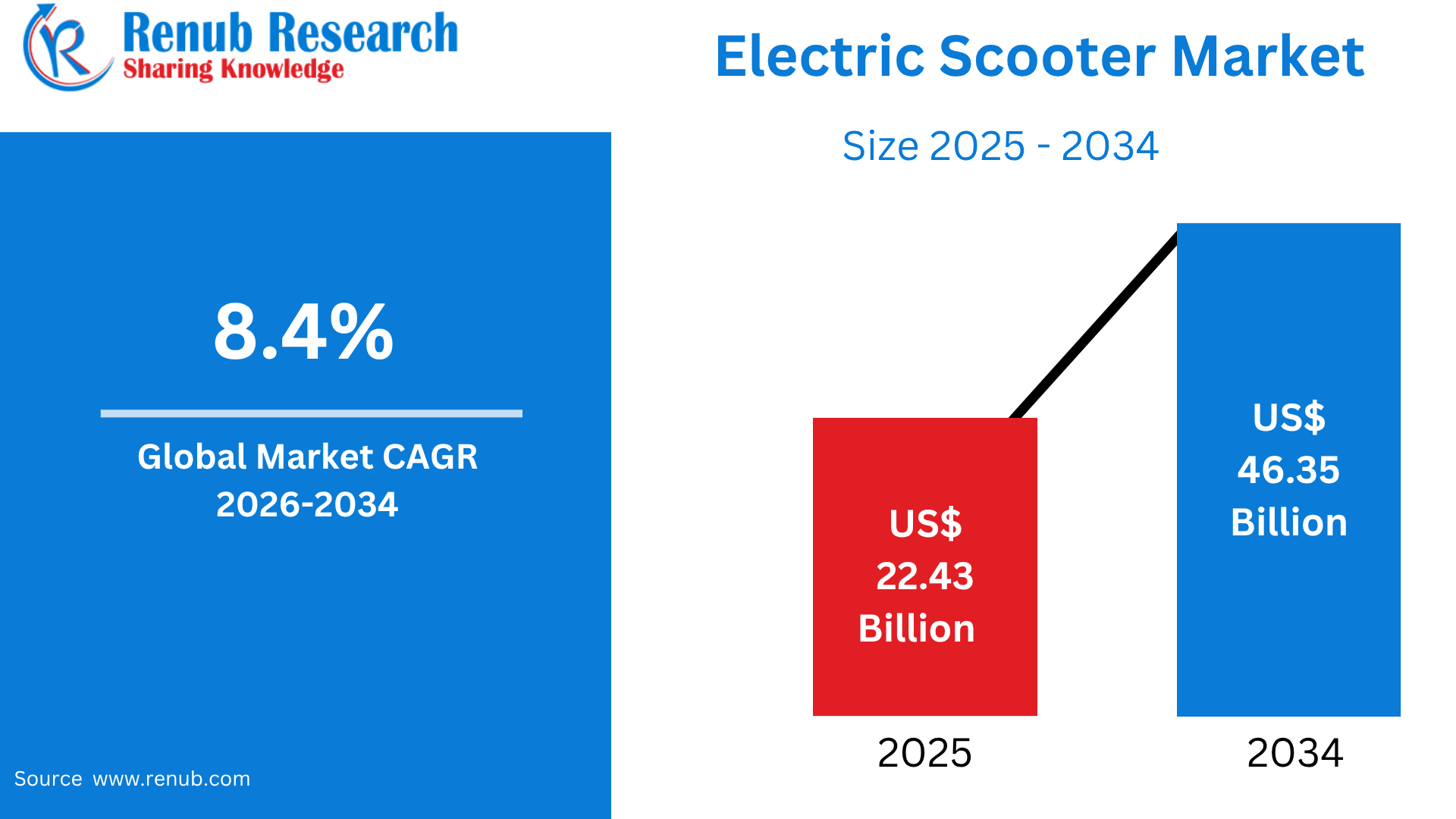
Electric Scooter Market is expected to reach US$ 46.35 billion by 2034 from US$ 22.43 billion in 2025, with a CAGR of 8.4% from 2026 to 2034. Growing urban congestion, rising fuel costs, supportive government policies, and expanding charging ecosystems are accelerating electric scooter adoption. Advances in battery technology, affordable pricing, and eco-conscious consumer behavior further strengthen market growth worldwide.
Electric Scooter Industry Overview
Electric scooters are two-wheeled vehicles powered by rechargeable batteries rather than internal-combustion engines. Designed for short and medium urban commutes, they offer a quiet, efficient, and low-emission transportation alternative. Most models use lithium-ion or emerging battery chemistries to deliver improved range, faster charging, and lower operating costs. Electric scooters appeal to riders seeking economical mobility solutions, especially in dense cities where fuel prices, pollution, and traffic congestion pose daily challenges. With smart connectivity, regenerative braking, and lightweight designs becoming more common, electric scooters continue to evolve into reliable, sustainable mobility options supported by expanding charging and battery-swap infrastructure.
The electric scooter market is expanding due to growing demand for clean, low-cost transportation solutions in rapidly urbanizing regions. Governments worldwide are promoting electrified mobility through incentives, charging infrastructure investments, and emissions regulations. Advances in battery technology—ranging from higher energy density to lower maintenance requirements—enhance performance and affordability. Consumers increasingly favor electric scooters for daily commutes due to reduced running costs and environmentally friendly operation. Major manufacturers are introducing feature-rich, competitively priced models to target mass-market adoption. Together, these factors are accelerating electric scooter penetration across emerging economies and developed markets alike.
Growth Drivers for the Electric Scooter Market
Affordability and Mass-Market Accessibility
Affordability remains one of the strongest growth drivers for the electric scooter industry, particularly in price-sensitive markets where consumers seek economical alternatives to rising fuel expenses. Manufacturers are prioritizing low-cost models without compromising on essential features, enabling broader adoption across urban and semi-urban populations. A notable development occurred in August 2025 when Zelo Electric introduced the Knight+, an attractively priced electric scooter at ₹59,990. This launch highlights the increasing emphasis on cost-effective EV options designed for everyday commuters. As more companies adopt similar pricing strategies, electric scooters are becoming increasingly competitive with traditional petrol-powered vehicles. Combined with lower maintenance costs and charging expenses, this affordability trend is expected to accelerate large-scale market penetration, especially in developing regions where budget-friendly mobility solutions are in high demand.
Premium Features and Controlled High-Demand Launches
A second key market driver is the rise of premium electric scooters offering advanced features, stronger performance, and modern design aesthetics. Manufacturers are launching higher-end models with improved acceleration, smartphone connectivity, enhanced safety systems, and long-range capabilities. This approach appeals to consumers seeking performance-oriented or lifestyle-focused mobility. An example is the July 2025 launch of the Kinetic DX electric scooter by Kinetic EV, priced at ₹1.11 lakh and ₹1.17 lakh (ex-showroom). Bookings were capped at 35,000 units through the official website, with deliveries scheduled from September 2025. Such controlled, high-demand launches help create premium brand positioning while showcasing the industry’s move toward technologically advanced offerings. As these premium models gain popularity, they elevate consumer expectations and encourage further innovation across the electric scooter sector.
Battery Innovation and Sustainable Technology Adoption
Technological advancements—especially in battery chemistry—represent a major growth driver for the global electric scooter industry. Countries and manufacturers are exploring alternatives to lithium-ion batteries to reduce costs, minimize supply-chain risks, and improve sustainability. In June 2025, China announced a major push toward sodium-ion battery adoption in electric scooters. Leading manufacturer Yadea launched multiple sodium-ion-powered models and began rapidly expanding supporting infrastructure, including thousands of planned fast-charging and battery-swap stations. Analysts expect sodium-ion technology to gain significant market share due to lower material costs and strong environmental benefits. Although lithium-ion remains dominant, these innovations are expanding consumer choice, reducing price barriers, and strengthening long-term market sustainability. Battery diversification ultimately enhances performance reliability and accelerates global electric scooter adoption.
Challenges in the Electric Scooter Market
Limited Charging Infrastructure in Emerging Markets
Dairy alternatives often incur higher production costs due to specialized ingredient sourcing, protein fortification, and advanced processing requirements. Nuts, grains, and legumes can fluctuate in price, while maintaining consistent product quality demands precise manufacturing techniques. These factors elevate retail prices, limiting adoption in cost-sensitive regions. Although scaling production can reduce costs, many brands still struggle to match the affordability of traditional dairy. Economic constraints may slow market penetration, particularly in emerging markets where consumers prioritize price over dietary variety. Addressing this challenge requires supply-chain efficiency, improved ingredient availability, and ongoing technological innovation.
Battery Degradation and Replacement Costs
Battery performance concerns remain a key obstacle for consumers evaluating electric scooters. Over time, batteries naturally degrade, reducing range and requiring expensive replacements. Although technology is improving, long-term reliability varies across brands and chemistries. High battery replacement costs often represent a substantial portion of the scooter’s upfront price, causing hesitation among buyers. Temperature variations, frequent fast charging, and heavy usage further accelerate battery wear. In addition, recycling and disposal systems for end-of-life batteries are still developing in many regions, raising environmental and logistical concerns. Until battery life improves and replacement costs decrease, this challenge will continue to impact large-scale adoption.
United States Electric Scooter Market
The electric scooter market in the United States is expanding rapidly due to rising interest in micromobility, congestion reduction, and sustainable transport. Urban areas are witnessing strong adoption of both personal e-scooters and shared mobility fleets. Federal and state incentives, investments in EV infrastructure, and growing environmental awareness support continued growth. Advanced battery technologies, smart connectivity, and integration with mobility-as-a-service platforms further enhance appeal. However, regulatory variations across states and the need for improved charging networks pose challenges. Despite this, demand for compact, energy-efficient transport solutions positions the United States as a strong growth market.
Germany Electric Scooter Market
Germany is strengthening its electric scooter market through ambitious climate policies, expanding EV infrastructure, and strong consumer interest in eco-friendly mobility. The country’s well-developed urban transport planning supports integration of electric scooters for last-mile travel. German consumers increasingly seek high-quality, durable models with advanced safety standards. Government incentives, emission reduction targets, and rising fuel prices further motivate electric scooter adoption. However, strict regulations, ongoing debates around shared scooter safety, and competition with well-established public transport remain challenges. Even so, Germany’s commitment to sustainable mobility continues to reinforce its position as a key European market for electric scooters.
China Electric Scooter Market
China dominates the global electric scooter market due to strong manufacturing capacity, rapid urbanization, and deep government support for electrified mobility. Extensive charging and battery-swap networks make electric scooters highly practical for daily commutes. Leading domestic brands innovate aggressively with battery technologies—including sodium-ion and next-generation lithium solutions—offering affordable, high-range models. Urban consumers favor electric scooters for convenience, low operating costs, and regulatory support that prioritizes EVs over gasoline two-wheelers. While rural regions still face infrastructure gaps, nationwide adoption is accelerating. China’s emphasis on clean transportation ensures it will remain the world’s largest and most influential electric scooter market.
Saudi Arabia Electric Scooter Market
In Saudi Arabia, the electric scooter market is emerging in response to national efforts to diversify transportation and support sustainability goals under Vision 2030. Urban centers such as Riyadh and Jeddah are seeing rising interest in micromobility for short-distance travel. Growing environmental awareness, supportive policies, and increasing availability of electric mobility solutions are fueling adoption. Retailers and mobility operators are beginning to introduce electric scooters, while improved charging infrastructure enhances feasibility. Cultural familiarity with car-centric mobility and high temperatures remain challenges, but interest among younger populations and expatriates is driving steady market growth.
Recent Developments in Electric Scooter Market
- December 2023: Taiwan-based battery-swapping pioneer Gogoro expanded its network to Delhi and Goa and introduced the India-built CrossOver GX250 electric scooter. The company is also collaborating with Hero MotoCorp to jointly develop electric vehicles and large-scale swapping infrastructure in the country.
- December 2023: Pune-headquartered EV manufacturer Kinetic Green rolled out the Zulu high-speed electric scooter, offering customers a battery subscription option designed to reduce upfront ownership costs by more than one-third while lowering long-term operating expenses.
- October 2023: Indian automaker LML secured land in Haryana for its upcoming EV-focused industrial park dedicated to e-scooter production. Supported by a strategic collaboration with Saera Electric Auto, the initiative aims to scale next-generation electric two-wheeler manufacturing through an integrated technology-driven ecosystem.
- `August 2023: Andhra Pradesh-based e-scooter maker Avera AI Mobility Pvt. Ltd. announced a USD 1-billion expansion plan to boost its annual production capacity from 25,000 to 100,000 units. The company aims to supply emerging international markets including Australia, Vietnam, and Sri Lanka, with further geographic growth expected.
Electric Scooter Market Segments
Voltage
- 24 V
- 36 V
- 48 V
- Greater than 48 V
Product
- Folding
- Standing/Self-Balancing
- Retro
Battery Type
- Li-ion
- Lead Acid
- Others
End Use
- Personal
- Commercial
Countries
North America
- United States
- Canada
Europe
- France
- Germany
- Italy
- Spain
- United Kingdom
- Belgium
- Netherlands
- Turkey
Asia Pacific
- China
- Japan
- India
- Australia
- South Korea
- Thailand
- Malaysia
- Indonesia
- New Zealand
Latin America
- Brazil
- Mexico
- Argentina
Middle East & Africa
- South Africa
- Saudi Arabia
- United Arab Emirates
All companies have been covered with 5 Viewpoints
- Overviews
- Key Person
- Recent Developments
- SWOT Analysis
- Revenue Analysis
Company Analysis:
- Yadea Technology Group Co. Ltd
- Niu Technologies
- Mahendra
- Vmoto Limited
- Amper Vehicles
- BMW Motorrad International
- Gogoro Inc.
- Govecs Group
- Hero Electric
- Zhejiang Luyuan Electric Vehicle Co Ltd
Report Details:
| Report Features | Details |
| Base Year |
2025 |
| Historical Period |
2022 - 2025 |
| Forecast Period |
2026 - 2034 |
| Market |
US$ Billion |
| Segment Covered |
Voltage, Product, Battery Type, End Use and Countries |
| Countries Covered |
|
| Companies Covered |
1. Yadea Technology Group Co. Ltd |
| Customization Scope |
20% Free Customization |
| Post-Sale Analyst Support |
1 Year (52 Weeks) |
| Delivery Format |
PDF and Excel through Email (We can also provide the editable version of the report in PPT/Word format on request) |
Customization Services available
- Analysis of Market Size and Its Segments
- More Company Profiles (Upto 10 without any additional cost):
- Additional Countries (Other than mentioned Countries):
- Region/Country Specific Reports:
- Market Entry Strategy:
- Region-Specific Market Dynamics:
- Regional Market Share Analysis:
- Trade Analysis:
- Production Insights:
- Others Customized Requests:
For more information contact our analysts.
Need More Assistance?
- Talk to our analysts to get more precious information on the current market trends.
- Include more countries and segments and customize the report based on the final requirement.
- Get a competitive advantage in your industry by knowing the report findings and making a positive impact on your revenues and operations.
- Our analysts are always ready to provide more help and pertinent information if you need any additional assistance.