Automotive Lighting Market Size, Share, Trends & Forecast by Vehicle Type, Application, Technology, Sales Channel and Country, 2026–2034
Buy NowAutomotive Lighting Market Size and Forecast
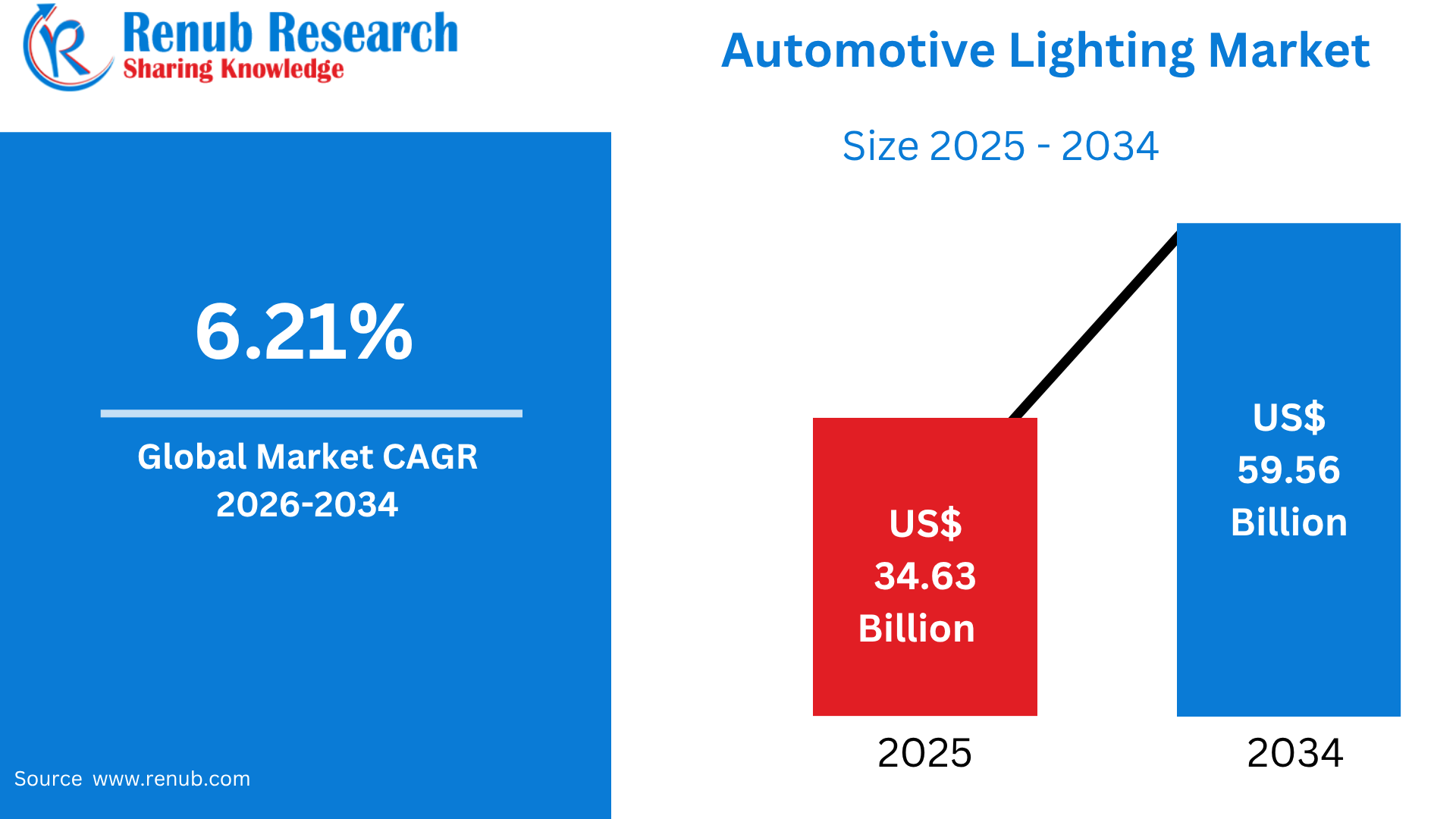
The global automotive lighting market is projected to expand significantly, increasing from US$ 34.63 billion in 2025 to US$ 59.56 billion by 2034, representing a CAGR of 6.21% during 2026–2034. Market expansion is being supported by increasing global vehicle production, growing adoption of LED and advanced lighting technologies, and rising demand for safer and more energy-efficient vehicle components. LED lighting is gradually replacing conventional halogen systems because of its longer operating life, lower energy consumption, compact design, and greater flexibility in styling.
What is Automotive Lighting and Its Uses & Popularity Worldwide?
Automotive lighting refers to the lighting systems installed in vehicles to provide illumination, improve visibility, communicate driving intentions, and enhance safety. These systems include headlamps, tail lamps, daytime running lights (DRLs), fog lamps, turn indicators, brake lights, interior lights, and adaptive lighting systems. Modern automotive lighting increasingly uses LED, OLED, laser, and intelligent lighting technologies because they offer improved energy efficiency, longer service life, compact designs, and greater flexibility compared with conventional halogen lamps.
Automotive lighting plays an important role in nighttime driving, adverse weather conditions, road visibility, signaling, parking, and driver assistance. Advanced systems such as adaptive headlights can automatically adjust light distribution according to vehicle speed, steering direction, traffic, and road conditions. According to the International Organization of Motor Vehicle Manufacturers (OICA), global vehicle production exceeded 92 million units in 2024, creating a substantial installed base and replacement opportunity for automotive lighting systems.
Worldwide popularity is increasing as automakers integrate sophisticated lighting into electric, connected, premium, and autonomous vehicles, while consumers increasingly value both vehicle safety and distinctive exterior styling.
Growth Drivers of the Automotive Lighting Market
Rising Vehicle Production and Increasing Adoption of Advanced Lighting
The expansion of global vehicle production is creating a larger addressable market for automotive lighting systems, as every newly manufactured vehicle requires exterior and interior lighting components. Beyond conventional headlamps and tail lamps, automakers are increasingly integrating LED, matrix LED, adaptive lighting, daytime running lights, and intelligent illumination systems to improve safety, efficiency, and vehicle design. LED technology is particularly attractive because it offers longer operating life, lower energy consumption, compact packaging, and greater design flexibility. The continued electrification of transportation is also strengthening demand for energy-efficient lighting technologies. Global electric car sales exceeded 17 million units in 2024, representing more than 20% of worldwide car sales, according to the International Energy Agency (IEA). The growing production of EVs provides lighting manufacturers with opportunities to supply lightweight and low-power systems while supporting distinctive vehicle designs. Increasing vehicle production in emerging economies, combined with premiumization in developed markets, is expected to sustain demand for technologically advanced automotive lighting.
Growing Focus on Vehicle Safety and Adaptive Lighting Technologies
Increasing emphasis on road safety, nighttime visibility, pedestrian protection, and driver assistance is accelerating adoption of sophisticated automotive lighting systems. Conventional lighting is increasingly being supplemented by adaptive technologies that automatically modify illumination according to road conditions, vehicle position, traffic, and surrounding objects. Adaptive Driving Beam (ADB) technology, for example, can reduce illumination toward occupied areas while maintaining stronger illumination elsewhere on the road. In the United States, the National Highway Traffic Safety Administration (NHTSA) issued a final rule in February 2022 permitting adaptive driving beam headlights on new vehicles and established performance requirements for the technology. NHTSA also identifies automatic high beams as a driver-assistance technology that switches between low and high beams according to lighting conditions and approaching traffic. These regulatory developments are encouraging automakers to incorporate advanced lighting as part of broader vehicle-safety strategies. As governments strengthen vehicle safety requirements and consumers become more aware of nighttime driving risks, demand for adaptive headlights, automatic beam control, intelligent signaling, and improved visibility systems is expected to increase.
Electrification, Connectivity, and Intelligent Vehicle Technologies
The rapid development of electric, connected, and increasingly automated vehicles is creating new applications for automotive lighting beyond basic illumination. Electric vehicles place greater emphasis on energy efficiency, making low-power LED and other solid-state lighting technologies attractive for minimizing electrical consumption. At the same time, connected vehicles are enabling lighting systems to interact with cameras, sensors, electronic control units, and advanced driver-assistance systems. Global EV sales exceeded 17 million units in 2024, growing by more than 25% year over year and accounting for over one-fifth of global car sales, demonstrating the rapid transition toward electrified transportation. Advanced lighting can support this transition through adaptive illumination, dynamic turn signals, intelligent brake lights, and exterior communication functions. NHTSA’s documentation on adaptive driving beams describes systems combining sensors, image processing, electronic control units, and lighting electronics, illustrating how automotive lighting is becoming integrated with vehicle electronics. Furthermore, OLED and matrix LED technologies allow manufacturers to create distinctive lighting signatures and dynamic displays. These developments are expanding automotive lighting from a conventional component into an intelligent vehicle technology.
Challenges of the Automotive Lighting Market
High Cost and Technical Complexity of Advanced Lighting Systems
The increasing sophistication of automotive lighting systems is creating challenges related to development costs, component complexity, calibration, and vehicle integration. Advanced matrix LED, adaptive driving beam, OLED, and laser-based systems require more sophisticated electronics, sensors, software, thermal management, and control units than conventional lighting technologies. NHTSA’s description of current adaptive driving beam systems illustrates this complexity: such systems can require cameras and image-processing units, electronic control units, control interfaces, and specialized headlamp components. These additional components increase research and development expenses as well as manufacturing and validation requirements. Premium lighting technologies can therefore remain concentrated in higher-end vehicles before gradually moving into mass-market models. Automakers must also ensure that lighting systems comply with detailed photometric and safety requirements across different markets. In the United States, FMVSS No. 108 establishes requirements for lamps, reflective devices, and associated equipment. Manufacturers consequently face substantial testing and compliance costs when introducing new technologies. Balancing advanced functionality with affordability is therefore a key challenge, particularly in price-sensitive vehicle segments and emerging markets.
Regulatory Differences and Supply-Chain Vulnerabilities
Automotive lighting manufacturers operate across multiple markets with different technical standards, certification requirements, vehicle architectures, and regulatory frameworks, making global product development more complicated. Lighting systems must meet specific requirements governing beam patterns, brightness, signaling, glare, positioning, and safety. For example, NHTSA’s FMVSS No. 108 specifies detailed requirements for vehicle lamps and reflective devices in the United States. Meanwhile, international markets can apply different regulatory frameworks, requiring manufacturers to modify or certify products for specific regions. Supply-chain dependence is another challenge because advanced lighting systems rely on LEDs, semiconductor components, sensors, electronic control units, optics, and specialized materials. Disruptions in any of these components can affect production schedules and increase costs. The rapid transition toward intelligent lighting further increases dependence on electronic components and software. At the same time, automotive manufacturers are under pressure to reduce costs while maintaining high reliability and safety standards. Consequently, lighting suppliers must develop resilient sourcing strategies, maintain multiple suppliers where possible, and invest in localized production and testing capabilities. These factors can increase operating complexity and influence profit margins across the automotive lighting value chain.
Automotive Lighting Product Launches Worldwide
- FORVIA HELLA SlimLine LED Combination Lamp – 2025: FORVIA HELLA expanded its SlimLine portfolio with a new LED combination lamp for commercial vehicles. The product integrates daytime running light, position light, and direction indicator functions into one compact rectangular module.
- FORVIA HELLA LED Matrix Headlamp for smart #5 – 2025: FORVIA HELLA developed a customized LED Matrix headlamp for the smart #5, combining intelligent lighting functions with distinctive vehicle styling. The system entered series production in September 2025.
- OSRAM XLS LR6 Automotive LED – 2025: ams OSRAM introduced the XLS LR6 red LED light source for automotive rear lighting and signal lamps. The compact plug-and-play solution was developed for series production and received an initial commitment from a U.S. automaker.
- OSRAM NIGHT BREAKER LED C5W ECE – 2025: ams OSRAM launched the NIGHT BREAKER LED C5W ECE, described as its first ECE R37-approved LED signal lamp for 12V vehicles, alongside new road-legal SMART retrofit models for HB3, H9, HIR2, and H19 applications.
- OSRAM OSLON Compact RM – 2025: ams OSRAM unveiled the OSLON Compact RM, an automotive LED designed for ultra-slim signature headlamps. Its compact architecture enables optical systems with heights of around 10 mm, supporting thinner headlamp designs.
- FORVIA HELLA FlatLight Daytime Running Light – 2025: FORVIA HELLA launched its FlatLight technology for front daytime-running-light applications. The system has a depth of only 5 mm, is reported to be 40% more energy-efficient and 80% lighter than conventional systems, and supports multi-color designs.
- ORACLE Lighting Lensless LED Headlight – 2025: ORACLE Lighting unveiled what it described as the world’s first lensless LED headlight at the 2025 SEMA Show. The design eliminates the conventional outer lens and uses a modular Bi-LED emitter configuration.
- Huawei XPixel Full-Color Smart Headlight – 2026: Huawei demonstrated an upgraded XPixel smart-headlight system with full RGB projection capabilities. The technology can project images and navigation-related graphics onto nearby surfaces while also providing adaptive lighting functions.
- FORVIA HELLA SlimLine Front Lighting Portfolio Expansion – 2025: The addition of the LED combination lamp expanded the SlimLine family to seven front-lighting functions, including Bi-LED low/high beam and LED fog lighting with cornering functionality, providing a broader modular lighting portfolio for commercial vehicles.
- OSRAM NIGHT BREAKER LED SMART Range Expansion – 2025: Alongside the C5W ECE launch, ams OSRAM introduced four additional SMART retrofit lamp types—HB3, H9, HIR2, and H19, expanding road-legal LED retrofit availability across a wider range of vehicles.
Rising Passenger Vehicle Production and Demand for Advanced Lighting
The passenger automotive lighting market covers lighting systems used in sedans, hatchbacks, SUVs, crossovers, and other passenger vehicles. Key products include headlamps, tail lamps, daytime running lights (DRLs), fog lamps, turn indicators, and interior lighting. Market growth is supported by expanding passenger vehicle production, urbanization, rising disposable incomes, and increasing consumer demand for safer and visually distinctive vehicles. According to the International Organization of Motor Vehicle Manufacturers (OICA), global motor vehicle production reached approximately 92.5 million units in 2024, highlighting the substantial demand base for automotive lighting components. Automakers are increasingly adopting LED, matrix LED, adaptive headlights, and intelligent lighting systems to improve visibility while reducing energy consumption. Lighting has also become an important styling element, with manufacturers using distinctive daytime running lights, illuminated grilles, and customized light signatures to strengthen vehicle identity. Growing regulatory attention toward vehicle safety is further encouraging the adoption of reliable lighting systems. The increasing popularity of SUVs and electric passenger vehicles is creating additional opportunities for innovative lighting designs, while connected and advanced vehicles are encouraging integration between lighting, sensors, and electronic control systems.
Safety Communication and Dynamic Lighting Technologies Drive Rear Automotive Lighting Adoption
The rear automotive lighting market includes tail lamps, brake lights, reverse lights, rear turn indicators, and other lighting components positioned at the back of vehicles. These systems are essential for communicating a vehicle’s movements to following drivers, particularly during braking, reversing, lane changes, and turning. As global vehicle ownership and traffic volumes increase, reliable rear lighting is becoming increasingly important for road safety. OICA data show that global vehicle production reached approximately 92.5 million units in 2024, creating substantial demand for rear lighting components. Manufacturers are increasingly replacing conventional bulbs with LED rear lamps, dynamic turn indicators, and sequential lighting systems because of their rapid response, lower energy consumption, durability, and design flexibility. Rear lighting has also evolved into an important branding feature, with automakers developing distinctive full-width light bars, connected tail lamps, and animated lighting signatures. Regulatory requirements governing visibility, signaling, and lamp performance continue to influence product development. The expansion of electric and premium vehicles is further supporting demand for sophisticated rear lighting systems that combine safety functionality with distinctive styling.
Energy Efficiency and Design Flexibility Accelerate Automotive LED Adoption
The automotive LED lighting market is expanding as vehicle manufacturers increasingly replace conventional lighting technologies with light-emitting diode systems. LEDs offer several advantages, including lower energy consumption, longer operating life, rapid illumination, compact size, and greater design flexibility. These characteristics make LED technology suitable for headlights, daytime running lights, tail lamps, brake lights, indicators, and interior illumination. The growing adoption of electric vehicles is providing another important opportunity because EV manufacturers prioritize energy-efficient components to maximize vehicle efficiency and range. Global electric car sales exceeded 17 million units in 2024, accounting for more than 20% of worldwide car sales, according to the International Energy Agency (IEA). LED systems can also support advanced functions such as adaptive lighting, matrix beam control, dynamic indicators, and customizable interior illumination. Automakers increasingly use sophisticated LED signatures to differentiate vehicle models and strengthen brand identity. In premium vehicles, matrix LED and other advanced solid-state lighting technologies are enabling highly precise control over light distribution. As electrification, vehicle personalization, and safety technologies continue to advance, LED lighting is expected to remain a key technology within the automotive lighting industry.
Low Cost and Easy Replacement Sustain Conventional Technology
The automotive halogen lighting market represents a mature segment of vehicle lighting, particularly for conventional headlights, fog lamps, and replacement applications. Halogen bulbs generate light by passing an electrical current through a tungsten filament inside a bulb containing halogen gas. Their major advantages include low purchase cost, simple design, widespread availability, and relatively easy replacement, making them attractive for entry-level vehicles and price-sensitive consumers. Despite increasing penetration of LED and other advanced technologies, halogen lighting continues to have a substantial installed base because millions of vehicles on the road still use conventional lighting systems. The large global vehicle fleet therefore creates continuing demand for replacement halogen bulbs through automotive aftermarket channels. However, halogen technology faces increasing competition because LEDs generally offer longer operating life, lower energy consumption, faster response, and greater styling flexibility. The International Energy Agency reported that global electric car sales surpassed 17 million units in 2024, highlighting the broader transition toward energy-efficient vehicle technologies. As automakers increasingly standardize LED systems in new models, the halogen segment is expected to face long-term pressure in original-equipment applications, although replacement demand and cost-sensitive markets can continue supporting the segment.
Vehicle Aging, Replacement Demand, and Upgrades Support Market Expansion
The automotive lighting aftermarket market comprises replacement and upgrade products sold after the original vehicle purchase. These include replacement headlights, tail lamps, fog lamps, LED bulbs, indicators, interior lights, and decorative lighting products. Demand is generated by damaged components caused by accidents, normal wear, environmental exposure, maintenance requirements, and vehicle aging. Consumers are also increasingly upgrading conventional halogen systems with LED products to improve illumination, appearance, and energy efficiency, where compatible and legally permitted. The large and expanding global vehicle fleet provides a substantial installed base for aftermarket lighting suppliers. OICA reported global motor vehicle production of approximately 92.5 million units in 2024, adding millions of vehicles to the potential future replacement market. The growing average age of vehicles in many mature markets can further support replacement demand, while rising awareness of road safety encourages motorists to maintain properly functioning headlights, brake lights, and indicators. E-commerce is also transforming the aftermarket by making replacement and upgrade products more accessible to consumers and repair professionals. Meanwhile, manufacturers are introducing brighter LED systems, smart lighting products, and customized decorative solutions, allowing the aftermarket to benefit from both maintenance-driven purchases and vehicle personalization trends.
Technological Innovation and Vehicle Safety Drive USA Market Growth
United States automotive lighting market is supported by the country’s large automotive industry, rapid technological development, and strong emphasis on vehicle safety. Automakers are increasingly incorporating LED headlights, adaptive driving beams, matrix lighting, daytime running lights, and intelligent interior illumination to improve visibility, safety, and vehicle styling. The U.S. market is also benefiting from the growing adoption of electric and premium vehicles, where advanced lighting is frequently used as a design and differentiation feature. According to the International Organization of Motor Vehicle Manufacturers (OICA), the United States produced approximately 10.6 million motor vehicles in 2024, providing a substantial demand base for automotive lighting components. Regulatory developments are further encouraging technological adoption. In 2022, the U.S. National Highway Traffic Safety Administration (NHTSA) finalized regulations allowing adaptive driving beam headlights under specified performance requirements. In January 2026, SMK Electronics Corporation USA announced its Automotive In-Cab Illumination Lamps, featuring RGB or white lighting, single or multiple LEDs, and an optimized lens design for controlling illumination range, angle, and intensity. These developments demonstrate the market’s shift toward intelligent and customizable vehicle illumination.
EV Adoption, Safety Standards, and Energy Efficiency Support UK Expansion
United Kingdom automotive lighting market is being shaped by strong demand for safer, energy-efficient, and technologically advanced vehicle components. Automakers are increasingly adopting LED headlights, adaptive lighting, daytime running lights, and intelligent interior systems to enhance nighttime visibility, reduce energy consumption, and improve vehicle aesthetics. The country’s transition toward electric mobility is creating additional opportunities because EV manufacturers prioritize energy-efficient components and distinctive lighting designs. According to the Society of Motor Manufacturers and Traders (SMMT), UK battery-electric car registrations reached approximately 381,000 units in 2025, accounting for around 23.4% of new car registrations. This expanding EV base is encouraging manufacturers to develop compact, efficient, and digitally controlled lighting solutions. Safety regulations and consumer demand for advanced vehicle features are also supporting market development. Automotive manufacturers and suppliers continue to invest in product development focused on visibility, efficiency, styling, and durability. In June 2025, Auto Electrical Suppliers Limited (AES) launched its AES LED Lighting brand, offering LED lighting solutions developed in response to customer requirements. Increasing electrification, technology adoption, and demand for premium vehicle features are expected to maintain steady growth in the UK’s automotive lighting market.
Expanding Vehicle Production and Electrification Create New Opportunities in India
India automotive lighting market is experiencing strong growth as vehicle production, ownership, urbanization, and consumer demand for advanced vehicle features continue to increase. Automotive manufacturers are progressively integrating LED headlights, daytime running lights, LED tail lamps, adaptive lighting, and other efficient illumination technologies into passenger and commercial vehicles. India’s expanding electric-vehicle ecosystem is providing another important opportunity for lighting suppliers, as manufacturers increasingly prioritize energy efficiency and modern vehicle design. According to OICA, India produced approximately 6.0 million motor vehicles in 2024, making it one of the world’s largest vehicle-producing countries. Government initiatives focused on road safety and vehicle visibility are also encouraging manufacturers to comply with lighting-performance requirements. The growing middle class and increasing consumer preference for technologically advanced vehicles are supporting demand for attractive and efficient lighting systems. In February 2026, Motherson inaugurated a new manufacturing facility in Sanand, Gujarat, focused on advanced exterior automotive lighting systems for passenger vehicles, strengthening India’s capabilities in higher-value lighting components. The combination of large-scale vehicle production, electrification, technological development, and expanding automotive manufacturing is expected to provide significant opportunities for automotive lighting companies in India.
Harsh Weather Conditions and Growing Vehicle Electrification Support Saudi Arabia Demand
Saudi Arabia automotive lighting market is expanding alongside vehicle ownership, infrastructure development, road-safety initiatives, and increasing adoption of advanced vehicle technologies. The country’s desert environment presents specific challenges, including dust, sandstorms, reduced visibility, and extreme temperatures, increasing the importance of reliable and high-performance lighting systems. LED headlights, fog lamps, daytime running lights, and advanced rear lighting are increasingly attractive because they provide efficient illumination, long operating life, and design flexibility. Saudi Arabia’s Vision 2030 initiatives are also supporting transportation and mobility infrastructure, creating opportunities for modern automotive technologies. The country’s transition toward electric and new-energy vehicles is adding another growth avenue. In December 2024, Al-Futtaim Electric Mobility launched BYD in Saudi Arabia, expanding access to new-energy vehicles in the market. The BYD Song plug-in hybrid SUV features technologies including ambient lighting and a 360-degree camera, demonstrating the integration of advanced illumination into modern vehicle interiors. International automotive brands are also expanding their presence in the country, increasing consumer access to vehicles equipped with LED and intelligent lighting systems. As vehicle technology advances and consumers increasingly value safety, efficiency, and styling, demand for modern automotive lighting solutions is expected to continue increasing in Saudi Arabia.
Market Segmentation
Vehicle Type
- Passenger Vehicle
- Commercial Vehicle
Application
- Front lighting/Headlamps
- Rear lighting
- Interior lighting
- Side lighting
Technology
- Halogen
- Xenon
- LED
- Other Technologies
Sales Channel
- Original Equipment Manufacturers
- Aftermarket
Countries
North America
- United States
- Canada
Europe
- France
- Germany
- Italy
- Spain
- United Kingdom
- Belgium
- Netherlands
- Turkey
Asia Pacific
- China
- Japan
- India
- Australia
- South Korea
- Thailand
- Malaysia
- Indonesia
- New Zealand
Latin America
- Brazil
- Mexico
- Argentina
Middle East & Africa
- South Africa
- Saudi Arabia
- United Arab Emirates
All companies have been covered with 5 Viewpoints
- Overviews
- Key Person
- Recent Developments
- SWOT Analysis
- Revenue Analysis
Company Analysis:
- Sony Corporation
- Samsung Electronics
- Bosch Sensor Tec
- Texas Instruments Incorporated.
- STMicroelectronics
- Omnivision Technologies
- Analog Devices
- Panasonic Corporation
- Knowles Electronics
- InvenSemse
Report Details:
| Report Features | Details |
| Base Year |
2025 |
| Historical Period |
2022 - 2025 |
| Forecast Period |
2026 - 2034 |
| Market |
US$ Billion |
| Segment Covered |
Vehicle Type, Application, Technology, Sales Channel and Countries |
| Countries Covered |
|
| Companies Covered |
|
| Customization Scope |
20% Free Customization |
| Post-Sale Analyst Support |
1 Year (52 Weeks) |
| Delivery Format |
PDF and Excel through Email (We can also provide the editable version of the report in PPT/Word format on request) |
Customization Services available
- Analysis of Market Size and Its Segments
- More Company Profiles (Upto 10 without any additional cost):
- Additional Countries (Other than mentioned Countries):
- Region/Country Specific Reports:
- Market Entry Strategy:
- Region-Specific Market Dynamics:
- Regional Market Share Analysis:
- Trade Analysis:
- Production Insights:
- Others Customized Requests:
For more information contact our analysts.
Need More Assistance?
- Talk to our analysts to get more precious information on the current market trends.
- Include more countries and segments and customize the report based on the final requirement.
- Get a competitive advantage in your industry by knowing the report findings and making a positive impact on your revenues and operations.
- Our analysts are always ready to provide more help and pertinent information if you need any additional assistance.