Automotive Aluminum Market Report by Product Form, Vehicle Type, Application, Countries and Company Analysis, 2025-2033
Buy NowAutomotive Aluminum Market Size and Forecast 2025-2033
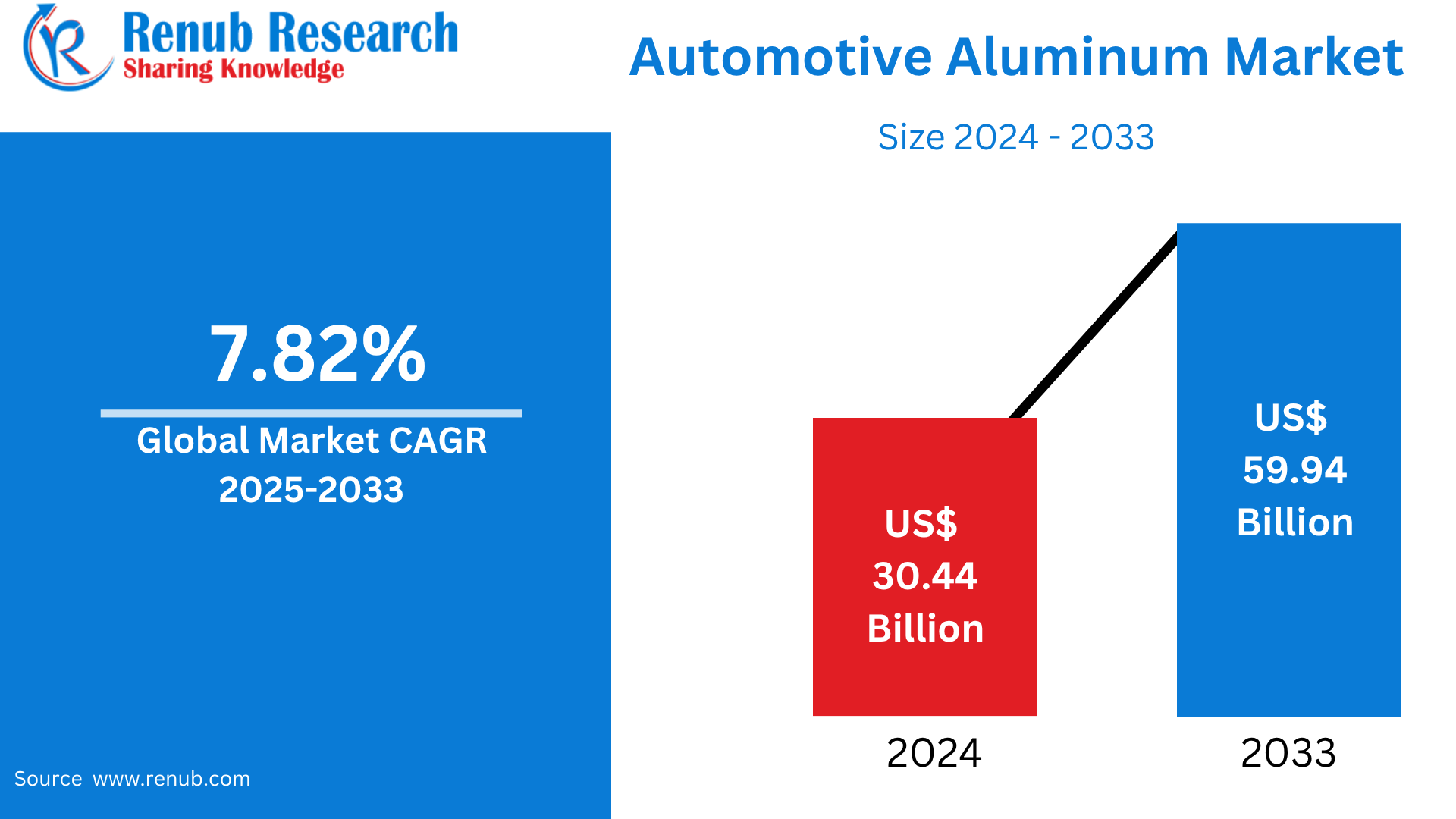
Automotive Aluminum Market is expected to reach US$ 59.94 Billion by 2033 from US$ 30.44 Billion in 2024, with a CAGR of 7.82% from 2025 to 2033. The Automotive Aluminum Market is anticipated to grow significantly during the forecast period, driven by rising demand for lightweight vehicles, fuel efficiency improvements, and the increasing adoption of sustainable manufacturing materials.
Automotive Aluminum Industry Overview
The Automotive Aluminum Market is witnessing robust growth due to the increasing need for fuel-efficient, lightweight, and environmentally sustainable vehicles. Aluminum’s exceptional strength-to-weight ratio, corrosion resistance, and recyclability make it an ideal material for vehicle manufacturing. Automakers are increasingly adopting aluminum to reduce vehicle weight, enhance performance, and meet stringent emission regulations. This trend is particularly strong in passenger cars, electric vehicles, and commercial vehicles, where weight reduction directly impacts efficiency and carbon footprint.
Technological advancements in aluminum alloys and production techniques have expanded its application across vehicle components such as body panels, engine blocks, wheels, and structural frames. The rise of electric vehicles (EVs) has further accelerated aluminum adoption, as lighter structures improve battery performance and extend vehicle range. Additionally, automotive OEMs and suppliers are investing in advanced forming technologies and recycling initiatives to lower production costs and environmental impact, aligning with global sustainability goals.
The global Automotive Aluminum Market is expected to grow across developed and emerging economies alike. North America and Europe dominate due to advanced manufacturing capabilities and strict fuel efficiency standards, while Asia-Pacific, led by China, shows strong growth driven by large-scale automotive production and increasing EV adoption. The Middle East, including the UAE, is also expanding its automotive manufacturing base and aluminum production capacities, supporting regional market growth.
Key Factors Driving the Automotive Aluminum Market Growth
Rising Demand for Lightweight Vehicles
The shift toward lightweight vehicles is a major growth driver for the Automotive Aluminum Market. Aluminum’s low density helps reduce vehicle weight, directly improving fuel efficiency and reducing emissions. Governments worldwide are implementing stringent emission standards, prompting automakers to replace heavier materials like steel with aluminum. Lightweight designs not only enhance energy efficiency but also improve vehicle handling, performance, and safety. As electric vehicles gain popularity, the use of aluminum has become critical in extending battery range and optimizing overall vehicle performance, driving continuous market expansion.
Growing Electric Vehicle (EV) Production
The rapid growth of the EV sector significantly contributes to aluminum demand. Lightweight aluminum components help offset heavy battery weights, enabling improved energy efficiency and range. Major EV manufacturers are integrating aluminum-intensive designs in battery enclosures, body structures, and chassis systems to enhance safety and performance. Furthermore, the recyclability of aluminum aligns with the sustainability goals of EV manufacturers, encouraging its use as a preferred material. The expanding EV market globally, supported by policy incentives and consumer adoption, continues to strengthen the demand for automotive aluminum.
Advancements in Aluminum Alloys and Processing Technologies
Technological innovations in aluminum alloy development and manufacturing processes are propelling market growth. New high-strength, corrosion-resistant alloys are being developed to replace traditional materials without compromising durability. Advanced casting, extrusion, and joining technologies have made aluminum easier to integrate into complex automotive designs. These innovations improve production efficiency, reduce waste, and lower costs. Additionally, the industry’s focus on circular economy practices—such as aluminum recycling and reuse—further enhances its appeal, supporting both economic and environmental objectives in modern vehicle manufacturing.
Challenges in the Automotive Aluminum Market
High Production and Processing Costs
The cost of producing and processing aluminum remains a key challenge for manufacturers. Compared to steel, aluminum production requires more energy, increasing overall costs. While technological improvements are reducing these expenses, high initial investment in equipment and processing technologies remains a barrier, particularly for small-scale manufacturers. Furthermore, fluctuations in raw material prices impact profit margins. Automakers must balance performance benefits with economic feasibility, especially in cost-sensitive markets, limiting large-scale adoption in certain vehicle segments.
Complex Manufacturing and Integration Issues
The integration of aluminum components into existing vehicle architectures presents technical challenges. Aluminum’s unique properties require specialized welding, joining, and forming techniques, which may not be compatible with traditional steel-based manufacturing systems. This necessitates retooling and process adjustments, increasing time and cost. Additionally, training and adaptation across the automotive supply chain are essential to maintain quality standards. The complexity of recycling mixed-material components also complicates sustainability efforts, creating further operational challenges for the industry.
Automotive Aluminum Market Overview by Regions
North America and Europe lead the Automotive Aluminum Market due to strong manufacturing capabilities and emission regulations, while Asia-Pacific and the Middle East are rapidly growing with increased vehicle production and infrastructure investments. The following provides a market overview by region:
United States Automotive Aluminum Market
The United States Automotive Aluminum Market is growing steadily, supported by strong regulatory emphasis on fuel efficiency and emission reduction. Automakers are increasingly using aluminum in vehicle frames, panels, and powertrain components to meet Corporate Average Fuel Economy (CAFE) standards. The demand for electric vehicles further boosts aluminum consumption, as manufacturers aim to optimize performance and extend battery range. Technological advancements in aluminum alloys and recycling systems have improved cost efficiency and sustainability. With established OEMs and expanding EV production, the U.S. market remains a key hub for aluminum innovation and manufacturing investment.
United Kingdom Automotive Aluminum Market
The United Kingdom’s Automotive Aluminum Market is expanding due to the country’s commitment to low-emission mobility and sustainable manufacturing. Automakers are adopting aluminum to meet strict environmental and fuel efficiency standards. The market benefits from a strong engineering base and the presence of leading automotive brands integrating aluminum-intensive vehicle designs. The growing shift toward electric vehicles has accelerated the demand for lightweight materials. Additionally, partnerships between aluminum producers and automotive OEMs are fostering innovation in alloy development and recycling, supporting the UK’s circular economy goals and ensuring long-term market growth.
China Automotive Aluminum Market
China’s Automotive Aluminum Market is experiencing rapid growth, driven by its large automotive production base and government initiatives promoting electric and energy-efficient vehicles. Aluminum is increasingly being used in vehicle structures, engines, and EV battery housings. Domestic and international automakers are investing heavily in lightweight materials to comply with emission standards and improve performance. Continuous improvements in smelting technology and recycling efficiency are reducing production costs, enhancing competitiveness. The rising consumer preference for sustainable mobility and the expansion of the EV sector make China one of the most dynamic markets for automotive aluminum adoption.
United Arab Emirates Automotive Aluminum Market
The UAE Automotive Aluminum Market is gaining traction due to the country’s growing automotive manufacturing and industrial diversification initiatives. As part of its sustainable development vision, the UAE is encouraging lightweight and energy-efficient vehicle production. The availability of advanced aluminum smelting facilities and regional investments in automotive assembly are supporting market expansion. Aluminum’s recyclability and alignment with green mobility goals make it a preferred material for future automotive projects. Furthermore, collaborations with international automakers and aluminum producers are driving innovation, positioning the UAE as a key regional hub for automotive aluminum applications.
Recent Developments in Automotive Aluminum Industry
- April 24, 2024: Vedanta Aluminium hosted AutoEdge 2024 in New Delhi, highlighting the importance of aluminum in India's expanding automotive sector, which is projected to account for around 15% of the country's GDP by 2031. Since each electric vehicle uses about 260 kg of aluminum, Vedanta provides hundreds of alloys, ingots, and billets for sustainability and innovation. With 2.37 million tons of aluminum produced in 2024 alone, the firm is already a prominent participant in the aluminum industry. It already provides low-carbon, high-performance aluminum solutions to a variety of industries, including the automotive sector.
Market Segmentations
Product Form
- Cast Aluminum
- Rolled Aluminum
- Extruded Aluminum
Vehicle Type
- Passenger Cars
- Light Commercial Vehicles (LCV)
- Heavy Commercial Vehicles (HCV)
Application
- Powertrain
- Chassis and Suspension
- Car Body
Regional Outlook
North America
- United States
- Canada
Europe
- France
- Germany
- Italy
- Spain
- United Kingdom
- Belgium
- Netherlands
- Turkey
Asia Pacific
- China
- Japan
- India
- South Korea
- Thailand
- Malaysia
- Indonesia
- Australia
- New Zealand
Latin America
- Brazil
- Mexico
- Argentina
Middle East & Africa
- Saudi Arabia
- United Arab Emirates
- South Africa
All the Key players have been covered
- Overviews
- Key Person
- Recent Developments
- SWOT Analysis
- Revenue Analysis
Company Analysis:
- Arconic
- Lorin Industries, Inc.
- Norsk Hydro ASA
- Constellium
- Howard Precision Metals Inc
- UACJ Corporation
- Jindal Aluminium Limited
- Kaiser Aluminum
- Speira GmbH
- ST Extruded Products Group (STEP-G)
Report Details:
| Report Features | Details |
| Base Year |
2024 |
| Historical Period |
2021 - 2024 |
| Forecast Period |
2025 - 2033 |
| Market |
US$ Billion |
| Segment Covered |
Product Form, Vehicle Type, Application and Countries |
| Countries Covered |
|
| Companies Covered |
|
| Customization Scope |
20% Free Customization |
| Post-Sale Analyst Support |
1 Year (52 Weeks) |
| Delivery Format |
PDF and Excel through Email (We can also provide the editable version of the report in PPT/Word format on request) |
Customization Services available
- Analysis of Market Size and Its Segments
- More Company Profiles (Upto 10 without any additional cost):
- Additional Countries (Other than mentioned Countries):
- Region/Country Specific Reports:
- Market Entry Strategy:
- Region-Specific Market Dynamics:
- Regional Market Share Analysis:
- Trade Analysis:
- Production Insights:
- Others Customized Requests:
For more information contact our analysts.
Need More Assistance?
- Talk to our analysts to get more precious information on the current market trends.
- Include more countries and segments and customize the report based on the final requirement.
- Get a competitive advantage in your industry by knowing the report findings and making a positive impact on your revenues and operations.
- Our analysts are always ready to provide more help and pertinent information if you need any additional assistance.