United States Automotive Aftermarket Market Report by Type, Distribution Channel, Service Channel, Certification, States and Company Analysis 2025-2033
Buy NowUnited States Automotive Aftermarket Industry Size and Forecast 2025-2033
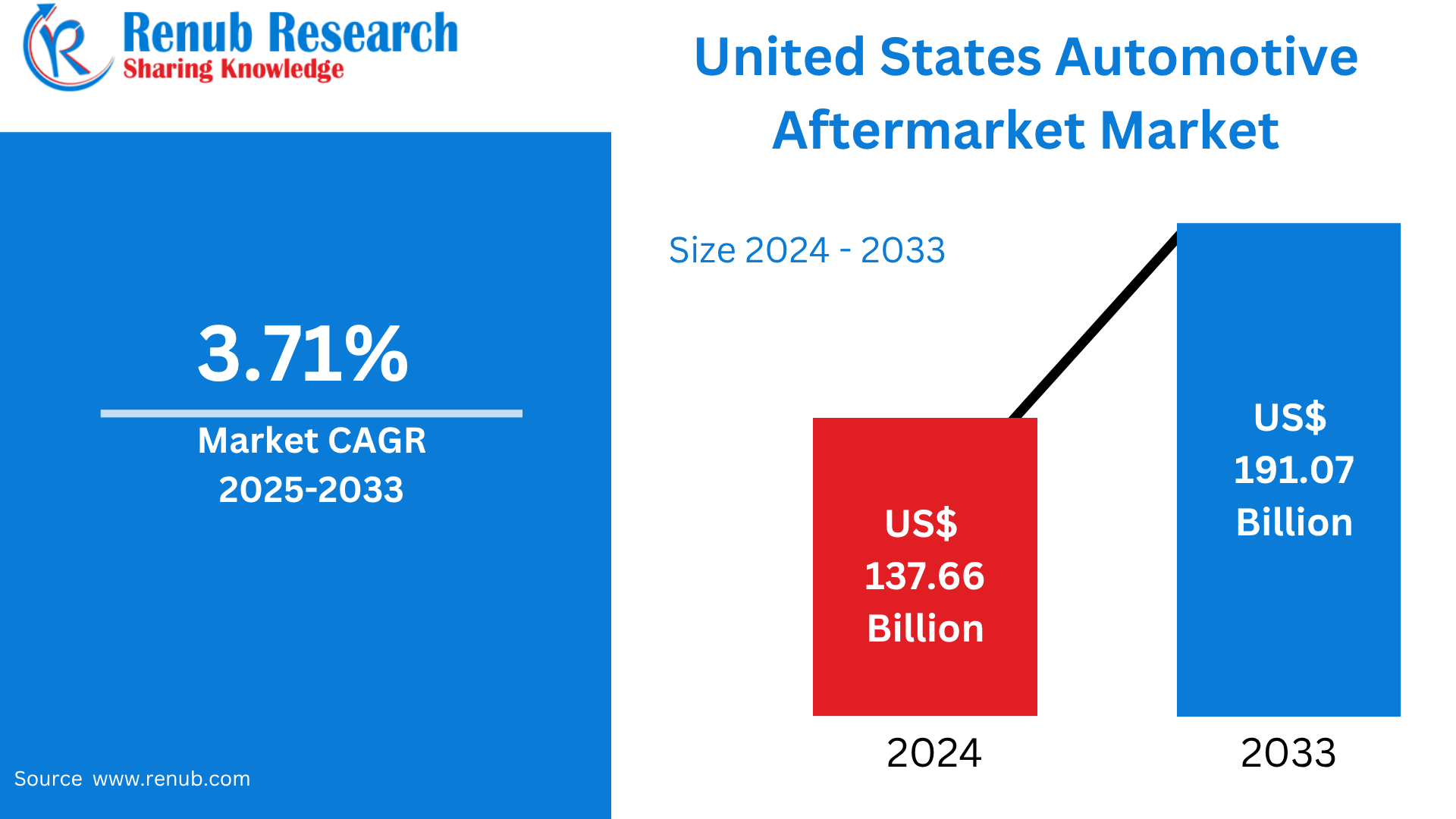
United States Automotive Aftermarket Industry is expected to reach US$ 191.07 billion by 2033 from US$ 137.66 billion in 2024, with a CAGR of 3.71% from 2025 to 2033. The demand for customization, growing e-commerce platforms, rising vehicle ownership, and increasing vehicle age all contribute to the growth of the U.S. automotive aftermarket industry by lowering the cost and increasing accessibility of parts for maintenance, repair, and performance improvement services across the country.
United States Automotive Aftermarket Industry Overview
The secondary market within the automotive industry that deals with the production, distribution, selling, and installation of vehicle parts, equipment, and accessories following a vehicle's sale by the original manufacturer is known as the automotive aftermarket. For cars that are no longer covered under warranty, it covers maintenance supplies, performance enhancements, replacement parts, and repair services. In order to increase vehicle longevity, improve performance, and facilitate personalization, the aftermarket is essential. Serving both professional repair shops and do-it-yourself (DIY) consumers, it promotes innovation and competition in the automotive industry while providing affordable substitutes for original equipment manufacturer (OEM) items.
With an average car age of over 12 years, the U.S. automotive aftermarket industry is fueled by an aging fleet of vehicles, which increases demand for maintenance, replacement parts, and repair services. Aftermarket products are becoming more affordable and widely available due to rising consumer preferences for car personalization and the quick growth of e-commerce. By increasing service efficiency, technological advancements like telematics and sophisticated diagnostics help the industry even more. Furthermore, the aftermarket sector is positioned as a major contributor to the larger automotive economy due to expanding disposable incomes and a growing emphasis on sustainability—through repair rather than replacement.
Growth Drivers for the United States Automotive Aftermarket Industry
Aging Vehicle Fleet
The aging of cars on the road is one of the biggest factors propelling the U.S. automotive aftermarket's expansion. The need for maintenance, replacement parts, and repair services increases continuously as consumers keep their cars longer. Frequent maintenance is necessary for older cars to retain their dependability, performance, and safety, which benefits repair shops, suppliers of parts, and service providers alike. Additionally, owners are encouraged to maintain rather than replace their automobiles due to the current economic climate and the high cost of new cars. Long-term market stability and expansion are guaranteed for both independent service networks and major retail chains by the steady aftermarket activity this prolonged vehicle ownership trend maintains across categories like tires, batteries, brakes, and filters.
Digitalization and E-Commerce Expansion
The automobile aftermarket scene in the United States has changed dramatically due to the quick transition to digital platforms. Buying parts and accessories is now quicker, simpler, and more transparent thanks to digital catalogs, smartphone apps, and online marketplaces. From the convenience of their homes, consumers can identify suitable components, read product reviews, and compare costs. E-commerce platforms give firms the ability to reach a wider audience, manage inventories more effectively, and streamline logistics. In order to improve service accuracy and customer happiness, service providers are using software-based maintenance solutions and digital diagnostic tools more and more. Digitalization is positioned as a major driver of continued industry expansion since it enhances efficiency and builds consumer trust throughout the aftermarket value chain.
Customization and Lifestyle Influence
The desire of consumers to customize their cars has grown to be a significant factor in the growth of the aftermarket. Many car owners try to alter the comfort, performance, and appearance of their vehicles because they perceive them as extensions of who they are. Customization represents lifestyle and cultural trends, ranging from visual modifications like lighting, wraps, and interiors to performance upgrades like suspension kits and exhaust systems. Younger drivers regularly invest in vehicle modification and enhancement due to the influence of digital media and automotive culture. Because of this increased interest, aftermarket manufacturers and retailers are more creative and consistently release new goods and designs. The combination of creativity, technology, and personal expression keeps the aftermarket sector vibrant and propels consistent consumer demand across a range of market niches.
Challenges in the United States Automotive Aftermarket Industry
Labor Shortages and Skill Gaps
A growing challenge in the U.S. automotive aftermarket industry is the shortage of skilled labor. As vehicle systems become more advanced and technology-driven, the demand for qualified technicians with expertise in diagnostics, electronics, and electric vehicle maintenance has surged. However, the industry faces a declining number of trained professionals, as fewer young workers pursue technical trades. This shortage leads to longer service times, higher labor costs, and reduced repair capacity for many businesses. Additionally, ongoing training and certification programs require substantial investment, particularly for small and independent repair shops. Bridging the skill gap through education, apprenticeships, and technological support is crucial for maintaining service quality and competitiveness in the evolving aftermarket landscape.
Supply Chain and Inventory Pressures
Global supply chain instability continues to challenge the automotive aftermarket sector. Disruptions in raw material availability, transportation delays, and dependency on international suppliers have caused unpredictable fluctuations in parts supply and pricing. Many aftermarket businesses face difficulties maintaining optimal inventory levels to meet fluctuating customer demand. Additionally, inflationary pressures and increased logistics costs have reduced profit margins for retailers and distributors. While companies are exploring strategies such as localized sourcing and digital inventory management, adapting these solutions takes time and investment. Maintaining consistent product availability and pricing stability remains a key obstacle to sustaining growth and ensuring customer satisfaction in an increasingly competitive and volatile market environment.
California Automotive Aftermarket Industry
California represents one of the largest and most dynamic automotive aftermarket markets in the U.S., driven by its vast vehicle population and focus on sustainability. The state’s stringent emission standards boost demand for eco-friendly replacement parts and hybrid or EV maintenance services. Additionally, California’s strong car culture—emphasizing customization, performance tuning, and aesthetics—fuels aftermarket growth. Urban centers like Los Angeles and San Francisco support dense networks of repair shops and specialty retailers. The rise of electric vehicles also encourages innovation in battery maintenance and charging infrastructure. With tech-forward consumers and environmental policies, California remains a leading hub for aftermarket innovation and product diversification.
Texas Automotive Aftermarket Industry
Texas boasts a robust automotive aftermarket industry supported by its large population, extensive road network, and high vehicle ownership rates. The state’s economy—rooted in energy, logistics, and agriculture—creates strong demand for heavy-duty vehicle parts and fleet maintenance services. Pickup trucks and SUVs dominate Texas roads, driving sales of performance parts, accessories, and off-road components. The presence of major distribution hubs like Dallas-Fort Worth and Houston enhances supply chain efficiency. Furthermore, Texas consumers exhibit a strong culture of vehicle personalization and DIY repairs, supported by numerous retailers and service centers. This blend of practicality, scale, and enthusiasm keeps Texas a top aftermarket market.
New York Automotive Aftermarket Industry
New York’s automotive aftermarket is characterized by its dense urban vehicle base and focus on maintenance efficiency. With limited parking space and harsh winters, demand for seasonal services—such as tire replacements, battery care, and corrosion protection—is high. The state’s large number of aging vehicles also sustains steady demand for replacement parts. New York City’s public transportation network slightly limits car ownership, but suburban and upstate regions drive significant aftermarket activity. Strict environmental regulations promote eco-friendly parts and hybrid service centers. The mix of urban density, weather challenges, and environmental initiatives ensures New York’s aftermarket remains stable and adaptive to evolving consumer needs.
Florida Automotive Aftermarket Industry
Florida’s automotive aftermarket thrives on its high vehicle density, tourism-driven economy, and year-round driving conditions. The warm climate reduces some seasonal repair needs but increases demand for cooling systems, tires, and aesthetic upgrades. The state’s growing retiree population tends to maintain vehicles longer, supporting steady replacement part sales. Additionally, Florida’s vibrant car culture—especially in Miami and Orlando—fuels customization and performance enhancement trends. Coastal environments also drive demand for anti-corrosion treatments and detailing services. With consistent vehicle use, a booming population, and strong consumer spending, Florida continues to be a vital and fast-growing segment of the U.S. automotive aftermarket industry.
Recent Developments in United States Automotive Aftermarket Industry
- In June 2025, PHINIA Inc. made a strategic advancement by acquiring Electromagnet Invest AB for USD 47 million. This acquisition strengthens PHINIA’s portfolio and enhances its expertise in electromagnetic components, positioning the company for greater innovation and market expansion.
- In November 2024, Standard Motor Products completed the USD 390 million acquisition of Nissens Automotive, significantly broadening its portfolio of thermal-management solutions. This move reinforces the company’s position in the competitive automotive aftermarket by expanding its range of advanced temperature control technologies.
- In August 2023, ZF Aftermarket expanded its product range across the U.S. and Canada, adding 74 new listings to its TRW and SACHS brand portfolios. These additions increased product coverage to a vast number of vehicles in operation, underscoring ZF’s commitment to comprehensive aftermarket support.
- In April 2023, Robert Bosch, LLC strengthened its North American aftermarket portfolio by introducing 52 new automotive parts, covering nearly 22 million vehicles. The new additions include braking components, fuel and water pumps, ignition coils, sensors, and fuel injectors, designed for both domestic and international vehicle types, reinforcing Bosch’s reputation for reliability and quality.
- In April 2022, 3M acquired the technological assets of LeanTec, a U.S. and Canadian provider of digital inventory management solutions for the automotive aftermarket. This acquisition supports 3M’s “Connected Bodyshop” initiative, integrating material platforms with data-driven solutions to enhance efficiency, connectivity, and responsiveness to emerging market trends.
United States Automotive Aftermarket Industry Segments:
Type
- Tire
- Battery
- Brake parts
- Filters
- Body parts
- Lighting & Electronic components
- Wheels
- Exhaust components
- Turbochargers
- Others
Distribution Channel
- Retail
- W&D
Service Channel
- DIY
- DIFM
- OE
Certification
- Genuine
- Certified Parts
- Uncertified Parts
States–Market breakup in 29 viewpoints:
- California
- Texas
- New York
- Florida
- Illinois
- Pennsylvania
- Ohio
- Georgia
- New Jersey
- Washington
- North Carolina
- Massachusetts
- Virginia
- Michigan
- Maryland
- Colorado
- Tennessee
- Indiana
- Arizona
- Minnesota
- Wisconsin
- Missouri
- Connecticut
- South Carolina
- Oregon
- Louisiana
- Alabama
- Kentucky
- Rest of United States
All companies have been covered from 5 viewpoints:
- Company Overview
- Key Persons
- Recent Development & Strategies
- SWOT Analysis
- Sales Analysis
Key Players Analysis
- 3M Company
- Continental AG
- Cooper Tire & Rubber Company
- Delphi Automotive PLC
- Denso Corporation
- Federal-Mogul Corporation
- HELLA KGaA Hueck & Co.
- Robert Bosch GmbH
- Valeo Group
- ZF Friedrichshafen AG
Report Details:
| Report Features | Details |
| Base Year |
2024 |
| Historical Period |
2021 - 2024 |
| Forecast Period |
2025 - 2033 |
| Market |
US$ Billion |
| Segment Covered |
Type, Distribution Channel, Service Channel, Certification and States |
| States Covered |
|
| Companies Covered |
|
| Customization Scope |
20% Free Customization |
| Post-Sale Analyst Support |
1 Year (52 Weeks) |
| Delivery Format |
PDF and Excel through Email (We can also provide the editable version of the report in PPT/Word format on request) |
Customization Services available
- Analysis of Market Size and Its Segments
- More Company Profiles (Upto 10 without any additional cost):
- Additional Countries (Other than mentioned Countries):
- Region/Country Specific Reports:
- Market Entry Strategy:
- Region-Specific Market Dynamics:
- Regional Market Share Analysis:
- Trade Analysis:
- Production Insights:
- Others Customized Requests:
For more information contact our analysts.
Need More Assistance?
- Talk to our analysts to get more precious information on the current market trends.
- Include more countries and segments and customize the report based on the final requirement.
- Get a competitive advantage in your industry by knowing the report findings and making a positive impact on your revenues and operations.
- Our analysts are always ready to provide more help and pertinent information if you need any additional assistance.