Australia Meat Snacks Market Report by Product, Nature, Distribution Channel, and Company Analysis 2026-2034
Buy NowAustralia Meat Snacks Market Size and Forecast
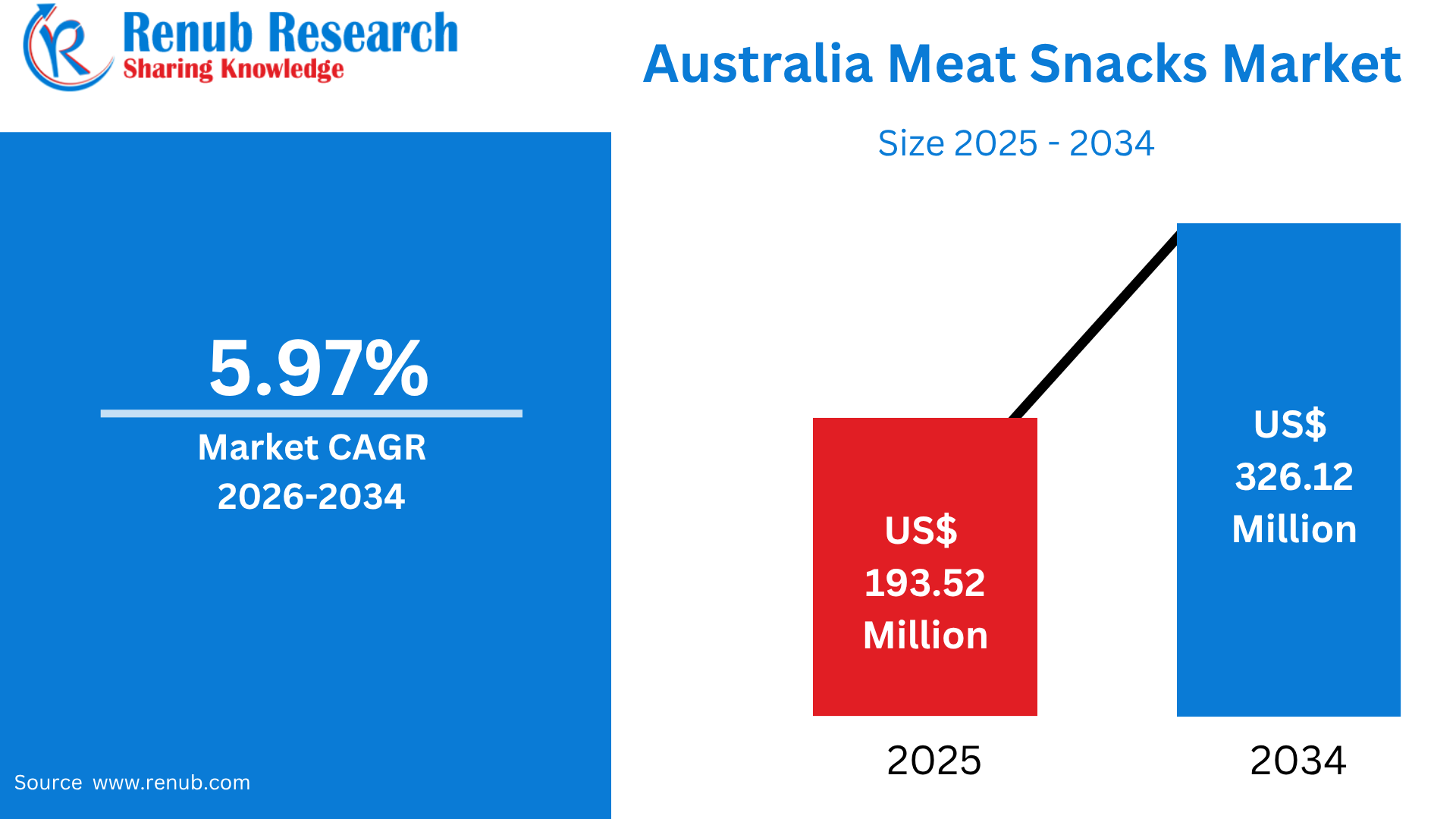
Australia Meat Snacks Market is projected to expand from US$ 193.52 million in 2025 to US$ 326.12 million by 2034, registering a CAGR of 5.97% during 2026–2034. Market growth is being supported by increasing consumer demand for high-protein, convenient, and portable snack options that fit busy lifestyles. The growing popularity of ready-to-eat foods is encouraging consumers to choose meat snacks such as jerky, meat sticks, and other shelf-stable protein products as convenient alternatives to traditional snacks.
What Are Meat Snacks and Their Uses & Popularity Worldwide
Meat snacks are convenient, ready-to-eat food products prepared from meat and designed for quick consumption between meals or as a portable source of protein. Common varieties include beef jerky, meat sticks, biltong, dried meat, salami snacks, and other cured or dried meat products. These products are typically processed through drying, curing, smoking, or cooking methods that improve shelf life while maintaining flavor and nutritional value. Meat snacks are increasingly popular among consumers seeking protein-rich, convenient, and filling foods that can be consumed while traveling, working, exercising, or participating in outdoor activities. Their portability and relatively long shelf life make them particularly attractive for busy lifestyles.
Worldwide popularity is increasing alongside demand for high-protein and ready-to-eat foods. According to the International Food Information Council’s 2024 survey, 71% of consumers reported trying to consume protein, highlighting strong interest in protein-focused foods. Product innovation is also expanding the category through reduced-sodium options, natural ingredients, premium meats, new flavors, and convenient packaging. Supermarkets, convenience stores, specialty retailers, and e-commerce platforms are broadening global access to meat snacks.
Meat & Poultry Products Consumption in Australia
- 2018–19: Apparent consumption of meat and poultry products was approximately 140 grams per capita per day.
- 2019–20: Consumption remained relatively stable at around 140 grams per capita per day.
- 2020–21: Meat and poultry consumption increased slightly to approximately 142 grams per capita per day.
- 2021–22: Consumption remained broadly stable at around 142 grams per capita per day.
- 2022–23: Apparent consumption was approximately 140 grams per capita per day, showing a minor decline.
- 2023–24: Consumption increased to approximately 145 grams per capita per day, representing the highest level shown in the chart.
- Overall Trend: Meat and poultry consumption remained relatively stable between 2018–19 and 2023–24, fluctuating within a narrow range of approximately 140–145 grams per capita per day.
Growth Drivers of the Australia Meat Snacks Market
Rising Demand for Protein-Rich and Convenient Snacks
The growing consumer preference for protein-rich foods is a major driver of the meat snacks market, as products such as beef jerky, biltong, meat sticks, and dried meat provide convenient sources of protein in portable formats. Consumers increasingly seek snacks that can support satiety, active lifestyles, and on-the-go eating without requiring preparation. The broader global protein trend provides a strong foundation for this category. In the 2024 International Food Information Council (IFIC) Food & Health Survey, 37% of consumers identified being a “good source of protein” as a criterion for defining a healthy food, making protein one of the most important attributes in food choices. Meat snacks are well positioned to benefit from this preference because they combine protein density with portability and extended shelf life. In Australia, demand is further supported by consumers’ interest in convenient foods suitable for work, travel, outdoor activities, and fitness. Manufacturers are responding with high-protein, portion-controlled, reduced-sugar, and premium formulations, encouraging wider consumption across different demographic groups.
Growing Popularity of Ready-to-Eat and On-the-Go Foods
The increasing preference for ready-to-eat and portable foods is supporting demand for meat snacks because these products require little or no preparation and can be consumed practically anywhere. Busy working schedules, commuting, travel, outdoor recreation, and changing household lifestyles are encouraging consumers to replace traditional meal occasions with convenient snacks. Meat snacks offer a particularly attractive combination of portability, protein content, and relatively long shelf life. Australia’s expanding digital retail ecosystem is also improving access to packaged food products. According to the Australian Bureau of Statistics (ABS), online food retail sales reached A$1.33 billion in December 2024, on a seasonally adjusted basis, while total online retail sales reached A$4.41 billion. Food online sales increased 4.1% month-on-month in December 2024. The expansion of supermarket delivery services, online grocery platforms, convenience stores, and specialty retailers is making meat snacks easier to purchase. As consumers increasingly prioritize convenience without completely sacrificing nutritional value, the ready-to-eat positioning of meat snacks is expected to support market expansion.
Product Innovation and Expanding Retail Distribution
Continuous product innovation, flavor diversification, packaging improvements, and wider retail distribution are creating additional growth opportunities for the Australian meat snacks market. Manufacturers are introducing products with different meat varieties, seasoning profiles, textures, portion sizes, and nutritional characteristics to attract consumers beyond traditional jerky buyers. Premium products, lower-sodium formulations, natural ingredients, and products emphasizing protein content can help companies respond to changing consumer preferences. Packaging innovation is also important because resealable and single-serve formats improve portability and product freshness. At the same time, expanding access through supermarkets, convenience stores, specialty food retailers, gyms, travel outlets, and e-commerce platforms is increasing product visibility. ABS data show that Australia’s food online sales were A$1.19 billion in January 2024, while online food retail represented approximately 5.8% of total food retailing during that month. This combination of physical and digital distribution enables manufacturers to reach consumers across multiple purchasing occasions. Continued innovation and broader availability are therefore expected to strengthen category penetration and encourage repeat purchases.
Challenges of the Australia Meat Snacks Market
Health Concerns Associated with Processed Meat Consumption
Health concerns surrounding processed meat consumption represent a significant challenge for the meat snacks market. Many products in this category undergo curing, salting, smoking, fermentation, or other processing methods, which can raise concerns regarding sodium content and long-term health effects. The International Agency for Research on Cancer (IARC), part of WHO, classifies processed meat as carcinogenic to humans (Group 1) based on sufficient evidence linking consumption to colorectal cancer. WHO reports that an analysis of 10 studies estimated that every 50 grams of processed meat consumed daily was associated with approximately an 18% increase in colorectal cancer risk. These findings can influence consumer perceptions, particularly among health-conscious shoppers who are increasingly examining ingredient lists, sodium levels, and processing methods. WHO also notes that colorectal cancer is the third most common cancer globally, accounting for approximately 10% of all cancer cases, with dietary factors including high consumption of processed meat identified as a risk factor. Consequently, manufacturers face pressure to develop lower-sodium, cleaner-label, and minimally processed alternatives while maintaining taste, shelf life, and affordability.
Sustainability Concerns and Meat Supply Costs
Environmental concerns associated with livestock production and fluctuations in meat supply costs can create challenges for the meat snacks industry. Livestock production requires significant resources and contributes to greenhouse-gas emissions, increasing pressure on food manufacturers to improve sustainability throughout their supply chains. The Food and Agriculture Organization (FAO) estimates that livestock supply chains generate approximately 7.1 gigatonnes of CO₂-equivalent emissions annually, representing about 14.5% of global human-caused greenhouse-gas emissions. These environmental concerns are contributing to greater consumer and regulatory attention toward sustainable sourcing, animal welfare, packaging waste, and carbon footprints. At the same time, fluctuations in livestock prices, feed costs, energy expenses, transportation costs, and processing costs can increase the production cost of meat snacks. Higher costs may translate into elevated retail prices, potentially limiting purchases among price-sensitive consumers. Manufacturers must therefore balance product affordability with investments in sustainable sourcing, efficient production, recyclable packaging, and transparent supply chains. These pressures may influence margins and require companies to continually optimize production and procurement strategies.
Meat Snacks Launches in Australia
- The Chilli Factory Spicy Beef Jerky Range – 2025: The Chilli Factory expanded into meat snacks with three 100% Queensland beef jerky varieties: Fiery Frillneck Hiss, Morning Afterburn, and Scorpion Strike. The products are marinated in the company’s signature chilli sauces and positioned as high-protein, single-serve snacks.
- Jack Link’s x MrBeast W.T.F. Beef Jerky – 2026: Jack Link’s launched two limited-edition Grass Fed Beef W.T.F. jerky flavors in Australia and New Zealand through its collaboration with MrBeast. The products are available in 45g packs and feature a secret-flavor guessing promotion.
- Jack Link’s x MrBeast Twin Beef Sticks – 2026: As part of the same Australian collaboration, Jack Link’s introduced a 50g Twin Beef Sticks product, targeting younger consumers and protein-focused snack occasions.
- Jack Link’s x MrBeast Beef Jerky & Meat Sticks – Australia/NZ Expansion: The broader Jack Link’s and MrBeast partnership was announced in 2025, with a range of beef jerky and beef sticks planned for Australian and New Zealand retailers, expanding the category through a high-profile co-branded launch.
- Jack Link’s Doritos Sweet & Tangy BBQ Beef Jerky – Australian Market Trend: Jack Link’s and Doritos introduced a co-branded Sweet & Tangy BBQ Beef Jerky, combining dried beef with Doritos-inspired seasoning. The launch reflects the growing use of familiar snack flavors in meat products.
- Jack Link’s Doritos Sweet & Tangy BBQ Meat Sticks – 2025: Alongside the jerky, the collaboration introduced Sweet & Tangy BBQ Meat Sticks, providing another portable format designed around a recognizable snack flavor profile. The meat sticks contain 5g of protein per serving.
- Mike’s Beef Jerky Black Pepper Jerky – 2025: South Australian producer Mike’s Beef Jerky received international recognition for its Black Pepper Jerky, which won Platinum at the IFFA DFV World Quality Competition in 2025, highlighting the premium positioning of Australian-made jerky.
- Mike’s Beef Jerky Chilli Jerky – 2025: Mike’s Chilli Jerky also received a Gold Medal at the 2025 IFFA DFV World Quality Competition, demonstrating continued innovation around spicy and premium meat-snack flavors.
- Mike’s Cheese & Chilli Cheese Kranski Snacks – 2025: Mike’s Beef Jerky’s Cheese and Chilli Cheese Kranski products received silver medals at the 2025 IFFA competition, reflecting growing interest in flavored sausage-style meat snacks.
- Jack Link’s Global Beef Jerky & Beef Sticks Range – Australia/NZ 2026: Jack Link’s expanded its international meat-snack portfolio into Australia and New Zealand through its 2025–26 collaboration program, with individual-sized beef jerky and meat-stick formats targeting school lunches, road trips, active lifestyles, and everyday protein snacking.
Strong Meat Culture and Product Innovation Support Sausages Meat Snacks Growth
Australia sausages meat snacks market is benefiting from consumers’ familiarity with sausages, cured meats, and convenient meat-based foods. Products such as mini sausages, cocktail sausages, cured sausage bites, and smoked meat snacks appeal to consumers seeking flavorful and protein-rich options that require little preparation. Australia’s established livestock and meat-processing industry provides a strong supply base for manufacturers. According to the Australian Bureau of Statistics (ABS), beef production reached 727,921 tonnes in the December 2025 quarter, while pig meat production totaled 118,764 tonnes during the same period. However, the category is also responding to changing dietary preferences. ABS data show that per-capita consumption of sausages and frankfurts was 11.2 grams per day in 2023–24, down 3.4% from the previous year, indicating that manufacturers need to differentiate products through innovation. New flavors, premium ingredients, reduced-fat and lower-sodium formulations, gourmet positioning, and convenient single-serve packaging are helping create new consumption occasions. Wider availability through supermarkets, specialty retailers, and convenience stores is further supporting product accessibility.
Portable Protein and Convenient Packaging Increase Consumer Appeal of Meat Sticks
Australia meat sticks market is gaining momentum as consumers increasingly seek portable snacks that combine convenience with protein. Meat sticks made from beef, pork, chicken, and other meats are generally cured, dried, or smoked, giving them a distinctive taste and relatively long shelf life. Their compact format makes them suitable for commuting, work, travel, fitness activities, and outdoor recreation. Australia’s strong meat-production base provides manufacturers with access to locally produced raw materials. In the December 2025 quarter, Australia produced approximately 727,921 tonnes of beef and 118,764 tonnes of pig meat, according to ABS statistics. Product development is also expanding the category through spicy, barbecue, smoky, peppered, and internationally inspired flavors. Growing interest in high-protein and lower-carbohydrate eating patterns provides an additional opportunity, while clean-label positioning and reduced-preservative formulations can attract health-conscious consumers. Distribution is expanding across supermarkets, convenience stores, specialty retailers, and e-commerce platforms. With Australia’s convenience-store industry representing 7,088 stores and more than 72,000 employees, according to the Australian Association of Convenience Stores, meat sticks have a substantial network through which to reach impulse and on-the-go consumers.
Health, Sustainability, and Premiumization Create Organic Meat Snacks Opportunities
Australia organic meat snacks market is emerging as consumers show greater interest in food quality, sustainable sourcing, natural ingredients, and premium products. Organic meat snacks can include organic jerky, meat sticks, sausages, and cured meat products produced using certified organic livestock and processing standards. The segment benefits from premiumization because consumers interested in organic and ethically sourced foods may be willing to pay higher prices for perceived quality, traceability, and environmental benefits. Australia’s broader meat industry provides a substantial production base for value-added snack products. ABS reported 2.4 million cattle slaughtered and 727,921 tonnes of beef production in the December 2025 quarter, demonstrating the scale of Australia’s beef supply chain. Organic products nevertheless represent a specialized segment and face competition from conventional products with lower prices. Manufacturers are responding through clean-label claims, premium seasonings, convenient packaging, and products emphasizing animal welfare and responsible sourcing. The expansion of specialty health-food stores and online retail is also improving accessibility. As consumers increasingly examine product ingredients and sourcing practices, organic meat snacks are positioned to benefit from Australia’s broader premium and health-oriented food trends.
Affordable Pricing and Broad Availability Maintain Conventional Meat Snacks Market Dominance
Australia conventional meat snacks market continues to represent an important portion of the category because of its affordability, established consumer acceptance, and extensive retail availability. Conventional products include jerky, sausages, meat sticks, cured meat snacks, and other industrially produced meat-based snacks manufactured using standardized processing methods. Compared with premium and organic alternatives, conventional products generally have broader consumer reach because competitive pricing makes them accessible to a larger portion of the population. Australia’s substantial meat-production infrastructure further supports the availability of raw materials. In the December 2025 quarter, the country produced 727,921 tonnes of beef, 118,764 tonnes of pig meat, and 391,018 tonnes of chicken meat, according to ABS data. Manufacturers are increasingly using automation, efficient processing technologies, improved shelf-life solutions, and high-volume production to control costs while maintaining consistent quality. Product variety is also expanding through different flavors, pack sizes, and portion formats. The segment is supported by supermarkets, convenience stores, independent retailers, and online channels, allowing conventional meat snacks to remain accessible to consumers seeking flavorful and convenient protein products at competitive prices.
Extensive Convenience Retail Network Supports Impulse and On-the-Go Purchases
Convenience stores are an important distribution channel for Australia’s meat snacks market, particularly because meat sticks, jerky, mini sausages, and similar products are portable and can be consumed immediately without preparation. Their small pack sizes and relatively long shelf life make them well suited to impulse purchases at checkout counters, service stations, transport locations, and urban convenience outlets. The Australian Association of Convenience Stores reports that the national convenience industry comprises approximately 7,088 stores and employs more than 72,000 people, providing manufacturers with a substantial retail network. The broader convenience-store industry was valued at approximately A$6.1 billion in 2025, according to IBISWorld, demonstrating the scale of this retail channel. Meat snacks can benefit from strategic placement alongside beverages, sports nutrition products, and other grab-and-go foods. Retailers are also expanding their food offerings as consumers increasingly seek convenient alternatives to traditional meals. Premium, high-protein, lower-sodium, and differentiated-flavor meat snacks can help retailers address diverse consumer preferences while generating additional impulse-purchase opportunities.
Health-Conscious Consumers and Premium Food Culture Drive Victoria Growth
Victoria meat snacks market is expanding as consumers increasingly seek convenient, protein-rich foods that fit busy lifestyles. Melbourne, as a major population and food innovation center, provides a strong market for beef jerky, meat sticks, mini sausages, biltong, and premium cured meats. Health-conscious consumers are increasingly interested in protein-focused snacks, while Victoria’s strong café, specialty food, and gourmet retail culture supports premium and artisanal products. The state’s large population also provides manufacturers with a substantial consumer base. According to the Australian Bureau of Statistics (ABS), Victoria’s population reached approximately 6.96 million people in September 2025, maintaining its position as Australia’s second-most populous state. Online shopping is another important growth channel, allowing niche organic and premium meat-snack brands to reach consumers beyond traditional specialty stores. Product innovation around natural ingredients, reduced sodium, organic sourcing, distinctive flavors, and sustainable packaging is also creating new opportunities. Melbourne’s multicultural food culture further encourages experimentation with international flavors, positioning Victoria as an important market for premium and innovative meat snacks.
Active Lifestyles, Tourism, and Livestock Production Support Queensland Demand
Queensland meat snacks market is benefiting from population growth, outdoor lifestyles, tourism, and the state’s extensive livestock industry. Consumers participating in hiking, camping, road trips, sports, and other outdoor activities increasingly value snacks that are portable, shelf-stable, filling, and protein-rich. Products such as beef jerky, biltong, meat sticks, and dried meat are particularly suitable for these consumption occasions because they require little preparation. Queensland also has one of Australia’s largest cattle industries, providing manufacturers with access to locally sourced meat and supporting the development of regional value-added food products. The state’s population reached approximately 5.7 million in September 2025, according to ABS estimates, creating a substantial and growing consumer base. Tourism provides an additional opportunity because Queensland attracts visitors to destinations such as the Gold Coast, Cairns, and the Great Barrier Reef, increasing demand for portable foods. Supermarkets, convenience stores, specialty retailers, and online platforms are expanding product availability. Growing consumer interest in high-protein and convenient foods is expected to continue supporting the regional market.
Local Meat Production and Gourmet Food Culture Create South Australia Opportunities
South Australia meat snacks market is developing alongside the state’s established agriculture, livestock, food-processing, and gourmet-food industries. Consumers are showing increasing interest in locally produced, premium, organic, and sustainably sourced meat products, creating opportunities for higher-value snacks such as artisan jerky, salami, biltong, and premium meat sticks. Adelaide serves as an important retail and food-processing center, while the state’s wine and tourism industries provide additional opportunities for premium meat-snack products to be marketed alongside gourmet foods. South Australia’s population reached approximately 1.9 million in September 2025, according to ABS estimates, providing a growing domestic consumer base. The state also has an established livestock and meat-processing supply chain that can support value-added meat products. Manufacturers are increasingly differentiating products through local sourcing, specialty seasonings, reduced-sodium formulations, organic certification, and premium packaging. The expansion of supermarkets, specialty food stores, farmers’ markets, tourism outlets, and e-commerce is improving access to these products. As consumers increasingly combine convenience with quality and provenance, South Australia is positioned as an attractive regional market for premium meat snacks.
Large Consumer Base and Urban Lifestyles Strengthen New South Wales Market Demand
New South Wales represents a significant regional market for meat snacks because of its large population, high level of urbanization, extensive retail infrastructure, and diverse consumer base. Sydney, Australia’s largest city, plays an important role in shaping food and snacking trends, while consumers with demanding work schedules increasingly seek convenient foods that can be consumed between meals or while traveling. Meat snacks such as jerky, meat sticks, biltong, and mini sausages are well suited to these occasions because they are portable and generally require no preparation. NSW had approximately 8.6 million residents in September 2025, according to ABS population estimates, providing the country’s largest state-level consumer base. The state’s strong fitness, sports, and wellness culture is also supporting demand for protein-oriented snacks. At the premium end of the market, consumers are showing interest in organic products, clean-label ingredients, lower-sodium formulations, and locally sourced meat. Sydney’s sophisticated supermarket, convenience, specialty, and online retail networks further improve product accessibility. Continued product innovation and growing demand for convenient protein options are expected to support the expansion of the NSW meat snacks market.
Australia Meat Snacks Market Segments
Product
- Jerky
- Sticks
- Sausages
- Others
Nature
- Conventional
- Organic
Distribution Channel
- Supermarkets/Hypermarkets
- Convenience Stores
- Online Retail Stores
- Others
Top States
- New South Wales
- Victoria
- Queensland
- Western Australia
- South Australia
- Australian Capital Territory
- Tasmania
- Northern Territory
All companies have been covered from 5 viewpoints:
- Overviews
- Key Person
- Recent Developments
- SWOT Analysis
- Revenue Analysis
Key Players Analysis
- Nestlé S.A.
- Hormel Foods
- Conagra Brands
- Bridgford Foods
- Hershey
- Associated British Foods plc
- Tyson Foods, Inc.
- Danish Crown
- Kerry Group plc.
Report Details:
| Report Features | Details |
| Base Year |
2024 |
| Historical Period |
2020 - 2024 |
| Forecast Period |
2025 - 2033 |
| Market |
US$ Million |
| Segment Covered |
Product, Nature and Distribution Channel |
| Distribution Channel Covered |
|
| Companies Covered |
|
| Customization Scope |
20% Free Customization |
| Post-Sale Analyst Support |
1 Year (52 Weeks) |
| Delivery Format |
PDF and Excel through Email (We can also provide the editable version of the report in PPT/Word format on request) |
Key Questions Answered in This Report:
- What is the projected market size of the Australian meat snacks industry by 2033?
- What is the expected CAGR of the Australian meat snacks market from 2025 to 2033?
- What are the key drivers fueling the growth of the meat snacks market in Australia?
- How is the demand for high-protein and low-carb snacks influencing market trends?
- What role does convenience and on-the-go consumption play in market expansion?
- How are supermarkets, convenience stores, and online retailers contributing to market growth?
- What challenges does the Australian meat snacks market face in terms of production costs?
- How do regulatory and health concerns impact the market for meat snacks in Australia?
- What are the emerging trends in jerky and sausage-based meat snacks in Australia?
Customization Services available
-
Analysis of Market Size and Its Segments
- More Company Profiles (Upto 10 without any additional cost):
- Additional Countries (Other than mentioned Countries):
- Region/Country Specific Reports:
- Market Entry Strategy:
- Region-Specific Market Dynamics:
- Regional Market Share Analysis:
- Trade Analysis:
- Production Insights:
- Others Customized Requests:
For more information contact our analysts.
Need More Assistance?
- Talk to our analysts to get more precious information on the current market trends.
- Include more countries and segments and customize the report based on the final requirement.
- Get a competitive advantage in your industry by knowing the report findings and making a positive impact on your revenues and operations.
- Our analysts are always ready to provide more help and pertinent information if you need any additional assistance.