Smart Camera Market Report by Component, Sensor Type, End User, Countries and Company Analysis 2026-2034
Buy NowSmart Camera Market Size and Forecast
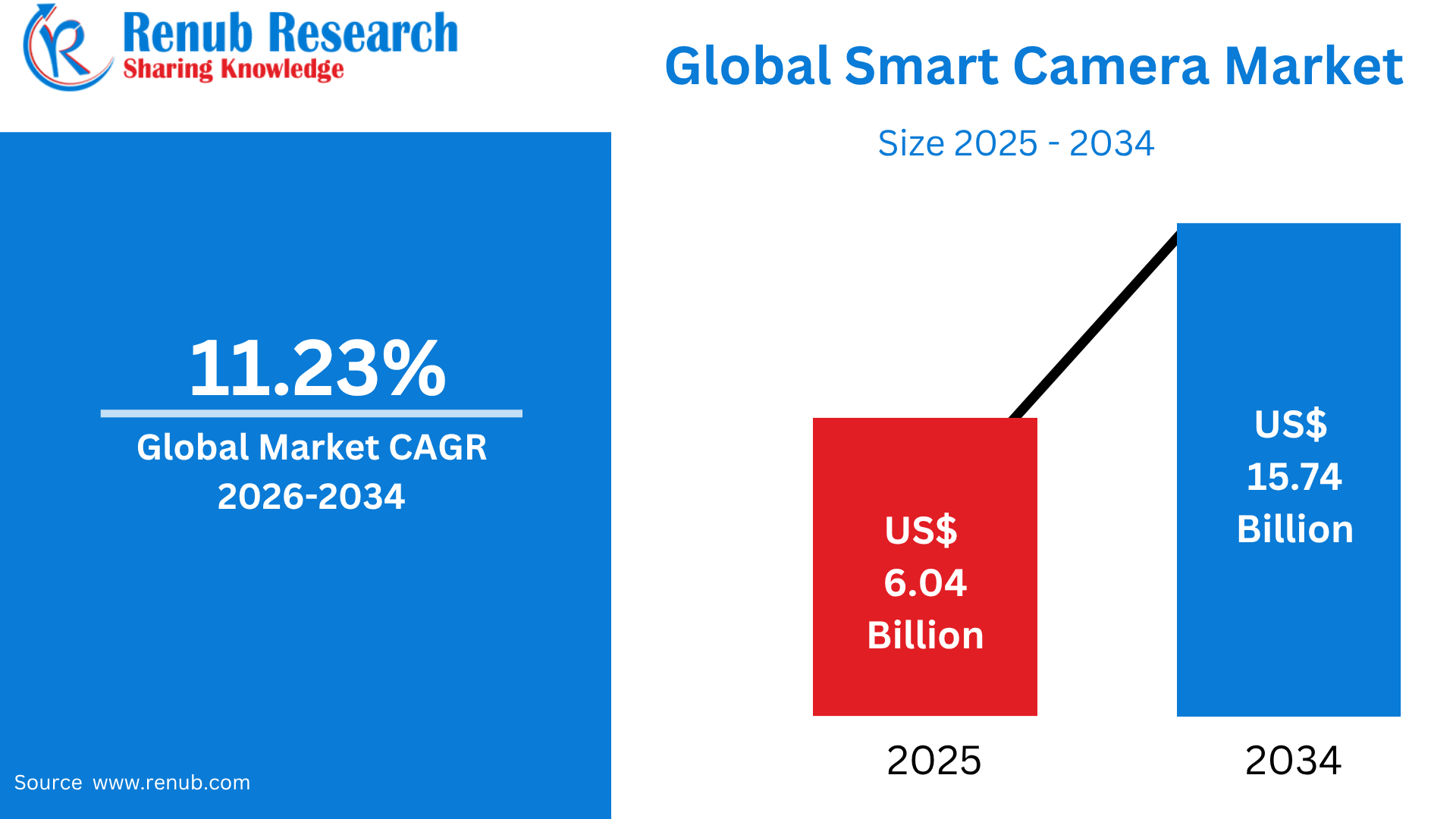
The Smart Camera Market is projected to expand significantly, increasing from US$ 6.04 billion in 2025 to approximately US$ 15.74 billion by 2034, representing a CAGR of 11.23% during 2026–2034. Market expansion is being driven by the growing need for advanced surveillance, real-time monitoring, and intelligent visual analytics across residential, commercial, industrial, and public environments. The integration of artificial intelligence, machine learning, edge computing, and advanced image-processing technologies is enabling smart cameras to detect objects, recognize patterns, identify unusual activities, and generate automated alerts with limited human intervention.
What is Smart Camera and Its Uses & Popularity Worldwide
A smart camera is an advanced imaging device that combines conventional image capture with onboard processing, artificial intelligence (AI), computer vision, connectivity, and automated analytics. Unlike traditional cameras that primarily record video, smart cameras can analyze visual information in real time, identify objects, detect movement, recognize patterns, and trigger automated alerts or actions.
Smart cameras are widely used for security and surveillance, traffic monitoring, retail analytics, industrial inspection, access control, smart parking, healthcare monitoring, and home security. In manufacturing, they can identify product defects and support automated quality control, while in smart cities they can monitor vehicles, pedestrians, traffic conditions, and public spaces.
Their popularity is increasing worldwide because of the rapid expansion of smart homes, IoT networks, cloud platforms, edge computing, and AI-powered visual analytics. Connected smart cameras can provide remote monitoring and notifications through smartphones and other devices, improving convenience and security. Growing demand for real-time monitoring, automation, and intelligent security solutions is therefore supporting adoption across residential, commercial, industrial, and public-sector applications.
Smart Home Security Camera Market in United States
* 61% of American households currently have at least one security camera, up from 52% back in 2024. Currently, 74.9 million households have indoor or outdoor security cameras.
* Ring leads the pack among brands for security equipment; 43% of respondents name their system or camera brand as Ring. Video doorbells made by Ring are owned by 58.9 million Americans.
* For the first time ever, DIY installation has surpassed professional installation: 49% of respondents who use alarm systems installed their system themselves, whereas 42% used a professional installer.
* Inflation quietly influences the market margins: 12% of respondents had to delay an upgrade over the last year because of increased expenses, and young users (18-29 years old) cancel or downgrade subscription plans more often.
* AI functionalities are growing in popularity: 28% of respondents have already set up AI-based functions such as face detection, and 39% would like to get face recognition technology, despite concerns regarding the availability of footage.
* People find their home security cameras' usefulness much greater than any risks posed by potential breaches of their privacy: 37% are afraid that someone other than them could have access to footage, but only 87% find home security comforting.
Growth Drivers of the Smart Camera Market
Rising Demand for AI-Powered Surveillance and Security
The increasing need for advanced security, real-time monitoring, and automated threat detection is a major growth driver for the smart camera market. Conventional cameras primarily record footage, whereas smart cameras can use artificial intelligence, computer vision, and machine learning to identify people, vehicles, objects, unusual behavior, and potential security incidents. This rapid expansion demonstrates the increasing integration of AI into surveillance infrastructure. Governments, businesses, transportation hubs, retail stores, industrial facilities, and residential users are adopting intelligent cameras to improve security while reducing dependence on continuous manual video monitoring. Smart cameras can also generate automated alerts, support facial or vehicle recognition, and analyze large volumes of footage in real time. Growing concerns regarding theft, unauthorized access, public safety, and asset protection are encouraging organizations to upgrade from traditional CCTV systems. As AI algorithms become more accurate and processing increasingly occurs at the camera edge, smart cameras are expected to become an increasingly important component of modern security infrastructure.
Expansion of Smart Homes and Connected IoT Ecosystems
The rapid development of smart homes and Internet of Things (IoT) ecosystems is creating strong demand for connected smart cameras. Modern consumers increasingly use cameras alongside smart locks, sensors, alarms, doorbells, lighting systems, and home-management platforms. Smart cameras provide remote monitoring through smartphones and can send real-time notifications when motion or unusual activity is detected. Smart-home adoption is also expanding beyond basic security, with cameras increasingly supporting functions such as package monitoring, elderly-care observation, pet monitoring, and home automation. Improved Wi-Fi connectivity, cloud platforms, edge computing, and smartphone applications have made smart cameras easier to install and operate. In addition, consumers increasingly expect connected devices to communicate with each other, encouraging manufacturers to develop cameras compatible with broader IoT ecosystems. As smart-home penetration increases worldwide, demand for affordable, easy-to-install, AI-enabled cameras is expected to rise, supporting continued expansion of the smart camera market.
Increasing Adoption of AI, Edge Computing, and Advanced Image Processing
Technological advancements in AI, edge computing, deep learning, and image processing are significantly improving smart camera capabilities and creating new applications. Modern smart cameras can process visual information locally, allowing them to identify objects, detect anomalies, count people, recognize vehicles, and generate alerts without continuously sending all video data to centralized servers. In manufacturing, cameras can support automated quality inspection; in retail, they can provide customer and inventory analytics; while transportation applications include traffic monitoring, license-plate recognition, and parking management. Edge AI also reduces latency because decisions can be made closer to where video is captured. As hardware becomes more capable and AI software becomes increasingly sophisticated, organizations are moving from passive video recording toward real-time visual intelligence and automated decision support, strengthening long-term market growth.
Challenges of the Smart Camera Market
Privacy, Data Protection, and Regulatory Concerns
Privacy and data-protection concerns represent a significant challenge for the smart camera market, particularly as AI-enabled systems become capable of facial recognition, behavioral analysis, and continuous monitoring. Smart cameras can collect large volumes of potentially sensitive visual information, including images of individuals, vehicle movements, and activities in public or private environments. Researchers have highlighted that the collection and storage of personally identifiable information creates increased privacy risks in AI-enabled surveillance systems. Regulatory requirements concerning biometric data, consent, data storage, access rights, and surveillance vary considerably across countries and regions, making compliance more complicated for manufacturers and operators. Public concerns can also delay deployments, particularly when cameras are used in schools, workplaces, transportation systems, and public spaces. Recent debates surrounding AI-powered surveillance demonstrate the tension between public-safety benefits and civil-liberty concerns. Companies therefore need to invest in privacy-preserving technologies, encryption, secure data management, transparent policies, and appropriate user controls. Failure to address these issues could result in regulatory penalties, reputational damage, reduced consumer trust, and slower adoption of advanced smart-camera technologies.
High Costs, Cybersecurity Risks, and Technical Complexity
The adoption of smart cameras can be constrained by higher equipment costs, cybersecurity requirements, connectivity dependence, and technical complexity compared with conventional surveillance cameras. AI-enabled cameras often require advanced processors, high-resolution image sensors, specialized software, cloud services, storage infrastructure, and regular system updates. Large commercial or public deployments can therefore involve significant upfront installation and integration expenses. Cybersecurity is another concern because connected cameras can become potential entry points for attackers if devices are poorly configured or inadequately protected. Research into IoT security emphasizes that the rapid proliferation of connected devices has introduced significant security challenges, including the need to identify and mitigate abnormal or malicious device behavior. Organizations must therefore invest in secure networks, authentication, encryption, firmware updates, and continuous monitoring. Technical complexity can also create difficulties when integrating smart cameras with existing CCTV, access-control, cloud, and IoT platforms. Smaller businesses may lack the technical expertise needed to manage these systems effectively. Consequently, manufacturers that can provide cost-effective, interoperable, secure, and easy-to-manage solutions will be better positioned to overcome these barriers and expand smart-camera adoption.
Smart Camera Launches Worldwide
- Canon MS-510 – 2026: Canon U.S.A. launched the MS-510 multi-purpose camera with a 1-inch SPAD sensor featuring approximately 3.2 million pixels, designed for ultra-low-light and long-range video applications.
- Xiaomi Smart Camera C701 – 2025: Xiaomi introduced the Smart Camera C701 globally with an 8MP sensor, 4K UHD video, full-color night vision, and a privacy-focused lens-shielding function.
- Xiaomi Smart Camera 4 – 2025: Xiaomi expanded its smart-camera portfolio with the Smart Camera 4, featuring advanced imaging and connected-home capabilities before its wider international availability.
- Hikvision Turbo HD 3K Smart Hybrid Light Camera – 2024: Hikvision India launched this camera with 3K resolution and Smart Hybrid Light technology, providing multiple illumination modes for clearer day-and-night surveillance.
- Xiaomi Smart Camera C500 Pro – 2024: Xiaomi launched the C500 Pro with a 5MP sensor, 3K resolution, 360° monitoring, AI-based abnormal-event detection, enhanced night vision, and privacy protection features.
- Sony Alpha 9 III – 2024: Sony introduced the Alpha 9 III with the world's first full-frame global-shutter image sensor, enabling shooting speeds of up to 120 frames per second and AI-powered autofocus.
- Canon EOS R1 – 2024: Canon unveiled the EOS R1 as its flagship full-frame mirrorless camera, incorporating advanced autofocus, high-speed imaging, and intelligent processing technologies.
- Canon EOS R5 Mark II – 2024: Canon introduced the EOS R5 Mark II alongside the EOS R1, targeting professional photographers and videographers with advanced high-resolution imaging and next-generation processing.
- Xiaomi Smart Camera C500 – 2024: Xiaomi expanded its connected-home security portfolio with the C500 series, emphasizing high-resolution monitoring, intelligent detection, and remote access.
- Xiaomi Smart Camera C300 – 2024: Xiaomi continued expanding its smart-home camera lineup with AI-assisted monitoring capabilities, remote connectivity, and enhanced home-security functionality.
Advancing Storage for AI-Enabled Vision
Smart Camera Memory Market is expanding as intelligent cameras increasingly require high-performance storage for large volumes of high-resolution video and AI-generated data. Modern smart cameras rely on DRAM, NAND flash, and solid-state drive (SSD) technologies to support continuous recording, real-time image processing, and AI-based analytics. The growing adoption of edge computing is further transforming the market by allowing cameras to process and temporarily store data locally, reducing latency, bandwidth requirements, and dependence on centralized servers. Cloud connectivity complements these capabilities by enabling scalable storage, remote access, and centralized data management. Demand is particularly strong across security and surveillance, automotive systems, industrial automation, retail, and smart-city applications, where cameras increasingly perform sophisticated analytics at the edge. As video resolution, frame rates, and AI workloads continue to increase, memory solutions must deliver greater capacity, speed, durability, and energy efficiency. In 2024, semiconductor manufacturers continued introducing low-power DRAM solutions for edge-AI applications, helping improve processing performance while supporting the power-efficiency requirements of intelligent camera systems.
Improving Visual Intelligence in Smart Camera Image Sensor
Image sensors are fundamental to smart-camera performance because they determine image quality, resolution, color accuracy, sensitivity, and the camera’s ability to capture details in challenging environments. The market is increasingly dominated by CMOS image sensors, which offer high-speed readout, lower power consumption, compact designs, and strong integration capabilities. Continuous improvements in pixel architecture have enhanced performance in low-light conditions, high-dynamic-range (HDR) imaging, and high-speed video capture. These developments are particularly valuable in surveillance, automotive safety, medical imaging, industrial inspection, and smart-city applications. Integrating AI algorithms with advanced image sensors is also improving capabilities such as object recognition, facial analysis, vehicle detection, and automated quality inspection. Manufacturers are increasingly developing high-resolution sensors to meet the growing requirements of intelligent imaging applications. In 2023, leading sensor manufacturers introduced CMOS image sensors exceeding 200 megapixels, demonstrating the industry’s progress toward ultra-high-resolution imaging. As smart cameras increasingly move beyond simple video capture toward real-time visual analytics, continued improvements in sensor sensitivity, resolution, dynamic range, and processing capabilities are expected to support market expansion.
Specialized High-Precision Imaging Drives Smart Camera CCD Sensors
Charge-Coupled Device (CCD) sensors continue to maintain a presence in specialized smart-camera applications where image quality, light sensitivity, and low noise are prioritized over cost and power efficiency. CCD technology has traditionally been valued for its excellent image uniformity, strong dynamic range, high light sensitivity, and low noise, making it suitable for precision-oriented applications. These characteristics support use in areas such as scientific research, medical imaging, microscopy, industrial inspection, and selected surveillance applications. However, CMOS technology has captured a larger share of the broader image-sensor market because of its lower power consumption, faster readout speeds, smaller form factors, and cost advantages. Despite this competitive pressure, CCD sensors remain relevant where highly accurate imaging is more important than large-scale affordability or energy efficiency. Manufacturers continue to enhance CCD architectures through improvements in noise reduction, signal quality, and image-processing capabilities. During 2024, sensor developers continued working on improved noise-control technologies for CCD-based imaging systems. The segment is therefore expected to remain concentrated in niche applications requiring high-precision image capture and consistent performance under demanding imaging conditions.
Expanding Business Intelligence Applications in Smart Camera
Smart Commercial Camera Market is gaining momentum as businesses increasingly use intelligent video systems for security, operational monitoring, customer analytics, and automation. Retailers deploy AI-enabled cameras to analyze customer traffic, movement patterns, queue lengths, store layouts, and potential security incidents, helping businesses optimize operations and improve customer experiences. Commercial offices and corporate facilities are also adopting smart cameras for access monitoring, workplace security, occupancy analysis, and asset protection. The integration of cloud platforms, edge AI, computer vision, and real-time analytics has significantly expanded the functionality of commercial surveillance systems. Rather than simply recording footage, modern cameras can identify predefined events and generate automated alerts, reducing the need for continuous manual monitoring. In 2024, several multinational retailers expanded their use of AI-enabled cameras capable of tracking and analyzing customer activity. Increasing demand for operational efficiency, loss prevention, workplace safety, and data-driven decision-making is encouraging businesses to upgrade traditional CCTV infrastructure. As commercial facilities become increasingly connected, smart cameras are expected to play a larger role in integrated security and business-intelligence platforms.
Growing Adoption of Intelligent Home Security
Smart Residential Camera Market is expanding rapidly as homeowners increasingly prioritize security, remote monitoring, and connected-home functionality. Products such as indoor security cameras, outdoor cameras, video doorbells, and baby-monitoring systems are becoming increasingly integrated into modern smart-home ecosystems. Advanced residential cameras can provide real-time notifications, motion detection, person recognition, two-way communication, and remote monitoring through smartphones. Integration with voice assistants, smart locks, alarms, lighting systems, and home automation platforms further enhances their functionality. Improvements in wireless connectivity, cloud services, edge processing, and camera affordability are making intelligent security systems accessible to a broader consumer base. Privacy and cybersecurity are also becoming important differentiating factors as manufacturers introduce features designed to protect personal video data. During 2024, major consumer-electronics companies continued launching AI-enabled residential cameras with enhanced privacy features, including on-device processing, encryption, and automatic image-blurring capabilities. Rising smart-home adoption, increased internet connectivity, greater consumer awareness of home security, and demand for remote monitoring are expected to remain key factors supporting the worldwide residential smart-camera market.
Advanced Surveillance and Situational Awareness
Smart Military and Defense Camera Market is driven by the increasing need for advanced surveillance, reconnaissance, border monitoring, and situational awareness capabilities. Defense organizations use intelligent imaging systems incorporating thermal imaging, infrared sensors, night vision, high-resolution cameras, and AI-powered analytics to monitor environments under challenging visibility conditions. AI-enabled cameras can assist in detecting and tracking objects, vehicles, or other potential threats, while reducing the time required to analyze large volumes of visual information. Integration with unmanned aerial vehicles (UAVs), drones, ground vehicles, and other autonomous platforms has further expanded the applications of smart imaging systems. Real-time processing allows visual information to be analyzed closer to the point of collection, supporting faster situational assessment. During 2023–2024, defense and security organizations continued increasing the use of AI-enabled cameras integrated with unmanned platforms for surveillance and monitoring applications. Demand for persistent observation, automated detection, and improved visibility in low-light or difficult environments is expected to support continued technological development in this segment.
Advancing Storage for AI-Enabled Vision
Smart Camera Memory Market is expanding as intelligent cameras increasingly require high-performance storage for large volumes of high-resolution video and AI-generated data. Modern smart cameras rely on DRAM, NAND flash, and solid-state drive (SSD) technologies to support continuous recording, real-time image processing, and AI-based analytics. The growing adoption of edge computing is further transforming the market by allowing cameras to process and temporarily store data locally, reducing latency, bandwidth requirements, and dependence on centralized servers. Cloud connectivity complements these capabilities by enabling scalable storage, remote access, and centralized data management. Demand is particularly strong across security and surveillance, automotive systems, industrial automation, retail, and smart-city applications, where cameras increasingly perform sophisticated analytics at the edge. As video resolution, frame rates, and AI workloads continue to increase, memory solutions must deliver greater capacity, speed, durability, and energy efficiency. In 2024, semiconductor manufacturers continued introducing low-power DRAM solutions for edge-AI applications, helping improve processing performance while supporting the power-efficiency requirements of intelligent camera systems.
Improving Visual Intelligence Sensor
Image sensors are fundamental to smart-camera performance because they determine image quality, resolution, color accuracy, sensitivity, and the camera’s ability to capture details in challenging environments. The market is increasingly dominated by CMOS image sensors, which offer high-speed readout, lower power consumption, compact designs, and strong integration capabilities. Continuous improvements in pixel architecture have enhanced performance in low-light conditions, high-dynamic-range (HDR) imaging, and high-speed video capture. These developments are particularly valuable in surveillance, automotive safety, medical imaging, industrial inspection, and smart-city applications. Integrating AI algorithms with advanced image sensors is also improving capabilities such as object recognition, facial analysis, vehicle detection, and automated quality inspection. Manufacturers are increasingly developing high-resolution sensors to meet the growing requirements of intelligent imaging applications. In 2023, leading sensor manufacturers introduced CMOS image sensors exceeding 200 megapixels, demonstrating the industry’s progress toward ultra-high-resolution imaging. As smart cameras increasingly move beyond simple video capture toward real-time visual analytics, continued improvements in sensor sensitivity, resolution, dynamic range, and processing capabilities are expected to support market expansion.
Specialized High-Precision Imaging
Charge-Coupled Device (CCD) sensors continue to maintain a presence in specialized smart-camera applications where image quality, light sensitivity, and low noise are prioritized over cost and power efficiency. CCD technology has traditionally been valued for its excellent image uniformity, strong dynamic range, high light sensitivity, and low noise, making it suitable for precision-oriented applications. These characteristics support use in areas such as scientific research, medical imaging, microscopy, industrial inspection, and selected surveillance applications. However, CMOS technology has captured a larger share of the broader image-sensor market because of its lower power consumption, faster readout speeds, smaller form factors, and cost advantages. Despite this competitive pressure, CCD sensors remain relevant where highly accurate imaging is more important than large-scale affordability or energy efficiency. Manufacturers continue to enhance CCD architectures through improvements in noise reduction, signal quality, and image-processing capabilities. During 2024, sensor developers continued working on improved noise-control technologies for CCD-based imaging systems. The segment is therefore expected to remain concentrated in niche applications requiring high-precision image capture and consistent performance under demanding imaging conditions.
Expanding Business Intelligence Applications
Smart Commercial Camera Market is gaining momentum as businesses increasingly use intelligent video systems for security, operational monitoring, customer analytics, and automation. Retailers deploy AI-enabled cameras to analyze customer traffic, movement patterns, queue lengths, store layouts, and potential security incidents, helping businesses optimize operations and improve customer experiences. Commercial offices and corporate facilities are also adopting smart cameras for access monitoring, workplace security, occupancy analysis, and asset protection. The integration of cloud platforms, edge AI, computer vision, and real-time analytics has significantly expanded the functionality of commercial surveillance systems. Rather than simply recording footage, modern cameras can identify predefined events and generate automated alerts, reducing the need for continuous manual monitoring. In 2024, several multinational retailers expanded their use of AI-enabled cameras capable of tracking and analyzing customer activity. Increasing demand for operational efficiency, loss prevention, workplace safety, and data-driven decision-making is encouraging businesses to upgrade traditional CCTV infrastructure. As commercial facilities become increasingly connected, smart cameras are expected to play a larger role in integrated security and business-intelligence platforms.
Growing Adoption of Intelligent Home Security
Smart Residential Camera Market is expanding rapidly as homeowners increasingly prioritize security, remote monitoring, and connected-home functionality. Products such as indoor security cameras, outdoor cameras, video doorbells, and baby-monitoring systems are becoming increasingly integrated into modern smart-home ecosystems. Advanced residential cameras can provide real-time notifications, motion detection, person recognition, two-way communication, and remote monitoring through smartphones. Integration with voice assistants, smart locks, alarms, lighting systems, and home automation platforms further enhances their functionality. Improvements in wireless connectivity, cloud services, edge processing, and camera affordability are making intelligent security systems accessible to a broader consumer base. Privacy and cybersecurity are also becoming important differentiating factors as manufacturers introduce features designed to protect personal video data. During 2024, major consumer-electronics companies continued launching AI-enabled residential cameras with enhanced privacy features, including on-device processing, encryption, and automatic image-blurring capabilities. Rising smart-home adoption, increased internet connectivity, greater consumer awareness of home security, and demand for remote monitoring are expected to remain key factors supporting the worldwide residential smart-camera market.
Advanced Surveillance and Situational Awareness
Smart Military and Defense Camera Market is driven by the increasing need for advanced surveillance, reconnaissance, border monitoring, and situational awareness capabilities. Defense organizations use intelligent imaging systems incorporating thermal imaging, infrared sensors, night vision, high-resolution cameras, and AI-powered analytics to monitor environments under challenging visibility conditions. AI-enabled cameras can assist in detecting and tracking objects, vehicles, or other potential threats, while reducing the time required to analyze large volumes of visual information. Integration with unmanned aerial vehicles (UAVs), drones, ground vehicles, and other autonomous platforms has further expanded the applications of smart imaging systems. Real-time processing allows visual information to be analyzed closer to the point of collection, supporting faster situational assessment. During 2023–2024, defense and security organizations continued increasing the use of AI-enabled cameras integrated with unmanned platforms for surveillance and monitoring applications. Demand for persistent observation, automated detection, and improved visibility in low-light or difficult environments is expected to support continued technological development in this segment.
United States Adoption of AI-Powered Imaging
United States Smart Camera Market is among the most advanced worldwide, supported by widespread adoption of connected devices, sophisticated industrial automation, and substantial investment in intelligent surveillance infrastructure. Smart cameras are increasingly used across residential security, retail, manufacturing, transportation, healthcare, and public-safety applications, where AI-powered video analytics enable real-time detection and monitoring. The country’s strong technology ecosystem, presence of major imaging and semiconductor companies, and continuous investment in computer vision, edge AI, and machine learning further strengthen market development. High consumer awareness and rapid acceptance of connected-home technologies are also encouraging demand for intelligent cameras. In addition, organizations are increasingly replacing conventional surveillance systems with cameras capable of automated object detection, behavioral analysis, and real-time alerts. In July 2024, Canon U.S.A. introduced the EOS R1 and EOS R5 Mark II mirrorless cameras, highlighting continued innovation in advanced imaging technology. Growing demand for high-resolution imaging, AI-enabled security, and connected-camera ecosystems is expected to sustain the U.S. market’s strong position.
France Smart-City and Public-Safety Applications Drive Smart Camera Growth
France Smart Camera Market is expanding as intelligent imaging technologies gain adoption across retail, transportation, public safety, commercial facilities, and smart-city projects. Increasing emphasis on security and urban modernization is encouraging organizations and public authorities to deploy AI-enabled cameras capable of real-time monitoring and automated image analysis. Retailers are also using smart cameras to understand customer movement, improve store operations, and strengthen loss-prevention measures. Meanwhile, transportation infrastructure is increasingly incorporating intelligent video systems to monitor traffic conditions, identify incidents, and improve operational efficiency. France’s broader digital-transformation initiatives and growing interest in connected urban infrastructure provide additional opportunities for smart-camera manufacturers. In March 2024, Xiaomi introduced the Smart Camera C500 Pro, featuring 3K resolution, 360-degree coverage, and voice-assistant integration, reflecting the growing availability of advanced connected-camera solutions in the French market. Continued investment in AI, computer vision, and smart infrastructure is expected to support market expansion.
India Urbanization and Affordable AI Solutions Accelerate Smart Camera Adoption
India Smart Camera Market is experiencing rapid expansion, supported by urbanization, increasing security requirements, smart-city development, expanding internet connectivity, and growing adoption of AI-based surveillance. Smart cameras are increasingly deployed in residential complexes, retail stores, transportation infrastructure, manufacturing facilities, and public spaces. The rapid growth of e-commerce and organized retail is also creating demand for intelligent video systems that can support security, customer analytics, and operational monitoring. India’s large technology ecosystem and comparatively affordable hardware are helping broaden access to smart-camera solutions. Government-backed smart-city initiatives are further encouraging the installation of connected surveillance and monitoring infrastructure. At the same time, advances in AI-based object detection, high-definition imaging, and hybrid-light technologies are improving camera performance in diverse environments. In August 2024, Hikvision India introduced its Turbo HD 3K Smart Hybrid Light Camera, demonstrating continued product development aimed at India’s expanding surveillance market. Rising digitalization and infrastructure investment are expected to keep India among the faster-growing smart-camera markets.
Vision-Led Infrastructure Modernization Supports Saudi Arabia Smart Camera Growth
Saudi Arabia Smart Camera Market is developing steadily as the country increases investment in smart cities, transportation infrastructure, public security, and digital transformation. Major infrastructure projects are creating demand for intelligent monitoring technologies capable of providing real-time surveillance and automated video analytics. Smart cameras are being deployed across public areas, transportation hubs, commercial facilities, industrial sites, and residential developments to strengthen security and improve operational efficiency. The country’s modernization programs are also encouraging the adoption of cloud-based video surveillance, AI analytics, and connected security platforms. Rising investment in large-scale urban developments under Saudi Vision 2030 is creating additional opportunities for intelligent imaging technologies. In September 2024, Eagle Eye Networks opened a new data center in Riyadh, supporting cloud video surveillance and AI-powered security services in the region. Continued infrastructure development, increasing security requirements, and adoption of cloud and AI technologies are expected to drive the Saudi Arabian smart-camera market over the coming years.
Smart Camera Market Segments
Component
- Image Sensor
- Lens
- Memory
- Processor
Sensor Type
- CCD Sensors
- CMOS Sensors
End-User
- Commercial
- Industrial
- Residential
- Military and Defense
- Others
Countries
North America
- United States
- Canada
Europe
- France
- Germany
- Italy
- Spain
- United Kingdom
- Belgium
- Netherlands
- Turkey
Asia Pacific
- China
- Japan
- India
- South Korea
- Thailand
- Malaysia
- Indonesia
- Australia
- New Zealand
Latin America
- Brazil
- Mexico
- Argentina
Middle East & Africa
- Saudi Arabia
- UAE
- South Africa
All companies have been covered with 5 Viewpoints
- Overviews
- Key Person
- Recent Developments
- SWOT Analysis
- Revenue Analysis
Key Players Analysis
- Samsung Electronics Co. Ltd
- Canon Inc.
- Bosch Security Systems (Robert Bosch LLC)
- Sony Corporation
- Panasonic Corporation
- Olympus Corporation
- TP-Link Corporation
- Zebra Technologies
- IMAGO Technologies
- Philips NV
Report Details:
| Report Features | Details |
| Base Year |
2024 |
| Historical Period |
2020 - 2024 |
| Forecast Period |
2025 - 2033 |
| Market |
US$ Billion |
| Segment Covered |
Component, Sensor Type, End User and Countries |
| Countries Covered |
|
| Companies Covered |
|
| Customization Scope |
20% Free Customization |
| Post-Sale Analyst Support |
1 Year (52 Weeks) |
| Delivery Format |
PDF and Excel through Email (We can also provide the editable version of the report in PPT/Word format on request) |
Key Questions Answered in This Report:
-
What is the expected growth rate of the global smart camera market from 2025 to 2033?
-
What are the key factors driving the growth of the smart camera market?
-
How do AI and IoT technologies contribute to the smart camera market?
-
In which sectors are smart cameras most commonly used?
-
What are some of the main challenges hindering the adoption of smart cameras?
-
How are privacy and data security concerns impacting the smart camera market?
-
What advancements in smart camera technology are influencing its market growth?
-
Which regions are seeing significant growth in smart camera adoption?
-
How are smart cameras being integrated into smart home and smart city initiatives?
-
What are some notable companies leading the smart camera market?
Customization Services available
- Analysis of Market Size and Its Segments
- More Company Profiles (Upto 10 without any additional cost):
- Additional Countries (Other than mentioned Countries):
- Region/Country Specific Reports:
- Market Entry Strategy:
- Region-Specific Market Dynamics:
- Regional Market Share Analysis:
- Trade Analysis:
- Production Insights:
- Others Customized Requests:
For more information contact our analysts.
Need More Assistance?
- Talk to our analysts to get more precious information on the current market trends.
- Include more countries and segments and customize the report based on the final requirement.
- Get a competitive advantage in your industry by knowing the report findings and making a positive impact on your revenues and operations.
- Our analysts are always ready to provide more help and pertinent information if you need any additional assistance.