Aircraft Cabin Interior Market Report by Product Type, Aircraft Type, Class, End User, Countries and Company Analysis 2025-2033
Buy NowAircraft Cabin Interior Market Size and Forecast 2025-2033
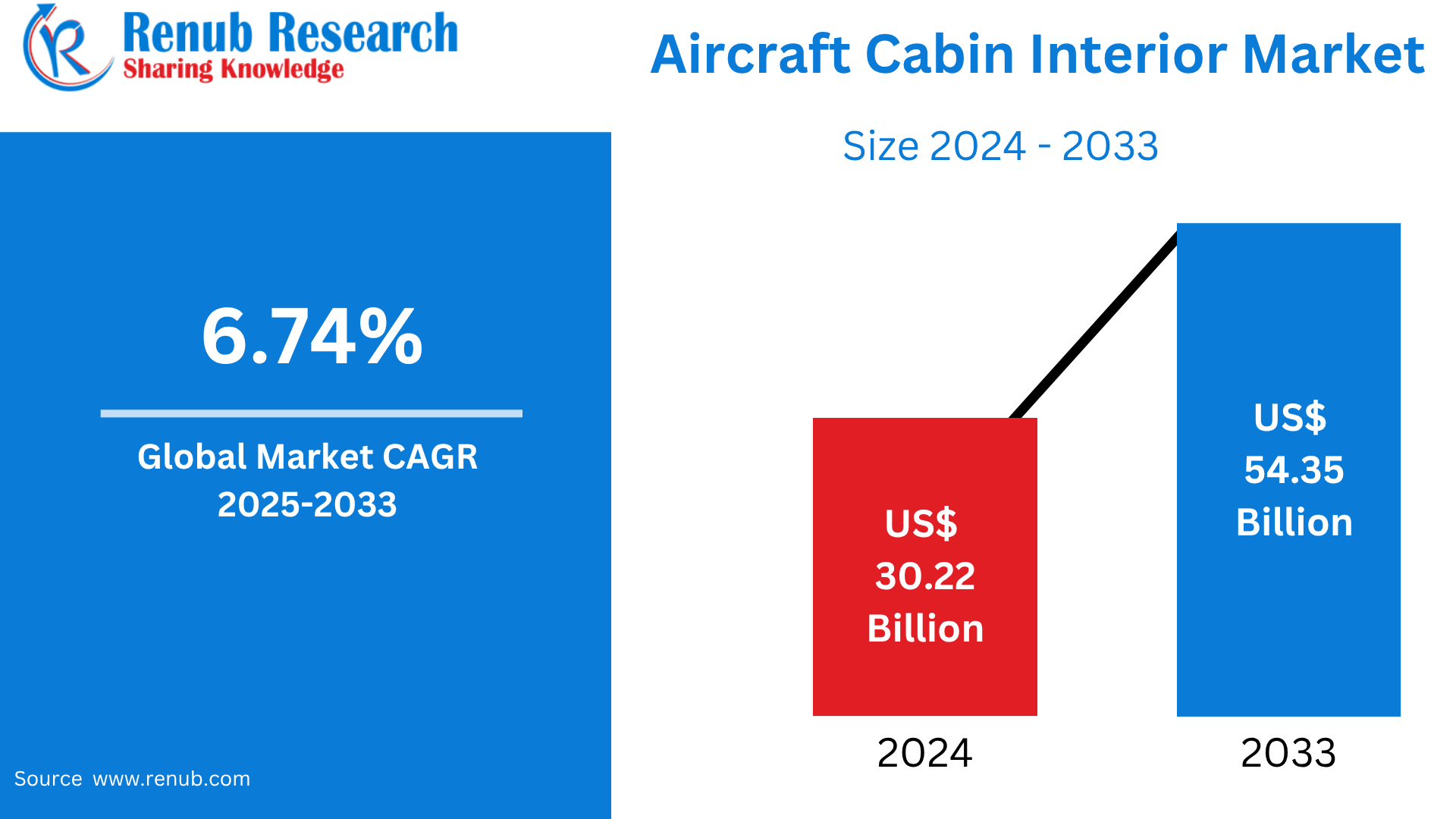
Aircraft Cabin Interior Market is expected to reach US$ 54.35 billion by 2033 from US$ 30.22 billion in 2024, with a CAGR of 6.74% from 2025 to 2033. The growing demand for comfort and in-flight entertainment, fleet modernization, adoption of lightweight materials, and technological advancements that improve passenger experience, fuel efficiency, and airline brand differentiation are all contributing factors to the growth of the aircraft cabin interior market.
Aircraft Cabin Interior Industry Overview
All in-flight amenities that improve passenger comfort and enjoyment, such as seating, lighting, galleys, restrooms, panels, stowage bins, and in-flight entertainment systems, are included in aircraft cabin interiors. These interiors, which are made with efficiency, safety, and beauty in mind, are essential to defining airline identity and passenger happiness. Contemporary designs prioritize modern digital systems for connectivity, lightweight materials to save fuel usage, and noise reduction technology. In order to maximize space, improve ergonomics, and adhere to stringent aviation standards, manufacturers and airlines are constantly updating cabin interiors. Consumer demands for elegance, comfort, and customized travel experiences are also reflected in the cabin interior industry.
Growing international air travel, which results in more aircraft deliveries and cabin retrofits, is one of the primary growth factors for the aircraft cabin interior market. Airlines are forced to invest in cutting-edge seating, entertainment, and lighting solutions due to growing customer expectations for comfort and first-rate in-flight experiences. Fuel economy and sustainability objectives are also supported by technological advancements like lightweight composite materials and smart cabin systems. Airlines are also concentrating on creating personalized cabin decor to improve brand distinctiveness. The demand for effective, affordable interior solutions is further increased by government programs that support air connectivity and the quick growth of low-cost airlines in developing nations.
Growth Drivers for the Aircraft Cabin Interior Market
Increasing Global Air Passenger Traffic
The steady rise in global air passenger traffic remains a major growth driver for the aircraft cabin interior market. Expanding middle-class populations, rising disposable incomes, and affordable airfares have led to significant increases in air travel, particularly in emerging markets like Asia-Pacific and the Middle East. As airlines expand fleets and launch new routes to meet this demand, the need for advanced cabin interiors grows proportionally. New aircraft deliveries and retrofit programs focus on improving passenger experience, comfort, and safety. Furthermore, the post-pandemic rebound in both leisure and business travel has accelerated investments in modern cabin designs. Airlines increasingly view cabin interiors as a competitive differentiator, using premium seating, entertainment systems, and elegant aesthetics to attract and retain passengers in a growing global aviation landscape.
Rising Demand for Enhanced Passenger Comfort
Passenger comfort has become a key differentiator for airlines, significantly driving demand for advanced aircraft cabin interiors. Travelers increasingly expect personalized, ergonomic, and technology-driven experiences during flights, encouraging airlines to invest in high-quality seating, mood lighting, and noise-reduction technologies. Premium cabins, in particular, emphasize luxury and wellness through spacious layouts and upgraded amenities. In December 2024, Air France introduced new onboard comfort kits tailored for La Première, Business, and Premium cabins, focusing on both passenger comfort and sustainability. The kits include high-end skincare products, eco-friendly materials, and amenities such as bamboo toothbrushes and recycled fabric accessories. This initiative reflects Air France's commitment to enhancing passenger well-being while promoting environmental responsibility. Such examples highlight how airlines worldwide are merging comfort with sustainability to elevate passenger satisfaction and strengthen brand loyalty in an increasingly competitive market.
Adoption of Lightweight Materials and Smart Technologies
The adoption of lightweight materials and smart technologies is transforming the aircraft cabin interior market by improving both operational efficiency and passenger experience. Lightweight composites, advanced polymers, and carbon fiber materials help reduce overall aircraft weight, enhancing fuel efficiency and lowering emissions. Meanwhile, smart cabin systems integrate digital technologies such as touchless controls, adaptive lighting, and IoT-enabled seating adjustments to provide personalized and connected travel experiences. In October 2024, Beta Technologies unveiled cabin interiors for its five-passenger electric aircraft, designed by a team of experts from leading aerospace and automotive industries. The interiors feature a futuristic layout, ergonomic seating, and sustainable materials optimized for electric propulsion systems. This innovation reflects the growing trend toward lightweight, tech-enabled, and eco-conscious cabin designs. As aviation embraces electrification and sustainability, smart lightweight interiors will play a crucial role in defining the next generation of efficient, comfortable, and environmentally responsible aircraft.
Challenges in the Aircraft Cabin Interior Market
High Manufacturing and Retrofitting Costs
One major challenge in the aircraft cabin interior market is the high cost of manufacturing and retrofitting. The development of lightweight, durable, and compliant materials demands significant investment in research, testing, and certification. Airlines often face budget constraints, especially during economic downturns, making interior upgrades less frequent. Additionally, retrofitting existing aircraft requires downtime, impacting operational schedules and revenue. Strict regulatory standards for safety and materials further increase production expenses. Small and mid-sized suppliers struggle to balance innovation with affordability, slowing market adoption. Consequently, high capital requirements and maintenance costs can restrain widespread implementation of advanced cabin interior solutions across all airline categories.
Stringent Safety and Regulatory Compliance
Aircraft cabin interiors must meet rigorous safety and regulatory standards set by authorities such as the FAA and EASA. Every material and design element undergoes extensive testing for flammability, toxicity, and structural integrity. These stringent requirements can delay product approvals, raising development timelines and costs. Frequent updates to regulatory frameworks also demand continuous adaptation by manufacturers, adding complexity to production cycles. Moreover, sustainability regulations now require the integration of recyclable materials, posing challenges for balancing environmental goals with performance and safety needs. Non-compliance risks costly recalls and reputational damage, making regulatory adherence one of the most critical and resource-intensive challenges in the industry.
United States Aircraft Cabin Interior Market
The United States dominates the aircraft cabin interior market due to its large commercial aviation sector and strong presence of key OEMs like Boeing, Collins Aerospace, and Honeywell. High passenger traffic, premium airline services, and frequent fleet modernization drive steady demand for advanced interiors. The U.S. market emphasizes in-flight entertainment, connectivity, and ergonomic seating to enhance passenger satisfaction. Furthermore, robust investment in lightweight materials and sustainable cabin solutions supports long-term growth. Rising refurbishment activities in aging fleets and a strong aftermarket network further boost the market. Technological innovation, combined with high consumer expectations for comfort and digital integration, positions the U.S. as a leader in cabin interior development.
Germany Aircraft Cabin Interior Market
Germany serves as a key hub in the European aircraft cabin interior market, supported by major aerospace companies like Lufthansa Technik, Diehl Aviation, and Recaro Aircraft Seating. The country’s strong engineering expertise and focus on quality design foster innovation in cabin systems, seating, and lighting solutions. Increasing demand for energy-efficient and lightweight components aligns with Germany’s sustainability goals. The nation also benefits from a high concentration of retrofit and maintenance facilities catering to European airlines. Continuous R&D investments and partnerships with global aircraft manufacturers strengthen Germany’s position in the value chain. However, challenges such as fluctuating raw material costs and strict EU environmental standards slightly constrain market expansion.
China Aircraft Cabin Interior Market
China’s aircraft cabin interior market is expanding rapidly, driven by surging domestic air travel and large-scale fleet expansion by major carriers like China Southern and Air China. Government initiatives promoting aviation infrastructure and the rise of low-cost airlines further increase demand for modern cabin interiors. Local manufacturers are collaborating with international firms to develop lightweight, cost-effective, and passenger-friendly solutions. As air travel becomes more accessible, passenger expectations for comfort and in-flight entertainment grow. The market is also supported by indigenous aircraft programs like COMAC’s C919, which stimulate local supply chain development. However, technology gaps and limited certification experience compared to Western competitors present ongoing challenges for China’s cabin interior industry.
Saudi Arabia Aircraft Cabin Interior Market
Saudi Arabia’s aircraft cabin interior market is witnessing strong growth, fueled by the country’s ambitious Vision 2030 initiative and rising tourism. Expansion of national carriers such as Saudia and the launch of Riyadh Air create opportunities for advanced cabin designs and premium in-flight services. The nation aims to become a regional aviation hub, prompting fleet modernization and airport development. Demand for luxurious interiors, including first-class suites and entertainment upgrades, is particularly strong in long-haul segments. Investments in maintenance, repair, and overhaul (MRO) capabilities are also increasing to support regional operations. However, reliance on imports for high-tech components and limited local manufacturing capacity remain challenges to full market self-sufficiency.
Recent Developments in Aircraft Cabin Interior Market
- August 2025: Air India launched a USD 400 million widebody retrofit program to upgrade its legacy Boeing 787-8 fleet. In July 2025, the airline sent the first of its 26 aircraft (VT-ANT) to Boeing’s facility in Victorville, California, for refurbishment. A second aircraft is scheduled for October 2025, with both expected to re-enter service by December 2025. The initiative focuses on modernizing cabin interiors to enhance passenger comfort and align with global service standards.
- March 2025: Delta Air Lines partnered with JetZero to develop a groundbreaking blended-wing-body aircraft aimed at enhancing fuel efficiency by 50% and reducing carbon emissions. This innovative design will serve both domestic and international routes, marking a significant step toward sustainable aviation. The first test flight of this next-generation aircraft is scheduled for 2027.
- July 2024: Turkish Airlines unveiled its new Crystal Business Class suite, designed to elevate luxury and comfort for long-haul passengers. The suite features sliding privacy doors, wireless charging stations, personal reading lamps, and 22-inch entertainment screens. This launch aligns with the airline’s strategy to enhance its premium cabin offerings and passenger experience.
- July 2024: Aviation Business Consultants International (ABCI) announced the completion of a significant project upgrading the interiors of two Electra Airways A320 aircraft by certifying, designing, and developing several cabin elements. These enhancements include five branding elements, two curtain kits, two carpet kits, A4 folders for informational/advertising display, and an interior placard kit.
- July 2024: Epsilon Aerospace Pvt. Ltd. entered into a strategic partnership with 4Repair to reinforce its commitment to strengthening maintenance, repair, and operation (MRO) services in India’s aerospace infrastructure ecosystem. The collaboration aims to enhance service reliability and expand local capabilities in the aviation maintenance sector.
- June 2024: At the 2024 Aircraft Interiors Expo, Collins Aerospace, a subsidiary of RTX Corporation, unveiled its Helix™ main cabin seat tailored for narrowbody aircraft. The Helix seat is lighter than its predecessors, offering improved ergonomic comfort and increased living space without compromising cabin density—highlighting Collins’ focus on sustainability and efficiency.
- October 2022: Singapore Airlines unveiled next-generation cabin interiors for its first, business, and economy classes. The redesigned cabins feature fully flat beds, fine dining, and luxury in-flight shower rooms to maximize passenger comfort. The airline also introduced the widest full-flat seat and enhanced storage, functionality, and onboard features.
- November 2022: J&C Aero, a Lithuanian aerospace company, entered an agreement with Crow Airlines of Libya to provide aircraft branding and refurbishment support during the delivery of its first two Airbus A320 aircraft. The deal covers galley modification, seat dress covers, seat belts, carpets, curtains, and other cabin interior elements.
- December 2022: The AeroVisto Group partnered with VARTAN, a Swiss aircraft cabin interior company, and AERO, a German manufacturer, to provide a one-stop solution for all interior cabin refurbishment needs in the private jet sector. This collaboration streamlines project management and enhances service efficiency for premium aviation clients.
- October 2022: Bombardier Inc., a Canada-based aviation company, unveiled executive cabins for its Global 7500 and Global 8000 business jets. The new design features an open-office concept with three collaborative workspaces, aimed at enhancing corporate productivity and in-flight collaboration among business travelers.
Aircraft Cabin Interior Market Segments:
Product Type
- Seat
- Cabin Lighting
- In-Flight Entertainment and Connectivity
- Aircraft Galley and Lavatory
- Aircraft Windows and Windshields
- Others
Aircraft Type
- Commercial Aircraft
- Business Jets
- Regional Jets
Class
- First Class
- Business Class
- Premium Economy Class
- Economy Class
End User
- Original Equipment Manufacturer (OEM)
- Aftermarket
Countries–Market breakup in 25 viewpoints:
North America
- United States
- Canada
Europe
- France
- Germany
- Italy
- Spain
- United Kingdom
- Belgium
- Netherlands
- Turkey
Asia Pacific
- China
- Japan
- India
- Australia
- South Korea
- Thailand
- Malaysia
- Indonesia
- New Zealand
Latin America
- Brazil
- Mexico
- Argentina
Middle East & Africa
- South Africa
- United Arab Emirates
- Saudi Arabia
All companies have been covered from 5 viewpoints:
- Company Overview
- Key Persons
- Recent Development & Strategies
- SWOT Analysis
- Sales Analysis
Key Players Analysis
- Aviointeriors S.p.A
- Jamco Corporation
- Safran S. A
- Boeing Encore Interiors LLC
- Diehl Stiftung & Co. KG
- Acro Aircraft Seating Ltd.
- Astronics Corporation
- Geven S.p.A.
- Global Aerospace Logistics (GAL)
Report Details:
| Report Features | Details |
| Base Year |
2024 |
| Historical Period |
2021 - 2024 |
| Forecast Period |
2025 - 2033 |
| Market |
US$ Billion |
| Segment Covered |
Product Type, Aircraft Type, Class, End User and Countries |
| Countries Covered |
|
| Companies Covered |
|
| Customization Scope |
20% Free Customization |
| Post-Sale Analyst Support |
1 Year (52 Weeks) |
| Delivery Format |
PDF and Excel through Email (We can also provide the editable version of the report in PPT/Word format on request) |
Customization Services available
- Analysis of Market Size and Its Segments
- More Company Profiles (Upto 10 without any additional cost):
- Additional Countries (Other than mentioned Countries):
- Region/Country Specific Reports:
- Market Entry Strategy:
- Region-Specific Market Dynamics:
- Regional Market Share Analysis:
- Trade Analysis:
- Production Insights:
- Others Customized Requests:
For more information contact our analysts.
Need More Assistance?
- Talk to our analysts to get more precious information on the current market trends.
- Include more countries and segments and customize the report based on the final requirement.
- Get a competitive advantage in your industry by knowing the report findings and making a positive impact on your revenues and operations.
- Our analysts are always ready to provide more help and pertinent information if you need any additional assistance.