Business Jet Market Report by Type, Business Model, System Analysis, Countries and Company Analysis 2026-2034
Buy NowBusiness Jet Market Trends
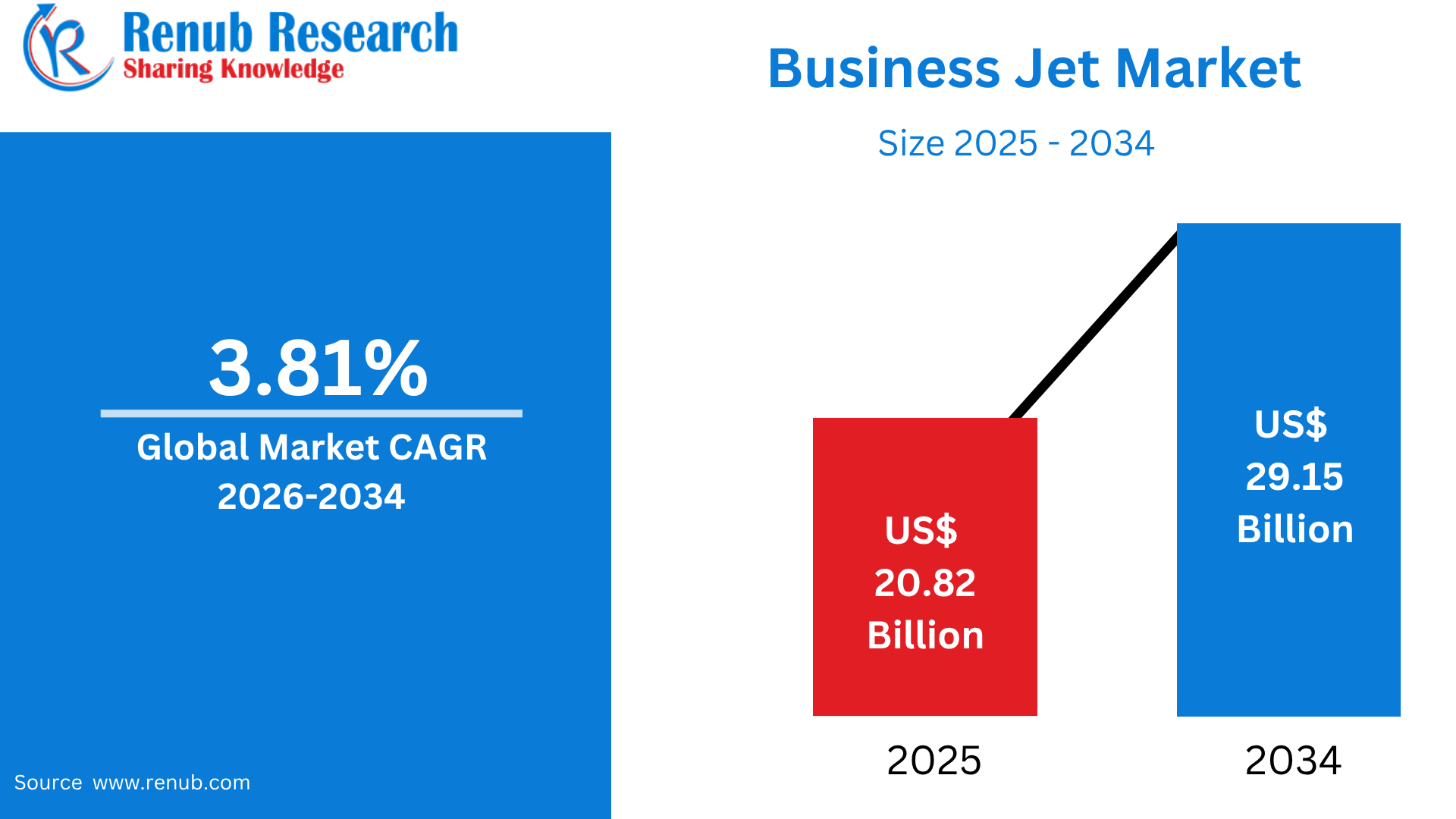
Business Jet Market is projected to grow from US$ 20.82 billion in 2025 to US$ 29.15 billion by 2034, registering a CAGR of 3.81% during the forecast period from 2026 to 2034. The market is witnessing steady expansion due to the increasing preference for private and corporate aviation, driven by the need for faster, more flexible, and time-efficient travel. Rising numbers of high-net-worth individuals (HNWIs), growing business globalization, and increasing corporate travel requirements are fueling demand for business jets worldwide. Technological advancements, including improved fuel efficiency, enhanced cabin comfort, extended flight range, and next-generation avionics, are further supporting market growth.
What is a Business Jet? Its Uses & Worldwide Popularity
A business jet, also known as a private jet or corporate jet, is a specially designed aircraft used to transport individuals or small groups for business or personal travel. Unlike commercial airlines, business jets offer flexible schedules, direct access to thousands of airports, greater privacy, and significantly reduced travel time. These aircraft vary in size and range, from light jets for short regional trips to ultra-long-range jets capable of intercontinental flights. Business jets are equipped with luxurious cabins, advanced avionics, high-speed connectivity, and customized interiors, making them ideal for executives, entrepreneurs, government officials, celebrities, and high-net-worth individuals. They are widely used for corporate meetings, executive travel, emergency medical transportation, humanitarian missions, government operations, sports team travel, and leisure tourism.
Business jets have gained widespread popularity worldwide due to increasing globalization, expanding international business activities, and the growing demand for time-efficient travel. North America remains the largest market because of its mature business aviation sector and extensive airport network, while Europe, the Middle East, and Asia-Pacific are experiencing strong growth driven by rising wealth, business expansion, and improving aviation infrastructure. The emergence of charter services, fractional ownership, and jet membership programs has also made business aviation more accessible to companies and individuals who prefer flexibility without owning an aircraft. Continuous advancements in fuel-efficient engines, sustainable aviation technologies, digital flight management systems, and enhanced passenger comfort are further strengthening the global demand for business jets.
Growth Drivers for the Business Jet Market
Increasing Demand for Time-Efficient and Flexible Air Travel
The growing need for faster, more flexible, and personalized travel is one of the major factors driving the global business jet market. As businesses expand internationally and executives manage operations across multiple regions, minimizing travel time has become increasingly important. Business jets offer significant advantages over commercial airlines by providing flexible scheduling, direct point-to-point flights, and access to thousands of regional and private airports that are not served by commercial carriers. This enables business travelers to attend multiple meetings within a single day while avoiding lengthy security procedures, flight delays, and layovers. In addition to corporate executives, entrepreneurs, government officials, celebrities, and high-net-worth individuals increasingly prefer private aviation for both business and leisure travel due to its privacy, convenience, and superior comfort. The ability to customize travel schedules and maximize productivity during flights continues to strengthen demand for business jets, making them an increasingly valuable transportation solution in today’s fast-paced global economy.
Technological Advancements and Next-Generation Aircraft Innovation
Continuous technological advancements are playing a crucial role in accelerating the growth of the business jet market. Aircraft manufacturers are introducing next-generation business jets equipped with fuel-efficient engines, advanced avionics, enhanced flight management systems, and state-of-the-art safety technologies that improve operational performance while lowering operating costs. Modern cabin designs offer high-speed internet connectivity, spacious interiors, improved noise reduction, and luxurious amenities that allow passengers to work, conduct meetings, or relax comfortably during flights. The use of lightweight composite materials and aerodynamic improvements has increased aircraft range, fuel efficiency, and overall performance, enabling longer nonstop flights with reduced emissions. Furthermore, the aviation industry is investing heavily in sustainable aviation fuels (SAF), hybrid-electric propulsion technologies, predictive maintenance systems, and artificial intelligence-based flight operations to improve sustainability and operational efficiency. These innovations not only enhance passenger experience but also reduce lifecycle costs, encouraging corporations, charter operators, and private owners to modernize fleets and invest in advanced business aircraft.
Expansion of Fractional Ownership and Charter Services
The growing popularity of fractional ownership programs, jet card memberships, and on-demand charter services has significantly broadened access to business aviation, driving market expansion. These flexible ownership models enable individuals and businesses to enjoy the advantages of private jet travel without the substantial financial commitment associated with full aircraft ownership. Fractional ownership allows multiple customers to share acquisition, maintenance, and operating expenses while ensuring guaranteed aircraft availability when needed. Similarly, jet card programs and charter services provide customers with convenient access to private flights through prepaid hours or pay-per-flight arrangements, eliminating long-term ownership responsibilities. These innovative business models have attracted not only high-net-worth individuals but also small and medium-sized enterprises seeking cost-effective, time-saving travel solutions. Increased aircraft utilization also improves operational efficiency for charter providers and fleet operators. As corporate travel continues to recover and demand for premium travel experiences increases, flexible ownership solutions are expected to remain a major contributor to the long-term growth of the global business jet market.
Business Jet Launches Worldwide
- October 2024 – Bombardier launched the Global 8000, its flagship ultra-long-range business jet featuring a top speed of Mach 0.94, a range of 8,000 nautical miles, and four distinct living spaces for ultra-long-haul executive travel.
- October 2024 – Gulfstream Aerospace introduced the Gulfstream G400, a next-generation large-cabin business jet offering a range of approximately 4,200 nautical miles, advanced Symmetry Flight Deck avionics, and enhanced fuel efficiency.
- May 2024 – Dassault Aviation launched the Falcon 6X, an ultra-widebody business jet featuring a 5,500-nautical-mile range, advanced digital flight controls, and one of the largest cabin cross-sections in business aviation.
- April 2024 – Embraer Executive Jets introduced the Phenom 100EX, an upgraded entry-level light business jet equipped with next-generation avionics, improved cabin comfort, and enhanced operational efficiency.
- February 2024 – Textron Aviation launched the Cessna Citation Ascend, a super-midsize business jet featuring advanced Garmin G5000 avionics, improved Pratt & Whitney engines, and a redesigned premium cabin.
- October 2023 – Bombardier unveiled the Challenger 3500 with new sustainability-focused cabin enhancements, advanced connectivity solutions, and upgraded passenger comfort features for corporate aviation.
- September 2023 – Gulfstream Aerospace received certification and began customer deliveries of the Gulfstream G700, offering one of the industry’s longest ranges, luxurious cabin configurations, and next-generation cockpit technologies.
- August 2023 – Honda Aircraft Company launched the HondaJet Echelon, a new light jet designed with transcontinental range, enhanced fuel efficiency, and advanced automation for business travelers.
- May 2023 – Embraer Executive Jets announced the Praetor 600 Enhanced Edition, introducing upgraded cabin technology, high-speed connectivity, and improved flight management capabilities for long-range business travel.
- March 2023 – Textron Aviation introduced new performance upgrades for the Cessna Citation CJ3 Gen2, including redesigned interiors, advanced Garmin avionics, wireless cabin management, and enhanced passenger productivity features.
Challenges in the Business Jet Market
High Acquisition, Operating, and Maintenance Costs
One of the biggest challenges facing the business jet market is the substantial cost associated with purchasing, operating, and maintaining private aircraft. Business jets require significant upfront capital investment, with acquisition costs varying from several million to tens of millions of dollars depending on aircraft size, capabilities, and customization. Beyond the initial purchase, owners must also manage ongoing expenses including fuel, scheduled maintenance, insurance, pilot and crew salaries, hangar rentals, airport charges, regulatory compliance, and aircraft upgrades. Regular inspections and replacement of certified aircraft components are essential to maintain strict aviation safety standards, further increasing operational expenditures. Additionally, fluctuations in global fuel prices can significantly affect operating costs and profitability. Although charter services and fractional ownership programs help reduce financial barriers, private aviation remains relatively expensive compared to commercial air travel. These high ownership and operating costs continue to limit market penetration, particularly among small businesses and cost-conscious customers, creating a significant challenge for broader industry expansion.
Stringent Regulatory Requirements and Environmental Sustainability Concerns
Compliance with increasingly stringent aviation regulations and environmental standards remains another major challenge for the global business jet industry. Aircraft manufacturers and operators must satisfy rigorous certification, safety, maintenance, and operational requirements established by aviation authorities worldwide before aircraft can enter commercial service. Regulatory approval processes are often lengthy, technically complex, and expensive, increasing development timelines and manufacturing costs. At the same time, growing global concerns regarding carbon emissions, climate change, and aircraft noise pollution are placing additional pressure on the business aviation sector. Business jets frequently face criticism for their higher carbon emissions per passenger compared to commercial airlines, prompting manufacturers to accelerate investments in sustainable aviation fuels, hybrid-electric propulsion systems, lightweight materials, and low-emission aircraft technologies. Meeting evolving environmental regulations while maintaining aircraft performance and profitability requires substantial research and development investment. Successfully balancing regulatory compliance, environmental sustainability, and operational efficiency will remain essential for supporting long-term growth and competitiveness in the global business jet market.
Light Business Jet Cost-Effective Private Aviation for Short- and Medium-Haul Travel
Light Business Jet Market is experiencing steady growth as corporations, charter operators, and private travelers increasingly seek efficient and cost-effective private aviation solutions. Light business jets are designed for short- to medium-range missions and typically accommodate four to eight passengers while offering lower acquisition, operating, and maintenance costs compared to larger aircraft. These jets are widely used for executive travel, regional business meetings, medical transport, government missions, and private leisure trips. Their ability to access smaller airports with shorter runways enables passengers to reach destinations closer to their final location, reducing overall travel time. Manufacturers continue to introduce new-generation light jets featuring fuel-efficient engines, advanced avionics, enhanced cabin comfort, and lower emissions to improve operational performance. Growing demand from small and medium-sized enterprises, increasing popularity of air charter services, and expanding business aviation infrastructure are further supporting market growth. As companies prioritize flexible and time-efficient travel, the light business jet segment is expected to remain an important contributor to the global business aviation industry.
Business Jet On-Demand Service Flexible Air Travel Driving Private Aviation Growth
Business Jet On-Demand Service Market is expanding rapidly as travelers increasingly prefer flexible, convenient, and personalized air travel without the financial commitment of aircraft ownership. On-demand business jet services allow customers to book private flights whenever needed through charter operators, digital booking platforms, or jet membership programs. This model has become increasingly popular among corporate executives, entrepreneurs, high-net-worth individuals, government agencies, and luxury travelers seeking efficient transportation solutions. Advances in digital reservation platforms, mobile applications, and artificial intelligence have simplified aircraft booking, pricing, scheduling, and flight management, significantly improving customer experience. The growing popularity of business aviation among small and medium-sized enterprises has also contributed to rising charter demand. Service providers continue expanding their fleets with modern, fuel-efficient aircraft while introducing flexible membership programs and subscription-based travel packages. As business travel recovers globally and customers seek greater convenience, privacy, and operational flexibility, the business jet on-demand service market is expected to witness sustained long-term growth.
Business Jet Propulsion System Advancing Performance Through Efficient Engine Technologies
Business Jet Propulsion System Market plays a critical role in the advancement of business aviation by providing high-performance engines that improve aircraft efficiency, reliability, safety, and environmental sustainability. Propulsion systems for business jets primarily consist of advanced turbofan engines engineered to deliver superior fuel efficiency, lower emissions, reduced noise levels, and extended flight range. Continuous innovation in engine design, lightweight materials, digital engine controls, and predictive maintenance technologies is enabling manufacturers to improve operational performance while reducing lifecycle costs. The industry is also investing heavily in sustainable aviation fuels (SAF), hybrid-electric propulsion technologies, and next-generation low-emission engine concepts to support global decarbonization initiatives. Increasing demand for long-range business jets, fleet modernization programs, and replacement of aging aircraft are further driving demand for advanced propulsion systems. As aviation regulations become more stringent regarding emissions and fuel efficiency, manufacturers continue focusing on environmentally responsible propulsion technologies that support both operational excellence and sustainable business aviation growth.
Business Jet Aero Structure Lightweight Materials Enhancing Aircraft Efficiency and Performance
Business Jet Aero Structure Market is witnessing steady growth as aircraft manufacturers increasingly focus on lightweight, durable, and high-performance structural components to improve overall aircraft efficiency. Aerostructures include the fuselage, wings, empennage, engine nacelles, landing gear support structures, and other primary airframe components that determine an aircraft’s strength, weight, and aerodynamic performance. Modern business jets increasingly utilize advanced composite materials, titanium alloys, aluminum-lithium alloys, and precision manufacturing technologies to reduce aircraft weight while improving structural durability and fuel efficiency. Growing demand for long-range aircraft, enhanced passenger comfort, and lower operating costs is encouraging manufacturers to invest in innovative aerostructure designs and advanced manufacturing techniques such as automated assembly and additive manufacturing. Fleet modernization initiatives and increasing production of next-generation business jets are also creating opportunities for aerostructure suppliers. As sustainability, fuel efficiency, and operational performance become key priorities across the aviation industry, continued innovation in lightweight aerostructures is expected to support the long-term growth of the global business jet aerostructure market.
Largest share of global business jet operations in United States
United States business jet market is the largest and most developed globally, supported by a strong corporate sector, a high concentration of high-net-worth individuals, and an extensive network of private airports and aviation infrastructure. The country accounts for the largest share of global business jet operations, with demand concentrated in major business hubs such as New York, Los Angeles, Chicago, Dallas, and Miami. Business jets are widely used for executive travel, corporate meetings, government operations, and luxury leisure trips, offering unmatched flexibility, privacy, and time efficiency. Continuous fleet modernization, increasing adoption of fractional ownership, jet card programs, and on-demand charter services are making private aviation accessible to a wider customer base. Technological advancements, including fuel-efficient engines, next-generation avionics, enhanced cabin connectivity, and sustainable aviation initiatives, continue to strengthen market growth. Although high operating expenses and strict regulatory compliance remain key challenges, strong economic activity, rising business travel, and continuous innovation are expected to sustain long-term expansion in the U.S. business jet market.
Growing demand from multinational corporations in Germany
Germany business jet market represents one of Europe’s leading private aviation sectors, driven by the country’s strong industrial base, global business presence, and strategic location within the continent. Major cities including Frankfurt, Munich, Berlin, and Hamburg serve as important business aviation hubs, supporting both domestic and international executive travel. Growing demand from multinational corporations, high-net-worth individuals, and charter operators is increasing the utilization of business jets for efficient and flexible transportation. The market is also benefiting from the rising popularity of charter services, fractional ownership programs, and on-demand aviation solutions that reduce the financial burden of full aircraft ownership. German customers increasingly favor modern aircraft equipped with fuel-efficient technologies, advanced avionics, and enhanced passenger comfort. Sustainability has become an important industry focus, encouraging investment in low-emission aircraft and sustainable aviation fuels. While operational costs and regulatory requirements remain significant challenges, Germany’s advanced aviation infrastructure and growing demand for premium business travel continue to support steady market growth.
Expanding international business activities, and continuous improvements in China
China business jet market is emerging as one of the most promising business aviation markets in the Asia-Pacific region, supported by economic development, expanding international business activities, and continuous improvements in aviation infrastructure. Increasing numbers of large corporations, private enterprises, and high-net-worth individuals are driving demand for business aviation services across major commercial centers such as Beijing, Shanghai, Shenzhen, and Guangzhou. Government initiatives aimed at expanding general aviation infrastructure, developing new airports, and improving fixed-base operator (FBO) services are creating favorable conditions for market growth. At the same time, increasing globalization of Chinese businesses has strengthened demand for flexible domestic and international executive travel. Although the market has experienced temporary challenges related to economic fluctuations, regulatory changes, and pandemic-related disruptions, business aviation activity has gradually recovered with increasing charter demand and cross-border operations. Growing adoption of modern aircraft, expanding private aviation services, and continued investments in aviation infrastructure are expected to support long-term growth in China’s business jet market.
Rising corporate investments, expanding international business activities Supported Saudi Arabia Business Jet
Saudi Arabia business jet market is experiencing rapid expansion as the Kingdom accelerates economic diversification and modernizes its aviation sector under its long-term development initiatives. Rising corporate investments, expanding international business activities, luxury tourism, and increasing numbers of high-net-worth individuals are driving strong demand for private aviation services. Major cities such as Riyadh, Jeddah, and Dammam have become important centers for business aviation, supported by ongoing investments in airports, dedicated business aviation terminals, fixed-base operator (FBO) facilities, and aircraft maintenance services. Government reforms designed to simplify aviation regulations and encourage private sector participation have further strengthened market development by attracting both domestic and international business jet operators. Growing demand for charter flights, executive transportation, and flexible travel solutions continues to support aircraft utilization across multiple industries. In addition, increasing investment in modern aircraft, premium aviation services, and sustainable aviation technologies is expected to create new growth opportunities. Supported by expanding infrastructure, favorable government policies, and rising business travel, Saudi Arabia is expected to remain one of the fastest-growing business jet markets in the Middle East.
Recent Developments in Business Jet Market
- In October 2025: Beginning with wing-structure assembly in North Carolina, Honda Aircraft Co. began manufacturing its first test unit of the aircraft formerly known as the HondaJet 2600 concept.
- May 2025: In accordance with its production flight protocol, Bombardier's first production Global 8000 business aircraft successfully conducted its inaugural flight from Toronto Pearson International Airport, testing important systems.
- Global private jet operator Flexjet and Embraer Executive Jets, a division of Embraer S.A., inked a purchase agreement in February 2025. In addition to an enhanced services and support arrangement, Flexjet will receive a number of Embraer business jet models, such as the Praetor 500, Praetor 600, and Phenom 300E. By 2030, Flexjet's fleet is expected to have grown greatly thanks to this order of 182 aircraft and a possible option for an additional 30 in the future.
- The Cessna Citation M2 Gen3, CJ3 Gen3, and CJ4 Gen3 are new light business aircraft that Textron Aviation announced in October 2024. The CJ4 Gen3 and the other two variants are anticipated to start production in 2026 and 2027, respectively. These aircraft have the state-of-the-art Garmin Emergency Autoland technology, and the Citation CJ4 Gen3 has the state-of-the-art Garmin G3000 PRIME avionics to give pilots easy control and convenience.
Market Segmentation
Type
- Light
- Medium
- Large
Business Model
- On-demand Service
- Ownership
Application
- Propulsion System
- Aero Structure
- Cabin Interiors
- Avionics
- Others
Countries
North America
- United States
- Canada
Europe
- France
- Germany
- Italy
- Spain
- United Kingdom
- Belgium
- Netherlands
- Turkey
Asia Pacific
- China
- Japan
- India
- Australia
- South Korea
- Thailand
- Malaysia
- Indonesia
- New Zealand
Latin America
- Brazil
- Mexico
- Argentina
Middle East & Africa
- South Africa
- Saudi Arabia
- United Arab Emirates
All the key players have been covered from 5 Viewpoints:
- Overview
- Key Persons
- Recent Development
- SWOT Analysis
- Financial Insights
Key Players Analysis:
- Airbus Se
- Bombardier Inc.
- Dassault Aviation SA
- Embraer SA
- General Dynamics Corp
- Honda Motor Co Ltd
- Pilatus Aircraft Ltd
- Textron Inc.
Report Details:
| Report Features | Details |
| Base Year |
2025 |
| Historical Period |
2022 - 2025 |
| Forecast Period |
2026 - 2034 |
| Market |
US$ Billion |
| Segment Covered |
Type, Business Model, System Analysis and Countries |
| Countries Covered |
|
| Companies Covered |
|
| Customization Scope |
20% Free Customization |
| Post-Sale Analyst Support |
1 Year (52 Weeks) |
| Delivery Format |
PDF and Excel through Email (We can also provide the editable version of the report in PPT/Word format on request) |
Customization Services available
- Analysis of Market Size and Its Segments
- More Company Profiles (Upto 10 without any additional cost):
- Additional Countries (Other than mentioned Countries):
- Region/Country Specific Reports:
- Market Entry Strategy:
- Region-Specific Market Dynamics:
- Regional Market Share Analysis:
- Trade Analysis:
- Production Insights:
- Others Customized Requests:
For more information contact our analysts.
Need More Assistance?
- Talk to our analysts to get more precious information on the current market trends.
- Include more countries and segments and customize the report based on the final requirement.
- Get a competitive advantage in your industry by knowing the report findings and making a positive impact on your revenues and operations.
- Our analysts are always ready to provide more help and pertinent information if you need any additional assistance.