Maritime Patrol Aircraft Market Size, Share, Growth Trends, Forecast by Type, Engine Type, Application, Countries and Company Analysis 2026-2034
Buy NowMaritime Patrol Aircraft Market Size
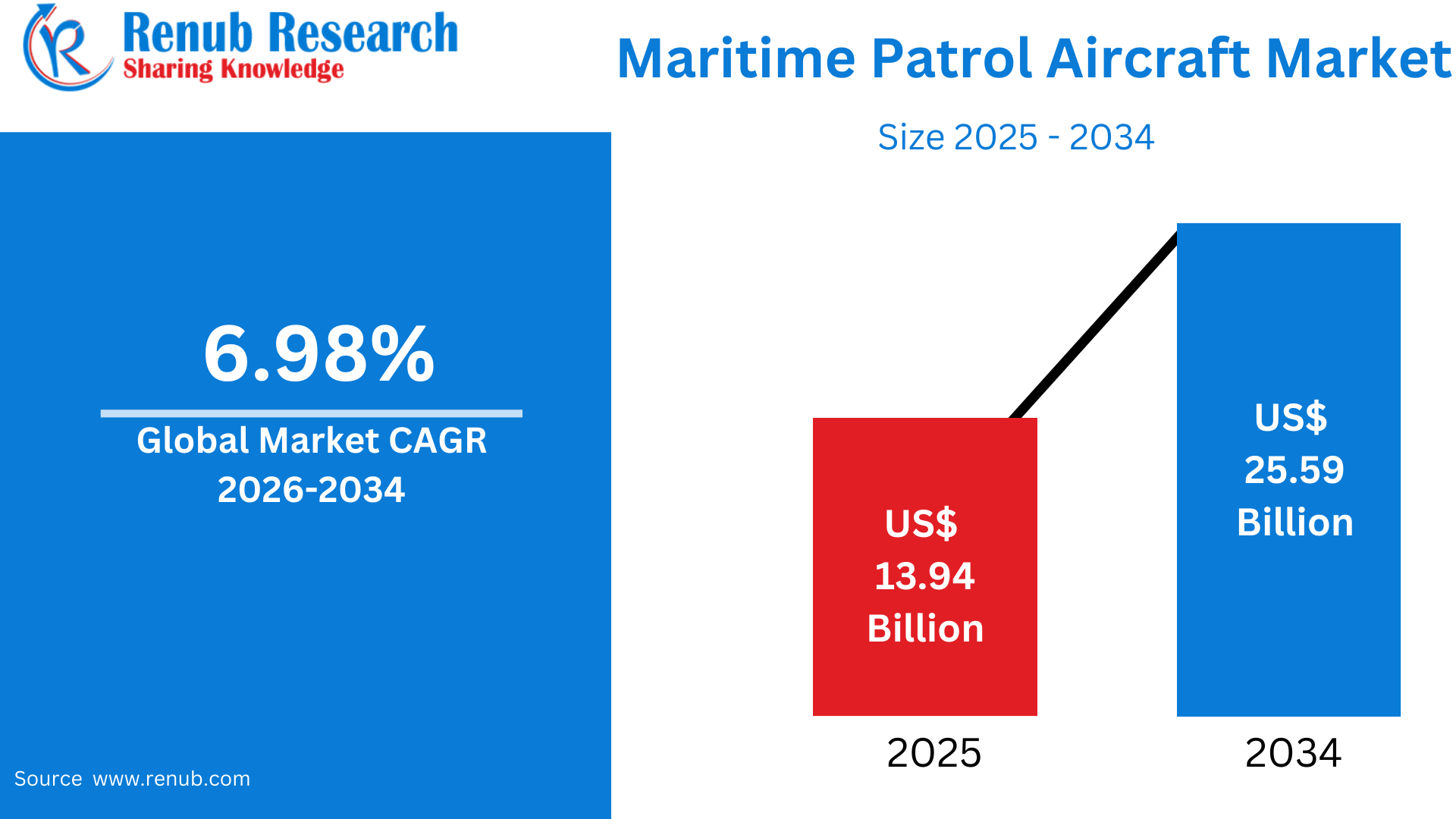
Maritime Patrol Aircraft Market is projected to grow from USD 13.94 billion in 2025 to USD 25.59 billion by 2034, expanding at a CAGR of 6.98% during 2026–2034. Market growth is driven by increasing maritime security challenges, ongoing naval modernization programs, heightened demand for coastal and offshore surveillance, and the rising adoption of advanced maritime patrol aircraft equipped with anti-submarine warfare (ASW), intelligence, surveillance, and reconnaissance (ISR) capabilities to enhance national defense and maritime domain awareness.
Maritime Patrol Aircraft Market Outlook
Maritime Patrol Aircraft (MPA) refer to the category of military aircraft used in extended range surveillance and operations in the maritime domain. The principal duties of MPAs entail maritime surveillance, anti-submarine warefare (ASW), anti-surface warefare (ASuW), surveillance and rescue, intelligence, surveillance, and reconnaissance (ISR), as well as surveillance of illegal acts like piracy, smuggling, and fishing. MPAs are designed to be equipped with sophisticated surveillance gear such as radar, electro-optical sensors, sonobuoys, Magnetic Anomaly Detectors, and communication systems, which provide extended range detection and tracking capabilities to surface ships and submarines. Modern MPAs currently in use have originated from commercial platforms, taking advantage of their extended range, dependability, and the capacity to support complex surveillance and mission equipment.
In fact, all over the world, maritime patrol aircraft have enjoyed strong popularity because of increasing challenges in maritime security and also geopolitical tensions. The expansion of naval trade routes, territorial disputes, and the need to protect exclusive economic zones have pushed nations to strengthen maritime domain awareness. Coastal and island nations, in particular, depend upon MPAs to monitor large sea areas efficiently and cost-effectively.
What are Maritime Patrol Aircrafts and Its Uses & Popularity Worldwide
A Maritime Patrol Aircraft (MPA) is a fixed-wing military aircraft specifically designed to conduct long-range surveillance, reconnaissance, anti-submarine warfare (ASW), anti-surface warfare (ASuW), search and rescue (SAR), and maritime border security operations over oceans and coastal regions. These aircraft are equipped with advanced radar systems, electro-optical and infrared sensors, sonobuoys, magnetic anomaly detectors (MAD), electronic intelligence (ELINT) systems, and secure communication technologies that enable real-time monitoring of maritime activities. Many modern MPAs are also capable of carrying torpedoes, anti-ship missiles, and depth charges to neutralize underwater and surface threats. Their primary missions include protecting territorial waters, monitoring exclusive economic zones (EEZs), combating piracy, preventing illegal fishing and smuggling, supporting disaster response, and safeguarding critical offshore infrastructure.
The popularity of maritime patrol aircraft has grown significantly worldwide due to increasing geopolitical tensions, expanding naval modernization programs, and rising concerns over submarine activities in strategically important waterways. Countries across North America, Europe, Asia-Pacific, and the Middle East continue investing in next-generation MPAs featuring artificial intelligence, satellite connectivity, unmanned system integration, and enhanced intelligence, surveillance, and reconnaissance (ISR) capabilities to strengthen maritime domain awareness and national security.
Growth Driver of the Maritime Patrol Aircraft Market
Rising Maritime Security Threats and Geopolitical Tensions
The growing complexity of maritime security threats is a major driver of the Maritime Patrol Aircraft (MPA) Market. Nations are strengthening their maritime surveillance capabilities to address illegal fishing, piracy, terrorism, smuggling, submarine incursions, and territorial disputes. According to the International Maritime Bureau (IMB), 116 piracy and armed robbery incidents against ships were reported globally in 2024, highlighting the continued need for persistent maritime monitoring. In addition, approximately 90% of global trade by volume is transported by sea, making secure sea lanes essential for economic stability. Rising tensions in regions such as the South China Sea, the Arctic, the Mediterranean, and the Indo-Pacific have encouraged governments to expand maritime patrol fleets. Modern MPAs equipped with synthetic aperture radar, electro-optical sensors, electronic intelligence systems, and satellite communications enable continuous monitoring of large ocean areas. Increasing defense budgets and stronger maritime domain awareness initiatives are prompting countries to procure advanced patrol aircraft capable of supporting intelligence, surveillance, reconnaissance (ISR), anti-surface warfare, and border protection missions.
Expanding Naval Modernization and Anti-Submarine Warfare Programs
Global naval modernization programs are significantly accelerating demand for advanced maritime patrol aircraft. Many countries are replacing aging patrol fleets with aircraft capable of conducting anti-submarine warfare (ASW), anti-surface warfare (ASuW), electronic intelligence, and long-range surveillance missions. According to the Stockholm International Peace Research Institute (SIPRI), global military expenditure exceeded US$2.7 trillion in 2024, with a substantial portion allocated to naval modernization and maritime security. The increasing deployment of advanced submarines by major naval powers has intensified the need for aircraft equipped with sonobuoys, magnetic anomaly detectors (MAD), advanced radar, and lightweight torpedoes. More than 500 submarines are currently in active service worldwide, creating continuous demand for airborne submarine detection capabilities. Governments are integrating maritime patrol aircraft with naval fleets, satellites, unmanned systems, and command-and-control networks to improve operational effectiveness. These modernization initiatives continue driving procurement of technologically advanced maritime patrol aircraft across North America, Europe, Asia-Pacific, and the Middle East.
Growing Demand for Maritime Surveillance and Exclusive Economic Zone (EEZ) Protection
The increasing importance of protecting Exclusive Economic Zones (EEZs) is driving investment in maritime patrol aircraft worldwide. Under the United Nations Convention on the Law of the Sea (UNCLOS), coastal nations possess sovereign rights over marine resources within 200 nautical miles of their coastline. Monitoring these vast maritime areas requires long-range aircraft capable of detecting suspicious vessels, illegal fishing activities, environmental hazards, and unauthorized intrusions. Worldwide, there are more than 150 coastal states responsible for securing extensive EEZs covering millions of square kilometers. Maritime patrol aircraft provide continuous surveillance through advanced radar, infrared sensors, automatic identification system (AIS) integration, and satellite communication links. Governments are increasingly using MPAs for fisheries enforcement, offshore energy infrastructure protection, disaster response, search and rescue, and environmental monitoring. Rising investments in offshore oil and gas production, renewable offshore wind farms, and undersea communication cables are further strengthening the demand for sophisticated maritime surveillance platforms capable of maintaining continuous situational awareness.
Challenges of the Maritime Patrol Aircraft Market
High Procurement, Maintenance, and Operating Costs
The high acquisition and lifecycle costs of maritime patrol aircraft remain one of the market's biggest challenges. Modern MPAs incorporate sophisticated mission systems, advanced radar, sonar processing equipment, electronic warfare suites, satellite communications, and anti-submarine weapon systems, making them among the most expensive military aircraft to procure and maintain. A single next-generation maritime patrol aircraft can cost well over US$200 million, depending on mission configuration, sensors, and weapon packages. In addition to procurement costs, operators must invest heavily in pilot training, maintenance infrastructure, spare parts, software upgrades, and long-term logistics support. Operating long-range surveillance missions also requires significant fuel consumption and continuous maintenance to ensure aircraft readiness. Budget constraints in many developing countries often delay fleet modernization programs or reduce procurement quantities. Furthermore, integrating new aircraft into existing naval command-and-control systems increases implementation costs. These financial barriers limit market growth, particularly among smaller nations with restricted defense budgets.
Rapid Technological Evolution and Competition from Unmanned Systems
Rapid advances in unmanned aerial systems (UAS), artificial intelligence, and satellite surveillance are creating new challenges for the traditional maritime patrol aircraft market. Long-endurance unmanned aerial vehicles (UAVs) can conduct persistent maritime surveillance missions at significantly lower operating costs while reducing risks to flight crews. Modern UAVs equipped with high-resolution radar, electro-optical sensors, infrared cameras, and satellite communications are increasingly complementing or replacing manned surveillance missions in some regions. At the same time, rapid technological innovation requires continuous upgrades to avionics, mission software, cybersecurity systems, and sensor suites, increasing lifecycle costs for existing fleets. Integrating artificial intelligence, autonomous mission planning, and network-centric warfare capabilities into legacy aircraft presents additional technical and financial challenges. Defense organizations must also ensure interoperability between manned aircraft, unmanned systems, naval vessels, and satellite networks. Balancing investments in traditional patrol aircraft with emerging autonomous technologies remains a strategic challenge for governments seeking to maximize maritime surveillance capabilities while controlling long-term defense expenditures.
Maritime Patrol Aircraft Launches Worldwide
- Boeing Introduced the P-8A Poseidon Increment 3 Upgrade (2025)
Boeing launched the latest Increment 3 Block 2 upgrade for the P-8A Poseidon, featuring enhanced anti-submarine warfare (ASW), improved radar processing, advanced electronic support measures, secure communications, and upgraded mission software to improve long-range maritime surveillance. - Airbus Unveiled the C295 Maritime Surveillance Aircraft Enhancement (2025)
Airbus introduced an upgraded C295 MPA equipped with next-generation mission systems, synthetic aperture radar (SAR), electro-optical/infrared sensors, Automatic Identification System (AIS), and improved anti-surface warfare capabilities for coastal security missions. - Kawasaki Heavy Industries Delivered Additional P-1 Maritime Patrol Aircraft (2025)
Japan’s Kawasaki expanded deliveries of the P-1 Maritime Patrol Aircraft, featuring indigenous turbofan engines, fly-by-light technology, enhanced acoustic processing, and upgraded anti-submarine warfare capabilities. - Embraer Showcased the C-390 Millennium Maritime Patrol Concept (2024)
Embraer introduced a maritime patrol configuration of the C-390 Millennium, integrating maritime surveillance radar, sonobuoys, mission management systems, intelligence, surveillance and reconnaissance (ISR) equipment, and anti-ship mission capabilities. - Leonardo Upgraded the ATR 72MP Maritime Patrol Aircraft (2024)
Leonardo launched an enhanced ATR 72MP featuring new mission computers, AESA surveillance radar, electronic intelligence systems, satellite communication, and expanded search-and-rescue capabilities for naval operators. - Turkish Aerospace Introduced the MELTEM-3 Enhanced Maritime Patrol Aircraft (2024)
Turkish Aerospace delivered upgraded ATR 72-600 TMPA aircraft under the MELTEM-3 program, incorporating advanced mission management systems, sonobuoys, magnetic anomaly detectors (MAD), and electronic surveillance sensors. - L3Harris Launched the Sky Warden Multi-Mission Aircraft (2024)
L3Harris introduced the Sky Warden OA-1K platform with configurable maritime surveillance capabilities, combining ISR payloads, electro-optical sensors, secure communications, and intelligence collection systems for coastal patrol missions. - Saab Introduced Enhanced Swordfish Maritime Patrol Aircraft (2023)
Saab unveiled upgraded versions of the Swordfish MPA, featuring AESA radar, advanced acoustic processing, electronic intelligence systems, anti-submarine warfare capabilities, and extended operational endurance for naval missions. - Boeing Expanded International Deliveries of the P-8I Poseidon (2023)
Boeing delivered additional P-8I Poseidon aircraft with enhanced maritime reconnaissance systems, long-range radar, electronic warfare capabilities, secure datalinks, and integrated anti-submarine warfare equipment to strengthen naval surveillance operations. - Airbus Defence and Space Enhanced the CN235 Maritime Patrol Aircraft (2023)
Airbus introduced upgraded CN235 MPA variants equipped with improved maritime surveillance radar, electro-optical imaging systems, satellite communications, mission management software, and enhanced search-and-rescue capabilities for coastal and offshore security operations.
Enhanced Survivability Driving Demand for Armoured Maritime Patrol Aircraft
Armoured Maritime Patrol Aircraft Market is expanding as defense forces seek aircraft capable of operating safely in high-threat maritime environments. These aircraft incorporate ballistic protection for the cockpit, crew stations, fuel tanks, avionics, and mission-critical systems, enabling them to withstand hostile fire during coastal surveillance, anti-piracy, and combat operations. Rising geopolitical tensions and increasing naval deployments in contested waters have accelerated demand for highly survivable patrol platforms. Global military spending exceeded US$2.7 trillion in 2024, with a growing share allocated to strengthening maritime defense capabilities. Armoured MPAs are increasingly deployed for anti-submarine warfare (ASW), anti-surface warfare (ASuW), intelligence gathering, and exclusive economic zone (EEZ) protection. Their ability to integrate advanced radar, electronic warfare systems, electro-optical sensors, and defensive countermeasure suites enhances operational effectiveness in conflict-prone regions. As nations modernize naval aviation fleets and prioritize crew safety during extended maritime missions, demand for armoured maritime patrol aircraft continues to increase across North America, Europe, Asia-Pacific, and the Middle East.
High-Speed Long-Range Operations Fuel Turbofan Market Growth
Turbofan Maritime Patrol Aircraft Market continues to expand due to the superior speed, endurance, and operational efficiency offered by turbofan-powered aircraft. Unlike turboprop platforms, turbofan MPAs are designed for rapid deployment across vast maritime regions, making them ideal for long-range intelligence, surveillance, reconnaissance (ISR), and anti-submarine warfare missions. Modern turbofan aircraft can achieve cruising speeds exceeding 800 km/h while covering operational ranges of more than 7,000 kilometers, allowing continuous monitoring of distant oceanic areas. Many next-generation patrol aircraft also remain airborne for 10–12 hours, supporting extended surveillance operations without frequent refueling. Growing investments in maritime security, offshore energy protection, and naval modernization have encouraged defense organizations to procure advanced turbofan patrol aircraft equipped with synthetic aperture radar, electronic intelligence systems, sonobuoys, and satellite communication technologies. Their high payload capacity enables integration of sophisticated mission equipment and precision-guided weapons, making turbofan-powered platforms increasingly attractive for modern naval air forces worldwide.
Expanding Maritime Domain Awareness Supporting Surveillance Aircraft Demand
Surveillance Maritime Patrol Aircraft Market is witnessing strong growth as governments strengthen maritime domain awareness to monitor territorial waters, shipping lanes, and offshore infrastructure. Approximately 90% of global trade by volume is transported by sea, making continuous maritime surveillance essential for protecting international commerce and national security. Surveillance MPAs are equipped with advanced airborne radar, electro-optical and infrared sensors, Automatic Identification System (AIS) receivers, satellite communication links, and electronic intelligence systems capable of detecting ships, submarines, and suspicious maritime activities over extensive ocean areas. These aircraft play vital roles in border security, illegal fishing prevention, anti-smuggling operations, environmental monitoring, disaster response, and search-and-rescue missions. The growing adoption of artificial intelligence, cloud-based mission management, and real-time data transmission significantly enhances situational awareness and operational decision-making. Increasing investments in coastal surveillance programs and integrated maritime security networks continue to support sustained demand for advanced surveillance maritime patrol aircraft globally.
Intelligence Gathering Capabilities Strengthening Defense Operations
Reconnaissance Maritime Patrol Aircraft Market is expanding as military organizations place greater emphasis on intelligence collection and early threat detection across strategically important maritime regions. Reconnaissance MPAs are specifically designed to conduct Intelligence, Surveillance, and Reconnaissance (ISR) missions by collecting real-time imagery, electronic signals, radar data, and communications intelligence. These aircraft operate over vast ocean areas, supporting naval task forces by identifying hostile vessels, submarines, aircraft, and emerging security threats before they reach national waters. Worldwide, more than 500 submarines remain in active naval service, increasing the importance of persistent airborne reconnaissance capabilities. Modern reconnaissance aircraft integrate high-resolution synthetic aperture radar, electro-optical imaging systems, electronic support measures, secure satellite communications, and artificial intelligence-enabled data analysis for rapid threat assessment. Governments are also integrating reconnaissance MPAs with unmanned aerial systems, satellites, and naval command centers to improve operational coordination. Continued investment in network-centric warfare and maritime intelligence systems is expected to sustain long-term growth in the reconnaissance maritime patrol aircraft market.
Naval Modernization and Indo-Pacific Strategy Driving United States Market Growth
The United States represents the largest maritime patrol aircraft market globally, supported by the world’s highest defense budget, advanced naval aviation capabilities, and expanding maritime security commitments. The U.S. defense budget exceeded US$890 billion in 2025, with significant investments directed toward naval modernization and airborne intelligence, surveillance, and reconnaissance (ISR) systems. The U.S. Navy operates one of the world’s largest fleets of maritime patrol aircraft, including advanced platforms such as the Boeing P-8A Poseidon, which has largely replaced the legacy P-3 Orion fleet. The country also maintains responsibility for protecting over 95,000 miles of coastline and extensive maritime interests across the Atlantic, Pacific, Arctic, and Indo-Pacific regions. Rising submarine activity, increasing geopolitical tensions, and expanding naval cooperation with allied nations continue to strengthen demand for next-generation maritime patrol aircraft. Continuous investments in artificial intelligence, network-centric warfare, unmanned system integration, and advanced mission sensors are expected to sustain long-term market growth in the United States.
Maritime Security and North Atlantic Operations Supporting Demand in United Kingdom
The United Kingdom Maritime Patrol Aircraft Market is expanding as the country strengthens its maritime surveillance and anti-submarine warfare capabilities to protect national waters and NATO interests. Surrounded by over 12,000 kilometers of coastline, the UK plays a strategic role in securing the North Atlantic, North Sea, and Arctic maritime routes. The Royal Air Force currently operates the P-8A Poseidon MRA1 fleet to conduct anti-submarine warfare, intelligence gathering, maritime surveillance, and search-and-rescue operations. Increasing submarine activity in the North Atlantic and growing geopolitical tensions have accelerated investments in advanced airborne surveillance systems. The United Kingdom also maintains one of Europe’s largest defense budgets, allocating approximately 2% of GDP or more to defense in line with NATO commitments. Ongoing modernization of military infrastructure, enhanced cooperation with NATO allies, and growing emphasis on maritime domain awareness continue to drive procurement of advanced maritime patrol aircraft equipped with modern radar, electronic warfare systems, and secure communication technologies.
Expanding Naval Capabilities Strengthening Maritime Surveillance in India
India’s Maritime Patrol Aircraft Market is experiencing robust growth due to expanding naval modernization programs and increasing maritime security requirements across the Indian Ocean Region. India possesses a coastline exceeding 7,500 kilometers and an Exclusive Economic Zone (EEZ) of approximately 2.37 million square kilometers, creating substantial demand for long-range maritime surveillance. The Indian Navy operates advanced maritime patrol aircraft, including the Boeing P-8I, for anti-submarine warfare, anti-surface warfare, reconnaissance, and search-and-rescue missions. India’s defense budget surpassed US$75 billion in 2025, with continuous investment in naval aviation, indigenous defense manufacturing, and maritime domain awareness systems. Rising concerns regarding submarine activity, illegal fishing, piracy, and protection of critical sea lanes have encouraged further procurement of advanced surveillance aircraft. Integration of maritime patrol aircraft with satellites, unmanned aerial systems, coastal radar chains, and naval command centers is significantly enhancing India’s maritime operational capabilities and supporting long-term market expansion.
Coastal Security and Defense Modernization Fueling Market Expansion in Saudi Arabia
Saudi Arabia’s Maritime Patrol Aircraft Market is growing steadily as the Kingdom enhances maritime security to protect strategic shipping routes, offshore energy infrastructure, and territorial waters in the Arabian Gulf and the Red Sea. Saudi Arabia has a coastline extending approximately 2,640 kilometers, supporting vital ports, offshore oil and gas facilities, and international trade corridors. The country consistently ranks among the world’s largest defense spenders, with annual military expenditure exceeding US$75 billion in recent years. Rising regional security concerns, maritime threats, and the protection of offshore petroleum assets have increased demand for advanced maritime surveillance platforms capable of intelligence, surveillance, reconnaissance (ISR), anti-surface warfare, and search-and-rescue operations. Under Vision 2030, Saudi Arabia is investing heavily in defense modernization, local aerospace manufacturing, and advanced command-and-control systems. Growing collaboration with international defense companies and the adoption of modern radar, electro-optical sensors, satellite communications, and unmanned systems are expected to support continued growth of the Saudi Arabian maritime patrol aircraft market.
Market Segmentation
Type
- Armoured
- Unarmoured
Engine Type
- Turbofan
- Turboprop
Application
- Surveillance
- Reconnaissance
- Situational Awareness
- Others
Countries
North America
- United States
- Canada
Europe
- France
- Germany
- Italy
- Spain
- United Kingdom
- Belgium
- Netherlands
- Turkey
Asia Pacific
- China
- Japan
- India
- Australia
- South Korea
- Thailand
- Malaysia
- Indonesia
- New Zealand
Latin America
- Brazil
- Mexico
- Argentina
Middle East & Africa
- South Africa
- Saudi Arabia
- United Arab Emirates
All companies have been covered with 5 Viewpoints
- Overview
- Key Persons
- Recent Development & Strategies
- Product Portfolio
- Financial Insights
Company Analysis
- Airbus SE
- BAE Systems plc
- Dassault Aviation SA
- Embraer S.A.
- Kawasaki Heavy Industries Ltd
- Lockheed Martin Corporation
- The Boeing Company
- Textron Inc.
- Saab AB
Report Details:
| Report Features | Details |
| Base Year |
2025 |
| Historical Period |
2022 - 2025 |
| Forecast Period |
2026 - 2034 |
| Market |
US$ Billion |
| Segment Covered |
Type, Engine Type, Application and Countries |
| Countries Covered |
|
| Companies Covered |
|
| Customization Scope |
20% Free Customization |
| Post-Sale Analyst Support |
1 Year (52 Weeks) |
| Delivery Format |
PDF and Excel through Email (We can also provide the editable version of the report in PPT/Word format on request) |
Key Questions Answered in Report:
- How big is the Maritime Patrol Aircraft industry?
- What is the Maritime Patrol Aircraft growth rate?
- Who are the key players in Maritime Patrol Aircraft industry?
- What are the factors driving the Maritime Patrol Aircraft industry?
- Which Region held the largest market share in the Maritime Patrol Aircraft industry?
- What segments are covered in the Maritime Patrol Aircraft Market report?
Customization Services available
- Analysis of Market Size and Its Segments
- More Company Profiles (Upto 10 without any additional cost):
- Additional Countries (Other than mentioned Countries):
- Region/Country Specific Reports:
- Market Entry Strategy:
- Region-Specific Market Dynamics:
- Regional Market Share Analysis:
- Trade Analysis:
- Production Insights:
- Others Customized Requests:
For more information contact our analysts.
Need More Assistance?
- Talk to our analysts to get more precious information on the current market trends.
- Include more countries and segments and customize the report based on the final requirement.
- Get a competitive advantage in your industry by knowing the report findings and making a positive impact on your revenues and operations.
- Our analysts are always ready to provide more help and pertinent information if you need any additional assistance.