Africa Fertilizers MarketReport by Type, Nitrogen Fertilizers, Category, Form, Application, Crop, Country and Company Analysis, 2026-2034
Buy NowAfrica Fertilizer Market Size and Forecast
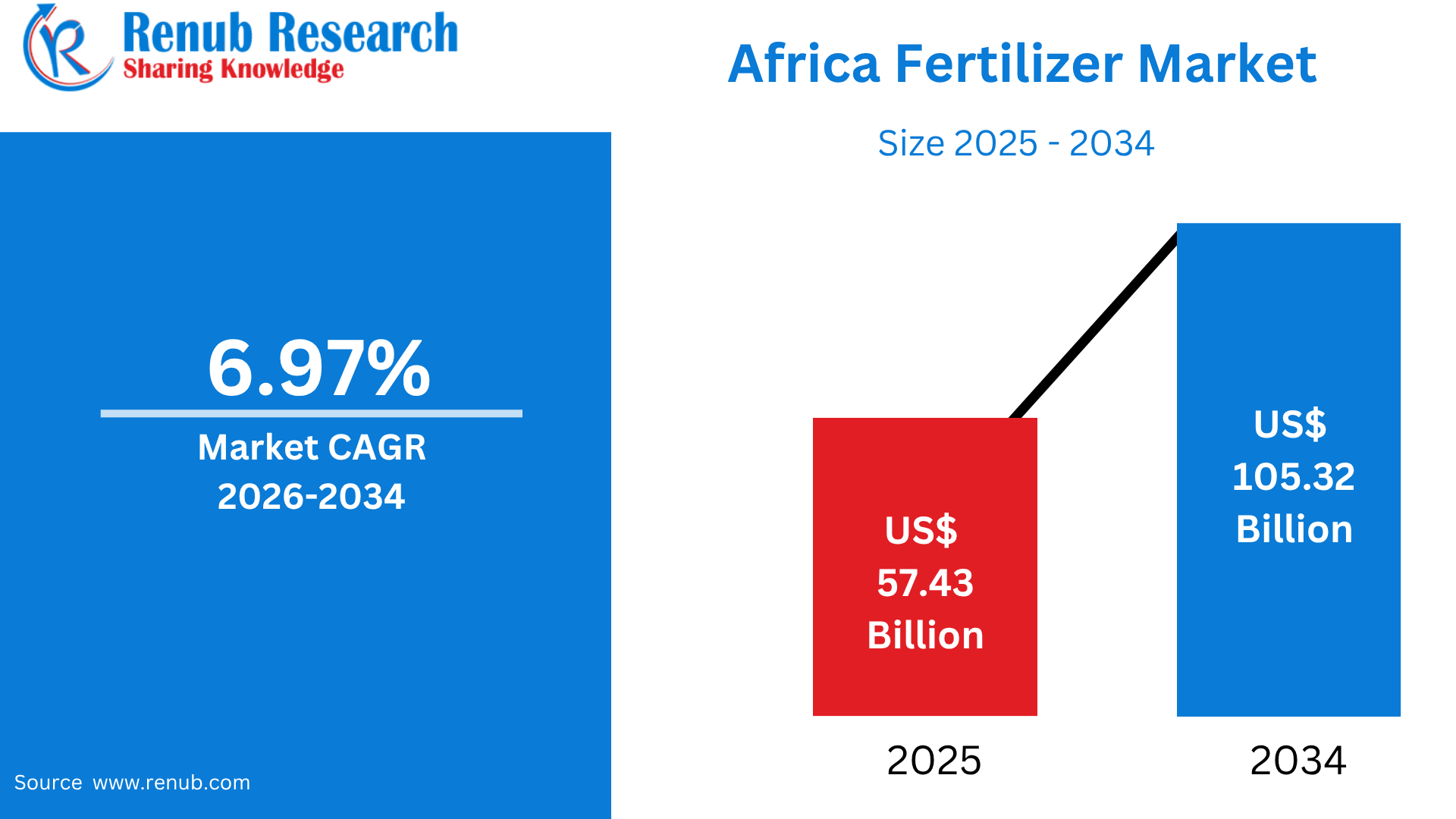
The Africa Fertilizer Market is projected to expand from US$ 57.43 billion in 2025 to US$ 105.32 billion by 2034, registering a CAGR of 6.97% during 2026–2034. The market is gaining momentum as rising food demand, expanding agricultural activities, and efforts to improve crop productivity increase fertilizer consumption across the region. Government programs aimed at strengthening food security, improving access to agricultural inputs, and supporting modern farming practices are further stimulating market development. In addition, growing awareness of soil fertility management and balanced nutrient application is encouraging farmers to adopt more efficient fertilizer solutions.
What is Fertilizer and its Uses & Popularity in Africa
Fertilizer refers to a natural or manufactured substance that supplies essential nutrients to plants and improves soil fertility, helping crops achieve healthier growth and higher yields. The major nutrients provided by fertilizers include nitrogen, phosphorus, and potassium, while secondary and micronutrients such as sulfur, calcium, zinc, and boron may also be supplied. In Africa, fertilizers are widely used for cereals, fruits, vegetables, oilseeds, cash crops, and plantation crops. They help replenish nutrients removed from the soil through continuous cultivation, improve crop quality, and increase agricultural productivity.
Fertilizers are particularly important in regions where soils have low nutrient availability and farmers are seeking to increase production from limited arable land. Their popularity is rising as African countries focus on improving food security, reducing dependence on food imports, and increasing farm incomes. Government-supported fertilizer subsidy programs, improved distribution networks, agricultural extension services, and growing awareness of balanced nutrient management are encouraging adoption. In addition, the expansion of commercial farming and modern agricultural practices is creating demand for specialty, organic, and controlled-release fertilizers across Africa.
Top 15 African Countries by Fertilizer Use kg per hectare of arable land, 2023
- Seychelles – 573.3
- Mauritius – 101.2
- Botswana – 93.1
- Malawi – 87.4
- Eswatini (Swaziland) – 80.9
- Zambia – 77.3
- South Africa – 77.2
- São Tomé and Príncipe – 68.0
- Kenya – 50.5
- Gabon – 50.3
- Ethiopia – 45.3
- Côte d’Ivoire – 43.8
- Burundi – 39.0
- Benin – 33.2
- Rwanda – 31.8
Note: Values are presented exactly as provided in your table; the table ranks countries by fertilizer use in 2023.
Fertilizer Product Launches in Africa
- 1. Rwanda Fertilizer Blending Products – Rwanda (2023): Rwanda Fertilizer Company launched a new fertilizer-blending facility with plans to formulate 20 customized fertilizer products by 2025, designed around the specific soil and crop requirements of Rwandan farmers.
- 2. Zinc-Enriched NPK Fertilizers – Tanzania (2024): Yara expanded specialty fertilizer production in Tanzania with zinc-enriched NPK formulations, targeting improved nutrient availability for crops such as cassava and supporting localized fertilizer supply.
- 3. Customized Fertilizer Formulations – Ghana (2025): Invess Agriculture commissioned a US$3.5 million fertilizer production facility at Shai Hills, with reported capacity of approximately 385,000 metric tons annually and around 20 formulations designed for Ghanaian agriculture.
- 4. Phosphate-Based Fertilizer Range – Morocco/Africa (2024): OCP continued expanding the availability of phosphate-based fertilizers across African markets, supporting region-specific nutrient formulations for farmers. OCP remains a major African fertilizer producer and exporter.
- 5. Granulated Urea Fertilizer Expansion – Nigeria (2025): Dangote Fertilizer advanced its expansion strategy around its 3-million-ton annual-capacity urea complex, with plans aimed at increasing domestic and regional fertilizer availability.
- 6. Humanitarian Fertilizer Supply Program – Africa (2024): PhosAgro expanded deliveries of mineral fertilizers to African countries. Its fertilizer shipments to Africa exceeded 730,000 tonnes in 2024, up 33% from 548,000 tonnes in 2023, broadening access to phosphate-based products.
- 7. Mozambique Fertilizer Dashboard – Mozambique (2024): AfricaFertilizer launched a Mozambique Fertilizer Dashboard, providing market and fertilizer information to improve transparency and support better decision-making across the agricultural supply chain.
- 8. New Customized Fertilizer Blends – East Africa (2024–2025): Fertilizer manufacturers and blending facilities across East Africa increasingly introduced crop- and soil-specific blends, including micronutrient-enriched formulations, to address localized nutrient deficiencies.
- 9. Triple Superphosphate (TSP) Fertilizer Expansion – Morocco (2025–2026): OCP increased its strategic focus on TSP fertilizers, targeting more than 50% of production in 2026, compared with about 30% in 2025, responding to changing global fertilizer-market conditions.
- 10. Fertilizer Access Initiative – Tanzania (2025): The Africa Fertilizer Financing Mechanism launched a project designed to increase fertilizer access for Tanzanian farmers, strengthening availability and supporting agricultural productivity.
Growth Drivers of the Africa Fertilizer Market
Rising Food Demand and Agricultural Production
Africa’s growing population is creating substantial pressure to increase agricultural productivity and strengthen food security. The continent’s population is projected to approach 2.5 billion by 2050, increasing the requirement for cereals, vegetables, fruits, and other agricultural products. Fertilizers are essential for replenishing soil nutrients and improving crop yields, particularly in regions where continuous cultivation has depleted soil fertility. Nitrogen, phosphorus, and potassium fertilizers are widely used to support crop growth and improve agricultural output. Countries such as Nigeria, Ethiopia, Kenya, Tanzania, and South Africa are expanding fertilizer use to increase the productivity of staple crops, including maize, wheat, rice, and sorghum. The African Union’s Comprehensive Africa Agriculture Development Programme (CAADP) also emphasizes improved agricultural productivity and investment. Increasing commercialization of farming and expanding food-processing industries are encouraging farmers to adopt productivity-enhancing inputs. As governments prioritize food security and reduce dependence on imported agricultural commodities, demand for fertilizers is expected to remain a major growth driver across Africa.
Government Initiatives to Improve Fertilizer Access
Government policies and agricultural support programs are significantly contributing to fertilizer-market development across Africa. Several countries are introducing fertilizer subsidies, input-support programs, improved distribution systems, and financing mechanisms to make fertilizers more accessible to smallholder farmers. The African Union’s Abuja Declaration set a target of increasing fertilizer use to 50 kilograms of nutrients per hectare, highlighting the continent’s historically low fertilizer application rates. Although the target has not been uniformly achieved, it has encouraged governments and development organizations to strengthen fertilizer availability and agricultural-input markets. Countries including Nigeria, Ethiopia, Ghana, Zambia, and Tanzania have introduced initiatives aimed at improving access to fertilizers and other farm inputs. The African Fertilizer and Soil Health Summit in 2024 further emphasized sustainable fertilizer use and soil-health management. Government efforts to develop domestic fertilizer production, improve transport infrastructure, and reduce dependence on imported products are also supporting market expansion. These initiatives are expected to encourage greater fertilizer adoption and improve agricultural productivity.
Increasing Adoption of Modern Farming and Soil Management
The adoption of modern agricultural practices is creating additional demand for fertilizers across Africa. Farmers are increasingly recognizing the importance of soil testing, balanced nutrient application, precision agriculture, and integrated soil-fertility management for improving productivity. Africa has approximately 60% of the world’s uncultivated arable land, yet agricultural productivity remains relatively low in many regions because of nutrient depletion, limited irrigation, and restricted access to modern inputs. Fertilizers can help address nutrient deficiencies and improve the productivity of cultivated land when applied appropriately. The growing use of improved seeds, irrigation, mechanization, and protected cultivation is also increasing the need for effective fertilizer management. Precision-farming technologies are enabling larger commercial farms to apply nutrients according to crop and soil requirements, reducing unnecessary fertilizer use while improving yields. In addition, growing interest in specialty fertilizers, micronutrients, biofertilizers, and controlled-release products is creating new opportunities. As farmers increasingly focus on sustainable soil management and higher productivity, fertilizer consumption is expected to increase.
Challenges of the Africa Fertilizer Market
High Fertilizer Prices and Limited Affordability
High fertilizer prices remain one of the major constraints affecting fertilizer adoption among African farmers. Many smallholder farmers operate with limited financial resources and are highly sensitive to changes in fertilizer and crop prices. Africa imports a significant portion of the fertilizers used in agriculture, making local markets vulnerable to international commodity prices, energy costs, currency fluctuations, and transportation expenses. The disruption of global fertilizer supply chains following the Russia-Ukraine conflict highlighted these vulnerabilities and contributed to significant price increases in many African markets. High prices can encourage farmers to reduce fertilizer application or use lower-cost products, potentially limiting crop productivity. Transportation expenses are another challenge because fertilizer must often travel long distances from ports or manufacturing facilities to rural farming communities. Although government subsidies can reduce the financial burden, subsidy programs may face budget limitations and distribution challenges. Improving local manufacturing capacity, strengthening fertilizer supply chains, expanding agricultural credit, and promoting efficient nutrient application will be important for improving affordability and market penetration.
Poor Infrastructure and Uneven Distribution Networks
Weak agricultural infrastructure continues to limit the efficient distribution and use of fertilizers across many African countries. Rural roads, storage facilities, rail networks, and logistics systems remain inadequate in several agricultural regions, increasing transportation costs and creating delays in fertilizer delivery. Many smallholder farmers live far from major commercial centers, making access to agricultural inputs difficult, particularly during peak planting periods. Africa’s fertilizer distribution system is also fragmented, with differences in market access, availability, and pricing between countries and even between rural communities within the same country. Limited access to reliable soil-testing services and agricultural extension programs further reduces the effectiveness of fertilizer use because farmers may not know the appropriate nutrient type, quantity, or application timing. Climate-related disruptions, including droughts and floods, can additionally affect transportation and agricultural operations. Strengthening rural infrastructure, expanding digital agricultural platforms, improving storage facilities, and developing local distribution networks could reduce these barriers. Better extension services and farmer education would also help ensure that fertilizers are applied efficiently and sustainably.
Africa Nitrogen Fertilizers Market
Africa Nitrogen Fertilizers Market is expanding as farmers seek to improve soil fertility, crop productivity, and food security across the continent. Nitrogen is one of the most essential nutrients for plant growth, supporting leaf development, protein formation, and overall crop yields. Africa’s fertilizer consumption remains relatively low compared with global averages, creating substantial room for market expansion as agricultural intensification increases. Growing cultivation of maize, wheat, rice, vegetables, and other staple crops is strengthening demand for nitrogen-based products such as urea and ammonium nitrate. Government fertilizer-subsidy programs, agricultural development initiatives, and investments in domestic fertilizer production are also improving availability in several countries. At the same time, expanding commercial farming and increasing adoption of improved seeds and irrigation are encouraging more efficient nutrient application. However, high fertilizer prices, transportation costs, currency fluctuations, and limited access among smallholder farmers continue to constrain consumption. As African countries prioritize higher agricultural productivity and reduced food-import dependence, nitrogen fertilizers are expected to remain a key component of the region’s agricultural development.
Africa Ammonium Nitrate Fertilizers Market
Africa Ammonium Nitrate Fertilizers Market is gaining momentum as farmers and commercial agricultural producers seek concentrated and rapidly available nitrogen sources to improve crop productivity. Ammonium nitrate generally contains around 34% nitrogen, making it an efficient fertilizer for crops requiring substantial nitrogen during active growth stages. Its application is particularly relevant to cereal and high-yield agricultural production, where maintaining adequate nutrient availability can support improved harvests. Growing investments in commercial agriculture, expansion of cultivated land, and increasing efforts to strengthen food security are supporting demand across African markets. Government programs designed to improve fertilizer accessibility and agricultural productivity are also creating opportunities for nitrogen-based products. However, ammonium nitrate faces regulatory and logistical challenges in some countries because of its safety requirements and controlled handling. Rising transportation and storage costs can further affect its affordability for smallholder farmers. Nevertheless, increasing agricultural intensification and demand for efficient nutrient management are expected to support the continued development of the ammonium nitrate fertilizer segment across Africa.
Africa Organic Fertilizers Market
Africa Organic Fertilizers Market is expanding as farmers increasingly focus on soil health, sustainable agriculture, and environmentally responsible production methods. Organic fertilizers derived from animal manure, compost, crop residues, plant materials, and other biological sources can improve soil structure while supplying nutrients and organic matter. This is particularly relevant in Africa, where soil degradation, nutrient depletion, and declining soil fertility affect agricultural productivity in several farming regions. Smallholder farmers are showing interest in locally available organic inputs because they can often be produced or sourced within farming communities, potentially reducing dependence on expensive imported fertilizers. Governments, development organizations, and agricultural institutions are also promoting integrated nutrient management and sustainable farming practices. The increasing interest in organic and environmentally friendly food production is creating additional opportunities for organic fertilizer adoption. However, inconsistent nutrient concentrations, limited processing infrastructure, transportation challenges, and insufficient farmer awareness can restrict commercial-scale adoption. With increasing emphasis on restoring soil fertility and reducing environmental impacts, organic fertilizers are expected to become an increasingly important component of Africa’s sustainable agricultural-input market.
Africa Agriculture Fertilizers Market
Africa Agriculture Fertilizers Market is a critical component of the continent’s efforts to increase agricultural productivity, improve food security, and strengthen rural economies. Fertilizers, including nitrogen, phosphate, potash, compound, and organic products, provide essential nutrients needed to improve crop growth and replenish depleted soils. Africa’s rapidly growing population is increasing demand for staple foods, placing greater pressure on farmers to produce higher yields from available agricultural land. The continent’s relatively low fertilizer application compared with many other agricultural regions also indicates considerable potential for future market expansion. Governments are introducing fertilizer subsidies, financing programs, improved distribution systems, and domestic manufacturing initiatives to increase farmer access. At the same time, commercial farming, mechanization, irrigation, improved seeds, and precision-agriculture practices are encouraging more efficient fertilizer use. However, affordability, inadequate rural infrastructure, import dependence, and limited access to agricultural extension services remain significant challenges. Continued investment in fertilizer production, distribution networks, farmer education, and soil testing is expected to support the long-term development of Africa’s agricultural fertilizer market.
Fertilizer Market in South Africa
South Africa Fertilizer Market is one of the most established fertilizer markets in Sub-Saharan Africa, supported by large-scale commercial agriculture, advanced farming practices, and a well-developed agricultural value chain. Fertilizers are extensively used in the cultivation of maize, wheat, sugarcane, fruits, and vegetables, creating consistent demand for nitrogen, phosphate, potash, and compound fertilizers. The increasing adoption of precision agriculture and soil-testing technologies is encouraging farmers to apply nutrients more efficiently and maintain long-term soil productivity. Large commercial farms and export-oriented agribusinesses are also investing in modern crop-management techniques to improve yields and meet international quality standards. Government agricultural programs and private-sector investments are further supporting fertilizer demand. However, fluctuations in energy and raw-material costs, exchange-rate movements, import dependence, and environmental concerns remain important market challenges. South Africa continues to account for a substantial share of fertilizer consumption in Sub-Saharan Africa because of its comparatively high agricultural productivity and sophisticated farming infrastructure. In August 2025, the launch of the SADC Soil Health and Fertilizer Hub (SADC SHFH) in Johannesburg further strengthened regional efforts toward sustainable soil management and improved fertilizer utilization.
Fertilizer Market in Algeria
Algeria Fertilizer Market is developing steadily as the country focuses on increasing domestic agricultural production and strengthening food security. Fertilizers are particularly important for Algeria because significant portions of the country have arid and semi-arid climatic conditions, where maintaining soil productivity can be challenging. Key crops such as wheat, barley, vegetables, potatoes, and citrus fruits generate demand for nitrogen, phosphate, and compound fertilizers. Algeria also benefits from its substantial natural-gas and petrochemical resources, which provide an important foundation for domestic nitrogen-fertilizer production. Government support for agricultural modernization, irrigation development, and improved crop productivity is encouraging farmers to adopt modern agricultural inputs. Expansion of irrigated agriculture is particularly important because improved water availability allows farmers to increase cropping intensity and fertilizer use. Nevertheless, water scarcity, logistics constraints, import requirements for certain fertilizer products, and uneven distribution networks can restrict market development. Continued investment in irrigation infrastructure, domestic fertilizer manufacturing, and agricultural modernization is expected to strengthen Algeria’s fertilizer market while supporting the country’s broader food-security objectives.
Fertilizer Market in Nigeria
Nigeria Fertilizer Market is experiencing significant development, supported by the country’s large agricultural sector, expanding food requirements, and growing population. Fertilizers are essential for improving the productivity of important crops such as maize, rice, cassava, sorghum, millet, and yams. Government initiatives, private-sector investments, and efforts to expand domestic fertilizer manufacturing have improved supply availability and reduced some dependence on imported products. Nigeria’s substantial natural-gas resources also provide an important advantage for producing nitrogen fertilizers, while increasing investment in blending and distribution infrastructure is supporting wider market access. The expansion of commercial farming and agro-processing industries is creating additional demand for reliable agricultural inputs. However, high fertilizer prices, inadequate rural roads and storage facilities, distribution inefficiencies, and currency volatility continue to affect affordability for smallholder farmers. Government-backed fertilizer programs and increased private-sector participation are helping address some of these barriers. With extensive arable land and a large agricultural workforce, Nigeria is expected to remain one of Africa’s most important fertilizer markets as the country seeks to improve domestic food production and agricultural productivity.
Fertilizer Market in Ghana
Ghana Fertilizer Market is expanding as the government and agricultural stakeholders prioritize food security, crop productivity, and modernization of farming practices. Fertilizers are widely used for crops including cocoa, maize, rice, vegetables, and other commercial and staple crops, making them an important component of the country’s agricultural-input industry. Government fertilizer-support programs and farmer assistance initiatives have helped improve access to agricultural inputs, while partnerships with international organizations have increased awareness of balanced nutrient management and proper fertilizer application. Growing investment in agro-processing and commercial agriculture is also creating demand for higher and more consistent crop yields. However, high fertilizer prices, transportation expenses, and weaknesses in rural distribution networks continue to limit access for some smallholder farmers. Domestic manufacturing investments are therefore becoming increasingly important for improving supply security and reducing reliance on imported products. In August 2025, a US$3.5 million fertilizer production facility at Shai Hills in Ghana’s Greater Accra Region was commissioned by Invess Agriculture Ltd. The facility was reported to have an annual production capacity of approximately 385,000 metric tons and 20 fertilizer formulations, strengthening Ghana’s domestic fertilizer-production capabilities.
Africa Fertilizers Market Segments
Type
- Nitrogen Fertilizers
- Phosphate Fertilizers
- Potash Fertilizers
Nitrogen Fertilizers
- Ammonia (N)
- Ammonium Nitrate (N)
- Ammonium Phosphate (N)
- Ammonium Sulphate (N)
- Calcium Ammonium Nitrate (N)
- Potassium Nitrate (N)
- Urea (N)
- Urea Ammonium Nitrate (N)
- NK (N)
- NPK (N)
- NP (N)
- Others
Category
- Organic
- Inorganic
Form
- Dry
- Liquid
Application
- Agriculture
- Horticulture
- Gardening
- Others
Crop
- Grassland
- Vegetables
- Fruits/Treenuts
- Roots/Tubers
- Sugar Crops
- Fibre Crops
- Other Oil Crops
- Oil Palm
- Soybeans
- Other Cereals
- Maize
- Rice
- Wheat
- Others
Country
- South Africa
- Egypt
- Algeria
- Ethiopia
- Morocco
- Nigeria
- Ghana
- Libya
- Rest of Africa
All companies have been covered from 5 viewpoints:
- Overviews
- Key Person
- Recent Developments
- SWOT Analysis
- Revenue Analysis
Key Players Analysis
- Foskor
- Gavilon South Africa (MacroSource, LLC)
- Haifa Group
- ICL Group Ltd
- K+S Aktiengesellschaft
- Kynoch Fertilizer
- UPL Limited
- Yara International ASA
Report Details:
| Report Features | Details |
| Base Year |
2024 |
| Historical Period |
2020 - 2024 |
| Forecast Period |
2025 - 2033 |
| Market |
US$ Billion |
| Segment Covered |
Type, Nitrogen Fertilizers, Category, Form, Application, Crop and Countries |
| Countries Covered |
|
| Companies Covered |
|
| Customization Scope |
20% Free Customization |
| Post-Sale Analyst Support |
1 Year (52 Weeks) |
| Delivery Format |
PDF and Excel through Email (We can also provide the editable version of the report in PPT/Word format on request) |
Customization Services available
- Analysis of Market Size and Its Segments
- More Company Profiles (Upto 10 without any additional cost):
- Additional Countries (Other than mentioned Countries):
- Region/Country Specific Reports:
- Market Entry Strategy:
- Region-Specific Market Dynamics:
- Regional Market Share Analysis:
- Trade Analysis:
- Production Insights:
- Others Customized Requests:
For more information contact our analysts.
Need More Assistance?
- Talk to our analysts to get more precious information on the current market trends.
- Include more countries and segments and customize the report based on the final requirement.
- Get a competitive advantage in your industry by knowing the report findings and making a positive impact on your revenues and operations.
- Our analysts are always ready to provide more help and pertinent information if you need any additional assistance.