Video Conferencing Market Size, Share, Growth, Trends, Industry Analysis & Forecast 2026–2034
Buy NowVideo Conferencing Market Size and Forecast
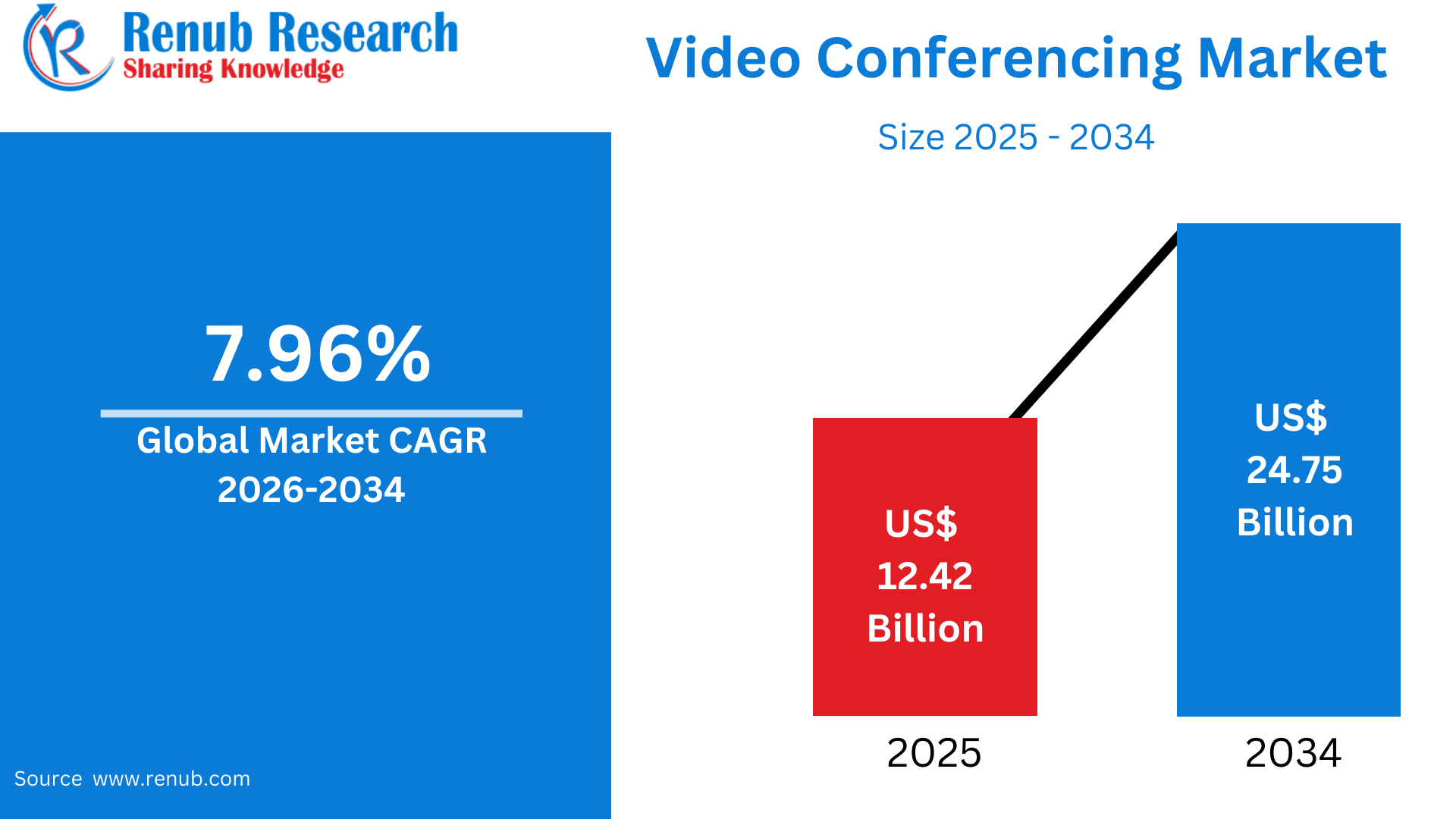
Video Conferencing Market is projected to expand from US$ 12.42 billion in 2025 to US$ 24.75 billion by 2034, registering a CAGR of 7.96% during the forecast period from 2026 to 2034. Market growth is fueled by the widespread adoption of remote and hybrid work environments, increasing the need for seamless virtual communication and real-time collaboration. Continuous innovations in artificial intelligence, cloud-based conferencing solutions, and high-definition audio-video technologies are further accelerating adoption across corporate enterprises, educational institutions, healthcare organizations, and government agencies.
Video Conferencing Industry Overview
Video conferencing is a communication technology that enables individuals or groups to interact in real time through audio and video over the internet. It allows users to conduct meetings, share content, and collaborate remotely from any location. Core components include cameras, microphones, speakers, software platforms, and network connectivity. Modern solutions feature screen sharing, virtual whiteboards, AI-based enhancements, and integration with productivity tools. Video conferencing is widely used in business, education, telehealth, customer engagement, and personal communication. Its key advantages include reduced travel cost, greater flexibility, improved productivity, and seamless global connectivity, making it essential in today’s hybrid and digital-first environments.
A significant growth driver for the video conferencing market is the increasing adoption of hybrid and remote work models. Organizations require flexible communication tools that support real-time collaboration, virtual meetings, and secure content sharing across distributed teams. The rise of digital transformation accelerates the shift toward cloud-based platforms that offer scalability and advanced features. Meanwhile, innovations in artificial intelligence—such as noise suppression, auto-framing, and real-time transcription—enhance meeting quality and user experience. Growing use cases in education, healthcare, customer service, and government also expand market potential. Together, these factors reinforce the continuous global demand for video conferencing solutions.
What is Video Conferencing and Its Uses & Popularity Worldwide
Video conferencing is a digital communication technology that enables individuals and groups in different locations to interact through live video and audio over the internet. It allows participants to conduct face-to-face meetings, webinars, training sessions, interviews, and collaborative discussions without requiring physical travel. Modern video conferencing platforms also offer features such as screen sharing, file sharing, meeting recording, virtual backgrounds, live chat, and AI-powered transcription, making communication more efficient and engaging.
The popularity of video conferencing has increased significantly worldwide due to the rapid adoption of remote and hybrid work models, digital transformation initiatives, and advancements in cloud computing and high-speed internet connectivity. Businesses use video conferencing to improve collaboration among global teams, reduce travel costs, and accelerate decision-making. Educational institutions rely on it for virtual classrooms and online learning, while healthcare providers use it for telemedicine consultations and remote patient monitoring. Governments and public organizations also leverage video conferencing for administrative meetings, public services, and emergency coordination. As organizations continue embracing flexible work environments and digital collaboration, video conferencing remains an essential tool for seamless communication, productivity, and global connectivity across industries.
Zoom Video Conferencing Usage Statistics
- Minimal usage before 2019, with Zoom showing very limited global web traffic.
- Rapid growth began in late 2019, signaling increasing enterprise and consumer adoption.
- Explosive surge occurred during 2020–2021, coinciding with the global shift to remote work, online education, and virtual meetings.
- Entire Internet traffic peaked at approximately 135,000–137,000 during 2022–2024, indicating Zoom’s highest level of global usage.
- Top 1 Million websites consistently generated the second-highest level of Zoom-related traffic, reaching around 19,000–20,000.
- Top 100,000 websites showed steady growth, peaking at approximately 4,500–5,000.
- Top 10,000 websites maintained relatively low but stable usage, generally remaining below 1,000.
- Top 1,000 websites recorded the lowest traffic throughout the period, indicating Zoom usage is concentrated across a broader range of websites rather than only the largest domains.
- A moderate decline is visible during 2025, with overall traffic dropping from previous highs before showing signs of recovery.
- By the latest period shown, Entire Internet traffic recovered to approximately 126,000–127,000, suggesting sustained long-term demand despite post-pandemic normalization.
- Overall trend: Zoom remains one of the world’s leading video conferencing platforms, supported by continued adoption of hybrid work, virtual collaboration, online education, telehealth, and enterprise digital transformation.
Video Conferencing Apps Statistics
- Zoom continues to dominate with over 350 million daily meeting participants as of 2023, accounting for 80% of the global video conferencing app market share.
- 74% of sales are made by TeamViewer, and 73% are made by Google Hangouts Meet.
- Microsoft Teams saw 270 million monthly active users by the end of 2023, growing at a rate of 25% year-over-year. Due to its integration with the Microsoft 365 ecosystem.
- Google Meet reached 150 million daily meeting participants in 2023. With a 20% increase in adoption among educational institutions and small businesses.
- Skype maintains a 6% share of the market, with 40 million active daily users, primarily catering to personal communication and small business needs.
- Cisco WebEx reached over 10 billion meetings hosted in 2023. With a significant presence in the enterprise sector, contributing to a 10% market share.
- GoToMeeting’s user base grew by 15% in 2023, with the app reporting 12 million active users as businesses continue to shift toward remote work solutions.
- Slack’s video conferencing feature saw a 30% increase in usage in 2023, contributing to the app’s overall growth in workplace communication.
- BlueJeans, acquired by Verizon, holds a 3% share of the video conferencing app market. Becoming a top choice for large enterprises with its focus on security and scalability.
Growth Driver of the Video Conferencing Market
Rising Adoption of Remote and Hybrid Work Models
The widespread shift toward remote and hybrid work is one of the strongest drivers of the global video conferencing market. Organizations are increasingly investing in virtual collaboration platforms to connect distributed workforces, improve productivity, and reduce operational costs. According to the International Labour Organization (ILO), approximately 23% of the global workforce worked remotely in 2023, while millions of employees continue to follow hybrid work schedules. In addition, global enterprises are reducing business travel expenses by replacing many in-person meetings with virtual conferences. Video conferencing also supports cross-border collaboration, allowing multinational companies to conduct meetings, employee training, and client interactions in real time. Integration with cloud-based productivity suites, AI-powered meeting summaries, and automatic language translation further enhances user experience. As companies continue prioritizing workplace flexibility, digital collaboration tools are becoming essential infrastructure. This sustained demand across corporate, SME, and startup segments is expected to remain a major contributor to the long-term growth of the global video conferencing market.
Expanding Digital Transformation Across Education and Healthcare
The accelerating digital transformation of education and healthcare sectors is significantly boosting demand for video conferencing solutions worldwide. Universities, schools, hospitals, and clinics increasingly rely on secure virtual communication platforms to deliver services efficiently. According to UNESCO, more than 1.5 billion students experienced school closures during the pandemic, accelerating the adoption of online learning technologies that continue to complement traditional education. In healthcare, telemedicine has become an integral service model, enabling remote consultations, specialist referrals, and follow-up appointments. The World Health Organization has also encouraged member countries to strengthen digital health capabilities, including telehealth services. Video conferencing enables healthcare providers to improve patient accessibility while reducing travel and waiting times. Educational institutions benefit from virtual classrooms, faculty collaboration, and international learning opportunities. Continued investments in digital infrastructure, cloud computing, and AI-powered communication platforms are strengthening adoption across these sectors, creating sustained growth opportunities for video conferencing solution providers globally.
AI Innovation and Cloud-Based Collaboration Platforms
Continuous innovation in artificial intelligence and cloud computing is transforming video conferencing into an intelligent collaboration ecosystem. Modern platforms now offer AI-powered capabilities including automatic meeting transcription, real-time translation, noise suppression, speaker recognition, meeting summaries, and smart scheduling. According to industry estimates, over 90% of enterprises worldwide are adopting cloud technologies as part of their digital transformation strategies, creating a favorable environment for cloud-based communication platforms. Cloud deployment enables organizations to scale video conferencing services rapidly without significant hardware investments while supporting secure access from multiple devices and locations. AI also enhances meeting productivity by automating administrative tasks and improving accessibility for multilingual and hearing-impaired users. These technological advancements are encouraging adoption across enterprises, government organizations, financial institutions, manufacturing companies, and professional service firms. As organizations continue modernizing workplace communication infrastructure, AI-enabled and cloud-native video conferencing solutions are expected to remain key drivers of market expansion throughout the forecast period.
Challenges of the Video Conferencing Market
Cybersecurity Risks and Data Privacy Concerns
Cybersecurity and data privacy remain major challenges for the global video conferencing market as organizations increasingly exchange sensitive business information through virtual meetings. Enterprises handling confidential financial, healthcare, legal, and government data require strong encryption, secure authentication, and compliance with international privacy regulations such as GDPR and HIPAA. According to the IBM Cost of a Data Breach Report 2024, the global average cost of a data breach reached US$4.88 million, underscoring the financial impact of cyber incidents. Video conferencing platforms continue to face threats, including unauthorized access to meetings, phishing attacks, credential theft, ransomware, and information leakage. These concerns encourage organizations to invest heavily in cybersecurity solutions, increasing deployment costs and implementation complexity. Regulatory compliance requirements also differ across countries, making global platform management more challenging. Vendors must continuously strengthen security architecture, implement zero-trust frameworks, and enhance end-to-end encryption to maintain customer confidence and support long-term market growth.
Connectivity Limitations and Uneven Digital Infrastructure
Despite strong global adoption, inconsistent internet connectivity and unequal digital infrastructure continue to limit the expansion of video conferencing solutions, particularly in developing economies and rural regions. High-quality video conferencing requires stable broadband, low latency, and reliable network coverage, which remain unavailable in many areas. According to the International Telecommunication Union (ITU), approximately 2.6 billion people worldwide remained offline in 2023, limiting access to advanced digital communication services. Network congestion, power interruptions, and bandwidth limitations can result in poor audio quality, frozen video, and interrupted meetings, reducing user satisfaction and business productivity. Organizations operating across multiple countries also experience inconsistent service quality because of regional infrastructure differences. Small businesses and educational institutions in low-income regions may struggle to invest in premium connectivity and conferencing equipment. Expanding broadband infrastructure, 5G deployment, satellite internet services, and affordable digital access will be essential to overcoming these challenges and supporting broader adoption of video conferencing technologies.
Video Conferencing Product Launches
- March 2024 – Zoom Workplace
-
- Zoom launched Zoom Workplace, an AI-powered collaboration platform integrating Meetings, Team Chat, Phone, Whiteboard, Scheduler, and AI Companion into a unified workspace.
- October 2024 – Zoom AI Companion 2.0
-
- Zoom introduced AI Companion 2.0, featuring intelligent meeting summaries, task creation, agenda generation, AI assistance, and enhanced productivity capabilities for hybrid work.
- June 2025 – Zoom Spaces Innovations
-
- Zoom unveiled new Zoom Spaces capabilities, including AI-powered room management, Recorder for Zoom Rooms, Visitor Management, and expanded integrations with Google, HP, Cisco, Logitech, and Meta.
- June 2024 – Logitech MeetUp 2
-
- Logitech launched MeetUp 2, an AI-powered video bar for huddle rooms featuring RightSight 2 intelligent framing, RightSound 2 audio processing, and compatibility with Zoom, Microsoft Teams, and Google Meet.
- January 2025 – Logitech Rally Board 65
-
- Logitech introduced Rally Board 65, an all-in-one 4K video conferencing display with AI camera technology, intelligent framing, and support for Zoom, Microsoft Teams, and Google Meet.
- October 2024 – Logitech Extend
-
- Logitech released Logitech Extend, a plug-and-play BYOD solution enabling users to join Zoom, Microsoft Teams, and other video meetings through a single USB-C connection.
- January 2024 – Poly Android-Based Google Meet Hardware
-
- Poly expanded its Android-based conferencing portfolio by enabling Poly Studio X30, X50, X52, and X70 devices to support interoperability with Zoom and Cisco Webex on Google Meet hardware.
- October 2024 – HP Poly Studio X72 and G62 for Zoom Rooms
-
- HP Poly introduced Poly Studio X72, Studio X52, Studio V52, and Studio G62, AI-powered conferencing systems certified for Zoom Rooms and enterprise meeting environments.
- September 2025 – QuickLink StudioEdge-1 & StudioEdge-2
-
- QuickLink launched StudioEdge-1 and StudioEdge-2, AI-enabled broadcast solutions supporting remote contributions from Zoom, Microsoft Teams, and StudioCall for professional media production.
- 2025 – Logitech Rally AI Pro
-
- Logitech unveiled Rally AI Pro, an advanced PTZ conferencing camera featuring dual-camera AI tracking, intelligent speaker detection, privacy controls, and seamless integration with Zoom and Microsoft Teams.
Video Conferencing Service Market
The Video Conferencing Service Market is expanding rapidly as organizations increasingly subscribe to Software-as-a-Service (SaaS) communication platforms instead of deploying on-premise systems. Service providers offer scalable solutions that include HD video meetings, webinars, screen sharing, cloud recording, AI-generated meeting summaries, and end-to-end encryption. More than 60% of enterprises globally now utilize subscription-based collaboration services for daily communication, while cloud-hosted conferencing platforms continue gaining popularity due to lower upfront costs and simplified maintenance. Small and medium-sized enterprises are major adopters because subscription pricing reduces capital expenditure while enabling enterprise-grade communication capabilities. Service vendors also provide 24/7 technical support, software updates, compliance management, and integration with productivity applications such as CRM, ERP, and project management platforms. Increasing international business operations, remote customer engagement, and digital transformation initiatives are further accelerating demand. As organizations prioritize flexible, scalable, and secure communication services, the Video Conferencing Service Market is expected to maintain strong long-term growth worldwide.
Integrated Video Conferencing Market
The Integrated Video Conferencing Market is witnessing robust growth as organizations seek unified communication ecosystems that combine video conferencing, messaging, voice calling, scheduling, document collaboration, and workflow management within a single platform. More than 70% of large enterprises have adopted unified communication strategies to streamline collaboration and improve employee productivity. Integrated platforms eliminate the need to switch between multiple applications, enabling users to access meetings, calendars, chat, and shared documents from one interface. Businesses also benefit from centralized user management, enhanced security policies, and AI-powered automation that simplifies meeting scheduling and follow-up tasks. Integration with enterprise software including Microsoft 365, Google Workspace, Salesforce, and customer support platforms further strengthens operational efficiency. Government agencies, educational institutions, healthcare providers, and multinational corporations increasingly prefer integrated solutions to improve collaboration across geographically distributed teams. Growing demand for seamless digital workplaces and enterprise-wide communication platforms continues to drive expansion of the Integrated Video Conferencing Market globally.
Cloud-Based Video Conferencing Market
The Cloud-Based Video Conferencing Market is experiencing significant expansion as organizations migrate communication infrastructure from on-premise systems to cloud environments. Industry estimates indicate that over 90% of enterprises worldwide have adopted cloud technologies in at least one business function, creating strong demand for cloud-native collaboration platforms. Cloud deployment enables businesses to scale meeting capacity, support remote users, reduce hardware investments, and simplify software management through automatic updates. Advanced cloud platforms also incorporate artificial intelligence features such as live transcription, meeting summaries, multilingual translation, speaker recognition, and intelligent noise suppression. Organizations benefit from high availability, disaster recovery capabilities, and secure access across desktops, smartphones, and tablets. Hybrid work models, digital transformation initiatives, and expanding global workforces continue accelerating cloud adoption among enterprises of every size. Financial institutions, healthcare providers, educational organizations, and government agencies increasingly choose cloud-based conferencing because it delivers flexibility, lower operational costs, and improved business continuity across multiple locations.
Healthcare Video Conferencing Market
The Healthcare Video Conferencing Market is growing steadily as hospitals, clinics, and healthcare systems expand telemedicine services to improve patient accessibility and operational efficiency. Digital healthcare adoption has accelerated significantly, with millions of virtual medical consultations conducted annually worldwide, reducing travel time and improving access to specialists. Video conferencing enables remote diagnosis, mental health consultations, chronic disease management, follow-up appointments, multidisciplinary case discussions, and continuous medical education. Healthcare organizations are investing in secure platforms that comply with stringent patient privacy regulations while supporting high-definition video and electronic health record integration. AI-powered transcription and clinical documentation tools further improve physician productivity and reduce administrative workloads. Rural healthcare facilities particularly benefit by connecting patients with specialists located in urban medical centers. Aging populations, increasing prevalence of chronic diseases, government investments in digital health infrastructure, and expanding internet connectivity continue strengthening adoption. These factors position healthcare as one of the fastest-growing end-user segments within the global video conferencing market.
Corporate Video Conferencing Market
The Corporate Video Conferencing Market remains the largest application segment as businesses worldwide increasingly rely on virtual communication to support hybrid workforces and international operations. Surveys indicate that over 80% of large organizations use video conferencing as a primary communication tool for internal collaboration and client engagement. Companies utilize these platforms for executive meetings, sales presentations, recruitment interviews, employee training, project management, customer support, and cross-border collaboration. AI-powered meeting assistants, automated note generation, real-time translation, and workflow integration significantly improve meeting productivity while reducing administrative effort. Enterprises also benefit from lower business travel expenses, faster decision-making, and improved employee engagement regardless of geographic location. Integration with enterprise applications including CRM, ERP, HR management, and document collaboration platforms further enhances operational efficiency. As multinational companies continue expanding global operations and flexible work arrangements become standard business practice, corporate demand will remain the primary growth engine for the worldwide video conferencing market.
United States Video Conferencing Market
The United States represents the largest and most technologically advanced video conferencing market, supported by widespread digital transformation, hybrid work adoption, and high enterprise cloud spending. More than 90% of U.S. businesses use cloud-based applications, creating strong demand for integrated communication platforms. The country has over 330 million internet users and internet penetration exceeding 93%, providing an ideal environment for high-definition video collaboration. Large enterprises, federal agencies, educational institutions, and healthcare providers extensively utilize video conferencing for remote meetings, employee training, telehealth, customer engagement, and virtual learning. The rapid adoption of artificial intelligence has further strengthened the market through features such as automatic transcription, meeting summaries, real-time translation, and intelligent noise suppression. Fortune 500 companies continue investing in digital workplace technologies to improve workforce productivity and reduce travel expenses. Strong 5G deployment, mature cloud infrastructure, cybersecurity investments, and continuous innovation by leading technology companies position the United States as the global leader in video conferencing adoption and technological advancement.
United Kingdom Video Conferencing Market
The United Kingdom Video Conferencing Market continues to expand as organizations accelerate digital transformation and embrace flexible working arrangements. Internet penetration exceeds 97%, while businesses across finance, professional services, education, healthcare, and government increasingly rely on virtual collaboration platforms. Hybrid work has become a permanent feature of many UK organizations, driving sustained demand for secure and cloud-based communication technologies. Universities utilize video conferencing for distance learning and international academic collaboration, while the National Health Service continues expanding virtual consultations to improve healthcare accessibility. Small and medium-sized enterprises are also adopting subscription-based conferencing solutions to reduce operational costs and improve collaboration with domestic and international clients. Artificial intelligence capabilities, including meeting transcription, multilingual translation, and automated scheduling, are improving productivity and user experience. Continued investments in digital infrastructure, cybersecurity, and nationwide broadband expansion further support market growth, making the United Kingdom one of Europe’s leading markets for enterprise video conferencing solutions.
India Video Conferencing Market
India is emerging as one of the fastest-growing video conferencing markets due to rapid digitalization, expanding internet access, and increasing adoption of hybrid work across public and private sectors. India has over 950 million internet subscribers and more than 800 million smartphone users, providing a vast customer base for cloud-based communication platforms. Government initiatives promoting Digital India and expanding broadband connectivity are encouraging businesses, educational institutions, and healthcare providers to adopt virtual collaboration technologies. Large IT companies, business process outsourcing firms, startups, and multinational corporations increasingly use video conferencing for remote collaboration, customer engagement, recruitment, and employee training. Educational institutions continue expanding online and blended learning models, while telemedicine services are improving healthcare access in rural areas. Growing deployment of affordable 5G services, increasing cloud adoption, and rising investments in digital infrastructure are expected to further accelerate market expansion. India’s large workforce and thriving technology ecosystem make it a highly attractive market for global video conferencing providers.
Saudi Arabia Video Conferencing Market
Saudi Arabia’s Video Conferencing Market is growing steadily, supported by digital transformation initiatives under Vision 2030, increasing enterprise modernization, and expanding investments in cloud technologies. The Kingdom has internet penetration exceeding 99%, among the highest globally, enabling widespread adoption of digital communication platforms across businesses and public institutions. Government agencies increasingly utilize video conferencing for administrative collaboration, public services, and digital governance, while private enterprises deploy virtual meeting solutions to support regional and international business operations. Healthcare organizations are expanding telemedicine services, and universities continue integrating virtual learning platforms into higher education. Banking, energy, construction, and professional service industries are investing in secure communication infrastructure to improve operational efficiency and collaboration across multiple locations. Growing deployment of 5G networks, rising enterprise cloud migration, and increasing adoption of artificial intelligence features such as automated transcription and multilingual translation continue strengthening market demand. Saudi Arabia is expected to remain one of the fastest-growing video conferencing markets in the Middle East due to sustained digital investments.
Recent Developments in Video Conferencing Market
- April 2025 – Avaya LLC launched the Avaya Infinity platform, a transformative solution that unifies fragmented customer experiences and evolves traditional contact centers into connection centers. It integrates AI, intelligent orchestration, and seamless channel connectivity with flexible cloud, on-premises, and hybrid deployment options.
- April 2024 – Adobe Inc. introduced Frame.io V4, a redesigned creative collaboration platform offering faster, more intuitive, and highly flexible workflows to streamline content creation and production.
- April 2024 – Zoom Video Communications, Inc. announced the general availability of Zoom Workplace, an AI-powered collaboration platform featuring new capabilities to enhance teamwork, foster stronger connections, and improve productivity.
- March 2023 – Zerify Inc. partnered with SpeakSpace LLC to strengthen sales efforts and raise brand visibility. Zerify delivers cybersecurity-driven video conferencing solutions that help businesses ensure secure communication.
- February 2023 – RingCentral, Inc. expanded and extended its strategic partnership with Avaya Inc., establishing an improved incentive structure to support and accelerate the migration to Avaya Cloud Office.
- February 2023 – Qualcomm Technologies, Inc. launched an AI-enhanced video conferencing solution designed to create more immersive communication experiences by eliminating distractions and improving participant engagement.
- January 2023 – Cordoniq, a New York–based smart video collaboration platform provider, introduced a new secured enterprise video conferencing offering that goes beyond standard solutions.
Market Segmentation
Component
- Hardware
- Software
- Service
Conference Type
- Telepresence System
- Integrated System
- Desktop System
- Service-Based System
Deployment Type
- On-Premises
- Cloud- Based
Enterprise Size
- Retail
- Financial Services
- Healthcare
- Industrial
- Transportation & Logistics
- Government
- Others
Application
- Corporate Communications
- Training and Development
- Marketing and Client Engagement
End Use
- Corporate
- Education
- Healthcare
- Government and Defense
- BFSI
- Media and Entertainment
- Others
Countries
North America
- United States
- Canada
Europe
- France
- Germany
- Italy
- Spain
- United Kingdom
- Belgium
- Netherlands
- Turkey
Asia Pacific
- China
- Japan
- India
- South Korea
- Thailand
- Malaysia
- Indonesia
- Australia
- New Zealand
Latin America
- Brazil
- Mexico
- Argentina
Middle East & Africa
- Saudi Arabia
- UAE
- South Africa
All companies have been covered with 5 Viewpoints
- Overview
- Key Persons
- Recent Development & Strategies
- SWOT Analysis
- Financial Insights
Company Analysis
- Adobe Inc.
- Amazon Web Services Inc.
- Avaya Inc.
- Cisco Systems Inc.
- Goto Group Inc.
- HP Inc
- Huawei Technologies Co. Ltd.
- Logitech International S.A.
- Microsoft Corporation
Report Details:
| Report Features | Details |
| Base Year |
2025 |
| Historical Period |
2022 - 2025 |
| Forecast Period |
2026 - 2034 |
| Market |
US$ Billion |
| Segment Covered |
Component, Conference Type, Deployment Mode, Enterprise Size, Application, End User and Countries |
| Countries Covered |
|
| Companies Covered |
|
| Customization Scope |
20% Free Customization |
| Post-Sale Analyst Support |
1 Year (52 Weeks) |
| Delivery Format |
PDF and Excel through Email (We can also provide the editable version of the report in PPT/Word format on request) |
Key Questions Answered in Report:
- How big is the Video Conferencing industry?
- What is the Video Conferencing growth rate?
- Who are the key players in Video Conferencing industry?
- What are the factors driving the Video Conferencing industry?
- Which Region held the largest market share in the Video Conferencing industry?
- What segments are covered in the Video Conferencing Market report?
Customization Services available
- Analysis of Market Size and Its Segments
- More Company Profiles (Upto 10 without any additional cost):
- Additional Countries (Other than mentioned Countries):
- Region/Country Specific Reports:
- Market Entry Strategy:
- Region-Specific Market Dynamics:
- Regional Market Share Analysis:
- Trade Analysis:
- Production Insights:
- Others Customized Requests:
For more information contact our analysts.
Need More Assistance?
- Talk to our analysts to get more precious information on the current market trends.
- Include more countries and segments and customize the report based on the final requirement.
- Get a competitive advantage in your industry by knowing the report findings and making a positive impact on your revenues and operations.
- Our analysts are always ready to provide more help and pertinent information if you need any additional assistance.