United States Wi-Fi Chipset Market Report by Band, MIMO Configuration, Standard, Application, States and Company Analysis, 2026-2034
Buy NowUnited States Wi-Fi Chipset Market Size
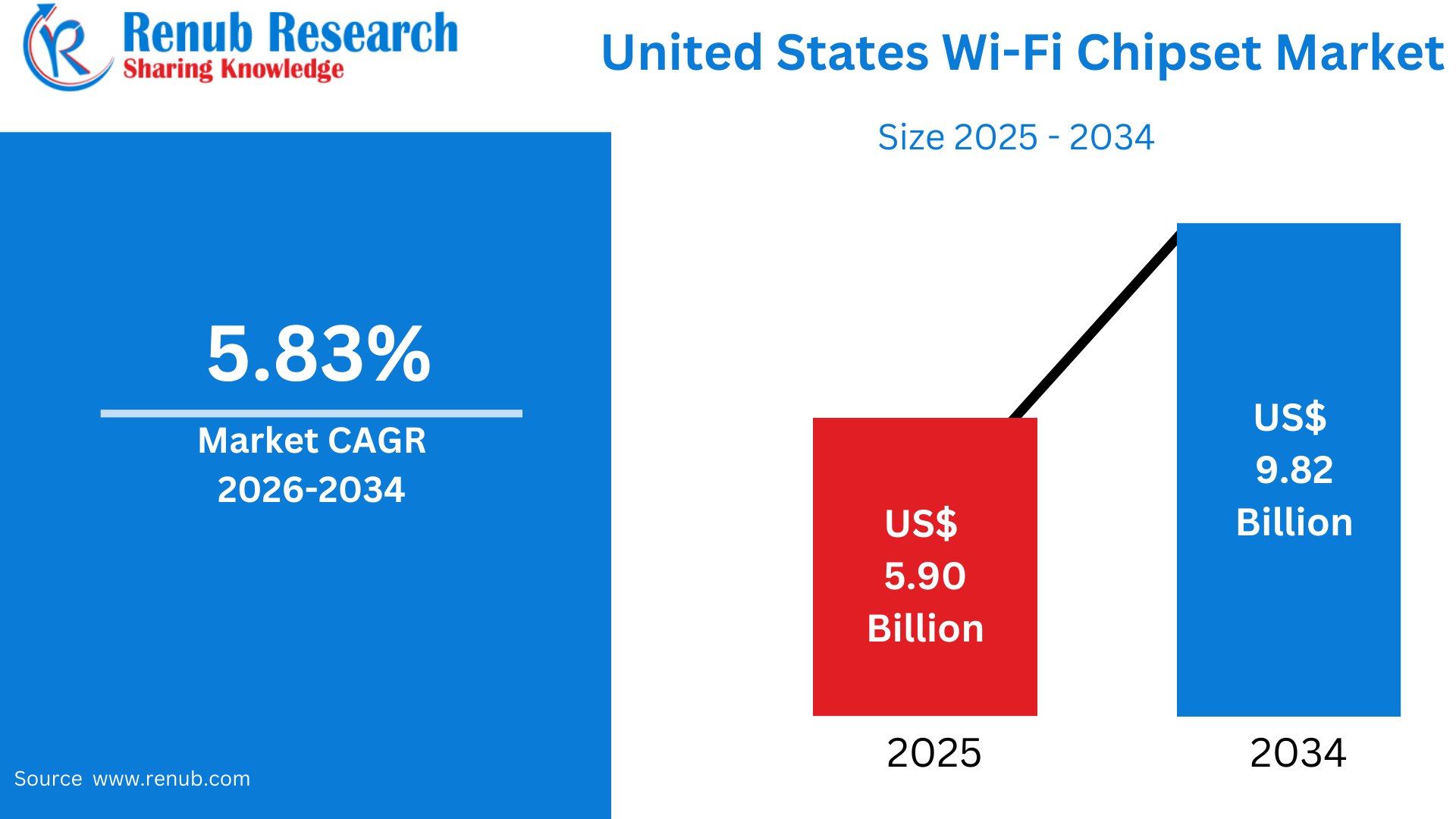
The United States Wi-Fi chipset market is expected to witness robust growth, expanding from US$ 5.90 billion in 2025 to US$ 9.82 billion by 2034, registering a compound annual growth rate (CAGR) of 5.83% during the forecast period from 2026 to 2034. Market growth is being fueled by the rapid adoption of Wi-Fi 6 and Wi-Fi 6E technologies, increasing penetration of smart home devices and Internet of Things (IoT) applications, and rising demand for high-speed, low-latency wireless connectivity. Furthermore, the growing deployment of advanced wireless networks across consumer electronics, enterprise infrastructure, industrial automation, and connected devices is expected to accelerate market expansion throughout the forecast period.
What Wi-Fi Chipset and its demands on United States?
A Wi-Fi chipset is an integrated semiconductor solution that enables wireless communication between electronic devices and Wi-Fi networks. It manages radio frequency (RF) communication, processes data transmission, and supports wireless networking standards such as Wi-Fi 5 (802.11ac), Wi-Fi 6 (802.11ax), Wi-Fi 6E, and emerging next-generation Wi-Fi technologies. These chipsets are widely integrated into smartphones, laptops, tablets, routers, smart televisions, connected home appliances, industrial equipment, automotive systems, and a broad range of Internet of Things (IoT) devices. By delivering high-speed, secure, and reliable wireless connectivity while improving power efficiency and network performance, Wi-Fi chipsets have become an essential component of today’s connected ecosystem.
The United States represents one of the world’s largest and most technologically advanced markets for Wi-Fi chipsets, supported by widespread broadband adoption, sophisticated digital infrastructure, and strong consumer demand for connected devices. The rapid expansion of smart homes, remote and hybrid work environments, online learning, cloud-based applications, and high-definition streaming services has significantly increased the need for high-performance wireless networking solutions. Businesses across industries are also investing heavily in advanced Wi-Fi technologies to support cloud computing, enterprise mobility, artificial intelligence (AI), industrial automation, and real-time collaboration. Moreover, the United States continues to lead the early adoption of next-generation wireless standards, encouraging continuous innovation and large-scale deployment of advanced Wi-Fi chipsets across consumer, commercial, industrial, and enterprise applications.
Apple to produce Made in America wireless chips with Broadcom in July 2026
Apple has entered into a multi-year agreement valued at more than US$30 billion with Broadcom to develop and manufacture over 15 billion custom wireless connectivity chips in the United States for use across Apple’s product portfolio. As part of the partnership, Apple will invest US$1.5 billion in capital expenditures to support the expansion of Broadcom’s semiconductor manufacturing facility in Fort Collins, Colorado. The agreement strengthens the long-standing collaboration between the two companies, with Broadcom serving as Apple’s primary supplier of wireless connectivity components. The investment also aligns with Apple’s broader commitment to invest US$600 billion in the U.S. economy over the next four years, reinforcing domestic manufacturing and semiconductor production initiatives.
Market Catalysts
Growing Adoption of Wi-Fi 6, Wi-Fi 6E, and Emerging Wireless Standards
The rapid adoption of advanced wireless networking standards is one of the primary factors driving the growth of the United States Wi-Fi chipset market. Technologies such as Wi-Fi 6, Wi-Fi 6E, and upcoming next-generation standards provide significantly higher data speeds, lower latency, greater network capacity, and improved performance in high-density environments, including offices, apartment buildings, campuses, and public venues. These advanced chipsets enable seamless support for bandwidth-intensive applications such as cloud gaming, ultra-high-definition video streaming, video conferencing, augmented and virtual reality (AR/VR), and real-time collaboration platforms. As consumers continue upgrading smartphones, laptops, routers, gaming consoles, and smart home devices, demand for compatible Wi-Fi chipsets continues to rise. Enterprises are also modernizing their wireless infrastructure to support increasing numbers of connected devices and data-intensive workloads. The United States’ strong culture of early technology adoption encourages manufacturers to rapidly integrate the latest wireless capabilities into new products. In October 2025, Sercomm introduced its next-generation wireless connectivity platform based on Broadcom’s Wi-Fi 8 chipset and the emerging IEEE 802.11bn standard. The platform offers deterministic low latency, multi-gigabit speeds, intelligent spectrum management, and integrated artificial intelligence and machine learning capabilities, providing a foundation for AI-enabled smart homes and advanced broadband services.
Expansion of Smart Homes, IoT Devices, and Connected Ecosystems
The continued expansion of smart homes and Internet of Things (IoT) ecosystems is significantly boosting demand for Wi-Fi chipsets across the United States. Connected devices—including smart thermostats, surveillance cameras, voice assistants, smart appliances, lighting systems, and home security solutions—depend on reliable, high-speed wireless connectivity for seamless operation. Advanced Wi-Fi chipsets provide the bandwidth, coverage, and network efficiency required to support multiple connected devices simultaneously while maintaining stable performance and low power consumption. Beyond residential applications, IoT adoption across industries such as healthcare, logistics, manufacturing, and commercial building automation is creating additional opportunities for chipset manufacturers. The increasing focus on automation, digital transformation, and connected living continues to drive the integration of high-performance Wi-Fi chipsets across consumer and enterprise markets. In March 2025, the Federal Communications Commission (FCC) officially launched the Cyber Trust Mark labeling program for consumer IoT devices, with major retailers including Amazon, Best Buy, and Google committing to promote certified products, further encouraging the adoption of secure connected devices.
Rising Demand for Remote Work, Streaming Services, and Cloud Computing
The widespread adoption of remote work, digital collaboration, and cloud-based services has substantially increased demand for advanced Wi-Fi chipsets in the United States. Businesses and households increasingly rely on reliable, low-latency wireless networks to support video conferencing, cloud storage, enterprise software-as-a-service (SaaS) platforms, online education, and real-time collaboration tools. Modern households often operate numerous connected devices simultaneously for work, learning, entertainment, and gaming, creating greater demand for high-performance wireless networking solutions. Advanced Wi-Fi chipsets equipped with technologies such as MU-MIMO, OFDMA, and beamforming help optimize network performance, reduce congestion, and improve connectivity across multiple devices. The growing popularity of 4K and 8K video streaming further increases bandwidth requirements, reinforcing demand for next-generation wireless technologies. According to U.S. labor statistics, 13.8% of American workers primarily worked from home in 2023, compared with 5.7% in 2019, while the number of remote workers increased from approximately 9 million in 2019 to more than 22 million in 2023, highlighting the sustained need for robust wireless connectivity.
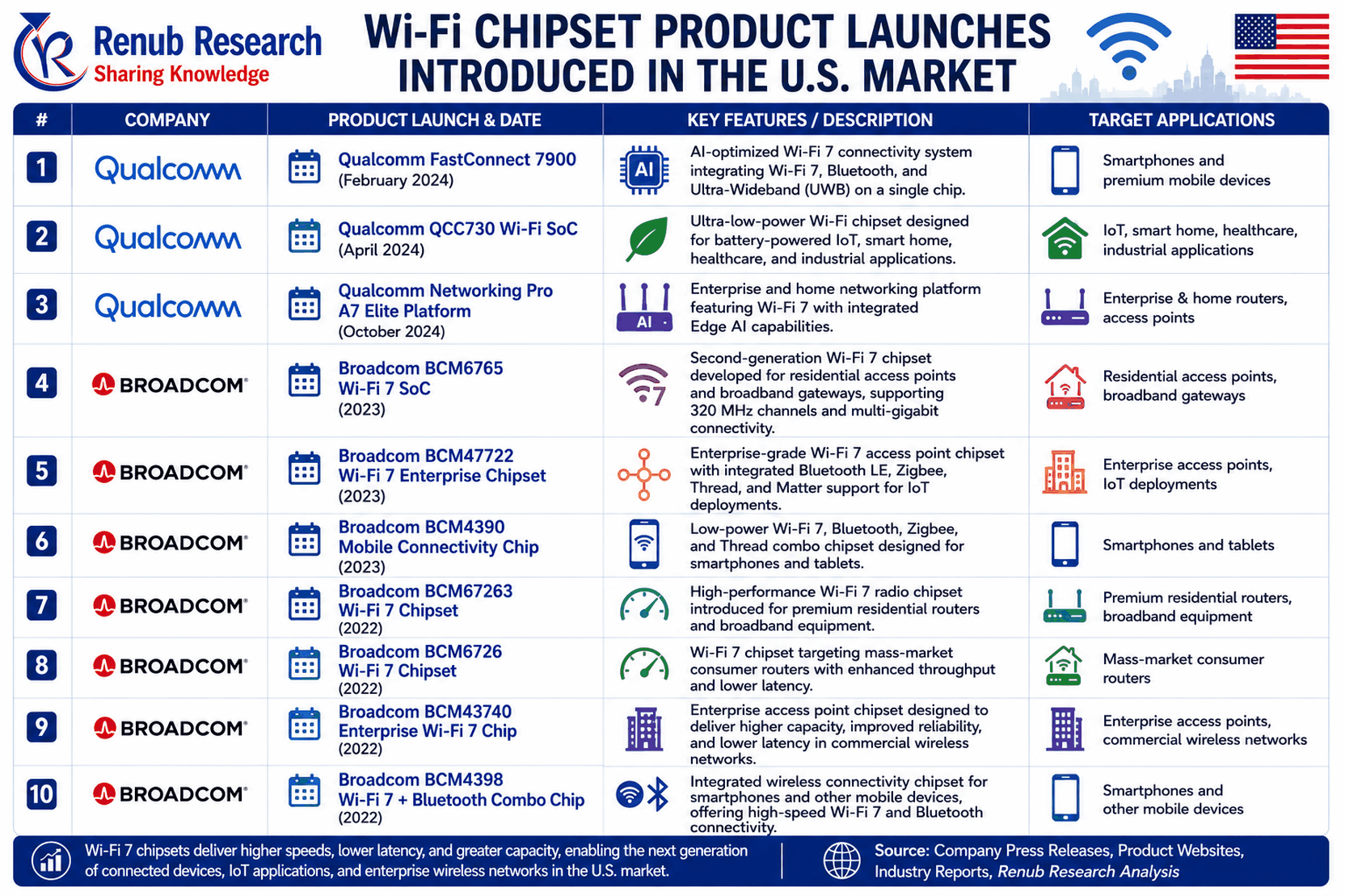
Wi-Fi chipset product launches introduced in the U.S. Market
- Qualcomm FastConnect 7900 (February 2024) – AI-optimized Wi-Fi 7 connectivity system integrating Wi-Fi 7, Bluetooth, and Ultra-Wideband (UWB) on a single chip for smartphones and premium mobile devices.
- Qualcomm QCC730 Wi-Fi SoC (April 2024) – Ultra-low-power Wi-Fi chipset designed for battery-powered IoT, smart home, healthcare, and industrial applications.
- Qualcomm Networking Pro A7 Elite Platform (October 2024) – Enterprise and home networking platform featuring Wi-Fi 7 with integrated Edge AI capabilities for next-generation routers and access points.
- Broadcom BCM6765 Wi-Fi 7 SoC (2023) – Second-generation Wi-Fi 7 chipset developed for residential access points and broadband gateways, supporting 320 MHz channels and multi-gigabit connectivity.
- Broadcom BCM47722 Wi-Fi 7 Enterprise Chipset (2023) – Enterprise-grade Wi-Fi 7 access point chipset with integrated Bluetooth LE, Zigbee, Thread, and Matter support for IoT deployments.
- Broadcom BCM4390 Mobile Connectivity Chip (2023) – Low-power Wi-Fi 7, Bluetooth, Zigbee, and Thread combo chipset designed for smartphones and tablets.
- Broadcom BCM67263 Wi-Fi 7 Chipset (2022) – High-performance Wi-Fi 7 radio chipset introduced for premium residential routers and broadband equipment.
- Broadcom BCM6726 Wi-Fi 7 Chipset (2022) – Wi-Fi 7 chipset targeting mass-market consumer routers with enhanced throughput and lower latency.
- Broadcom BCM43740 Enterprise Wi-Fi 7 Chip (2022) – Enterprise access point chipset designed to deliver higher capacity, improved reliability, and lower latency in commercial wireless networks.
- Broadcom BCM4398 Wi-Fi 7 + Bluetooth Combo Chip (2022) – Integrated wireless connectivity chipset for smartphones and other mobile devices, offering high-speed Wi-Fi 7 and Bluetooth connectivity.
Market Restraints
Semiconductor Supply Chain Disruptions and Manufacturing Cost Pressures
Supply chain challenges remain one of the key constraints affecting the U.S. Wi-Fi chipset market. The industry continues to face uncertainties related to global semiconductor manufacturing, including limited foundry capacity, dependence on advanced fabrication technologies, geopolitical tensions, and fluctuations in the availability of critical raw materials. These factors can result in component shortages, delayed product launches, and higher manufacturing costs, ultimately increasing the prices of consumer electronics and networking equipment. Smaller device manufacturers are particularly vulnerable to supply disruptions due to limited purchasing power and reduced access to manufacturing capacity. Although ongoing investments in domestic semiconductor production are expected to improve long-term supply resilience, achieving stable, large-scale manufacturing capacity remains a significant industry challenge.
Increasing Complexity of Wireless Standards and Cybersecurity Requirements
The continuous evolution of Wi-Fi technologies is making chipset design increasingly complex and resource-intensive. Supporting multiple wireless standards, frequency bands, backward compatibility, and advanced networking features requires extensive engineering, testing, and certification processes. At the same time, growing cybersecurity threats are driving the need for stronger encryption, secure authentication, and enhanced protection against network vulnerabilities, further increasing product development complexity. Manufacturers must carefully balance performance, power efficiency, security, and cost while maintaining compatibility with rapidly evolving wireless standards. Frequent technology upgrades also shorten product life cycles, requiring continuous investment in research and development, increasing production costs, and intensifying competitive pressure within the U.S. Wi-Fi chipset market.
Band Insights
Dual-Band Wi-Fi Chipset
Dual-band Wi-Fi chipsets, which operate on both the 2.4 GHz and 5 GHz frequency bands, have become a standard connectivity solution across the United States. By supporting two frequency bands, these chipsets deliver faster data transmission, reduced network congestion, and improved signal reliability, particularly in environments with numerous connected devices. They are widely integrated into smartphones, laptops, routers, smart televisions, gaming consoles, and other connected consumer electronics. As households and businesses continue to connect multiple devices simultaneously, dual-band Wi-Fi chipsets offer an optimal balance between performance, coverage, and affordability. Their broad compatibility with existing wireless infrastructure and consumer devices continues to drive widespread adoption across both mid-range and premium electronic products.
MIMO Configuration Insights
MU-MIMO Wi-Fi Chipset
The adoption of Multi-User Multiple-Input Multiple-Output (MU-MIMO) technology is accelerating across the U.S. Wi-Fi chipset market as demand for high-capacity wireless networks continues to grow. MU-MIMO technology enables wireless routers and access points to communicate with multiple devices simultaneously, significantly improving network efficiency, reducing latency, and increasing overall throughput. These chipsets are particularly valuable in high-density environments such as corporate offices, educational institutions, airports, hotels, and multi-device households, where numerous users require uninterrupted connectivity. The increasing popularity of video streaming, cloud gaming, virtual meetings, and bandwidth-intensive enterprise applications continues to strengthen demand for MU-MIMO-enabled Wi-Fi chipsets, making the technology an essential feature in next-generation wireless networking solutions.
Standard Insights
IEEE 802.11ad Wi-Fi Chipset
The IEEE 802.11ad Wi-Fi chipset segment addresses specialized applications that require ultra-high-speed wireless communication over short distances. Operating in the 60 GHz frequency band, these chipsets provide exceptionally high data transfer rates with minimal latency, making them suitable for applications such as wireless docking stations, virtual reality (VR), augmented reality (AR), high-definition multimedia streaming, and rapid file transfers. Although their relatively limited transmission range restricts widespread consumer adoption, IEEE 802.11ad chipsets continue to gain traction in enterprise, industrial, and commercial environments where high-bandwidth, low-latency connectivity is essential for specialized workflows and advanced digital applications.
Application Insights
Smartphone Wi-Fi Chipset
Smartphones represent one of the largest application segments for Wi-Fi chipsets in the United States, driven by growing consumer demand for fast, seamless, and reliable wireless connectivity. Modern smartphones increasingly incorporate advanced Wi-Fi technologies to support high-definition video streaming, cloud gaming, video conferencing, social media applications, and integration with smart home ecosystems. As consumers continue upgrading to newer smartphone models, manufacturers are integrating the latest Wi-Fi standards to improve connection speeds, reduce latency, enhance power efficiency, and deliver superior user experiences. Continuous innovation in mobile devices is expected to sustain strong demand for high-performance Wi-Fi chipsets throughout the forecast period.
Laptop Wi-Fi Chipset
The laptop segment remains a significant contributor to the U.S. Wi-Fi chipset market as wireless connectivity continues to play a critical role in business productivity, education, and digital entertainment. The increasing prevalence of hybrid work environments, remote learning, and cloud-based applications has intensified demand for laptops equipped with advanced wireless networking capabilities. Modern Wi-Fi chipsets featuring dual-band connectivity, MU-MIMO technology, low-power operation, and support for the latest Wi-Fi standards enable faster data transfer, improved battery efficiency, and more reliable network performance. As hybrid work and digital collaboration become permanent features of the modern workplace, demand for advanced laptop Wi-Fi chipsets is expected to remain strong.
States Insights
California Wi-Fi Chipset
California serves as the leading center for Wi-Fi chipset innovation in the United States, supported by its well-established semiconductor industry, world-renowned technology companies, and extensive research and development ecosystem. The state hosts numerous chipset designers, networking equipment manufacturers, cloud computing providers, and technology startups that continue to drive innovation in wireless communication technologies. Strong adoption of smart devices, enterprise networking solutions, Internet of Things (IoT) applications, artificial intelligence (AI), and augmented and virtual reality (AR/VR) technologies continues to generate substantial demand for advanced Wi-Fi chipsets across California.
California’s technology-driven environment also encourages the early commercialization and deployment of next-generation wireless standards. For example, in January 2024, a California-based broadband technology company introduced Wi-Fi 7 chipsets and a tri-band access point that achieved industry certification and was selected as a reference platform for interoperability testing. Such developments reinforce California’s position as a leader in next-generation wireless innovation. Supported by substantial research investment, a mature digital infrastructure, and a strong ecosystem of early adopters, California continues to set industry benchmarks and drive the nationwide adoption of advanced Wi-Fi chipset technologies.
New York Wi-Fi Chipset
New York represents one of the most significant regional markets for Wi-Fi chipsets due to its highly urbanized environment and extensive reliance on advanced wireless connectivity. Residential high-rise buildings, commercial offices, transportation hubs, educational institutions, and public venues require high-performance Wi-Fi networks capable of supporting thousands of connected devices simultaneously. Industries including finance, media, advertising, healthcare, and professional services increasingly depend on robust wireless connectivity to facilitate cloud computing, digital collaboration, real-time communications, and data-intensive applications.
The growing popularity of smart homes, connected entertainment systems, wearable devices, and personal digital technologies is further expanding consumer demand for advanced Wi-Fi chipsets across the state. In addition, New York’s thriving technology startup ecosystem and strong presence of financial institutions continue to accelerate the adoption of next-generation wireless networking technologies. Ongoing investments in broadband infrastructure and digital transformation initiatives are expected to sustain long-term demand for high-performance Wi-Fi chipset solutions across both consumer and enterprise sectors.
Washington Wi-Fi Chipset
Washington is emerging as a key regional market for Wi-Fi chipsets, supported by its strong technology ecosystem, expanding cloud computing industry, and continued investment in digital infrastructure. The presence of leading cloud service providers, software companies, and technology enterprises has created substantial demand for advanced wireless networking solutions capable of supporting enterprise collaboration, large-scale data processing, and hybrid work environments. Data centers, corporate campuses, and commercial facilities increasingly rely on high-performance Wi-Fi chipsets to ensure reliable, secure, and low-latency connectivity.
The growing adoption of Internet of Things (IoT) technologies across smart buildings, healthcare facilities, logistics operations, manufacturing plants, and industrial automation applications is further accelerating demand for advanced Wi-Fi chipsets throughout the state. Washington’s innovation-driven economy encourages early adoption of emerging wireless standards, including Wi-Fi 6, Wi-Fi 6E, and future next-generation technologies. As organizations continue investing in digital transformation and intelligent connectivity solutions, Washington is expected to remain an important contributor to innovation and long-term growth within the United States Wi-Fi chipset market.
Market Segmentations
Band
- Single
- Dual
- Tri Band
MIMO Configuration
- MU-MIMO
- SU-MIMO
Standard
- IEEE 802.11ay
- IEEE 802.11ad
- IEEE 802.11ax (Wi-Fi 6 & Wi-Fi 6E)
- IEEE 802.11ac
- IEEE 802.11n (SB and DB)
- EEE 802.11b/G
Application
- Smartphones
- Tablet
- Desktop PC
- Laptop
- Connected Home Devices
- Others
Top States
- California
- Texas
- New York
- Florida
- Illinois
- Pennsylvania
- Ohio
- Georgia
- New Jersey
- Washington
- North Carolina
- Massachusetts
- Virginia
- Michigan
- Maryland
- Colorado
- Tennessee
- Indiana
- Arizona
- Minnesota
- Wisconsin
- Missouri
- Connecticut
- South Carolina
- Oregon
- Louisiana
- Alabama
- Kentucky
- Rest of United States
All companies have been covered with 5 Viewpoints
- Overviews
- Key Person
- Recent Developments
- SWOT Analysis
- Revenue Analysis
Company Analysis:
- Qualcomm Technologies Inc.
- Broadcom Inc.
- MediaTek Inc.
- Intel Corporation
- Texas Instruments Incorporated
- STMicroelectronics N.V.
- Samsung Electronics Co., Ltd.
- NXP Semiconductors N.V.
- ON Semiconductor Corporation
- Espressif Systems
Report Details:
| Report Features | Details |
| Base Year |
2025 |
| Historical Period |
2022 - 2025 |
| Forecast Period |
2026 - 2034 |
| Market |
US$ Billion |
| Segment Covered |
Band, MIMO Configuration, Standard, Application and States |
| States Covered |
|
| Companies Covered |
|
| Customization Scope |
20% Free Customization |
| Post-Sale Analyst Support |
1 Year (52 Weeks) |
| Delivery Format |
PDF and Excel through Email (We can also provide the editable version of the report in PPT/Word format on request) |
Customization Services available
- Analysis of Market Size and Its Segments
- More Company Profiles (Upto 10 without any additional cost):
- Additional Countries (Other than mentioned Countries):
- Region/Country Specific Reports:
- Market Entry Strategy:
- Region-Specific Market Dynamics:
- Regional Market Share Analysis:
- Trade Analysis:
- Production Insights:
- Others Customized Requests:
For more information contact our analysts.
Need More Assistance?
- Talk to our analysts to get more precious information on the current market trends.
- Include more countries and segments and customize the report based on the final requirement.
- Get a competitive advantage in your industry by knowing the report findings and making a positive impact on your revenues and operations.
- Our analysts are always ready to provide more help and pertinent information if you need any additional assistance.