United States E-Learning Market Report by Technology, Provider, Application, State and Company Analysis 2026-2034
Buy NowUnited States E-Learning Market Size and Forecast, Rising Adoption of Digital and Hybrid Learning
United States E-Learning Market is projected to expand from US$138.42 billion in 2025 to US$284.17 billion by 2034, advancing at a CAGR of 8.32% from 2026 to 2034. The market is benefiting from the continued digitalization of education and professional training, wider adoption of online, remote, and hybrid learning models, and increasing demand for flexible, self-paced educational solutions. Growing investments in digital learning infrastructure, cloud-based platforms, artificial intelligence, and interactive educational technologies are improving the accessibility and personalization of online education.
What is E-Learning? Uses and Popularity in the United States
E-learning, or electronic learning, refers to the delivery of educational, training, and skill-development content through digital technologies such as computers, smartphones, tablets, learning management systems (LMS), virtual classrooms, and online platforms. It enables learners to access courses, lectures, assessments, videos, simulations, and interactive learning materials remotely and at flexible times. In the United States, e-learning is widely used by schools, universities, businesses, government organizations, and professional training providers. Educational institutions use digital learning to supplement classroom teaching, deliver distance education, and provide flexible programs for students.
Businesses increasingly rely on e-learning for employee onboarding, compliance training, technical skills, leadership development, and reskilling programs. Its popularity has increased because learners can study from virtually anywhere while organizations can reach large audiences at comparatively lower delivery costs. Mobile learning, cloud-based platforms, artificial intelligence, adaptive learning, and interactive content are further improving user engagement and personalization. The continued adoption of remote and hybrid learning models, growing corporate investment in workforce development, and expanding digital infrastructure are strengthening the role of e-learning in the U.S. education and training ecosystem.
Top Online Learning Statistics for 2026
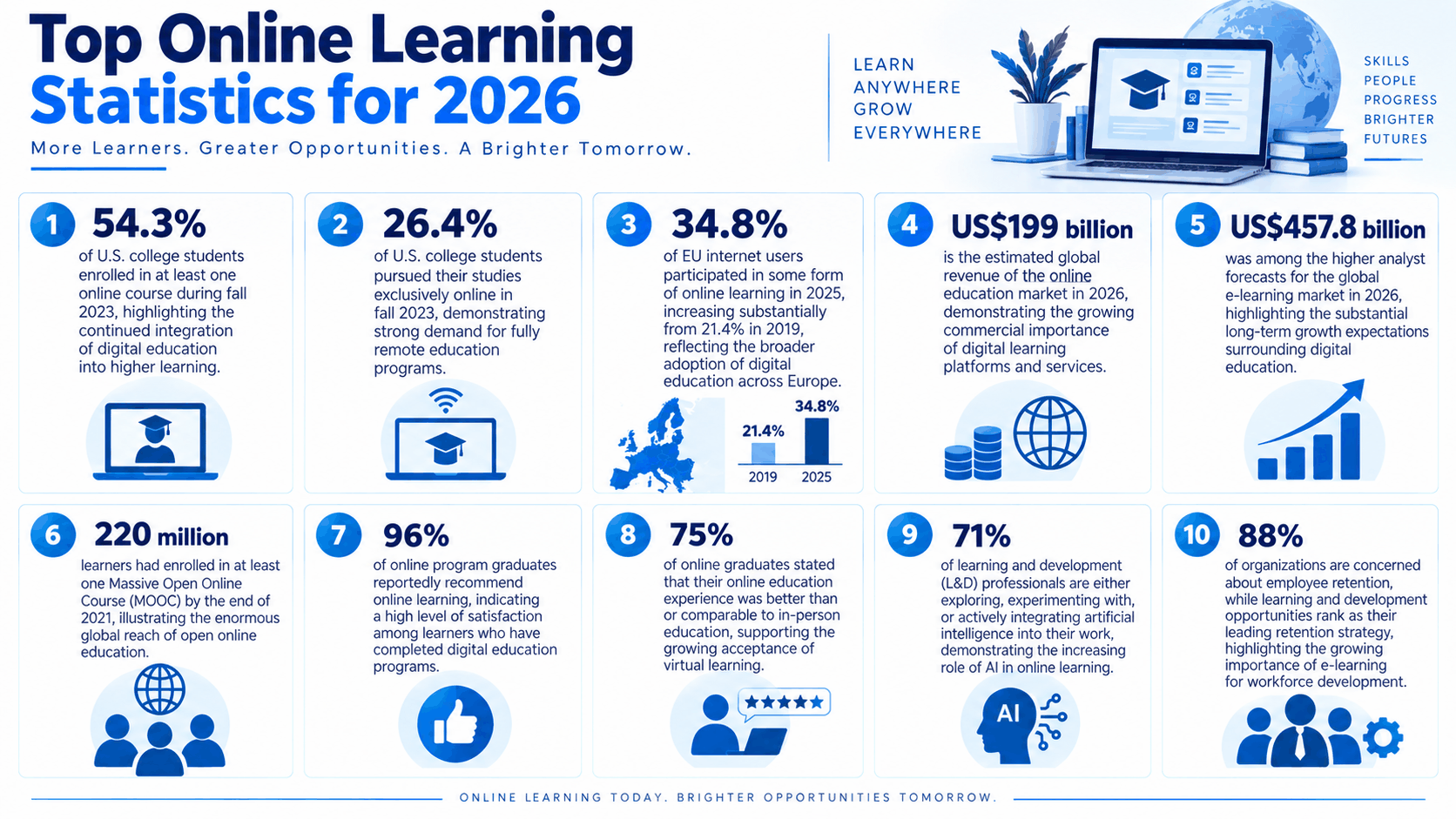
- 54.3% of U.S. college students enrolled in at least one online course during fall 2023, highlighting the continued integration of digital education into higher learning.
- 26.4% of U.S. college students pursued their studies exclusively online in fall 2023, demonstrating strong demand for fully remote education programs.
- 34.8% of EU internet users participated in some form of online learning in 2025, increasing substantially from 21.4% in 2019, reflecting the broader adoption of digital education across Europe.
- US$199 billion is the estimated global revenue of the online education market in 2026, demonstrating the growing commercial importance of digital learning platforms and services.
- US$457.8 billion was among the higher analyst forecasts for the global e-learning market in 2026, highlighting the substantial long-term growth expectations surrounding digital education.
- 220 million learners had enrolled in at least one Massive Open Online Course (MOOC) by the end of 2021, illustrating the enormous global reach of open online education.
- 96% of online program graduates reportedly recommend online learning, indicating a high level of satisfaction among learners who have completed digital education programs.
- 75% of online graduates stated that their online education experience was better than or comparable to in-person education, supporting the growing acceptance of virtual learning.
- 71% of learning and development (L&D) professionals are either exploring, experimenting with, or actively integrating artificial intelligence into their work, demonstrating the increasing role of AI in online learning.
- 88% of organizations are concerned about employee retention, while learning and development opportunities rank as their leading retention strategy, highlighting the growing importance of e-learning for workforce development.
Growth Drivers of the United States E-Learning Market
Expansion of Remote, Hybrid, and Digital Learning Models
The continued adoption of remote and hybrid education is a major growth driver for the U.S. e-learning market. According to the National Center for Education Statistics, approximately 30% of U.S. undergraduate students were enrolled exclusively in distance education courses in fall 2022, while another 30% participated in at least one distance education course. This demonstrates the established role of online learning within higher education. Universities, colleges, schools, and professional institutions increasingly combine physical classrooms with digital platforms, recorded lectures, virtual assessments, and online resources. E-learning also provides greater flexibility for working students and adult learners who cannot attend conventional classes. Businesses are similarly adopting virtual training to support geographically distributed employees. Cloud-based learning management systems, video conferencing, mobile applications, and interactive content are making digital education more accessible. As institutions continue investing in digital infrastructure and flexible learning models, demand for e-learning platforms and educational content is expected to remain strong in the United States.
Rising Corporate Investment in Employee Training and Upskilling
Increasing investment in employee training, reskilling, and professional development is creating substantial opportunities for the U.S. e-learning market. According to the Association for Talent Development, organizations surveyed in its 2023 State of the Industry report spent an average of approximately $1,280 per employee on training, demonstrating the importance of workforce development. Digital learning allows companies to provide training programs to large numbers of employees without requiring extensive physical classrooms or travel. Organizations are increasingly using online platforms for onboarding, compliance, cybersecurity, leadership development, technical training, and soft-skill development. The rapid adoption of artificial intelligence, automation, cloud computing, and other technologies is also increasing the need for continuous workforce upskilling. E-learning enables employees to access training through computers and mobile devices and complete courses at their own pace. Additionally, learning analytics help employers monitor completion rates, performance, and skill gaps. These advantages are encouraging businesses to integrate e-learning into long-term workforce strategies, supporting sustained market expansion.
Growing Adoption of AI, Personalized Learning, and Mobile Education
Technological innovation is transforming the U.S. e-learning market by making digital education more personalized, interactive, and accessible. Artificial intelligence is increasingly being integrated into learning platforms to provide adaptive assessments, automated feedback, personalized course recommendations, and AI-powered tutoring. According to a 2024 EDUCAUSE survey, more than half of higher-education institutions reported experimenting with generative AI, highlighting the rapid emergence of AI within the education ecosystem. Mobile learning is another important trend, enabling users to access educational content through smartphones and tablets from virtually any location. Gamification, virtual simulations, interactive videos, and data analytics are also improving learner engagement and allowing educators to identify individual learning gaps. Personalized learning systems can adjust course difficulty and content according to learner performance, helping improve educational outcomes. Meanwhile, cloud-based platforms allow institutions and businesses to scale training programs efficiently. As U.S. organizations continue adopting AI and advanced digital technologies, the integration of intelligent and personalized learning capabilities is expected to remain a significant growth engine.
Challenges of the United States E-Learning Market
Digital Divide and Unequal Access to High-Speed Internet
The digital divide remains a significant challenge for the U.S. e-learning market because effective online education depends on reliable internet connectivity, suitable devices, and digital skills. Although broadband availability has improved substantially, access remains uneven across income groups and geographic areas. According to the Federal Communications Commission’s 2024 National Broadband Map, broadband availability continues to vary across locations, particularly in rural and underserved communities. Households with limited financial resources may also face difficulties purchasing computers, tablets, or reliable internet subscriptions. These disparities can affect students’ ability to attend virtual classes, download learning materials, participate in video sessions, and complete online assessments. Rural communities can face additional connectivity challenges because of infrastructure limitations. Educational institutions and governments have responded through broadband expansion programs, device-lending initiatives, and digital inclusion efforts, but gaps remain. Consequently, unequal access to technology can restrict the addressable audience for e-learning platforms and create differences in educational outcomes. Addressing affordability, connectivity, and digital literacy will therefore be important for achieving broader adoption.
Data Privacy, Cybersecurity, and Content Quality Concerns
The increasing digitization of education creates significant concerns regarding data privacy, cybersecurity, and the reliability of online learning content. E-learning platforms can collect sensitive information, including student identities, academic performance, behavioral data, payment details, and employee training records. According to the Identity Theft Resource Center, the United States recorded more than 3,000 data compromises in 2023, demonstrating the broader cybersecurity risks facing organizations that store digital information. Educational institutions and businesses therefore need strong encryption, authentication, access controls, and cybersecurity systems to protect learner information. At the same time, the rapid expansion of AI-generated educational content raises concerns about accuracy, plagiarism, misinformation, and intellectual-property rights. Poorly designed courses can also result in low engagement and completion rates, particularly when content lacks interaction or instructor support. Compliance with privacy requirements and institutional security policies can increase technology and operational costs. These issues may slow adoption among organizations that prioritize data protection, making security, quality assurance, and responsible AI implementation critical to long-term market development.
E-Learning Launches in the USA
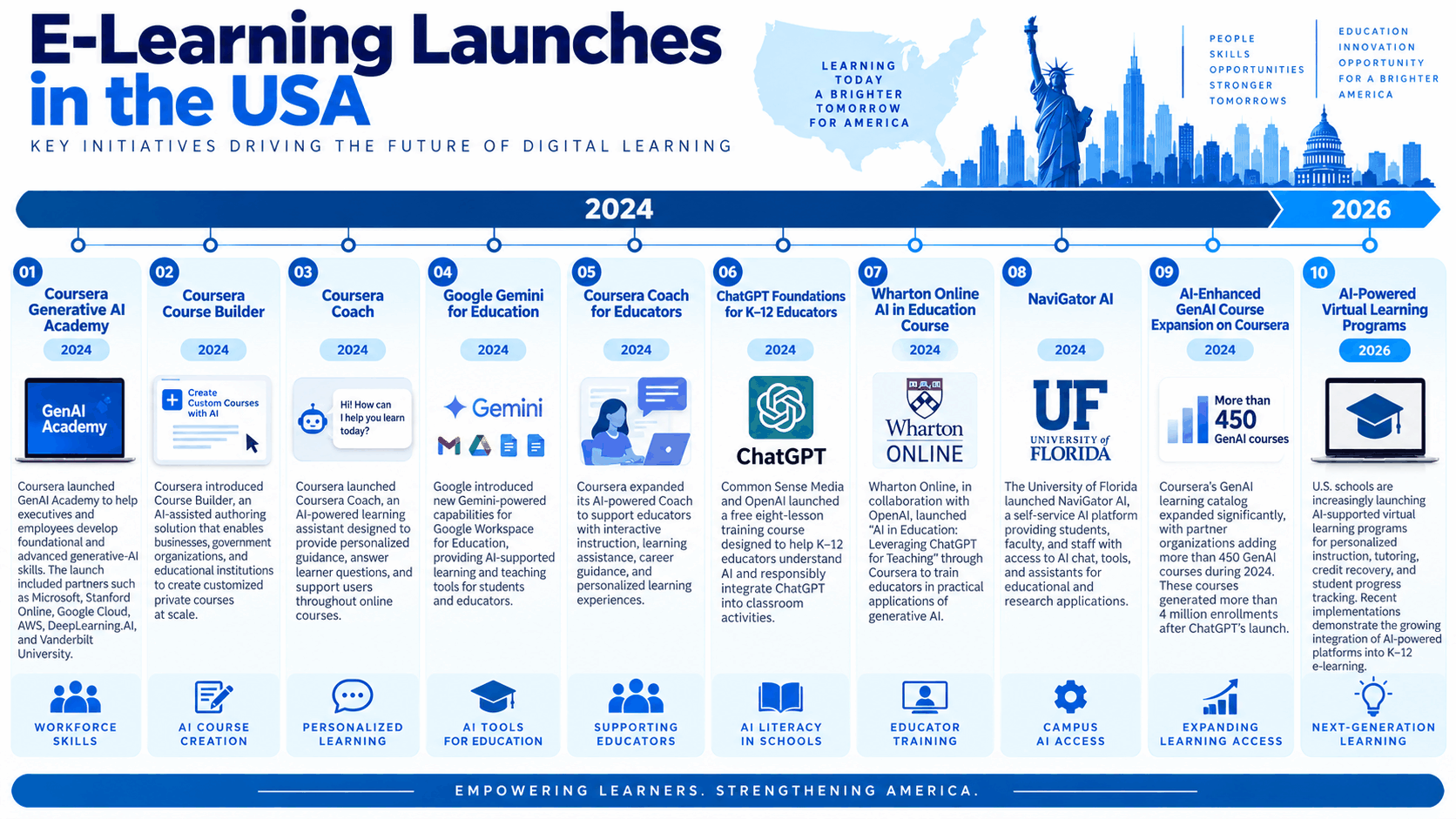
- Coursera Generative AI Academy – 2024: Coursera launched GenAI Academy to help executives and employees develop foundational and advanced generative-AI skills. The launch included partners such as Microsoft, Stanford Online, Google Cloud, AWS, DeepLearning.AI, and Vanderbilt University.
- Coursera Course Builder – 2024: Coursera introduced Course Builder, an AI-assisted authoring solution that enables businesses, government organizations, and educational institutions to create customized private courses at scale.
- Coursera Coach – 2024: Coursera launched Coursera Coach, an AI-powered learning assistant designed to provide personalized guidance, answer learner questions, and support users throughout online courses.
- Google Gemini for Education – 2024: Google introduced new Gemini-powered capabilities for Google Workspace for Education, providing AI-supported learning and teaching tools for students and educators.
- Coursera Coach for Educators – 2024: Coursera expanded its AI-powered Coach to support educators with interactive instruction, learning assistance, career guidance, and personalized learning experiences.
- ChatGPT Foundations for K–12 Educators – 2024: Common Sense Media and OpenAI launched a free eight-lesson training course designed to help K–12 educators understand AI and responsibly integrate ChatGPT into classroom activities.
- Wharton Online AI in Education Course – 2024: Wharton Online, in collaboration with OpenAI, launched “AI in Education: Leveraging ChatGPT for Teaching” through Coursera to train educators in practical applications of generative AI.
- NaviGator AI – 2024: The University of Florida launched NaviGator AI, a self-service AI platform providing students, faculty, and staff with access to AI chat, tools, and assistants for educational and research applications.
- AI-Enhanced GenAI Course Expansion on Coursera – 2024: Coursera’s GenAI learning catalog expanded significantly, with partner organizations adding more than 450 GenAI courses during 2024. These courses generated more than 4 million enrollments after ChatGPT’s launch.
- AI-Powered Virtual Learning Programs – 2026: U.S. schools are increasingly launching AI-supported virtual learning programs for personalized instruction, tutoring, credit recovery, and student progress tracking. Recent implementations demonstrate the growing integration of AI-powered platforms into K–12 e-learning.
Expanding Access Through Digital Education in United States
United States online e-learning market is expanding as universities, schools, training providers, and businesses increasingly adopt web-based education. According to U.S. education statistics, around 60% of undergraduate students participated in at least one distance education course in 2022, demonstrating the strong integration of online learning into higher education. Online platforms provide flexible access to recorded lectures, live virtual classes, assessments, digital libraries, and professional courses. The growing popularity of remote and hybrid learning has further strengthened demand for online education. Businesses are also using web-based platforms for employee onboarding, compliance, cybersecurity, and technical training. Cloud-based learning management systems enable organizations to deliver courses to geographically dispersed users while reducing classroom and travel expenses. Artificial intelligence, interactive content, virtual simulations, and learning analytics are improving engagement and personalization. Increasing broadband penetration and widespread smartphone ownership further support accessibility. As educational institutions and enterprises continue transitioning toward flexible digital learning models, online e-learning is expected to remain a major segment of the U.S. market.
Smartphone Adoption Accelerates Learning in USA
United States mobile e-learning market is benefiting from widespread smartphone adoption and increasing demand for flexible, on-the-go education. More than 9 in 10 U.S. adults own a smartphone, creating a substantial technological foundation for mobile learning applications. Smartphones and tablets allow learners to access short courses, educational videos, quizzes, language programs, professional certifications, and corporate training without relying on desktop computers. Mobile learning is particularly attractive to working professionals who prefer completing training modules during commuting, breaks, or other flexible periods. Microlearning is also gaining popularity because short, focused lessons can improve convenience and encourage regular engagement. Businesses are incorporating mobile learning into employee development, sales training, compliance programs, and product education. Educational institutions are similarly expanding mobile-friendly learning management systems and applications. The integration of artificial intelligence, push notifications, gamification, and adaptive learning further enhances user engagement. With high mobile-device penetration and increasing preference for flexible learning experiences, mobile e-learning is expected to remain an important growth segment in the United States.
Rising Demand for Professional Learning Solutions in the United States
United States e-learning services market includes content development, learning management, consulting, implementation, assessment, instructional design, and technical support services. Demand is increasing as organizations require customized digital education rather than relying solely on standardized courses. Corporate training remains a major application, particularly as companies invest in employee reskilling to address technological changes. The Association for Talent Development reported that organizations participating in its 2023 industry survey spent approximately $1,280 per employee on training, highlighting the economic importance of workforce development. E-learning service providers help businesses convert traditional classroom programs into interactive digital courses and integrate them with existing HR and learning systems. Higher education institutions also increasingly outsource course design, virtual classroom support, accessibility services, and digital-content development. Artificial intelligence and analytics are creating additional opportunities for personalized learning and automated assessment. Demand for multilingual content, mobile compatibility, cybersecurity, and accessibility is also increasing. Consequently, specialized e-learning services are becoming essential for organizations seeking scalable and technology-enabled education solutions.
Strong Integration Across Higher Education in the U.S.
United States academic e-learning market is supported by widespread adoption of online education across universities, colleges, community colleges, and other educational institutions. According to U.S. higher-education statistics, approximately 30% of undergraduate students were enrolled exclusively in distance education in 2022, while another substantial share combined online and in-person courses. This demonstrates the importance of digital learning within the academic environment. Universities increasingly use learning management systems, virtual classrooms, recorded lectures, digital assessments, and online libraries to support students. Online education also expands access for working adults, students living far from campuses, and learners seeking specialized courses that may not be available locally. Community colleges and professional education providers are particularly benefiting from flexible online formats. Artificial intelligence, adaptive learning, virtual laboratories, and interactive simulations are further improving the academic learning experience. However, institutions continue to focus on faculty training, student engagement, accessibility, and academic integrity. Continued investment in digital infrastructure and hybrid education models is expected to support sustained growth in U.S. academic e-learning.
United States Workforce Upskilling Drives Adoption
United States corporate e-learning market is experiencing strong demand as companies increasingly prioritize employee upskilling, reskilling, compliance, and continuous professional development. Organizations across technology, healthcare, finance, manufacturing, retail, and professional services are using digital platforms to train geographically distributed workforces. According to the Association for Talent Development, average direct learning expenditure among organizations surveyed in its 2023 State of the Industry report was approximately $1,280 per employee, demonstrating significant corporate commitment to workforce development. E-learning allows companies to deliver standardized training at scale while reducing expenses associated with physical classrooms, travel, and printed materials. Popular applications include employee onboarding, leadership development, cybersecurity awareness, regulatory compliance, sales training, and technical skills. The rapid adoption of artificial intelligence and automation is creating additional demand for digital reskilling programs. Learning analytics also enable employers to track participation, completion, assessment results, and skill gaps. Mobile-compatible courses and microlearning are becoming increasingly popular among employees. As businesses focus on workforce productivity and technological transformation, corporate e-learning is expected to remain one of the strongest segments of the U.S. e-learning market.
E-Learning Technology Leadership and Digital Education Adoption in California
California represents one of the most advanced e-learning markets in the United States, supported by its large education ecosystem, strong technology infrastructure, and concentration of technology companies. The state has more than 5.8 million K–12 students, creating a substantial addressable market for digital learning platforms, learning management systems, and educational content. California’s universities and community colleges continue expanding online and hybrid programs, while businesses in technology, healthcare, entertainment, and professional services increasingly use digital training. The state’s strong technology ecosystem also encourages adoption of artificial intelligence, adaptive learning, virtual classrooms, and personalized educational platforms. Investments in broadband connectivity and digital-equity programs are helping improve access for underserved communities. In addition, California’s large technology and startup ecosystem supports continuous development of innovative education technologies. Corporate demand for employee reskilling and professional certification further strengthens the market. With a digitally oriented population, extensive education infrastructure, and strong innovation capabilities, California is expected to remain a major contributor to the U.S. e-learning industry.
Texas Student Base and Workforce Training Support E-Learning Growth
Texas is emerging as a major U.S. e-learning market because of its large and growing population, extensive education system, and expanding workforce-development requirements. The state has more than 5.5 million public-school students, providing a significant user base for digital learning technologies. Universities and community colleges increasingly offer online degrees, certifications, and professional development programs, allowing students and working professionals to access education more flexibly. E-learning is also widely used by industries such as energy, manufacturing, healthcare, technology, and logistics for employee onboarding, safety training, compliance, and technical upskilling. Rural school districts are increasingly investing in digital platforms to improve access to educational resources where specialized teachers and facilities may be limited. Hybrid learning models are becoming more common across K–12 and higher education. Population growth and increasing demand for affordable, flexible education are supporting market expansion. Continued investment in broadband, digital infrastructure, AI-enabled learning, and workforce-development initiatives is expected to strengthen Texas’s position in the national e-learning market.
Strong Academic and Corporate Demand in New York E-Learning
New York has a highly developed e-learning ecosystem supported by its large concentration of universities, schools, businesses, and technology companies. The state serves more than 2.5 million public-school students, while its extensive higher-education network provides a substantial market for online courses, learning management systems, and digital educational content. Universities increasingly offer online degrees, professional certificates, executive education, and hybrid programs to meet demand from working adults and geographically dispersed learners. Corporate e-learning demand is particularly strong in finance, healthcare, technology, professional services, and media, where continuous skills development is essential. New York City also provides an important innovation hub for education technology, supporting startups focused on artificial intelligence, adaptive learning, digital assessment, and interactive content. Growing emphasis on personalized education and digital accessibility is encouraging institutions to modernize their learning infrastructure. As organizations continue adopting flexible training models and learners seek convenient access to education, New York is expected to remain a significant market for e-learning platforms and services.
Strong Virtual Learning Infrastructure in Florida E-Learning
Florida is a prominent U.S. market for e-learning, supported by its established virtual education infrastructure, large student population, and growing demand for flexible learning. The state has approximately 3 million public-school students, creating significant demand for digital curricula, virtual classrooms, and online learning platforms. Florida Virtual School (FLVS) has played an important role in expanding access to online education and has served millions of students since its establishment. Higher-education institutions are also expanding online degree programs, certifications, and hybrid learning options. Beyond academics, businesses in tourism, healthcare, logistics, retail, and professional services increasingly use e-learning for employee training, compliance, onboarding, and professional development. Florida’s population growth is expanding the potential learner base, while improvements in broadband infrastructure are supporting greater digital access. The state’s emphasis on flexible education models and established virtual-learning capabilities provides a favorable environment for e-learning providers. Continued investment in digital content, AI-powered learning tools, and online education infrastructure is expected to support further market development.
Recent Developments in United States E-Learning Market
- May 2025: Udemy introduced Innovation Studio, a new initiative aimed at accelerating the development of personalized, immersive, and AI-powered learning experiences. The studio will prototype advanced learning formats, beginning with its inaugural program, AI for Business Leaders, which focuses on executive reskilling. The launch highlights Udemy’s shift toward outcome-driven and adaptive workforce education.
- April 2025: The US Department of Education unveiled a USD 1 billion grant program to expand the use of open educational resources (OER) across K–12 schools nationwide. Designed to increase access to affordable, high-quality learning materials, the initiative aims to reduce dependence on traditional textbooks and support more equitable digital learning environments.
United States E-learning Market Segments
Technology
- Online E-Learning
- Learning Management System
- Mobile E-Learning
- Rapid E-Learning
- Virtual Classroom
- Others
Provider
- Services
- Content
Application
- Academic
- Corporate
- Government
States
- California
- Texas
- New York
- Florida
- Illinois
- Pennsylvania
- Ohio
- Georgia
- New Jersey
- Washington
- North Carolina
- Massachusetts
- Virginia
- Michigan
- Maryland
- Colorado
- Tennessee
- Indiana
- Arizona
- Minnesota
- Wisconsin
- Missouri
- Connecticut
- South Carolina
- Oregon
- Louisiana
- Alabama
- Kentucky
- Rest of United States
All the Key Trends have been covered from 5 Viewpoints:
- Overviews
- Key Person
- Recent Developments
- SWOT Analysis
- Revenue Analysis
Key Players Analysis
- Aptara Inc.
- Adobe Inc.
- Cisco Systems
- GP Strategies Corp.
- Instructure Inc.
- Oracle Corp.
- Pearson Plc.
- Skillsoft Corp
- Thomson Reuters Corp
Report Details:
| Report Features | Details |
| Base Year |
2024 |
| Historical Period |
2020 - 2024 |
| Forecast Period |
2025 - 2033 |
| Market |
US$ Billion |
| Segment Covered |
By Technology, By Provider, By Application and By Regions |
| Regions Covered |
|
| Companies Covered |
|
| Customization Scope |
20% Free Customization |
| Post-Sale Analyst Support |
1 Year (52 Weeks) |
| Delivery Format |
PDF and Excel through Email (We can also provide the editable version of the report in PPT/Word format on request) |
Key Questions Answered in This Report:
- What was the market size of the U.S. e-learning industry in 2025?
- What is the projected market value of the U.S. e-learning sector by 2034?
- What is the expected compound annual growth rate (CAGR) of the U.S. e-learning market from 2026 to 2034?
- What are the primary factors driving the growth of the U.S. e-learning market?
- How are Artificial Intelligence (AI), Virtual Reality (VR), and Augmented Reality (AR) influencing e-learning?
- What are the major challenges faced by the e-learning industry in the U.S.?
- How is the corporate sector utilizing e-learning for employee training and development?
- What are the key segments of the U.S. e-learning market based on technology, provider, and application?
- Which regions in the U.S. are leading in e-learning adoption and why?
- Who are the key players in the U.S. e-learning market, and what role do they play?
Customization Services available
- Analysis of Market Size and Its Segments
- More Company Profiles (Upto 10 without any additional cost):
- Additional Countries (Other than mentioned Countries):
- Region/Country Specific Reports:
- Market Entry Strategy:
- Region-Specific Market Dynamics:
- Regional Market Share Analysis:
- Trade Analysis:
- Production Insights:
- Others Customized Requests:
For more information contact our analysts.
Need More Assistance?
- Talk to our analysts to get more precious information on the current market trends.
- Include more countries and segments and customize the report based on the final requirement.
- Get a competitive advantage in your industry by knowing the report findings and making a positive impact on your revenues and operations.
- Our analysts are always ready to provide more help and pertinent information if you need any additional assistance.