United States Video Surveillance Market Size, Share, Growth, Trends, Industry Analysis & Forecast 2026–2034
Buy NowUnited States Video Surveillance Market Trends
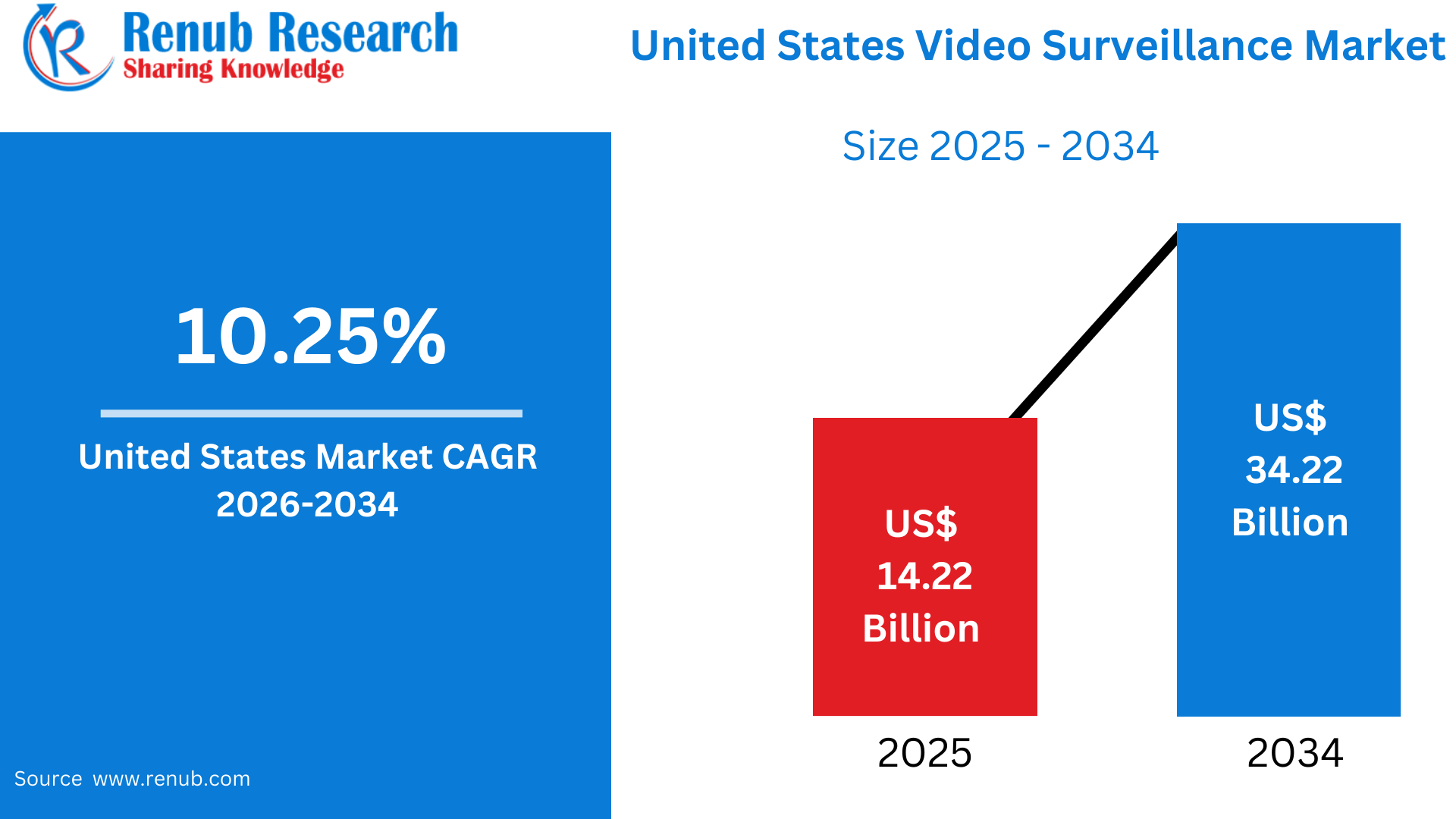
United States Video Surveillance Market is expected to witness consistent growth, expanding from US$ 14.22 Billion in 2025 to US$ 34.22 Billion by 2034, at a Compound Annual Growth Rate of 10.25% during the forecast period from 2026 to 2034. Market expansion is primarily driven by rising security concerns, increasing investments in smart city infrastructure, and the widespread adoption of cloud-based and AI-powered video surveillance technologies.
Video Surveillance Overview & Uses in United States
Video surveillance refers to the use of cameras, recording devices, and intelligent software to monitor, capture, and analyze activities across various physical environments for security, safety, and operational management. Modern surveillance systems integrate closed-circuit television (CCTV) with advanced technologies such as artificial intelligence, cloud computing, and video analytics to deliver real-time monitoring and actionable insights. These systems are extensively deployed across commercial establishments, public infrastructure, industrial facilities, transportation networks, and residential properties to strengthen security and improve operational efficiency.
In the United States, demand for video surveillance solutions continues to grow due to increasing concerns over public safety, criminal activities, and the protection of critical infrastructure. Organizations across industries are investing in advanced surveillance systems to prevent theft, safeguard employees, enhance situational awareness, and optimize business operations. At the same time, government initiatives promoting smart city development and infrastructure security are creating additional opportunities for market growth. Furthermore, continuous technological advancements—including cloud-based video storage, AI-enabled analytics, facial recognition, and high-definition imaging—are enhancing the capabilities of surveillance systems, accelerating the adoption of next-generation video surveillance solutions across the country.
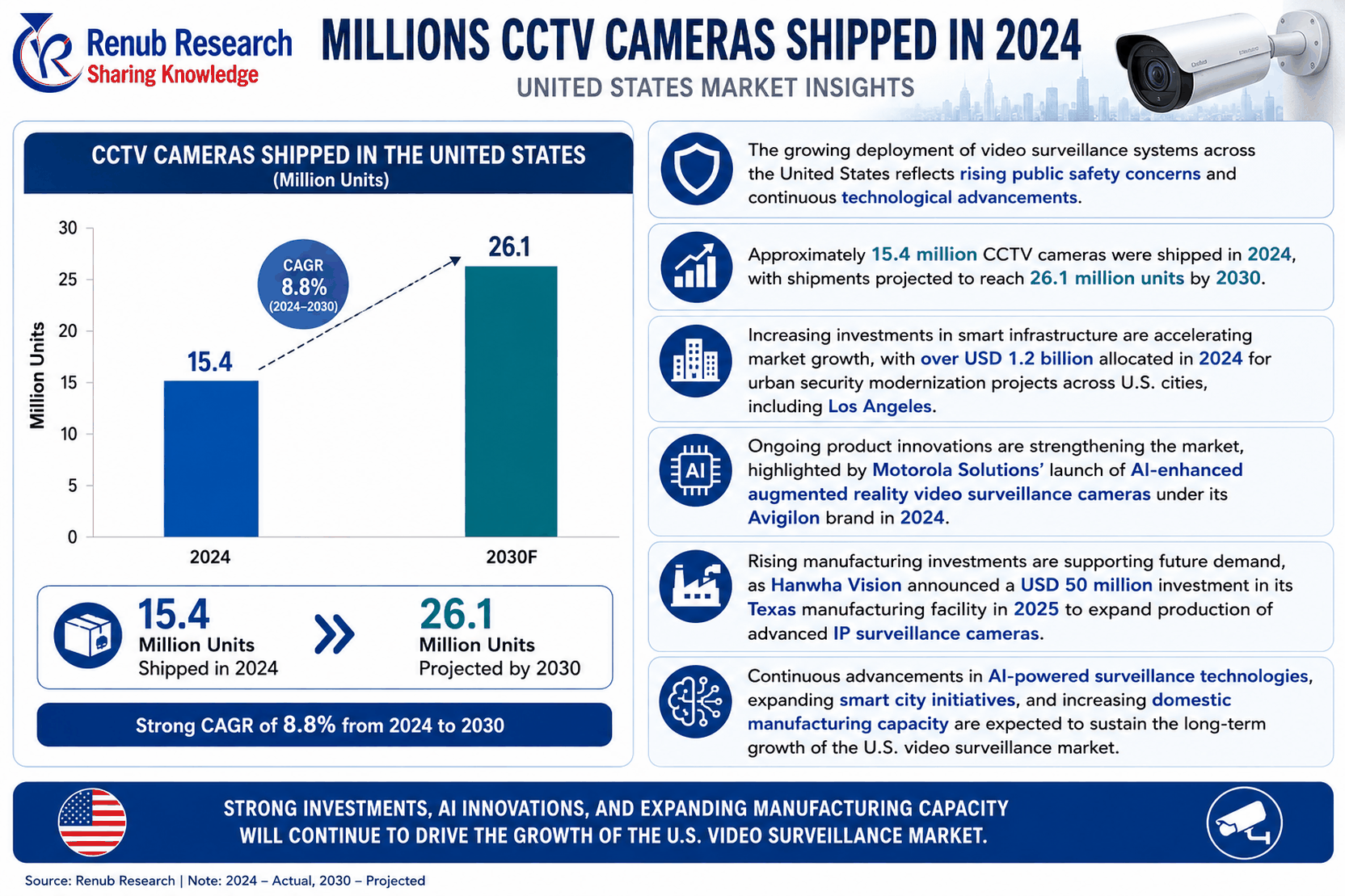
Millions CCTV cameras shipped in 2024
- The growing deployment of video surveillance systems across the United States reflects rising public safety concerns and continuous technological advancements.
- Approximately 15.4 million CCTV cameras were shipped in 2024, with shipments projected to reach 26.1 million units by 2030.
- Increasing investments in smart infrastructure are accelerating market growth, with over USD 1.2 billion allocated in 2024 for urban security modernization projects across U.S. cities, including Los Angeles.
- Ongoing product innovations are strengthening the market, highlighted by Motorola Solutions’ launch of AI-enhanced augmented reality video surveillance cameras under its Avigilon brand in 2024.
- Rising manufacturing investments are supporting future demand, as Hanwha Vision announced a USD 50 million investment in its Texas manufacturing facility in 2025 to expand production of advanced IP surveillance cameras.
- Continuous advancements in AI-powered surveillance technologies, expanding smart city initiatives, and increasing domestic manufacturing capacity are expected to sustain the long-term growth of the U.S. video surveillance market.
Key Growth Drivers
Rising Security Concerns and Increasing Demand for Crime Prevention
Growing concerns regarding public safety and crime prevention remain one of the primary factors driving the expansion of the United States video surveillance market. The increasing incidence of theft, vandalism, workplace violence, and unauthorized access has encouraged businesses, government agencies, and residential users to invest in advanced surveillance solutions. Retail organizations deploy video surveillance systems to minimize shoplifting, employee theft, and inventory losses, while commercial and industrial facilities rely on these systems to safeguard assets, employees, and critical infrastructure. Public transportation authorities, airports, and municipal administrations also utilize surveillance technologies to enhance operational security, support law enforcement investigations, and improve emergency response capabilities. Furthermore, government initiatives focused on reducing violent crime continue to strengthen market demand. In December 2024, the U.S. Department of Justice announced the expansion of the National Public Safety Partnership (PSP) to five additional locations. Administered by the Bureau of Justice Assistance, the program provides comprehensive violence prevention resources and public safety support to communities experiencing elevated levels of violent crime.
Growing Adoption of Artificial Intelligence and Advanced Video Analytics
The integration of artificial intelligence (AI) and advanced video analytics is significantly transforming the capabilities of modern video surveillance systems across the United States. AI-powered surveillance solutions enable features such as facial recognition, object detection, behavioral analysis, anomaly detection, and automated threat identification, allowing organizations to improve security while reducing dependence on continuous human monitoring. Beyond security applications, businesses increasingly leverage AI-driven analytics to generate operational insights related to customer behavior, workforce safety, and facility management. Within smart city initiatives, AI-enabled surveillance supports intelligent traffic management, crowd monitoring, and faster emergency response. The growing adoption of cloud-based surveillance platforms is further accelerating this trend by enabling scalable storage, remote monitoring, and real-time data analysis. In June 2025, Hexagon’s Safety, Infrastructure & Geospatial division introduced HxGN dC3 Video | Cloud, reinforcing the industry’s transition toward cloud-native video surveillance solutions.
Expansion of Smart City Programs and Infrastructure Modernization
Ongoing investments in smart city development and infrastructure modernization are creating significant growth opportunities for the U.S. video surveillance market. Federal, state, and local governments continue to invest in intelligent transportation systems, public safety infrastructure, and connected urban environments to improve operational efficiency and citizen safety. Video surveillance systems equipped with Internet of Things (IoT) connectivity play a central role in monitoring traffic conditions, public spaces, and critical infrastructure while enabling rapid incident detection and emergency response. The deployment of smart cameras integrated with advanced analytics enhances urban management through real-time monitoring and automated decision-making. In April 2025, US Ignite and Signify launched the BrightSites pilot project, which utilized existing streetlight infrastructure to deploy gigabit-speed Wi-Fi hotspots. The initiative demonstrated that smart city services could be implemented with approximately 80% lower deployment costs while also reducing carbon emissions by leveraging existing public infrastructure.
Key Challenges
Privacy Concerns and Increasing Regulatory Oversight
Privacy protection and regulatory compliance continue to pose significant challenges for the U.S. video surveillance industry. The widespread deployment of surveillance cameras, particularly those equipped with facial recognition and biometric identification technologies, has intensified concerns regarding personal privacy, data collection, and civil liberties. Consequently, federal, state, and local authorities are introducing stricter regulations governing the collection, storage, sharing, and use of surveillance data. Organizations deploying video surveillance systems must balance security objectives with compliance requirements related to data privacy, cybersecurity, and responsible AI usage. Navigating these evolving regulatory frameworks while maintaining effective security operations remains a key challenge for both public and private sector organizations.
High Deployment and Maintenance Costs
The substantial cost associated with deploying and maintaining advanced video surveillance systems remains another important restraint on market growth. Modern surveillance solutions require significant investment in high-definition and AI-enabled cameras, networking infrastructure, storage systems, cloud services, and video management software. In addition to installation expenses, organizations must account for ongoing maintenance, software updates, cybersecurity measures, and cloud storage subscription costs. These financial requirements can be particularly challenging for small and medium-sized enterprises (SMEs), limiting their ability to adopt sophisticated surveillance technologies. Furthermore, integrating new surveillance platforms with existing legacy security systems often involves additional technical complexity and implementation costs, further slowing adoption among budget-conscious organizations.
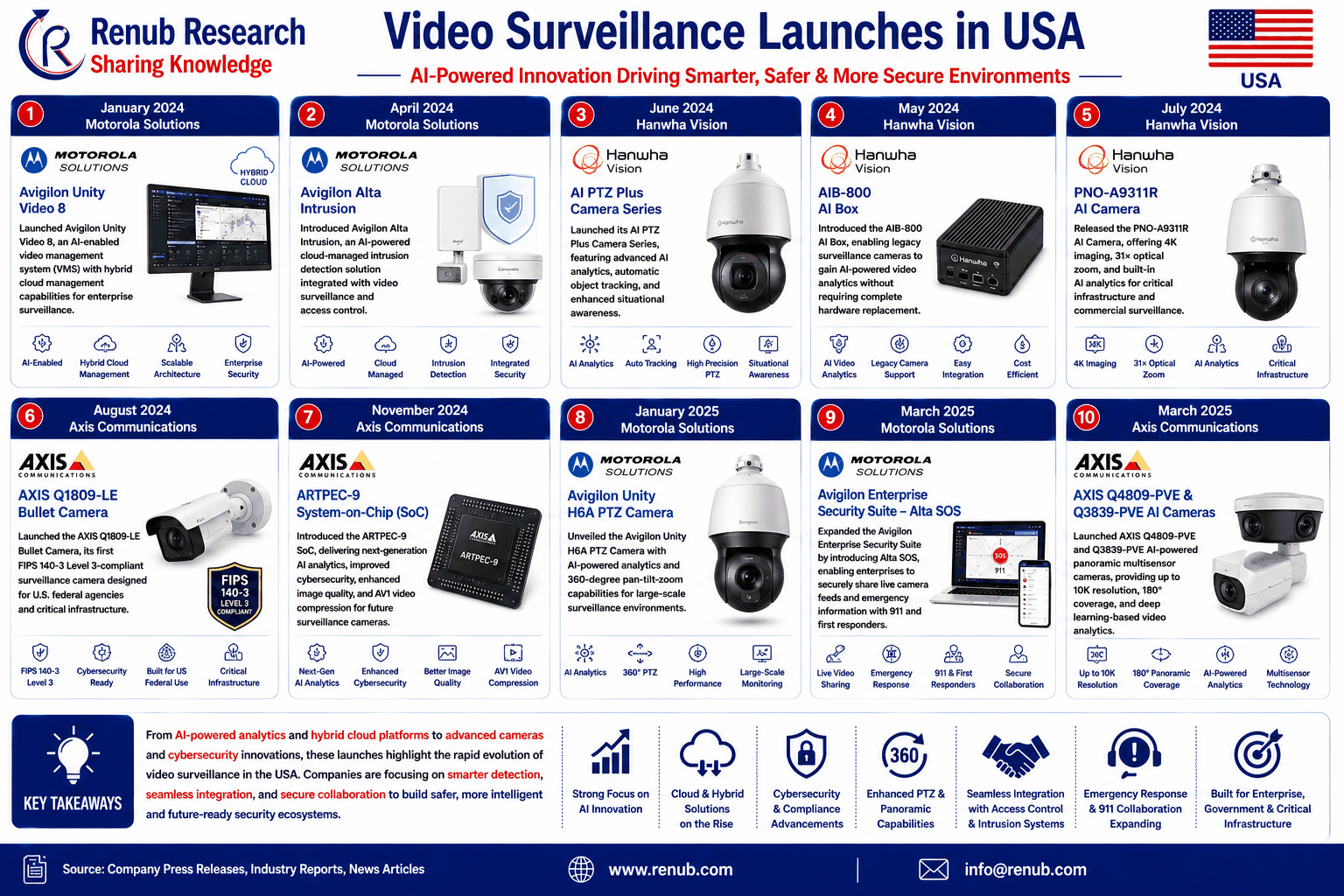
Video Surveillance launches in USA
- January 2024 – Motorola Solutions launched Avigilon Unity Video 8, an AI-enabled video management system (VMS) with hybrid cloud management capabilities for enterprise surveillance.
- April 2024 – Motorola Solutions introduced Avigilon Alta Intrusion, an AI-powered cloud-managed intrusion detection solution integrated with video surveillance and access control.
- June 2024 – Hanwha Vision launched its AI PTZ Plus Camera Series, featuring advanced AI analytics, automatic object tracking, and enhanced situational awareness for enterprise security applications.
- May 2024 – Hanwha Vision introduced the AIB-800 AI Box, enabling legacy surveillance cameras to gain AI-powered video analytics without requiring complete hardware replacement.
- July 2024 – Hanwha Vision released the PNO-A9311R AI Camera, offering 4K imaging, 31× optical zoom, and built-in AI analytics for critical infrastructure and commercial surveillance.
- August 2024 – Axis Communications launched the AXIS Q1809-LE Bullet Camera, its first FIPS 140-3 Level 3-compliant surveillance camera designed for U.S. federal agencies and critical infrastructure.
- November 2024 – Axis Communications introduced the ARTPEC-9 System-on-Chip (SoC), delivering next-generation AI analytics, improved cybersecurity, enhanced image quality, and AV1 video compression for future surveillance cameras.
- January 2025 – Motorola Solutions unveiled the Avigilon Unity H6A PTZ Camera with AI-powered analytics and 360-degree pan-tilt-zoom capabilities for large-scale surveillance environments.
- March 2025 – Motorola Solutions expanded the Avigilon Enterprise Security Suite by introducing Alta SOS, enabling enterprises to securely share live camera feeds and emergency information with 911 and first responders.
- March 2025 – Axis Communications launched the AXIS Q4809-PVE and Q3839-PVE AI-powered panoramic multisensor cameras, providing up to 10K resolution, 180° coverage, and deep learning-based video analytics.
Component Analysis
United States Video Surveillance Software
The United States video surveillance software market is experiencing robust growth as organizations increasingly adopt intelligent software platforms that extend beyond traditional video monitoring. Modern video surveillance software enables centralized management of multiple cameras, real-time monitoring, video recording, and advanced analytics capabilities such as facial recognition, object detection, behavioral analysis, and automated event detection. Businesses are increasingly utilizing these solutions to improve security, optimize operational performance, and generate actionable insights from surveillance data. Furthermore, the growing adoption of cloud-based platforms and artificial intelligence (AI)-powered video analytics is accelerating the transition toward smarter and more scalable surveillance software solutions across the country.
Video Surveillance Services in United States
The United States video surveillance services market is expanding steadily, driven by increasing demand for comprehensive security management and remote monitoring solutions. The market encompasses a broad range of services, including system installation, integration, maintenance, remote monitoring, managed security services, software upgrades, cybersecurity support, and system optimization. Organizations are increasingly outsourcing surveillance management to specialized service providers to improve operational efficiency while reducing the burden on in-house IT and security teams. The growing adoption of cloud-based surveillance platforms and AI-enabled monitoring services is further strengthening demand for managed video surveillance services, particularly among large enterprises and organizations operating across multiple locations.
System Type Analysis
United States Video IP Surveillance
The U.S. IP video surveillance market is witnessing strong growth as businesses and public sector organizations replace conventional analog surveillance systems with advanced Internet Protocol (IP)-based solutions. IP surveillance systems deliver superior image quality, remote accessibility, centralized management, and real-time monitoring across multiple sites. In addition to high-definition video capture, modern IP cameras incorporate intelligent capabilities such as motion detection, facial recognition, artificial intelligence, and advanced video analytics to enhance threat detection and situational awareness. These technological advantages continue to drive widespread adoption of IP surveillance systems across commercial, industrial, and public infrastructure applications.
Video Surveillance Hybrid in United States
The United States hybrid video surveillance market is growing as organizations seek cost-effective solutions for transitioning from legacy analog surveillance infrastructure to modern IP-based systems. Hybrid surveillance platforms enable businesses to integrate existing analog cameras with newly deployed IP cameras, allowing gradual system upgrades without replacing their entire surveillance infrastructure. This approach helps organizations maximize previous investments while gaining access to advanced software features, centralized management capabilities, and intelligent analytics. As a result, hybrid surveillance solutions remain an attractive option for enterprises pursuing digital transformation while minimizing implementation costs.
Application Analysis
United States Residential Video Surveillance Industry
The residential video surveillance market in the United States is expanding rapidly, supported by increasing consumer awareness regarding home security and personal safety. Homeowners are increasingly installing surveillance cameras to protect their properties, deter theft, monitor visitors, and enhance overall household security. Growing demand for wireless security cameras, smart home integration, mobile application-based monitoring, and cloud video storage is further accelerating market growth. Additionally, rising incidents of package theft and residential property crimes have encouraged consumers to invest in advanced residential surveillance systems that provide real-time alerts and remote access through connected devices.
Commercial Video Surveillance in United States
The commercial video surveillance market in the United States serves a diverse range of industries, including retail, corporate offices, manufacturing, healthcare, hospitality, logistics, and transportation. Organizations deploy advanced surveillance systems to strengthen security, prevent theft, safeguard employees, and ensure regulatory compliance. Beyond traditional security applications, AI-powered video analytics enable retailers to analyze customer behavior and optimize store operations, while manufacturers utilize intelligent surveillance to improve workplace safety and operational efficiency. Cloud-enabled surveillance platforms also allow businesses to monitor multiple facilities from centralized control centers, improving scalability and operational visibility. As organizations increasingly recognize the strategic value of surveillance data, commercial video surveillance has evolved into an essential investment that supports both risk management and business intelligence initiatives.
Top States Analysis
California Video Surveillance Market
California represents one of the largest and most technologically advanced video surveillance markets in the United States, supported by its strong economy, extensive urban infrastructure, and thriving technology ecosystem. The widespread deployment of surveillance systems across smart cities, transportation networks, commercial complexes, educational institutions, residential communities, and public spaces continues to drive market growth. As a leader in artificial intelligence (AI) innovation, California has witnessed rapid adoption of AI-powered video analytics, cloud-based surveillance platforms, facial recognition technologies, and intelligent monitoring solutions. Organizations increasingly utilize these systems not only to strengthen security but also to improve operational efficiency, generate customer insights, and enhance workplace safety. While the market benefits from rising urbanization, high-value infrastructure, and ongoing smart city investments, stringent state privacy regulations require organizations to ensure transparent data collection, secure information management, and responsible use of surveillance data.
New York Video Surveillance Market
The New York video surveillance market continues to expand due to the state’s dense population, extensive critical infrastructure, and strong emphasis on public safety and security. Video surveillance systems are widely deployed across public transportation networks, airports, commercial buildings, retail centers, healthcare facilities, and residential developments to enhance security and support efficient operations. High pedestrian volumes and complex urban security requirements have accelerated the adoption of advanced surveillance technologies, including intelligent video analytics, automated alerts, and integrated emergency response systems. Businesses increasingly rely on surveillance solutions to reduce inventory losses, manage crowd movement, and protect employees and customers. Government agencies and public authorities also continue to invest in large-scale surveillance networks to strengthen situational awareness, improve emergency response capabilities, and support law enforcement activities. Additionally, the growing integration of artificial intelligence enables more accurate object recognition, incident detection, and forensic investigations, further enhancing the effectiveness of modern surveillance systems.
Washington Video Surveillance Market
Washington’s video surveillance market is experiencing steady growth, supported by the state’s strong technology sector, expanding commercial infrastructure, and increasing government investments in public safety initiatives. Demand for advanced surveillance solutions is rising across corporate offices, data centers, retail establishments, seaports, transportation hubs, and public facilities. The state’s technology-driven environment has accelerated the adoption of Internet Protocol (IP)-based cameras, cloud-managed surveillance platforms, and AI-powered video analytics that offer greater scalability, remote accessibility, and intelligent data analysis. Businesses are increasingly deploying these systems to strengthen physical security, protect valuable assets, improve operational efficiency, and enhance workplace safety. Furthermore, government programs focused on smart transportation systems, urban security, and public infrastructure modernization continue to support market expansion. Growing consumer interest in smart home technologies and connected residential security solutions is also contributing to increased adoption of video surveillance systems across the residential sector.
Market Segmentations
Component
- Hardware
- Software
- Services
System Type
- Analog Surveillance
- IP Surveillance
- Hybrid Surveillance
Application
- Public Facility
- Commercial
- Residential
- Industrial
- Military & Defense
- Infrastructure
Top States
- California
- Texas
- New York
- Florida
- Illinois
- Pennsylvania
- Ohio
- Georgia
- New Jersey
- Washington
- North Carolina
- Massachusetts
- Virginia
- Michigan
- Maryland
- Colorado
- Tennessee
- Indiana
- Arizona
- Minnesota
- Wisconsin
- Missouri
- Connecticut
- South Carolina
- Oregon
- Louisiana
- Alabama
- Kentucky
- Rest of United States
All companies have been covered with 5 Viewpoints
- Overviews
- Key Person
- Recent Developments
- SWOT Analysis
- Revenue Analysis
Company Analysis:
- Honeywell International Inc.
- Robert Bosch GmbH
- Schneider Electric SE
- Panasonic Holdings Corporation
- Cisco Systems Inc.
- TKH GROUP N.V.
- Motorola Solutions, Inc.
- Verint Systems Inc.
Report Details:
| Report Features | Details |
| Base Year |
2025 |
| Historical Period |
2022 - 2025 |
| Forecast Period |
2026 - 2034 |
| Market |
US$ Billion |
| Segment Covered |
Component, System Type, Application and State |
| States Covered |
|
| Companies Covered |
|
| Customization Scope |
20% Free Customization |
| Post-Sale Analyst Support |
1 Year (52 Weeks) |
| Delivery Format |
PDF and Excel through Email (We can also provide the editable version of the report in PPT/Word format on request) |
Customization Services available
- Analysis of Market Size and Its Segments
- More Company Profiles (Upto 10 without any additional cost):
- Additional Countries (Other than mentioned Countries):
- Region/Country Specific Reports:
- Market Entry Strategy:
- Region-Specific Market Dynamics:
- Regional Market Share Analysis:
- Trade Analysis:
- Production Insights:
- Others Customized Requests:
For more information contact our analysts.
Need More Assistance?
- Talk to our analysts to get more precious information on the current market trends.
- Include more countries and segments and customize the report based on the final requirement.
- Get a competitive advantage in your industry by knowing the report findings and making a positive impact on your revenues and operations.
- Our analysts are always ready to provide more help and pertinent information if you need any additional assistance.