India Video Surveillance Market Size, Share, Trends, Growth Analysis and Forecast Report 2026–2034
Buy NowIndia Video Surveillance Market Size and Forecast
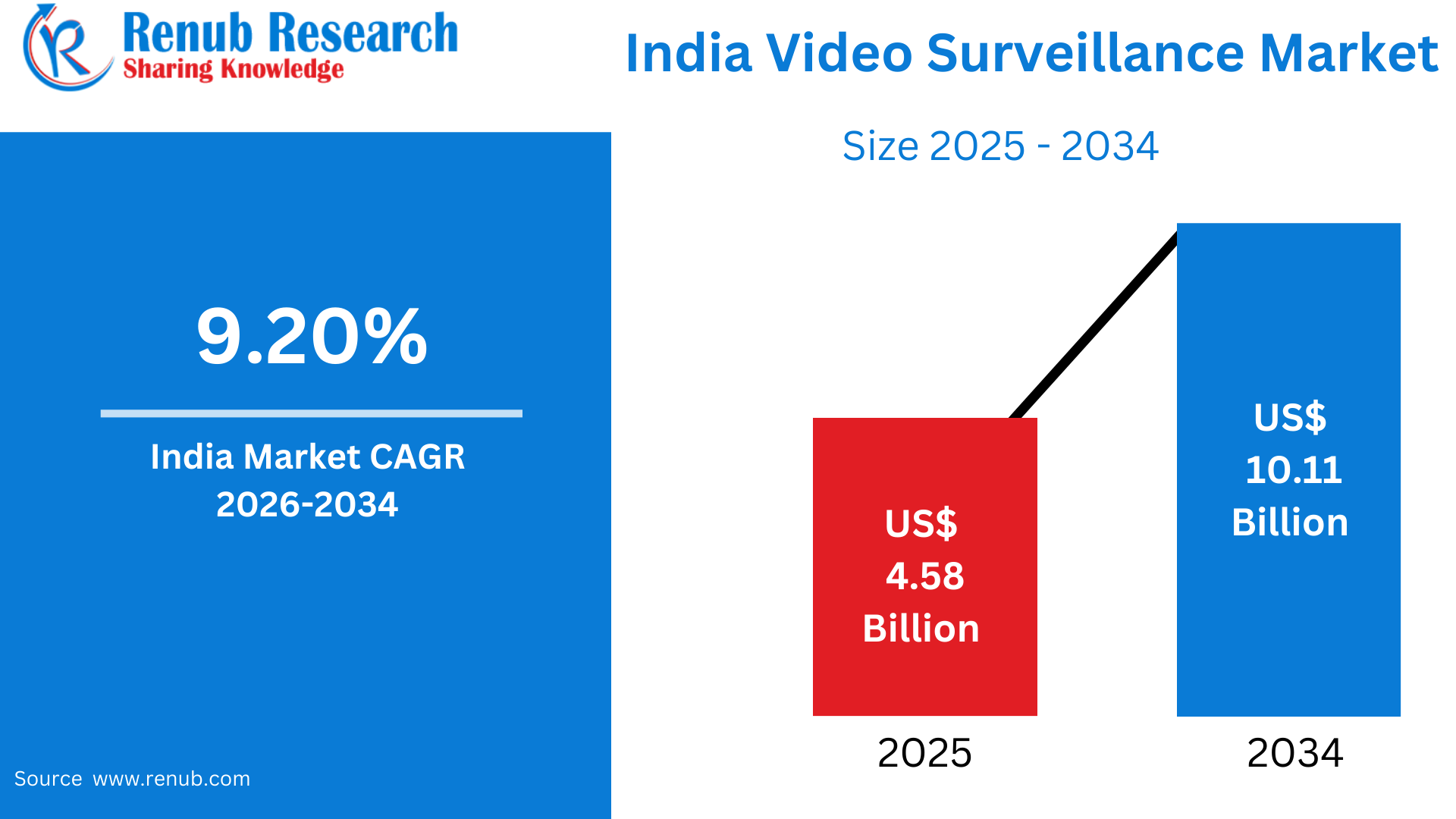
The India video surveillance market is projected to witness robust growth during the forecast period, expanding from US$ 4.58 billion in 2025 to approximately US$ 10.11 billion by 2034, registering a compound annual growth rate (CAGR) of 9.20% between 2026 and 2034. Market expansion is being driven by increasing concerns regarding public safety and asset protection, the rapid implementation of smart city initiatives, and the growing deployment of video surveillance solutions across commercial, residential, industrial, and transportation sectors. In addition, advancements in intelligent surveillance technologies and rising investments in digital infrastructure are further supporting market growth.
Video Surveillance and Its Demand in India
Video surveillance refers to the use of cameras, recording systems, and monitoring software to observe, record, and analyze activities across public and private environments. Modern surveillance solutions incorporate technologies such as closed-circuit television (CCTV) cameras, Internet Protocol (IP) cameras, network video recorders (NVRs), cloud-based storage, and artificial intelligence (AI)-enabled video analytics. These systems are widely utilized to enhance security, deter criminal activities, monitor traffic, safeguard critical infrastructure, improve workplace safety, and support law enforcement investigations. Advanced capabilities including facial recognition, motion detection, automatic number plate recognition (ANPR), behavioral analytics, and real-time alert systems have significantly expanded the role of video surveillance from passive monitoring to intelligent, proactive security management.
In India, the adoption of video surveillance solutions has accelerated considerably in recent years, driven by rapid urbanization, expanding infrastructure projects, and increasing emphasis on public security. Government initiatives such as the Smart Cities Mission, digital policing programs, and transportation modernization projects have encouraged large-scale deployment of surveillance systems across metropolitan areas, highways, airports, railway stations, and other critical public locations. At the same time, businesses operating in sectors including retail, banking, manufacturing, healthcare, education, and corporate offices are increasingly implementing video surveillance systems to prevent theft, strengthen operational security, improve workforce productivity, and ensure regulatory compliance. Falling hardware costs, expanding broadband connectivity, and continuous innovations in AI-powered video analytics are expected to further accelerate the adoption of advanced video surveillance technologies across India throughout the forecast period.
Delhi CCTV Project:
The project is an initiative by the current state government to enhance public safety and security in the national capital. As of January 2024, around 2.5 lakh CCTV cameras were installed by the state government which is likely to reach 2.8 lakhs by the end of the year (2024). As part of the project, 10,000 CCTV and automatic number plate recognition cameras were installed by the Delhi police. Automatic number plate recognition (ANPR) and facial recognition capabilities enable law enforcement agencies with better insights in real-time allowing swift response to incidents as these cameras can identify vehicles and individuals associated with criminal activities. The project also encourages community involvement by promoting the installation of private CCTV cameras in residential areas, creating a collaborative environment for safety. Notably, Delhi, Hyderabad, Chennai and Mumbai remain among the most surveilled cities (outside China) in the world in terms of # of CCTV cameras per square mile.
Growth Drivers
Government Initiatives Supporting Smart Cities and Public Safety
Government-led investments in smart infrastructure and public security are among the primary factors driving the growth of the India video surveillance market. Through initiatives such as the Smart Cities Mission, authorities are deploying surveillance cameras, integrated command-and-control centers, intelligent traffic management systems, and advanced monitoring networks to enhance urban safety and improve city management. Video surveillance solutions are being increasingly installed across transportation hubs, highways, educational institutions, government buildings, and other public spaces to strengthen crime prevention, improve traffic regulation, and enable faster emergency response. The integration of advanced technologies, including artificial intelligence (AI), facial recognition, traffic analytics, and automated incident detection, is transforming surveillance systems into proactive security tools capable of supporting real-time decision-making. In addition to central government initiatives, state governments and municipal authorities continue to expand surveillance infrastructure through public-private partnerships, accelerating project implementation and improving operational efficiency. Various government agencies—including the Ministry of Home Affairs, Central Police Organizations, Central Armed Police Forces (CAPFs), State Police Forces, Economic Offences Wing, Crime Investigation Departments (CID), National Disaster Management Authority (NDMA), Special Protection Group (SPG), and National Security Guard (NSG)—are actively utilizing surveillance technologies to strengthen law enforcement, disaster response, and national security. These coordinated efforts continue to create significant opportunities for the expansion of video surveillance solutions across India.
Rising Security Awareness Across Commercial and Residential Sectors
In December 2025, CP PLUS, one of Asia’s leading video security brands, partnered with Qualcomm Technologies to introduce a new generation of AI-powered video surveillance solutions for the Indian market. The collaboration combines CP PLUS’s extensive product portfolio and distribution network with Qualcomm Dragonwing™ processors and the Qualcomm® Insight Platform, enabling intelligent security solutions tailored to evolving industrial and public safety requirements. Growing concerns regarding theft, vandalism, workplace safety, and personal security are driving widespread adoption of video surveillance systems across both commercial and residential environments. Businesses operating in sectors such as retail, banking, healthcare, manufacturing, logistics, hospitality, and corporate offices are increasingly deploying surveillance systems to protect assets, monitor operations, enhance employee safety, and comply with regulatory requirements. At the same time, residential demand is increasing as apartment complexes, gated communities, and individual homeowners invest in surveillance solutions to improve property security and monitor daily activities. The availability of affordable surveillance hardware, cloud-enabled monitoring platforms, mobile applications, and real-time notification capabilities has made advanced security systems more accessible to households and small businesses. In addition, real estate developers are increasingly incorporating integrated surveillance infrastructure into new residential and commercial projects, further stimulating market demand.
Technological Advancements in AI, Video Analytics, and IP-Based Surveillance
In December 2025, IFSEC India 2025 showcased the latest AI- and Internet of Things (IoT)-enabled security technologies, featuring participation from more than 300 global and domestic brands. The exhibition highlighted increasing collaboration between government agencies and private enterprises while demonstrating the growing importance of AI-powered surveillance solutions in enhancing security, operational efficiency, and large-scale monitoring capabilities. Rapid technological innovation continues to reshape the India video surveillance market by improving system performance, scalability, and operational intelligence. The ongoing transition from conventional analog systems to Internet Protocol (IP)-based surveillance enables higher-resolution video capture, improved network integration, and more efficient remote monitoring capabilities. Artificial intelligence, machine learning, and advanced video analytics have significantly expanded surveillance functionality through features such as facial recognition, object detection, intrusion alerts, crowd management, behavioral analysis, and automated event detection. These capabilities enable organizations to move beyond traditional video recording toward predictive security and data-driven operational management. Cloud-based surveillance platforms further improve scalability by reducing infrastructure costs, simplifying data storage, and enabling centralized monitoring across multiple locations. The declining cost of high-definition cameras, improved broadband connectivity, and expanding deployment of 5G and fiber-optic networks are also supporting widespread adoption of intelligent surveillance systems across India.
Video Surveillance Product launches in India
- CP PLUS – AI-Powered Video Security Solutions with Qualcomm Technologies (December 2025): CP PLUS partnered with Qualcomm Technologies to launch a new generation of AI-powered video surveillance solutions powered by Qualcomm Dragonwing™ processors and the Qualcomm® Insight Platform, offering intelligent analytics, facial recognition, and enhanced edge computing capabilities for commercial and industrial security applications.
- Hikvision India – ColorVu 3.0 Camera Series (2025): Hikvision India introduced the ColorVu 3.0 surveillance camera lineup featuring AI-powered image processing, full-color imaging in ultra-low-light conditions, AcuSense technology, and improved night-time monitoring for residential, commercial, and public safety applications.
- Prama Hikvision India – Smart Hybrid Light Cameras (2025): Prama Hikvision launched its Smart Hybrid Light surveillance cameras that intelligently switch between infrared and white light, providing energy-efficient monitoring while improving image clarity and reducing light pollution.
- Dahua Technology India – WizColor AI Camera Series (2025): Dahua introduced its WizColor AI-enabled surveillance cameras capable of delivering vivid full-color video in low-light environments without supplemental lighting, targeting smart cities, transportation, retail, and industrial security.
- Axis Communications India – AXIS Q1809-LE Bullet Camera (2025): Axis launched the AXIS Q1809-LE, an AI-enabled 41 MP network camera designed for long-distance surveillance, perimeter protection, highways, airports, and critical infrastructure projects.
- Bosch Security Systems India – FLEXIDOME 8100i Camera Series (2025): Bosch introduced the FLEXIDOME 8100i intelligent camera range equipped with built-in AI analytics, object classification, and automated incident detection for enterprise and government security deployments.
- Honeywell India – 70 Series AI IP Cameras (2024): Honeywell expanded its surveillance portfolio with the 70 Series IP Cameras, featuring AI-based object detection, facial recognition support, cyber-secure architecture, and remote monitoring capabilities for commercial buildings and industrial facilities.
- TP-Link VIGI – VIGI C540-W Outdoor Pan-Tilt Camera (2024): TP-Link launched the VIGI C540-W, an outdoor wireless surveillance camera offering 360-degree pan-tilt functionality, AI human and vehicle detection, full-color night vision, and cloud-enabled remote access for homes and small businesses.
- EZVIZ India – H9c Dual-Lens Wi-Fi Security Camera (2024): EZVIZ introduced the H9c Dual-Lens smart security camera featuring dual-lens imaging, AI-powered human and vehicle detection, auto-tracking, dual-view monitoring, and color night vision for residential surveillance.
- Qubo (Hero Group) – Smart Outdoor Security Camera Pro 2K (2024): Qubo launched its Smart Outdoor Security Camera Pro 2K, equipped with AI-based person detection, intrusion alerts, weather-resistant construction, cloud storage support, and smartphone connectivity for home and small business security.
Challenges
Privacy Concerns and Regulatory Uncertainty
Privacy protection and regulatory compliance remain key challenges for the India video surveillance market. The increasing deployment of surveillance cameras across public and private spaces has intensified concerns regarding personal data protection, unauthorized access, misuse of recorded information, and the collection of biometric data without adequate consent. As India’s data protection and privacy regulations continue to evolve, businesses face uncertainty regarding legal requirements for data collection, storage, retention, sharing, and cybersecurity compliance. Furthermore, the deployment of facial recognition technologies and continuous public monitoring has raised ethical concerns that may influence adoption in certain applications. Maintaining an appropriate balance between public safety, regulatory compliance, and individual privacy rights will remain essential for sustainable market development.
High Implementation and Infrastructure Costs
Despite strong market demand, infrastructure limitations and implementation costs continue to present significant barriers to broader adoption of advanced video surveillance solutions. Many rural and semi-urban regions still face challenges related to reliable electricity supply, high-speed internet connectivity, and the availability of skilled technical professionals required to install and maintain sophisticated surveillance networks. In addition, AI-enabled surveillance platforms, cloud-based monitoring systems, and large-scale integrated security deployments require substantial capital investment, making adoption more difficult for small and medium-sized enterprises (SMEs) and budget-constrained public sector organizations. Ongoing expenses associated with equipment maintenance, software upgrades, cybersecurity measures, cloud storage, and system integration further increase the total cost of ownership, limiting the pace of deployment across cost-sensitive segments of the Indian market.
Component Insights
Video Surveillance Software
The India video surveillance software market is witnessing rapid growth, driven by the increasing demand for intelligent, AI-enabled security solutions across both public and private sectors. Video surveillance software enables centralized management, monitoring, recording, and analysis of multiple surveillance cameras through a single platform, improving operational efficiency and security management. The integration of artificial intelligence and advanced video analytics has introduced capabilities such as facial recognition, automatic number plate recognition (ANPR), motion detection, object tracking, behavioral analysis, and anomaly detection. These intelligent software platforms are being widely deployed across airports, smart city projects, retail establishments, manufacturing facilities, transportation networks, and critical infrastructure to enhance situational awareness and operational decision-making. Furthermore, the growing adoption of cloud-based surveillance software is enabling remote access, centralized data management, and scalable security operations, further accelerating market growth.
Video Surveillance Services
The India video surveillance services market represents a critical component of the overall surveillance ecosystem, encompassing system design, installation, integration, maintenance, technical support, and managed security services. As surveillance systems become increasingly sophisticated, organizations are relying on specialized service providers to ensure seamless deployment, optimal system performance, and regular maintenance. Demand for managed surveillance services, including remote system monitoring, cloud-based management, preventive maintenance, and technical support, is rising steadily, particularly among enterprises lacking in-house security expertise. The market is also benefiting from recurring revenue models, long-term maintenance contracts, and the growing need for professional consulting, system upgrades, and advanced video analytics support.
System Type Insights
IP Video Surveillance
The India IP video surveillance market is expanding rapidly as organizations continue transitioning from traditional analog systems to Internet Protocol (IP)-based surveillance solutions. IP cameras provide superior image quality, enhanced scalability, remote accessibility, and seamless integration with access control systems, artificial intelligence, and advanced video analytics platforms. These systems are increasingly being deployed across smart city initiatives, commercial buildings, transportation infrastructure, educational institutions, healthcare facilities, and industrial environments. India’s ongoing digital transformation, coupled with expanding broadband connectivity and smart infrastructure development, has significantly accelerated the adoption of IP-based surveillance technologies. Additionally, declining prices of IP cameras and networking equipment have made these advanced surveillance systems increasingly affordable for organizations of all sizes.
Hybrid Surveillance Systems
The India hybrid surveillance systems market is gaining traction as organizations seek cost-effective solutions for modernizing existing surveillance infrastructure. Hybrid systems combine analog and IP-based technologies, allowing businesses and public institutions to upgrade their security capabilities while leveraging previously installed analog equipment. This phased migration approach minimizes capital expenditure by eliminating the need for complete system replacement and enables organizations to gradually transition toward fully digital surveillance environments. Hybrid surveillance solutions are particularly well suited for small and medium-sized enterprises (SMEs), educational institutions, government agencies, and local public organizations operating under budget constraints, offering flexibility, scalability, and enhanced functionality without major infrastructure overhauls.
Application Insights
Residential Video Surveillance
The India residential video surveillance market is among the fastest-growing segments of the country’s surveillance industry, supported by rapid urbanization, rising disposable incomes, growing nuclear family structures, and increasing awareness of home security. Demand for surveillance systems is expanding across apartment complexes, gated communities, villas, and individual residences as homeowners seek enhanced protection for their families and property. The availability of affordable surveillance cameras, wireless connectivity, smartphone-enabled remote monitoring, and cloud-based video storage has made home security solutions more accessible to middle-income households. In addition, residential developers and housing societies are increasingly installing surveillance systems in common areas such as entrances, parking facilities, elevators, and recreational spaces to strengthen overall community security.
Military & Defense Video Surveillance
The India military and defense video surveillance market is driven by the country’s continued focus on strengthening national security, border protection, and defense modernization. Advanced surveillance technologies are extensively deployed across international borders, military installations, strategic infrastructure, and high-security zones to improve situational awareness and support real-time threat detection. Modern defense surveillance systems increasingly integrate high-definition imaging, thermal cameras, infrared sensors, artificial intelligence, and intelligent analytics to enhance surveillance capabilities under diverse environmental and operational conditions. Ongoing government investments in defense modernization programs, border security initiatives, and critical infrastructure protection continue to generate sustained demand for highly secure, technologically advanced video surveillance solutions across India’s defense sector.
States Insights
Maharashtra
Maharashtra represents one of India’s largest video surveillance markets due to its high level of urbanization, industrial development, and commercial activity. Cities such as Mumbai, Pune, Nagpur, Nashik, and Thane are continuously investing in intelligent surveillance infrastructure to strengthen public safety, traffic management, and emergency response capabilities. Government-led smart city initiatives and integrated command-and-control centers have accelerated the deployment of AI-enabled surveillance cameras across roads, railway stations, airports, government buildings, and other public spaces. The state’s strong manufacturing, banking, retail, logistics, and information technology sectors are also driving demand for advanced surveillance solutions to safeguard assets, monitor operations, and ensure regulatory compliance. Residential complexes and commercial real estate projects are increasingly integrating cloud-connected CCTV and IP-based surveillance systems as part of modern security infrastructure. Continuous investments in digital infrastructure, artificial intelligence, and smart transportation systems are expected to sustain strong market growth across Maharashtra throughout the forecast period.
Tamil Nadu
Tamil Nadu is emerging as a significant market for video surveillance solutions, supported by rapid industrialization, expanding urban infrastructure, and growing investments in public security. Major cities including Chennai, Coimbatore, Madurai, Tiruchirappalli, and Salem are witnessing increased deployment of surveillance systems across transportation networks, educational institutions, healthcare facilities, commercial establishments, and public spaces. The state’s well-established automobile, electronics, textile, and manufacturing industries continue to invest in advanced surveillance technologies to improve workplace safety, monitor production facilities, and strengthen operational security. Government initiatives aimed at enhancing traffic management, crime prevention, and smart city development are further boosting demand for AI-powered surveillance platforms and integrated monitoring systems. Rising adoption of cloud-based video management software, intelligent analytics, and remote monitoring solutions among businesses and residential communities is creating new opportunities for market expansion. Growing digital connectivity and investments in modern security infrastructure are expected to support sustained growth in the Tamil Nadu video surveillance market.
Karnataka
Karnataka has established itself as a leading market for advanced video surveillance solutions, largely driven by its strong technology ecosystem and expanding urban infrastructure. Bengaluru, the state’s capital and India’s leading information technology hub, accounts for substantial demand for AI-enabled surveillance systems across corporate campuses, technology parks, data centers, residential communities, and commercial buildings. Increasing investments in smart city projects, intelligent traffic management, and digital policing initiatives are accelerating the deployment of IP cameras, cloud-based surveillance platforms, and video analytics solutions across major urban centers. Manufacturing industries, educational institutions, healthcare organizations, and retail businesses are also adopting intelligent surveillance systems to improve operational efficiency, asset protection, and regulatory compliance. The growing integration of artificial intelligence, facial recognition, license plate recognition, and cloud-based monitoring technologies is transforming the state’s security landscape. Continuous technological innovation and expanding digital infrastructure are expected to maintain Karnataka’s position as one of India’s fastest-growing video surveillance markets.
Uttar Pradesh
Uttar Pradesh is witnessing substantial growth in the video surveillance market, driven by rapid urbanization, expanding public infrastructure, and increasing government investments in law enforcement and public safety. Major cities such as Lucknow, Kanpur, Noida, Ghaziabad, Varanasi, Prayagraj, and Agra are implementing large-scale surveillance projects to strengthen crime prevention, improve traffic management, and enhance emergency response capabilities. Smart city initiatives and modernization of transportation infrastructure have significantly increased the deployment of CCTV cameras, IP-based surveillance systems, and centralized monitoring centers across highways, railway stations, airports, government offices, educational institutions, and public spaces. Growing industrial development, commercial expansion, and rising residential construction activities are further supporting demand for intelligent surveillance solutions among businesses and homeowners. The increasing adoption of AI-powered video analytics, cloud-based surveillance platforms, and remote monitoring technologies is improving operational efficiency while enabling proactive security management. Continued investments in digital governance and urban infrastructure are expected to drive long-term growth of the Uttar Pradesh video surveillance market.
Market Segmentations
Component
- Hardware
- Software
- Services
System Type
- Analog Surveillance
- IP Surveillance
- Hybrid Surveillance
Application
- Public Facility
- Commercial
- Residential
- Industrial
- Military & Defense
- Infrastructure
Top States
- Maharashtra
- Tamil Nadu
- Karnataka
- Uttar Pradesh
- Gujarat
- West Bengal
- Rajasthan
- Telangana
- Andhra Pradesh
- Madhya Pradesh
- Other States
All companies have been covered with 5 Viewpoints
- Overviews
- Key Person
- Recent Developments
- SWOT Analysis
- Revenue Analysis
Company Analysis:
- Honeywell International Inc.
- Robert Bosch GmbH
- Schneider Electric SE
- Panasonic Holdings Corporation
- Samsung Electronics Co Ltd
- Videocon Industries Ltd
- Zicom Electronic Security Systems
- D-Link India Limited
Report Details:
| Report Features | Details |
| Base Year |
2025 |
| Historical Period |
2022 - 2025 |
| Forecast Period |
2026 - 2034 |
| Market |
US$ Billion |
| Segment Covered |
Component, System Type, Application and Top States |
| States Covered |
|
| Companies Covered |
|
| Customization Scope |
20% Free Customization |
| Post-Sale Analyst Support |
1 Year (52 Weeks) |
| Delivery Format |
PDF and Excel through Email (We can also provide the editable version of the report in PPT/Word format on request) |
Customization Services available
- Analysis of Market Size and Its Segments
- More Company Profiles (Upto 10 without any additional cost):
- Additional Countries (Other than mentioned Countries):
- Region/Country Specific Reports:
- Market Entry Strategy:
- Region-Specific Market Dynamics:
- Regional Market Share Analysis:
- Trade Analysis:
- Production Insights:
- Others Customized Requests:
For more information contact our analysts.
Need More Assistance?
- Talk to our analysts to get more precious information on the current market trends.
- Include more countries and segments and customize the report based on the final requirement.
- Get a competitive advantage in your industry by knowing the report findings and making a positive impact on your revenues and operations.
- Our analysts are always ready to provide more help and pertinent information if you need any additional assistance.