United States Residential Toaster Ovens Market Report by Product Type, Distribution Channel, States and Company Analysis, 2025-2034
Buy NowUnited States Residential Toaster Ovens Market Size and Forecast
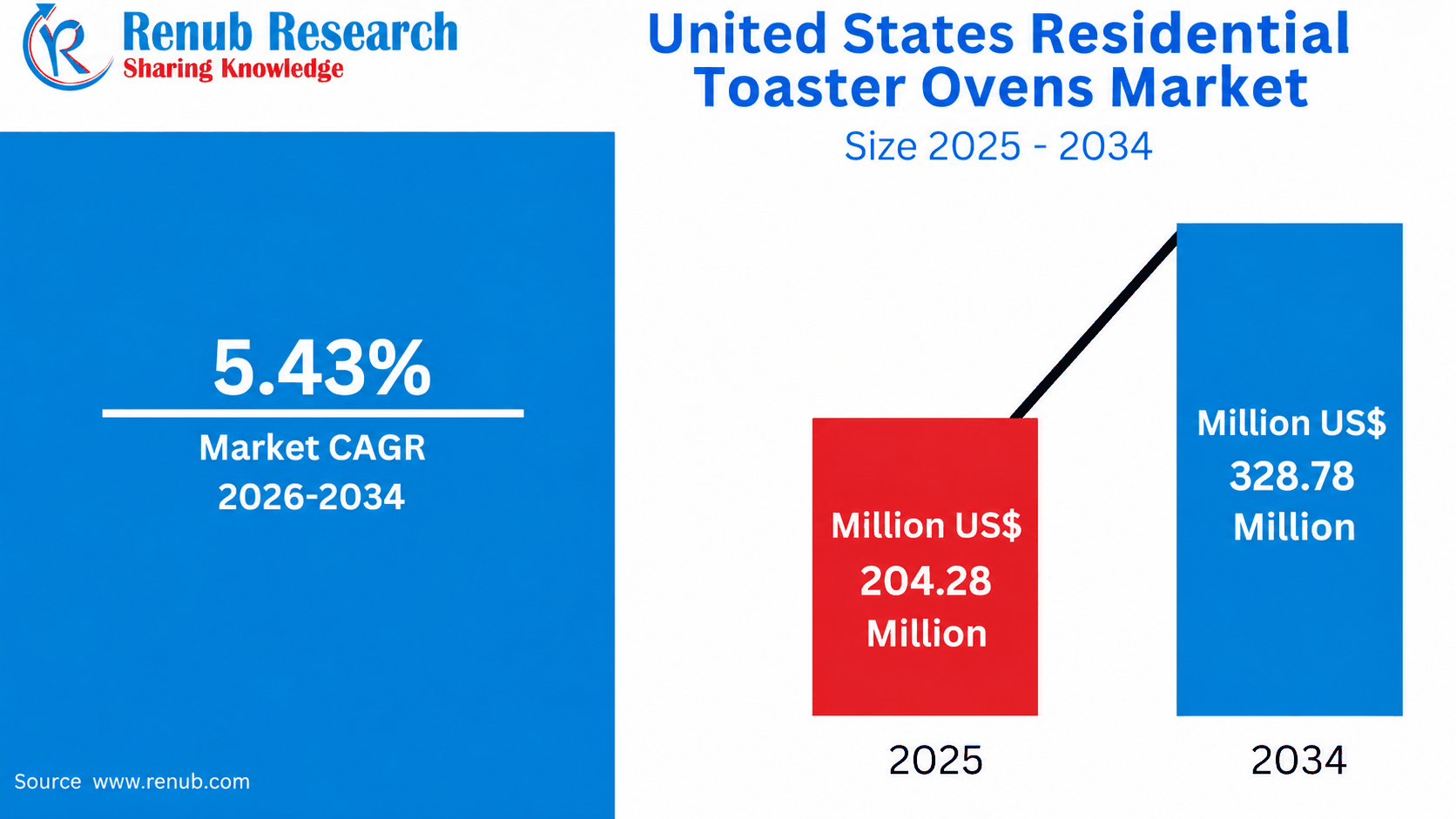
United States Residential Toaster Ovens Market is expected to grow from US$ 204.28 Million in 2025 to US$ 328.78 Million by 2034, registering a Compound Annual Growth Rate of 5.43 % during 2025–2034. Market growth is supported by rising demand for compact, multifunctional kitchen appliances, increasing home cooking activities, and consumer preference for convenient food preparation. Technological advancements, including convection cooking, digital temperature controls, and energy-efficient designs, are further strengthening demand across American households.
What Are Residential Toaster Ovens and Their Uses and Popularity in the United States?
Residential toaster ovens are compact countertop kitchen appliances designed to toast, bake, broil, reheat, and cook small portions of food. Unlike conventional ovens, they generally require less kitchen space and can be convenient for preparing quick meals, snacks, and individual servings. Available models include conventional toaster ovens, convection toaster ovens, air-fryer toaster oven combinations, and smart appliances with digital controls, preset cooking programs, and temperature adjustments. In the United States, these appliances appeal to busy professionals, small households, apartment residents, students, and families seeking convenient cooking options.
Their popularity is supported by demand for versatile kitchen appliances that simplify everyday food preparation. According to a 2025 Houzz U.S. Kitchen Trends Study, 35% of homeowners purchasing small appliances for kitchen renovations selected toaster-and-convection oven combinations. A January 2025 YouGov survey also found that 25% of Americans considering a kitchen appliance purchase planned to buy a toaster oven within the following 12 months. These findings highlight opportunities for manufacturers offering multifunctionality, attractive designs, energy-conscious operation, and user-friendly features.
Growth Drivers of the United States Residential Toaster Ovens Market
Growing Demand for Convenient and Multifunctional Cooking Appliances
Convenience is a major growth driver for the United States Residential Toaster Ovens Market. Consumers increasingly seek appliances that can perform multiple cooking tasks without requiring the space or operating time associated with a conventional oven. Residential toaster ovens support toasting bread, baking small dishes, reheating leftovers, roasting vegetables, and preparing frozen foods. Convection and air-frying models extend these capabilities, making them attractive to households seeking versatility from a single countertop appliance. Consumer purchase intentions demonstrate this demand. A 2025 YouGov survey found that 25% of Americans considering a kitchen appliance purchase were thinking about buying a toaster oven during the following 12 months. This indicates a meaningful potential customer base for manufacturers introducing multifunctional products. Features such as digital displays, automatic shutoff, programmable timers, temperature controls, and preset cooking modes can further improve usability. As consumers prioritize convenience and flexibility in daily meal preparation, manufacturers that combine reliable performance with multiple cooking functions can strengthen their competitive position. Continued product innovation is likely to support replacement purchases and encourage adoption among consumers upgrading older kitchen appliances.
Rising Interest in Home Cooking and Kitchen Renovations
Increasing interest in home cooking and kitchen modernization is supporting demand for residential toaster ovens across the United States. Homeowners upgrading kitchens frequently consider countertop appliances that improve cooking flexibility without requiring major changes to existing layouts. Toaster ovens fit this preference because they are portable, relatively compact, and available in a range of price points. They can complement conventional ovens, particularly when preparing small meals, reheating food, or cooking several dishes using different appliances. The 2025 Houzz U.S. Kitchen Trends Study found that 35% of homeowners purchasing small appliances as part of kitchen renovations chose toaster-and-convection oven combinations. The same study reported that quality influenced 47% of these purchasers, while specialty features mattered to 36%. These figures highlight opportunities for premium models offering consistent heating, improved temperature control, durable construction, and additional cooking modes. Kitchen remodeling also provides manufacturers and retailers with opportunities to reach consumers through appliance displays, bundled offers, and online product recommendations. As renovation projects encourage households to reassess their cooking equipment, feature-rich toaster ovens can benefit from greater visibility and stronger purchasing interest.
Demand for Compact Appliances and Energy-Conscious Cooking
Compact kitchen appliances are attractive to consumers living in apartments, smaller homes, and households with limited countertop or storage space. Residential toaster ovens offer an alternative for preparing smaller meals without necessarily heating a full-size oven. Their compact design, countertop installation, and relatively straightforward operation make them suitable for individuals and couples, as well as households that regularly prepare snacks and smaller portions. Energy use can also influence purchase decisions. The U.S. Environmental Protection Agency’s ENERGY STAR scoping report on toaster ovens states that industry representatives estimated toaster ovens could use approximately one-third to one-half less energy than conventional electric ovens when cooking small meals. This estimate is based on older industry information and should not be interpreted as a universal result for every model or cooking task. Actual savings depend on appliance efficiency, portion size, cooking duration, and usage patterns. Nevertheless, this potential advantage gives manufacturers an opportunity to promote appropriately sized appliances for everyday cooking. Models combining compact dimensions, effective insulation, precise temperature settings, and versatile cooking modes may appeal to consumers seeking convenience and more efficient meal preparation.
Challenges of the United States Residential Toaster Ovens Market
Intense Competition and Price Sensitivity
The United States Residential Toaster Ovens Market faces competition from conventional toaster ovens, air fryers, microwaves, countertop convection ovens, and multifunctional cooking appliances. Many competing products perform overlapping tasks, allowing consumers to compare alternatives based on price, cooking capacity, brand reputation, and convenience. This makes product differentiation challenging, particularly in entry-level segments where consumers may prioritize affordability over advanced features. A 2025 YouGov survey found that 29% of Americans considering a kitchen appliance purchase were thinking about buying an air fryer, compared with 25% considering a toaster oven. Although these figures represent purchase intentions rather than actual sales, they illustrate competition from adjacent appliance categories. Manufacturers must demonstrate why a toaster oven offers value beyond other countertop products. Premium models with convection, air-frying, smart controls, and larger capacities may attract consumers seeking versatility, but additional functions can raise retail prices. Retailers also use discounts and seasonal promotions to attract buyers, potentially compressing profit margins. Companies must therefore balance pricing, product quality, useful features, and brand differentiation to maintain competitiveness.
Energy Consumption, Product Reliability, and Safety Concerns
Energy consumption and product reliability can create challenges for residential toaster oven manufacturers. These appliances generate substantial heat within a compact enclosure and commonly operate at electrical power levels of approximately 1,200–1,400 watts, according to the U.S. Environmental Protection Agency’s toaster oven scoping report. The report is based on older industry data, so these figures should be treated as indicative rather than representative of every current model. Consumers concerned about electricity costs may compare toaster ovens with microwaves, air fryers, and conventional ovens before purchasing. Safety and durability are also important considerations. High operating temperatures, hot exterior surfaces, food residue, and improper placement can increase the risk of burns or fire. Manufacturers must incorporate suitable insulation, stable doors, reliable temperature controls, automatic shutoff where appropriate, and clear operating instructions. Products also need to withstand repeated heating cycles without deterioration in performance. Meanwhile, rising expectations for digital controls, convection systems, and multifunctional cooking modes can increase design and manufacturing complexity. Companies must balance affordability with dependable components and safety features. Failure to meet consumer expectations may lead to negative reviews, warranty claims, and reduced repeat purchases, making quality assurance essential for long-term market growth.
Residential Toaster Oven Launches in the USA
1. Panasonic FlashXpress Air Fry Toaster Oven (NB-G211 Series) – March 2025: Panasonic introduced a multifunctional countertop oven featuring 11 preset functions, including air fry, roast, bake, broil, dehydrate, and toast. It uses dual heating elements for rapid preheating and has a 28-liter interior. The suggested retail price was US$299.99.
2. Panasonic FlashXpress Toaster Oven (NB-G200) – March 2025: Panasonic refreshed its FlashXpress range with a stainless-steel design, an improved user interface, and a PFAS-free aluminum interior. The model was introduced at a suggested retail price of US$169.99.
3. Instant Pot InstantHeat Pizza and Toaster Oven – August 2025: Instant Pot Brands launched a countertop oven designed to prepare pizza quickly without preheating for applicable cooking functions. It combines pizza-specific settings with everyday toaster oven capabilities.
4. Instant Pot 6-Slice InstantHeat Air Fryer Toaster Oven – August 2025: This 10-in-1 model combines air frying, toasting, roasting, baking, broiling, and dehydration functions. Its larger capacity targets households seeking a versatile appliance for everyday meals.
5. Instant Pot 4-Slice InstantHeat Mini Air Fryer Toaster Oven – August 2025: Designed for smaller households, this compact 7-in-1 appliance offers multiple cooking functions in a countertop format. The launch expanded Instant Pot’s offerings for consumers with limited kitchen space.
6. Frigidaire Indoor Countertop Pizza Oven – November 2025: Frigidaire introduced its first indoor countertop pizza oven, capable of reaching 700°F and accommodating pizzas up to 12 inches. It also includes air-fry and bake functions, digital touch controls, and preset pizza programs. The announced price was US$299.
7. Ninja French Door Premier Air Fryer, Convection Oven and Toaster – November 2025: Ninja introduced a countertop cooking appliance combining toaster oven, convection, and air-frying functionality. Its French-door design and 10 cooking functions reflect demand for convenient, multifunctional kitchen equipment.
8. Panasonic FlashXpress Indoor Pizza Oven Plus (NB-G300) – July 2026: Panasonic introduced a countertop oven focused on pizza preparation while supporting air frying, baking, broiling, grilling, and roasting. The product extends the company’s FlashXpress family beyond conventional toasting.
9. Cuisinart Artisan French Door Air Fryer Toaster Oven (TOA-FD70) – September 2026: Cuisinart launched a seven-function appliance offering air frying, toasting, baking, broiling, roasting, pizza, and warming modes. Its French doors, family-size capacity, and US$199.95 launch price emphasize convenience and versatility.
10. Breville Smart Oven Air Fryer Compact – 2024: Breville introduced a compact countertop oven combining air frying, roasting, baking, and toasting. Its space-saving format addresses demand for multifunctional appliances among consumers who want several cooking capabilities without a full-size oven.
California Sustainability, Smart Appliances, and Compact Kitchen Solutions
California Residential Toaster Ovens Market is supported by demand for energy-conscious appliances, innovative kitchen technology, and convenient home cooking solutions. California had approximately 39.4 million residents in 2024, according to U.S. Census Bureau estimates, creating a substantial consumer base for residential kitchen appliances. Urban households and apartment residents increasingly value compact toaster ovens that support baking, toasting, roasting, and reheating without requiring the space of a conventional oven. Multifunctional models featuring convection cooking, air frying, digital temperature controls, and programmable settings are particularly attractive to technology-oriented consumers. California’s emphasis on energy efficiency also encourages interest in appliances that can prepare smaller meals without heating a full-size oven. However, actual energy savings depend on the appliance model, portion size, and cooking duration. Online retailers and specialty appliance stores further support market development by offering a broad selection of premium and mid-range products. Rising interest in home cooking, customized kitchen spaces, and smart appliance features is expected to sustain demand across California.
Texas Population Growth and Demand for Versatile Cooking Appliances
The Texas Residential Toaster Ovens Market benefits from population growth, residential development, and increasing demand for convenient kitchen appliances. The U.S. Census Bureau estimated Texas’s population at approximately 31.3 million in 2024, supporting a substantial market for household cooking equipment. Major metropolitan areas, including Houston, Dallas–Fort Worth, Austin, and San Antonio, provide opportunities for manufacturers to reach diverse consumer groups. Toaster ovens appeal to families, working professionals, and smaller households because they can toast, bake, broil, roast, and reheat food using a single countertop appliance. Models with air-frying and convection capabilities are particularly attractive to consumers seeking greater cooking flexibility. Texas’s varied household sizes and housing arrangements also create demand for appliances across different capacities and price points. Retail stores, online marketplaces, and promotional sales improve product accessibility. Manufacturers offering durable construction, simple controls, larger interiors, and competitive pricing can strengthen their position in the state. Growing interest in home meal preparation and multifunctional appliances is expected to support continued market expansion.
New York Residential Toaster Ovens Market
Urban Living and Space-Efficient Kitchen Appliances
The New York Residential Toaster Ovens Market is influenced by dense urban living, limited kitchen space, and demand for convenient meal preparation. New York State had approximately 19.9 million residents in 2024, according to U.S. Census Bureau estimates, with New York City representing an important center of apartment-based living. Compact toaster ovens are attractive to renters, students, young professionals, and smaller households because they offer several cooking functions without requiring the installation space of a conventional oven. Products with smaller footprints, removable trays, digital controls, and convection settings can meet the needs of consumers managing busy schedules and limited countertop areas. Air-fryer toaster oven combinations also appeal to buyers seeking versatility from a single appliance. New York’s extensive retail network and online shopping options allow consumers to compare product features, sizes, and prices. Manufacturers can capture demand by offering compact designs, easy-to-clean interiors, and efficient cooking performance across multiple price segments. These space-saving and multifunctional characteristics are expected to support demand throughout the state.
Florida Residential Expansion and Convenient Home Cooking
The Florida Residential Toaster Ovens Market is supported by population growth, residential demand, and consumer interest in convenient cooking appliances. The U.S. Census Bureau estimated Florida’s population at approximately 23.4 million in 2024, providing a substantial customer base across urban, suburban, and retirement-oriented communities. Residential toaster ovens appeal to individuals, couples, families, and retirees seeking straightforward appliances for preparing breakfasts, snacks, small meals, and reheated food. Their countertop format can be particularly useful in smaller kitchens, condominiums, and seasonal residences. Multifunctional models with baking, roasting, convection, and air-frying capabilities offer additional flexibility while reducing the need for separate appliances. Florida’s tourism and vacation-rental industries may also create indirect demand from property owners furnishing short-term accommodation and residential units. Online retailers and large appliance chains help consumers access products across different budgets and feature preferences. Manufacturers emphasizing easy-to-use controls, compact dimensions, accessible pricing, and simple cleaning can appeal to a broad customer base. Continued residential development and demand for practical kitchen equipment are expected to support market growth in Florida.
Market Segmentations
Product Type
- Pop-up
- Oven
- Conveyer
Distribution Channel
- Offline
- Online
States
- California
- Texas
- New York
- Florida
- Illinois
- Pennsylvania
- Ohio
- Georgia
- New Jersey
- Washington
- North Carolina
- Massachusetts
- Virginia
- Michigan
- Maryland
- Colorado
- Tennessee
- Indiana
- Arizona
- Minnesota
- Wisconsin
- Missouri
- Connecticut
- South Carolina
- Oregon
- Louisiana
- Alabama
- Kentucky
- Rest of United States
All the Key players have been covered
- Overviews
- Key Person
- Recent Developments
- SWOT Analysis
- Revenue Analysis
Company Analysis:
- AB Electrolux
- Bajaj Electricals Ltd.
- Brentwood Appliance Inc.
- Breville Pty Ltd
- De Longhi S.p.A.
- Haier Smart Home Co. Ltd.
- Hamilton Beach Brands Holding Co.
- Havells India Ltd.
- Koninklijke Philips NV
- Midea Group Co. Ltd
Report Details:
| Report Features | Details |
| Base Year |
2024 |
| Historical Period |
2021 - 2024 |
| Forecast Period |
2025 - 2034 |
| Market |
US$ Billion |
| Segment Covered |
Product Type, Distribution Channel and States |
| States Covered |
|
| Companies Covered |
|
| Customization Scope |
20% Free Customization |
| Post-Sale Analyst Support |
1 Year (52 Weeks) |
| Delivery Format |
PDF and Excel through Email (We can also provide the editable version of the report in PPT/Word format on request) |
Customization Services available
- Analysis of Market Size and Its Segments
- More Company Profiles (Upto 10 without any additional cost):
- Additional Countries (Other than mentioned Countries):
- Region/Country Specific Reports:
- Market Entry Strategy:
- Region-Specific Market Dynamics:
- Regional Market Share Analysis:
- Trade Analysis:
- Production Insights:
- Others Customized Requests:
For more information contact our analysts.
Need More Assistance?
- Talk to our analysts to get more precious information on the current market trends.
- Include more countries and segments and customize the report based on the final requirement.
- Get a competitive advantage in your industry by knowing the report findings and making a positive impact on your revenues and operations.
- Our analysts are always ready to provide more help and pertinent information if you need any additional assistance.