United States Microwave Oven Market Report by Type, Application, Structure, Distribution Channel, State and Company Analysis 2026-2034
Buy NowUnited States Microwave Oven Industry Research: Revenue Projections & Key Dynamics
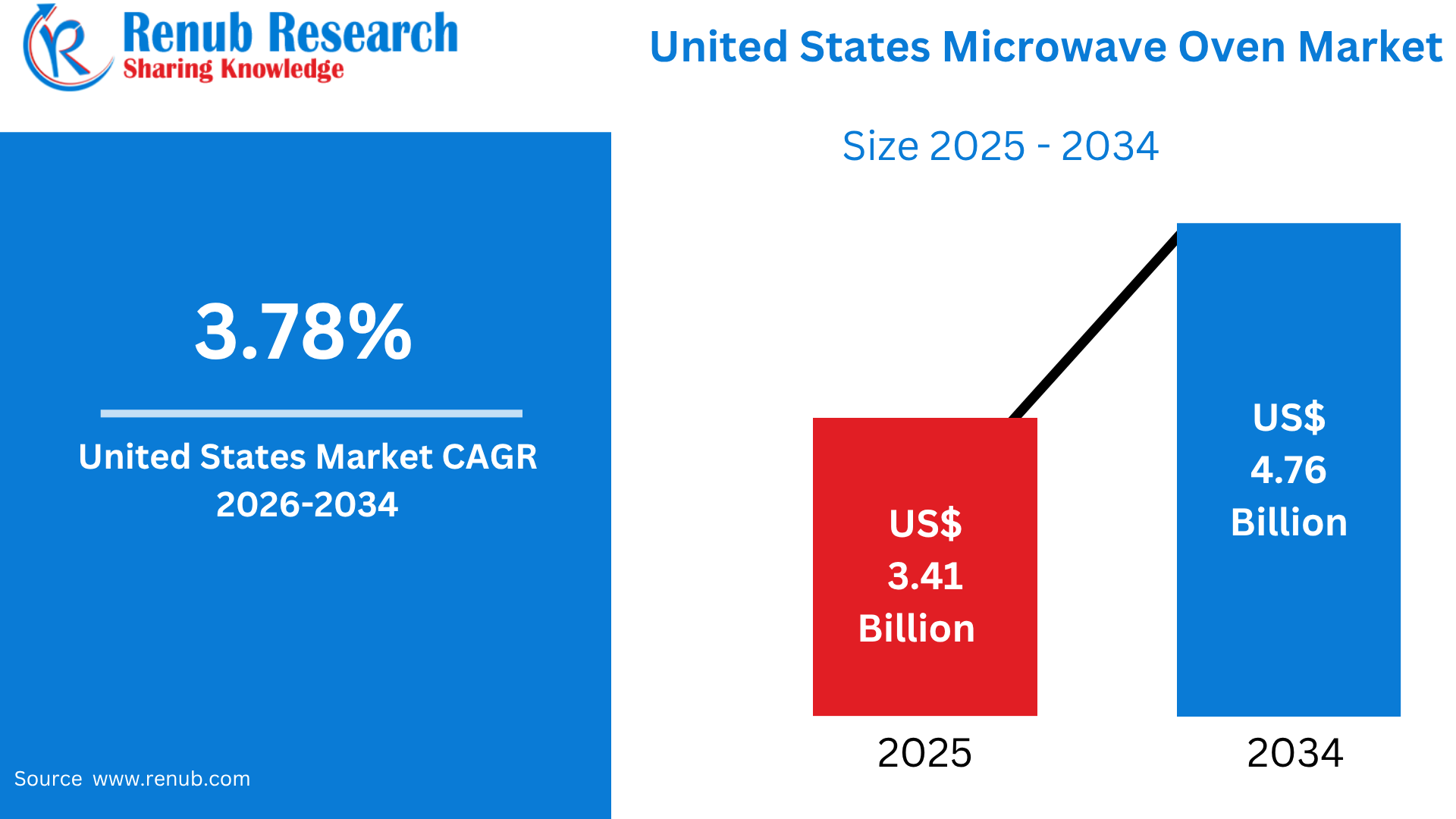
United States Microwave Ovens Market is projected to expand from US$ 3.41 billion in 2025 to US$ 4.76billion by 2034, registering a CAGR of 3.78% during 2026–2034. Market growth is being driven by increasing consumer demand for convenient and time-saving cooking appliances, continuous technological advancements, and the rising adoption of smart kitchen solutions. Growing urbanization, busy lifestyles, and the popularity of ready-to-eat and frozen foods are further boosting microwave oven sales.
What are Microwave Ovens and Their Uses & Popularity in the United States
Microwave ovens are electric kitchen appliances that use electromagnetic microwave radiation to quickly heat, cook, and defrost food. Unlike conventional ovens, microwave ovens generate heat by causing water molecules within food to vibrate, allowing meals to be prepared in significantly less time while consuming relatively less energy. They are widely used for reheating leftovers, cooking frozen meals, defrosting meat and vegetables, preparing beverages, steaming vegetables, making snacks, and supporting everyday meal preparation. Modern microwave ovens incorporate advanced features such as inverter technology, sensor cooking, convection cooking, grill functions, touch-screen controls, and smart connectivity for enhanced cooking precision and convenience.
In the United States, microwave ovens have become one of the most common household kitchen appliances, with over 90% of American households owning at least one unit. Their popularity is driven by busy lifestyles, increasing demand for convenience foods, and the growing consumption of ready-to-eat and frozen meals. Microwave ovens are extensively used in homes, offices, hotels, restaurants, dormitories, hospitals, and convenience stores because they offer fast, efficient, and user-friendly cooking solutions. Rising adoption of smart home technologies, energy-efficient appliances, and multifunctional kitchen equipment continues to strengthen demand across the U.S. market. Manufacturers are also introducing compact countertop models, over-the-range units, and built-in microwave ovens with Wi-Fi connectivity and voice control, further enhancing their appeal among modern consumers.
Number of Connected Devices in U.S. Households
- 2021: Average of 25 connected devices per U.S. household.
- 2022: Average decreased to 22 connected devices per household.
- 2023: Average further declined to 21 connected devices per household.
- Overall Trend (2021–2023): The average number of connected devices fell from 25 to 21, representing a decline of 4 devices (16%) over the three-year period.
- Consumer Insight: Despite the slight decline, U.S. households continue to maintain a high level of smart device adoption, supporting demand for connected home appliances and smart kitchen technologies.
Source: Deloitte Insights (via ConsumerAffairs).
Growth Driver
Rising Demand for Convenience Foods and Time-Saving Cooking Solutions
The increasing consumption of convenience foods and fast meal preparation is a primary driver of the United States microwave ovens market. Busy work schedules, dual-income households, and changing lifestyles have significantly increased reliance on appliances that reduce cooking time. Industry estimates indicate that over 90% of U.S. households own at least one microwave oven, making it one of the country’s most widely used kitchen appliances. Additionally, more than 80% of American consumers regularly purchase frozen or ready-to-eat meals, many of which are specifically designed for microwave cooking. The growing popularity of meal kits, frozen snacks, packaged foods, and home delivery services further strengthens microwave usage. Microwave ovens provide quick reheating, defrosting, steaming, and cooking while consuming less energy than conventional ovens for short cooking tasks. Continuous product innovations, including sensor cooking and inverter technology, further improve cooking efficiency and food quality. As consumer demand for convenience continues rising, microwave ovens are expected to remain an essential appliance in modern American households.
Technological Innovation and Smart Kitchen Integration
Technological advancements are significantly accelerating growth in the U.S. microwave ovens market. Manufacturers are introducing smart microwave ovens equipped with Wi-Fi connectivity, voice control compatibility, inverter technology, humidity sensors, and AI-assisted cooking programs to improve convenience and cooking precision. Industry estimates suggest that smart home adoption exceeds 65% among U.S. households, creating favorable conditions for connected kitchen appliances. Modern microwave ovens now integrate with digital ecosystems such as Amazon Alexa, Google Assistant, and smartphone applications, allowing users to monitor cooking remotely and access automated cooking settings. Energy-efficient inverter technology delivers uniform heating while reducing electricity consumption compared to conventional microwave systems. Premium models also combine convection baking, air frying, grilling, and steam cooking functions within a single appliance, increasing consumer value. Continuous investments in product innovation, touchscreen interfaces, stainless-steel finishes, and compact built-in designs are encouraging appliance replacement and supporting long-term market expansion throughout residential and commercial sectors.
Growth of Residential Construction and Kitchen Renovation Activities
The expanding residential housing market and increasing investment in kitchen remodeling continue to create strong demand for microwave ovens across the United States. Industry estimates indicate that millions of existing homes undergo kitchen renovations each year, with built-in and over-the-range microwave ovens becoming standard features in modern kitchens. Rising homeownership, increasing disposable incomes, and premium kitchen upgrades have accelerated replacement purchases for energy-efficient and multifunctional appliances. Builders increasingly incorporate integrated microwave systems into newly constructed apartments, condominiums, and single-family homes to enhance property value. In addition, commercial establishments including hotels, offices, hospitals, educational institutions, and convenience stores continue investing in durable microwave ovens for food preparation and customer convenience. Growing demand for aesthetically integrated kitchens has increased sales of built-in microwave models with smart connectivity and advanced cooking technologies. Continued residential construction, home improvement spending, and commercial infrastructure development are expected to sustain stable market growth during the forecast period.
Challenge
Market Saturation and Longer Replacement Cycles
One of the major challenges facing the U.S. microwave ovens market is the high level of household ownership, which limits opportunities for first-time purchases. With microwave penetration exceeding 90% of households, market growth increasingly depends on replacement demand rather than new customer acquisition. Modern microwave ovens have operational lifespans of 8–12 years, resulting in relatively slow replacement cycles. Many consumers postpone purchasing new appliances unless significant technological improvements or product failures occur. Intense competition among manufacturers has also created pricing pressure, particularly within the entry-level countertop microwave segment. Discount retailers and online marketplaces further intensify price competition, reducing profit margins for manufacturers. While premium smart microwave ovens continue attracting certain consumer segments, higher purchase prices may discourage widespread adoption. Manufacturers must therefore focus on product differentiation, energy efficiency, multifunctionality, and smart features to encourage replacement purchases and maintain sustainable revenue growth in a mature market.
Competition from Multifunctional Cooking Appliances
The increasing popularity of multifunctional kitchen appliances presents a significant challenge for the microwave ovens market. Consumers are increasingly purchasing air fryers, countertop convection ovens, toaster ovens, pressure cookers, and multifunctional cooking systems capable of performing several cooking functions within a single appliance. Many of these products offer healthier cooking methods, improved texture, and greater versatility than traditional microwave ovens. Consumer preference for air frying, roasting, baking, and grilling has reduced dependence on microwave-only cooking in certain households. In addition, premium multifunctional appliances often combine microwave, convection, grill, and steam cooking technologies, increasing competition within the broader kitchen appliance market. Manufacturers must continue investing in innovative product designs that integrate multiple cooking functions while maintaining affordability and energy efficiency. Enhancing smart connectivity, improving cooking performance, and offering compact space-saving designs will remain essential strategies for maintaining competitiveness as consumer preferences continue evolving.
Microwave Oven Launches in the United States
- January 2026 – GE Appliances introduced its Profile Smart Countertop Microwave Oven with built-in scan-to-cook technology, Wi-Fi connectivity, and voice control compatibility through Amazon Alexa and Google Assistant.
- October 2025 – Panasonic launched the HomeCHEF 4-in-1 Multi-Oven, combining microwave, convection oven, air fryer, and broiler functions with Cyclonic Inverter Technology for even cooking.
- August 2025 – LG Electronics USA unveiled a new lineup of NeoChef Smart Microwave Ovens featuring ThinQ connectivity, Smart Diagnosis, sensor cooking, and energy-efficient inverter technology.
- May 2025 – Whirlpool Corporation expanded its kitchen portfolio with Smart Over-the-Range Microwave Ovens, offering Scan-to-Cook technology, voice assistant compatibility, and fingerprint-resistant stainless-steel finishes.
- January 2025 – Sharp Home Electronics introduced a Convection Grill Microwave Series featuring air fry capability, sensor reheat, and family-sized cooking capacity for modern kitchens.
- September 2024 – Breville launched the Combi Wave 3-in-1 Air Fry Microwave, integrating microwave cooking, convection baking, and air frying into a single countertop appliance for premium home kitchens.
- July 2024 – Samsung Electronics America introduced its Smart All-in-One Microwave Oven Series featuring air frying, grilling, steaming, fermentation modes, Wi-Fi connectivity, SmartThings integration, and voice control.
- April 2024 – Toshiba Lifestyle US released a new Inverter Countertop Microwave Oven equipped with humidity sensor cooking, ECO Mode, memory functions, and quiet operation technology.
- March 2024 – Midea America launched a Smart Countertop Microwave Oven with app-based controls, inverter heating technology, auto-cook menus, and compact space-saving design for apartments and small kitchens.
- January 2024 – KitchenAid expanded its premium built-in appliance portfolio with a Built-In Convection Microwave Oven, offering sensor cooking, convection baking, grill functionality, and seamless integration with luxury modular kitchens.
U.S. Rising Demand for Multifunctional Cooking Appliances
U.S. Grill Microwave Oven Market is experiencing steady growth as consumers increasingly seek multifunctional kitchen appliances that combine microwave cooking with grilling capabilities. Grill microwave ovens enable users to reheat, defrost, cook, and grill food within a single appliance, providing greater versatility and convenience. Industry estimates indicate that multifunction microwave ovens account for over 30% of premium microwave sales in the United States, driven by demand from urban households and younger consumers. These appliances are particularly popular for preparing crispy pizzas, grilled chicken, vegetables, sandwiches, and snacks while reducing overall cooking time. Manufacturers continue introducing models featuring inverter technology, sensor cooking, convection-grill combinations, and smart connectivity to improve cooking performance. Growing interest in compact, space-saving appliances and premium kitchen upgrades is further supporting market expansion. As consumers increasingly prefer all-in-one cooking solutions offering both convenience and enhanced food quality, the U.S. grill microwave oven market is expected to witness sustained growth during the forecast period.
U.S. High Household Penetration Supporting Stable Demand
U.S. Household Microwave Oven Market represents the largest segment of the overall microwave oven industry due to widespread consumer adoption and daily usage. Industry estimates show that more than 90% of American households own at least one microwave oven, making it one of the most commonly used kitchen appliances nationwide. Microwave ovens are extensively utilized for reheating leftovers, defrosting frozen foods, preparing ready-to-eat meals, and cooking everyday dishes. Rising numbers of dual-income families, busy lifestyles, and increasing consumption of frozen and convenience foods continue to drive replacement demand. Compact countertop models, over-the-range units, and built-in microwave ovens are widely installed in modern residential kitchens. Technological advancements including inverter technology, humidity sensors, voice control, and Wi-Fi connectivity are encouraging consumers to upgrade older appliances. Growing home renovation activities and increasing demand for energy-efficient, smart kitchen appliances are expected to maintain the household segment’s dominant position throughout the forecast period.
U.S. Foodservice Expansion Driving Industrial Demand
U.S. Commercial Microwave Oven Market is expanding steadily due to rising demand from restaurants, hotels, hospitals, educational institutions, cafés, convenience stores, and quick-service restaurant (QSR) chains. Commercial microwave ovens are engineered for heavy-duty operation, offering higher wattage, faster cooking speeds, and enhanced durability compared to residential models. Industry estimates indicate that the U.S. foodservice industry serves billions of meals annually, creating continuous demand for reliable commercial cooking equipment. The rapid expansion of cloud kitchens, meal delivery services, convenience stores, and institutional foodservice operations has significantly increased microwave oven installations across commercial establishments. Features such as programmable menus, stainless-steel construction, touch controls, and high-capacity interiors improve operational efficiency while reducing food preparation time. Commercial operators also benefit from lower labor requirements and consistent cooking performance. As foodservice businesses continue investing in automation, productivity, and customer service improvements, demand for advanced commercial microwave ovens is expected to grow steadily across the United States.
U.S. Growing Preference for Premium Kitchen Designs
U.S. Built-In Microwave Oven Market is witnessing healthy growth as homeowners increasingly invest in premium kitchen remodeling and integrated appliance solutions. Built-in microwave ovens are installed directly into cabinetry or wall units, providing a streamlined appearance while maximizing countertop space. Industry estimates suggest that built-in appliances account for a growing share of premium residential kitchen installations, particularly in newly constructed homes and high-end renovation projects. Consumers increasingly prefer these appliances because they enhance kitchen aesthetics, improve ergonomics, and complement other integrated appliances such as wall ovens and refrigerators. Modern built-in microwave ovens feature convection cooking, grilling, inverter technology, sensor-based cooking programs, touchscreen interfaces, and smart home connectivity. Rising home improvement expenditures, luxury housing developments, and increasing adoption of modular kitchen concepts continue driving market expansion. As demand for elegant, space-efficient, and technologically advanced kitchen solutions increases, the built-in microwave oven segment is expected to achieve sustained long-term growth.
U.S. Online E-commerce Accelerating Consumer Purchases
U.S. Online Microwave Oven Market has grown rapidly with the continued expansion of e-commerce platforms and changing consumer purchasing behavior. Industry estimates indicate that online channels account for more than one-quarter of major home appliance sales in the United States, with microwave ovens representing a significant product category. Digital platforms provide consumers with extensive product selections, detailed specifications, customer reviews, competitive pricing, financing options, and convenient home delivery services. Online retailers frequently attract buyers through promotional discounts, seasonal sales, bundled offers, and flexible return policies. The rapid adoption of smartphones and digital payment systems has further simplified online appliance purchasing. Growth accelerated following the COVID-19 pandemic, permanently changing consumer shopping preferences toward digital channels. Manufacturers have also strengthened direct-to-consumer sales strategies through official websites and online marketplaces. Continued improvements in logistics, same-day delivery services, and omnichannel retail strategies are expected to further strengthen the online microwave oven market across the United States during the forecast period.
California Technology-Driven Demand and Premium Kitchen Appliances
California represents one of the largest microwave oven markets in the United States, supported by its population of nearly 39 million residents, high urbanization, and strong consumer spending on smart home technologies. The state’s technology-oriented consumers increasingly prefer advanced microwave ovens equipped with Wi-Fi connectivity, inverter technology, voice control, sensor cooking, and smart home integration. Major metropolitan areas including Los Angeles, San Francisco, and San Diego generate significant demand due to busy lifestyles and widespread adoption of convenient cooking appliances. Industry estimates indicate that California accounts for more than 12% of U.S. home appliance sales, making it a key regional market. Rising apartment living, premium kitchen renovations, and increasing adoption of energy-efficient appliances continue supporting product upgrades. Consumers also favor multifunctional microwave ovens with convection, grilling, and air-frying capabilities. Growing environmental awareness and demand for ENERGY STAR-certified appliances further contribute to market expansion. Continuous innovation and rising smart home adoption are expected to drive sustained growth across California.
New York Urban Living Supporting High Appliance Adoption
New York Microwave Oven Market is experiencing steady growth, driven by dense urban populations, compact residential spaces, and fast-paced lifestyles. With a state population exceeding 19 million people, microwave ovens remain essential kitchen appliances in apartments, condominiums, and urban residences where space efficiency is highly valued. Industry estimates indicate that New York ranks among the leading U.S. states for built-in and compact kitchen appliance installations, reflecting strong demand for integrated kitchen solutions. Consumers increasingly rely on microwave ovens for reheating meals, preparing frozen foods, and quick everyday cooking. The popularity of ready-to-eat meals, meal delivery services, and frozen food products further supports appliance demand. Commercial establishments including restaurants, cafés, convenience stores, hospitals, and office cafeterias also contribute significantly to microwave oven sales. Increasing adoption of smart kitchen appliances featuring Wi-Fi connectivity, sensor cooking, and voice control continues driving replacement purchases. Ongoing residential renovations and premium kitchen upgrades are expected to maintain healthy market growth across New York.
Washington Smart Home Adoption and Sustainable Living
Washington Microwave Oven Market continues to expand as consumers increasingly invest in advanced, energy-efficient kitchen appliances. Supported by a population of nearly 8 million residents, the state demonstrates high adoption of smart home technologies, particularly in Seattle and surrounding metropolitan areas. Technology-oriented consumers increasingly purchase microwave ovens equipped with smart connectivity, inverter technology, convection cooking, grill functions, and AI-assisted cooking features. Industry estimates indicate that the Pacific Northwest records some of the highest adoption rates of energy-efficient household appliances in the United States. Rising numbers of young professionals, smaller households, and apartment dwellers continue supporting demand for compact, multifunctional microwave ovens. Sustainability initiatives and environmentally conscious purchasing behavior have accelerated sales of energy-saving appliance models. Commercial demand from cafés, restaurants, corporate offices, and institutional foodservice operations also contributes to market growth. Continued technological innovation and increasing smart home integration are expected to strengthen Washington’s microwave oven market over the forecast period.
Connecticut Residential Renovation Driving Replacement Demand
Connecticut Microwave Oven Market is supported by stable residential demand, increasing home renovation activities, and growing consumer interest in premium kitchen appliances. With a population of approximately 3.7 million people, the state has a balanced mix of urban and suburban households that consistently invest in modern kitchen equipment. Microwave ovens remain essential appliances for reheating, defrosting, and convenient meal preparation across residential and commercial settings. Industry estimates suggest that kitchen remodeling remains one of the largest home improvement categories in the northeastern United States, supporting demand for built-in and premium microwave oven models. Rising disposable incomes have encouraged greater adoption of smart microwave ovens featuring inverter technology, touch controls, and Wi-Fi connectivity. Commercial establishments including hotels, educational institutions, healthcare facilities, and office cafeterias continue investing in durable microwave equipment. Growing environmental awareness has also increased consumer preference for energy-efficient appliances with improved performance and reduced electricity consumption, supporting continued market expansion.
Texas Population Growth and Housing Development Fueling Demand
Texas Microwave Oven Market is witnessing robust growth, supported by its population of more than 31 million residents, rapid urbanization, and strong residential construction activity. Major metropolitan areas including Houston, Dallas, Austin, and San Antonio continue generating substantial demand for microwave ovens due to expanding housing developments and rising household formation. Industry estimates indicate that Texas consistently ranks among the leading U.S. states in new residential construction, creating significant opportunities for kitchen appliance manufacturers. Growing multicultural communities and busy consumer lifestyles have increased demand for microwave ovens capable of preparing a wide variety of international cuisines quickly and efficiently. Commercial demand from restaurants, hotels, convenience stores, hospitals, and educational institutions further supports market expansion. Consumers increasingly prefer energy-efficient, multifunctional microwave ovens featuring convection cooking, grilling, air-frying, and smart connectivity. In July 2024, Samsung introduced a new lineup of smart all-in-one microwave ovens incorporating air-frying, grilling, steaming, fermentation functions, Wi-Fi connectivity, SmartThings integration, and voice-control capabilities, reinforcing innovation within the premium appliance segment.
Market Segmentation
Type
- Grill
- Solo
- Convection
Application
- Commercial
- Household
Structure
- Built-In
- Counter Top
Distribution Channel
- Online
- Offline
Top States
- California
- Texas
- New York
- Florida
- Illinois
- Pennsylvania
- Ohio
- Georgia
- New Jersey
- Washington
- North Carolina
- Massachusetts
- Virginia
- Michigan
- Maryland
- Colorado
- Tennessee
- Indiana
- Arizona
- Minnesota
- Wisconsin
- Missouri
- Connecticut
- South Carolina
- Oregon
- Louisiana
- Alabama
- Kentucky
- Rest of United States
All companies have been covered with 5 Viewpoints
- Overviews
- Key Person
- Recent Developments
- SWOT Analysis
- Revenue Analysis
Company Analysis:
- Illinois Tool Works Inc.
- Sharp
- LG Electronics
- Whirlpool Corporation
- GE Appliances
- Panasonic Corporation
- Samsung Electronics
- Midea Group
Report Details:
| Report Features | Details |
| Base Year |
2025 |
| Historical Period |
2022 - 2025 |
| Forecast Period |
2026 - 2034 |
| Market |
US$ Billion |
| Segment Covered |
Type, Application, Structure, Distribution Channel and States |
| States Covered |
1. California |
| Companies Covered |
1. Illinois Tool Works Inc. |
| Customization Scope |
20% Free Customization |
| Post-Sale Analyst Support |
1 Year (52 Weeks) |
| Delivery Format |
PDF and Excel through Email (We can also provide the editable version of the report in PPT/Word format on request) |
Frequently Asked Questions
What is the market size of the US Microwave Oven industry?
The US microwave oven market is projected to reach over US$ X Billion by 2033.
Which segment leads in the US microwave oven market?
Convection and smart microwave ovens are gaining major traction due to multifunctionality.
Who are the key players in the US market?
Samsung, LG, Whirlpool, Panasonic, and GE Appliances are major brands.
Customization Services available
- Analysis of Market Size and Its Segments
- More Company Profiles (Upto 10 without any additional cost):
- Additional Countries (Other than mentioned Countries):
- Region/Country Specific Reports:
- Market Entry Strategy:
- Region-Specific Market Dynamics:
- Regional Market Share Analysis:
- Trade Analysis:
- Production Insights:
- Others Customized Requests:
For more information contact our analysts.
Need More Assistance?
- Talk to our analysts to get more precious information on the current market trends.
- Include more countries and segments and customize the report based on the final requirement.
- Get a competitive advantage in your industry by knowing the report findings and making a positive impact on your revenues and operations.
- Our analysts are always ready to provide more help and pertinent information if you need any additional assistance.