United States Procurement Software Market Size, Share, Growth, Trends, Industry Analysis & Forecast 2026–2034
Buy NowUnited States Procurement Software Market Size and Forecast
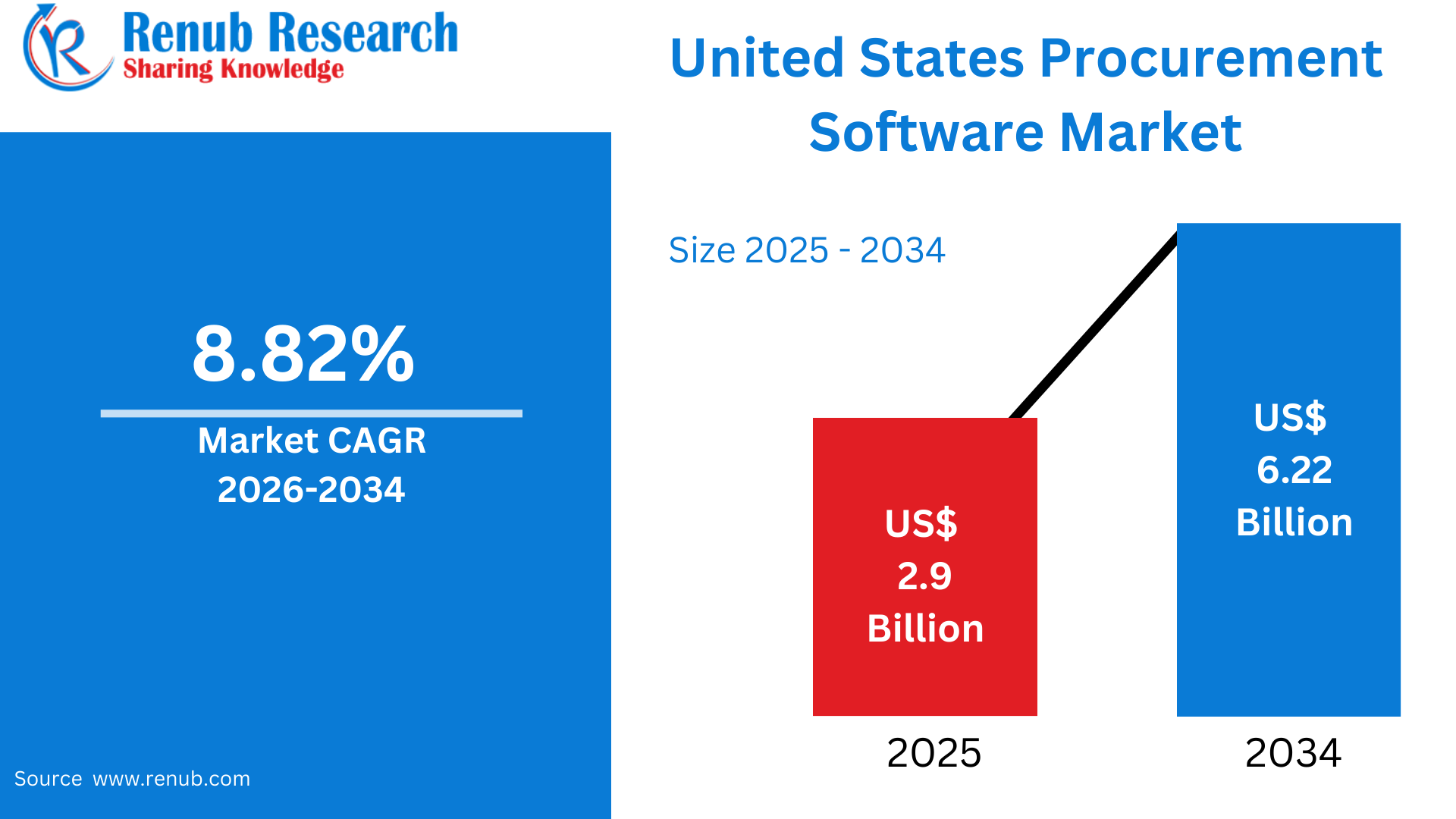
United States Procurement Software Market is projected to grow from US$ 2.90 billion in 2025 to US$ 6.22 billion by 2034, registering a compound annual growth rate of 8.82% during the forecast period from 2026 to 2034. Market expansion is being driven by the rapid pace of digital transformation, increasing adoption of cloud-based technologies, and the integration of artificial intelligence (AI) into procurement operations. Organizations are increasingly implementing procurement software to improve spend visibility, automate purchasing workflows, strengthen supplier management, and enhance operational efficiency.
United States Procurement Software Industry Overview
Procurement software is a digital solution that automates, simplifies, and streamlines the end-to-end procurement cycle, including sourcing, supplier management, contract management, purchase orders, and invoice processing. These platforms help organizations improve efficiency, enhance visibility into spending, reduce operational costs, and enforce compliance with procurement policies. Modern procurement systems integrate with ERP and accounting platforms to support real-time data sharing and financial alignment. Advanced solutions incorporate AI, analytics, and automation to enable smarter supplier selection, risk mitigation, and strategic sourcing. By centralizing and digitizing procurement operations, organizations gain better control, transparency, and agility across all purchasing activities.
In the United States, rapid digital transformation and the growing emphasis on cost control are key forces accelerating procurement software adoption. Organizations increasingly seek automated tools to eliminate manual processes, improve compliance, and gain real-time visibility into purchasing activities. Cloud-based platforms and AI-enabled procurement analytics support smarter decision-making and reduce operational risk. Strict regulatory environments in sectors such as healthcare, BFSI, and government further increase demand for standardized, auditable procurement systems. Moreover, the rise of distributed workforces fuels the need for centralized, accessible procurement platforms. Collectively, these factors position the U.S. as one of the fastest-growing procurement software markets globally.
Procurement Software and Its Demand in the United States
Procurement software is a comprehensive digital platform designed to automate and optimize the entire procurement lifecycle, including strategic sourcing, supplier relationship management, contract lifecycle management, purchase requisitions, purchase order processing, invoice management, and payment coordination. These solutions enable organizations to streamline procurement operations, improve spending transparency, reduce administrative costs, and ensure compliance with internal policies and external regulations. Modern procurement platforms integrate seamlessly with enterprise resource planning (ERP), accounting, and financial management systems to facilitate real-time information sharing, improve financial visibility, and enhance operational efficiency. Advanced capabilities such as artificial intelligence, predictive analytics, machine learning, and workflow automation further support intelligent supplier selection, procurement risk management, demand forecasting, and strategic sourcing. By centralizing procurement activities within a unified digital platform, organizations can strengthen governance, improve supplier collaboration, increase operational agility, and make more informed purchasing decisions.
In the United States, the growing emphasis on digital transformation, operational efficiency, and cost optimization continues to accelerate the adoption of procurement software across industries. Organizations are increasingly replacing manual procurement processes with automated solutions that improve purchasing accuracy, strengthen compliance management, and provide real-time visibility into procurement activities. Cloud-based procurement platforms equipped with AI-driven analytics enable businesses to optimize spending, identify procurement risks, enhance supplier performance, and make data-driven sourcing decisions. Highly regulated sectors such as healthcare, banking and financial services (BFSI), manufacturing, and government are driving significant demand for standardized, secure, and auditable procurement systems that support regulatory compliance and operational transparency. Furthermore, the expansion of hybrid and remote work models has increased the need for centralized procurement platforms that enable seamless collaboration across distributed teams. These combined factors position the United States as one of the largest and fastest-growing markets for procurement software worldwide.
Worldwide IT Spending Forecast (Millions of U.S. Dollars)
- Data Center Systems
-
- 2025 Spending: US$ 496,231 million
- 2025 Growth: 48.9%
- 2026 Spending: US$ 653,403 million
- 2026 Growth: 31.7%
- Devices
-
- 2025 Spending: US$ 788,335 million
- 2025 Growth: 9.1%
- 2026 Spending: US$ 836,417 million
- 2026 Growth: 6.1%
- Software
-
- 2025 Spending: US$ 1,249,509 million
- 2025 Growth: 11.5%
- 2026 Spending: US$ 1,433,633 million
- 2026 Growth: 14.7%
- IT Services
-
- 2025 Spending: US$ 1,717,590 million
- 2025 Growth: 6.4%
- 2026 Spending: US$ 1,866,856 million
- 2026 Growth: 8.7%
- Communications Services
-
- 2025 Spending: US$ 1,303,651 million
- 2025 Growth: 3.8%
- 2026 Spending: US$ 1,365,184 million
- 2026 Growth: 4.7%
- Overall IT Spending
-
- 2025 Spending: US$ 5,555,316 million
- 2025 Growth: 10.3%
- 2026 Spending: US$ 6,155,493 million
- 2026 Growth: 10.8%
SaaS Companies Shaping Enterprise Software in 2026
- Microsoft reported more than US$ 135 billion in annualized commercial cloud revenue, with Azure continuing to achieve double-digit growth across enterprise workloads.
- Microsoft Azure revenue increased 29% year over year, primarily driven by rising demand for AI-powered services and accelerated enterprise cloud migration.
- Salesforce reported US$ 34.9 billion in revenue for fiscal year 2025, maintaining its position as the world’s largest standalone enterprise SaaS provider by revenue.
- Subscription and support services accounted for more than 93% of Salesforce’s total revenue, highlighting the strength and scalability of its subscription-based SaaS business model.
- Oracle generated US$ 53 billion in total revenue for fiscal year 2025, with cloud services and license support contributing over 77% of total company revenue.
- Oracle’s cloud infrastructure and cloud applications business grew 25% year over year, reflecting sustained enterprise investment in cloud migration and digital transformation.
- SAP reported €26.7 billion in cloud revenue during the first nine months of 2025, representing 23% year-over-year growth driven by increasing enterprise cloud adoption.
- SAP’s current cloud backlog reached €15.7 billion as of Q3 2025, demonstrating strong customer demand and a substantial pipeline of contracted future cloud revenue.
- IBM generated more than US$ 24 billion in hybrid cloud revenue, with Red Hat continuing to play a central role in enterprise cloud modernization initiatives.
- IBM’s software segment recorded 6% year-over-year growth, supported by increasing adoption of hybrid cloud platforms, AI-enabled solutions, and enterprise automation technologies.
Market Catalysts
Accelerating Digital Transformation and Procurement Automation
The rapid pace of digital transformation is a key factor driving the growth of the U.S. procurement software market as organizations replace traditional, manual procurement processes with intelligent, cloud-based platforms. Businesses are increasingly implementing digital procurement solutions to automate supplier sourcing, purchase approvals, contract lifecycle management, compliance monitoring, and procure-to-pay (P2P) operations. Automation significantly reduces manual errors, shortens procurement cycles, and lowers administrative workloads, allowing procurement teams to focus on strategic initiatives and value creation. Advanced technologies such as artificial intelligence (AI), machine learning (ML), robotic process automation (RPA), and predictive analytics are enhancing procurement capabilities by enabling accurate demand forecasting, intelligent supplier recommendations, automated invoice matching, and data-driven purchasing decisions. Integration with enterprise resource planning (ERP) and financial management systems further improves operational visibility, governance, and decision-making. As organizations expand globally and seek greater operational resilience, the demand for centralized procurement platforms that provide standardized workflows, unified data management, and real-time spend visibility continues to increase, driving sustained market growth.
Growing Demand for Spend Visibility and Regulatory Compliance
Increasing emphasis on financial transparency, procurement governance, and regulatory compliance is significantly boosting demand for procurement software across the United States. Modern procurement platforms consolidate information related to suppliers, purchase orders, contracts, invoices, and spending activities into a centralized system, providing organizations with comprehensive real-time visibility into procurement operations and budget utilization. This enhanced transparency enables businesses to identify unauthorized spending, strengthen policy enforcement, optimize supplier negotiations, and improve overall cost management. Industries including healthcare, financial services, manufacturing, and government operate under strict regulatory frameworks that require comprehensive procurement documentation, audit readiness, and traceable purchasing records. Procurement software supports these requirements through automated audit trails, supplier risk assessments, compliance monitoring, and built-in policy enforcement tools that reduce fraud risks and regulatory violations. Furthermore, growing environmental, social, and governance (ESG) reporting requirements are encouraging organizations to adopt procurement platforms capable of tracking supplier sustainability performance and ethical sourcing practices. As governance standards continue to evolve, demand for compliance-focused procurement solutions is expected to remain strong.
Expansion of Cloud Procurement Solutions and AI-Enabled Technologies
The increasing adoption of cloud computing and artificial intelligence is transforming procurement operations and serving as a major catalyst for the U.S. procurement software market. Cloud-based procurement platforms provide organizations with scalable, flexible, and cost-effective solutions that support remote accessibility, automatic software updates, and seamless integration with ERP, CRM, and financial management systems. The widespread adoption of Software-as-a-Service (SaaS) deployment models allows businesses of all sizes to implement advanced procurement capabilities without substantial infrastructure investments. AI-powered features—including intelligent supplier evaluation, automated contract analysis, guided purchasing, fraud detection, spend forecasting, and predictive analytics—are improving procurement efficiency while enabling more informed business decisions. Procurement software vendors continue to strengthen their offerings through strategic partnerships, acquisitions, and low-code or no-code development capabilities that simplify workflow customization and reduce implementation complexity. As organizations continue addressing supply chain disruptions and operational uncertainties, cloud-based procurement platforms equipped with AI-driven capabilities are becoming essential for enhancing supplier visibility, strengthening risk management, and improving procurement resilience.
Procurement Software launches in United States
- March 2024 – Coupa launched new AI-driven automations to enhance procurement workflows with intelligent buying experiences, supplier collaboration, workflow automation, and generative AI capabilities aimed at improving purchasing efficiency and business spend management.
- April 2023 – Coupa introduced new Business Spend Management (BSM) platform innovations featuring enhanced procurement, sourcing, supplier management, and spend optimization capabilities to help enterprises improve profitability and procurement performance.
- August 2023 – Ivalua released Platform Release 178, adding AI-powered contract data capture, purchasing optimization, supplier risk automation, improved contract analytics, and expanded e-invoicing compliance for enterprise procurement teams.
- October 2023 – GEP launched GEP Quantum, an AI-powered, low-code procurement and supply chain platform that enables organizations to rapidly configure procurement workflows, improve visibility, and automate sourcing and procurement operations.
- October 2023 – Procurify partnered with Olive Technologies to introduce AI-enabled vendor sourcing and supplier selection capabilities, helping procurement teams automate vendor evaluation and improve sourcing decisions.
- May 2023 – SAP expanded its procurement portfolio by integrating Icertis Contract Intelligence (ICI) with SAP S/4HANA, enabling procurement organizations to strengthen contract intelligence, supplier negotiations, and procurement governance.
- 2024 – Zip introduced its AI Suite and Zip AI Assistant, expanding its procurement orchestration platform with AI-powered intake management, workflow automation, procurement insights, and intelligent purchasing assistance.
- 2024 – Coupa enhanced its AI-powered procurement platform with new intelligent purchasing features, collaboration capabilities, and automation tools designed to improve procurement productivity and supply chain resilience.
- 2023 – Ivalua enhanced its Source-to-Contract solution with AI-enabled supplier risk monitoring, automated contract digitization, purchasing optimization, and enhanced procurement analytics to support enterprise procurement transformation.
- 2024 – Zip expanded its procurement orchestration platform by introducing new enterprise procurement products focused on AI-driven workflow orchestration, approval automation, supplier collaboration, and spend management across large organizations.
Key Challenges
Integration Complexity with Legacy Enterprise Systems
A significant challenge facing the U.S. procurement software market is the integration of modern procurement platforms with existing legacy enterprise systems. Many organizations continue to rely on outdated ERP, finance, inventory, and procurement applications that lack compatibility with modern APIs and cloud-based technologies. Integrating new procurement software often requires extensive customization, complex data migration, and significant IT resources, increasing implementation costs and extending deployment timelines. Migrating historical procurement records from spreadsheets and legacy databases can also create data inconsistencies and operational disruptions if not managed effectively. Without seamless integration, organizations may experience fragmented workflows, limited visibility across procurement operations, and reduced automation benefits. Additionally, concerns regarding data security, system interoperability, and business continuity—particularly within highly regulated industries—can delay procurement modernization initiatives and slow broader market adoption.
Supplier Risk Management, Compliance Complexity, and Organizational Change
Successfully implementing procurement software extends beyond technology deployment and requires organizations to effectively manage supplier risks, regulatory compliance, and organizational change. Many enterprises encounter resistance from employees who are accustomed to traditional procurement methods, while inadequate user training and limited digital expertise can reduce adoption rates and delay the realization of expected benefits. At the same time, procurement teams must manage increasingly complex supplier networks, monitor evolving compliance requirements, and ensure adherence to environmental, social, and governance (ESG) standards. Maintaining accurate supplier information, conducting comprehensive risk assessments, and consistently enforcing procurement policies across departments remain ongoing challenges. Improper software configuration or poorly designed workflows can create operational bottlenecks rather than improve efficiency. Consequently, organizations must invest in employee training, effective change management strategies, and cross-functional collaboration to maximize the value of procurement software and achieve successful long-term digital transformation.
Cloud-based Procurement Software in USA
USA Cloud-based Procurement Software is expanding rapidly as organizations across industries accelerate cloud adoption to improve procurement efficiency, reduce operational costs, and enhance supply chain resilience. Enterprises are increasingly replacing on-premises procurement systems with cloud-based platforms that offer greater scalability, flexibility, and real-time access to procurement data. These solutions streamline supplier management, sourcing, purchase order processing, contract lifecycle management, invoice automation, and spend analytics through centralized digital environments. Integration with enterprise resource planning (ERP), customer relationship management (CRM), and financial systems enables seamless data exchange and improves decision-making. Artificial intelligence and machine learning capabilities further enhance procurement by automating supplier selection, forecasting demand, identifying procurement risks, and optimizing purchasing strategies. The growing adoption of hybrid work models has also increased demand for secure, remotely accessible procurement solutions. As U.S. organizations continue investing in digital transformation, cybersecurity, and cloud infrastructure, cloud-based procurement software is expected to remain a key driver of procurement modernization and long-term operational efficiency.
US Large Enterprise Procurement Software Industry
Large Enterprise Procurement Software in USA is witnessing sustained growth as large corporations invest in advanced procurement technologies to manage complex sourcing operations, extensive supplier networks, and global supply chains. Enterprises across manufacturing, healthcare, retail, financial services, and technology sectors are adopting integrated procurement platforms to improve purchasing efficiency, enhance supplier collaboration, and strengthen regulatory compliance. Modern procurement software supports strategic sourcing, supplier relationship management, contract lifecycle management, spend analytics, invoice automation, and procurement governance within a unified platform. Artificial intelligence, predictive analytics, and robotic process automation enable organizations to automate repetitive procurement tasks, improve supplier performance evaluation, identify cost-saving opportunities, and mitigate supply chain risks. Integration with ERP, finance, inventory, and logistics systems provides end-to-end visibility across procurement activities while enhancing operational control. As U.S. enterprises continue expanding globally and prioritizing digital transformation, demand for scalable, secure, and AI-enabled procurement software solutions is expected to grow steadily, supporting improved transparency, operational efficiency, and long-term cost optimization.
United States Retail and e-Commerce Procurement Software
Retail and e-Commerce Procurement Software Market in United States is growing significantly as retailers and online businesses modernize procurement operations to meet evolving consumer expectations and increasingly complex supply chain requirements. Procurement software enables organizations to automate supplier management, inventory replenishment, purchase order processing, contract administration, and spend monitoring through centralized digital platforms. Artificial intelligence and predictive analytics help retailers forecast demand, optimize inventory levels, identify reliable suppliers, and minimize stock shortages while reducing procurement costs. Integration with warehouse management systems, enterprise resource planning (ERP), inventory management software, and e-commerce platforms provides real-time visibility across procurement and fulfillment operations. The rapid expansion of omnichannel retailing, direct-to-consumer business models, and cross-border e-commerce has further increased the need for agile procurement solutions. Additionally, growing investments in supply chain digitization, automation, and sustainability initiatives are driving adoption among retailers of all sizes. As competition intensifies, procurement software continues to play a critical role in improving operational efficiency, supplier collaboration, and customer satisfaction across the U.S. retail sector.
Healthcare and Pharmaceutical Procurement Software in USA
USA Healthcare and Pharmaceutical Procurement Software is experiencing robust growth as healthcare providers, hospitals, pharmaceutical manufacturers, and medical distributors increasingly adopt digital procurement solutions to improve operational efficiency, strengthen regulatory compliance, and enhance supply chain resilience. Procurement software automates the sourcing and purchasing of pharmaceuticals, medical devices, laboratory equipment, and healthcare supplies while improving supplier relationship management and inventory control. These platforms support contract lifecycle management, invoice processing, supplier qualification, compliance documentation, and real-time spend monitoring through centralized digital systems. Artificial intelligence and advanced analytics enable healthcare organizations to forecast demand, optimize inventory levels, evaluate supplier performance, and minimize procurement-related risks. Integration with hospital information systems (HIS), enterprise resource planning (ERP), warehouse management systems, and financial platforms improves procurement visibility and operational accuracy. Rising healthcare expenditures, increasing investments in digital health infrastructure, and stricter regulatory requirements are accelerating software adoption. As healthcare organizations prioritize patient safety, cost efficiency, and uninterrupted product availability, procurement software will remain an essential component of the U.S. healthcare supply chain.
California Procurement Software Industry
California’s procurement software market is experiencing strong growth, supported by the state’s extensive technology ecosystem, large public sector, and highly regulated industries such as healthcare, utilities, and life sciences. State and local government agencies are accelerating digital transformation initiatives by implementing e-procurement platforms that improve procurement transparency, automate tendering processes, and strengthen supplier diversity monitoring. In the private sector, organizations are adopting advanced procurement solutions to manage complex supply chains, comply with environmental and sustainability reporting requirements, and gain deeper visibility into organizational spending through AI-powered analytics. Demand continues to increase for cloud-based procurement platforms, contract lifecycle management solutions, and software that seamlessly integrates with enterprise resource planning (ERP) systems such as SAP and Oracle. Vendors offering scalable, compliance-focused, and AI-enabled procurement solutions that support geographically dispersed workforces are well positioned to capitalize on California’s growing demand for digital procurement technologies.
Texas Procurement Software Industry
The Texas procurement software market is expanding steadily as organizations across both the public and private sectors invest in digital procurement technologies to improve purchasing efficiency, reduce operational costs, and modernize legacy procurement systems. Major industries including energy, manufacturing, transportation, construction, and logistics increasingly rely on procurement platforms to streamline sourcing activities, improve inventory visibility, strengthen supplier management, and oversee contract performance. Government agencies, municipalities, and educational institutions are also adopting digital procurement solutions to simplify competitive bidding processes, improve audit readiness, and enhance procurement transparency. Texas’ pro-business environment and rapidly growing economy continue to attract enterprises seeking cloud-based procurement platforms with advanced automation, workflow management, and enterprise integration capabilities. Increasing demand for predictive analytics, supplier performance monitoring, and scalable procurement systems is expected to support continued market expansion throughout the state.
New York Procurement Software Industry
New York’s procurement software market continues to grow as organizations across industries embrace digital procurement technologies to improve operational efficiency, regulatory compliance, and procurement transparency. The state’s diversified economy, including financial services, healthcare, education, retail, and large corporate enterprises, creates substantial demand for advanced procurement solutions capable of managing complex purchasing operations. Public sector organizations are modernizing procurement processes through cloud-based platforms that streamline sourcing, contract lifecycle management, vendor oversight, and purchasing approvals. Meanwhile, private enterprises are investing in procurement software equipped with artificial intelligence, advanced analytics, workflow automation, and ERP integration to optimize supplier relationships and strengthen spend management. The presence of numerous multinational corporations, financial institutions, and government agencies continues to accelerate the adoption of intelligent procurement technologies. As businesses prioritize digital transformation and data-driven procurement strategies, New York remains a significant market for innovative procurement software solutions.
Florida Procurement Software Industry
Florida’s procurement software market is witnessing consistent growth as government organizations and private enterprises increasingly adopt digital procurement solutions to improve purchasing efficiency, operational transparency, and supplier collaboration. State and local agencies are replacing outdated procurement systems with modern platforms that automate bidding, strengthen contract management, improve vendor communication, and ensure greater regulatory compliance. Private sector industries—including tourism, hospitality, construction, logistics, healthcare, and real estate—are implementing procurement software to manage large procurement volumes, optimize supplier relationships, and improve visibility across geographically distributed operations. Cloud-based procurement platforms featuring automated workflows, supplier management capabilities, spend analytics, and seamless integration with enterprise systems are experiencing particularly strong demand. Florida’s expanding population, continued economic development, and ongoing infrastructure investments are further increasing the need for scalable procurement technologies that reduce manual processes, enhance strategic sourcing, and improve overall supply chain performance.
Recent Developments in Animal Parasiticides Market
- May 2025: The Hackett Group completed its acquisition of Spend Matters, strengthening its AI-driven procurement advisory capabilities and expanding its influence in digital sourcing intelligence.
- March 2025: Beroe finalized the acquisition of nnamu, enhancing its procurement-intelligence platform with deeper market-research capabilities and enriched category insights.
- December 2024: Ivalua launched an AI-powered Intake Management solution designed to streamline and standardize procurement requests. Featuring an intuitive chat-based interface, the tool guides employees through supplier inquiries, contract requests, and other purchasing needs while enforcing policy compliance. Key features include AI-led assistance, seamless integration with existing systems, a collaborative tracking dashboard, and a no-code configuration engine that boosts operational efficiency and scalability.
- July 2024: GEP acquired OpusCapita, a Helsinki-based leader in e-invoicing and accounts payable automation. The acquisition integrates OpusCapita’s financial automation capabilities with GEP’s AI-driven procurement and supply chain software, strengthening GEP’s presence in the Nordic region. OpusCapita will continue operating as a standalone subsidiary while expanding GEP’s global footprint and customer base.
Market Segmentation
Deployment
- Cloud-based
- On-premises
Organization
- Small and Medium-sized Enterprises
- Large Enterprise
End Use
- Retail & e-Commerce
- Healthcare and Pharmaceutical
- Manufacturing & Automotive
- BFSI
- IT & Telecom
- Oil & Gas, Energy & Utilities
- Others
States
- California
- Texas
- New York
- Florida
- Illinois
- Pennsylvania
- Ohio
- Georgia
- New Jersey
- Washington
- North Carolina
- Massachusetts
- Virginia
- Michigan
- Maryland
- Colorado
- Tennessee
- Indiana
- Arizona
- Minnesota
- Wisconsin
- Missouri
- Connecticut
- South Carolina
- Oregon
- Louisiana
- Alabama
- Kentucky
- Rest of United States
All companies have been covered with 5 Viewpoints
- Overviews
- Key Person
- Recent Developments
- SWOT Analysis
- Revenue
Company Analysis
- GT Nexus (Infor Inc.)
- SAP SE
- Zycus Inc.
- Coupa Software Inc.
- Microsoft Corporation
- Oracle Corporation
- Jaggaer Inc.
- GEP Corporation
Report Details:
| Report Features | Details |
| Base Year |
2025 |
| Historical Period |
2022 - 2025 |
| Forecast Period |
2026 - 2034 |
| Market |
US$ Billion |
| Segment Covered |
Deployment, Organization, End User and States |
| States Covered |
|
| Companies Covered |
|
| Customization Scope |
20% Free Customization |
| Post-Sale Analyst Support |
1 Year (52 Weeks) |
| Delivery Format |
PDF and Excel through Email (We can also provide the editable version of the report in PPT/Word format on request) |
Customization Services available
- Analysis of Market Size and Its Segments
- More Company Profiles (Upto 10 without any additional cost):
- Additional Countries (Other than mentioned Countries):
- Region/Country Specific Reports:
- Market Entry Strategy:
- Region-Specific Market Dynamics:
- Regional Market Share Analysis:
- Trade Analysis:
- Production Insights:
- Others Customized Requests:
For more information contact our analysts.
Need More Assistance?
- Talk to our analysts to get more precious information on the current market trends.
- Include more countries and segments and customize the report based on the final requirement.
- Get a competitive advantage in your industry by knowing the report findings and making a positive impact on your revenues and operations.
- Our analysts are always ready to provide more help and pertinent information if you need any additional assistance.