Procurement Software Market Size, Share, Growth, Trends, Industry Analysis & Forecast 2026–2034
Buy NowProcurement Software Market Size and Forecast
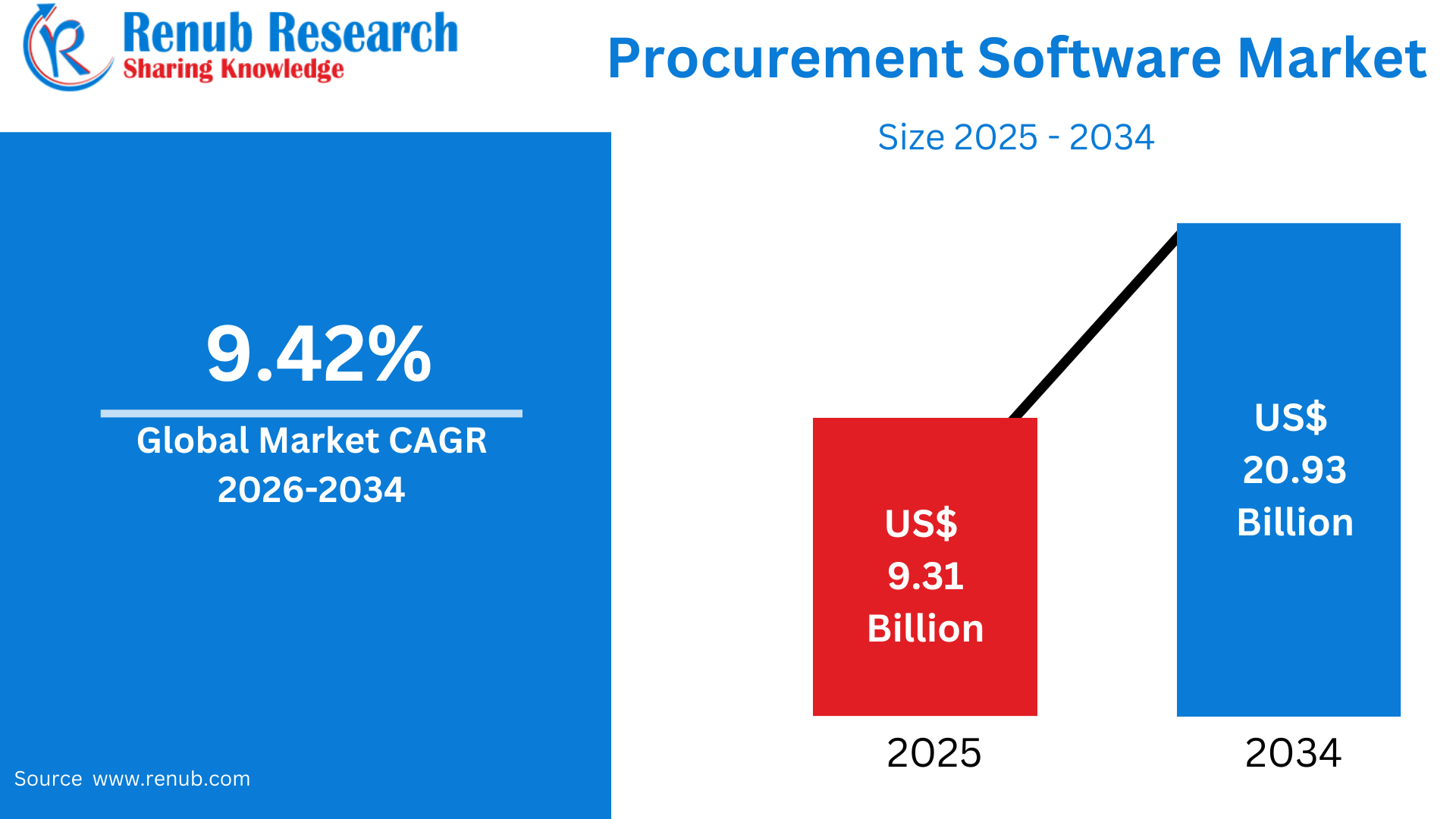
Global procurement software market is projected to grow from US$ 9.31 billion in 2025 to US$ 20.93 billion by 2034, registering a CAGR of 9.42% during the forecast period from 2026 to 2034. Market growth is primarily fueled by the increasing pace of digital transformation across industries, rising demand for procurement process automation, and a stronger emphasis on cost optimization. Organizations are also embracing AI-powered procurement solutions to streamline sourcing, supplier management, spend analysis, and contract administration. These advanced technologies improve operational efficiency, strengthen regulatory compliance, and enhance transparency, making procurement software an essential component of modern enterprise operations.
Procurement Software Industry Overview
Procurement software is a digital solution that automates and streamlines an organization’s purchasing processes, from requisition to payment. It helps businesses manage supplier relationships, compare vendor quotes, negotiate contracts, track orders, and monitor spending in real time. These platforms support functions such as sourcing, purchase order creation, invoice management, and contract lifecycle oversight. Modern procurement tools integrate AI, analytics, and cloud-based systems to improve visibility, reduce errors, and enhance compliance. By centralizing procurement activities, organizations can lower operational costs, accelerate approval workflows, and make data-driven purchasing decisions to strengthen supply chain efficiency and financial performance.
A major growth driver of the procurement software market is the rising need for automation and cost efficiency across enterprises. Organizations are increasingly adopting cloud-based and AI-enabled procurement platforms to improve supplier selection, enhance transparency, and reduce manual processes. The shift toward data-driven decision-making, real-time spend visibility, and digital contract management is accelerating adoption. Furthermore, increasing global supply chain complexities, demand for compliance with regulatory standards, and the need for risk mitigation are pushing companies to modernize procurement workflows. Together, these factors significantly fuel the expansion of the procurement software industry.
Procurement Software and Its Uses
Procurement software is a technology-driven platform designed to automate and optimize the complete procurement lifecycle, from purchase requests to invoice processing and final payment. It enables businesses to efficiently manage supplier relationships, evaluate vendor quotations, negotiate contracts, generate purchase orders, monitor deliveries, and track organizational spending through a centralized system. Modern procurement platforms incorporate advanced technologies such as artificial intelligence, cloud computing, and data analytics to improve decision-making, reduce manual intervention, and ensure policy compliance. By providing real-time visibility into procurement activities, these solutions help organizations streamline approval workflows, minimize procurement risks, reduce operational costs, and improve overall supply chain performance while supporting strategic purchasing decisions.
The procurement software market continues to expand as organizations increasingly prioritize automation and operational efficiency to remain competitive. Enterprises are investing in cloud-based and AI-powered procurement solutions to optimize supplier selection, automate routine procurement tasks, and improve spend visibility across business units. The growing reliance on data-driven procurement strategies, digital contract management, and predictive analytics is further accelerating market adoption. In addition, the increasing complexity of global supply chains, stricter regulatory requirements, and the need to strengthen supplier risk management are encouraging businesses to modernize their procurement operations. These combined factors are expected to drive sustained growth in the global procurement software market throughout the forecast period.
Procurement Software Mergers & Acquisitions and Funding & Investment Activities
- May 2023 – Zip raised US$100 Million in Series C Funding
-
- Zip secured US$100 million in a Series C funding round, valuing the procurement orchestration platform at approximately US$1.5 billion. The funding was earmarked for global expansion and the development of generative AI capabilities.
- October 2023 – Procurify raised US$50 Million in Series C Funding
-
- Procurify completed a US$50 million Series C funding round to accelerate product innovation, AI-powered procurement automation, and international market expansion.
- October 2023 – Olive Technologies partnered with Procurify
-
- Olive Technologies entered a strategic partnership with Procurify to integrate AI-driven vendor sourcing, procurement automation, and supplier management capabilities.
- September 2023 – Coupa launched Supply Chain Collaboration
-
- Coupa expanded its procurement platform with Supply Chain Collaboration, enabling buyers and suppliers to improve visibility, business continuity, and procurement decision-making.
- October 2023 – GEP launched GEP Quantum
-
- GEP introduced GEP Quantum, a generative AI-powered low-code platform designed to enhance procurement, sourcing, supply chain visibility, and sustainability applications.
- 2024 – Coupa acquired BELLIN
-
- Coupa completed the acquisition of BELLIN, expanding its treasury management capabilities and strengthening its end-to-end procurement and spend management platform.
- 2024 – Ivalua and PwC formed a strategic partnership
-
- Ivalua partnered with PwC to accelerate enterprise procurement transformation through integrated digital procurement and source-to-pay solutions.
- July 2024 – Pactum AI raised US$20 Million in Series B Funding
-
- Pactum secured US$20 million in Series B funding to expand its AI-powered autonomous procurement negotiation platform and strengthen enterprise AI capabilities.
- 2024 – Zip raised US$190 Million in Series D Funding
-
- Zip announced a US$190 million Series D funding round, one of the largest investments in procurement software in over two decades, to accelerate AI innovation and procurement orchestration globally.
- June 2025 – Pactum AI raised US$54 Million in Series C Funding
-
- Pactum secured US$54 million in Series C funding led by Insight Partners to scale its Agentic AI procurement platform and expand autonomous supplier negotiation capabilities.
Key Growth Pillars
AI-Driven Optimization and Intelligent Procurement Platforms
Artificial intelligence is reshaping procurement by introducing predictive analytics, intelligent automation, and data-driven decision-making into purchasing operations. AI-powered procurement solutions enable organizations to improve supplier evaluation, optimize sourcing strategies, and automate complex procurement processes with greater speed and accuracy. For example, in October 2023, Olive Technologies partnered with Procurify to incorporate AI-enabled vendor sourcing and supplier selection capabilities, helping businesses streamline procurement activities while improving decision quality. These advanced platforms analyze spending behavior, evaluate supplier performance, identify procurement risks, and generate real-time insights that support better negotiation outcomes. In addition, AI automates routine functions such as purchase order creation, invoice validation, and approval workflows, allowing procurement professionals to concentrate on strategic initiatives. As enterprises increasingly emphasize agility, transparency, and data-driven procurement, AI-powered platforms are becoming a critical growth driver for the procurement software market.
Digital Transformation and Low-Code Procurement Ecosystems
The accelerating digital transformation of enterprises is significantly contributing to the expansion of the procurement software market. Organizations are increasingly implementing low-code and no-code procurement platforms that enable rapid process automation with minimal technical expertise. A notable development occurred in October 2023, when GEP introduced GEP Quantum, an AI-powered low-code procurement and supply chain platform designed to simplify workflow automation and digital transformation. Supporting solutions such as GEP Smart and GEP Nexxe, the platform offers real-time procurement visibility, sustainability monitoring, and flexible workflow configuration. These capabilities enable business users to develop and customize procurement processes without relying heavily on IT teams, reducing implementation timelines and operational complexity. As businesses continue to seek scalable, user-friendly, and adaptable procurement technologies, low-code ecosystems are emerging as a key factor driving market growth.
Rising Demand for Operational Efficiency and Spend Optimization
The growing emphasis on improving operational efficiency, reducing procurement costs, and strengthening spend management is accelerating the adoption of advanced procurement software worldwide. Organizations are replacing fragmented, manual procurement processes with centralized digital platforms that improve supplier management, automate approval workflows, and provide comprehensive spend visibility. In October 2023, Atamis partnered with Maximus UK to deliver advanced procurement solutions aimed at enhancing sourcing efficiency and increasing operational transparency. This partnership reflects the broader industry trend toward intelligent procurement platforms that deliver real-time insights into purchasing activities, supplier performance, and compliance risks. By enabling organizations to make informed purchasing decisions, improve budget control, and maximize return on investment, procurement software has become an essential business tool. As economic pressures continue to encourage cost optimization, demand for procurement solutions that strengthen efficiency and spending control is expected to remain strong.
Market Restraints
Integration Challenges with Legacy Systems
One of the primary obstacles to procurement software adoption is the complexity of integrating modern procurement platforms with existing legacy systems. Many organizations continue to rely on outdated enterprise resource planning (ERP) systems, paper-based procurement methods, or disconnected regional purchasing processes. Transitioning to modern procurement software often requires extensive system customization, large-scale data migration, and significant workflow redesign, resulting in higher implementation costs and longer deployment periods. Integration issues may also create data inconsistencies, interrupt business operations, and reduce employee acceptance of new technologies. Furthermore, organizations with limited IT capabilities frequently encounter interoperability challenges when connecting procurement software with finance applications, supplier networks, and enterprise systems. These implementation barriers are particularly significant for small and medium-sized enterprises, slowing overall market adoption and creating challenges for both software providers and end users.
Cybersecurity and Data Privacy Concerns
Growing cybersecurity threats and increasing data privacy requirements represent major challenges for the procurement software market. Procurement platforms store highly sensitive information, including supplier agreements, pricing details, financial records, procurement transactions, and regulatory compliance documents. As more procurement activities migrate to cloud-based environments, organizations face heightened risks from cyberattacks, ransomware, unauthorized access, and data breaches. Concerns over protecting confidential procurement information and maintaining uninterrupted supply chain operations often make businesses cautious about adopting fully digital procurement systems. Additionally, compliance with evolving international data protection regulations, including GDPR and similar privacy frameworks, adds further complexity to software implementation and management. Weak cybersecurity controls can expose confidential supplier negotiations, compromise financial data, and damage long-term supplier relationships. Consequently, concerns regarding information security and regulatory compliance remain significant barriers to broader procurement software adoption.
Recent Developments in Procurement Software Market
- May 2025: The Hackett Group acquired Spend Matters, enhancing its AI-driven procurement advisory capabilities and strengthening its position in digital procurement intelligence.
- March 2025: Beroe completed its acquisition of nnamu, expanding its procurement-intelligence suite with deeper market-research capabilities and broader category insights.
- January 2025: Unimarket and VendorPanel merged, forming an expanded source-to-pay platform designed to better serve mid-market organizations with integrated procurement, sourcing, and vendor-management tools.
- January 2025: GEP launched its AI-powered Total Orchestration Solution, enabling simplified guided buying for non-specialists and improving procurement decision support.
- May 2025: Jaggaer finalized its acquisition of BravoSolution, significantly strengthening its Source-to-Pay portfolio, particularly in strategic sourcing and supplier risk management, further expanding its global market presence.
- March 2024: Coupa Software entered a strategic partnership with Microsoft to integrate Coupa’s business spend management capabilities with Microsoft Dynamics 365 Finance and Operations, enabling seamless data flows and enhanced procurement-finance alignment.
- January 2024: Icertis introduced a new Procurement Module within its Contract Intelligence platform, enabling automated workflows, improved supplier management, and real-time insights that extend its offerings beyond contract lifecycle management.
- September 2023: Coupa Software launched Supply Chain Collaboration, enhancing supply assurance and business continuity through improved communication and decision-making between buyers and suppliers to mitigate delivery risks.
- August 2023: Ivalua released version 178 of its platform, adding advanced features for contract digitization, analytics, purchasing visibility, global e-invoicing compliance, virtual card payments, and digital adoption to boost procurement efficiency and value creation.
Deployment Insights
Cloud-based Procurement Software Industry
Cloud-based Procurement Software is experiencing rapid expansion as organizations increasingly embrace cloud technologies to modernize procurement processes and enhance overall supply chain performance. Cloud-based procurement solutions provide a centralized, web-enabled platform that enables businesses to efficiently manage sourcing, supplier collaboration, purchase orders, contract lifecycle management, invoicing, and spend analysis from virtually any location. These platforms offer significant advantages, including scalability, flexibility, and real-time access to procurement data, allowing organizations to streamline procurement workflows across multiple offices, regions, and business units. Seamless integration with enterprise resource planning (ERP) systems, financial applications, and supplier networks improves operational visibility, enhances collaboration, and supports faster, data-driven procurement decisions. Additionally, cloud deployment reduces infrastructure and maintenance costs through automatic software updates while enabling secure remote access for procurement professionals. Modern cloud-based procurement platforms increasingly incorporate artificial intelligence, machine learning, and advanced analytics to automate supplier selection, identify procurement risks, optimize purchasing strategies, and improve spend management. As enterprises continue accelerating digital transformation initiatives and prioritizing operational agility, scalability, and cost efficiency, cloud-based procurement software is expected to remain one of the fastest-growing segments of the global procurement software market.
Organization Insights
Large Enterprise Procurement Software around the World
Large Enterprise Procurement Software Market is experiencing steady growth as multinational organizations increasingly adopt advanced procurement solutions to manage complex purchasing operations across multiple regions and business units. Large enterprises oversee extensive supplier ecosystems, diverse procurement categories, stringent regulatory requirements, and high procurement transaction volumes, creating significant demand for integrated procurement software platforms. These solutions streamline critical functions such as strategic sourcing, supplier relationship management, contract lifecycle management, purchase requisition processing, invoice automation, spend analysis, and procurement governance through centralized digital workflows. Advanced technologies including artificial intelligence, machine learning, and predictive analytics enable organizations to identify cost-saving opportunities, evaluate supplier performance, anticipate procurement risks, and make more informed purchasing decisions. Integration with enterprise resource planning (ERP), financial management, inventory management, and supply chain systems provides real-time visibility into procurement activities while improving operational efficiency and collaboration across departments. In addition, large enterprises increasingly seek procurement software that supports customizable workflows, multilingual functionality, multi-currency transactions, and global regulatory compliance. As organizations continue expanding their international operations and accelerating digital procurement transformation, enterprise-grade procurement software is becoming indispensable for enhancing transparency, strengthening supplier collaboration, improving operational control, and achieving sustainable cost optimization.
End Use Insights
Retail and e-Commerce Procurement Software industry globally
Retail and e-Commerce Procurement Software is witnessing robust growth as retailers and online businesses increasingly implement digital procurement solutions to address evolving consumer preferences and increasingly complex supply chain operations. Procurement software enables organizations to automate key functions such as supplier management, purchase order processing, inventory replenishment, contract management, and spend monitoring through a unified digital platform. Advanced technologies, including artificial intelligence and predictive analytics, help retailers forecast demand more accurately, optimize inventory levels, identify high-performing suppliers, and reduce procurement costs while minimizing stockouts and excess inventory. Seamless integration with inventory management systems, warehouse management solutions, e-commerce platforms, and enterprise resource planning (ERP) software provides real-time visibility into procurement activities across multiple sales channels. Automated workflows also streamline purchasing processes, improve operational efficiency, and accelerate procurement decisions. As omnichannel retailing, international e-commerce, and customer expectations continue to evolve, procurement software is becoming increasingly essential for strengthening supply chain resilience, improving inventory availability, and supporting business growth. Continued digital transformation initiatives are expected to further drive the adoption of procurement software across the global retail and e-commerce sector.
Healthcare and Pharmaceutical Procurement Software
Healthcare and Pharmaceutical Procurement Software is expanding rapidly as healthcare providers, hospitals, pharmaceutical manufacturers, and medical distributors increasingly adopt digital procurement solutions to enhance operational efficiency, improve supply chain visibility, and maintain regulatory compliance. Procurement software enables organizations to automate the sourcing and purchasing of pharmaceuticals, medical devices, laboratory equipment, healthcare consumables, and other critical supplies while improving supplier relationship management. These platforms support essential procurement functions such as inventory management, contract lifecycle management, supplier qualification, invoice processing, and compliance documentation, ensuring uninterrupted product availability and reducing procurement-related risks. Artificial intelligence and advanced analytics enable healthcare organizations to forecast demand, optimize inventory levels, monitor supplier performance, and proactively address supply chain disruptions. Integration with hospital information systems (HIS), enterprise resource planning (ERP) platforms, warehouse management systems, and financial applications provides real-time procurement visibility and improves purchasing accuracy. As healthcare organizations continue prioritizing cost control, product quality, patient safety, and uninterrupted clinical operations, procurement software has become a critical component of modern healthcare supply chain management. Growing investments in healthcare digitalization and smart procurement technologies are expected to support sustained market growth over the coming years.
Country Insights
Procurement Software Industry in the United States
The United States is one of the most developed and influential markets for procurement software, supported by rapid digital transformation and widespread adoption of cloud-based enterprise technologies. Organizations across industries such as manufacturing, healthcare, retail, government, and financial services are increasingly deploying AI-powered procurement solutions to improve operational efficiency, optimize purchasing processes, and enhance supply chain visibility. The country’s advanced digital infrastructure, strong presence of leading procurement software providers, and rigorous regulatory and compliance requirements continue to support market expansion. Businesses are investing in integrated procure-to-pay platforms, automation, predictive analytics, and intelligent sourcing solutions to improve decision-making and reduce procurement costs. In addition, increasing focus on supplier risk management, sustainability, and digital procurement strategies is expected to drive continued growth in the U.S. procurement software market.
Procurement Software Industry in Germany
Germany’s procurement software market is expanding steadily, supported by the country’s strong manufacturing sector and globally recognized industries, including automotive, engineering, chemicals, and industrial machinery. German organizations increasingly adopt digital procurement platforms to improve supplier collaboration, strengthen cost management, and maintain high levels of operational transparency. The country’s commitment to Industry 4.0 initiatives and industrial automation is accelerating the deployment of AI-powered, cloud-based procurement technologies that enable real-time monitoring, predictive analytics, and automated purchasing workflows. Furthermore, strict environmental regulations, sustainability requirements, and quality compliance standards are encouraging companies to implement procurement solutions capable of tracking supplier certifications and environmental performance. As businesses continue modernizing supply chains and digitizing procurement operations, demand for advanced procurement software in Germany is expected to remain strong.
Procurement Software Industry in China
China represents one of the fastest-growing procurement software markets, driven by rapid digitalization, large-scale manufacturing activities, and increasing adoption of intelligent business technologies. Enterprises across diverse industries are implementing procurement software to manage extensive supplier networks, improve procurement efficiency, optimize sourcing strategies, and gain greater visibility into organizational spending. Government initiatives promoting digital transformation, smart manufacturing, and intelligent supply chain development are further accelerating market growth. Cloud-based procurement platforms are gaining widespread acceptance among both large enterprises and small and medium-sized businesses due to their scalability, flexibility, and cost-effectiveness. As organizations continue integrating artificial intelligence, advanced analytics, and workflow automation into procurement operations, demand for intelligent procurement solutions is expected to increase significantly. The continued expansion of e-commerce and international trade also strengthens the long-term growth prospects of China’s procurement software market.
Procurement Software Industry in Saudi Arabia
Saudi Arabia’s procurement software market is experiencing steady growth as organizations accelerate digital transformation initiatives aligned with the country’s Vision 2030 strategy. The government’s focus on economic diversification, digital innovation, and operational efficiency is encouraging both public and private sector organizations to adopt advanced procurement technologies. Enterprises are increasingly implementing procurement platforms to improve transparency, automate purchasing processes, strengthen regulatory compliance, and enhance supplier management. The growing number of large-scale infrastructure, energy, construction, and smart city projects has created significant demand for centralized procurement systems capable of managing complex vendor ecosystems and procurement workflows. In addition, the rapid expansion of cloud computing services across the Kingdom is supporting wider adoption of procurement software. As organizations continue prioritizing cost optimization, strategic sourcing, and procurement automation, Saudi Arabia is expected to emerge as one of the leading procurement software markets in the Middle East.
Recent Developments in Procurement Software Market
- May 2025: The Hackett Group acquired Spend Matters, enhancing its AI-driven procurement advisory capabilities and strengthening its position in digital procurement intelligence.
- March 2025: Beroe completed its acquisition of nnamu, expanding its procurement-intelligence suite with deeper market-research capabilities and broader category insights.
- January 2025: Unimarket and VendorPanel merged, forming an expanded source-to-pay platform designed to better serve mid-market organizations with integrated procurement, sourcing, and vendor-management tools.
- January 2025: GEP launched its AI-powered Total Orchestration Solution, enabling simplified guided buying for non-specialists and improving procurement decision support.
- May 2025: Jaggaer finalized its acquisition of BravoSolution, significantly strengthening its Source-to-Pay portfolio, particularly in strategic sourcing and supplier risk management, further expanding its global market presence.
- March 2024: Coupa Software entered a strategic partnership with Microsoft to integrate Coupa’s business spend management capabilities with Microsoft Dynamics 365 Finance and Operations, enabling seamless data flows and enhanced procurement-finance alignment.
- January 2024: Icertis introduced a new Procurement Module within its Contract Intelligence platform, enabling automated workflows, improved supplier management, and real-time insights that extend its offerings beyond contract lifecycle management.
- September 2023: Coupa Software launched Supply Chain Collaboration, enhancing supply assurance and business continuity through improved communication and decision-making between buyers and suppliers to mitigate delivery risks.
- August 2023: Ivalua released version 178 of its platform, adding advanced features for contract digitization, analytics, purchasing visibility, global e-invoicing compliance, virtual card payments, and digital adoption to boost procurement efficiency and value creation.
Market Segmentation
Deployment
- Cloud-based
- On-premises
Organization
- Small and Medium-sized Enterprises
- Large Enterprise
End Use
- Retail & e-Commerce
- Healthcare and Pharmaceutical
- Manufacturing & Automotive
- BFSI
- IT & Telecom
- Oil & Gas, Energy & Utilities
- Others
Countries
North America
- United States
- Canada
Europe
- France
- Germany
- Italy
- Spain
- United Kingdom
- Belgium
- Netherlands
- Turkey
Asia Pacific
- China
- Japan
- India
- South Korea
- Thailand
- Malaysia
- Indonesia
- Australia
- New Zealand
Latin America
- Brazil
- Mexico
- Argentina
Middle East & Africa
- Saudi Arabia
- UAE
- South Africa
All companies have been covered with 5 Viewpoints
- Overviews
- Key Person
- Recent Developments
- SWOT Analysis
- Revenue
Company Analysis
- Coupa Software Inc.
- SAP SE
- Zycus Inc.
- GT Nexus (Infor Inc.)
- Microsoft Corporation
- Oracle Corporation
- GEP Corporation
- Jaggaer Inc.
Report Details:
| Report Features | Details |
| Base Year |
2025 |
| Historical Period |
2022 - 2025 |
| Forecast Period |
2026 - 2034 |
| Market |
US$ Billion |
| Segment Covered |
Deployment, Organization, End User and Countries |
| Countries Covered |
|
| Companies Covered |
|
| Customization Scope |
20% Free Customization |
| Post-Sale Analyst Support |
1 Year (52 Weeks) |
| Delivery Format |
PDF and Excel through Email (We can also provide the editable version of the report in PPT/Word format on request) |
Customization Services available
- Analysis of Market Size and Its Segments
- More Company Profiles (Upto 10 without any additional cost):
- Additional Countries (Other than mentioned Countries):
- Region/Country Specific Reports:
- Market Entry Strategy:
- Region-Specific Market Dynamics:
- Regional Market Share Analysis:
- Trade Analysis:
- Production Insights:
- Others Customized Requests:
For more information contact our analysts.
Need More Assistance?
- Talk to our analysts to get more precious information on the current market trends.
- Include more countries and segments and customize the report based on the final requirement.
- Get a competitive advantage in your industry by knowing the report findings and making a positive impact on your revenues and operations.
- Our analysts are always ready to provide more help and pertinent information if you need any additional assistance.