United States Lawn Mowers Market Report by Offering, Propulsion Type, Type, Lawn Size, Level of Autonomy, Distribution Channel, End Use, States and Company Analysis 2025-2033
Buy NowUnited States Lawn Mowers Market Size and Forecast 2025-2033
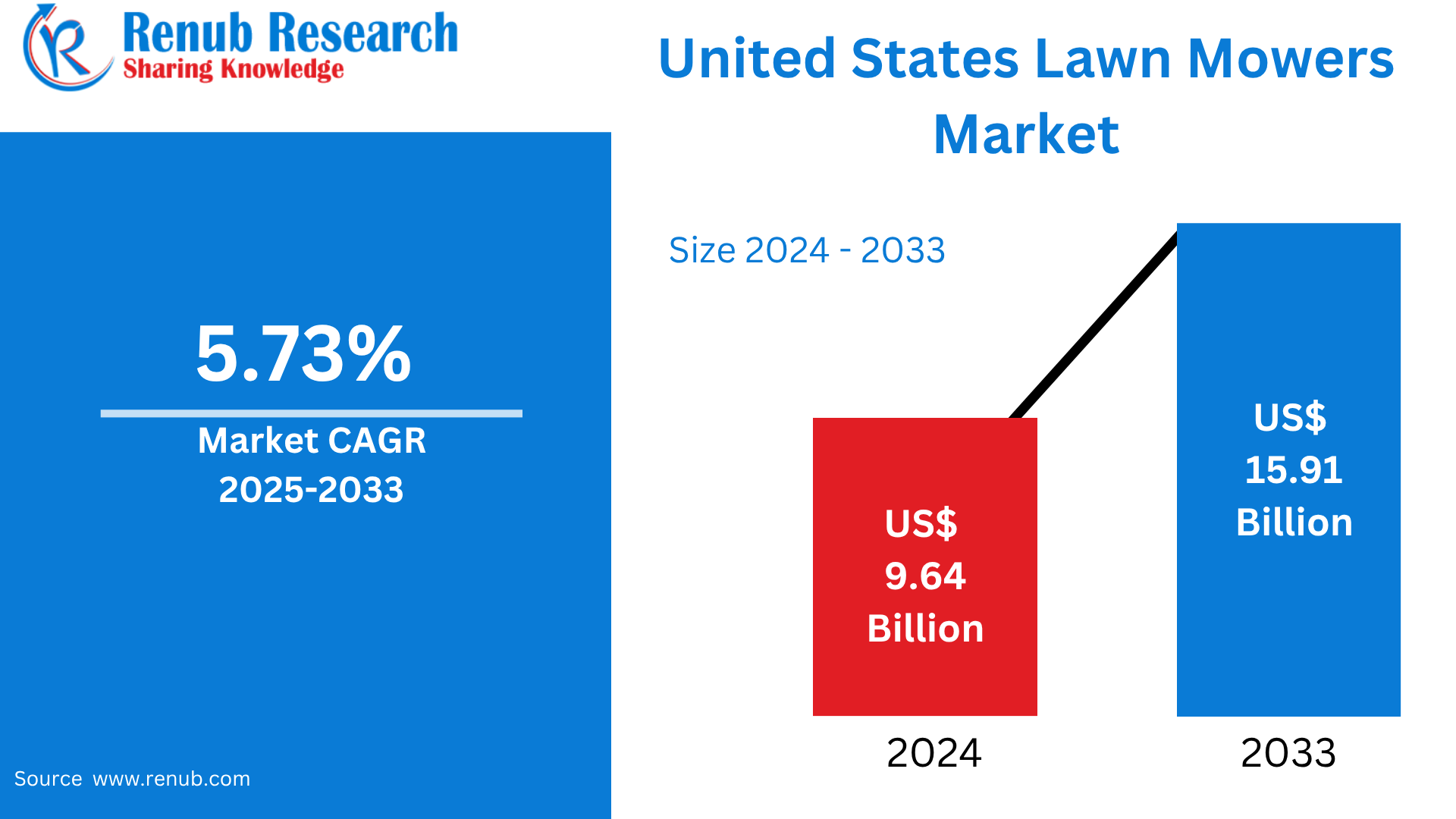
United States Lawn Mowers Market is expected to reach US$ 15.91 billion by 2033 from US$ 9.64 billion in 2024, with a CAGR of 5.73% from 2025 to 2033. The growing emphasis on outdoor living areas, landscape aesthetics, and lawn maintenance, as well as technical developments like automation, battery-powered systems, and smart connectivity that improve sustainability and efficiency, are driving growth in the U.S. lawn mower industry.
United States Lawn Mowers Industry Overview
Lawn mowers are devices used in public, commercial, and household settings that are made to cut grass surfaces to a consistent height. They include sophisticated ride-on, robotic, and electric types as well as manual push mowers. These devices are crucial for keeping up sports fields, gardens, and lawns, which enhances outdoor beauty and landscape management. In order to increase efficiency and lessen their impact on the environment, modern lawn mowers come equipped with technologies like self-propulsion, eco-friendly power systems, and customizable cutting heights. Lawn mowers are essential for improving the aesthetic appeal, hygienic conditions, and usage of open green spaces as outdoor lifestyles and landscaping tastes change.
The market for lawn mowers in the United States is growing as a result of growing interest in sustainable landscaping techniques, house renovation, and garden care. Manufacturers are concentrating on electric and robotic lawn mowers due to the growing need for equipment that is user-friendly, low-emission, and efficient. Lawn maintenance activities have increased as a result of expanding urban and suburban housing developments, the growing appeal of outdoor recreation, and home gardening. Additionally, in order to increase efficiency and lower operating expenses, professional landscaping firms are implementing cutting-edge equipment. All of these elements work together to drive market innovation and the broad use of contemporary lawn mowers in both residential and commercial settings in the US.
Growth Drivers for the United States Lawn Mowers Market
Technological Advancement and Automation
The market for lawn mowers in the United States is mostly driven by technological advancement. Traditional lawn care has changed with the advent of smart, automated, and battery-powered mowers that provide sustainability, accuracy, and convenience. With sensors, GPS navigation, and app-based controls, robotic lawn mowers enable homeowners to effectively maintain their lawns without requiring personal labor. Models that run on batteries fulfill rising environmental standards by lowering noise and pollutants. Predictive maintenance and energy optimization are made possible by the combination of artificial intelligence and Internet of Things connectivity. Faster charging systems, robust materials, and ergonomic designs are also being prioritized by manufacturers. The next stage of the U.S. lawn mower market's evolution is being shaped by these innovations, which are drawing in both residential and commercial customers looking for eco-friendly, safe, and efficient solutions.
Growing Landscaping and Home Improvement Trends
One of the main factors propelling the U.S. lawn mower industry is the growing emphasis on outdoor living, beautiful landscaping, and house renovation. More money is being spent by homeowners, especially in affluent and suburban regions, on keeping aesthetically pleasing lawns, gardens, and recreational areas. The demand for equipment is rising as a result of social trends encouraging sustainable and healthful outdoor lifestyles as well as the cultural significance of well-kept lawns. Reliable and high-performing mowers are necessary as public institutions, resorts, sports complexes, and professional landscaping firms grow their maintenance operations. The use of energy-efficient and quiet electric mowers is encouraged by seasonal lawn care and growing environmental consciousness. The nation's market momentum is being reinforced by the increased emphasis on sustainable property management and outside beautifying.
Rising Preference for Eco-Friendly and Smart Solutions
The U.S. market is witnessing a steady shift toward eco-friendly, smart, and energy-efficient lawn mowers. Growing awareness of carbon emissions and noise pollution is encouraging the adoption of electric and robotic alternatives over gasoline-powered models. Consumers are prioritizing sustainability and convenience, choosing cordless and rechargeable options that require less maintenance. Smart connectivity features, such as smartphone integration and programmable cutting schedules, enhance user control and efficiency. Manufacturers are investing in recyclable materials, durable components, and low-energy technologies to appeal to environmentally conscious customers. This transition aligns with broader sustainability goals and consumer expectations for cleaner, quieter, and more intelligent lawn care solutions, driving long-term innovation in the industry.
Challenges in the United States Lawn Mowers Market
High Initial Costs and Maintenance Issues
The comparatively expensive initial investment and ongoing maintenance costs of advanced models are a significant obstacle for the U.S. lawn mower business. Despite their efficiency, robotic, ride-on, and battery-powered lawn mowers can be prohibitively pricey for typical homes. Long-term ownership expenses are increased by the requirement for routine maintenance, such as software updates, battery replacement, and blade sharpening. These elements may discourage buyers on a tight budget and restrict adoption, particularly in economies where prices are crucial. Furthermore, some users find advanced models difficult to maintain or run, which limits accessibility. Expanding market penetration and promoting broader adoption of contemporary mowing technologies continue to depend on removing cost barriers through innovation, streamlined design, and service-friendly solutions.
Environmental and Regulatory Concerns
Environmental and regulatory challenges also affect the U.S. lawn mowers market. Gasoline-powered mowers contribute to emissions, noise pollution, and fuel waste, prompting stricter environmental regulations in several states. Manufacturers must comply with evolving standards on emissions, battery disposal, and energy efficiency, which increases production complexity and cost. Additionally, environmental concerns are influencing consumer perception, with growing preference for sustainable alternatives creating pressure to innovate rapidly. Transitioning to cleaner technologies requires significant research, material sourcing, and infrastructure adjustments. While these regulations aim to improve sustainability, they can slow production and limit flexibility for traditional manufacturers, making adaptation and eco-friendly innovation essential for long-term market resilience.
California Lawn Mowers Market
California’s lawn mowers market is strongly influenced by environmental policies and sustainability trends. The state’s focus on emission reduction and energy-efficient solutions has accelerated the adoption of electric and battery-powered mowers. Urban landscaping, residential gardening, and commercial property maintenance drive continuous demand. With a strong culture of outdoor living and eco-conscious consumers, California leads in adopting robotic and smart mowing technologies. Water conservation practices also encourage efficient lawn care equipment that minimizes resource use. The market benefits from innovation hubs and proximity to technology developers, fostering the integration of smart systems and sustainable design in landscaping equipment.
Texas Lawn Mowers Market
Texas has one of the largest markets for lawn mowers in the United States, driven by its extensive residential areas, large lawns, and thriving landscaping industry. The state’s warm climate ensures year-round grass growth, increasing the need for reliable mowing equipment. Both residential and commercial users prefer durable, high-performance mowers suitable for large landscapes. Gas-powered models remain popular, though electric and battery-powered options are gaining momentum as sustainability awareness rises. Professional lawn care services play a major role, fueling demand for efficient and powerful machinery. Texas’s strong construction and real estate sectors further support continuous demand for lawn maintenance products.
New York Lawn Mowers Market
New York’s lawn mower market is shaped by urban landscaping initiatives, suburban growth, and eco-conscious consumer behavior. Residential users, municipalities, and facility managers prioritize compact, quiet, and efficient equipment suitable for limited green spaces. Electric and robotic mowers are increasingly popular in densely populated areas due to noise and emission concerns. Public parks and recreational facilities also drive steady demand for commercial-grade equipment. With growing emphasis on sustainability and smart technology integration, the market is shifting toward advanced, connected, and low-maintenance lawn care solutions. Local regulations and environmental awareness continue to guide purchasing trends toward cleaner, greener technologies.
Florida Lawn Mowers Market
Florida’s lawn mower market benefits from its tropical climate, which supports continuous grass growth and high landscaping activity throughout the year. Residential homeowners, resorts, golf courses, and property management companies all contribute to strong equipment demand. The focus on outdoor aesthetics and tourism-related maintenance sustains a robust market for both residential and commercial-grade mowers. Consumers prefer durable, weather-resistant, and easy-to-maintain models that can handle humid conditions. Additionally, growing environmental consciousness is driving interest in electric and battery-powered mowers. With a blend of residential demand and tourism-driven landscaping needs, Florida remains one of the most dynamic and opportunity-rich markets for lawn care equipment in the United States.
Recent Developments in United States Lawn Mowers Market
- In January 2025, John Deere introduced its latest innovation — a fully electric, battery-powered autonomous zero-turn, stand-on mower. Designed with a 60-inch rear-discharge deck, the mower can function autonomously or be manually operated by a user. It features integrated batteries with off-board charging options, offering quieter performance and reduced emissions. Equipped with multiple cameras, GPS antennas, and wheel odometry, it ensures precise navigation and object detection. Developed by adapting John Deere’s advanced agricultural technology and refined in collaboration with landscaping professionals, the mower addresses the evolving needs of commercial lawn care operations with enhanced efficiency and sustainability.
- In September 2023, John Deere formed a strategic partnership with EGO and its parent company Chervon, a global leader in Outdoor Power Equipment (OPE) and power tools. The collaboration enables John Deere dealers to offer EGO’s battery-powered lawn care solutions to homeowners, strengthening the company’s commitment to sustainable and electric-powered product expansion.
- In May 2023, AriensCo, under its Ariens brand, unveiled the IKON ONYX, a premium custom zero-turn lawn mower featuring a 52-inch deck. The model combines durability, comfort, and performance, catering to residential and professional users seeking precision and design excellence.
- In March 2022, AriensCo announced a partnership with country music artist and U.S. Army veteran Craig Morgan to represent its Gravely commercial lawn mower brand and Ariens products. This collaboration reinforces the brand’s connection with hardworking professionals and the values of reliability and craftsmanship that define its equipment.
United States Lawn Mowers Market Segments:
Offering
- Hardware
- Software
Propulsion Type
- Electric
- ICE
Type
- Riding Lawn Movers
- Walk-behind Lawn Movers
- Robotic Lawn Movers
Lawn Size
- Small
- Medium
- Large
Level of Autonomy
- Autonomous
- Non-autonomous
Distribution Channel
- Online
- Retail
End Use
- Residential
- Commercial
States–Market breakup in 29 viewpoints:
- California
- Texas
- New York
- Florida
- Illinois
- Pennsylvania
- Ohio
- Georgia
- New Jersey
- Washington
- North Carolina
- Massachusetts
- Virginia
- Michigan
- Maryland
- Colorado
- Tennessee
- Indiana
- Arizona
- Minnesota
- Wisconsin
- Missouri
- Connecticut
- South Carolina
- Oregon
- Louisiana
- Alabama
- Kentucky
- Rest of United States
All companies have been covered from 5 viewpoints:
- Company Overview
- Key Persons
- Recent Development & Strategies
- SWOT Analysis
- Sales Analysis
Key Players Analysis
- American Honda Motor Co., Inc.
- Ariens Company
- Briggs Stratton
- Deere & Company
- Falcon Garden Tools
- Fiskars
- Husqvarna Group
- MTD Products
- Robert Bosch GmbH
- Robomow Friendly House
Report Details:
| Report Features | Details |
| Base Year |
2024 |
| Historical Period |
2021 - 2024 |
| Forecast Period |
2025 - 2033 |
| Market |
US$ Billion |
| Segment Covered |
Offering, Propulsion Type, Type, Lawn Size, Level of Autonomy, Distribution Channel, End Use and States |
| States Covered |
|
| Companies Covered |
|
| Customization Scope |
20% Free Customization |
| Post-Sale Analyst Support |
1 Year (52 Weeks) |
| Delivery Format |
PDF and Excel through Email (We can also provide the editable version of the report in PPT/Word format on request) |
Customization Services available
- Analysis of Market Size and Its Segments
- More Company Profiles (Upto 10 without any additional cost):
- Additional Countries (Other than mentioned Countries):
- Region/Country Specific Reports:
- Market Entry Strategy:
- Region-Specific Market Dynamics:
- Regional Market Share Analysis:
- Trade Analysis:
- Production Insights:
- Others Customized Requests:
For more information contact our analysts.
Need More Assistance?
- Talk to our analysts to get more precious information on the current market trends.
- Include more countries and segments and customize the report based on the final requirement.
- Get a competitive advantage in your industry by knowing the report findings and making a positive impact on your revenues and operations.
- Our analysts are always ready to provide more help and pertinent information if you need any additional assistance.