United States Hospital & Nursing Home Probiotics Market Report by Application, States and Company Analysis 2026-2034
Buy NowUnited States Hospital And Nursing Home Probiotics Market Size and Forecast 2026-2034
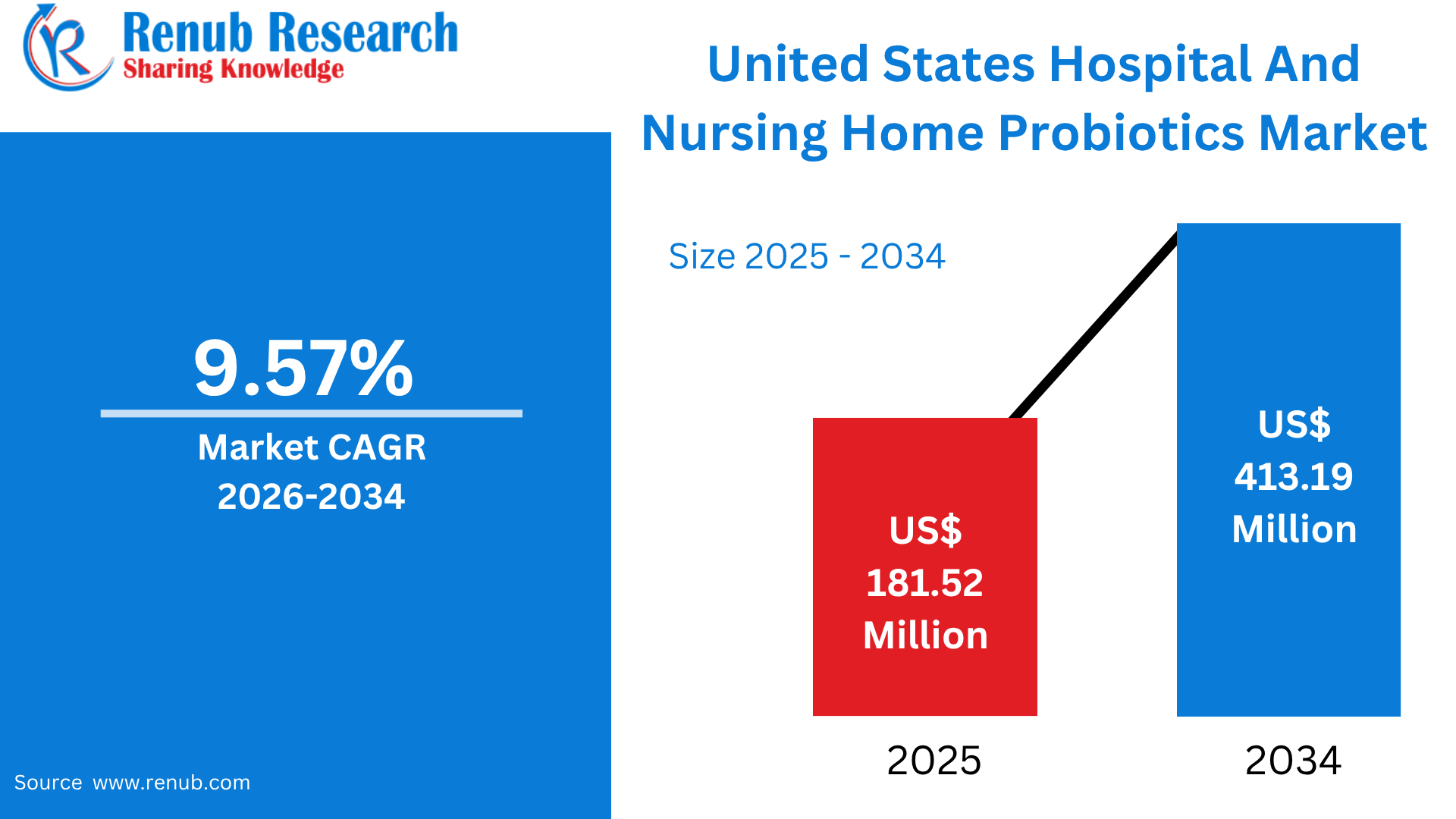
United States Hospital And Nursing Home Probiotics Market is expected to reach US$ 413.19 Million by 2034 from US$ 181.52 Million in 2025, with a CAGR of 9.57% from 2026 to 2034. Growing focus on preventive healthcare, rising gastrointestinal disorders, and increasing use of probiotics to support immunity and recovery in hospitals and nursing homes are key drivers, supported by clinical research and expanding elderly patient populations.
United States Hospital And Nursing Home Probiotics Industry Overview
Hospital and nursing home probiotics refer to beneficial live microorganisms administered in healthcare settings to support patient health, particularly digestive and immune functions. These probiotics are commonly used to restore gut microbiota balance, especially in patients undergoing antibiotic treatment, surgery, or long-term care. In hospitals, probiotics help manage infections such as antibiotic-associated diarrhea and support recovery in critically ill patients. In nursing homes, they are widely used among elderly residents with weakened immune systems to enhance digestion and reduce infection risks. These products are available in capsules, powders, and liquid forms, and are increasingly integrated into clinical nutrition and preventive healthcare protocols.
The U.S. hospital and nursing home probiotics market is expanding due to increasing awareness of gut health and its role in overall wellness. Healthcare providers are incorporating probiotics into treatment protocols to manage gastrointestinal disorders, improve immunity, and reduce infection risks, particularly in patients receiving antibiotics. Rising elderly populations in nursing homes further drive demand, as older individuals often experience digestive issues and weakened immune systems. Additionally, growing research supporting probiotic efficacy and the shift toward preventive healthcare encourage adoption in clinical settings. These factors, combined with increasing healthcare expenditures and patient-centered care approaches, continue to support sustained market growth.
Recent Developments in United States Hospital And Nursing Home Probiotics Market
- In November 2025, Probi expanded its probiotic portfolio with Sports & Active Nutrition by Probi, a clinical probiotic solution designed to support digestive comfort, circulatory health, endurance, and vitality for physically active individuals. This launch leverages the strain Lactiplantibacillus plantarum 299V (LP299V®) to help enhance nutrient absorption and overall physical performance, reflecting growing interest in gut-linked performance support beyond traditional digestive benefits.
- At SupplySide West 2024, Probi unveiled its Metabolic Health by Probi® formulation targeting metabolic syndrome markers, weight management, and cardiovascular support with dual proprietary strains (LP299V® and L. paracasei 8700:2®). This product addresses the link between metabolic health and microbiome balance, broadening probiotic applications into systemic wellness areas.
- In September 2023, SIG and AnaBio Technologies jointly launched the first long-life probiotic yogurt in aseptic packaging, enabling shelf-stable probiotic beverages without refrigeration. This innovation unlocks new distribution and usability scenarios — including for institutional settings — by extending live probiotic availability beyond cold chains.
Growth Drivers for the United States Hospital And Nursing Home Probiotics Market
Rising Prevalence of Gastrointestinal Disorders and Infections
The increasing incidence of gastrointestinal diseases and healthcare-associated infections is a major driver for probiotic adoption in hospitals and nursing homes. Conditions such as irritable bowel syndrome, antibiotic-associated diarrhea, and Clostridioides difficile infections are common in clinical settings, particularly among patients undergoing antibiotic treatments. Probiotics help restore gut microbiota balance, reduce inflammation, and support faster recovery, making them an essential part of patient care. Healthcare institutions are increasingly integrating probiotics into treatment protocols to minimize complications and improve patient outcomes.
Supporting this trend, in May 2024, Bio-K+ introduced a new range of vegan, shelf-stable probiotic capsules designed for immunity and bowel support, enhancing clinical nutrition options for hospitals and long-term care facilities.
Growing Geriatric Population in Nursing Homes
The rising elderly population in the United States significantly drives probiotic demand in nursing homes. Older adults often suffer from weakened immune systems, chronic illnesses, and digestive disorders, making them more vulnerable to infections and complications. Probiotics are increasingly used to maintain gut health, improve nutrient absorption, and reduce the risk of antibiotic-associated complications in this population. Nursing homes are adopting probiotics as part of routine dietary and therapeutic regimens to enhance residents’ quality of life.
Reflecting this trend, in October 2024, Probi launched its “Metabolic Health by Probi” solution, targeting metabolic and gut health, which is particularly relevant for aging populations in long-term care environments.
Shift Toward Preventive Healthcare and Clinical Nutrition
Healthcare providers are increasingly focusing on preventive care and supporting overall patient wellbeing, which is boosting probiotic adoption in hospitals and nursing homes. As digestive health becomes a more prominent component of patient care, probiotics are incorporated into clinical nutrition protocols to help manage gastrointestinal issues and support immunity, particularly during and after antibiotic treatment or surgery. Growing awareness among providers and patients of gastrointestinal wellness is encouraging more routine use in vulnerable populations, including long-term care residents. Industry reports indicate that broader incorporation of probiotics in clinical environments is driven by mounting empirical evidence of their health benefits and rising demand for immune and gut support in healthcare settings.
A recent innovation highlighting this trend is the 2025 launch of BioGaia’s probiotic product shown to help prevent antibiotic-associated diarrhea, enhancing clinical gut health support across care settings.
Challenges in the United States Hospital And Nursing Home Probiotics Market
Regulatory Uncertainty and Lack of Standardization
One of the major challenges in the U.S. hospital and nursing home probiotics market is the lack of clear regulatory classification and standardization. Probiotics are generally regulated as dietary supplements rather than pharmaceuticals, leading to inconsistencies in quality, labeling, and clinical validation. This creates hesitation among healthcare providers when incorporating probiotics into treatment protocols, as standardized dosing and strain-specific efficacy are not always well-defined. Hospitals and nursing homes require clinically proven and reliable products to ensure patient safety, especially in vulnerable populations. The absence of uniform guidelines limits widespread adoption and creates barriers for manufacturers seeking to position probiotics as essential components of clinical care.
High Costs and Limited Insurance Coverage
The cost of high-quality probiotic formulations can be a barrier for healthcare institutions, particularly nursing homes operating under tight budgets. Since probiotics are often not covered under standard insurance programs such as Medicare or Medicaid, patients and facilities must bear the expenses. This limits their routine use despite proven benefits in improving gut health and reducing complications. Additionally, budget constraints in public healthcare facilities restrict large-scale procurement of advanced probiotic products. While probiotics can reduce long-term healthcare costs by preventing infections and improving recovery, the lack of immediate financial support and reimbursement policies continues to challenge broader market adoption in hospitals and long-term care settings.
California Hospital And Nursing Home Probiotics Market
California remains a leading healthcare market with strong demand for probiotics in hospitals and nursing homes. The state has one of the highest elderly populations in the U.S., with over 6 million residents aged 65 and above, increasing the need for digestive and immune health management. Additionally, California records a high number of hospital admissions annually, particularly for chronic and gastrointestinal conditions. The state also actively focuses on infection prevention programs in healthcare facilities, encouraging the use of supportive therapies like probiotics. Nursing homes in California are increasingly incorporating probiotics into dietary regimens to improve gut health and reduce complications associated with antibiotic use, making the state a key contributor to market growth.
Texas Hospital And Nursing Home Probiotics Market
Texas has a rapidly growing population and expanding healthcare infrastructure, contributing to rising demand for probiotics. The state reports over 30 million residents, with a steadily increasing elderly demographic requiring long-term care services. Texas also experiences a high number of hospitalizations related to chronic diseases and digestive disorders, driving the need for supportive treatments like probiotics. Furthermore, healthcare facilities in Texas are focusing on reducing hospital-acquired infections and improving patient outcomes, which supports probiotic adoption. Nursing homes are increasingly using probiotics to enhance residents’ digestive health and immunity, particularly for those undergoing long-term medication or antibiotic treatments, strengthening the role of probiotics in clinical and elderly care settings.
New York Hospital And Nursing Home Probiotics Market
New York has a dense population and a well-developed healthcare system, supporting significant demand for probiotics in hospitals and nursing homes. The state has one of the highest hospital admission rates in the country, particularly in urban centers like New York City. Additionally, a large aging population and high prevalence of chronic diseases contribute to increased demand for preventive healthcare solutions. Hospitals in New York are increasingly adopting probiotics to support gut health in patients undergoing intensive treatments, while nursing homes utilize them to improve digestion and reduce infection risks among elderly residents. The state’s emphasis on advanced patient care and infection control measures further promotes the integration of probiotics into healthcare protocols.
Florida Hospital And Nursing Home Probiotics Market
Florida is a key market due to its large elderly population and strong long-term care sector. The state has one of the highest proportions of residents aged 65 and older, accounting for over 21% of its population, significantly increasing demand for probiotics in nursing homes. Florida also reports a high number of hospital visits annually, particularly related to chronic illnesses and digestive health conditions. The warm climate and high population density further contribute to infection risks, encouraging preventive healthcare measures. Nursing homes and hospitals in Florida are increasingly incorporating probiotics into patient care to improve gut health, boost immunity, and reduce complications associated with antibiotic use, supporting consistent market growth.
United States Gut Health Hospital and Nursing Home Probiotics Market
The United States gut health hospital and nursing home probiotics market is expanding as healthcare facilities increasingly emphasize microbiome-supportive interventions for patients with digestive disorders, antibiotic-associated diarrhea, and weakened immunity. Hospitals are integrating clinically validated probiotic strains into patient care protocols to improve gut flora balance, support recovery, and reduce gastrointestinal complications. Nursing homes, which manage a large elderly population with higher digestive vulnerability, are adopting probiotics to maintain regularity, reduce constipation, and enhance overall gut resilience. Growing clinical evidence on strain-specific benefits and improved product quality standards also drive adoption. Additionally, partnerships between healthcare systems and probiotic manufacturers are increasing access to specialized formulations that meet hospital-grade safety and efficacy requirements.
United States Wellness Hospital and Nursing Home Probiotics Market
The United States wellness hospital and nursing home probiotics market is growing due to increasing recognition of probiotics as supportive tools for whole-body health, beyond just digestive benefits. Healthcare facilities are using wellness-focused probiotic formulations to improve immunity, reduce inflammation, and support holistic patient well-being. Nursing homes, where residents often experience weakened immune responses and chronic conditions, are incorporating probiotics into daily nutrition plans to promote vitality and maintain microbial balance. Hospitals are also adopting probiotics in preventive care programs, especially for long-stay patients. Rising emphasis on nutrition-based wellness strategies, combined with demand for clean-label, clinically validated probiotic products, supports broader acceptance. Improved regulatory clarity and growing interest in personalized microbiome care further strengthen market expansion.
United States Hospital & Nursing Home Probiotics Market Segments
Hospital Probiotics Channel
Number of Beds
- 1-199
- 200-299
- 300-499
- 500+
Payer
- Medicare
- Medicaid
- Self-pay
- Private
- Others
Location
- Rural
- Urban
Nursing home Probiotics Channel
Number of Beds
- Less than 50
- 50-99
- 100-199
- 199+
Payer
- Medicare
- Medicaid
- Dual
Location
- Rural
- Urban
Application
- Gut Health
- Immunity
- Wellness
- Others
Top States
- California
- Texas
- New York
- Florida
- Illinois
- Pennsylvania
- Ohio
- Georgia
- New Jersey
- Washington
- North Carolina
- Massachusetts
- Virginia
- Michigan
- Maryland
- Colorado
- Tennessee
- Indiana
- Arizona
- Minnesota
- Wisconsin
- Missouri
- Connecticut
- South Carolina
- Oregon
- Louisiana
- Alabama
- Kentucky
- Rest of United States
All companies have been covered with 5 Viewpoints
- Overviews
- Key Person
- Recent Developments
- SWOT Analysis
- Revenue Analysis
Company Analysis
- American Lifeline Inc.
- Rising Pharmaceuticals
- BD
- Dietary Pros Inc.
- Dr. Joseph Mercola
- Probi
- Lallemand Inc
- Biocodex
- Probiotical S.p.A.
- Protexin
Report Details:
| Report Features | Details |
| Base Year |
2024 |
| Historical Period |
2021 - 2024 |
| Forecast Period |
2025 - 2033 |
| Market |
US$ Million |
| Segment Covered |
Application and Region |
| Region Covered |
|
| Companies Covered |
|
| Customization Scope |
20% Free Customization |
| Post-Sale Analyst Support |
1 Year (52 Weeks) |
| Delivery Format |
PDF and Excel through Email (We can also provide the editable version of the report in PPT/Word format on request) |
Key Questions Answered in This Report:
-
What was the market size of the U.S. Hospital & Nursing Home Probiotics Market in 2024?
-
What is the projected market size for this sector by 2033?
-
What is the compound annual growth rate (CAGR) for the market from 2025 to 2033?
-
What factors are driving the growth of the probiotics market in U.S. hospitals and nursing homes?
-
How are probiotics contributing to infection control and immunity enhancement in healthcare facilities?
-
How is the aging population in the U.S. influencing the demand for probiotics in hospitals and nursing homes?
-
What challenges are impacting the growth of the U.S. Hospital & Nursing Home Probiotics Market?
-
How does the use of probiotics help in managing antibiotic-associated diarrhea and gastrointestinal disorders in patients?
-
Which geographic regions in the U.S. are seeing higher adoption of probiotics in healthcare settings?
-
Who are some of the major companies operating in the U.S. Hospital & Nursing Home Probiotics Market?
Customization Services available
- Analysis of Market Size and Its Segments
- More Company Profiles (Upto 10 without any additional cost):
- Additional Countries (Other than mentioned Countries):
- Region/Country Specific Reports:
- Market Entry Strategy:
- Region-Specific Market Dynamics:
- Regional Market Share Analysis:
- Trade Analysis:
- Production Insights:
- Others Customized Requests:
For more information contact our analysts.
Need More Assistance?
- Talk to our analysts to get more precious information on the current market trends.
- Include more countries and segments and customize the report based on the final requirement.
- Get a competitive advantage in your industry by knowing the report findings and making a positive impact on your revenues and operations.
- Our analysts are always ready to provide more help and pertinent information if you need any additional assistance.