United States Golf Cart Market Report by Propulsion Type, Seating Capacity, Vehicle Format, Application, Sales Channel, States and Company Analysis 2025-2033
Buy NowUnited States Golf Cart Market Size and Forecast 2025-2033
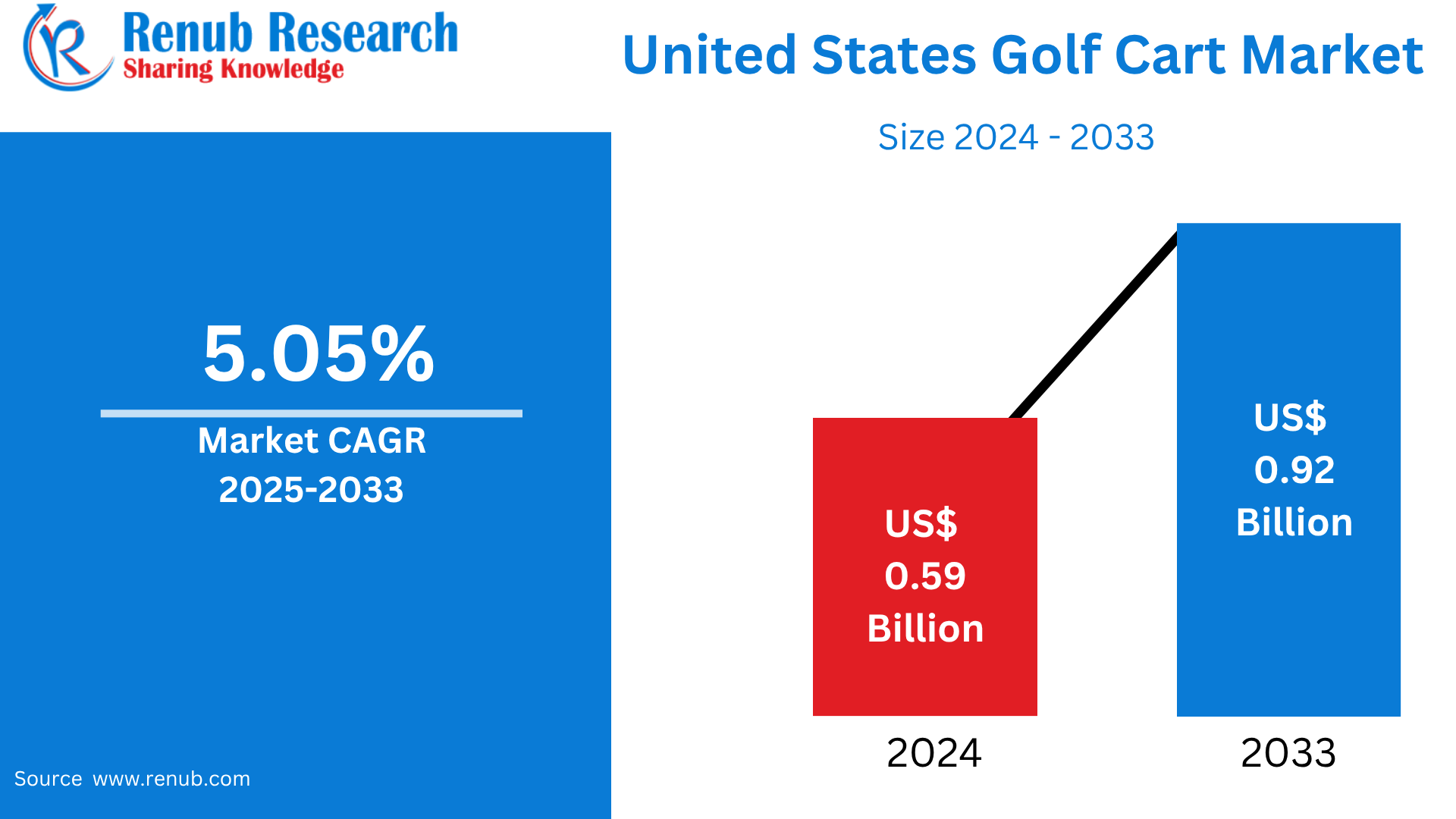
United States Golf Cart Market is expected to reach US$ 0.92 billion by 2033 from US$ 0.59 billion in 2024, with a CAGR of 5.05% from 2025 to 2033. Expanding golf participation, growing demand in residential and commercial communities, eco-friendly electric models, tourism growth, and the growing use of carts for industrial, urban, and personal mobility applications outside of golf course use are all factors driving the growth of the U.S. golf cart market.
United States Golf Cart Industry Overview
A golf cart is a compact, gas- or electric-powered vehicle used mainly for the efficient movement of golfers and their gear around a golf course. Because of their portability, small size, and inexpensive running costs, these carts have been used for a variety of purposes outside of golf, including residential neighborhoods, resorts, airports, industrial campuses, and gated communities. Modern golf carts frequently include cutting-edge designs with improved comfort, safety, and environmentally friendly technologies, especially electric models that require less upkeep and emit less pollutants. Golf carts are becoming more and more recognized as useful and adaptable mobility options in both business and recreational settings as sustainability and leisure lifestyles gain traction.
Golf's increasing appeal as a sport and recreational activity is driving the steady growth of the golf cart business in the United States. In addition to conventional courses, golf carts are being utilized more and more for short-distance mobility in residential neighborhoods, resorts, airports, and industrial locations. Demand is also being driven by the trend toward environmentally friendly electric vehicles, which is aided by developments in battery technology and vehicle design. Sales are also increased by growing tourist, lifestyle developments, and university transportation requirements. These elements, together with adaptable designs and environmentally friendly options, place golf carts as a developing market niche within the larger light electric vehicle industry in the United States.
Growth Drivers for the United States Golf Cart Market
Rising Golf Participation
One of the main factors propelling the golf cart market's expansion in the US is the sport's growing appeal. Golf's growing popularity among women, corporate executives, and younger players is increasing its user base and driving up demand for sleek, effective carts. Consistent sales are further supported by the construction of additional resort amenities, recreational clubs, and golf courses. In an effort to increase accessibility, some towns are also spending money on public golf courses. In addition to being essential for players' mobility, golf carts are now also necessary for course management and upkeep. Together with increasing demand for tournaments and recreational golf travel, this expanding involvement guarantees consistent market growth and opens up new business opportunities for producers and rental service providers around the country.
Shift Toward Electric Mobility
As efficiency and sustainability become more important, the U.S. golf cart market is seeing a significant shift from gasoline-powered models to electric alternatives. Due to their eco-friendly performance, reduced maintenance costs, and silent operation, electric carts are becoming more and more popular among consumers and golf facilities. In response, producers are introducing cutting-edge innovations that improve dependability and range, like lithium-ion batteries, regenerative braking, and intelligent control systems. Kandi America and Lowe's teamed up to introduce legally approved NFL team electric golf carts with 48V lithium batteries, touchscreens, and branding for each of the 32 teams in July 2024.This partnership combines a love of sports with cutting-edge electric technology, showcasing how environmentally conscious and lifestyle-driven designs are revolutionizing the golf cart market and appealing to a wider range of consumers looking for contemporary, sustainable mobility options.
Technological Advancements
Rapid technological innovation is redefining the capabilities and appeal of modern golf carts. Manufacturers are integrating features such as digital displays, GPS tracking, smart connectivity, and upgraded suspension systems to enhance comfort and performance. Advancements in battery technology, particularly lithium-ion systems, have improved energy efficiency, charging speed, and durability. Automation and telematics are also being explored to optimize fleet management for commercial users in resorts and communities. In December 2023, Vero Technologies launched a floorplan financing program in partnership with TrojanEV to expand the distribution of eco-friendly electric carts through tailored financing solutions. This initiative highlights the industry’s shift toward integrating financial innovation with technological progress, making advanced electric carts more accessible to dealers and customers. Collectively, these advancements are transforming golf carts from simple course vehicles into intelligent, multi-purpose mobility solutions.
Challenges in the United States Golf Cart Market
High Initial Costs and Limited Financing Options
One of the major challenges in the U.S. golf cart market is the relatively high initial cost of advanced electric and customized models. The integration of lithium-ion batteries, smart displays, and luxury features increases the overall price, making them less affordable for budget-conscious consumers and smaller golf facilities. Although operational costs are lower compared to gas-powered carts, upfront investment remains a deterrent. Limited financing options and varying state regulations on low-speed vehicles further complicate purchases for individuals and businesses. While manufacturers and financial institutions are introducing new leasing and payment programs, broader adoption still depends on improved affordability, financing accessibility, and consumer awareness regarding long-term cost benefits and sustainability advantages.
Regulatory and Infrastructure Constraints
The expansion of golf carts beyond traditional golf courses faces challenges related to inconsistent regulations and infrastructure limitations. Many states and municipalities have differing rules governing the operation of low-speed vehicles (LSVs) on public roads, leading to compliance difficulties for manufacturers and users. Additionally, the lack of standardized charging infrastructure restricts the widespread adoption of electric models in residential and urban areas. Safety requirements, licensing restrictions, and zoning limitations further complicate the use of golf carts as alternative transportation. These regulatory inconsistencies create uncertainty in market expansion and discourage investment. Streamlined national guidelines and improved charging infrastructure are essential to unlocking the full potential of golf carts as sustainable mobility solutions in both recreational and community settings.
California Golf Cart Market
California’s golf cart market thrives on the state’s strong environmental policies, high-income communities, and vibrant tourism industry. The increasing shift toward electric mobility aligns with California’s sustainability goals, encouraging the adoption of zero-emission electric carts across golf courses, resorts, and residential developments. Gated communities and coastal towns, particularly in Southern California, use golf carts as eco-friendly transportation alternatives for short commutes. The state’s numerous golf courses and luxury resorts also sustain strong commercial demand. Moreover, tech-driven innovation in lithium-ion batteries and smart connectivity enhances cart performance and efficiency. With a blend of recreational and urban use, California represents a leading hub for sustainable golf cart adoption.
Texas Golf Cart Market
Texas has emerged as one of the largest and most dynamic golf cart markets in the U.S., supported by its vast landscapes, strong golfing culture, and extensive residential communities. The state’s numerous golf courses and retirement communities create consistent demand for both electric and gas-powered carts. Additionally, Texas residents increasingly use golf carts for neighborhood commuting and recreational mobility. Local manufacturing and customization businesses cater to off-road and utility-focused designs, reflecting the state’s preference for versatile vehicles. The growing popularity of electric models aligns with sustainability initiatives, while tourism in cities like Austin, Dallas, and San Antonio further supports the market’s expansion across leisure and hospitality sectors.
New York Golf Cart Market
New York’s golf cart market is driven by a mix of recreation, tourism, and urban innovation. While the state’s climate limits year-round golfing, high-end clubs, resorts, and seasonal facilities maintain strong cart demand during warmer months. In suburban and upstate areas, golf carts are increasingly used in gated communities, college campuses, and large estates for convenient short-distance travel. The push toward electric mobility complements New York’s environmental policies, leading to growing interest in energy-efficient models. Additionally, tourism in destinations like the Finger Lakes, the Hamptons, and upstate resorts fuels commercial purchases. This blend of luxury leisure, green initiatives, and functional transport sustains New York’s steady golf cart market growth.
Florida Golf Cart Market
Florida represents the largest and most vibrant golf cart market in the United States, fueled by its year-round warm climate, strong golfing culture, and extensive retirement communities. Golf carts are widely used not only on courses but also as everyday vehicles in planned neighborhoods and resort towns. The state’s growing preference for electric carts aligns with its focus on sustainability and convenience. Coastal regions like Naples, Palm Beach, and The Villages have embraced golf carts as essential community transport. Tourism, lifestyle communities, and recreation-based development continue to drive strong demand. With increasing adoption across leisure and residential applications, Florida remains a powerhouse in the U.S. golf cart industry.
Recent Developments in United States Golf Cart Market
- In May 2025, Kandi Technologies achieved a major milestone with the rollout of its first U.S.-assembled electric golf cart at its new manufacturing facility in Garland, Texas. This development marks a significant step in the company’s North American expansion, enhancing local production efficiency, reducing delivery times, and strengthening competitiveness within the electric off-road vehicle market.
- In March 2025, Club Car refreshed its Tempo golf cart lineup, introducing an Automatic Park Brake integrated with StopSmart Technology to ensure smoother deceleration and prevent roll-away incidents. The redesigned dashboard features two-tone trim, repositioned switches, integrated phone cradles, and both USB-A and USB-C ports, offering players enhanced safety, style, and connectivity throughout their game.
- In February 2025, Textron Specialized Vehicles launched the Cushman Hauler XL, a robust utility vehicle equipped with a 68.5-inch aluminum bed and a 1,600-pound payload capacity. Customers can select between a gasoline engine or the ELiTE lithium-electric powertrain, backed by a five-year battery warranty and an automatic parking brake that enables street-legal operation in most U.S. states.
- In July 2024, Kandi America partnered with Lowe’s to release officially licensed NFL team electric golf carts, each powered by 48V lithium batteries and equipped with touchscreens and full team branding for all 32 franchises. These limited-edition models provide fans with a stylish, high-performance mobility option for both game days and everyday use, available exclusively through Lowe’s retail network.
- In May 2024, Columbia Vehicle Group, a manufacturer specializing in electric transportation, announced a $12.2 million investment to establish operations in Aiken County, South Carolina. The new 154,480-square-foot facility consolidates assembly previously handled in Florida and Wisconsin, streamlining production and strengthening supply chain proximity to regional suppliers and customers.
- In June 2023, E-Z-GO introduced the Liberty LSV, a luxury, street-legal model combining comfort and versatility. Featuring four forward-facing seats and a top speed exceeding 25 mph, it complies with NHTSA low-speed vehicle standards. Later that year, the company unveiled the Freedom RXV, boasting a redesigned front fascia, integrated LED headlights, and an upgraded dashboard. Both models offer either ELiTE lithium or EX1 gas powertrains, balancing performance and efficiency while catering equally to golf course and neighborhood driving needs.
United States Golf Cart Market Segments:
Propulsion Type
- Electric Golf Carts
- Gasoline Golf Carts
- Solar-Hybrid Golf Carts
Seating Capacity
- 2 Seater
- 4 Seater
- 6 Seater
- 8+ Seater
Vehicle Format
- Open-Top
- Enclosed / Weather-proof
Application
- Golf Courses
- Personal / Residential Mobility
- Commercial Services (Resorts, Theme-Parks, Campuses)
- Industrial & Airport Utility
Sales Channel
- Offline (Dealers & Distributors)
- Online / Direct-to-Consumer
States–Market breakup in 29 viewpoints:
- California
- Texas
- New York
- Florida
- Illinois
- Pennsylvania
- Ohio
- Georgia
- New Jersey
- Washington
- North Carolina
- Massachusetts
- Virginia
- Michigan
- Maryland
- Colorado
- Tennessee
- Indiana
- Arizona
- Minnesota
- Wisconsin
- Missouri
- Connecticut
- South Carolina
- Oregon
- Louisiana
- Alabama
- Kentucky
- Rest of United States
All companies have been covered from 5 viewpoints:
- Company Overview
- Key Persons
- Recent Development & Strategies
- SWOT Analysis
- Sales Analysis
Key Players Analysis
- Yamaha Golf-Car Company
- Columbia Vehicle Group (ParCar)
- HDK Electric Vehicles
- Suzhou Eagle EV Mfg. Co.
- JH Global Services (Star EV)
- ICON EV
- Marshell Electric Vehicle
- Bintelli Electric Vehicles
- Xiamen Dalle Electric Car
- Speedways Electric
Report Details:
| Report Features | Details |
| Base Year |
2024 |
| Historical Period |
2021 - 2024 |
| Forecast Period |
2025 - 2033 |
| Market |
US$ Billion |
| Segment Covered |
Propulsion Type, Seating Capacity, Vehicle Format, Application, Sales Channel and States |
| States Covered |
|
| Companies Covered |
|
| Customization Scope |
20% Free Customization |
| Post-Sale Analyst Support |
1 Year (52 Weeks) |
| Delivery Format |
PDF and Excel through Email (We can also provide the editable version of the report in PPT/Word format on request) |
Customization Services available
- Analysis of Market Size and Its Segments
- More Company Profiles (Upto 10 without any additional cost):
- Additional Countries (Other than mentioned Countries):
- Region/Country Specific Reports:
- Market Entry Strategy:
- Region-Specific Market Dynamics:
- Regional Market Share Analysis:
- Trade Analysis:
- Production Insights:
- Others Customized Requests:
For more information contact our analysts.
Need More Assistance?
- Talk to our analysts to get more precious information on the current market trends.
- Include more countries and segments and customize the report based on the final requirement.
- Get a competitive advantage in your industry by knowing the report findings and making a positive impact on your revenues and operations.
- Our analysts are always ready to provide more help and pertinent information if you need any additional assistance.