Thermal Camera Market Size, Share, Trends & Forecast by Product, Type, Application, End User and Country, 2026–2034
Buy NowThermal Camera Market Size and Forecast
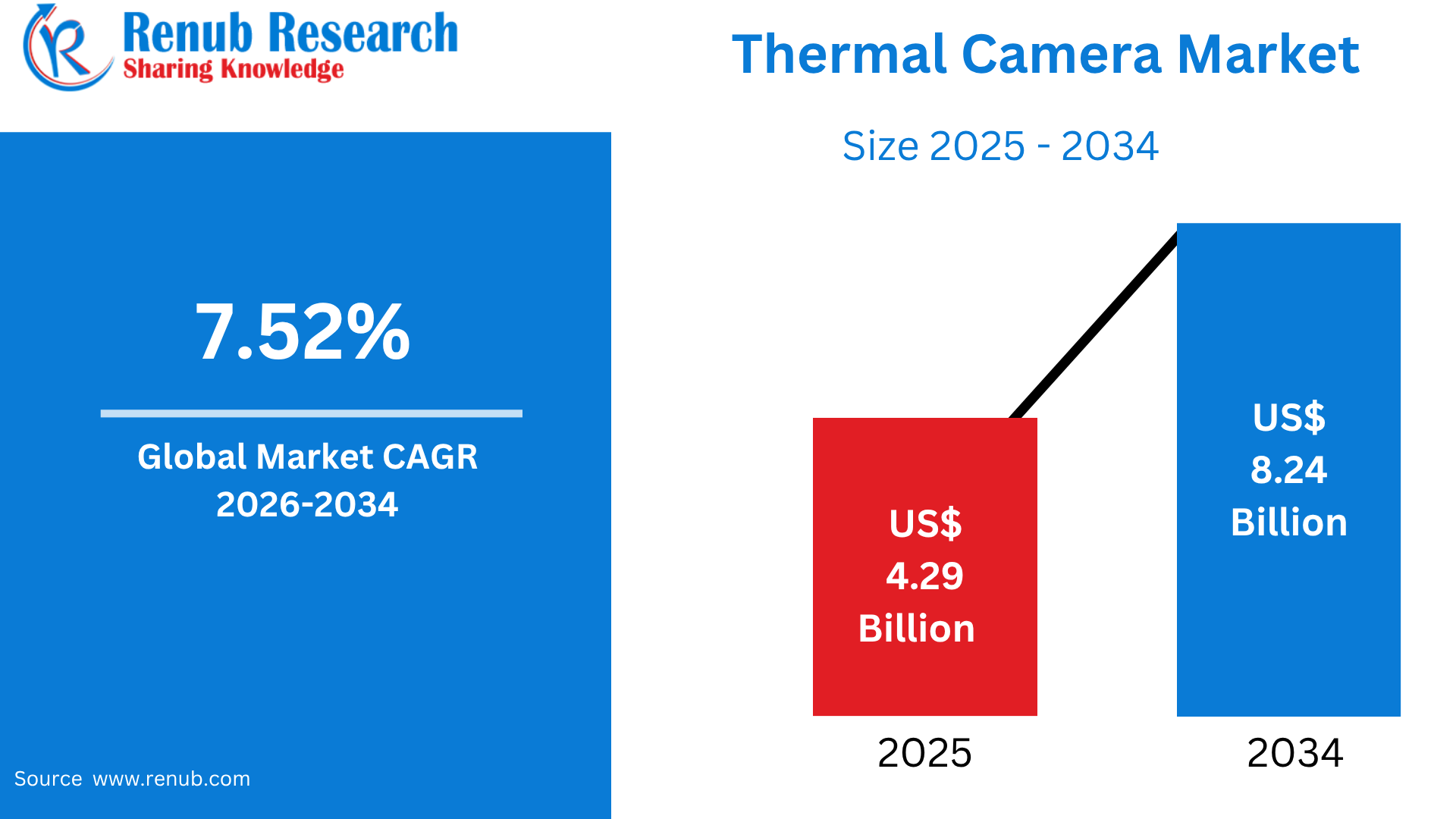
Global Thermal Camera Market is projected to expand from US$ 4.29 billion in 2025 to US$ 8.24 billion by 2034, registering a CAGR of 7.52% during 2026–2034. Market growth is being supported by rising adoption of thermal imaging across security and surveillance, industrial inspection, healthcare, automotive, and defense applications. Technological advancements in thermal sensors, improved image resolution, and enhanced night-vision capabilities are further increasing the usability of thermal cameras. In addition, the expansion of smart cities, infrastructure monitoring, and automated inspection systems is creating new opportunities for thermal imaging solutions.
What is a Thermal Camera? Uses & Popularity Worldwide
A thermal camera, also known as an infrared camera or thermal imager, is a device that detects infrared radiation emitted by objects and converts temperature differences into a visible thermal image. Unlike conventional cameras, thermal cameras can identify temperature variations even in darkness, smoke, fog, or other low-visibility conditions. They are available in handheld, fixed, mounted, cooled, and uncooled configurations and are used across numerous industries.
Thermal cameras are widely used for security and surveillance, military and defense, industrial inspection, predictive maintenance, firefighting, healthcare, automotive safety, building inspection, and search-and-rescue operations. In manufacturing and utilities, thermal imaging helps identify overheating equipment and potential failures, while automotive applications increasingly use it for night vision and advanced driver-assistance systems (ADAS).
Their worldwide popularity is increasing as sensor technology improves and costs decline. In 2025, military and defense represented more of the global thermal imaging market in one industry estimate.
Growth Drivers of the Thermal Camera Market
Rising Demand for Security, Surveillance & Defense
The growing need for 24/7 security, border monitoring, critical-infrastructure protection, and military surveillance is a major driver of thermal camera adoption. Thermal cameras can detect heat signatures in complete darkness and challenging weather conditions, providing capabilities that conventional visible-light cameras cannot consistently deliver. They are increasingly deployed at airports, borders, industrial facilities, ports, utilities, and public spaces. Defense organizations are also integrating thermal cameras with drones and unmanned systems for reconnaissance, target tracking, and night operations. At the same time, governments and private organizations are investing in advanced surveillance infrastructure to improve public safety. Rising urbanization and smart-city development are further increasing demand for intelligent monitoring systems. As security requirements become more sophisticated, thermal imaging is increasingly being combined with AI, analytics, visible cameras, and automated alerts, creating additional opportunities for thermal camera manufacturers.
Expansion of Industrial Inspection & Predictive Maintenance
Industrial inspection and predictive maintenance are becoming important applications for thermal cameras because they allow organizations to identify abnormal heat patterns before equipment failures occur. Thermal imaging is used to inspect electrical panels, motors, bearings, transformers, HVAC systems, production machinery, and industrial processes without physical contact. This enables companies to detect overheating components, energy losses, insulation problems, and mechanical abnormalities at an early stage. Industry research indicates that industrial and commercial applications represented major of the thermal camera market in 2025 in one recent estimate. The shift toward Industry 4.0, automation, and connected maintenance systems is further supporting adoption. Thermal cameras can provide continuous temperature information that can be integrated with monitoring platforms and predictive analytics. This helps manufacturers reduce unplanned downtime, improve workplace safety, and extend equipment life. The technology is also increasingly used in building diagnostics and energy audits. As industries worldwide prioritize operational efficiency and asset reliability, thermal cameras are becoming an important component of automated inspection and maintenance programs.
Technological Advancements & Wider Automotive and Healthcare Applications
Technological improvements are expanding the use of thermal cameras beyond traditional defense and industrial applications. Advances in uncooled infrared sensors, microbolometers, image processing, miniaturization, and AI-based analytics are helping manufacturers develop smaller, more affordable, and easier-to-use thermal imaging devices. Uncooled cameras are particularly attractive because they do not require external cooling systems, helping reduce equipment size, complexity, and maintenance requirements. Automotive applications represent another important opportunity. Thermal cameras can improve visibility at night and support ADAS and autonomous-driving technologies. Healthcare and life sciences are also using thermal imaging for temperature monitoring and complementary diagnostic applications. The integration of thermal sensors with smartphones, drones, robots, smart infrastructure, and IoT platforms is further broadening the addressable market. As hardware becomes more compact and cost-effective, thermal imaging is moving into new commercial and consumer applications.
Challenges of the Thermal Camera Market
High Cost of Advanced Thermal Imaging Systems
The relatively high cost of sophisticated thermal cameras remains a significant challenge, particularly for small businesses and price-sensitive markets. Advanced cooled thermal cameras, high-resolution sensors, specialized optics, and sophisticated image-processing systems can require substantial investment compared with conventional cameras. Cooled systems generally provide higher sensitivity and performance but require additional cooling technology, increasing equipment complexity and cost. Although technological advancements and mass production are gradually improving affordability, premium thermal imaging equipment remains expensive for many potential users. This can slow adoption in emerging markets and smaller industrial facilities. The challenge is particularly relevant when organizations need to deploy large numbers of cameras across factories, transportation infrastructure, or smart-city projects. Industry research notes that improvements in mass production and the development of cost-effective uncooled cameras are helping address this barrier. Manufacturers are therefore focusing on compact uncooled sensors, lower-cost thermal modules, and smartphone-integrated solutions. Continued reductions in component costs will be important for expanding thermal cameras into residential, automotive, commercial, and other price-sensitive applications.
Technical Limitations, Environmental Conditions & Skilled-User Requirements
Despite their advantages, thermal cameras face technical limitations that can restrict performance. Thermal imaging measures infrared radiation rather than visible light, meaning emissivity, reflective surfaces, atmospheric conditions, temperature differences, and environmental factors can influence image interpretation and measurement accuracy. Rain, humidity, fog, and certain materials can also affect thermal performance depending on the application and wavelength used. Another challenge is the requirement for skilled personnel to correctly interpret thermal images, particularly in industrial inspection, electrical diagnostics, and healthcare applications. Incorrect interpretation can result in missed abnormalities or unnecessary maintenance. Advanced AI analytics can help automate detection, but these systems require high-quality data, appropriate calibration, and reliable software. Cybersecurity and data integration are additional concerns as thermal cameras increasingly connect to cloud platforms, IoT networks, and smart-city infrastructure. Nevertheless, technological advances in sensors, analytics, and image processing are steadily improving reliability. The development of better uncooled detectors and increasingly compact systems is helping thermal imaging become more practical across commercial, industrial, and residential applications.
Thermal Camera Launches Worldwide
- FOTRIC TK6 – November 2025: FOTRIC launched the TK6 professional handheld thermal camera with 384 × 288 resolution, manual focus, ceramic-packaged detector, and a 3.5-inch HD display.
- Raythink TN460U – June 2025: Raythink introduced the TN460U ultra-high-temperature thermal camera, supporting temperature measurement up to 2,000°C and 640 × 512 resolution for industrial applications.
- Thermal Master P3 – October 2025: Thermal Master launched the P3 smartphone thermal camera with 512 × 384 resolution, USB-C connectivity, and an 8 mm macro lens for electronics inspection.
- Sonim XP Pro Thermal 5G – February 2025: Sonim introduced a rugged 5G smartphone integrating thermal imaging for professionals working in demanding environments.
- Seek Nano – June 2024: Seek Thermal launched the Nano smartphone thermal camera, designed to provide professional-grade thermal imaging in a compact and affordable format.
- FLIR A6301 – May 2024: FLIR launched the A6301 cooled midwave thermal camera for 24/7 industrial inspection, process control, and quality assurance.
- Hanwha Vision AI Radiometric Thermal Cameras – January 2024: Hanwha Vision introduced AI-enabled radiometric thermal cameras featuring 384 × 288 resolution and 30 mK NETD for industrial and critical infrastructure monitoring.
- HIKMICRO HABROK Pro HX60L(N) – November 2024: HIKMICRO launched the 1280-resolution HABROK Pro thermal and digital binocular, targeting long-range outdoor and hunting applications.
- HIKMICRO STELLAR 3.0 SX60L – November 2024: HIKMICRO introduced the STELLAR 3.0 SX60L thermal scope with a 1280 thermal detector and advanced imaging capabilities.
- iTherml TypCor-SC 640 – January 2026: iTherml launched the TypCor-SC 640 thermal camera module, expanding its range of compact thermal-imaging solutions for professional applications.
Portability and Growing Field Applications in Thermal Cameras
Handheld thermal camera market is expanding as professionals increasingly require portable tools for rapid temperature measurement and on-site diagnostics. These cameras are widely used in construction, electrical maintenance, HVAC, firefighting, manufacturing, and residential inspections. Handheld devices can identify heat loss, electrical hotspots, insulation deficiencies, and overheating machinery without physical contact. Their portability enables technicians to conduct real-time inspections and make faster maintenance decisions. The growing emphasis on predictive maintenance and workplace safety is encouraging adoption among small and medium-sized businesses. Advances in compact infrared sensors and smartphone-connected thermal cameras are also making these systems easier to operate and more accessible. As industries seek to reduce equipment downtime and improve energy efficiency, demand for handheld thermal imaging solutions is expected to increase.
High-Performance Imaging for Critical Applications
Cooled radiation-detector thermal cameras serve specialized applications requiring high sensitivity, long-range detection, and precise temperature measurement. They are particularly important in defense, aerospace, surveillance, scientific research, and advanced industrial inspection. Cooling the detector reduces thermal noise and enables the camera to identify smaller temperature differences than many uncooled systems. This makes cooled thermal cameras suitable for long-distance target detection and detailed thermal analysis. However, their sophisticated cooling systems, higher acquisition costs, and maintenance requirements can limit adoption. Defense and government spending remains an important source of demand, while improvements in detector technology, miniaturization, and optical performance are helping manufacturers enhance capabilities. The continued requirement for high-precision infrared imaging in mission-critical applications is expected to sustain this specialized segment.
Rising Demand for 24/7 Security Monitoring
Security and surveillance represent major applications for thermal cameras because they can detect heat signatures in darkness and challenging visibility conditions. These systems are increasingly deployed for border protection, airports, military facilities, critical infrastructure, ports, industrial sites, and smart-city projects. Thermal cameras can complement conventional video surveillance by identifying people, vehicles, and other heat-emitting objects when visible-light cameras have limited effectiveness. Integration with artificial intelligence, video analytics, and automated alert systems is further improving threat detection and reducing the need for continuous manual monitoring. Growing concerns about public safety and infrastructure protection are encouraging governments and private organizations to invest in advanced surveillance technologies. The expansion of smart-city infrastructure and connected security systems is expected to create additional opportunities for thermal cameras worldwide.
Predictive Maintenance and Industrial Efficiency
Thermal cameras are increasingly used for equipment monitoring, predictive maintenance, and non-contact inspection across manufacturing, energy, utilities, oil and gas, transportation, and construction. They can identify abnormal temperature patterns in motors, electrical systems, transformers, pipelines, bearings, and other equipment before failures occur. In buildings, thermal imaging helps detect insulation deficiencies, heat loss, moisture intrusion, and HVAC problems, supporting energy-efficiency initiatives. The ability to inspect equipment without shutting down operations is particularly valuable for industrial users because it can reduce downtime and maintenance costs. Safety regulations and increasing investments in automated monitoring are further supporting demand. Integration with IoT platforms and analytics software is also allowing thermal data to be monitored remotely and analyzed continuously. As industries increasingly prioritize asset reliability and preventive maintenance, monitoring and inspection applications are expected to remain an important growth area.
Expanding Adoption Across Business Applications
Commercial thermal cameras are gaining popularity as businesses adopt infrared imaging for security, facility management, energy audits, equipment inspection, and temperature monitoring. Retail facilities, healthcare centers, hotels, offices, warehouses, and other commercial buildings can use thermal cameras to identify abnormal temperatures, monitor equipment, and improve building energy performance. The pandemic also increased awareness of thermal imaging for temperature-screening applications in public and commercial environments. Meanwhile, falling component costs and the availability of compact, portable, and user-friendly thermal cameras are making the technology accessible to a broader range of businesses. Integration with digital platforms and building-management systems is further improving the usefulness of thermal imaging. As companies increasingly pursue energy efficiency, automation, safety, and predictive maintenance, commercial applications are expected to contribute steadily to the overall thermal camera market.
Advanced Defense and Industrial Applications in USA
United States thermal camera market remains highly developed, supported by strong demand from defense, security, manufacturing, energy, construction, and commercial sectors. Thermal imaging is widely used for border surveillance, military operations, law enforcement, critical-infrastructure protection, and nighttime monitoring. Industrial users increasingly employ thermal cameras for predictive maintenance, identifying overheating electrical components, machinery faults, insulation problems, and abnormal temperature patterns before failures occur. Investments in smart infrastructure, automation, and high-resolution imaging are further strengthening adoption. Growing demand for compact, high-performance equipment is encouraging manufacturers to improve resolution, sensitivity, portability, and image-processing capabilities. In November 2025, FOTRIC launched the TK6 handheld thermal imaging camera, featuring 384 × 288 thermal resolution, ceramic packaging, and manual focus, targeting engineers and technicians requiring professional-grade inspection capabilities.
Growing Demand for Security and Infrastructure Inspection in UK
United Kingdom thermal camera market is expanding steadily as thermal imaging becomes increasingly important in security, transportation, public safety, building inspection, and industrial maintenance. Airports, railways, public spaces, and critical infrastructure use thermal cameras for monitoring in low-light and challenging environmental conditions. Meanwhile, building owners and energy-management companies use thermal imaging to identify heat loss, insulation deficiencies, and potential structural problems. Manufacturers are increasingly integrating advanced sensors and multispectral imaging into thermal systems. In October 2025, FLIR introduced its M460 and M560 multispectral maritime camera systems, expanding thermal-imaging capabilities for marine surveillance and monitoring. However, relatively high equipment costs and the need for trained professionals can limit adoption among smaller organizations.
Industrialization and Infrastructure Development in India
India’s thermal camera market is experiencing strong growth, supported by industrialization, infrastructure expansion, energy-efficiency initiatives, and increasing awareness of predictive maintenance. Thermal imaging is increasingly used across power generation, manufacturing, construction, utilities, and industrial inspection to identify overheating equipment, electrical faults, and energy losses. Defense and security applications also contribute to demand, particularly for surveillance and perimeter monitoring. Smart-city development and increasing investments in digital infrastructure are creating additional opportunities for thermal imaging solutions. Thermal cameras also gained visibility during the pandemic because of their use in temperature-screening applications. In October 2024, Prama India partnered with C-DAC under the Ministry of Electronics and Information Technology (MeitY) for a technology partnership focused on thermal cameras. Increasing domestic technology development and digitalization are expected to support India’s long-term market expansion.
Security, Oil & Gas, and Industrial Applications in Saudi Arabia
Saudi Arabia’s thermal camera market is benefiting from substantial investments in security, infrastructure, oil and gas, industrial facilities, and smart-city development. Thermal imaging systems are particularly valuable for perimeter surveillance, border monitoring, critical-infrastructure protection, and nighttime security. The country’s oil and gas industry also uses thermal cameras to monitor equipment, detect abnormal heat, identify potential failures, and improve operational safety. Saudi Arabia’s economic diversification and smart-infrastructure initiatives are creating additional opportunities for advanced imaging technologies. The country’s demanding environmental conditions also increase the need for reliable surveillance and industrial inspection solutions. In October 2024, Raythink Technology showcased its 1080 Infrared Module and thermal-imaging technologies at INTERSEC Saudi Arabia 2024 in Riyadh. Despite strong potential, high equipment costs and reliance on imported technologies remain important market challenges.
Market Segments
Product
- Handheld
- Fixed/Mounted
Type
- Cooled RD Detector
- Uncooled RD Detector
Application
- Security & Surveillance
- Monitoring & Inspection
- Detection & Measurement
End User
- Military and Defense
- Industrial
- Commercial
- Healthcare and Life Sciences
- Residential
- Automotive
- Oil and Gas
Country
North America
- United States
- Canada
Europe
- France
- Germany
- Italy
- Spain
- United Kingdom
- Belgium
- Netherlands
- Turkey
Asia Pacific
- China
- Japan
- India
- Australia
- South Korea
- Thailand
- Malaysia
- Indonesia
- New Zealand
Latin America
- Brazil
- Mexico
- Argentina
Middle East & Africa
- South Africa
- Saudi Arabia
- United Arab Emirates
All companies have been covered with 5 Viewpoints
- Overviews
- Key Person
- Recent Developments
- SWOT Analysis
- Revenue Analysis
Key Players Analysis
- 3M Scott
- Caterpillar Inc
- Schneider Electric SE
- Bosch Security Systems
- Honeywell International Inc.
- Leonardo DRS
- BAE Systems plc
Report Details:
| Report Features | Details |
| Base Year |
2025 |
| Historical Period |
2022 - 2025 |
| Forecast Period |
2026 - 2034 |
| Market |
US$ Billion |
| Segment Covered |
Product, Type, Application, End User and Countries |
| Countries Covered |
|
| Companies Covered |
|
| Customization Scope |
20% Free Customization |
| Post-Sale Analyst Support |
1 Year (52 Weeks) |
| Delivery Format |
PDF and Excel through Email (We can also provide the editable version of the report in PPT/Word format on request) |
Customization Services available
- Analysis of Market Size and Its Segments
- More Company Profiles (Upto 10 without any additional cost):
- Additional Countries (Other than mentioned Countries):
- Region/Country Specific Reports:
- Market Entry Strategy:
- Region-Specific Market Dynamics:
- Regional Market Share Analysis:
- Trade Analysis:
- Production Insights:
- Others Customized Requests:
For more information contact our analysts.
Need More Assistance?
- Talk to our analysts to get more precious information on the current market trends.
- Include more countries and segments and customize the report based on the final requirement.
- Get a competitive advantage in your industry by knowing the report findings and making a positive impact on your revenues and operations.
- Our analysts are always ready to provide more help and pertinent information if you need any additional assistance.