Saudi Arabia Seafood Market Report by Type, Form, Distribution Channel, Cities and Company Analysis 2026-2034
Buy NowSaudi Arabia Seafood Market Size and Forecast
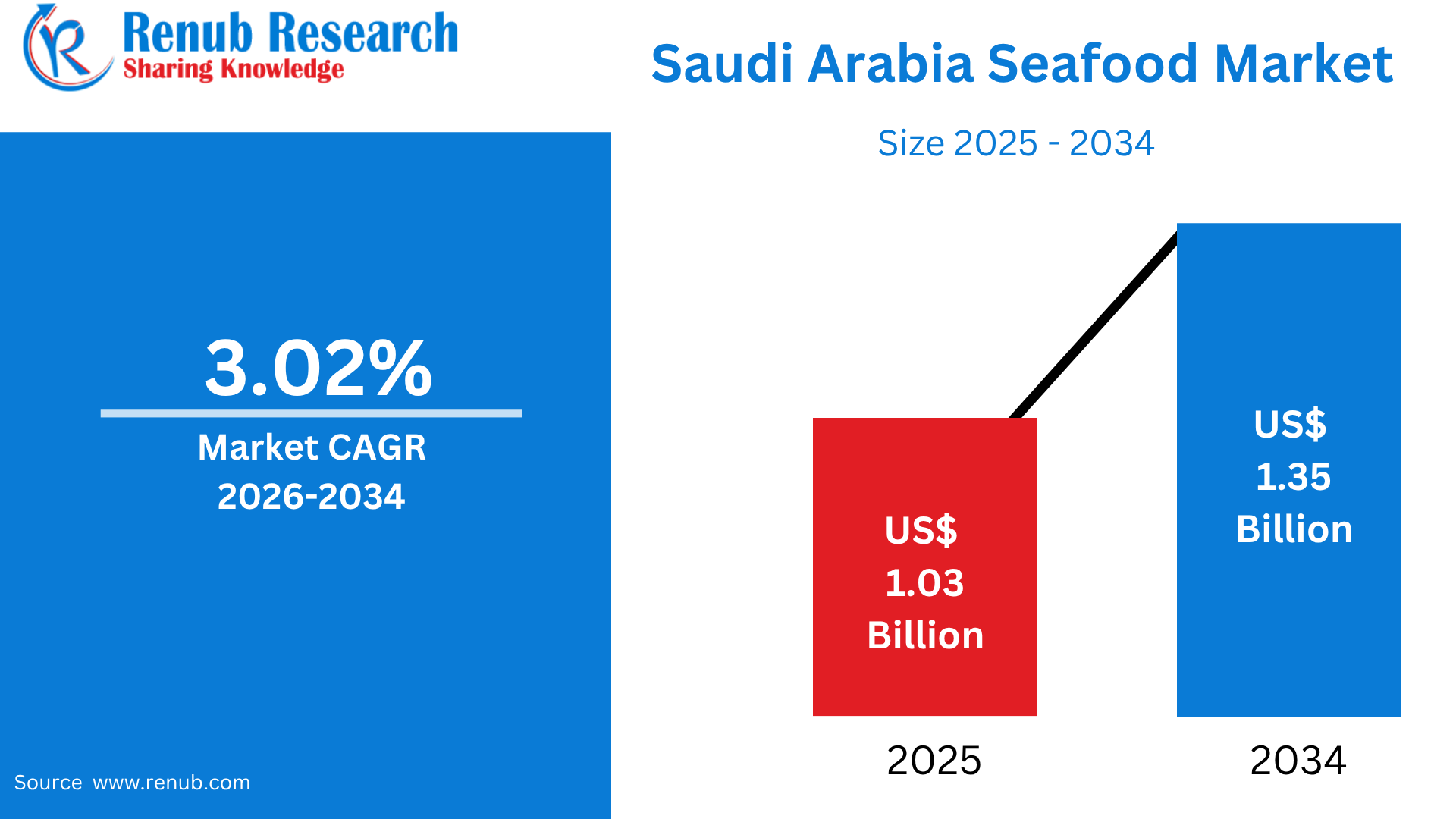
Saudi Arabia Seafood Market is projected to grow from approximately US$1.03 billion in 2025 to US$1.35 billion by 2034, representing a CAGR of 3.02% during 2026–2034. Market growth is being supported by increasing consumer awareness of the nutritional benefits of seafood, including its high-quality protein, omega-3 fatty acids, vitamins, and minerals. Growing preference for healthier and protein-rich diets is encouraging consumers to incorporate fish and other seafood products more frequently into their meals.4
What Is Seafood and Its Uses & Popularity in Saudi Arabia?
Seafood refers to edible aquatic animals and plants, primarily including fish, shrimp, prawns, crabs, lobster, squid, and other shellfish. It is an important source of high-quality protein and provides nutrients such as omega-3 fatty acids, vitamin D, vitamin B12, selenium, and iodine, making it increasingly attractive to health-conscious consumers.
In Saudi Arabia, seafood has traditionally been an important part of the diet, particularly in coastal regions along the Red Sea and Arabian Gulf. Popular varieties include shrimp, kingfish, hamour (grouper), tuna, sardines, and other locally sourced and imported species. Seafood is consumed in households and is widely served across restaurants, hotels, catering businesses, and foodservice establishments. It is prepared through grilling, frying, baking, steaming, and traditional Saudi cooking methods. Growing awareness of the health benefits of seafood, combined with rising disposable incomes, urbanization, and expanding restaurant and hospitality sectors, is increasing consumption across the Kingdom. Saudi Arabia’s investments in aquaculture and domestic fish production are also improving availability. Premium imported seafood is further expanding consumer choices, supporting the growing popularity and commercial importance of seafood nationwide.
Saudi Arabia Processed Fish Imports – 2024
- Import Value: Saudi Arabia imported approximately US$379 million worth of processed fish in 2024, making the country the 12th-largest processed fish importer globally, out of 223 importing countries.
- Import Ranking: Processed fish ranked as the 122nd most imported product in Saudi Arabia among 1,212 product categories during 2024.
- Thailand – Leading Supplier: Thailand was the largest source of processed fish imports, supplying approximately US$221 million, accounting for the majority of Saudi Arabia’s imports.
- Indonesia – Second-Largest Origin: Indonesia supplied around US$124 million worth of processed fish to Saudi Arabia, making it the second-largest supplier.
- Italy – European Supplier: Imports from Italy reached approximately US$13.1 million, highlighting Italy’s role in supplying processed seafood products to the Saudi market.
- Japan – Growing Asian Supplier: Saudi Arabia imported approximately US$6.64 million in processed fish from Japan in 2024.
- Yemen – Regional Supplier: Imports from Yemen were valued at approximately US$6.33 million, reflecting the contribution of regional suppliers to Saudi Arabia’s processed seafood trade.
Fastest-Growing Import Origins, 2023–2024
- Thailand: Imports increased by approximately US$5.37 million, representing the largest growth among the major origins.
- Japan: Imports from Japan increased by approximately US$1.89 million, indicating strengthening trade in processed seafood products.
- Latvia: Imports from Latvia recorded growth of approximately US$330,000, making it one of the fastest-growing origins during 2023–2024.
Growth Drivers of the Saudi Arabia Seafood Market
Expansion of Aquaculture and Domestic Seafood Production
The expansion of aquaculture is becoming a major growth driver for the Saudi Arabia seafood market as the Kingdom seeks to strengthen domestic food production and reduce reliance on imports. According to Saudi Arabia’s General Authority for Statistics (GASTAT), total fisheries production reached 289.9 thousand tons in 2025, up from 246.9 thousand tons in 2024. Aquaculture accounted for 192.4 thousand tons in 2025, representing approximately two-thirds of total fisheries production and a 19% increase from 2024. Shrimp was the leading aquaculture species at 86.8 thousand tons, followed by tilapia at 71.2 thousand tons and seabass at 18.8 thousand tons. Government investment initiatives are further supporting this expansion. Saudi Arabia has identified multiple aquaculture investment locations across Tabuk, Jazan, Asir, Makkah, and Madinah, with a long-term objective of increasing aquaculture production substantially by 2030. The development of modern fish farms, improved production technologies, and expanded aquaculture value chains is consequently increasing domestic seafood availability and creating a stronger foundation for market growth.
Rising Seafood Consumption and Health-Conscious Dietary Preferences
Growing awareness of seafood’s nutritional benefits is supporting demand across Saudi Arabia. Fish and shellfish provide high-quality protein, omega-3 fatty acids, vitamins, and minerals, making seafood increasingly attractive to consumers seeking healthier sources of protein. Saudi Arabia’s Ministry of Environment, Water and Agriculture highlights seafood as an important source of nutritious protein and recognizes aquaculture’s role in supplying affordable, high-quality food. Government investment assessments also indicate that Saudi seafood consumption is expected to grow at approximately 7.4% annually through 2030, with population growth and increasing per-capita consumption expected to generate an additional 500,000 tons of demand by 2030. Changing lifestyles, urbanization, increasing health awareness, and greater interest in protein-rich diets are encouraging consumers to include seafood more frequently in household meals. Demand is also expanding beyond traditional fish varieties toward shrimp, seabass, salmon, tuna, and premium imported products. The combination of nutritional awareness and rising consumption frequency is therefore expected to provide a sustained demand base for seafood retailers, processors, restaurants, and foodservice operators.
Expanding Foodservice Sector and Improved Seafood Supply Infrastructure
The development of Saudi Arabia’s restaurant, hospitality, tourism, and foodservice sectors is creating additional demand for seafood products. Seafood is widely used by hotels, restaurants, catering companies, resorts, and institutional foodservice providers, particularly as Saudi Arabia expands tourism and hospitality capacity under its economic diversification strategy. At the same time, improvements in cold-chain logistics, seafood processing, storage, transportation, and retail distribution are helping suppliers deliver fresh and frozen seafood more efficiently across the Kingdom. GASTAT reported that Saudi Arabia’s marine-product imports increased to approximately 179.9 thousand tons in 2024, compared with 162.5 thousand tons in 2023, demonstrating the importance of international supply in meeting domestic demand. Domestic supply is also strengthening: marine fisheries catch reached 97.6 thousand tons in 2025, up 14.4% from 2024, while aquaculture production increased to 192.4 thousand tons. The combination of local production, imports, modern distribution networks, and expanding foodservice outlets is improving seafood availability and supporting market expansion.
Challenges of the Saudi Arabia Seafood Market
Dependence on Imports and Supply-Chain Vulnerabilities
Despite rapid growth in domestic aquaculture, Saudi Arabia remains dependent on imported seafood to satisfy a significant portion of consumer and foodservice demand. GASTAT reported approximately 179.9 thousand tons of marine-product imports in 2024, compared with domestic aquaculture production of 161.6 thousand tons and marine capture of 85.3 thousand tons. Although domestic production is increasing rapidly, reliance on international suppliers exposes the market to fluctuations in global seafood prices, transportation costs, exchange rates, trade restrictions, and disruptions to international logistics. Seafood is also highly perishable, making temperature-controlled transportation, storage, and distribution essential for maintaining product quality and safety. Imported products must therefore move efficiently through ports, cold-storage facilities, distribution centers, and retail or foodservice channels. The expansion of domestic aquaculture can gradually reduce import dependence, but increasing consumption may simultaneously create additional demand. Saudi government assessments have previously noted that domestic consumption growth could generate 500,000 tons of additional demand by 2030, increasing the importance of strengthening local production capacity and supply-chain resilience. Managing the balance between domestic output and imports will remain a key challenge for market participants.
Environmental Constraints and High Costs of Sustainable Aquaculture
The expansion of Saudi Arabia’s seafood industry faces environmental and operational challenges, particularly because water scarcity, climate conditions, and resource management can increase the cost of aquaculture production. Saudi Arabia has limited freshwater resources, making conventional freshwater-intensive farming systems difficult to scale sustainably. The Ministry of Environment, Water and Agriculture specifically recognizes freshwater scarcity as an important consideration for aquaculture operators and emphasizes the need for efficient water-resource management. Marine and saline-water aquaculture can provide an alternative, but operators still need to manage feed costs, energy consumption, disease risks, water quality, biosecurity, and environmental impacts. Scaling production also requires significant investment in ponds, cages, hatcheries, processing facilities, cold-chain systems, and specialized technology. Although Saudi aquaculture production reached 192.4 thousand tons in 2025, a 19% year-on-year increase, maintaining rapid growth while meeting sustainability and efficiency requirements will require continued investment. Consequently, producers must balance the Kingdom’s objective of increasing seafood self-sufficiency with environmental protection, efficient resource utilization, and commercially viable production costs.
Shrimp Product Launches / New Product Introductions in Saudi Arabia
- NAQUA Nagwa Shrimp – 3 New Products | 2024 – Saudi-based National Aquaculture Group (NAQUA) announced the launch of three new shrimp products under its new “Nagwa” brand, alongside three new Red Sea Barramundi products. The launch focused on sustainable, high-quality seafood and was designed to respond to changing consumer preferences in Saudi Arabia.
- Nagwa Shrimp Product Range – New Brand Launch | 2024 – NAQUA’s strategic transformation introduced Nagwa as a new consumer-facing seafood brand, with three shrimp products forming a key part of the initial portfolio. The launch strengthened the company’s focus on branded, value-added aquaculture products.
- Saudi Farmed Shrimp – Expanded Production Availability | 2025 – Saudi aquaculture production continued expanding, with shrimp production reaching approximately 86.8 thousand tons in 2025, up from around 71.7 thousand tons in 2024. This represents an important increase in the availability of locally produced shrimp for retail and foodservice markets.
- Eastern Province Shrimp Season Products | 2024 – Saudi authorities opened the 2024 shrimp fishing season on August 1, with 710 licensed fishing boats operating along approximately 1,000 km of the Eastern Province’s Arabian Gulf coastline. The seasonal catch supplied fresh shrimp to domestic markets.
- Jazan Red Sea Shrimp Season | 2024–2025 – The shrimp fishing season in Jazan opened on September 2024, and continued for seven months through March 2025. The initiative was intended to support sustainable shrimp availability and strengthen food security in the region.
- NAQUA Locally Produced Shrimp – Retail Expansion | 2024–2025 – NAQUA’s expansion of branded shrimp products reflects the increasing commercialization of Saudi farmed seafood. The company’s Nagwa launch provides consumers with locally produced shrimp products positioned around quality and sustainability.
- Farmed Shrimp for Saudi Foodservice – Production Expansion | 2025 – The rapid growth of domestic shrimp aquaculture has increased the supply available to restaurants, hotels, catering businesses, and seafood retailers. Shrimp represented one of the largest aquaculture categories in Saudi Arabia during 2025.
- Fresh Gulf Shrimp – Eastern Province Seasonal Introduction | 2024 – The reopening of the Gulf shrimp season enabled fresh locally caught shrimp to enter Saudi seafood markets following the annual fishing restriction. The 2024 season covered major fishing ports including Jubail, Qatif, Darin Island, Manifa, and Safaniya.
- Red Sea Shrimp – Jazan Seasonal Market Supply | 2024–2025 – The Jazan fishing season provided another important source of locally caught shrimp for Saudi consumers. Authorities emphasized sustainable fishing practices to maintain shrimp stocks and ensure continued availability.
- Value-Added Saudi Shrimp Portfolio – Nagwa | 2024 – NAQUA’s three-product Nagwa shrimp launch represents the clearest recent example of value-added branded shrimp commercialization in Saudi Arabia, moving beyond commodity seafood toward consumer-oriented packaged products.
Aquaculture Expansion and Rising Consumer Shrimp Demand
Saudi Arabia Shrimp Market is expanding as shrimp becomes increasingly popular across household, retail, and foodservice channels. Shrimp is one of the Kingdom’s most important aquaculture species, with domestic production rising significantly. In 2025, Saudi Arabia produced approximately 86.8 thousand tons of shrimp through aquaculture, compared with 71.7 thousand tons in 2024, representing growth of about 21%. Marine fisheries also contributed approximately 17.9 thousand tons of shrimp catch in 2025. Shrimp is gaining popularity because of its high-quality protein content, versatility in Saudi and international cuisines, and growing presence in restaurants and premium foodservice outlets. The country’s per-capita seafood consumption is estimated at 11.7 kg, while the government aims to increase this to 20 kg by 2030, creating additional opportunities for shrimp consumption. Rising disposable incomes, urbanization, health awareness, and increasing availability of locally farmed shrimp are supporting demand. Expansion of cold-chain infrastructure and modern seafood processing is also improving year-round availability. As domestic aquaculture capacity expands, Saudi Arabia is expected to strengthen its shrimp supply while reducing dependence on imported products.
Saudi Arabia Premium Crab Consumption and Expanding Seafood Variety
Saudi Arabia Crab Market is developing as consumers increasingly seek greater variety in seafood products, particularly in restaurants, hotels, and premium foodservice establishments. Crab is positioned as a relatively premium seafood product and is commonly consumed through restaurants, seafood-specialty outlets, hotels, and catering businesses. Although crab represents a smaller portion of Saudi Arabia’s seafood production than shrimp and finfish, the country’s expanding seafood consumption base is creating opportunities for crustacean products. Saudi Arabia’s total fisheries and aquaculture production reached approximately 289.9 thousand tons in 2025, including 192.4 thousand tons from aquaculture and 97.6 thousand tons from marine fisheries. Shrimp accounted for the largest share among major aquaculture species, demonstrating the Kingdom’s growing capacity for crustacean production. Rising tourism, hospitality development, premium dining, and international cuisine are supporting demand for crab and other specialty seafood. The expansion of cold-chain logistics is also improving the availability of imported and locally sourced crab products. As consumers become more familiar with premium seafood varieties and restaurants diversify their menus, the crab segment is expected to gradually expand, particularly in major urban centers and tourism destinations.
Convenience and Longer Shelf Life Support Canned Seafood Demand
Saudi Arabia Canned Seafood Market is benefiting from increasing consumer demand for convenient, affordable, and shelf-stable protein products. Canned tuna, sardines, mackerel, and other preserved seafood products are particularly suitable for households seeking products with longer shelf lives and minimal preparation requirements. The segment benefits from Saudi Arabia’s growing urban population and changing lifestyles, which are encouraging consumers to choose convenient meal solutions. Seafood consumption in the Kingdom remains below the government’s long-term target, with per-capita consumption estimated at approximately 11.7 kg, compared with the national goal of 20 kg by 2030. This gap provides opportunities for convenient formats such as canned seafood to expand consumption. Canned products also benefit from their relatively easy storage and distribution compared with highly perishable fresh seafood. Retailers, supermarkets, hypermarkets, and online grocery platforms provide broad access to domestic and imported canned seafood brands. Rising health awareness is additionally supporting demand because canned fish provides protein and, depending on the species, omega-3 fatty acids. Product diversification, smaller convenient portions, flavored varieties, and premium canned seafood are expected to create further opportunities.
Strong Consumer Preference for Fresh Shrimps Products
Saudi Arabia Fresh and Chilled Seafood Market represents one of the strongest segments of the country’s seafood industry, supported by consumer preference for freshness, taste, texture, and minimally processed products. Fresh and chilled seafood accounted for approximately 52.3% of Saudi Arabia’s seafood market by form in 2025, demonstrating its importance within national consumption. Demand is particularly strong for fish and shrimp sold through traditional seafood markets, supermarkets, hypermarkets, specialty retailers, and foodservice outlets. Saudi Arabia’s domestic seafood supply is expanding rapidly, with total fisheries and aquaculture production reaching 289.9 thousand tons in 2025. Aquaculture alone contributed 192.4 thousand tons, increasing by 19% from 2024, while marine fisheries reached 97.6 thousand tons. Improvements in refrigerated transportation, cold-storage facilities, seafood processing, and modern retail distribution are helping maintain product quality from farms and fishing ports to consumers. Urbanization and rising household incomes are also encouraging purchases of premium fresh seafood. As cold-chain infrastructure continues to improve and domestic aquaculture expands, fresh and chilled seafood is expected to remain a dominant component of the Saudi seafood market.
Saudi Arabia Tourism, Restaurants, and Hospitality Drive Seafood Foodservice Consumption
Saudi Arabia Seafood Foodservice Market is expanding alongside the country’s rapidly developing restaurant, tourism, hospitality, and catering industries. Seafood is increasingly featured on menus ranging from traditional Saudi restaurants and seafood-specialty outlets to international restaurants, hotels, resorts, and premium dining establishments. The foodservice channel is particularly important because on-trade venues accounted for approximately 63.85% of Saudi Arabia’s seafood market revenue in 2025, according to industry estimates. The Kingdom’s expanding tourism infrastructure and development of new hospitality destinations are creating additional opportunities for seafood suppliers and distributors. At the same time, rising incomes and changing consumer preferences are increasing demand for premium seafood dishes, including shrimp, crab, salmon, lobster, and specialty fish. Saudi Arabia’s seafood consumption is also targeted for substantial expansion, with the government aiming to increase per-capita consumption from approximately 11.7 kg to 20 kg by 2030. Restaurants and hotels therefore have significant potential to contribute to this growth. Improved cold-chain logistics, centralized food distribution, and greater availability of locally farmed seafood are further supporting foodservice operators by providing more consistent supplies of fresh, chilled, and frozen products.
Riyadh Urbanization, Premium Consumption, and Modern Retail Support Seafood Growth
Riyadh Seafood Market is expanding as Saudi Arabia’s capital benefits from a large urban consumer base, relatively high purchasing power, and rapidly developing food retail infrastructure. Riyadh has a population of more than 7 million, creating a substantial customer base for seafood products across households, restaurants, hotels, and catering businesses. The city’s extensive network of hypermarkets, supermarkets, specialty seafood retailers, and online grocery platforms provides consumers with access to both locally produced and imported fish and shellfish. The growing hospitality and foodservice sectors are also increasing demand for premium seafood, particularly shrimp, salmon, tuna, lobster, and other specialty products. Riyadh’s position as the Kingdom’s principal business and commercial center further supports corporate catering and hospitality consumption. Improvements in refrigerated transportation, cold storage, and last-mile delivery are helping maintain the quality of fresh and chilled seafood transported from coastal production areas. Rising health awareness is another important factor, as consumers increasingly recognize seafood as a source of lean protein and omega-3 fatty acids. Together, population growth, purchasing power, modern retail, foodservice expansion, and improved distribution infrastructure are supporting sustained seafood market development in Riyadh.
Jeddah oastal Access and Strong Seafood Culture Strengthen Seafood Market Position
Jeddah Seafood Market benefits from the city’s strategic location on the Red Sea and its role as one of Saudi Arabia’s most important commercial and logistics centers. With a population of more than 4 million, Jeddah provides a substantial consumer base while its coastal location offers relatively direct access to locally caught seafood and imported products. The city has a strong cultural preference for fish and seafood, supporting demand across traditional fish markets, supermarkets, restaurants, hotels, and catering establishments. Jeddah’s tourism and hospitality industries further contribute to seafood consumption, with restaurants and hotels offering fresh fish, shrimp, crab, and premium international seafood varieties. Wholesale markets, cold-storage facilities, processing operations, and refrigerated transportation networks help connect suppliers with retailers and foodservice operators. The city’s large expatriate population also contributes to demand for international seafood cuisines and species. Saudi Arabia’s total fisheries and aquaculture production reached approximately 289.9 thousand tons in 2025, strengthening domestic supply availability. Continued investment in seafood processing, logistics, modern retail, and hospitality infrastructure is expected to reinforce Jeddah’s position as a major seafood consumption and distribution hub.
Dammam Port Connectivity and Eastern Province Demand Drive Seafood Expansion
Dammam Seafood Market benefits from its strategic location within Saudi Arabia’s Eastern Province and its proximity to important ports and industrial centers. Dammam, together with the wider metropolitan area, represents a major commercial and population center, creating consistent demand for seafood across households, restaurants, hotels, catering companies, and institutional buyers. Access to regional ports facilitates the movement of imported seafood, while connections with nearby fishing and aquaculture areas support domestic supply. Saudi Arabia’s aquaculture sector produced approximately 192.4 thousand tons in 2025, demonstrating the increasing availability of domestically farmed seafood for regional markets. Rising household incomes and established seafood consumption habits are supporting demand for fresh, chilled, frozen, and value-added products. The city’s expanding supermarket and hypermarket networks are making seafood more accessible, while e-commerce and grocery-delivery services are creating additional purchasing channels. Hotels, restaurants, and corporate catering operations also contribute to demand for premium seafood. Meanwhile, improvements in cold-chain transportation and storage are helping reduce spoilage and maintain product quality. Growth in convenient products, including ready-to-cook and processed seafood, is expected to create additional opportunities in Dammam.
Affluent Consumers and Premium Seafood Demand Support Dhahran Seafood Growth
Dhahran Seafood Market is supported by relatively high household purchasing power, a diverse expatriate population, and strong demand for premium food products. Dhahran forms part of the important Dammam metropolitan area, alongside Dammam and Al Khobar, creating access to a large and economically active consumer base. The city’s affluent households and international communities contribute to demand for diverse seafood products, including premium fish, shrimp, salmon, crab, lobster, and imported specialty varieties. Premium supermarkets, specialty food retailers, restaurants, hotels, and online grocery platforms provide multiple channels for purchasing seafood. Dhahran’s strong corporate presence, including major energy-sector activity, also supports demand from corporate catering, business dining, and hospitality establishments. Increasing awareness of healthy diets is encouraging consumers to select seafood as a source of high-quality protein and beneficial fatty acids. Improvements in refrigerated logistics and distribution networks help ensure regular availability of fresh, chilled, and frozen products from domestic and international suppliers. Saudi Arabia’s growing aquaculture production is further strengthening seafood availability nationwide. As premium retail, foodservice, e-commerce, and health-conscious consumption continue to develop, Dhahran is expected to remain an important high-value seafood market within the Eastern Province.
Recent Developments in Seafood Market
- January 2025: Saudi Arabia has inaugurated the Middle East’s largest salmon production facility in Hail, targeting an annual output of 100,000 tons. The project is a joint initiative between the Ministry of Environment, Water and Agriculture and King Abdulaziz University, reinforcing national efforts to expand large-scale aquaculture capabilities.
- December 2024: Almarai announced expansion plans worth USD 4.8 billion to strengthen its operations. The investment includes establishing new facilities dedicated to domestic seafood production, as well as expanding beef and lamb processing capacities to support national food security goals.
- November 2024: The Saudi Fisheries Company has launched a new aquaculture entity aimed at advancing the government’s strategy to significantly increase fish-farming output and enhance the overall sustainability of the Kingdom’s seafood sector.
Saudi Arabia Seafood Market Segments
Type
- Fish
- Shrimp
- Crab
- Lobster
- Others
Form
- Canned
- Fresh / Chilled
- Frozen
- Processed
Distribution Channel
- Supermarket/Hypermarket
- Departmental Stores
- Specialized Stores
- Institution Sales
- Food Service
- Online
- Others
Cities
- Riyadh
- Jeddah
- Dammam
- Dhahran
- Jubail
- Khobar
- Tabuk
- Mecca
- Medina
- Rest of Cities
All companies have been covered with 5 Viewpoints
- Overviews
- Key Person
- Recent Developments
- SWOT Analysis
- Revenue Analysis
Key Players Analysis
- Almunajem Foods
- Arab Fisheries Co.
- IZAFCO Fish Packing Company
- National Aquaculture Group
- Saudi Fisheries Company
- Shell Fisheries Company W.L.L.
- Tabuk Fisheries Co.
- The Savola Group
Report Details:
| Report Features | Details |
| Base Year |
2024 |
| Historical Period |
2020 - 2024 |
| Forecast Period |
2025 - 2033 |
| Market |
US$ Billion |
| Segment Covered |
By Type, By Form, By Distribution Channel and By Region |
| Region Covered |
|
| Companies Covered |
|
| Customization Scope |
20% Free Customization |
| Post-Sale Analyst Support |
1 Year (52 Weeks) |
| Delivery Format |
PDF and Excel through Email (We can also provide the editable version of the report in PPT/Word format on request) |
Key Questions Answered in This Report:
-
What is the expected market size of the Saudi Arabia Seafood Market by 2033?
-
What is the projected growth rate (CAGR) of the Saudi Arabia Seafood Market from 2025 to 2033?
-
What are the major drivers of growth in the Saudi Arabia Seafood Market?
-
How is the Saudi Arabian government supporting the growth of the seafood sector under Vision 2030?
-
What technological innovations are driving the growth of the seafood industry in Saudi Arabia?
-
How is consumer awareness of nutrition and health impacting the demand for seafood in Saudi Arabia?
-
What challenges does the Saudi Arabia Seafood Market face regarding sustainability and overfishing?
-
What is the current dependency of Saudi Arabia on seafood imports, and how is it being addressed?
-
What are the main types of seafood products in the Saudi Arabian market?
-
Which regions in Saudi Arabia are most influential in the seafood market, and why?
Customization Services available
- Analysis of Market Size and Its Segments
- More Company Profiles (Upto 10 without any additional cost):
- Additional Countries (Other than mentioned Countries):
- Region/Country Specific Reports:
- Market Entry Strategy:
- Region-Specific Market Dynamics:
- Regional Market Share Analysis:
- Trade Analysis:
- Production Insights:
- Others Customized Requests:
For more information contact our analysts.
aNeed More Assistance?
- Talk to our analysts to get more precious information on the current market trends.
- Include more countries and segments and customize the report based on the final requirement.
- Get a competitive advantage in your industry by knowing the report findings and making a positive impact on your revenues and operations.
- Our analysts are always ready to provide more help and pertinent information if you need any additional assistance.