Saudi Arabia Poultry Meat Market Report by Type, Form, Distribution Channel, Cities and Company Analysis 2026-2034
Buy NowSaudi Arabia Poultry Meat Market Analysis: Size, Share, Trends, and Forecast
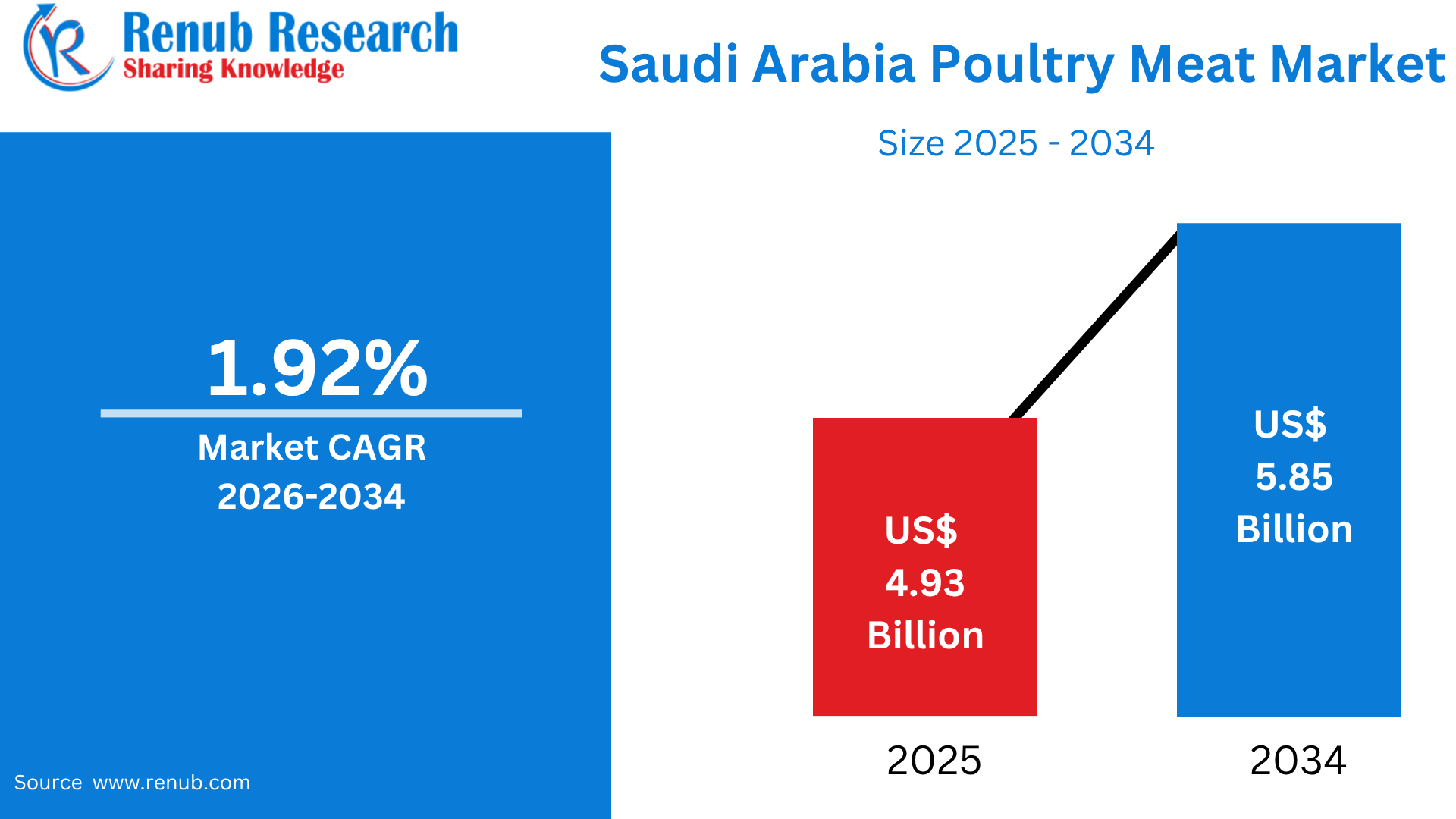
Saudi Arabia Poultry Meat Market is projected to increase from US$ 4.93 billion in 2025 to US$ 5.85 billion by 2034, expanding at a CAGR of 1.92% during the forecast period from 2026 to 2034. Market growth is supported by rising population levels, increasing demand for affordable and high-quality protein, and evolving dietary preferences favoring poultry over other meat products. Growing urbanization, higher disposable incomes, expansion of modern retail channels, and government initiatives to strengthen domestic poultry production and food security are also contributing to steady market development.
Poultry Shapes Meals, Restaurants, and Retail in Saudi Arabia
Poultry refers to domesticated birds raised primarily for meat and egg production, including chickens, turkeys, ducks, quails, and geese. In Saudi Arabia, chicken is by far the most widely consumed poultry product due to its affordability, nutritional value, versatility, and compliance with halal dietary requirements. Poultry meat is an excellent source of high-quality protein, essential amino acids, vitamins such as B6 and B12, and minerals including phosphorus and selenium, making it a staple component of balanced diets. It is widely used in households, restaurants, hotels, catering services, and fast-food chains to prepare grilled chicken, shawarma, kabsa, broasted chicken, nuggets, burgers, sandwiches, soups, and ready-to-cook meals.
Poultry enjoys widespread popularity in Saudi Arabia because of changing dietary habits, rapid urbanization, and increasing health awareness among consumers seeking lean protein alternatives to red meat. Rising disposable incomes, population growth, and the expansion of modern supermarkets and hypermarkets have improved access to fresh, frozen, and processed poultry products throughout the Kingdom. The foodservice sector, including quick-service restaurants and international fast-food brands, continues to drive substantial poultry consumption. Additionally, government initiatives aimed at increasing domestic poultry production and improving food security have strengthened local supply. The growing demand for convenient, value-added, and halal-certified poultry products is expected to further support the popularity and long-term growth of the Saudi Arabian poultry market.
Saudi Arabia Poultry Sector
Saudi Arabia’s poultry sector has experienced strong and sustained growth over the past decade, driven by increasing domestic demand, government investment, and advancements in modern farming technologies. According to the Ministry of Environment, Water and Agriculture (MEWA), the Kingdom produced more than 900,000 metric tons of poultry meat in 2023, with production continuing to increase in 2024 to meet rising consumption. Poultry remains the country’s most widely consumed source of animal protein due to its affordability, nutritional value, and widespread acceptance in halal diets. Population growth, rapid urbanization, and expansion of the foodservice industry have further strengthened market demand.
As part of Saudi Vision 2030, the government has prioritized food security by increasing domestic poultry production and reducing reliance on imports. The Kingdom aims to achieve approximately 80% poultry self-sufficiency, compared with nearly 70% in 2023, through continued investments in modern poultry farms, hatcheries, feed mills, automated processing facilities, and cold-chain infrastructure. Government subsidies, financing programs, and public-private partnerships have encouraged producers to adopt advanced breeding technologies, biosecurity measures, and efficient production systems. These initiatives are improving productivity, enhancing supply chain resilience, and positioning Saudi Arabia’s poultry industry for sustainable long-term growth.
Growth Driver
Rising Population and Increasing Poultry Consumption
Saudi Arabia’s growing population and changing food consumption patterns continue to drive demand for poultry meat. With the Kingdom’s population exceeding 38 million people, poultry remains the country’s most consumed animal protein due to its affordability, nutritional value, and wide availability. Industry estimates indicate that chicken accounts for over 70% of total meat consumption in Saudi Arabia, significantly exceeding beef and lamb consumption. Urbanization, a young population, and rising disposable incomes have encouraged higher consumption of fresh, frozen, and processed poultry products. Quick-service restaurants, supermarkets, and food delivery platforms have further expanded consumer access to poultry-based meals. Poultry is widely used in traditional dishes such as kabsa, shawarma, grilled chicken, and broasted chicken, supporting year-round demand. Government efforts to strengthen domestic food security and increase self-sufficiency in poultry production have also boosted local investments. Continued population growth, expanding retail distribution, and increasing consumer preference for lean protein are expected to sustain long-term market growth.
Government Support for Domestic Production and Food Security
Saudi Arabia’s Vision 2030 strategy has significantly accelerated investments in domestic poultry production to improve food security and reduce reliance on imports. The government has introduced financial incentives, agricultural subsidies, and modernization programs to expand local poultry farming capacity. Industry estimates suggest that domestic producers now supply approximately 70–80% of national poultry demand, with further increases targeted over the coming years. Investments in automated poultry farms, modern hatcheries, feed production facilities, and advanced processing plants have improved productivity and operational efficiency. Biosecurity measures, veterinary healthcare programs, and improved breeding technologies have also strengthened production quality. Large poultry companies continue expanding production capacity to meet growing domestic consumption while reducing import dependency. The expansion of cold-chain logistics, refrigerated transportation, and modern processing facilities ensures improved product quality and nationwide distribution. These government initiatives are expected to enhance long-term market stability and support sustainable growth across Saudi Arabia’s poultry meat industry.
Expansion of Foodservice and Processed Poultry Products
The rapid growth of Saudi Arabia’s foodservice industry has become a major driver for poultry meat consumption. Quick-service restaurants (QSRs), casual dining chains, hotels, catering companies, and cloud kitchens rely heavily on poultry because of its affordability, versatility, and consumer acceptance. Industry estimates indicate that more than 60% of fast-food menu items in the Kingdom feature chicken-based products, including burgers, fried chicken, shawarma, wraps, nuggets, and grilled meals. Demand for processed and value-added poultry products such as marinated chicken, ready-to-cook portions, frozen meals, and breaded products is also increasing due to changing lifestyles and rising demand for convenience foods. Modern retail outlets continue expanding refrigerated and frozen poultry product offerings, improving accessibility for consumers. Food delivery applications and online grocery platforms further support poultry sales through convenient home delivery services. Continuous expansion of tourism, hospitality, and restaurant investments is expected to generate sustained demand for poultry products throughout the forecast period.
Challenge
Feed Cost Volatility and Rising Production Expenses
One of the major challenges facing the Saudi Arabia poultry meat market is the fluctuation in feed prices and overall production costs. Poultry production depends heavily on imported feed ingredients such as corn and soybean meal, which represent approximately 60–70% of total production costs. Changes in global commodity prices, transportation costs, currency fluctuations, and supply chain disruptions directly affect production profitability. Rising energy costs, labor expenses, veterinary services, and biosecurity investments further increase operational expenditures for poultry producers. Small and medium-sized farms often face greater financial pressure because they have limited purchasing power compared with large integrated producers. Although government support programs help offset some costs, maintaining affordable poultry prices while protecting producer margins remains challenging. Investments in feed efficiency, automation, local feed production, and improved farming technologies will be essential for minimizing production costs and maintaining long-term competitiveness.
Disease Risks and Import Competition
Disease outbreaks and competition from imported poultry products continue to present significant challenges for Saudi Arabia’s poultry industry. Avian influenza and other poultry diseases can disrupt production, reduce flock sizes, and increase biosecurity expenditures for producers. Preventive vaccination programs, continuous veterinary monitoring, and strict farm hygiene protocols require ongoing investment throughout the production chain. In addition, imported poultry products from major global exporters increase competitive pressure by offering lower-cost alternatives during periods of supply shortages. Although Saudi Arabia has expanded domestic production, imported poultry continues to contribute a meaningful share of market supply in certain product categories. Maintaining consistent quality, competitive pricing, and adequate production capacity remains essential for local producers. Strengthening disease surveillance systems, improving farm management practices, investing in advanced breeding technologies, and expanding local production efficiency will be critical for supporting sustainable growth and enhancing the resilience of the Saudi Arabian poultry meat market.
Poultry Meat Product Launches in Saudi Arabia
- November 2025 – Al-Watania Poultry launched a new range of antibiotic-free fresh whole chicken and chicken cuts, targeting health-conscious consumers seeking premium halal poultry products.
- October 2025 – Tanmiah Food Company introduced Ready-to-Cook Marinated Chicken Fillets in multiple Arabic and international flavors, designed for quick meal preparation.
- August 2025 – Almarai expanded its poultry portfolio with Fresh Chicken Breast Portions and Boneless Thigh Fillets, featuring improved vacuum packaging for extended freshness.
- June 2025 – A’Saffa Foods launched Frozen Breaded Chicken Burgers and Chicken Nuggets across Saudi retail chains, targeting the growing convenience food segment.
- April 2025 – BRF – Sadia introduced a premium range of Halal Frozen Chicken Wings and Drumsticks with resealable family-size packaging for supermarkets and hypermarkets.
- January 2025 – Sunbulah Group expanded its frozen food portfolio by launching Ready-to-Cook Chicken Meatballs and Chicken Kofta, aimed at households and foodservice operators.
- October 2024 – Americana Foods launched Premium Breaded Chicken Strips and Popcorn Chicken, offering high-protein convenience meals for retail and quick-service restaurant customers.
- July 2024 – Al-Watania Poultry introduced Fresh Organic Chicken Products, including whole chicken and premium cuts produced under enhanced animal welfare and sustainability standards.
- March 2024 – Tanmiah Food Company launched Fresh Chicken Sausages and Chicken Meatballs, expanding its value-added processed poultry product portfolio in Saudi Arabia.
- January 2024 – Sadia (BRF) released its Frozen Ready-to-Grill Chicken Range, including marinated whole chicken, drumsticks, and mixed grill selections tailored for Middle Eastern consumer preferences.
Strong Domestic Production and Rising Protein Consumption Drive Saudi Arabia Poultry Meat
Saudi Arabia Poultry Meat Market is one of the fastest-growing segments of the country’s food industry, supported by increasing domestic consumption, government food security initiatives, and expanding local production capacity. Poultry, particularly chicken, accounts for more than 70% of total meat consumption in Saudi Arabia because of its affordability, nutritional benefits, and compliance with halal dietary standards. Population growth exceeding 38 million, rapid urbanization, and rising disposable incomes continue to strengthen demand for fresh, chilled, frozen, and processed poultry products. Under the Vision 2030 program, the government has prioritized increasing poultry self-sufficiency through investments in modern poultry farms, automated processing facilities, hatcheries, and feed production. Industry estimates indicate that domestic producers supply approximately 70–80% of national poultry demand, reducing dependence on imports. Expansion of supermarkets, cold-chain logistics, and digital grocery platforms has further improved product accessibility. Growing consumer preference for lean protein and healthier diets is expected to support sustained growth in the Saudi poultry meat market.
Growing Demand for Premium Lean Protein in Saudi Arabia
Saudi Arabia Turkey Meat Market represents a niche but steadily expanding segment within the country’s poultry industry. Although turkey consumption remains considerably lower than chicken, rising health awareness and changing dietary preferences are gradually increasing market demand. Turkey meat contains lower fat and calorie levels while providing high-quality protein, making it increasingly attractive among fitness-conscious consumers. Industry estimates suggest that turkey products account for less than 5% of total poultry meat consumption, with demand concentrated in premium retail outlets, hotels, restaurants, and catering services. Imported turkey continues to dominate market supply because domestic production remains limited. Processed turkey products, including sliced deli meat, sausages, smoked turkey, and ready-to-cook products, are becoming increasingly available in supermarkets and hypermarkets. Seasonal demand also rises during festive celebrations, international events, and hospitality activities. Although higher retail prices compared with chicken remain a limiting factor, expanding premium food retail and growing health-conscious consumer segments are expected to support gradual long-term market growth.
Consumer Preference for Fresh Quality in Saudi Arabia
Saudi Arabia Fresh and Chilled Poultry Meat Market continues to dominate poultry consumption due to strong consumer preference for freshness, taste, and perceived product quality. Industry estimates indicate that fresh and chilled poultry accounts for nearly 60–65% of total retail poultry sales, supported by widespread availability through supermarkets, hypermarkets, neighborhood grocery stores, and specialty meat retailers. Local poultry producers benefit from government initiatives promoting domestic production, improved biosecurity standards, and investment in modern processing facilities. Advanced cold-chain logistics, refrigerated transportation, and automated packaging technologies have significantly improved product safety, freshness, and shelf life. Consumers increasingly choose chilled poultry for preparing traditional Saudi dishes, family meals, and restaurant menus. Rising health awareness has further strengthened demand for minimally processed, preservative-free poultry products. Modern retail expansion and improvements in nationwide distribution networks ensure consistent product availability across both urban and semi-urban markets. Continued investments in domestic production and cold-chain infrastructure are expected to support steady growth in this segment.
Reliable Supply and Long Shelf Life Supports Frozen Poultry Meat in Saudi Arabia
Saudi Arabia Frozen Poultry Meat Market plays an essential role in maintaining year-round product availability and supporting national food security. Frozen poultry products remain highly popular because of their affordability, extended shelf life, convenient storage, and consistent supply throughout the Kingdom. Industry estimates suggest that frozen products represent approximately 35–40% of total poultry consumption, serving both household and foodservice customers. Imports continue to supplement domestic production, particularly during periods of peak demand. Significant investments in cold storage facilities, refrigerated transportation, and advanced freezing technologies have improved product quality while preserving nutritional value. Restaurants, hotels, catering companies, and quick-service restaurant chains rely heavily on frozen poultry because of inventory management efficiency and cost control. Consumers also increasingly purchase frozen poultry in bulk through supermarkets and wholesale outlets for household convenience. Continued modernization of cold-chain logistics and growing demand for convenient protein products are expected to strengthen long-term market expansion.
Rising Demand for Value-Added Poultry Meatballs in Saudi Arabia
Saudi Arabia Poultry Meatballs Market is expanding steadily as consumer demand shifts toward convenient, ready-to-cook, and value-added food products. Poultry meatballs, primarily manufactured using chicken and occasionally turkey, have become popular ingredients for pasta dishes, sandwiches, pizzas, soups, and Middle Eastern cuisine. Industry estimates indicate that processed poultry products account for approximately 15–20% of value-added poultry sales, with continued growth expected due to changing lifestyles and urbanization. Working professionals, smaller households, and younger consumers increasingly prefer convenient meal solutions requiring minimal preparation time. Food manufacturers continue introducing healthier formulations featuring lower fat content, reduced sodium, natural ingredients, and preservative-free recipes to meet evolving consumer preferences. Modern supermarkets, hypermarkets, and online grocery platforms have expanded product availability nationwide. The rapid growth of food delivery services and quick-service restaurants further supports demand for processed poultry products. Continued product innovation and expanding convenience food consumption are expected to drive sustained growth in the poultry meatballs segment.
Saudi Arabia Modern Retail Driving Product Accessibility
Saudi Arabia Poultry Meat in Supermarkets and Hypermarkets Market represents the country’s primary retail distribution channel for fresh, chilled, frozen, and processed poultry products. Modern retail outlets account for over 60% of organized poultry retail sales, offering consumers extensive product selection, competitive pricing, and reliable quality assurance. Leading supermarket and hypermarket chains continue expanding across major cities, improving nationwide product availability. Retailers prioritize food safety through temperature-controlled storage, hygienic handling practices, traceability systems, and clear halal certification labeling. Promotional campaigns, loyalty programs, bundled offers, and private-label poultry brands further encourage consumer purchases while improving affordability. Growing adoption of online grocery shopping and home delivery services has strengthened omnichannel retail strategies, allowing consumers to purchase poultry conveniently through digital platforms. Investments in refrigerated logistics, automated inventory management, and premium fresh food sections continue enhancing customer experience. The expansion of organized retail and digital commerce is expected to remain a key driver supporting Saudi Arabia’s poultry meat market growth.
Riyadh Largest Poultry Meat Consumer Hub Driven by Urban Population
Riyadh represents the largest poultry meat market in Saudi Arabia, supported by a population exceeding 8 million residents, high urbanization, and strong household purchasing power. As the Kingdom’s political, financial, and commercial center, Riyadh accounts for an estimated 30–35% of Saudi Arabia’s organized poultry retail sales. Chicken remains the primary source of animal protein due to its affordability, halal certification, and versatility in traditional dishes such as kabsa, shawarma, grilled chicken, and broasted meals. The city benefits from an extensive distribution network comprising supermarkets, hypermarkets, neighborhood grocery stores, wholesale markets, and rapidly expanding online grocery platforms. The foodservice sector—including hotels, restaurants, cafés, catering companies, and international quick-service restaurant chains—continues to generate substantial demand for fresh, chilled, frozen, and processed poultry products. Government initiatives supporting domestic poultry production, modern processing facilities, and cold-chain logistics have strengthened product availability. Rising health awareness and increasing demand for premium, antibiotic-free, and value-added poultry products are expected to support sustained market growth across Riyadh.
Commercial Gateway Supporting Diverse Poultry Consumer Demand in Jeddah
Jeddah Poultry Meat Market continues to expand steadily, supported by its position as Saudi Arabia’s principal commercial port city and one of the Kingdom’s largest metropolitan areas with a population of more than 4.5 million people. Jeddah serves as a major gateway for international trade, tourism, and religious visitors traveling to Makkah, creating consistent demand for poultry products across multiple consumer segments. Industry estimates indicate that Western Saudi Arabia contributes nearly one-quarter of national poultry consumption, with Jeddah representing the region’s largest market. Poultry products are widely consumed in Saudi, Middle Eastern, Asian, and Western cuisines served through thousands of restaurants, hotels, cafés, and catering establishments. Modern supermarkets, wholesale distributors, and online grocery platforms ensure broad product availability throughout the city. Imported frozen poultry supplements domestic production, while growing demand for convenient ready-to-cook and processed poultry products continues to expand. Ongoing tourism growth, hospitality investments, and retail modernization are expected to sustain long-term expansion of Jeddah’s poultry meat market.
Dhahran Poultry Meat Consumption Supported by High Income Levels
Dhahran Poultry Meat Market is characterized by relatively smaller population size but exceptionally strong purchasing power, supported by its strategic role in Saudi Arabia’s energy sector. Home to numerous multinational companies and highly skilled professionals, Dhahran demonstrates above-average demand for premium poultry products, including fresh, organic, antibiotic-free, and value-added offerings. Industry estimates suggest that premium poultry products account for a larger share of retail sales in Dhahran than the national average, reflecting consumers’ preference for high-quality food products. Supermarkets, specialty food retailers, and premium grocery chains offer extensive selections of chilled, frozen, marinated, and ready-to-cook poultry. Growing health awareness has accelerated demand for lean protein products with clean-label ingredients and enhanced food safety standards. Restaurants, business hotels, corporate catering services, and expatriate communities further contribute to stable poultry consumption. Continued residential development, rising disposable incomes, and expanding premium retail infrastructure are expected to support sustained growth in Dhahran’s poultry meat market.
Industrial Growth and Modern Retail Supporting Dammam Poultry Meat Market Expansion
Dammam Poultry Meat Market is experiencing healthy growth due to rapid industrial development, expanding residential communities, and increasing consumer demand across the Eastern Province. With a metropolitan population exceeding 1.5 million residents, Dammam serves as one of Saudi Arabia’s most important commercial and logistics centers. Its strategic proximity to major ports, industrial zones, and neighboring Gulf Cooperation Council (GCC) countries supports efficient poultry distribution and supply chain operations. Industry estimates indicate that the Eastern Province represents approximately 20% of Saudi Arabia’s organized poultry retail market. Poultry remains the preferred protein source for households because of its affordability, nutritional value, and convenience. Modern supermarkets, hypermarkets, traditional markets, and digital grocery platforms provide consumers with extensive access to fresh, chilled, frozen, and processed poultry products. The city’s expanding hospitality, restaurant, and catering industries continue generating strong commercial demand. Government support for domestic poultry production, investments in cold-chain logistics, and continuous retail expansion are expected to maintain steady long-term growth in the Dammam poultry meat market.
Saudi Arabia Poultry Meat Industry Segments
Type
• Chicken
• Turkey
• Duck
• Other
Form
• Canned
• Fresh / Chilled
• Frozen
• Processed
1. Deli Meats
2. Marinated/ Tenders
3. Meatballs
4. Nuggets
5. Sausages
6. Other Processed Poultry
Distribution Channel
• Convenience Stores
• Online Channel
• Supermarkets and Hypermarkets
• Others
Cities
- Riyadh
- Jeddah
- Dammam
- Dhahran
- Jubail
- Khobar
- Tabuk
- Mecca
- Medina
- Rest of Cities
All companies have been covered with 5 Viewpoints
- Overviews
- Key Person
- Recent Developments
- SWOT Analysis
- Revenue Analysis
Key Players Analysis
1. Al-Watania Poultry
2. Almarai Food Company
3. Almunajem Foods
4. Americana Group
5. BRF S.A.
6. Golden Chicken Farm Factory Company CJSC
7. Sunbulah Group
8. Tanmiah Food Company
9. The Savola Group
Report Details:
| Report Features | Details |
| Base Year |
2024 |
| Historical Period |
2020 - 2024 |
| Forecast Period |
2025 - 2033 |
| Market |
US$ Billion |
| Segment Covered |
By Type, By Form and By Distribution Channel |
| Companies Covered |
|
| Customization Scope |
20% Free Customization |
| Post-Sale Analyst Support |
1 Year (52 Weeks) |
| Delivery Format |
PDF and Excel through Email (We can also provide the editable version of the report in PPT/Word format on request) |
Key Questions Answered in This Report:
-
What is the projected size of the Saudi Arabia Poultry Meat market by 2033?
-
What is the compound annual growth rate (CAGR) for the Saudi Poultry Meat market from 2025 to 2033?
-
Which segment of poultry meat is most prominent in Saudi Arabia: chicken, turkey, or duck?
-
What are the main factors driving the growth of the Saudi Poultry Meat market?
-
How does the Saudi government support the poultry meat industry?
-
What is the significance of halal certification in the Saudi Poultry Meat market?
-
How much of Saudi Arabia's poultry production was domestic in 2022?
-
Which foreign companies have invested in the Saudi poultry meat industry recently?
-
What challenges does the Saudi poultry industry face in terms of competition?
-
Which distribution channels are most prominent for poultry meat in Saudi Arabia?
Customization Services available
- Analysis of Market Size and Its Segments
- More Company Profiles (Upto 10 without any additional cost):
- Additional Countries (Other than mentioned Countries):
- Region/Country Specific Reports:
- Market Entry Strategy:
- Region-Specific Market Dynamics:
- Regional Market Share Analysis:
- Trade Analysis:
- Production Insights:
- Others Customized Requests:
For more information contact our analysts.
Need More Assistance?
- Talk to our analysts to get more precious information on the current market trends.
- Include more countries and segments and customize the report based on the final requirement.
- Get a competitive advantage in your industry by knowing the report findings and making a positive impact on your revenues and operations.
- Our analysts are always ready to provide more help and pertinent information if you need any additional assistance.