Saudi Arabia Hotel Market Size, Share, Growth, Trends, Industry Analysis & Forecast 2026–2034
Buy NowSaudi Arabia Hotel Market Size
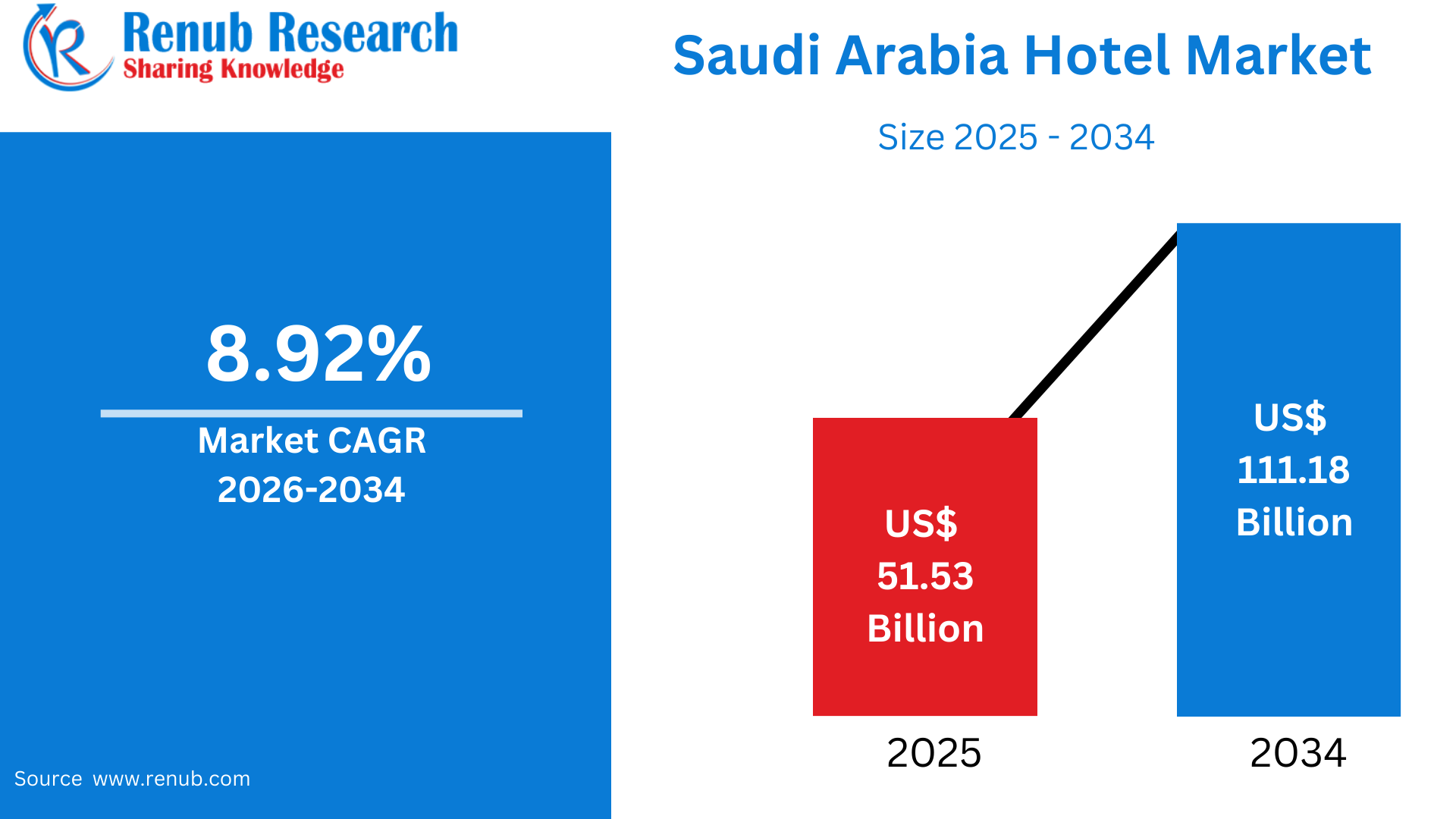
Saudi Arabia Hotel Market is projected to expand from US$ 51.53 billion in 2025 to US$ 111.18 billion by 2034, registering a CAGR of 8.92% during the forecast period (2026–2034). Market growth is being fueled by the rapid expansion of religious and leisure tourism, ambitious government investments under Vision 2030, rising international tourist arrivals, large-scale global events such as Expo 2030 and Riyadh Season, and increasing demand for premium as well as mid-range hospitality accommodations.
Saudi Arabia Hotel Industry Overview
The Saudi Arabia hotel market comprises lodging establishments ranging from budget and midscale hotels to luxury resorts, serviced apartments, and boutique accommodations. Hotels cater to religious tourism in Makkah and Madinah, business travel in Riyadh, and leisure tourism across the Red Sea and coastal regions. Growth is fueled by increasing international visitor arrivals, mega-events, and government initiatives promoting tourism under Vision 2030. Hotels focus on modern amenities, smart booking systems, and hospitality experiences tailored to international and domestic travelers. Investments in infrastructure, hotel chains, and integrated resorts are expanding capacity and diversifying offerings, strengthening the country’s hospitality sector.
The Saudi Arabia hotel market is primarily driven by the rise in religious tourism, particularly Hajj and Umrah pilgrimages, which generate high occupancy in Makkah and Madinah. Leisure and business travel are growing due to economic diversification under Vision 2030, including the development of mega-projects such as NEOM and the Red Sea resorts. Government initiatives supporting tourism infrastructure, visa facilitation, and global marketing campaigns are increasing international arrivals. Additionally, mega-events like Riyadh Season, Formula E, and Expo 2030 attract significant visitors. Rising disposable incomes and a growing domestic travel culture also support demand for midscale and luxury hotels, further boosting market expansion.
Hotel Industry in Saudi Arabia
Saudi Arabia’s hotel industry encompasses a diverse portfolio of accommodation options, including budget hotels, midscale properties, luxury resorts, serviced apartments, boutique hotels, and integrated hospitality developments. The sector serves a wide range of travelers, from millions of religious pilgrims visiting Makkah and Madinah to corporate travelers in Riyadh and leisure tourists exploring destinations along the Red Sea, AlUla, and other emerging tourism hubs. Supported by Vision 2030, the hospitality industry is witnessing significant transformation through large-scale investments in infrastructure, international hotel brands, and mixed-use tourism projects. Hotels are increasingly adopting digital booking platforms, smart hospitality technologies, and personalized guest experiences to meet the evolving expectations of both domestic and international visitors. As accommodation capacity continues to expand, the market is becoming more diversified and globally competitive.
Saudi Arabia’s hotel market is experiencing strong momentum, largely driven by the continued growth of religious tourism, with the annual Hajj and Umrah pilgrimages generating consistently high hotel occupancy rates in the country’s holy cities. At the same time, business and leisure travel are accelerating as economic diversification initiatives under Vision 2030 stimulate investments in landmark developments such as NEOM, The Red Sea Project, Diriyah Gate, and Qiddiya. Government efforts to simplify visa procedures, enhance transportation infrastructure, and promote Saudi Arabia as a global tourism destination are attracting an increasing number of international visitors. Major entertainment and sporting events, including Riyadh Season, Formula E, international conferences, and the upcoming Expo 2030, are further strengthening hotel demand across multiple regions. In addition, rising disposable incomes, a growing preference for domestic tourism, and increasing demand for luxury, upscale, and midscale accommodations are creating new opportunities for hotel operators, reinforcing the long-term growth prospects of Saudi Arabia’s hospitality industry.
Major Hotel Chain Investments & Acquisitions/Partnerships in Saudi Arabia
- Marriott International × Al Qimmah Hospitality (2026)
-
- Partnership to develop 5 new hotels across Jeddah, Makkah, and Madinah.
- Investment will add 2,700+ hotel rooms under JW Marriott, Four Points by Sheraton, Element Hotels, and Four Points Flex by Sheraton.
- Marriott International × Taiba Investment
-
- Signed a management agreement for a Marriott Hotel at STC Square, Riyadh.
- The project includes 159 guestrooms and forms part of Riyadh’s mixed-use development strategy.
- Hilton × Dan Company
-
- Strategic agreement to develop three Hilton-branded properties in Al Ahsa.
- Supports Saudi Arabia’s tourism expansion and Vision 2030 objectives.
- Hilton Saudi Arabia Expansion
-
- Hilton announced plans to exceed 100 hotels operating or in the pipeline across Saudi Arabia.
- Expansion spans luxury, lifestyle, full-service, and midscale brands, creating over 15,000 jobs.
- IHG Hotels & Resorts × Ashaad Company
-
- Signed an agreement for three hotels:
-
- Hotel Indigo Jeddah Gate
- InterContinental Al Khobar Al Hamra
- voco Al Khobar Al Andalus
- The development adds approximately 1,700 rooms to IHG’s Saudi portfolio.
- IHG Hotels & Resorts × Refad
-
- Partnership to develop Hotel Indigo & Residences Al Khobar.
- The project includes 200+ hotel rooms and serviced apartments supported by the Tourism Development Fund (TDF).
- IHG Hotels & Resorts × Koushan Real Estate
-
- Signed a dual-brand agreement introducing Saudi Arabia’s first:
-
- Kimpton Hotel
- EVEN Hotel
- Located within King Abdullah Sports City, Jeddah.
- IHG Hotels & Resorts × SEDCO Capital
-
- Management agreement for Hotel Indigo Grand Square Jeddah.
- The 150-room lifestyle hotel is part of the Grand Square mixed-use development.
- Accor Expansion with AMSA Hospitality
-
- Accor entered a multi-city development partnership with AMSA Hospitality.
- The agreement supports the rollout of multiple Accor brands across Saudi Arabia as part of its long-term expansion strategy.
- Accor Strategic Projects in Saudi Arabia
- Accor announced major investment partnerships for:
-
- Rua Al Madinah Project
- Master-planned Riyadh Development
- Additional mixed-use hospitality projects.
Hotels Opened or Opening in Saudi Arabia
- The Chedi Hegra – AlUla
-
- Opened in December 2024
- Luxury heritage hotel located within the UNESCO World Heritage Site of Hegra, blending archaeology with premium hospitality.
- Desert Rock Resort – The Red Sea
-
- Opened in December 2024
- A luxury resort built into the mountains, featuring cliffside villas and sustainable architecture.
- Shebara Resort – The Red Sea
-
- Opened in November 2024
- Ultra-luxury island resort featuring futuristic overwater and beachfront villas.
- Four Points by Sheraton Riyadh
-
- Opened in 2025
- A 132-room business hotel offering meeting facilities, fitness amenities, and skyline views.
- The Red Sea EDITION – The Red Sea
-
- Expected opening: 2025
- EDITION Hotels’ first property in Saudi Arabia, offering luxury beachfront accommodations.
- Equinox Resort AMAALA
-
- Expected opening: 2025
- Luxury wellness resort with a world-class spa, fitness club, marina, and wellness-focused experiences.
- Miraval The Red Sea
-
- Expected opening: 2025/2026
- Premium wellness retreat on Shura Island focused on holistic health, mindfulness, and luxury experiences.
- W Riyadh – KAFD
-
- Opened in 2026
- The first W Hotel in Saudi Arabia, located in Riyadh’s King Abdullah Financial District, targeting luxury business travelers.
- Holiday Inn Jeddah Al Naseem
-
- Scheduled to open in 2026
- A 222-room hotel developed by IHG to serve business and leisure travelers in Jeddah.
- Four Seasons Resort at The Red Sea (Shura Island)
-
- Expected opening: 2025
- Luxury beachfront resort offering private villas, premium dining, wellness facilities, and Red Sea experiences.
Growth Drivers for the Saudi Arabia Hotel Market
Rising Religious Tourism in Makkah and Madinah
Religious tourism continues to be the cornerstone of Saudi Arabia’s hotel industry, with millions of Muslims visiting Makkah and Madinah every year for Hajj and Umrah pilgrimages. These religious journeys create sustained demand for hotels across luxury, midscale, and budget categories, particularly during peak pilgrimage seasons when occupancy rates approach full capacity. To accommodate the growing number of pilgrims, the Saudi government is investing extensively in airport expansions, high-speed rail networks, road infrastructure, and hospitality developments surrounding the holy cities. Hotels are also enhancing guest experiences through multilingual services, transportation packages, digital check-in, and customized pilgrimage assistance. The increasing availability of online booking platforms and international travel partnerships further simplifies travel planning for pilgrims worldwide. As Saudi Arabia continues expanding its capacity to host more religious visitors each year, pilgrimage tourism remains a long-term catalyst for hotel market growth.
Vision 2030 and Government-Led Tourism Development
Saudi Arabia’s Vision 2030 program has become a transformative force for the hospitality sector by positioning tourism as a key pillar of economic diversification. Massive investments in world-class tourism destinations such as NEOM, The Red Sea Project, Diriyah Gate, Qiddiya, and AlUla are creating substantial opportunities for hotel developers and global hospitality brands. The government’s introduction of tourist e-visas, infrastructure modernization, destination marketing campaigns, and investment-friendly regulations has significantly improved the country’s appeal to international travelers. Public-private partnerships are encouraging renowned hotel operators to establish new properties, while improved transportation networks and smart city initiatives enhance visitor accessibility across the Kingdom. In addition, domestic tourism campaigns, cultural festivals, and hospitality workforce development programs are strengthening occupancy rates and service quality. These strategic initiatives are expected to support sustainable long-term expansion of Saudi Arabia’s hotel market.
Expansion of Mega-Events, Business Travel, and Leisure Tourism
Saudi Arabia’s growing calendar of international events is significantly increasing demand for hotel accommodations across the Kingdom. High-profile attractions such as Riyadh Season, Expo 2030, Formula E, international sporting competitions, exhibitions, and business conferences continue to attract millions of domestic and overseas visitors. At the same time, business travel is expanding rapidly due to increasing foreign investment, corporate headquarters, financial districts, and commercial developments in cities including Riyadh, Jeddah, and Dammam. Leisure tourism is also flourishing as travelers explore Red Sea resorts, luxury island destinations, heritage sites, desert experiences, and entertainment hubs. To meet evolving customer expectations, hotels are introducing flexible booking options, premium hospitality services, wellness facilities, and integrated entertainment experiences. The combination of business, leisure, and event-driven tourism is generating year-round occupancy growth and encouraging both domestic and international hotel brands to expand their presence across Saudi Arabia.
Challenges in the Saudi Arabia Hotel Market
Seasonal Demand Variations and Capacity Management
Despite robust long-term growth, Saudi Arabia’s hotel market continues to face challenges related to seasonal demand fluctuations. Hotel occupancy reaches exceptionally high levels during the Hajj and Umrah seasons, creating temporary shortages in accommodation and increasing operational pressure. However, occupancy can decline considerably during off-peak periods, particularly in pilgrimage-focused destinations, making it difficult for operators to maintain stable revenue throughout the year. Managing staffing requirements, room inventory, pricing strategies, and operational costs across varying demand cycles remains a significant challenge. Hotel operators must balance capacity expansion with long-term profitability while developing strategies to attract leisure and business travelers beyond religious tourism seasons. Diversifying tourism offerings and promoting year-round events are becoming increasingly important to reduce seasonal dependence and improve hotel utilization.
Intensifying Competition and Regulatory Requirements
The rapid expansion of Saudi Arabia’s hospitality sector has intensified competition among domestic operators and international hotel brands. To remain competitive, hotels must continuously differentiate themselves through superior guest experiences, innovative amenities, digital services, sustainability initiatives, and competitive pricing strategies. At the same time, compliance with Saudi Arabia’s hospitality regulations, labor policies, environmental standards, and cultural guidelines increases operational complexity. Hotels are required to maintain high service standards while respecting local customs and religious considerations, requiring ongoing investment in employee training and operational excellence. Smaller independent hotels often face greater challenges in meeting these evolving standards and competing with globally recognized brands. As new hotel developments continue to enter the market, maintaining profitability while ensuring regulatory compliance and exceptional customer satisfaction will remain a critical challenge for the industry.t
Saudi Arabia Luxury Hospitality Driven by Premium Tourism and Global Investments
The Saudi Arabia high-end hotel market is witnessing robust growth, supported by the country’s transformation into a global tourism and business destination under Vision 2030. Luxury hotels are expanding rapidly across Riyadh, Jeddah, Makkah, Madinah, AlUla, and the Red Sea coast, catering to affluent leisure travelers, corporate executives, international tourists, and VIP religious pilgrims. High-end properties differentiate themselves through personalized concierge services, world-class dining, wellness and spa facilities, premium suites, smart room technologies, and exclusive hospitality experiences. The development of mega-projects such as NEOM, The Red Sea Project, Diriyah Gate, and Qiddiya is creating strong demand for internationally branded luxury accommodations. Major entertainment festivals, sporting events, and business conferences further increase occupancy throughout the year. Sustainability initiatives, eco-luxury resorts, and digitally enhanced guest experiences are becoming important competitive advantages. As international visitor numbers continue to rise, the premium hotel segment is expected to remain one of the fastest-growing categories within Saudi Arabia’s hospitality industry, supported by rising investment, higher tourism spending, and expanding luxury travel demand.
Saudi Arabia Mid-Scale Affordable Accommodation Supporting Business, Religious, and Domestic Tourism
The Saudi Arabia mid-scale hotel market is expanding steadily as demand grows for quality accommodation that combines affordability with modern amenities. Midscale hotels primarily serve business travelers, domestic tourists, families, and millions of Hajj and Umrah pilgrims seeking comfortable yet cost-effective lodging. Cities such as Riyadh, Jeddah, Makkah, Madinah, and Dammam are witnessing increasing development of branded midscale properties due to rising occupancy and year-round travel activity. These hotels typically offer spacious rooms, complimentary Wi-Fi, business facilities, restaurants, fitness centers, and convenient transportation access while maintaining competitive pricing. The expansion of domestic tourism, improved road and airport infrastructure, and government initiatives promoting regional tourism continue to strengthen demand. International hotel chains are also increasing their presence in this segment by introducing standardized services and digital booking capabilities. As travelers become more value-conscious without compromising on quality, the mid-scale hotel segment is expected to experience sustained growth, making it an attractive investment opportunity within Saudi Arabia’s evolving hospitality landscape.
Saudi Arabia Digital Booking Platforms Transforming the Hospitality Industry
The Saudi Arabia online hotel market is growing rapidly as digital technologies reshape the way travelers search, compare, and book accommodations. Increasing smartphone penetration, high internet usage, secure digital payment systems, and widespread adoption of travel applications have accelerated the shift toward online hotel reservations. Consumers increasingly prefer digital platforms because they provide instant price comparisons, customer reviews, virtual property tours, flexible cancellation policies, and exclusive promotional offers. Hotel operators are investing in user-friendly websites, mobile applications, AI-powered customer support, and personalized booking experiences to strengthen direct online sales and improve customer engagement. Online travel agencies and hotel booking platforms also play a significant role in expanding market reach by connecting domestic and international travelers with a wide range of accommodation options. The growth of business travel, leisure tourism, religious pilgrimages, and international events further supports online booking demand. As Saudi Arabia continues its digital transformation under Vision 2030, online hotel bookings are expected to account for an increasingly larger share of total hotel reservations, driving efficiency, convenience, and long-term market growth.
Makkah Hotel Market
Makkah remains the heart of Saudi Arabia’s religious tourism industry, welcoming millions of pilgrims each year for Hajj and Umrah. The city’s hotels experience exceptionally high occupancy during pilgrimage seasons, with strong demand spanning luxury, upscale, midscale, and budget accommodations. Continuous government investments in airport expansions, high-speed transportation, road infrastructure, and hospitality developments have significantly enhanced the visitor experience and increased accommodation capacity. Hotels are increasingly offering value-added services such as multilingual customer support, shuttle transportation to the Holy Mosque, digital concierge solutions, and customized pilgrimage assistance. Although demand is highly seasonal, operators effectively manage occupancy through dynamic pricing strategies and flexible capacity planning. Supported by consistent pilgrim arrivals and ongoing infrastructure development, Makkah continues to attract significant investments from both domestic and international hotel brands, reinforcing its position as Saudi Arabia’s largest and most important hospitality market.
Riyadh Hotel Market
Riyadh has emerged as Saudi Arabia’s leading business and commercial hospitality destination, driven by its role as the Kingdom’s political, financial, and corporate center. Strong demand for business, luxury, and upscale hotels is fueled by multinational companies, government institutions, international conferences, exhibitions, and corporate events. Major attractions such as Riyadh Season, global sporting events, and entertainment festivals have further strengthened leisure tourism, increasing hotel occupancy throughout the year. Hotels in Riyadh are investing in advanced conference facilities, executive lounges, wellness amenities, and smart hospitality technologies to meet the expectations of modern business travelers. Vision 2030 initiatives continue to enhance urban infrastructure, transportation connectivity, and tourism offerings, making the city increasingly attractive to international visitors. As competition intensifies, hotel operators are focusing on personalized guest experiences, digital innovation, and premium services to maintain market leadership, while year-round business travel continues to support sustained investment across both luxury and midscale hotel segments.
Madinah Hotel Market
Madinah represents one of Saudi Arabia’s most significant religious tourism destinations, attracting millions of pilgrims visiting the Prophet’s Mosque throughout the year. Hotel demand reaches its highest levels during the Hajj season, Ramadan, and other religious occasions, while occupancy moderates during off-peak periods. The city’s hospitality sector includes a broad range of accommodations, from affordable hotels serving budget-conscious pilgrims to internationally recognized luxury properties catering to premium travelers. Ongoing investments in airport modernization, transportation infrastructure, and urban development have improved accessibility and enhanced the overall visitor experience. Hotels continue to strengthen their service offerings by providing multilingual staff, guided religious tours, shuttle transportation, and personalized pilgrimage services. Despite seasonal fluctuations, Madinah remains one of the Kingdom’s most profitable hotel markets, supported by steady religious tourism and increasing investments from local and international hospitality companies. Growing demand for affordable accommodations alongside premium hospitality services is expected to drive further market expansion.
Jeddah Hotel Market
Jeddah serves as one of Saudi Arabia’s most dynamic hospitality markets, functioning as the primary gateway for international visitors, business travelers, and pilgrims traveling to Makkah. The city offers a diverse hotel landscape that includes luxury beachfront resorts, business hotels, serviced apartments, boutique accommodations, and internationally branded properties. Growing tourism along the Red Sea coastline, waterfront redevelopment projects, and expanding leisure attractions are significantly boosting demand for hotel rooms. Jeddah’s strategic location, supported by King Abdulaziz International Airport, one of the region’s busiest airports, and its major seaport, strengthens connectivity for both domestic and international travelers. Business conferences, trade exhibitions, and cultural events continue to generate strong corporate travel demand, while luxury resorts and coastal developments attract high-end leisure tourists. Increasing market competition is encouraging hotels to invest in innovative guest experiences, premium amenities, digital technologies, and personalized hospitality services. The city’s unique combination of business, leisure, transit, and pilgrimage-related travel positions Jeddah as a key growth engine for Saudi Arabia’s expanding hotel industry.
Recent Developments in Saudi Arabia Hotel Market
- August 2025: The Hospitality Network (THN), a leading platform connecting key decision-makers in the hospitality and real estate sectors, announced its expansion into Saudi Arabia. The new Riyadh hub aims to foster strategic collaborations, facilitate industry discussions, and offer tailored solutions to help stakeholders navigate the country’s rapidly evolving hospitality and real estate landscape.
- July 2025: Hilton signed its first Tapestry Collection by Hilton property in Saudi Arabia—the 221-room Diyar Ajwa in Madinah—scheduled to open in late 2025.
- July 2025: IDS Next completed over 50 hotel installations in Saudi Arabia. Its ERP solutions were customized for multi-property management, complex integrations, regulatory compliance, and multi-language support, meeting the needs of both the local workforce and international clients.
- May 2025: IHG partnered with Ashaad Company to develop three properties in Jeddah and Al Khobar, adding over 1,700 rooms, with expected completions between 2028 and 2030.
- May 2025: Wyndham and Le Park Concord unveiled a decade-long plan to develop 100 Super 8 hotels, with the first properties slated for delivery in 2026.
- April 2025: HMH announced expansions in Al Khobar and Makkah, including a flagship 460-room project in the holy city.
- October 2024: The New Murabba Development Company, part of Saudi Arabia’s Public Investment Fund, confirmed its platinum sponsorship of the Future Hospitality Summit in Dubai (September 30 – October 2). CEO Michael Dyke revealed plans for a 27 million sqm development featuring 18 communities, over 100,000 housing units, 9,000 hotel rooms, and the Mukaab, a 400-meter cubic building blending contemporary Najdi architecture with advanced digital technologies.
Market Segmentation
Hotel Type
- High End Hotel
- Mid-Scale Hotel
- Budget Hotel
Ordering Platform
- Online
- Offline
Region
- Makkah
- Riyadh
- Madinah
- Jeddah
- Al Khobar
- Dammam
All companies have been covered with 5 Viewpoints
- Overview
- Key Person
- Recent Development
- SWOT Analysis
- Revenue Analysis
Company Analysis
- Dur Group
- IHG Group
- Marriot International
- Accor
- Hilton Hotels
- Al Hokair Group
- Altyaar Group
Report Details:
| Report Features | Details |
| Base Year |
2025 |
| Historical Period |
2022 - 2025 |
| Forecast Period |
2026 - 2034 |
| Market |
US$ Billion |
| Segment Covered |
Hotel Type, Ordering Platform and Region |
| Region Covered |
|
| Companies Covered |
|
| Customization Scope |
20% Free Customization |
| Post-Sale Analyst Support |
1 Year (52 Weeks) |
| Delivery Format |
PDF and Excel through Email (We can also provide the editable version of the report in PPT/Word format on request) |
Key Questions Answered in Report:
- How big is the Saudi Arabia Hotel industry?
- What is the Saudi Arabia Hotel growth rate?
- Who are the key players in Saudi Arabia Hotel industry?
- What are the factors driving the Saudi Arabia Hotel industry?
- Which Region held the largest market share in the Saudi Arabia Hotel industry?
- What segments are covered in the Saudi Arabia Hotel Market report?
Customization Services available
- Analysis of Market Size and Its Segments
- More Company Profiles (Upto 10 without any additional cost):
- Additional Countries (Other than mentioned Countries):
- Region/Country Specific Reports:
- Market Entry Strategy:
- Region-Specific Market Dynamics:
- Regional Market Share Analysis:
- Trade Analysis:
- Production Insights:
- Others Customized Requests:
For more information contact our analysts.
Need More Assistance?
- Talk to our analysts to get more precious information on the current market trends.
- Include more countries and segments and customize the report based on the final requirement.
- Get a competitive advantage in your industry by knowing the report findings and making a positive impact on your revenues and operations.
- Our analysts are always ready to provide more help and pertinent information if you need any additional assistance.