Russia Spices and Seasonings Market Report by Product, Application, City and Company Analysis 2026-2034
Buy NowRussia Spices and Seasonings Market Size & Forecast
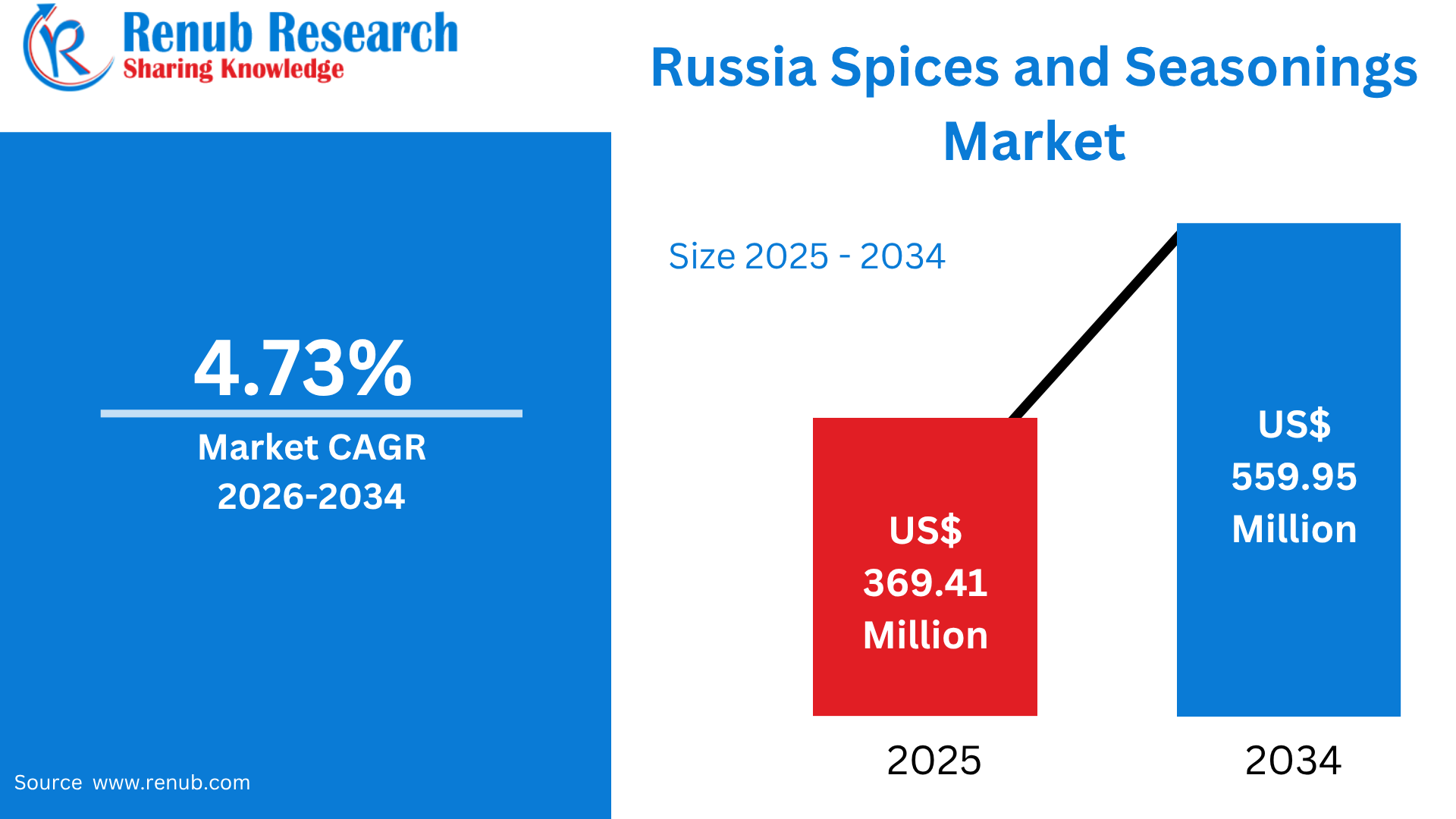
Russia Spices and Seasonings Market is projected to grow from approximately US$369.41 million in 2025 to US$559.95 million by 2034, registering a CAGR of 4.73% during the 2026–2034 forecast period. Market expansion is being supported by changing consumer preferences, increasing interest in diverse cuisines, urbanization, and the growing use of spices and seasonings in processed food manufacturing. Rising demand for convenient and ready-to-eat foods is encouraging food manufacturers to incorporate a broader range of flavors into packaged meals, snacks, sauces, and instant-food products.
What are Spices and Seasonings and Their Uses & Popularity Worldwide
Spices and seasonings are natural or processed ingredients used to enhance the flavor, aroma, color, and sometimes preservation of food. Spices generally come from seeds, fruits, roots, bark, or other plant parts, including pepper, cumin, turmeric, cinnamon, ginger, and paprika, while seasonings can include blended spices, herbs, salt, and flavor-enhancing ingredients. They are extensively used in household cooking, restaurants, foodservice, processed foods, sauces, snacks, meat products, bakery items, frozen meals, beverages, and ready-to-eat foods.
Russia Spices and Seasonings popularity is increasing worldwide as consumers explore international cuisines and seek convenient products with distinctive flavors. In Russia, spices are used in traditional dishes as well as increasingly popular international cuisines, while ready-to-use blends are gaining acceptance among convenience-oriented consumers. Growing interest in natural ingredients, functional foods, ethnic flavors, and premium seasonings is further strengthening their worldwide popularity.
India–Russia Spice Trade in 2026: Expanding Export Opportunities Amid Trade and Payment Shifts
India’s exports to Russia reached approximately US$4.88 billion in FY2025, highlighting Russia’s growing importance as a potential diversification market for Indian exporters. The opportunity is particularly relevant for the spice industry as exporters seek to reduce excessive dependence on traditional markets, including the United States, which accounts for around 15–16% of India’s total spice exports.
Rupee–Rouble Settlement Creates New Trade Opportunities
The development of alternative payment mechanisms has the potential to reduce one of the major barriers to India–Russia trade. Rupee–rouble settlement arrangements and Special Rupee Vostro Accounts (SRVAs) provide Indian exporters and Russian buyers with mechanisms for conducting transactions without relying exclusively on U.S. dollar-based payments. Alternative settlement options, including Chinese yuan transactions in some trade channels, may also provide additional flexibility.
Russia Offers Scope for Indian Spice Exporters
Russia’s changing trade relationships and reduced dependence on some European suppliers could create opportunities for Indian producers of pepper, ginger, turmeric, cumin, coriander, chili, spice blends, and processed seasoning products. Growing demand from food processors, restaurants, hotels, catering businesses, retailers, and packaged-food manufacturers could further expand the addressable market.
Industry representatives have also encouraged Indian exporters to diversify toward Russia, Africa, and Southeast Asia to reduce concentration in established markets. For exporters targeting Russia, successful market entry will depend on competitive pricing, consistent quality, appropriate product specifications, certification compliance, reliable logistics, and suitable payment arrangements. GOST-R and other applicable Russian food-safety and conformity requirements should be evaluated carefully for each product and shipment before commercialization.
Growth Drivers of the Russia Spices and Seasonings Market
Rising Demand for Diverse and International Flavors
Changing consumer preferences and increasing interest in international cuisines are creating strong opportunities for Russia’s spices and seasonings market. Russian consumers are increasingly experimenting with flavors associated with Asian, Middle Eastern, Mediterranean, and other international cuisines, increasing demand for products such as turmeric, cumin, paprika, ginger, cinnamon, and exotic spice blends. Research indicates that growing consumer demand for diverse culinary experiences is one of the major factors supporting this expansion. Social media, food blogs, cooking programs, restaurants, and international food trends are also exposing consumers to new recipes and flavor combinations. At-home cooking is contributing to the trend as consumers purchase specialty spices to reproduce restaurant-style and international dishes. Premium, organic, natural, and preservative-free products are also gaining attention. This shift from traditional seasonings toward broader flavor portfolios is encouraging manufacturers to introduce blended products, ethnic seasoning mixes, and application-specific formulations for meat, snacks, sauces, bakery products, and ready meals.
Expansion of Processed and Convenience Foods
The expansion of Russia’s processed and convenience food industry is a significant driver for spices and seasonings because manufacturers depend on flavoring systems to improve taste, aroma, consistency, and product differentiation. Ready-to-eat meals, frozen foods, instant noodles, sauces, snacks, processed meat, and meal kits frequently use customized spice blends and seasoning systems. Faster-paced urban lifestyles are also encouraging consumers to choose convenient foods that require less preparation time. Research on the Russian market highlights expanding processed-food production and rising demand for ready-to-eat and frozen meals as important contributors to spice consumption. Food manufacturers are increasingly developing distinctive flavor profiles to differentiate products and respond to changing consumer preferences. Demand for pre-mixed and ready-to-use seasonings is consequently increasing because these products simplify food preparation while delivering consistent taste. Continued development of supermarkets, convenience stores, food delivery, and modern food-processing facilities is expected to strengthen industrial demand for spices and seasonings throughout Russia.
Growth of Retail, E-Commerce, and Natural Ingredient Preferences
Improving retail distribution and increasing consumer interest in natural and healthier ingredients are supporting the Russian spices and seasonings market. Supermarkets, hypermarkets, specialty food stores, and online platforms are providing consumers with greater access to domestic and imported spices, premium blends, and specialty products. Research indicates that improved retail distribution, including e-commerce, is contributing to market expansion in Russia. At the same time, consumers are becoming more interested in natural ingredients and functional foods, encouraging demand for spices perceived to offer nutritional or wellness benefits. Ingredients such as ginger, garlic, turmeric, and cinnamon are increasingly incorporated into everyday diets because of their association with health and natural-food trends. Russia’s government also approved an organic agriculture strategy in 2024, supporting the broader development of organic production and standards. The global spices and seasonings market is similarly benefiting from increasing demand for natural flavors and health-oriented products. For Russian manufacturers, these trends create opportunities to develop organic, clean-label, minimally processed, traceable, and premium spice products. Expansion of online grocery shopping can further increase geographic reach, allowing specialty products to reach consumers beyond major urban centers.
Challenges of the Russia Spices and Seasonings Market
Fluctuating Raw-Material Prices and Supply-Chain Risks
Dependence on imported spices and exposure to international commodity markets create challenges for the Russian spices and seasonings industry. Many important spices, including pepper, cumin, turmeric, cinnamon, and cardamom, require climatic conditions that are not widely available domestically, making international sourcing important. Fluctuations in global crop production, transportation costs, exchange rates, energy prices, and geopolitical conditions can therefore influence procurement costs. Industry research specifically identifies fluctuating prices caused by supply-chain disruptions and geopolitical factors as a restraint for the Russian market. Transportation and logistics challenges can be particularly significant for imported spices because products often travel long distances from producing countries before reaching Russian processors and retailers. Supply disruptions can increase wholesale prices and make it difficult for manufacturers to maintain stable margins. Smaller processors may be more vulnerable because they generally have less purchasing power and limited ability to maintain large inventories. Companies are responding through supplier diversification, longer-term procurement agreements, inventory management, and greater use of domestic processing and packaging capabilities. However, continued volatility in international agricultural markets and logistics conditions could remain a challenge for the market, particularly for premium and exotic spices that depend heavily on imports.
Food-Safety Regulations, Quality Control, and Product Availability
Strict food-safety requirements and quality standards represent another challenge for the Russian spices and seasonings market. Spices can be vulnerable to contamination, adulteration, excessive residues, microbial contamination, and inconsistent quality during cultivation, transportation, processing, and storage. Manufacturers and importers therefore need robust testing, traceability, packaging, and quality-control systems to comply with food-safety requirements. Industry research identifies strict regulations and quality standards affecting imports, along with limited availability of certain exotic spices, as important market restraints. Imported products may require additional documentation, testing, and compliance procedures, increasing costs and potentially extending supply timelines. Quality variation can also create problems for food manufacturers that require consistent flavor, color, aroma, and potency in industrial seasoning formulations. At the same time, consumer demand for natural, organic, and minimally processed products increases the need for transparent sourcing and reliable certification. These requirements can raise operational costs, particularly for small and medium-sized businesses. Manufacturers are therefore investing in advanced testing, supplier verification, traceability systems, improved processing technologies, and better packaging. Strengthening quality infrastructure can improve consumer confidence, but compliance costs and limited availability of certain specialty spices may continue to constrain market development.
Spices and Seasonings Product Launches & New Product Developments in Russia
- Miratorg Natural Spice Mixes – January 2024: Russian meat producer Miratorg expanded its portfolio with new natural spice blends developed for semi-finished meat products and ready-to-eat foods, responding to demand for distinctive flavors and convenient meal solutions.
- Aidigo New Spice & Seasoning Lines – February 2024: Russian spice company Aidigo presented new products and collections at the 31st ProdExpo exhibition in Moscow, alongside a new brand identity and expanded product portfolio.
- ND Prime Vitaroma – January 2025: Nord Ingredients launched ND Prime Vitaroma, a new range of flavoring solutions designed to enhance the taste profiles of different food products and provide manufacturers with additional flavor-development options.
- Dorot Gardens Fresh-Frozen Herbs & Garlic – October 2024: Dorot Gardens introduced an updated brand identity and an expanded range of fresh-frozen, pre-portioned herbs and garlic, including products available in the Russian market.
- Arikon Universal “20 Vegetables and Herbs” Seasoning – 2026: Russian producer Arikon lists its “20 Vegetables and Herbs” universal seasoning in its 2026 product catalogue. The product is supplied in a 90 g doypack format, targeting convenient everyday cooking.
- Arikon Mulled Wine Seasoning – 2026: Arikon’s 2026 catalogue includes a dedicated mulled-wine seasoning, supplied in a 30 g mini doypack. The product reflects demand for ready-made spice blends for specialty beverages and seasonal consumption.
- Arikon Premix Black Peppercorns – 2026: The company expanded its Premix range with 100 g black peppercorns, targeting both retail consumers and food-preparation applications. Arikon reports that its overall portfolio exceeds 500 SKUs across spices, seasonings, grocery products, and instant foods.
- Arikon Premix Ground Black Pepper – 2026: Arikon’s Premix portfolio also includes 100 g ground black pepper, providing a convenient ready-to-use format for household and foodservice applications.
- Natural Spice Blends for Ready-to-Eat Meat Products – 2024: Miratorg’s R&D team developed custom natural spice combinations specifically for semi-prepared meat and ready-to-eat products, illustrating the increasing use of application-specific seasoning formulations in Russia’s convenience-food sector.
- Expanded Imported Spice Supply from India – 2024: Although not a single-brand product launch, India’s tea, coffee, and spice exports to Russia increased 1.5 times in August 2024, expanding the availability of imported spices and seasonings in the Russian market. In 2024, pepper accounted for 57.2% of Russia’s spice and seasoning imports by volume, highlighting its importance to product development and retail offerings.
Rising Interest in Healthy and Natural Herbs
Herbs play an important role in Russia’s culinary culture, combining traditional cooking practices with growing interest in international cuisines. Commonly used herbs such as dill, parsley, bay leaves, and thyme are incorporated into soups, stews, meat, fish, sauces, and salads. Increasing consumer awareness of healthy eating is encouraging demand for both fresh and dried herbs, particularly products perceived as natural and minimally processed. Herbs are also increasingly associated with antioxidant and digestive-health benefits, supporting their appeal among health-conscious consumers. Organic and sustainably produced herbs are gaining attention as consumers become more interested in clean-label ingredients. Home cooking is another important contributor, supported by the growing availability of recipes through social media, television, and online cooking platforms. Supermarkets and grocery retailers are also expanding their herb selections, including packaged dried herbs, herb blends, and premium varieties.
Black Pepper Remains a Household Staple
Pepper is one of the most widely used spices in Russia, with black pepper serving as a staple ingredient in household kitchens, restaurants, and food-processing operations. It is commonly added to soups, meat dishes, sauces, marinades, salads, and prepared foods to provide heat and flavor. Alongside conventional black pepper, demand for white pepper, red pepper, chili varieties, and specialty pepper blends is increasing as consumers become more interested in international cuisines and stronger flavor profiles. The foodservice sector is also contributing to demand for high-quality pepper products as restaurants and fast-food outlets seek consistent seasoning solutions. Urban consumers are increasingly attracted to premium products, including freshly ground pepper and specialty blends. Russia’s large urban population provides a significant customer base for packaged and convenience-oriented spice products. Manufacturers are responding by offering grinders, refill packs, blended seasonings, and application-specific products for meat and poultry. The expanding packaged-food industry further supports industrial consumption. As consumers experiment with different cuisines and flavors, premium, convenient, and ready-to-use pepper products are expected to gain additional market share.
Mediterranean Cuisine Boosts Oregano Consumption
Oregano is gaining popularity in Russia as consumers increasingly explore Italian, Mediterranean, and international cuisines. The herb is widely associated with pizza, pasta sauces, salads, marinades, grilled meat, and vegetable dishes, making it an increasingly familiar ingredient among younger and urban consumers. Dried oregano is particularly popular because it offers a distinctive aroma, convenient storage, affordable pricing, and a long shelf life. The growing popularity of international restaurants, food-delivery services, and packaged foods is exposing consumers to oregano-based flavor profiles. Russia’s foodservice sector and expanding home-cooking culture are therefore contributing to demand. Social media, recipe websites, cooking videos, and television programs are also encouraging consumers to recreate international dishes at home. The global spices and seasonings market is projected to expand significantly through the end of the decade, reflecting broader consumer interest in international flavors and specialty seasonings. Within Russia, manufacturers and retailers are capitalizing on this trend by offering oregano in individual packs, mixed Italian seasonings, and premium herb blends. Continued interest in international recipes is expected to support steady oregano consumption.
Premium Positioning Limits Mass-Market Penetration
Cardamom occupies a premium position in Russia’s spices market because of its distinctive aroma, complex flavor, and relatively high price. It is used in bakery products, confectionery, flavored teas, coffee, desserts, and Middle Eastern-inspired dishes. Growing consumer interest in specialty beverages and gourmet foods is creating opportunities for cardamom, particularly among affluent urban consumers and specialty-food enthusiasts. Cafés and tea shops offering exotic beverages and premium tea blends are also helping increase awareness of the spice. Cardamom is additionally associated with traditional wellness benefits, including digestive support, which can appeal to consumers interested in natural ingredients. However, its relatively high price and reliance on imports limit broader household adoption compared with more affordable spices such as black pepper, coriander, and paprika. Global cardamom production is concentrated in countries such as India and Guatemala, making Russian availability sensitive to international supply conditions, transportation costs, and currency fluctuations. Retailers are increasingly offering smaller packages to make premium spices more accessible. Despite its niche position, growing interest in gourmet cooking, specialty beverages, and international cuisine is expected to sustain demand for cardamom among premium consumers.
Processed Meat and Barbecue Culture Drive Demand
Meat and poultry seasonings represent an important application area within Russia’s spices and seasonings industry. Popular ingredients include garlic, black pepper, paprika, coriander, mustard, cumin, and chili, which are used to enhance grilled, roasted, fried, smoked, and marinated meat products. The expansion of processed meat, ready-to-cook foods, and foodservice is creating additional demand for standardized seasoning blends. Convenience is becoming particularly important, with consumers increasingly purchasing pre-mixed seasonings that provide consistent flavor without requiring multiple individual spices. Supermarkets, restaurants, fast-food chains, and food-delivery businesses are also supporting consumption. Russia’s processed meat industry represents a substantial downstream market, with meat and poultry products forming an important component of household food consumption. Manufacturers are responding with specialized blends designed for chicken, beef, pork, barbecue, kebabs, sausages, and grilled foods. Premium and natural seasonings are gaining attention as consumers increasingly seek recognizable ingredients and fewer artificial additives. International flavor influences are also encouraging the development of spicy, smoky, Mediterranean, Asian, and regional blends. Continued convenience-food consumption and product innovation are expected to support growth in meat and poultry seasonings.
Convenience and Preservation Support Frozen Herb Products
Russia’s frozen spices and seasonings segment is benefiting from increasing consumer demand for convenience, freshness, longer shelf life, and ready-to-use ingredients. Frozen garlic, ginger, basil, parsley, dill, and mixed-herb cubes provide consumers with convenient alternatives to fresh ingredients while helping preserve flavor and aroma. The expansion of ready-to-cook meals, frozen foods, meal kits, and quick-preparation recipes is creating additional opportunities for frozen seasoning products. Retailers are responding by expanding frozen-food sections and introducing convenient portion-controlled formats. Improvements in freezing, packaging, and cold-chain technologies are also helping manufacturers maintain product quality and reduce waste. Frozen herbs can be particularly attractive to urban consumers who cook at home but want ingredients that can be stored for longer periods. In October 2024, Dorot Gardens introduced a refreshed brand identity and expanded its range of fresh-frozen, pre-portioned herbs and garlic across global markets. Product formats such as frozen cubes and measured portions align closely with the growing convenience trend. As Russian consumers increasingly seek easy meal-preparation solutions, frozen herbs and seasonings are expected to gain greater visibility across supermarkets, modern retail channels, and online grocery platforms.
Moscow-Led Urban Consumption Supports Central Russia Growth
Central Russia, particularly the Moscow metropolitan area and surrounding regions, represents one of the country’s most important markets for spices and seasonings. High population density, relatively strong purchasing power, urban lifestyles, and diverse culinary preferences create substantial demand for both mainstream and premium spice products. The region benefits from a combination of domestic production and imported spices, providing consumers with access to products ranging from traditional Russian herbs to international blends. The concentration of restaurants, hotels, foodservice chains, supermarkets, hypermarkets, and specialty food retailers further strengthens consumption. Moscow’s large foodservice and hospitality ecosystem creates demand for bulk spices, standardized seasoning blends, and premium ingredients. At the household level, increasing interest in international cuisines is encouraging consumers to experiment with products such as paprika, oregano, curry blends, turmeric, and specialty peppers. Online grocery shopping and food-delivery services are also expanding access to premium and niche products. Central Russia is therefore expected to remain a major consumption and distribution hub.
Traditional Cuisine and Food Processing Drive Volga District Demand
Volga District represents another significant regional market for spices and seasonings, supported by its diverse culinary traditions, large urban centers, and expanding food-processing sector. Cities such as Kazan, Nizhny Novgorod, Samara, and Ufa contribute substantially to regional consumption through household cooking, restaurants, food manufacturers, and retail channels. Spices are traditionally used in meat dishes, pickled foods, soups, sauces, and preserved products, creating a stable base of demand for products such as black pepper, coriander, mustard, paprika, garlic, dill, and mixed seasonings. The region’s food-processing industry further increases demand for standardized and bulk seasoning formulations used in processed meat, snacks, sauces, and convenience foods. Expanding supermarket and hypermarket networks are improving consumer access to both domestic and imported spices. Rising disposable incomes and greater exposure to international cuisines are also encouraging consumers to experiment with new flavors and premium products. The broader Russian processed-food sector is expected to remain an important end-use market for seasonings as demand for convenient foods increases. In addition, growth in restaurants, cafés, delivery services, and ready-to-eat foods is supporting commercial consumption. Consequently, the Volga District is positioned as an important growth market for packaged, blended, and application-specific spices and seasonings.
Russia Spices and Seasonings Market Segments
Product
Salt and Salt Substitutes
Herbs
- Thyme
- Basil
- Oregano
- Parsley
- Others
Spices
- Pepper
- Cardamom
- Cinnamon
- Clove
- Nutmeg
- Others
Application
- Meat and Poultry Products
- Snacks and Convenience Food
- Soups, Sauces and Dressings
- Bakery and Confectionery
- Frozen Products
- Beverages
- Others
Top City
- Moscow
- Saint Petersburg
- Novosibirsk
- Yekaterinburg
- Kazan
- Nizhny
- Chelyabinsk
All companies have been covered with 5 Viewpoints
- Overviews
- Key Person
- Recent Developments
- SWOT Analysis
- Revenue Analysis
Key Players Analysis
- MTK LTD
- ARTA GROUP LLC
- UNITED SPICES LTD
- Fuchs Group
- Ariake
- Euroma
- Nielsen-Massey
- De Ruijter
- McCormick
- MDH Spices
Report Details:
| Report Features | Details |
| Base Year |
2024 |
| Historical Period |
2020 - 2024 |
| Forecast Period |
2025 - 2033 |
| Market |
US$ Million |
| Segment Covered |
Product, Application and Region |
| Region Covered |
|
| Companies Covered |
|
| Customization Scope |
20% Free Customization |
| Post-Sale Analyst Support |
1 Year (52 Weeks) |
| Delivery Format |
PDF and Excel through Email (We can also provide the editable version of the report in PPT/Word format on request) |
Customization Services available
- Analysis of Market Size and Its Segments
- More Company Profiles (Upto 10 without any additional cost):
- Additional Countries (Other than mentioned Countries):
- Region/Country Specific Reports:
- Market Entry Strategy:
- Region-Specific Market Dynamics:
- Regional Market Share Analysis:
- Trade Analysis:
- Production Insights:
- Others Customized Requests:
For more information contact our analysts.
Need More Assistance?
- Talk to our analysts to get more precious information on the current market trends.
- Include more countries and segments and customize the report based on the final requirement.
- Get a competitive advantage in your industry by knowing the report findings and making a positive impact on your revenues and operations.
- Our analysts are always ready to provide more help and pertinent information if you need any additional assistance.