Global Prostate Cancer Diagnostics Market Report by Type, Test Type, End User, Countries and Company Analysis 2026-2034
Buy NowGlobal Prostate Cancer Diagnostics Market Size & Forecast
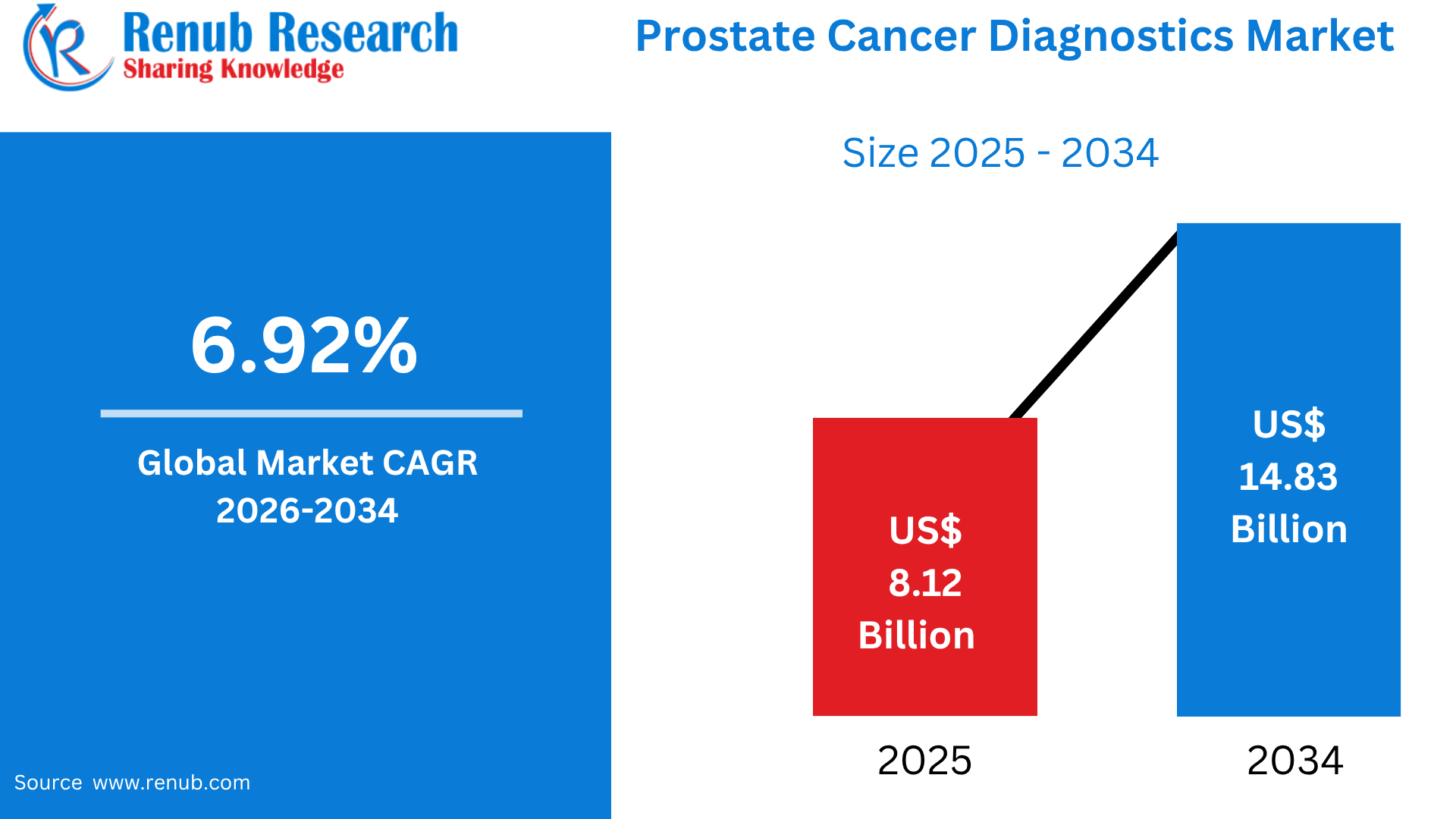
Prostate Cancer Diagnostics Market is projected to expand steadily, increasing from approximately US$ 8.12 billion in 2025 to US$ 14.83 billion by 2034, registering a CAGR of 6.92% during 2026–2034. Market growth is being driven by the rising prevalence of prostate cancer and growing awareness regarding the importance of early and accurate diagnosis. Increasing adoption of screening and diagnostic procedures is encouraging more individuals to undergo routine prostate cancer evaluations. In addition, government-led cancer screening initiatives, improved healthcare infrastructure, and efforts to promote early detection are supporting market expansion.
What is Prostate Cancer Diagnostics and Its Uses & Popularity Worldwide
Prostate cancer diagnostics refers to a range of medical tests and procedures used to detect, confirm, evaluate, and monitor prostate cancer. These diagnostic methods help healthcare professionals identify abnormal prostate conditions, determine the presence and stage of cancer, and assess the risk of disease progression. Common approaches include prostate-specific antigen (PSA) blood tests, digital rectal examinations (DRE), prostate biopsies, magnetic resonance imaging (MRI), ultrasound, and molecular or biomarker-based tests. These technologies are widely used for initial screening, diagnosis, treatment planning, and monitoring patients after treatment to identify potential recurrence.
The popularity of prostate cancer diagnostics is increasing worldwide due to the growing incidence of prostate cancer, particularly among aging populations. Greater public awareness of prostate health and the importance of early detection is encouraging more men to undergo diagnostic testing. Improvements in healthcare infrastructure and the availability of advanced imaging and molecular diagnostic technologies are further supporting adoption. In addition, government screening initiatives, improved access to healthcare services, and ongoing innovation in minimally invasive diagnostic techniques are contributing to the expanding use of prostate cancer diagnostics across developed and emerging markets.
Prostate Cancer: Top 10 Countries by New Cases, 2022
- World: 1,467,854 new cases; ASR: 29.4 per 100,000
- 1. United States: 230,125 new cases; ASR: 75.2 per 100,000
- 2. China: 134,156 new cases; ASR: 9.7 per 100,000
- 3. Japan: 104,318 new cases; ASR: 50.1 per 100,000
- 4. Brazil: 102,519 new cases; ASR: 76.3 per 100,000
- 5. Germany: 65,269 new cases; ASR: 54.2 per 100,000
- 6. France (metropolitan): 57,357 new cases; ASR: 82.3 per 100,000
- 7. United Kingdom: 55,485 new cases; ASR: 74.0 per 100,000
- 8. Russia: 52,712 new cases; ASR: 47.4 per 100,000
- 9. Italy: 38,180 new cases; ASR: 49.5 per 100,000
- 10. India: 37,948 new cases; ASR: 5.6 per 100,000
Key Findings & Trends — Prostate Cancer Statistics 2026
- Rising Global Disease Burden: Global prostate cancer incidence is projected to increase substantially, with annual cases expected to reach approximately 2.4 million by 2040, driven largely by population growth and aging.
- Increase in Distant-Stage Disease: The incidence of distant-stage prostate cancer is increasing across all age groups, with annual growth rates ranging from 2.6% to 6.2%, highlighting growing concerns regarding late-stage diagnosis.
- Limited Survival for Advanced Cancer: Despite improvements in treatment and disease management, survival among patients with distant-stage prostate cancer remains relatively low, at approximately 36%–43%.
- Major Global Mortality Disparities: The mortality-to-incidence ratio is nearly five times higher in low-income countries than in high-income countries, reaching 0.95 compared with 0.24, respectively. This reflects significant differences in early detection and access to treatment.
- Widening DALY Gap: Disability-adjusted life years (DALYs) associated with prostate cancer have declined by 25.8% in high-income countries, while increasing by 13.8% in low-income countries, indicating widening inequalities in cancer outcomes.
- Highest Mortality in Africa: The African Region records the highest prostate cancer mortality rates globally, emphasizing the need for improved screening, diagnostic infrastructure, and access to effective treatment.
- Significant Survival Differences: Five-year prostate cancer survival rates exceed 90% in high-income countries, whereas survival is only around 28% in South Africa, demonstrating substantial disparities in cancer care.
- Higher Mortality Among African-Ancestry Populations: Men of African ancestry experience disproportionately higher prostate cancer mortality, even after accounting for differences in incidence, highlighting the influence of biological, socioeconomic, healthcare-access, and diagnostic factors.
Growth Drivers of the Prostate Cancer Diagnostics Market
Rising Global Burden of Prostate Cancer
The increasing prevalence of prostate cancer is one of the major factors driving demand for diagnostic technologies worldwide. According to the World Health Organization, prostate cancer is among the most commonly diagnosed cancers in men, with approximately 1.5 million new cases reported globally in 2022. The disease also accounted for around 397,000 deaths during the same year, highlighting the need for timely diagnosis and disease management. The risk of prostate cancer increases substantially with age, particularly among men over 50 years, while global population aging is expanding the number of individuals at risk. Growing incidence is consequently increasing demand for PSA testing, digital rectal examinations, prostate biopsies, MRI, ultrasound, and advanced molecular diagnostics. Healthcare providers are also placing greater emphasis on early detection to improve treatment outcomes. As awareness of prostate cancer symptoms and risk factors increases, more men are undergoing screening and diagnostic evaluations, supporting sustained expansion of the global prostate cancer diagnostics market.
Increasing Adoption of Advanced Diagnostic Technologies
Technological advancements in prostate cancer diagnosis are creating significant growth opportunities for the market. Traditional PSA testing and biopsy procedures are increasingly being complemented by advanced imaging, molecular diagnostics, and biomarker-based technologies that can improve diagnostic accuracy and risk assessment. Multiparametric magnetic resonance imaging (mpMRI), for example, provides detailed visualization of prostate abnormalities and is increasingly used to identify suspicious lesions before biopsy. The adoption of MRI-targeted biopsy techniques can help clinicians obtain tissue samples from areas more likely to contain clinically significant cancer. In addition, genomic and molecular tests are gaining attention because they can provide information about tumor characteristics and help support personalized treatment decisions. The global precision medicine market is also expanding, encouraging the development of diagnostic tests that distinguish aggressive cancers from less clinically significant disease. Continuous investments in research and development by diagnostic companies, hospitals, and research institutions are therefore expected to increase the availability and adoption of innovative prostate cancer diagnostic solutions.
Growing Awareness and Government Screening Initiatives
Increasing awareness of prostate cancer and the importance of early diagnosis is supporting the adoption of diagnostic tests across developed and emerging economies. Public health organizations increasingly promote awareness campaigns that educate men about age-related risks, family history, symptoms, and available screening options. In the United States, the National Cancer Institute estimates that approximately 313,780 new prostate cancer cases and 35,770 deaths are expected in 2025, demonstrating the considerable disease burden and need for effective diagnostic strategies. Healthcare systems are also improving access to PSA testing, clinical examinations, imaging, and specialist consultations. However, screening recommendations differ among countries because PSA testing can produce false-positive results and may lead to unnecessary biopsies. Shared decision-making between physicians and patients is therefore increasingly emphasized. Government-supported cancer awareness programs, improved healthcare access, and growing participation in preventive health examinations are expected to increase demand for prostate cancer diagnostics, particularly as populations become more informed about the benefits and limitations of early detection.
Challenges of the Prostate Cancer Diagnostics Market
Limitations and False Positives Associated with PSA Testing
The limitations of prostate-specific antigen (PSA) testing represent a significant challenge for the prostate cancer diagnostics market. PSA is widely used as an initial diagnostic and screening tool, but elevated PSA levels do not necessarily indicate prostate cancer. Benign prostatic hyperplasia, prostatitis, urinary infections, and other non-cancerous conditions can also increase PSA concentrations. Consequently, PSA testing can generate false-positive results and lead to additional diagnostic procedures, including biopsies. According to the National Cancer Institute, only about 25% of men who undergo a prostate biopsy because of an elevated PSA level are ultimately found to have prostate cancer, illustrating the limitations of PSA-based screening. Overdiagnosis is another concern because some detected prostate cancers may grow slowly and never cause symptoms or become life-threatening. Unnecessary biopsies can cause discomfort, bleeding, infection, and anxiety. These limitations have encouraged the development of more specific biomarkers, imaging techniques, and risk-assessment tools, but concerns regarding diagnostic accuracy continue to influence screening practices and market adoption.
High Diagnostic Costs and Limited Healthcare Access
High costs associated with advanced prostate cancer diagnostic procedures can restrict market penetration, particularly in developing and low-income countries. While PSA testing is relatively accessible, advanced procedures such as multiparametric MRI, MRI-targeted biopsy, genomic testing, and specialized molecular diagnostics require sophisticated equipment, trained professionals, and specialized healthcare facilities. These requirements can significantly increase the overall cost of diagnosis. The International Agency for Research on Cancer reported that more than 1.4 million prostate cancer cases were recorded globally in 2022, with a substantial proportion occurring in countries where access to specialized cancer care remains limited. Differences in healthcare infrastructure, insurance coverage, reimbursement policies, and availability of trained urologists and radiologists can therefore create disparities in diagnostic access. Rural populations may face additional challenges because advanced imaging and pathology services are often concentrated in major urban hospitals. These economic and infrastructure barriers can delay diagnosis and reduce adoption of sophisticated diagnostic technologies, particularly across emerging markets.
Prostate Cancer Diagnostics Launches Worldwide
- Quest Diagnostics – Novel Prostate Cancer Biomarker Test (2023): Quest Diagnostics launched a tissue-based prostate cancer biomarker testing service through AmeriPath in collaboration with Envision Sciences. The test was designed to help identify and differentiate potentially aggressive prostate cancer cases, supporting more informed diagnosis and grading.
- MyProstateScore 2.0 (MPS2) – United States (2024): Researchers supported by the U.S. National Cancer Institute developed and validated an improved 18-gene urine biomarker test designed to identify clinically significant prostate cancer in men with elevated PSA levels and potentially reduce unnecessary biopsies.
- Trofolastat (RoTecPSMA) – United Kingdom (2025): The UK’s MHRA approved trofolastat, a PSMA-targeting diagnostic imaging product used with technetium-99m to detect prostate cancer lesions. The approval represented the first authorization of a PSMA-targeting product for this specific imaging application.
- AI-Enhanced Prostate MRI Diagnostic Model – United States (2025): Researchers at the National Cancer Institute updated a prostate cancer predictive model using PI-RADS version 2.1 and multiparametric MRI data. The model was evaluated using data from 1,319 patients and demonstrated improved performance compared with traditional clinical models.
- NHS AI Prostate Cancer Diagnostic Pilot – United Kingdom (2025–2026): NHS England announced an AI-powered “one-day diagnostics” pilot designed to analyze prostate MRI scans and identify suspicious lesions more rapidly. The program is planned across up to 15 NHS hospitals, with an initial pilot expected to involve around 100 men.
- PI-CAI-2B AI Diagnostic Model – International (2025): Researchers developed the next-generation PI-CAI-2B prostate MRI AI model for detecting clinically significant prostate cancer. Its development involved 22,481 MRI examinations from 21,288 patients across 46 cities in 22 countries, supporting efforts to develop globally applicable AI-assisted diagnostics.
- ProViCNet Prostate MRI AI Model – International (2025): Researchers introduced ProViCNet, a prostate-specific vision foundation model designed to detect clinically significant prostate cancer from MRI and transrectal ultrasound images. The model was trained and validated using 4,401 patients across six institutions and demonstrated strong diagnostic performance in validation cohorts.
- PROSTDAI AI-Enhanced MRI Diagnostic Technology – Chile (2025): Researchers introduced PROSTDAI, an AI-enhanced diagnostic approach combining time-dependent diffusion MRI with machine learning to improve identification of clinically significant prostate cancer. The technology is being evaluated against PI-RADS and MRI-guided biopsy results.
- ProstNFound+ Micro-Ultrasound Diagnostic Model – International (2025): ProstNFound+ was developed as a medical foundation-model approach for prostate cancer detection using micro-ultrasound. The system generates cancer heatmaps and risk scores and was prospectively evaluated using data from a new clinical site, demonstrating potential for scalable AI-assisted diagnosis.
- Updated MRI-Based Prostate Cancer Diagnostic Approach – United States (2025): The PRIME Diagnostic Clinical Trial evaluated biparametric MRI against multiparametric MRI for prostate cancer diagnosis, examining whether a streamlined MRI approach could maintain diagnostic effectiveness while reducing complexity and examination requirements. The findings were published in JAMA in September 2025.
Growing Importance of Early-Stage Prostate Cancer Diagnostics Screening
The preliminary tests segment plays a crucial role in the early identification and initial assessment of prostate cancer risk. Common preliminary diagnostic methods include prostate-specific antigen (PSA) blood testing, digital rectal examination (DRE), and imaging procedures such as ultrasound and MRI. PSA testing remains one of the most widely used approaches for evaluating prostate abnormalities. According to the National Cancer Institute, approximately 313,780 new prostate cancer cases and 35,770 deaths were estimated in the U.S. for 2025, highlighting the importance of accessible diagnostic pathways. Preliminary tests help physicians determine whether additional investigations, such as prostate biopsy or advanced imaging, are necessary. Growing awareness regarding the benefits of early cancer detection is encouraging men, particularly those in higher-risk age groups, to undergo screening. Healthcare organizations are also promoting informed screening decisions. Furthermore, PSA tests are relatively affordable and widely available compared with advanced diagnostic procedures. Improvements in testing accuracy and the increasing focus on preventive healthcare are expected to support continued demand for preliminary prostate cancer diagnostic tests worldwide.
Hospitals Remain Key Centers for Comprehensive Diagnosis
Hospitals represent a major distribution channel in the prostate cancer diagnostics market because they provide comprehensive diagnostic and clinical services within integrated healthcare facilities. Hospitals typically have access to laboratories, advanced imaging equipment, pathology departments, operating facilities, and specialized urologists and oncologists. This enables patients to progress from preliminary screening, such as PSA testing and DRE, to advanced procedures including multiparametric MRI, targeted biopsy, histopathological analysis, and molecular testing within the same healthcare ecosystem. The global burden of prostate cancer is substantial, with approximately 1.5 million new cases and 397,000 deaths reported worldwide in 2022, according to the World Health Organization. This significant disease burden is increasing the need for hospitals capable of providing accurate diagnosis and coordinated treatment. Multidisciplinary teams involving urologists, radiologists, pathologists, and oncologists can also improve clinical decision-making for complex cases. Increasing healthcare expenditure, investments in hospital infrastructure, advanced diagnostic equipment, and insurance coverage are further strengthening hospital-based prostate cancer diagnostics. Consequently, hospitals are expected to remain a leading segment over the forecast period.
Rising Demand for Specialized and Outpatient Diagnostic Services
Diagnostic centers are gaining importance in the prostate cancer diagnostics market by providing specialized, convenient, and comparatively cost-effective testing services. These facilities commonly offer PSA blood tests, ultrasound, MRI, biopsy-related services, pathology testing, and other diagnostic procedures depending on their capabilities. Their outpatient-focused model can reduce waiting times and provide patients with greater convenience compared with larger hospital systems. The growing preference for outpatient healthcare is supporting the expansion of independent diagnostic laboratories and specialized imaging centers worldwide. Diagnostic centers can also invest in advanced equipment and specialized testing capabilities, enabling them to provide high-quality services without requiring patients to undergo hospital admission. The increasing global incidence of prostate cancer is creating additional demand for accessible diagnostic facilities, particularly as healthcare systems emphasize early detection and preventive screening. Technological developments in imaging, pathology, and biomarker testing are further expanding the capabilities of these centers. In emerging economies, the decentralization of healthcare services and expansion of private diagnostic networks are improving access to testing beyond major hospitals. As healthcare delivery increasingly moves toward accessible outpatient models, diagnostic centers are expected to capture a growing share of prostate cancer diagnostic procedures.
Advanced Healthcare Infrastructure and Strong Screening Awareness in United States
United States prostate cancer diagnostics market is well established, supported by advanced healthcare infrastructure, high awareness of cancer screening, and rapid adoption of innovative diagnostic technologies. According to the American Cancer Society, approximately 313,780 new prostate cancer cases and 35,770 deaths were estimated in the U.S. in 2025, creating substantial demand for early detection, risk assessment, and disease monitoring. Screening and diagnostic procedures such as PSA testing, digital rectal examination, MRI, biopsy, and molecular testing are widely available through hospitals, urology practices, and specialized diagnostic centers. Increasing adoption of artificial intelligence (AI)-assisted imaging and pathology technologies is also improving diagnostic capabilities and supporting market development. The country’s aging male population represents another important growth factor because prostate cancer risk increases considerably with age. Favorable insurance coverage and established reimbursement mechanisms further support access to diagnostic procedures. In March 2025, AbbVie announced new oncology research and development data at the AACR Annual Meeting, including findings related to investigational molecules ABBV-514 and ABBV-969, highlighting continued investment in oncology innovation.
NHS Support and Increasing Adoption of Advanced Diagnostics in United Kingdom
United Kingdom prostate cancer diagnostics market is expected to experience steady expansion, supported by the country’s established public healthcare infrastructure and growing awareness of early cancer detection. The NHS plays a central role by providing access to diagnostic consultations, PSA testing, imaging, biopsies, and specialist urological services. Prostate cancer represents a significant healthcare burden in the country, with more than 50,000 men diagnosed annually in the UK, according to Prostate Cancer UK. Increasing use of multiparametric MRI before biopsy is also strengthening diagnostic pathways by helping clinicians identify suspicious lesions and improve biopsy targeting. Government efforts to improve cancer diagnosis and reduce diagnostic waiting times are encouraging healthcare providers to enhance capacity and efficiency. At the same time, the UK’s aging population is increasing the number of men within higher-risk age groups. Private diagnostic providers are also contributing by offering faster access to imaging and testing. In September 2024, Astellas presented oncology research at the ESMO Congress, demonstrating continued pharmaceutical and clinical research activity in cancer care. These developments are expected to support the country’s diagnostic ecosystem.
Rising Awareness and Expanding Urban Healthcare Infrastructure in India
India prostate cancer diagnostics market is expected to grow rapidly as awareness of cancer prevention and early diagnosis increases alongside improvements in healthcare infrastructure. According to GLOBOCAN 2022 estimates, India recorded more than 37,000 new prostate cancer cases and over 24,000 deaths, demonstrating the country’s substantial disease burden. Historically, limited awareness and restricted access to screening have contributed to delayed diagnosis, particularly outside major urban centers. However, growing health education, increasing urbanization, expanding private healthcare networks, and greater availability of PSA testing and advanced imaging are improving access to prostate cancer diagnostics. Diagnostic centers in metropolitan areas are increasingly investing in MRI, pathology, and other advanced technologies to improve diagnostic accuracy. Rising health insurance coverage and increasing healthcare expenditure are also expected to make diagnostic services more accessible. Nevertheless, affordability, rural healthcare infrastructure, and awareness disparities remain important challenges. In January 2023, Mumbai-based BDR Pharmaceuticals launched Apatide, a generic version of apalutamide, for specified advanced prostate cancer indications, reflecting India’s expanding oncology treatment and diagnostic ecosystem. Continued investment in healthcare infrastructure is expected to accelerate market development.
Healthcare Investment and Vision 2030 Supporting Saudi Arabia Market Development
Saudi Arabia prostate cancer diagnostics market is gradually expanding as the country invests heavily in healthcare infrastructure, digital health, and advanced medical technologies. Healthcare transformation under Saudi Vision 2030 is encouraging modernization of medical facilities, expansion of private healthcare services, and greater adoption of technologically advanced diagnostic solutions. Increasing health awareness among the population is also encouraging greater attention to cancer prevention, screening, and early diagnosis. Hospitals and specialized medical centers are increasingly equipped with advanced imaging, laboratory testing, pathology, and biopsy capabilities, strengthening the country’s diagnostic capacity. Saudi Arabia’s aging population is another factor likely to support demand for prostate cancer screening and diagnostic services. According to GLOBOCAN 2022, Saudi Arabia recorded more than 1,400 new prostate cancer cases, demonstrating a continuing need for improved detection and disease management. Private healthcare providers are also playing an increasingly important role by expanding specialized oncology services and investing in modern diagnostic equipment. In January 2026, ImmunityBio reported that the Saudi Food and Drug Authority (SFDA) had approved ANKTIVA in combination with BCG for BCG-unresponsive non-muscle-invasive bladder cancer, illustrating the country’s evolving regulatory and oncology landscape.
Segments
Type – Market breakup in 4 viewpoints:
- Benign Prostatic Hyperplasia
- Prostatic Adenocarcinoma
- Small Cell Carcinoma
- Others
Test Type – Market breakup in 2 viewpoints:
- Preliminary Tests
- Confirmatory Tests
End User – Diagnostics Market breakup in 4 viewpoints:
- Hospitals
- Diagnostic Centers
- Research Institutes
- Others
Country – Market breakup in 25 viewpoints:
North America
- United States
- Canada
Europe
- France
- Germany
- Italy
- Spain
- United Kingdom
- Belgium
- the Netherlands
- Turkey
Asia Pacific
- China
- Japan
- India
- Australia
- South Korea
- Thailand
- Malaysia
- Indonesia
- New Zealand
Latin America
- Brazil
- Mexico
- Argentina
Middle East & Africa
- South Africa
- Saudi Arabia
- United Arab Emirates
All the Key players have been covered from 5 Viewpoints:
- Business overview
- Key Persons
- Recent Development & Strategies
- SWOT Analysis
- Revenue Analysis
Company Analysis:
- F. Hoffman-La Roche AG
- Bayer AG
- Thermo Fisher Scientific Inc.
- Abbott Laboratories Inc.
- Siemens Healthineers AG
- Becton Dickinson and Company
- Agilent Technologies Inc.
- Hologic Inc
- Qiagen N.V.
- OPKO Health Inc
Report Details:
| Report Features | Details |
| Base Year |
2025 |
| Historical Period |
2022 - 2025 |
| Forecast Period |
2026 - 2034 |
| Market |
US$ Billion |
| Segment Covered |
Type, Test Type, End User and Countries |
| Countries Covered |
|
| Companies Covered |
|
| Customization Scope |
20% Free Customization |
| Post-Sale Analyst Support |
1 Year (52 Weeks) |
| Delivery Format |
PDF and Excel through Email (We can also provide the editable version of the report in PPT/Word format on request) |
Customization Services available
- Analysis of Market Size and Its Segments
- More Company Profiles (Upto 10 without any additional cost):
- Additional Countries (Other than mentioned Countries):
- Region/Country Specific Reports:
- Market Entry Strategy:
- Region-Specific Market Dynamics:
- Regional Market Share Analysis:
- Trade Analysis:
- Production Insights:
- Others Customized Requests:
For more information contact our analysts.
Need More Assistance?
- Talk to our analysts to get more precious information on the current market trends.
- Include more countries and segments and customize the report based on the final requirement.
- Get a competitive advantage in your industry by knowing the report findings and making a positive impact on your revenues and operations.
- Our analysts are always ready to provide more help and pertinent information if you need any additional assistance.