Global Printer Market Report by Type, End Use, Country and Company Analysis 2026-2034
Buy NowGlobal Printer Market Size and Forecast
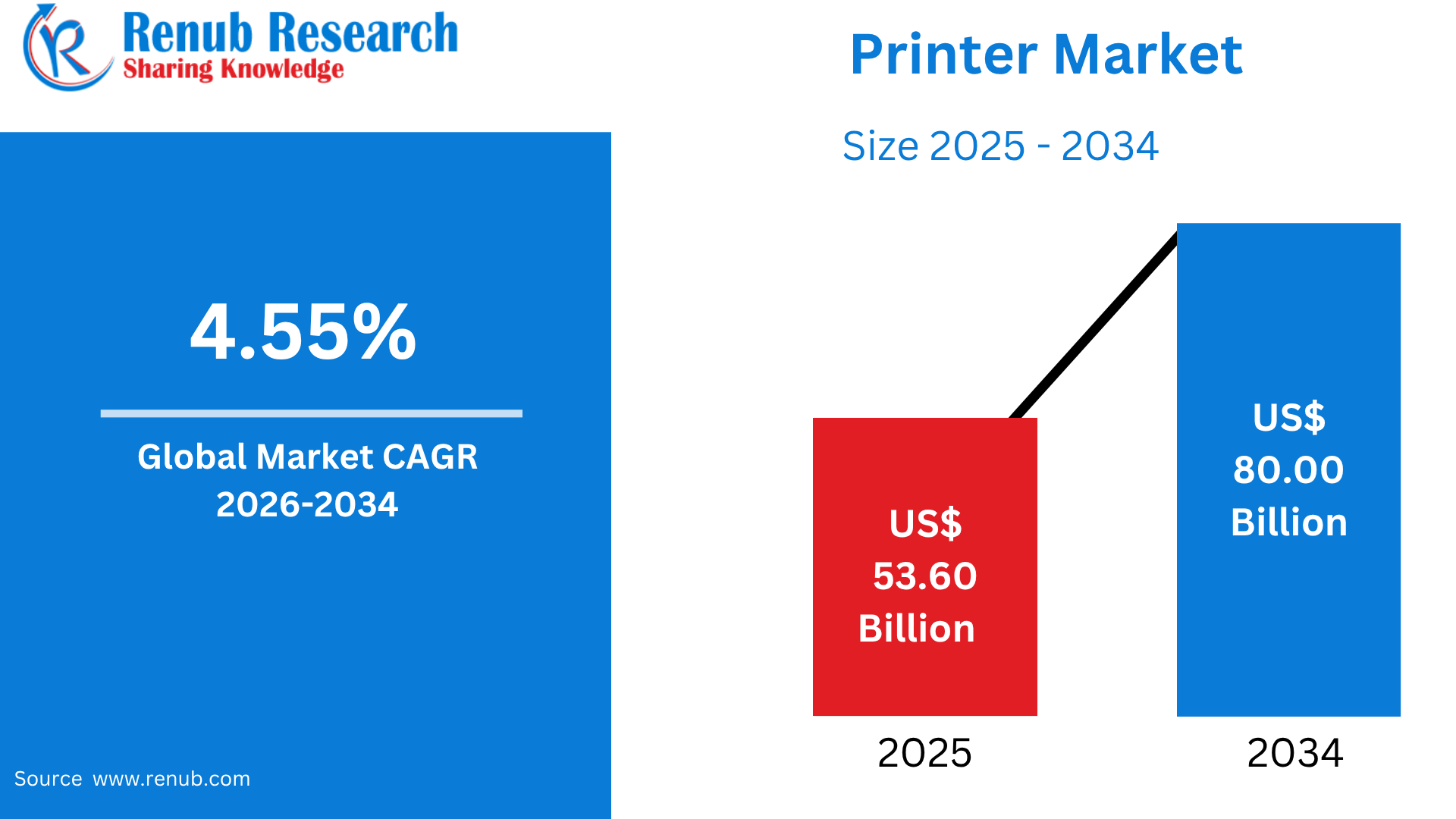
Global Printer Market is expected to grow from US$ 53.6 billion in 2025 to US$ 80.0 billion by 2034, registering a compound annual growth rate (CAGR) of 4.55% during 2026–2034. Furthermore, the rising need for digital documentation support, increasing number of small and medium-sized enterprises (SMEs), and expanding commercial printing applications are expected to further drive the growth of the global printer market. The market is projected to witness steady growth over the forecast period, driven by increasing demand across commercial, educational, and residential sectors. The growing trend of home offices, remote work, and home-based learning has also boosted demand for personal printing devices.
Printing and its Popularity Worldwide
Printing is the process of producing text, images, and designs on physical surfaces such as paper, textiles, packaging materials, plastics, and other media using ink, toner, or digital printing technologies. It is one of the most influential inventions in human history, transforming communication, education, business, and information sharing. Traditional methods such as offset printing, screen printing, and flexographic printing have evolved significantly with advanced technologies like digital printing, 3D printing, and industrial printing solutions.
Printing is widely used across industries, including publishing, advertising, packaging, healthcare, education, retail, manufacturing, and government sectors. Books, newspapers, product labels, brochures, business documents, medical records, and promotional materials rely heavily on printing. The packaging industry is one of the largest users of printing due to rising demand for branded and attractive product packaging.
Worldwide, printing remains highly popular despite digital transformation because of its reliability, accessibility, and ability to create tangible products. The growth of e-commerce, personalized products, smart packaging, and sustainable printing technologies continues to drive market expansion. Developing regions are also witnessing increased adoption due to growing literacy, industrialization, and business activities. Printing continues to play a crucial role in global communication and commercial growth.
Growth Drivers of the Printer Market
Expanding Small and Medium-Sized Enterprises (SMEs) and Office Printing Demand
The rapid growth of small and medium-sized enterprises (SMEs) worldwide is a major driver of the printer market. SMEs account for over 90% of businesses globally and contribute significantly to employment and economic activity, creating continuous demand for printing solutions. Offices require printers for invoices, contracts, financial reports, marketing materials, shipping labels, and business documentation. The expansion of co-working spaces, startups, financial institutions, legal firms, healthcare facilities, and government offices has further increased the need for reliable multifunction printers. Modern businesses are increasingly adopting laser printers and multifunction devices that combine printing, scanning, copying, and faxing to improve productivity while reducing operational costs. Cloud printing, wireless connectivity, mobile printing, and document management software have also enhanced workplace efficiency. As organizations continue investing in digital workflows that still require physical documentation for regulatory and operational purposes, demand for high-performance printers is expected to remain strong, particularly across commercial and enterprise environments.
Rising Demand for Home Offices, Education, and Remote Learning
The growing adoption of remote work, hybrid work models, and digital education is significantly boosting demand for home printers. Millions of employees now work remotely for part of the week, creating ongoing demand for compact, affordable, and wireless printing solutions. Educational institutions also continue to require printers for assignments, examination papers, certificates, and administrative documentation. Households increasingly use printers for educational materials, tax records, legal documents, photographs, and creative projects. Inkjet printers remain particularly popular for home users because they provide high-quality color printing at relatively low purchase costs. Manufacturers are introducing compact multifunction printers featuring Wi-Fi connectivity, cloud integration, automatic duplex printing, and smartphone compatibility to improve user convenience. Subscription-based ink replacement services and refillable ink tank systems have further reduced operating costs for consumers. As digital education, home businesses, freelancing, and hybrid work environments continue expanding worldwide, residential demand will remain an important contributor to long-term printer market growth.
Technological Advancements and Growth of Smart Printing Solutions
Continuous technological innovation is transforming the global printer market by improving printing efficiency, connectivity, sustainability, and operational performance. Modern printers increasingly incorporate cloud computing, Internet of Things (IoT) connectivity, artificial intelligence (AI), and advanced security features to meet evolving business requirements. Wireless printing, mobile device compatibility, voice assistant integration, and remote printer management enable users to print documents from virtually anywhere. The growing adoption of refillable ink tank systems significantly reduces printing costs while minimizing plastic cartridge waste. High-speed laser printers capable of printing 30–70 pages per minute are improving productivity in commercial environments, while photo printers deliver professional-quality color output for creative industries. Manufacturers are also developing energy-efficient printers with lower power consumption and automated maintenance functions to reduce operating costs. Growing demand for secure document printing, digital workflow integration, managed print services, and environmentally sustainable printing technologies is expected to continue driving innovation and supporting expansion of the global printer market.
Printing Product Launches Worldwide
- HP – Latex R530 All-in-One Printer (2025): HP introduced the Latex R530, an all-in-one large-format printer capable of printing on both rigid and flexible media, designed for sign makers and print service providers with improved automation and sustainability features.
- Canon – imagePRESS V1000 Digital Press (2025): Canon expanded its production printing portfolio with the imagePRESS V1000, delivering high-speed commercial printing, automated color calibration, and enhanced media versatility.
- Epson – SureColor S9170 Eco-Solvent Printer (2025): Epson launched the SureColor S9170, featuring an 11-color ink set, improved print quality, and higher productivity for signage, graphics, and professional printing applications.
- Xerox – PrimeLink C9200 Series (2025): Xerox introduced the PrimeLink C9200 Series color printers with AI-assisted workflow automation, improved print speeds, and enhanced finishing options for commercial print environments.
- Brother – HL-L9470CDN Professional Color Laser Printer (2025): Brother launched the HL-L9470CDN, offering enterprise-level security, high-volume printing capabilities, and advanced connectivity for business users.
- Ricoh – Pro C9500 Digital Color Press (2024): Ricoh introduced the Pro C9500, designed for commercial printing with faster output speeds, improved color consistency, and support for diverse print media.
- Konica Minolta – AccurioPress C14010 Series (2024): Konica Minolta launched the AccurioPress C14010, providing high-speed digital production printing, intelligent quality optimization, and automated workflow features.
- Fujifilm – Revoria Press EC2100 Series (2024): Fujifilm unveiled the Revoria Press EC2100 digital press, offering advanced toner technology, high-resolution image quality, and expanded substrate compatibility.
- Kyocera – TASKalfa MA3500ci Multifunction Printer (2024): Kyocera introduced the TASKalfa MA3500ci, featuring energy-efficient operation, cloud connectivity, enhanced security, and high-performance office printing capabilities.
- Lexmark – CX950 Series Color Multifunction Printers (2024): Lexmark launched the CX950 Series, delivering A3 color printing, advanced document management features, enterprise-grade security, and improved productivity for corporate environments.
Challenges of the Printer Market
Digital Transformation and Declining Paper Consumption
One of the biggest challenges facing the printer market is the rapid shift toward digital documentation and paperless business operations. Organizations across industries are increasingly replacing printed documents with cloud storage, electronic signatures, digital contracts, online billing, and document management platforms. Government agencies, educational institutions, financial organizations, and healthcare providers are investing heavily in digital transformation initiatives that reduce dependence on physical paperwork. Smartphones, tablets, laptops, and cloud collaboration platforms allow employees to review, edit, and share documents electronically without printing. Environmental sustainability initiatives are also encouraging companies to reduce paper consumption and minimize printing volumes. Many businesses now implement print management policies that encourage duplex printing and digital approvals before printing documents. As electronic record-keeping becomes more widespread, demand for traditional office printing continues to decline in several mature markets. Printer manufacturers therefore face increasing pressure to diversify product portfolios and develop value-added services beyond conventional document printing.
Rising Raw Material Costs and Intense Market Competition
The printer market also faces challenges from volatile raw material prices, supply chain disruptions, and intense global competition. Printers require numerous electronic components, semiconductors, precision motors, sensors, plastics, and metal parts, making manufacturing costs sensitive to fluctuations in global commodity prices. Semiconductor shortages and logistics disruptions experienced in recent years increased production costs and delayed product deliveries across the electronics industry. At the same time, manufacturers compete aggressively on pricing, particularly in the consumer inkjet and multifunction printer segments, reducing profit margins. Competition has intensified as established brands introduce similar features such as wireless connectivity, cloud printing, automatic duplex printing, and mobile app integration. Additionally, recurring customer concerns regarding ink cartridge costs encourage some consumers to delay printer purchases or choose alternative document-sharing methods. Maintaining profitability while investing in research, sustainability, cybersecurity, and next-generation printing technologies remains a significant challenge for manufacturers operating in the highly competitive global printer market.
Growing Demand for High-Quality and Cost-Effective Printing
Inkjet Printer market continues to expand due to its affordability, superior color printing capabilities, and versatility across residential, educational, and small business applications. Inkjet printers use microscopic droplets of liquid ink to produce high-resolution text and images, making them ideal for printing photographs, presentations, brochures, labels, and creative materials. More than 60% of home printer installations worldwide are estimated to use inkjet technology because of its lower upfront cost and excellent print quality. The increasing adoption of refillable ink tank systems has significantly reduced printing costs while improving page yield, encouraging greater consumer adoption. Wireless connectivity, cloud printing, mobile printing applications, and multifunction capabilities have further strengthened demand for modern inkjet printers. Educational institutions, home offices, freelance professionals, and small enterprises increasingly rely on inkjet devices for everyday document printing. Manufacturers continue introducing energy-efficient models with faster print speeds, improved ink formulations, and smart connectivity features, supporting long-term market growth across developed and emerging economies.
Reliable Continuous Printing Supporting Industrial Applications
Dot Matrix Printer market remains relevant despite the growing popularity of laser and inkjet technologies because of its durability, low operating costs, and ability to print multi-part forms. Dot matrix printers use impact printing technology in which pins strike an ink ribbon to produce characters on continuous paper. These printers remain widely used in banking, logistics, transportation, manufacturing, government offices, retail billing, warehouses, and industrial operations where duplicate invoices, receipts, shipping documents, and multipart forms are required. A typical 24-pin dot matrix printer can print between 300 and 600 characters per second, offering dependable performance in demanding environments. Their long operational lifespan, low maintenance requirements, and ability to function under harsh industrial conditions continue to make them valuable for specialized applications. Although demand has declined in consumer markets due to digital documentation, many organizations continue investing in impact printing systems because of regulatory requirements, continuous stationery compatibility, and cost-effective high-volume document production.
Packaging Industry Expansion Driving Market Demand
Flexographic Printer market is witnessing robust growth due to increasing demand for flexible packaging, labels, corrugated boxes, food packaging, pharmaceutical packaging, and consumer goods printing. Flexographic printing uses flexible relief printing plates capable of printing on various materials, including paper, plastic films, aluminum foil, cardboard, and biodegradable packaging substrates. The continued growth of e-commerce, food delivery services, and consumer packaged goods has significantly increased packaging production worldwide. Modern flexographic printing presses can operate at speeds exceeding 500 meters per minute, enabling efficient high-volume production while maintaining excellent print quality. Technological advancements such as digital plate imaging, automated color registration, UV-curable inks, and water-based printing systems have improved productivity while reducing waste and environmental impact. Manufacturers increasingly adopt flexographic printing because it supports rapid production, lower operating costs, and compatibility with sustainable packaging materials. Rising investments in environmentally friendly packaging and brand customization continue to strengthen long-term market expansion.
Business Printing and Industrial Documentation Supporting Commercial Printer Growth
Commercial Printer market is expanding steadily due to growing demand from corporate offices, educational institutions, healthcare facilities, government agencies, financial organizations, and commercial printing service providers. Commercial printers are designed for high-volume printing of documents, catalogs, books, promotional materials, invoices, brochures, packaging labels, and marketing materials. Many commercial laser printers can produce 40–100 pages per minute, enabling businesses to manage large printing workloads efficiently. Increasing business activities, rising demand for customized promotional materials, and expansion of publishing, advertising, and packaging industries continue to drive market growth. Modern commercial printers incorporate cloud connectivity, automated workflow management, secure printing, artificial intelligence-based maintenance, and energy-efficient operation to improve productivity. The growing adoption of managed print services (MPS), digital printing technologies, and integrated document management systems is helping organizations reduce operating costs while improving printing efficiency. Continued expansion of commercial infrastructure and business operations worldwide supports sustained demand for advanced commercial printing solutions.
Home Offices and Digital Learning Driving Consumer Demand Residential Printer
Residential Printer market continues to grow as home offices, remote work, online education, and personal document printing become increasingly common worldwide. Home users require printers for school assignments, tax documents, legal paperwork, photographs, greeting cards, creative projects, and home business activities. The expansion of hybrid work models has significantly increased demand for compact multifunction printers that combine printing, scanning, copying, and wireless connectivity. More than one-third of knowledge workers globally now spend at least part of their workweek at home, supporting steady demand for personal printing devices. Inkjet printers dominate this segment because they offer affordable pricing, excellent color output, and compact designs suitable for residential environments. Manufacturers are introducing refillable ink tank systems, automatic duplex printing, smartphone compatibility, voice assistant integration, and cloud printing capabilities to enhance user convenience. Growing digital education, increasing home entrepreneurship, and rising consumer preference for convenient document management continue to support long-term growth of the global residential printer market.
Business Digitization and Home Office Demand Driving United States Market Growth
United States printer market remains one of the largest globally due to the strong presence of corporate offices, educational institutions, healthcare organizations, and government agencies. Businesses continue to invest in multifunction printers, laser printers, and managed print services to improve workflow efficiency and document management. The United States has more than 33 million small businesses, creating consistent demand for office printing solutions, invoices, contracts, shipping labels, and marketing materials. The growth of hybrid work models has also increased residential demand for compact wireless printers capable of printing, scanning, and copying. Educational institutions continue to require high-volume printers for administrative operations and learning materials. Technological advancements such as cloud printing, Wi-Fi connectivity, AI-powered maintenance, and secure printing solutions are further enhancing adoption. Increasing demand from logistics, healthcare, financial services, and e-commerce industries continues to strengthen commercial printer sales. Ongoing investments in energy-efficient printing technologies and subscription-based ink services are expected to support sustained growth across the U.S. printer market.
Commercial Printing and Digital Workplace Solutions Supporting United Kingdom Expansion
United Kingdom printer market is growing steadily due to increasing demand from businesses, educational institutions, healthcare providers, and public sector organizations. Although digital documentation is expanding, many industries continue to rely on printed contracts, invoices, legal records, packaging labels, and promotional materials. The UK has more than 5.5 million small and medium-sized enterprises (SMEs), creating significant demand for multifunction office printers and managed print services. Hybrid working environments and home-based businesses have also increased consumer demand for compact wireless inkjet and laser printers. Commercial printing companies continue investing in high-speed digital printing equipment to meet demand from retail, publishing, packaging, and advertising sectors. Manufacturers are introducing cloud-enabled printing, mobile printing applications, automatic duplex printing, and enhanced cybersecurity features to improve productivity. Growing emphasis on sustainable printing, recyclable cartridges, and energy-efficient devices is encouraging businesses to replace older equipment with environmentally friendly printer technologies, supporting long-term market growth across the United Kingdom.
Expanding Education Sector Driving India Demand
India’s printer market is witnessing robust growth due to rapid digitalization, expanding educational infrastructure, rising office automation, and increasing demand from small businesses. India has more than 65 million micro, small, and medium enterprises (MSMEs), making the commercial sector one of the largest users of printing equipment. Government offices, schools, universities, banks, hospitals, and corporate organizations continue to require printers for documentation, reporting, billing, and administrative activities. The growing adoption of online education and hybrid working models has further increased demand for affordable home printers and multifunction devices. Ink tank printers are particularly popular because they offer lower printing costs and higher page yields, making them suitable for cost-sensitive consumers. Domestic manufacturing initiatives, increasing internet penetration, and growing e-commerce sales are improving printer availability across urban and rural markets. Continued investments in digital infrastructure, business expansion, and education are expected to position India among the fastest-growing printer markets in the Asia-Pacific region.
Digital Transformation and Commercial Infrastructure Supporting Saudi Arabia Growth
Saudi Arabia’s printer market is expanding steadily as government digital transformation initiatives, business development, and educational investments continue to strengthen demand for modern printing solutions. Under Vision 2030, the Kingdom is investing heavily in commercial infrastructure, healthcare, education, financial services, and government modernization, all of which require efficient document management systems. Saudi Arabia has a literacy rate exceeding 95%, while expanding universities, schools, and training institutions continue to generate demand for educational printing. Businesses increasingly deploy multifunction laser printers, cloud-connected devices, and managed print services to improve operational efficiency. Growth in banking, logistics, retail, hospitality, healthcare, and construction sectors is also increasing demand for high-volume commercial printing equipment. Manufacturers are introducing energy-efficient printers with wireless connectivity, mobile printing capabilities, secure document authentication, and remote device management to support modern workplaces. Rising adoption of home offices, expanding small businesses, and ongoing investments in smart city projects are expected to drive sustained growth in the Saudi Arabian printer market over the coming years.
Key Segments
Type
- Inkjet Printers
- Laser Printers
- Dot Matrix Printers
- 3D Printers
- Off Set Printers
- Flexographic
- Others
End Use
- Industrial
- Commercial
- Residential
Countries
North America
- United States
- Canada
Europe
- France
- Germany
- Italy
- Spain
- United Kingdom
- Belgium
- Netherlands
- Turkey
Asia Pacific
- China
- Japan
- India
- Australia
- South Korea
- Thailand
- Malaysia
- Indonesia
- New Zealand
Latin America
- Brazil
- Mexico
- Argentina
Middle East & Africa
- South Africa
- Saudi Arabia
- UAE
All the Key players have been covered from 5 Viewpoints:
- Overviews
- Key Person
- Recent Developments
- SWOT Analysis
- Revenue Analysis
Company Analysis:
- Canon Inc.
- FUJIFILM Corporation
- Fujitsu Limited
- Hitachi Ltd.
- Honeywell International Inc.
- HP Inc.
- Panasonic Corporation
- Seiko Epson Corporation
- Toshiba Corporation
- Xerox Corporation
Report Details:
| Report Features | Details |
| Base Year |
2025 |
| Historical Period |
2022 - 2025 |
| Forecast Period |
2026 - 2034 |
| Market |
US$ Billion |
| Segment Covered |
Type, End User and Countries |
| Countries Covered |
|
| Companies Covered |
|
| Customization Scope |
20% Free Customization |
| Post-Sale Analyst Support |
1 Year (52 Weeks) |
| Delivery Format |
PDF and Excel through Email (We can also provide the editable version of the report in PPT/Word format on request) |
Customization Services available
- Analysis of Market Size and Its Segments
- More Company Profiles (Upto 10 without any additional cost):
- Additional Countries (Other than mentioned Countries):
- Region/Country Specific Reports:
- Market Entry Strategy:
- Region-Specific Market Dynamics:
- Regional Market Share Analysis:
- Trade Analysis:
- Production Insights:
- Others Customized Requests:
For more information contact our analysts.
Need More Assistance?
- Talk to our analysts to get more precious information on the current market trends.
- Include more countries and segments and customize the report based on the final requirement.
- Get a competitive advantage in your industry by knowing the report findings and making a positive impact on your revenues and operations.
- Our analysts are always ready to provide more help and pertinent information if you need any additional assistance.