Personal Computers Market Report by Form Factor, End User, Processor Architecture, Price Band, Distribution Channel, Operating System, Countries and Companies Analysis 2026-2034
Buy NowPersonal Computer Market Size and Forecast
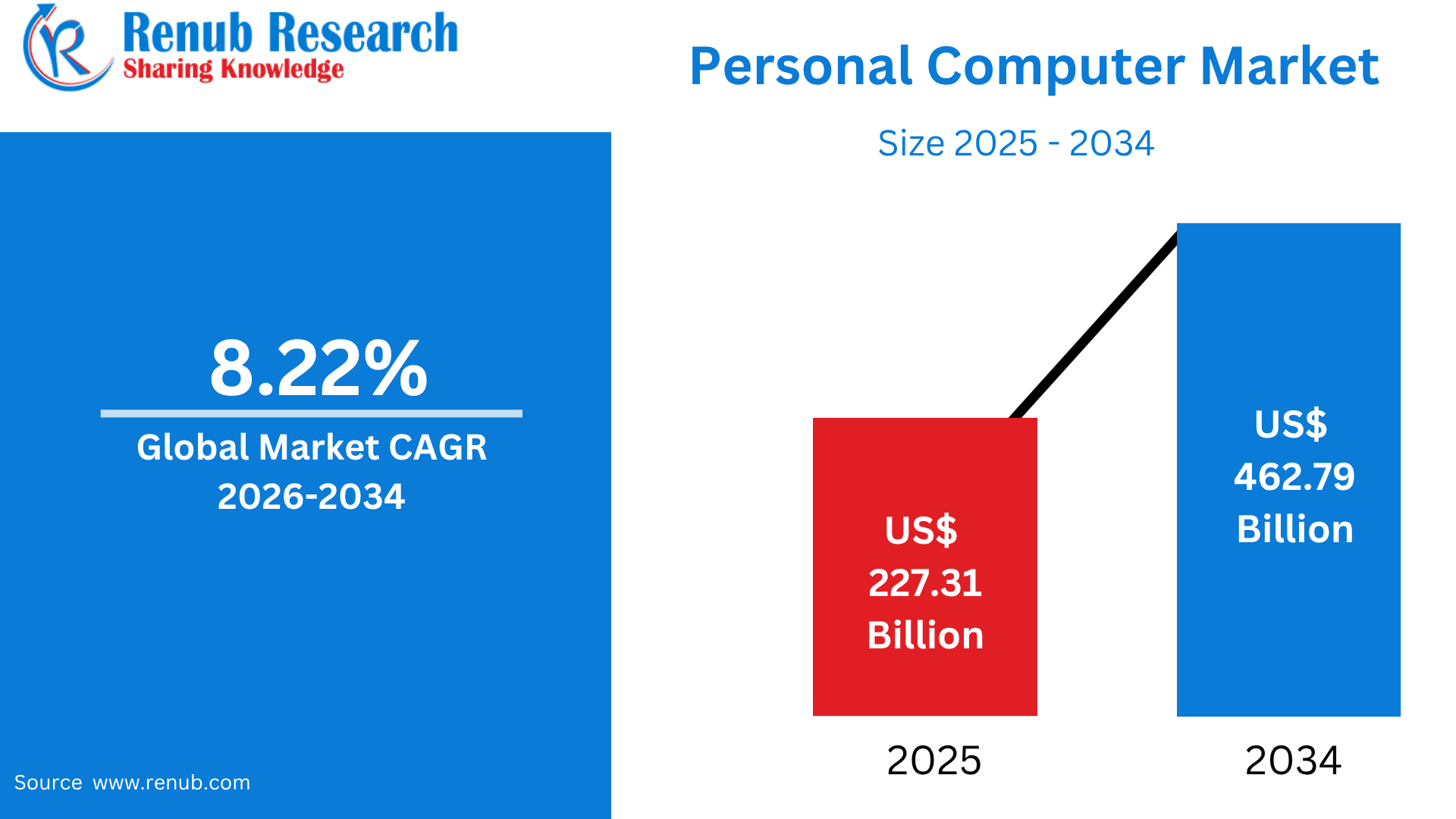
Personal Computer Market is projected to grow significantly, reaching US$ 462.79 billion by 2034, compared with US$ 227.31 billion in 2025, representing a CAGR of 8.22% from 2026 to 2034. Market expansion is expected to be supported by accelerating digital transformation across businesses and institutions, continued adoption of remote and hybrid work models, and ongoing technological advancements in computing devices. Growing demand for laptops, desktops, and advanced PCs for professional, educational, gaming, and personal applications is also contributing to market development.
What is a Personal Computer and Its Uses & Popularity Worldwide
A personal computer (PC) is an electronic computing device designed for individual use, capable of processing data, running software, accessing the internet, storing information, and performing tasks ranging from basic productivity to advanced computing. PCs include desktop computers, laptops, workstations, and other specialized personal computing devices. They are widely used in businesses, educational institutions, healthcare, government organizations, creative industries, gaming, research, and households. Common applications include document creation, video conferencing, programming, data analysis, online learning, content creation, entertainment, gaming, and professional software applications.
The worldwide popularity of PCs is supported by continued digitalization, hybrid work, online education, cloud computing, and growing demand for powerful computing capabilities. Gartner reported that more than 270 million PCs were shipped globally in 2025, representing 9.1% growth from 2024. The market is also undergoing a major transformation through AI-enabled computers. Gartner estimated that AI PCs accounted for 31% of worldwide PC shipments in 2025, with shipments projected to reach 143 million units and 55% market share in 2026.
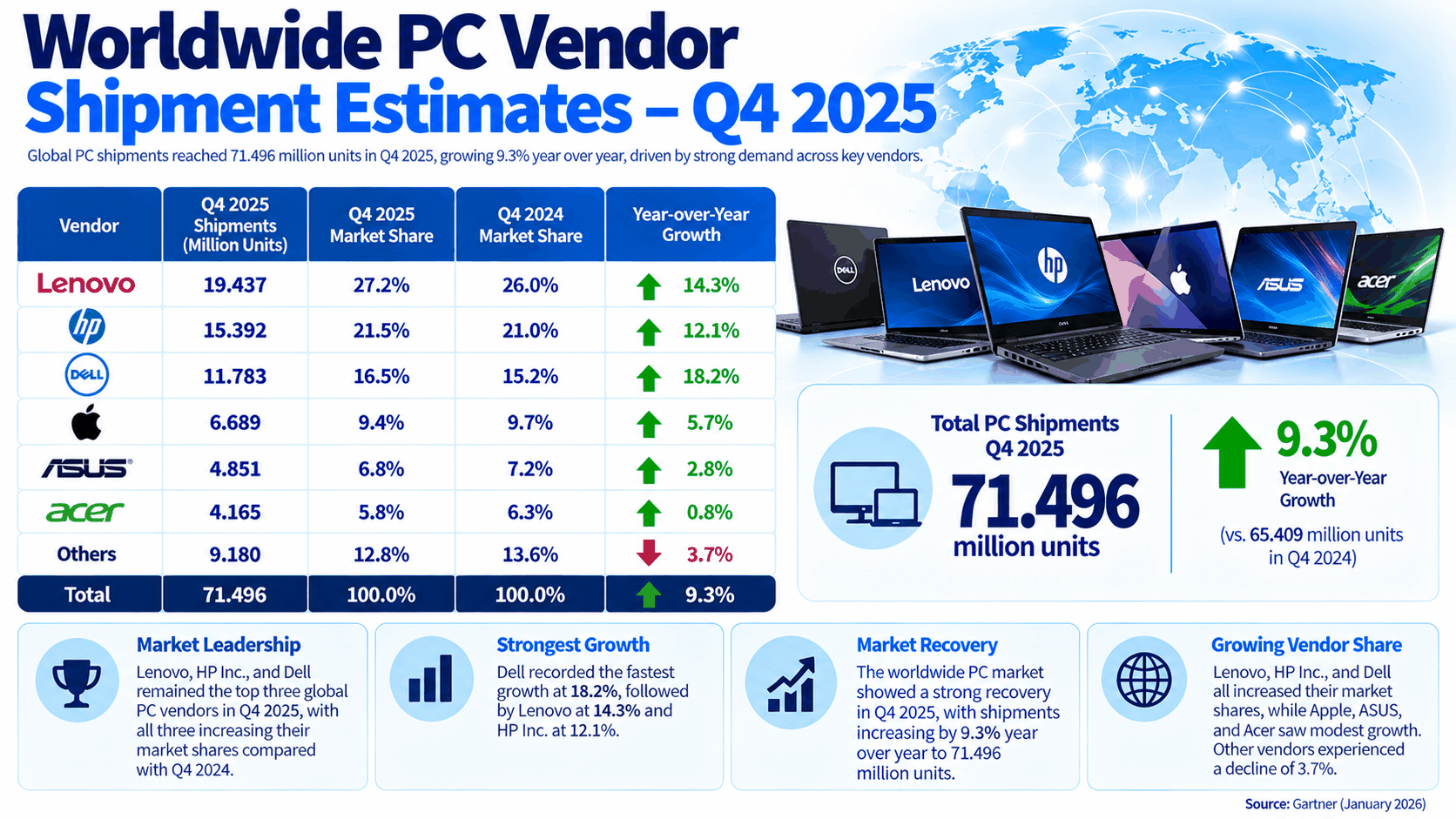
Worldwide PC Vendor Shipment Estimates – Q4 2025
- Total PC Shipments: 71.496 million units in Q4 2025, compared with 65.409 million units in Q4 2024, representing 9.3% year-over-year growth.
- Lenovo: Shipped 19.437 million units, achieving a 27.2% market share, up from 26.0% in Q4 2024. Shipments grew 14.3% year over year.
- HP Inc.: Shipped 15.392 million units, accounting for a 21.5% market share, compared with 21.0% in Q4 2024. Shipments increased 12.1%.
- Dell: Recorded 11.783 million units in shipments, with a 16.5% market share, up from 15.2% in Q4 2024. Shipments increased 18.2%, the highest growth among the top six vendors.
- Apple: Shipped 6.689 million units, representing a 9.4% market share, compared with 9.7% in Q4 2024. Shipments grew 5.7%.
- ASUS: Recorded 4.851 million units in shipments and a 6.8% market share, compared with 7.2% in Q4 2024. Shipments increased 2.8%.
- Acer: Shipped 4.165 million units, capturing a 5.8% market share, compared with 6.3% in Q4 2024. Shipments grew 0.8%.
- Other Vendors: Combined shipments reached 9.180 million units, representing a 12.8% market share. Their shipments declined 3.7% year over year.
- Market Leadership: Lenovo, HP Inc., and Dell remained the top three global PC vendors in Q4 2025, with all three increasing their market shares compared with Q4 2024.
- Strongest Growth: Dell recorded the fastest growth at 18.2%, followed by Lenovo at 14.3% and HP Inc. at 12.1%.
- Overall Market Trend: The worldwide PC market demonstrated a strong recovery in Q4 2025, with shipments increasing by 9.3% year over year to 71.496 million units.
Source: Gartner (January 2026)
Growth Drivers of the Personal Computer Market
Increasing Adoption of AI PCs and Advanced Computing Technologies
The rapid integration of artificial intelligence into personal computers is creating a significant replacement and upgrade opportunity worldwide. Modern AI PCs incorporate neural processing units (NPUs), advanced processors, improved graphics capabilities, and software optimized for on-device AI workloads. These capabilities enable features such as AI-assisted productivity, image and video generation, real-time translation, intelligent search, cybersecurity, and personalized computing. Gartner estimated that AI PCs represented 31% of worldwide PC shipments in 2025, equivalent to approximately 77.8 million units. The share is forecast to increase to 55% in 2026, with shipments reaching approximately 143 million units. AI capabilities are particularly attractive to enterprises seeking greater productivity and data privacy because some workloads can be processed locally instead of entirely through cloud services. IDC expects AI PCs to become increasingly pervasive, with their share approaching 60% of the PC market by 2028. As AI software becomes more capable and hardware manufacturers introduce faster processors and NPUs, consumers and organizations are likely to replace older computers with AI-ready systems. This technology transition is therefore becoming an important long-term growth driver for the global personal computer market.
Enterprise PC Replacement and Windows Upgrade Cycles
Enterprise hardware replacement cycles continue to support global PC demand as businesses upgrade aging computer fleets to maintain security, compatibility, performance, and productivity. The transition away from Windows 10 has been particularly important because organizations have needed to migrate to newer Windows 11-compatible hardware. Gartner reported that worldwide PC shipments exceeded 270 million units in 2025, increasing 9.1% from 2024, with business demand benefiting from the Windows 11 upgrade cycle. The replacement opportunity extends beyond operating-system compatibility because businesses increasingly require computers capable of supporting AI applications, cybersecurity tools, cloud platforms, collaboration software, and demanding professional workloads. Gartner also reported that worldwide PC shipments reached 71.5 million units in Q4 2025, representing 9.3% year-over-year growth. Enterprises across financial services, healthcare, education, manufacturing, professional services, and government are therefore contributing to demand for notebooks, desktops, and workstations. In addition, hybrid work arrangements continue to require employees to have reliable computing devices for collaboration and productivity. As organizations maintain regular hardware refresh schedules and seek higher-performance equipment, enterprise replacement demand is expected to remain an important contributor to PC market development.
Growing Demand for Computing in Education, Gaming, and Digital Content Creation
Increasing use of computers for education, gaming, entertainment, programming, and digital content creation is expanding the global consumer market. Students and educators depend on PCs for online learning, research, document preparation, coding, virtual classrooms, and access to digital educational resources. At the same time, gaming and content creation are generating demand for high-performance laptops and desktops equipped with powerful CPUs, GPUs, high-resolution displays, and advanced cooling systems. Gartner reported that laptop shipments were boosted by education demand and AI-ready refreshes during Q2 2025, while worldwide PC shipments increased 4.4% year over year to more than 63 million units during the quarter. The increasing popularity of video production, graphic design, streaming, software development, and social-media content creation is also encouraging users to purchase more capable systems. Gaming PCs represent another important premium segment because modern games increasingly require advanced graphics performance and faster processors. As digital education, entertainment, gaming, and creator economies expand worldwide, demand is shifting toward multifunctional and higher-performance personal computers. This diversification of use cases reduces dependence on traditional office computing and creates additional opportunities for PC manufacturers.
Challenges of the Personal Computer Market
Rising Component Costs and Memory Supply Constraints
Rising component costs and shortages of memory and other critical hardware components are creating significant challenges for the personal computer industry. PCs require processors, memory, storage, displays, batteries, graphics components, and other electronic parts, making manufacturers vulnerable to fluctuations in semiconductor and component prices. IDC’s 2026 outlook indicates that the global PC market is facing a significant memory shortage, with full-year 2026 PC shipments forecast to decline 11.3%. IDC also projects that PC average selling prices could increase by 18.3% in 2026 because of higher memory costs. Higher hardware prices can reduce affordability, particularly among price-sensitive consumers and small businesses. Manufacturers may also face pressure on profit margins if they cannot fully pass increased component costs to customers. Supply constraints can additionally delay product availability and disrupt production planning. These challenges are particularly important for entry-level and mid-range PCs, where consumers are more sensitive to price increases. Although premium AI PCs and high-performance systems can absorb some price increases because of their advanced features, persistent component shortages could slow unit growth across the broader market. Manufacturers therefore need stronger supply-chain management, diversified sourcing strategies, and efficient inventory planning.
Strong Competition, Longer Replacement Cycles, and Consumer Price Sensitivity
Intense competition and relatively long PC replacement cycles can limit market expansion, particularly in mature economies. Consumers do not necessarily need to replace a functioning PC every year, and improvements in device durability and performance can encourage users to keep computers for several years. This creates a replacement-driven market in which significant growth often depends on operating-system transitions, new technologies, or major hardware innovations. Gartner noted that consumer demand remained subdued at lower price points in 2025, with buyers affected by macroeconomic pressures and showing greater caution in their purchasing decisions. The market is also highly competitive, with major vendors such as Lenovo, HP, Dell, Apple, ASUS, and Acer competing across multiple price categories. In 2025, the top six vendors accounted for the majority of worldwide PC shipments, with Lenovo holding approximately 27.2%, HP 21.3%, and Dell 15.3%, according to Gartner. Competition places pressure on manufacturers to continuously introduce innovative designs, improve performance, offer competitive pricing, and differentiate AI capabilities. Meanwhile, consumers increasingly compare PCs with smartphones and tablets for everyday tasks, creating additional pressure on traditional PC demand.
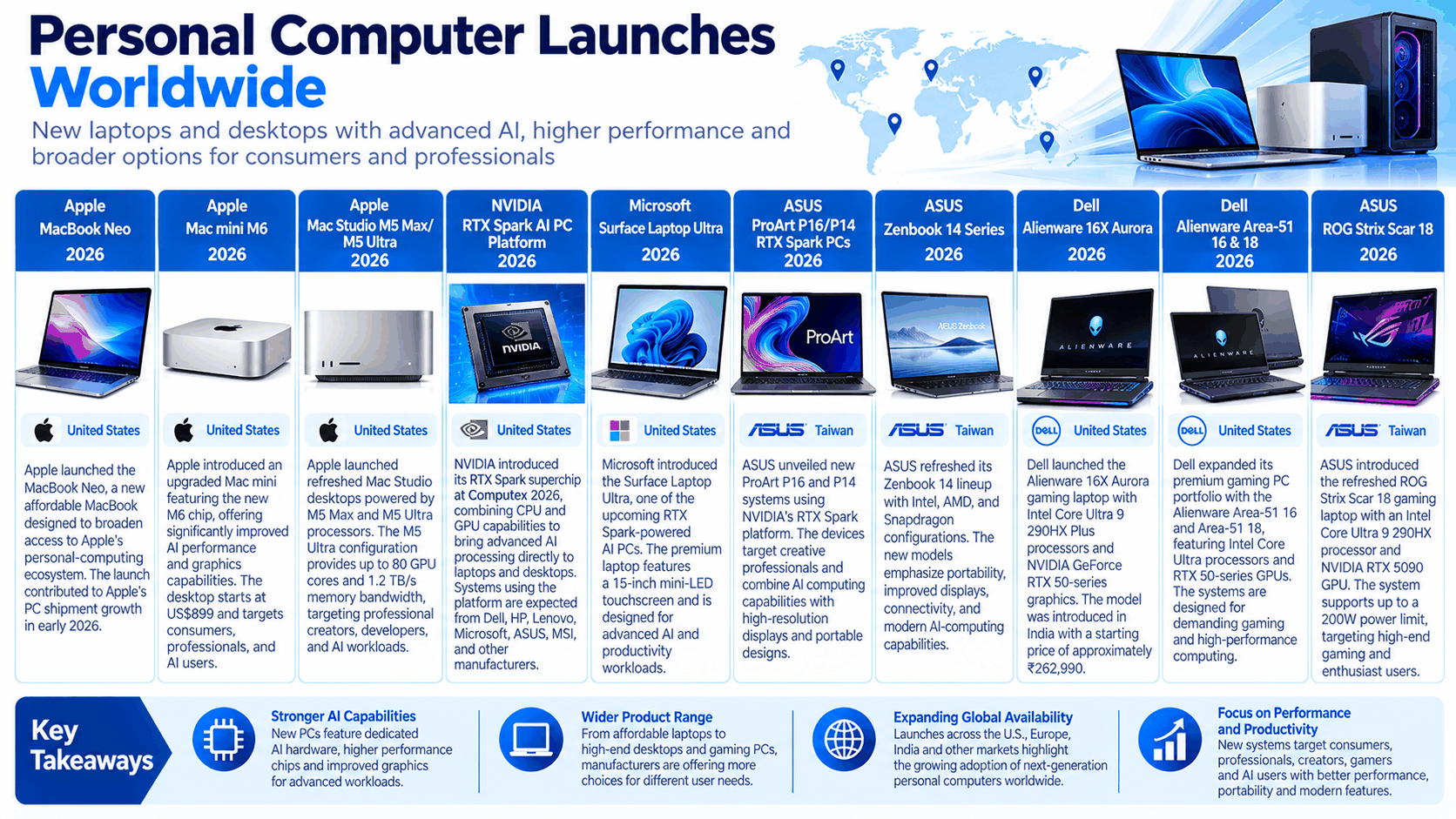
Personal Computer Launches Worldwide
- Apple MacBook Neo – 2026: Apple launched the MacBook Neo, a new affordable MacBook designed to broaden access to Apple’s personal-computing ecosystem. The launch contributed to Apple’s PC shipment growth in early 2026.
- Apple Mac mini M6 – 2026: Apple introduced an upgraded Mac mini featuring the new M6 chip, offering significantly improved AI performance and graphics capabilities. The desktop starts at US$899 and targets consumers, professionals, and AI users.
- Apple Mac Studio M5 Max/M5 Ultra – 2026: Apple launched refreshed Mac Studio desktops powered by M5 Max and M5 Ultra processors. The M5 Ultra configuration provides up to 80 GPU cores and 1.2 TB/s memory bandwidth, targeting professional creators, developers, and AI workloads.
- NVIDIA RTX Spark AI PC Platform – 2026: NVIDIA introduced its RTX Spark superchip at Computex 2026, combining CPU and GPU capabilities to bring advanced AI processing directly to laptops and desktops. Systems using the platform are expected from Dell, HP, Lenovo, Microsoft, ASUS, MSI, and other manufacturers.
- Microsoft Surface Laptop Ultra – 2026: Microsoft introduced the Surface Laptop Ultra, one of the upcoming RTX Spark-powered AI PCs. The premium laptop features a 15-inch mini-LED touchscreen and is designed for advanced AI and productivity workloads.
- ASUS ProArt P16/P14 RTX Spark PCs – 2026: ASUS unveiled new ProArt P16 and P14 systems using NVIDIA’s RTX Spark platform. The devices target creative professionals and combine AI computing capabilities with high-resolution displays and portable designs.
- ASUS Zenbook 14 Series – 2026: ASUS refreshed its Zenbook 14 lineup with Intel, AMD, and Snapdragon configurations. The new models emphasize portability, improved displays, connectivity, and modern AI-computing capabilities.
- Dell Alienware 16X Aurora – 2026: Dell launched the Alienware 16X Aurora gaming laptop with Intel Core Ultra 9 290HX Plus processors and NVIDIA GeForce RTX 50-series graphics. The model was introduced in India with a starting price of approximately ₹262,990.
- Dell Alienware Area-51 16 & 18 – 2026: Dell expanded its premium gaming PC portfolio with the Alienware Area-51 16 and Area-51 18, featuring Intel Core Ultra processors and RTX 50-series GPUs. The systems are designed for demanding gaming and high-performance computing.
- ASUS ROG Strix Scar 18 – 2026: ASUS introduced the refreshed ROG Strix Scar 18 gaming laptop with an Intel Core Ultra 9 290HX processor and NVIDIA RTX 5090 GPU. The system supports up to a 200W power limit, targeting high-end gaming and enthusiast users.
Rising Demand for Laptops and Digital Computing Devices
Global consumer personal computer market continues to benefit from increasing dependence on digital services, online education, entertainment, gaming, content creation, and remote or hybrid work. Consumers are increasingly replacing older computers with devices offering better performance, longer battery life, improved displays, and AI-enabled capabilities. In 2025, worldwide PC shipments exceeded 270 million units, representing 9.1% year-over-year growth, indicating a broad recovery in PC demand. Consumer demand was an important contributor to this recovery, although purchasing remained more cautious at lower price points because of economic pressures. The growing availability of AI PCs is also encouraging consumers to consider hardware upgrades, particularly as on-device AI features become integrated into productivity, communication, image generation, security, and personalization applications. AI PCs represented approximately 31% of worldwide PC shipments in 2025, equivalent to around 77.8 million units, demonstrating the increasing importance of intelligent computing in consumer purchasing decisions. Rising internet penetration, digital lifestyles, gaming adoption, and demand for portable computing are
Energy Efficiency and AI Capabilities Strengthen ARM Adoption
ARM-based personal computer market is gaining momentum as manufacturers increasingly focus on energy efficiency, extended battery life, lightweight designs, and on-device artificial intelligence. ARM processors have traditionally been prominent in smartphones and tablets, but their presence in laptops and PCs is expanding through platforms from Apple, Qualcomm, MediaTek, and other semiconductor companies. In 2026, ARM reportedly reached a record 15.3% share of the global client CPU market, reflecting increasing adoption across PCs and other client devices. Consumer laptops are an especially important opportunity because ARM-based systems can provide strong performance per watt and extended battery life. AI capabilities are further supporting adoption as ARM platforms increasingly integrate dedicated NPUs for local AI workloads. Gartner has projected that ARM-based laptops will gain a larger share of the consumer AI PC market as software compatibility improves. Windows on ARM is also expanding its application ecosystem, with thousands of compatible applications available and continued support from major PC manufacturers. As compatibility improves and consumers prioritize battery life and AI performance, ARM-based PCs are expected to capture a greater portion of the global laptop market.
High-Performance Hardware and AI Gaming Drive Premium Premium / Gaming Demand
Premium and gaming personal computer market is supported by rising demand for high-performance processors, dedicated GPUs, high-refresh-rate displays, advanced cooling systems, and large-capacity memory and storage. Gaming PCs are increasingly used not only for gaming but also for video editing, 3D rendering, software development, streaming, artificial intelligence, and other demanding workloads. The growing popularity of esports, game streaming, digital content creation, and immersive gaming experiences is encouraging consumers to purchase higher-specification systems. AI-enabled features are also becoming increasingly important in premium PCs, with modern processors and GPUs supporting AI-assisted gaming, image generation, upscaling, content creation, and productivity applications. In 2025, worldwide PC shipments reached more than 270 million units, while premium manufacturers such as Apple and ASUS recorded continued shipment growth. However, premium PC demand is sensitive to component costs, particularly GPUs and memory. High-end GPU price increases were already affecting PC purchasing decisions during 2025. Nevertheless, enthusiasts and professional users remain willing to pay for superior performance, creating attractive opportunities for manufacturers in gaming laptops, desktop gaming systems, creator PCs, and AI workstations.
Physical Stores and Value-Added Resellers Remain Important
Offline retail and value-added reseller (VAR) market remains an important distribution channel for personal computers, particularly for consumers and businesses that prefer physical product demonstrations, technical assistance, configuration services, and after-sales support. Offline channels include electronics retailers, computer stores, supermarkets, specialist PC outlets, enterprise resellers, system integrators, and authorized dealers. In 2025, worldwide PC shipments exceeded 270 million units, creating substantial volume for distributors and retail partners. The channel is particularly important for business customers purchasing customized systems, workstations, security solutions, peripherals, and managed IT services. VARs can differentiate themselves by bundling hardware with software, installation, maintenance, cybersecurity, cloud services, and technical support. Physical stores also remain useful for consumers who want to compare screen quality, keyboard design, build quality, and performance before purchasing. Although e-commerce continues to gain market share, offline retailers benefit from direct customer interaction and immediate availability. Major vendors such as Lenovo, HP, Dell, ASUS, and Acer maintain extensive channel ecosystems, while local resellers provide greater customization and service support. This combination is expected to keep offline retail and VARs relevant in both consumer and commercial PC markets.
Windows 11 Migration and Enterprise Replacement Support Growth
Windows personal computer market continues to represent the largest portion of global PC computing because Windows remains deeply established across enterprises, government organizations, educational institutions, and households. The transition from Windows 10 to Windows 11 generated substantial replacement demand as organizations upgraded hardware to maintain security, compatibility, and support. Gartner reported that worldwide PC shipments reached 270.2 million units in 2025, up 9.1% from 2024, with the Windows 11 upgrade cycle identified as a major growth factor. Enterprise customers have particularly strong incentives to upgrade because modern Windows PCs can support enhanced security features, AI applications, cloud-based workflows, and productivity software. AI PCs are also increasingly being introduced into the Windows ecosystem, with Gartner forecasting 143 million AI PC shipments in 2026, representing approximately 55% of the global PC market. ARM-based Windows PCs are gradually expanding alongside traditional x86 systems, particularly among consumers seeking longer battery life and AI capabilities. Continued enterprise digitization, security requirements, software compatibility, and the growing availability of Windows AI PCs are expected to support the Windows PC market, although competition from macOS, ChromeOS, tablets, and mobile devices remains a factor.
AI Innovation and Enterprise Upgrades Support United States Market Growth
United States personal computer market is one of the world’s most mature and technologically advanced markets, supported by high digital adoption across businesses, government institutions, educational organizations, and households. Demand for laptops, desktops, workstations, and AI-enabled PCs is being supported by hybrid work, cybersecurity requirements, cloud computing, digital transformation, gaming, and content creation. In 2025, worldwide PC shipments reached approximately 270.2 million units, representing 9.1% growth, while the United States remained one of the largest individual markets for personal computing devices. AI-enabled computers are creating additional replacement opportunities as consumers and enterprises seek faster processors, dedicated NPUs, improved security, and on-device AI capabilities. In March 2024, HP introduced its Elite and Pro PC portfolio with AI-focused capabilities, including dedicated NPUs and configurations powered by AMD Ryzen PRO and Intel Core Ultra processors. These systems use intelligent performance and power optimization to adjust computing resources according to user activity. Enhanced audio and conferencing capabilities also support hybrid work and virtual collaboration. Growing demand for premium laptops, gaming PCs, professional workstations, and AI-enabled devices is expected to sustain the U.S. market’s expansion.
Hybrid Work and Digital Transformation Drive United Kingdom Demand
United Kingdom personal computer market is supported by widespread digitalization across businesses, educational institutions, government organizations, and households. Enterprises continue to upgrade their IT infrastructure with modern laptops, desktops, and workstations capable of supporting hybrid work, cloud applications, cybersecurity systems, and AI-enabled productivity tools. The country’s high level of internet connectivity and established digital economy further supports PC adoption. In 2025, global PC shipments exceeded 270 million units, reflecting renewed replacement activity across commercial and consumer segments. The transition toward Windows 11 and increasing interest in AI PCs are also encouraging organizations to replace aging hardware with more capable systems. Educational institutions continue to depend on computers for online learning, research, administration, and digital collaboration, while consumers use laptops and desktops for productivity, entertainment, gaming, and content creation. E-commerce platforms and specialist technology retailers remain important distribution channels because they provide consumers with access to a broad range of devices and competitive pricing. Growing demand for energy-efficient, secure, portable, and AI-ready computing products is expected to create further opportunities across the United Kingdom personal computer market.
Large Digital Economy and Domestic Manufacturing Strengthen China Demand
China is one of the world’s largest personal computer markets, supported by its extensive electronics manufacturing ecosystem, large consumer population, expanding digital economy, and strong technology industry. Personal computers are widely used across enterprises, government institutions, educational organizations, households, gaming, and professional applications. Increasing adoption of cloud computing, artificial intelligence, e-commerce, online education, and digital services continues to generate demand for advanced computing devices. China is also home to major PC manufacturers and technology companies, creating a highly competitive environment focused on performance, affordability, design, and technological innovation. In 2025, Lenovo maintained its position as the world’s largest PC vendor, accounting for approximately 27% of global PC shipments, highlighting the importance of China’s technology ecosystem in the international PC industry. Gaming and content creation are also important segments, while businesses increasingly require AI-capable computers to support advanced workloads. Domestic innovation in processors, operating systems, AI technologies, and semiconductor components is further influencing the development of China’s PC industry. As digital transformation and AI adoption accelerate, demand for laptops, desktops, workstations, and specialized computing systems is expected to remain significant.
Vision 2030 and Digital Transformation Create New Saudi Arabia Opportunities
Saudi Arabia personal computer market is benefiting from rapid digital transformation, government technology initiatives, increasing enterprise digitization, and growing consumer adoption of advanced computing devices. Businesses are investing in laptops, desktops, workstations, and high-performance systems to support cloud applications, cybersecurity, artificial intelligence, data analytics, and remote collaboration. Government-led digital transformation under Saudi Vision 2030 is encouraging organizations to modernize technology infrastructure and expand digital services. Educational institutions are also increasing their reliance on computers for digital learning, research, and administrative activities. Among consumers, laptops and desktops are widely used for entertainment, gaming, communication, education, and professional development. Demand for premium notebooks, gaming PCs, professional workstations, and AI-enabled devices is particularly relevant as consumers and businesses increasingly seek higher performance. The expansion of e-commerce and organized electronics retail is improving access to international and regional PC brands. Furthermore, investments in cloud computing, smart-city infrastructure, artificial intelligence, and advanced digital services are creating additional demand for computing hardware. Continued technology investment and economic diversification are expected to support steady growth in Saudi Arabia’s personal computer market.
Recent Developments in Personal Computer Market
- In Dell introduced the Pro Max Plus laptop in May 2025, which has a Qualcomm AI 100 inference card and 64 GB of NPU memory for use in business AI processes.
- April 2025: Ryzen AI Pro 300 CPUs and Windows 11 Copilot+ certification served as the foundation for AMD's AI PC effort.
- March 2025: HP launched ProBook 4, EliteBook 6, and EliteBook 8 series, each sporting NPUs and tool-less maintenance designs.
- January 2025: Lenovo reported record Q3 2025 revenue of USD 18.79 billion, up 106% year over year, and predicted that AI PCs will account for 80% of the market by 2027.
Market Segmentation
End User
- Consumer
- Small and Medium Business
- Large Enterprise
- Government and Education
Processor Architecture
- x86 (Intel-AMD)
- ARM-based
- RISC-V & Others
Price Band
- Entry-Level (< USD 600)
- Mid-Range (USD 600-1200)
- Premium / Gaming (> USD 1200)
Distribution Channel
- Offline Retail and VARs
- E-commerce and Direct-to-Consumer
Operating System
- Windows
- macOS
- ChromeOS
- Linux Distros
Countries
North America
- United States
- Canada
Europe
- France
- Germany
- Italy
- Spain
- United Kingdom
- Belgium
- Netherlands
- Turkey
Asia Pacific
- China
- Japan
- India
- South Korea
- Thailand
- Malaysia
- Indonesia
- Australia
- New Zealand
Latin America
- Brazil
- Mexico
- Argentina
Middle East & Africa
- Saudi Arabia
- UAE
- South Africa
All the Key players have been covered with 5 Viewpoints
- Overviews
- Key Person
- Recent Developments
- SWOT Analysis
- Revenue Analysis
Key Players Analysis
- Lenovo Group Limited
- HP Inc.
- Dell Technologies Inc.
- Apple Inc.
- Acer Incorporated
- Microsoft Corporation
- Samsung Electronics Co., Ltd.
- Huawei Technologies Co., Ltd.
- Xiaomi Corporation
- LG Electronics Inc.
Report Details:
| Report Features | Details |
| Base Year |
2024 |
| Historical Period |
2021 - 2024 |
| Forecast Period |
2025 - 2033 |
| Market |
US$ Billion |
| Segment Covered |
By Form Factor, By End User, By Processor Architecture, By Price Band, By Distribution Channel, By Operating System and By Countries |
| Countries Covered |
|
| Companies Covered |
|
| Customization Scope |
20% Free Customization |
| Post-Sale Analyst Support |
1 Year (52 Weeks) |
| Delivery Format |
PDF and Excel through Email (We can also provide the editable version of the report in PPT/Word format on request) |
Customization Services available
- Analysis of Market Size and Its Segments
- More Company Profiles (Upto 10 without any additional cost):
- Additional Countries (Other than mentioned Countries):
- Region/Country Specific Reports:
- Market Entry Strategy:
- Region-Specific Market Dynamics:
- Regional Market Share Analysis:
- Trade Analysis:
- Production Insights:
- Others Customized Requests:
For more information contact our analysts.
Need More Assistance?
- Talk to our analysts to get more precious information on the current market trends.
- Include more countries and segments and customize the report based on the final requirement.
- Get a competitive advantage in your industry by knowing the report findings and making a positive impact on your revenues and operations.
- Our analysts are always ready to provide more help and pertinent information if you need any additional assistance.