Global Power Transformer Market Report by Core, Insulation, Phase, Power Rating, Application, Country and Company Analysis 2026-2034
Buy NowPower Transformer Market Size
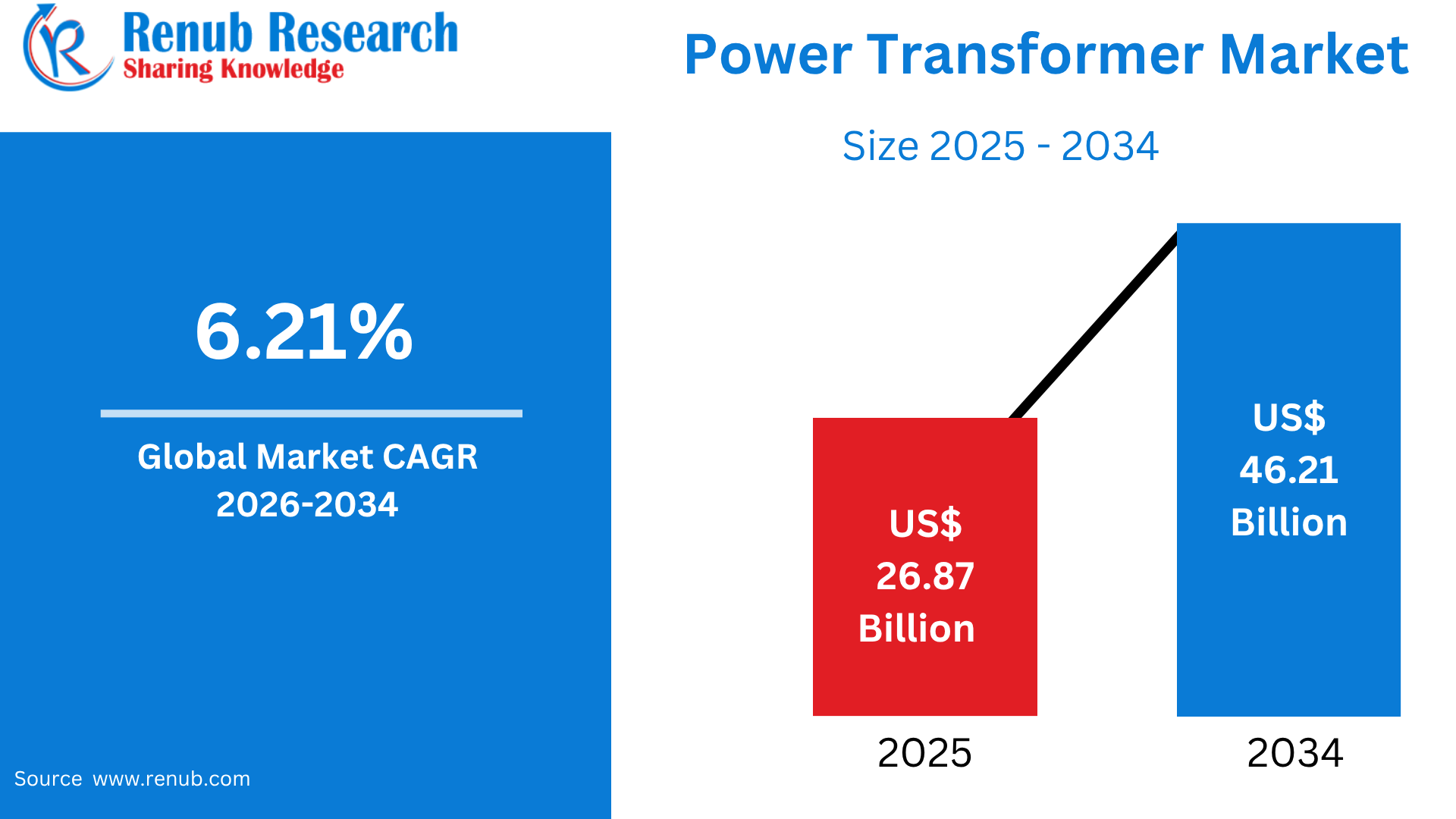
Power Transformer Market is poised for sustained growth, driven by rising global electricity demand, ongoing expansion of transmission and distribution networks, and increasing investments in renewable energy projects. Power transformers are critical components of electrical grids, enabling the efficient transmission of electricity over long distances by stepping voltage levels up or down to minimize energy losses. The market is projected to grow from US$ 26.87 billion in 2025 to US$ 46.21 billion by 2034, registering a compound annual growth rate (CAGR) of 6.21% during the forecast period from 2026 to 2034. Growth is further supported by grid modernization initiatives, rapid urbanization, industrial expansion, and the integration of renewable power sources into national electricity networks worldwide.
What is a Power Transformer and Its Uses & Popularity Worldwide
A power transformer is a high-capacity electrical device used to transfer electrical energy between circuits by electromagnetic induction while changing voltage levels to enable efficient power transmission and distribution. Installed mainly in power generation stations, transmission substations, and industrial facilities, power transformers step up voltage for long-distance electricity transmission to reduce energy losses and step down voltage for safe distribution to utilities and end users. They are essential components of national power grids, supporting reliable electricity delivery across residential, commercial, and industrial sectors.
Power transformers are widely used in thermal, hydroelectric, nuclear, wind, and solar power plants, as well as in manufacturing facilities, data centers, mining operations, and transportation infrastructure. Their global popularity has increased due to rising electricity demand, rapid urbanization, industrialization, and investments in renewable energy integration and grid modernization. The expansion of smart grids, high-voltage transmission networks, and cross-border power interconnections has further strengthened demand for advanced power transformers. Improved insulation materials, digital monitoring systems, and energy-efficient transformer designs are enhancing operational reliability, reducing maintenance costs, and supporting the transition toward cleaner and more resilient electrical infrastructure worldwide.
Global Electricity Generation by Region (2015–2025) – Key Highlights
- Global electricity generation increased steadily from approximately 24,000 TWh in 2015 to nearly 32,000 TWh in 2025, reflecting growing worldwide electricity demand.
- Asia remained the largest electricity-producing region throughout the period, contributing more than 50% of global electricity generation by 2025.
- Asia’s electricity generation increased significantly, rising from approximately 10,500 TWh in 2015 to over 16,500 TWh in 2025, driven by industrialization, urbanization, and population growth.
- North America remained the second-largest contributor, maintaining relatively stable generation at around 5,000–5,500 TWh annually.
- Europe’s electricity generation remained relatively stable, contributing approximately 3,500–4,000 TWh each year despite increasing renewable energy adoption.
- The Commonwealth of Independent States (CIS) recorded gradual growth, generating roughly 1,400–1,700 TWh over the study period.
- Latin America experienced moderate growth, increasing electricity generation from approximately 1,500 TWh in 2015 to around 1,900 TWh by 2025.
- Africa showed steady expansion, although it remained one of the smallest contributors, with generation increasing from roughly 600 TWh to approximately 900 TWh.
- The Pacific region recorded gradual increases in electricity production, supported by economic growth and expanding energy infrastructure.
- The Middle East demonstrated consistent growth, rising from approximately 1,000 TWh in 2015 to nearly 1,500 TWh in 2025 due to increasing electricity demand, urban development, and industrial expansion.
- A slight slowdown is visible around 2020, reflecting the impact of the COVID-19 pandemic on industrial and commercial electricity consumption before demand rebounded strongly in subsequent years.
- Overall trend: The chart highlights that Asia is the primary driver of global electricity generation growth, while emerging regions such as Africa, Latin America, and the Middle East continue to expand their electricity production alongside investments in power infrastructure and economic development.
Growth Drivers of the Power Transformer Market
Rising Global Electricity Demand and Grid Expansion Fueling Market Growth
The increasing global demand for electricity is one of the strongest growth drivers for the power transformer market. Rapid urbanization, industrialization, population growth, and electrification are placing greater pressure on national power grids, requiring investments in new transmission and distribution infrastructure. Global electricity consumption continues to rise by approximately 2–3% annually, while developing economies are expanding power generation capacity to meet growing residential and industrial demand. Power transformers are critical for stepping up voltage at generation stations and stepping it down for efficient distribution with minimal transmission losses. Countries are investing in high-voltage transmission lines, smart grids, and cross-border interconnections to improve grid reliability and energy security. Industrial sectors such as manufacturing, mining, data centers, and electric vehicle charging infrastructure also require stable electricity supplies supported by high-capacity transformers. Continuous investments in utility modernization and replacement of aging transmission equipment are expected to sustain long-term demand for power transformers across developed and emerging economies.
Renewable Energy Integration Driving High-Capacity Transformer Deployment
The rapid expansion of renewable energy projects is significantly increasing demand for modern power transformers worldwide. Wind farms, solar parks, hydroelectric plants, and offshore renewable installations require transformers to efficiently transmit generated electricity into national grids. Global renewable energy capacity now exceeds 4,000 GW, with hundreds of gigawatts of new renewable capacity being added every year. Since renewable generation facilities are often located far from consumption centers, high-voltage power transformers are essential for long-distance electricity transmission while minimizing energy losses. Grid operators are also upgrading substations and transmission infrastructure to accommodate fluctuating renewable energy generation and maintain grid stability. Advanced transformers with improved insulation systems, digital monitoring capabilities, and higher energy efficiency are becoming increasingly important for renewable integration. Government decarbonization policies, net-zero emission targets, and increasing investments in clean energy infrastructure continue to accelerate deployment of power transformers, making renewable energy expansion one of the most significant long-term growth drivers for the global market.
Grid Modernization and Smart Infrastructure Investments Accelerating Demand
Power utilities across the world are investing heavily in grid modernization programs to improve electricity reliability, efficiency, and resilience. Many transmission networks currently operate with aging transformers that have been in service for 30–40 years, increasing maintenance requirements and operational risks. Replacement of aging infrastructure with digitally connected, energy-efficient power transformers is becoming a strategic priority for utilities. Smart transformers equipped with sensors, remote monitoring systems, Internet of Things (IoT) connectivity, and predictive maintenance software enable real-time performance monitoring and reduce unexpected equipment failures. Increasing electrification of transportation, expansion of electric vehicle charging networks, growth of data centers, and development of smart cities are further driving investments in advanced transmission infrastructure. Governments and utilities are allocating substantial capital toward transmission upgrades, substation automation, and grid resilience against extreme weather events. These modernization initiatives are expected to generate sustained demand for high-performance power transformers over the next decade.
Power Transformer Launches Worldwide
1. Hitachi Energy – TXpert™ Hub Digital Transformer Monitoring Platform (2024)
Company: Hitachi Energy
Launch Year: 2024
Hitachi Energy introduced the latest version of its TXpert™ Hub digital monitoring platform for power transformers. The solution combines real-time transformer monitoring, predictive maintenance, cloud connectivity, and artificial intelligence (AI) analytics to improve asset reliability and reduce unexpected failures. It enables utilities to optimize transformer performance and extend equipment life while supporting smart grid modernization and renewable energy integration.
2. Siemens Energy – CAREPOLE Distribution Transformer (2024)
Company: Siemens Energy
Launch Year: 2024
Siemens Energy expanded its transformer portfolio with the CAREPOLE environmentally friendly distribution transformer. The transformer is designed using biodegradable insulating fluid and energy-efficient core materials, reducing environmental impact while improving operational efficiency. It is intended for utilities, commercial buildings, and renewable energy installations seeking sustainable grid solutions.
3. GE Vernova – Flexible AC Transmission (FACTS) Grid Transformer Solutions (2024)
Company: GE Vernova
Launch Year: 2024
GE Vernova introduced advanced grid transformer solutions integrated with Flexible AC Transmission Systems (FACTS) to improve voltage stability and grid reliability. These transformers are designed to support renewable energy integration, high-voltage transmission networks, and increasing electricity demand while enhancing overall power system efficiency.
4. Hitachi Energy – EconiQ™ 420 kV Power Transformer (2025)
Company: Hitachi Energy
Launch Year: 2025
Hitachi Energy launched the EconiQ™ 420 kV power transformer, designed to reduce environmental impact by using sustainable insulation technologies and eco-efficient materials. The transformer supports ultra-high-voltage transmission projects, renewable energy integration, and carbon reduction initiatives while maintaining high operational reliability.
5. Siemens Energy – Blue Portfolio Grid Transformer (2025)
Company: Siemens Energy
Launch Year: 2025
Siemens Energy expanded its Blue Portfolio with next-generation power transformers designed for low-carbon electricity networks. These transformers incorporate advanced insulation systems, digital monitoring sensors, and reduced lifecycle emissions, making them suitable for smart grids, offshore wind farms, and utility-scale renewable projects.
6. Toshiba Energy Systems – 500 kV Digital Power Transformer (2025)
Company: Toshiba Energy Systems & Solutions
Launch Year: 2025
Toshiba introduced a 500 kV digital power transformer equipped with online condition monitoring, intelligent diagnostics, and predictive maintenance capabilities. The transformer is designed for high-voltage transmission networks, improving operational reliability while reducing maintenance costs for electric utilities.
7. CG Power & Industrial Solutions – Next-Generation Green Power Transformer (2025)
Company: CG Power & Industrial Solutions
Launch Year: 2025
CG Power launched a new generation of energy-efficient green power transformers featuring low-loss core technology, biodegradable ester insulation fluid, and enhanced thermal performance. The product is designed for utilities, renewable energy plants, and industrial power distribution systems aiming to reduce carbon emissions.
8. Hyosung Heavy Industries – 765 kV Ultra High Voltage Power Transformer (2026)
Company: Hyosung Heavy Industries
Launch Year: 2026
Hyosung introduced its latest 765 kV ultra-high-voltage power transformer, developed for long-distance electricity transmission and large-scale renewable energy integration. The transformer offers improved insulation, higher efficiency, advanced cooling systems, and digital asset monitoring to support national transmission grid expansion.
9. Mitsubishi Electric – Digital Smart Power Transformer Series (2026)
Company: Mitsubishi Electric
Launch Year: 2026
Mitsubishi Electric launched a Digital Smart Power Transformer series featuring IoT-enabled monitoring, AI-assisted diagnostics, cloud-based asset management, and real-time health analysis. The transformers are designed to improve operational efficiency, reduce downtime, and support predictive maintenance for modern electricity networks.
10. Bharat Heavy Electricals Limited (BHEL) – 765 kV Indigenous Power Transformer (2026)
Company: Bharat Heavy Electricals Limited (BHEL)
Launch Year: 2026
BHEL introduced a new 765 kV indigenous power transformer developed for India’s expanding high-voltage transmission infrastructure. The transformer incorporates advanced insulation technology, improved cooling systems, reduced transmission losses, and digital monitoring features. It supports grid modernization, renewable energy integration, and the country’s growing electricity demand through domestically developed high-capacity transformer technology.
Challenges of the Power Transformer Market
High Manufacturing Costs and Volatile Raw Material Prices
One of the major challenges facing the power transformer market is the high manufacturing cost associated with large-capacity transformers. Power transformers require significant quantities of copper, electrical steel, aluminum, transformer oil, insulation materials, and specialized components. Raw materials account for nearly 60–70% of total transformer manufacturing costs, making profitability highly sensitive to fluctuations in commodity prices. Global supply chain disruptions, geopolitical tensions, and inflation have contributed to increasing prices of electrical steel and copper in recent years, raising production expenses for manufacturers. In addition, large transformers require customized engineering, extensive factory testing, and complex transportation logistics, resulting in long production cycles that may range from several months to over one year. Utility companies often face budget constraints when replacing aging infrastructure, delaying procurement decisions. These cost pressures create challenges for both manufacturers and electricity providers while limiting rapid deployment of new transformer installations.
Supply Chain Constraints and Long Equipment Delivery Timelines
The power transformer industry faces ongoing supply chain challenges due to increasing global demand and limited manufacturing capacity for high-voltage transformers. Large power transformers require specialized production facilities, highly skilled engineering expertise, and stringent quality testing before deployment. Manufacturing lead times commonly range from 9 to 18 months, while extra-high-voltage transformers may require even longer delivery periods because of their customized designs. Transportation also presents significant logistical challenges, as many transformers weigh 100–400 metric tons, requiring specialized vehicles, rail transport, or heavy-lift shipping equipment. Delays in obtaining electrical steel, semiconductor-based monitoring systems, insulation materials, and other critical components further extend project timelines. Additionally, geopolitical uncertainties, trade restrictions, and shortages of skilled labor continue to affect manufacturing schedules worldwide. These supply chain bottlenecks can postpone grid expansion projects, renewable energy integration, and replacement of aging transmission infrastructure, creating a significant obstacle to sustained growth in the global power transformer market.
Growing Demand for Robust and High-Capacity Grid Infrastructure
Shell Power Transformers market is expanding steadily due to increasing investments in high-voltage transmission networks, utility substations, and industrial power distribution systems. Shell-type transformers feature windings enclosed by the magnetic core, providing superior mechanical strength, enhanced short-circuit resistance, and excellent voltage regulation. These transformers are widely used in power generation plants, steel manufacturing, mining, railways, petrochemical industries, and large commercial facilities where operational reliability is critical. Globally, electricity demand continues to increase by nearly 2–3% annually, encouraging utilities to strengthen transmission infrastructure with durable transformer technologies. Shell transformers are particularly suitable for high-current applications because they offer lower leakage flux, improved thermal performance, and better fault tolerance than many conventional designs. Manufacturers are incorporating advanced insulation systems, biodegradable insulating fluids, digital monitoring sensors, and predictive maintenance technologies to improve operational efficiency. Increasing investments in smart grids, renewable energy integration, and replacement of aging transmission equipment are expected to support sustained demand for shell power transformers worldwide.
Eco-Friendly Insulation Technologies Supporting Gas Power Transformers Market Growth
Gas Power Transformers market is gaining momentum as utilities and industries seek environmentally friendly alternatives to conventional oil-filled transformers. Gas-insulated transformers primarily use sulfur hexafluoride (SF₆) alternatives or environmentally safer insulating gas mixtures to provide high dielectric strength while reducing fire risks and minimizing environmental contamination. These transformers are increasingly deployed in densely populated urban areas, underground substations, airports, tunnels, offshore platforms, and commercial buildings where safety and space optimization are essential. Urbanization is expected to exceed 68% of the global population by 2050, increasing demand for compact and fire-resistant electrical infrastructure. Gas power transformers require less maintenance, produce lower fire hazards, and operate effectively in confined installations compared to traditional oil-filled units. Continuous technological improvements in gas insulation materials, digital monitoring systems, and environmentally sustainable dielectric gases are further enhancing product performance. Rising investments in smart cities, metro rail projects, renewable energy infrastructure, and high-density commercial developments continue to drive adoption of gas power transformers globally.
Reliable Power Distribution Supporting Industrial and Utility Applications
Single Power Transformers market continues to grow due to increasing demand for reliable electricity transmission and distribution across industrial facilities, commercial establishments, and utility networks. Single-phase power transformers are widely used in rural electrification, residential distribution systems, renewable energy projects, railway signaling, telecommunications infrastructure, and light industrial operations. They efficiently transfer electrical energy while minimizing transmission losses and maintaining stable voltage levels. Global electrification initiatives continue expanding electricity access to millions of households, increasing deployment of single-phase transformer installations in distribution networks. These transformers are valued for their relatively simple construction, cost-effectiveness, ease of maintenance, and high operational reliability. Growing investments in distributed renewable generation, rooftop solar installations, electric vehicle charging stations, and decentralized power systems are creating additional demand. Manufacturers are introducing compact transformer designs with improved insulation materials, lower core losses, enhanced cooling technologies, and digital monitoring capabilities, ensuring greater efficiency and longer operational life across diverse electrical applications.
Ultra-High Capacity Transmission Projects Driving Demand
501 MVA to 800 MVA Power Transformers market is expanding due to rising investments in ultra-high-voltage transmission networks, large-scale renewable energy projects, and high-capacity power generation facilities. Transformers within this capacity range are essential for transmitting electricity over long distances while minimizing transmission losses and ensuring stable grid operation. They are commonly installed in nuclear power plants, hydroelectric stations, thermal power facilities, offshore wind farms, and national transmission substations operating at 220 kV, 400 kV, 500 kV, and above. Increasing electricity demand from rapidly urbanizing and industrializing economies is encouraging utilities to develop larger transmission infrastructure capable of handling higher power loads. These transformers incorporate advanced cooling systems, high-performance insulation materials, online condition monitoring, and digital protection technologies to improve operational efficiency and reliability. Expansion of cross-border electricity interconnections, renewable energy integration, and replacement of aging high-voltage transmission assets continue to create strong long-term growth opportunities for transformers within the 501 MVA to 800 MVA capacity segment.
Commercial Infrastructure Expansion Strengthening Market Growth
Commercial Power Transformers market is experiencing consistent growth due to increasing construction of office buildings, shopping malls, hospitals, hotels, educational institutions, airports, data centers, and mixed-use commercial developments worldwide. Commercial transformers provide reliable voltage regulation and uninterrupted electricity supply for lighting systems, HVAC equipment, elevators, communication networks, security systems, and information technology infrastructure. Rapid urbanization, rising commercial real estate investments, and expansion of digital infrastructure are significantly increasing electricity consumption in commercial facilities. Modern commercial buildings increasingly require energy-efficient electrical equipment capable of supporting intelligent building management systems and renewable energy integration. Power transformers equipped with low-loss magnetic cores, advanced cooling technologies, digital monitoring sensors, and IoT-enabled predictive maintenance systems help improve operational efficiency while reducing maintenance costs. Growing adoption of green buildings, smart commercial complexes, electric vehicle charging infrastructure, and distributed solar power systems is further driving demand for advanced commercial power transformers. Continued investment in urban infrastructure and energy-efficient commercial facilities is expected to sustain long-term market expansion.
Grid Modernization and Renewable Energy Expansion Driving United States Market Growth
United States power transformer market is expanding steadily due to increasing investments in transmission infrastructure, renewable energy integration, and modernization of the aging electrical grid. A significant portion of the country’s high-voltage transformers has been operating for 30–40 years, creating strong demand for replacement and grid reliability upgrades. The U.S. generates more than 4,000 terawatt-hours (TWh) of electricity annually, requiring extensive transmission and distribution infrastructure supported by high-capacity power transformers. Rising electricity demand from data centers, electric vehicle (EV) charging networks, advanced manufacturing facilities, and digital infrastructure is further driving transformer installations. Utility companies are increasingly deploying energy-efficient transformers equipped with digital monitoring, IoT sensors, and predictive maintenance technologies to improve operational efficiency and reduce downtime. Expansion of wind and solar power projects, combined with investments in high-voltage substations and interstate transmission networks, continues to strengthen market growth. Government infrastructure spending and grid resilience initiatives are expected to sustain long-term demand for advanced power transformers across the United States.
Net-Zero Energy Goals and Grid Reinforcement Supporting United Kingdom Demand
United Kingdom power transformer market is witnessing steady growth, driven by renewable energy expansion, electricity network upgrades, and the country’s commitment to achieving net-zero carbon emissions. Offshore wind projects, solar installations, and battery energy storage systems require advanced power transformers to integrate renewable electricity into the national grid efficiently. The UK generates more than 300 TWh of electricity annually, while electricity demand from electric vehicles, commercial buildings, and digital infrastructure continues to increase. National Grid modernization programs are replacing aging transmission equipment with energy-efficient transformers featuring improved insulation systems, digital monitoring, and remote asset management capabilities. High-voltage transformers are also being deployed for offshore wind transmission, interconnectors with neighboring countries, and smart grid development. Growing investment in railway electrification, urban infrastructure, and industrial decarbonization further supports transformer demand. Continued government investment in clean energy infrastructure and transmission capacity expansion is expected to drive sustained growth in the UK power transformer market.
Rapid Electrification and Infrastructure Development Fueling India Expansion
India’s power transformer market is experiencing strong growth due to rapid urbanization, industrialization, expanding electricity generation, and continuous investment in transmission and distribution infrastructure. India has an installed electricity generation capacity exceeding 480 GW, making expansion of high-voltage transmission networks essential for reliable nationwide power delivery. Government initiatives to strengthen rural electrification, modernize substations, and reduce transmission losses are increasing deployment of energy-efficient power transformers across the country. Large-scale renewable energy projects, including solar parks and wind farms, require high-capacity transformers to connect new generation facilities with national and state electricity grids. Increasing electricity demand from manufacturing industries, commercial developments, metro rail systems, and data centers is also driving market expansion. Manufacturers are introducing transformers with lower core losses, biodegradable insulating fluids, digital monitoring systems, and enhanced cooling technologies to improve efficiency and reliability. Continued investment in smart grids, renewable energy integration, and transmission corridor expansion is expected to position India among the fastest-growing power transformer markets globally.
Vision 2030 Infrastructure Projects Driving Transformer Demand in Saudi Arabia
Saudi Arabia’s power transformer market is growing steadily due to major investments in electricity infrastructure, industrial diversification, and renewable energy development under Vision 2030. Rising electricity consumption from expanding cities, industrial zones, petrochemical complexes, and large-scale infrastructure projects is increasing demand for high-capacity transmission equipment. The Kingdom has an installed power generation capacity of more than 90 GW, requiring continuous expansion and modernization of substations and transmission networks. Large projects such as NEOM, new industrial cities, metro systems, and utility-scale solar and wind power developments are driving deployment of advanced power transformers. Utilities are increasingly adopting digitally monitored, high-efficiency transformers to improve grid reliability, minimize transmission losses, and support smart grid implementation. Growing investments in hydrogen production, desalination plants, and industrial manufacturing further strengthen demand for reliable power transmission infrastructure. Continued government funding, expansion of renewable energy capacity, and modernization of the national electricity grid are expected to support sustained growth of the Saudi Arabian power transformer market over the coming decade.
Segmentation Market
Core
- Closed
- Shell
- Berry
Insulation
- Gas
- Oil
- Solid
- Air
- Others
Phase :
- Single
- Three
Power Rating
- 100 MVA To 500 MVA
- 501 MVA To 800 MVA
- 801 MVA To 1200 MVA
Application
- Industrial
- Residential and Commercial
- Utilities
Countries
North America
- United States
- Canada
Europe
- France
- Germany
- Italy
- Spain
- United Kingdom
- Belgium
- Netherlands
- Turkey
Asia Pacific
- China
- Japan
- India
- Australia
- South Korea
- Thailand
- Malaysia
- Indonesia
- New Zealand
Latin America
- Brazil
- Mexico
- Argentina
Middle East & Africa
- South Africa
- Saudi Arabia
- UAE
All the Key players have been covered from 5 Viewpoints:
- Overviews
- Key Person
- Recent Developments
- SWOT Analysis
- Revenue Analysis
Competitive Landscape
- Bharat Heavy Electricals Limited
- Daihen Corporation
- General Electric Company
- Hitachi Ltd.
- Hyosung Heavy Industries Corporation
- Hyundai Electric & Energy Systems Co. Ltd.
- Kirloskar Electric Co. Ltd.
- Mitsubishi Electric Power Products Inc. (Mitsubishi Electric Corporation)
- Schneider Electric Se
- Siemens Energy AG
Report Details:
| Report Features | Details |
| Base Year |
2025 |
| Historical Period |
2022 - 2025 |
| Forecast Period |
2026 - 2034 |
| Market |
US$ Billion |
| Segment Covered |
Core, Insulation, Phase, Power Rating, Application and Countries |
| Countries Covered |
|
| Companies Covered |
|
| Customization Scope |
20% Free Customization |
| Post-Sale Analyst Support |
1 Year (52 Weeks) |
| Delivery Format |
PDF and Excel through Email (We can also provide the editable version of the report in PPT/Word format on request) |
Customization Services available
- Analysis of Market Size and Its Segments
- More Company Profiles (Upto 10 without any additional cost):
- Additional Countries (Other than mentioned Countries):
- Region/Country Specific Reports:
- Market Entry Strategy:
- Region-Specific Market Dynamics:
- Regional Market Share Analysis:
- Trade Analysis:
- Production Insights:
- Others Customized Requests:
For more information contact our analysts.
Need More Assistance?
- Talk to our analysts to get more precious information on the current market trends.
- Include more countries and segments and customize the report based on the final requirement.
- Get a competitive advantage in your industry by knowing the report findings and making a positive impact on your revenues and operations.
- Our analysts are always ready to provide more help and pertinent information if you need any additional assistance.