Point of Sale (POS) Terminal Market Size, Share, Growth, Trends, Industry Analysis & Forecast 2026–2034
Buy NowPoint of Sale Terminal Market Size & Forecast
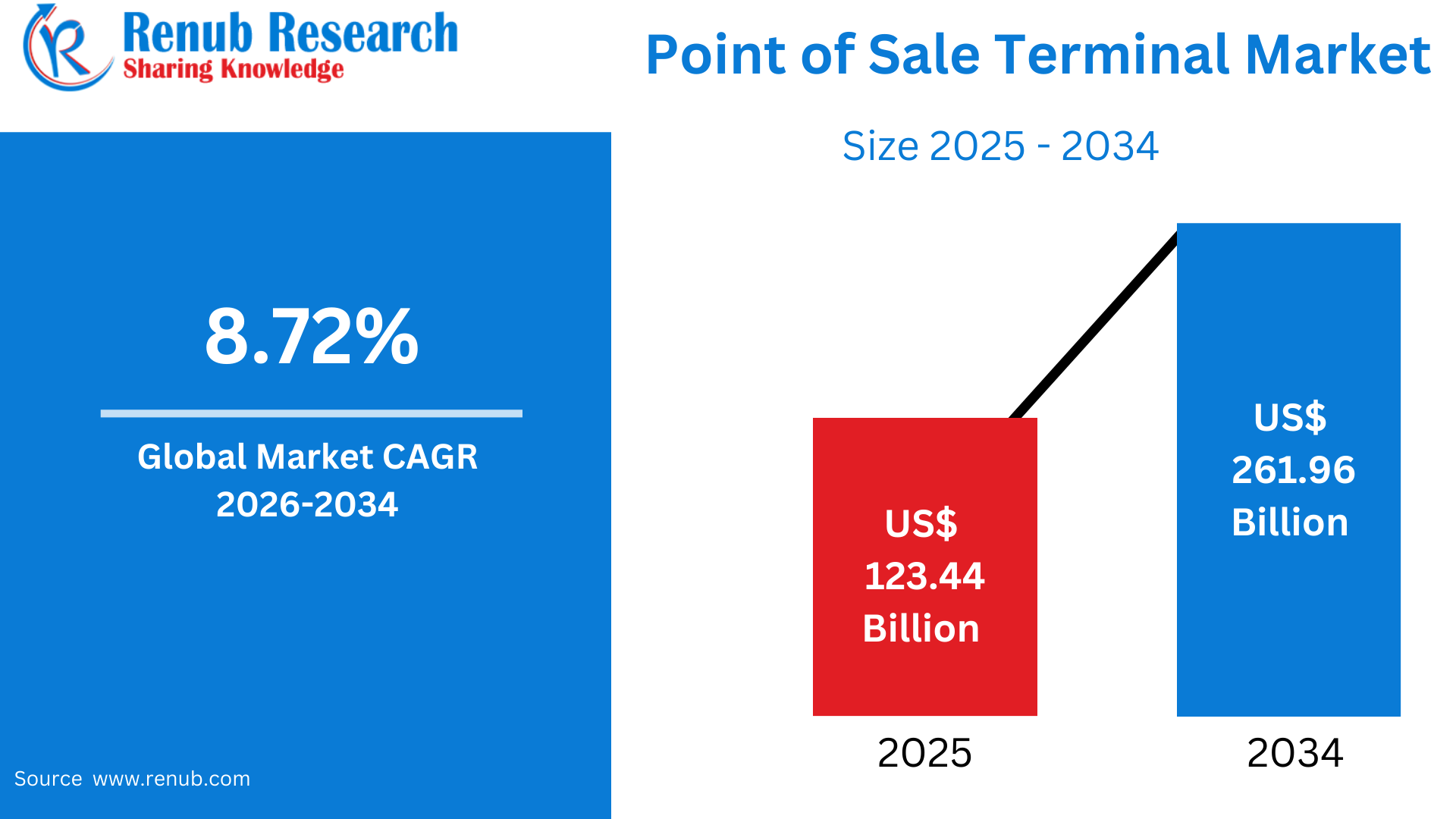
The global Point of Sale (POS) Terminal Market is expected to witness robust growth, supported by the accelerating shift toward digital payment methods, rapid expansion of the retail and hospitality sectors, and increasing deployment of cloud-enabled and mobile POS solutions. Rising demand for secure, fast, and integrated payment processing systems is encouraging businesses to modernize their transaction infrastructure. Furthermore, advancements in payment technologies and omnichannel commerce are creating significant growth opportunities. The market is projected to grow from US$ 123.44 billion in 2025 to US$ 261.96 billion by 2034, registering a CAGR of 8.72% during 2026–2034.
Point of Sale Terminal Overview and Demands
A Point of Sale (POS) terminal is an integrated hardware and software system that enables businesses to process customer payments while managing various sales-related operations. Modern POS terminals support multiple payment methods, including debit and credit cards, contactless transactions, digital wallets, QR code payments, and cash. Beyond payment processing, these systems offer functionalities such as inventory tracking, sales reporting, customer relationship management (CRM), receipt generation, and seamless integration with accounting and enterprise management software. Available in fixed, mobile, tablet-based, and cloud-based configurations, POS terminals are designed to meet the operational requirements of businesses of all sizes across diverse industries.
The global adoption of POS terminals has increased significantly due to the rapid transition toward digital and cashless payment ecosystems. Consumers increasingly prefer secure, fast, and contactless payment options, encouraging merchants to replace traditional cash registers with intelligent POS solutions. The growth of e-commerce, mobile commerce, and omnichannel retailing has further accelerated demand for integrated payment platforms that unify online and offline transactions. In emerging economies, government initiatives promoting digital payments and financial inclusion have encouraged widespread POS adoption among small and medium-sized enterprises (SMEs). Additionally, cloud computing, artificial intelligence, and advanced analytics are transforming POS systems into intelligent business management platforms that enhance operational efficiency and customer experience.
UPI Payments in India (2025-2026)
|
Month |
No. of Banks Live on UPI |
Transaction Volume (Mn.) |
Transaction Value (₹ Cr.) |
|
Mar-26 |
705 |
22,641.11 |
29,52,542.05 |
|
Feb-26 |
694 |
20,394.18 |
26,84,229.29 |
|
Jan-26 |
691 |
21,703.44 |
28,33,481.22 |
|
Dec-25 |
685 |
21,634.67 |
27,96,712.73 |
|
Nov-25 |
684 |
20,466.98 |
26,31,632.63 |
|
Oct-25 |
683 |
20,700.92 |
27,27,790.68 |
|
Sep-25 |
686 |
19,633.43 |
24,89,736.54 |
|
Aug-25 |
688 |
20,008.31 |
24,85,472.91 |
|
Jul-25 |
684 |
19,467.95 |
25,08,498.09 |
|
Jun-25 |
675 |
18,395.01 |
24,03,930.69 |
|
May-25 |
673 |
18,677.46 |
25,14,297.01 |
|
Apr-25 |
668 |
17,893.42 |
23,94,925.87 |
Key Growth Drivers
Increasing Preference for Cashless and Contactless Payments
The worldwide transition toward digital payment methods remains one of the strongest drivers of the POS terminal market. Consumers increasingly prefer credit cards, debit cards, mobile wallets, QR-code payments, and NFC-enabled contactless transactions because of their speed, convenience, and security. Governments and financial institutions continue to encourage cashless transactions to improve financial inclusion, increase transparency, and reduce dependence on physical cash. Consequently, businesses across retail, hospitality, healthcare, and transportation are upgrading to advanced POS systems capable of supporting multiple digital payment options. The COVID-19 pandemic further accelerated the adoption of touch-free payment technologies, creating lasting changes in consumer payment behavior. Reflecting this trend, CaixaBank became the first financial institution in Spain to introduce Tap to Pay on iPhone in June 2025, allowing merchants to accept contactless payments directly through an iPhone without additional payment hardware.
Expansion of Retail, Hospitality, and Service Industries
The continued growth of retail stores, supermarkets, restaurants, cafés, hotels, and other service-oriented businesses is driving demand for modern POS terminals worldwide. These industries require efficient payment processing solutions capable of managing high transaction volumes while improving customer service and operational efficiency. Emerging economies are witnessing rapid growth in organized retail and small businesses, creating additional opportunities for POS deployment. Advanced POS systems now combine payment processing with inventory management, sales analytics, customer loyalty programs, and business reporting, enabling organizations to streamline operations. Furthermore, increasing adoption of omnichannel retail strategies, including click-and-collect and integrated online-offline shopping experiences, is boosting demand for flexible POS platforms. For example, Banner Health introduced a cashless payment system across its facilities in December 2025, enhancing operational efficiency, improving security, and offering patients and visitors more convenient payment options.
Advancements in Cloud-Based and Smart POS Technologies
Continuous technological innovation is transforming traditional POS terminals into intelligent, cloud-connected business management platforms. Cloud-based POS solutions provide real-time access to business data, remote system management, automatic software updates, and seamless integration with accounting, inventory, and customer loyalty applications. Mobile and tablet POS terminals offer greater portability, affordability, and operational flexibility, making them particularly attractive to small businesses and mobile retailers. Artificial intelligence is also enabling merchants to analyze customer purchasing behavior, optimize inventory, and personalize marketing strategies. Supporting this digital transformation, SAP introduced a cloud-based version of its Customer Checkout solution, enabling businesses to deploy scalable omnichannel POS systems with native integration into SAP S/4HANA and the SAP Business Technology Platform, thereby accelerating digital retail transformation.
Point of Sale Terminal Product Launches Worldwide
- May 2025 – Square launched Square Handheld, a portable all-in-one POS device featuring an integrated payment terminal, barcode scanner, and inventory management capabilities for retail and hospitality businesses.
- April 2025 – Ingenico introduced AXIUM DX8000, a next-generation Android smart POS terminal offering enhanced security, cloud connectivity, and support for integrated business applications.
- April 2025 – Ingenico and Visa Cybersource launched a pre-integrated payment application for AXIUM terminals, enabling merchants to accelerate deployment and reduce payment certification time.
- June 2025 – CaixaBank launched Tap to Pay on iPhone for business customers in Spain, allowing merchants to accept contactless payments directly on compatible iPhones without additional POS hardware.
- January 2025 – PAX Technology launched the A920MAX SmartPOS, an Android-based mobile payment terminal featuring a larger touchscreen, high-speed processing, and support for NFC, QR code, and mobile wallet payments.
- October 2024 – Verifone introduced the Victa Portfolio, a new family of Android-based payment terminals designed with enhanced security, flexible connectivity, and cloud-native payment capabilities for retailers.
- September 2024 – Newland NPT launched the N950 Smart POS Terminal, combining biometric authentication, Android OS, high-speed payment processing, and multi-payment acceptance in a compact device.
- June 2024 – Diebold Nixdorf launched the DN Series® BEETLE M2110, a modular POS terminal designed to improve checkout efficiency, simplify maintenance, and support omnichannel retail environments.
- April 2024 – Oracle introduced enhanced Oracle MICROS Simphony POS capabilities with AI-powered analytics, expanded cloud functionality, and improved restaurant management features for hospitality businesses.
- February 2024 – Toshiba Global Commerce Solutions launched the TCx® 820 All-in-One POS System, providing retailers with a compact, high-performance POS platform featuring advanced processing, flexible peripheral integration, and enhanced durability for high-volume retail environments.
Key Challenges
High Implementation Costs and System Integration Challenges
The significant upfront investment required for POS hardware, software licenses, installation, and employee training remains a major obstacle, particularly for small and medium-sized businesses. Integrating modern POS systems with existing inventory management, enterprise resource planning (ERP), accounting, and customer management platforms can be complex, time-consuming, and resource-intensive. Additionally, recurring expenses associated with software subscriptions, cloud services, maintenance, and system upgrades increase the overall cost of ownership, limiting adoption among budget-conscious organizations.
Cybersecurity Threats and Data Privacy Issues
As POS terminals process sensitive financial and customer information, they remain attractive targets for cybercriminals seeking to exploit payment systems through hacking, malware, fraud, and data breaches. Businesses must comply with stringent security standards, including the Payment Card Industry Data Security Standard (PCI DSS), requiring continuous investment in cybersecurity technologies, encryption, and fraud prevention measures. Growing concerns regarding customer data privacy and increasingly strict regulatory requirements further complicate system management. Any security breach or compliance failure can damage brand reputation, reduce consumer trust, and result in significant financial and legal consequences.
Component Insights
Point of Sale (POS) Terminal Software
The POS terminal software market comprises applications that enable payment processing, inventory management, sales reporting, customer relationship management (CRM), and business analytics. Modern POS software has evolved beyond basic billing systems into comprehensive business management platforms that support data-driven decision-making. Market growth is fueled by increasing demand for real-time business insights, omnichannel commerce integration, and customizable software tailored to industry-specific requirements. Cloud-based and subscription-based deployment models are gaining widespread popularity due to their lower initial investment, automatic updates, and remote accessibility. Integration with accounting software, loyalty programs, digital payment gateways, and enterprise applications further enhances operational efficiency, making POS software an essential component of modern retail and service businesses.
Point of Sale (POS) Terminal Services
The POS terminal services market includes system installation, integration, maintenance, technical support, employee training, and managed services. Businesses increasingly rely on specialized service providers to ensure seamless implementation, efficient operation, and ongoing maintenance of POS infrastructure. Rising system complexity, frequent software upgrades, and evolving cybersecurity requirements have significantly increased demand for managed POS services. These services help organizations minimize downtime, maintain regulatory compliance, and reduce dependence on internal IT resources. Small and medium-sized enterprises (SMEs), in particular, are adopting outsourced POS services to improve operational efficiency while lowering technology management costs. As POS technologies continue to advance, demand for comprehensive support services is expected to grow steadily.
Deployment Insights
Cloud Point of Sale (POS) Terminal
The cloud POS market is expanding rapidly as businesses increasingly migrate from traditional on-premise systems to cloud-based payment platforms. Cloud POS solutions provide organizations with remote access to transaction data, centralized management, automatic software updates, and seamless synchronization across multiple business locations. These platforms also deliver enhanced scalability, lower infrastructure costs, and advanced business analytics, enabling organizations to make informed decisions based on real-time operational data. Growing demand for flexible, mobile, and digitally connected business operations continues to accelerate the adoption of cloud-based POS systems across retail, hospitality, healthcare, and other service industries.
End Use Insights
Restaurant Point of Sale (POS) Terminal
The restaurant POS terminal market is driven by the growing need for efficient order processing, payment management, and customer service optimization. Modern restaurant POS systems streamline menu management, kitchen operations, table reservations, billing, and order fulfillment while improving overall operational efficiency. Features such as online ordering, food delivery integration, digital payments, and contactless checkout have become standard requirements across restaurants and cafés. Additionally, mobile POS terminals and self-service kiosks are gaining widespread adoption, particularly among quick-service restaurants (QSRs) and fast-food chains, helping reduce waiting times and improve customer experience.
Healthcare Point of Sale (POS) Terminal
The healthcare POS terminal market encompasses payment solutions used for patient billing, insurance co-payments, pharmacy transactions, and appointment fee collection. Increasing digitalization across healthcare facilities is driving adoption of secure and compliant payment technologies that improve billing accuracy and streamline financial operations. Integration with Electronic Health Records (EHR), Hospital Management Systems (HMS), and pharmacy management platforms further enhances operational efficiency while reducing manual processing errors. As hospitals, clinics, and pharmacies prioritize patient convenience and administrative efficiency, demand for advanced POS terminals continues to increase.
Entertainment Point of Sale (POS) Terminal
The entertainment POS terminal market serves venues such as cinemas, amusement parks, stadiums, concert arenas, and event centers, where efficient transaction processing is essential for managing high customer volumes. POS systems facilitate ticket sales, food and beverage purchases, merchandise transactions, and digital payments while reducing waiting times. Wireless and contactless payment technologies are increasingly adopted to enhance customer convenience and improve operational efficiency. Furthermore, integration with ticketing platforms, customer loyalty programs, and event management systems helps entertainment operators optimize revenue generation and deliver a seamless visitor experience.
Country Insights
United States Point of Sale (POS) Terminal
The United States represents one of the world’s most mature and technologically advanced POS terminal markets, supported by widespread adoption of cashless payment methods, credit and debit cards, mobile wallets, and contactless transactions. Retailers, restaurants, and service providers are increasingly implementing cloud-based and mobile POS solutions to improve operational efficiency and access real-time business insights. Growing adoption of NFC-enabled terminals, self-checkout systems, and integrated POS platforms featuring inventory management and customer relationship management capabilities continues to strengthen market demand. Small and medium-sized businesses are increasingly adopting mobile POS solutions because of their affordability, flexibility, and ease of deployment. In April 2025, Ingenico and Visa Cybersource announced pre-integrated payment applications for AXIUM terminals, reducing merchant onboarding and certification time by approximately 18 months.
United Kingdom Point of Sale (POS) Terminal
The United Kingdom has a highly developed POS terminal market driven by extensive adoption of contactless card payments and digital payment technologies. As one of the world’s leading cashless economies, the country continues to experience strong demand for NFC-enabled payment terminals across retail and service industries. Small businesses and independent retailers are increasingly adopting mobile and tablet-based POS systems due to their flexibility and affordability. Cloud-based POS platforms are also gaining traction by offering scalable and remotely managed business solutions. Demonstrating ongoing innovation, Square introduced Square Handheld in May 2025, a portable POS device featuring integrated payment processing, barcode scanning, and inventory management capabilities.
China Point of Sale (POS) Terminal
China remains one of the largest and fastest-growing POS terminal markets, driven by its massive retail sector and widespread adoption of digital payment technologies. Despite the dominance of mobile payment platforms, POS terminals continue to play an essential role in supporting QR code payments, credit card transactions, and contactless payment services. Businesses are increasingly adopting cloud-enabled POS systems integrated with artificial intelligence, inventory management, and customer loyalty applications to enhance operational efficiency. Rapid urbanization, retail expansion, and growing numbers of small and medium-sized enterprises further support market growth. In March 2025, China established a dedicated payment service zone along the Central Axis and introduced overseas credit card tap-to-ride metro services for visitors from more than 100 countries, strengthening payment accessibility for international travelers.
Brazil Point of Sale (POS) Terminal
Brazil’s POS terminal market is expanding steadily due to increasing electronic payment adoption and continued growth in the retail and service sectors. Government initiatives promoting financial inclusion and digital payment infrastructure have encouraged widespread deployment of POS terminals, particularly among small and medium-sized enterprises. Card-based transactions remain the dominant payment method, while contactless and mobile payments continue to gain popularity. Affordable mobile POS devices are experiencing strong demand among restaurants, street vendors, and small businesses seeking flexible payment solutions. Although infrastructure limitations and implementation costs remain challenges, expanding urbanization and e-commerce activities are expected to drive long-term market growth.
UAE Point of Sale (POS) Terminal
The United Arab Emirates has emerged as one of the fastest-growing POS terminal markets, supported by strong government initiatives promoting digital transformation and cashless transactions. Industries including retail, hospitality, tourism, transportation, and entertainment are increasingly deploying advanced POS systems to improve payment efficiency and customer experience. High smartphone penetration, widespread adoption of contactless payments, and growing use of mobile wallets are encouraging merchants to upgrade to integrated, cloud-enabled POS platforms. Robust digital infrastructure, strong consumer spending, expanding tourism, and ongoing smart city initiatives continue to create favorable conditions for market growth. Continued investment in digital payment ecosystems is expected to sustain the UAE’s position as a leading regional market for advanced POS solutions.
Market Segmentations
Product
- Fixed
- Mobile
Component
- Hardware
- Software
- Services
Deployment
- On-Premises
- Cloud
End Use
- Restaurants
- Retail
- Healthcare
- Warehouse
- Hospitality
- Entertainment
- Others
Country
North America
- United States
- Canada
Europe
- France
- Germany
- Italy
- Spain
- United Kingdom
- Belgium
- Netherlands
- Turkey
Asia Pacific
- China
- Japan
- India
- South Korea
- Thailand
- Malaysia
- Indonesia
- Australia
- New Zealand
Latin America
- Brazil
- Mexico
- Argentina
Middle East & Africa
- Saudi Arabia
- UAE
- South Africa
All companies have been covered with 5 Viewpoints
- Overviews
- Key Person
- Recent Developments
- SWOT Analysis
- Revenue Analysis
Key Players Analysis
- Samsung Electronics Co. Ltd.
- Panasonic Corporation
- NEC Corporation
- PAX Technology
- NCR Voyix
- Fujitsu Limited
- Agilysys Inc.
- Oracle Corporation
Report Details:
| Report Features | Details |
| Base Year |
2025 |
| Historical Period |
2022 - 2025 |
| Forecast Period |
2026 - 2034 |
| Market |
US$ Billion |
| Segment Covered |
Product, Component, Deployment, End Use and Countries |
| Countries Covered |
|
| Companies Covered |
|
| Customization Scope |
20% Free Customization |
| Post-Sale Analyst Support |
1 Year (52 Weeks) |
| Delivery Format |
PDF and Excel through Email (We can also provide the editable version of the report in PPT/Word format on request) |
Customization Services available
- Analysis of Market Size and Its Segments
- More Company Profiles (Upto 10 without any additional cost):
- Additional Countries (Other than mentioned Countries):
- Region/Country Specific Reports:
- Market Entry Strategy:
- Region-Specific Market Dynamics:
- Regional Market Share Analysis:
- Trade Analysis:
- Production Insights:
- Others Customized Requests:
For more information contact our analysts.
Need More Assistance?
- Talk to our analysts to get more precious information on the current market trends.
- Include more countries and segments and customize the report based on the final requirement.
- Get a competitive advantage in your industry by knowing the report findings and making a positive impact on your revenues and operations.
- Our analysts are always ready to provide more help and pertinent information if you need any additional assistance.