Outdoor LED Lighting Market 2026–2034: Global Size, Share, Growth Trends, Application, Installation, Offering & Country Analysis
Buy NowOutdoor LED Lighting Market Size and Forecast
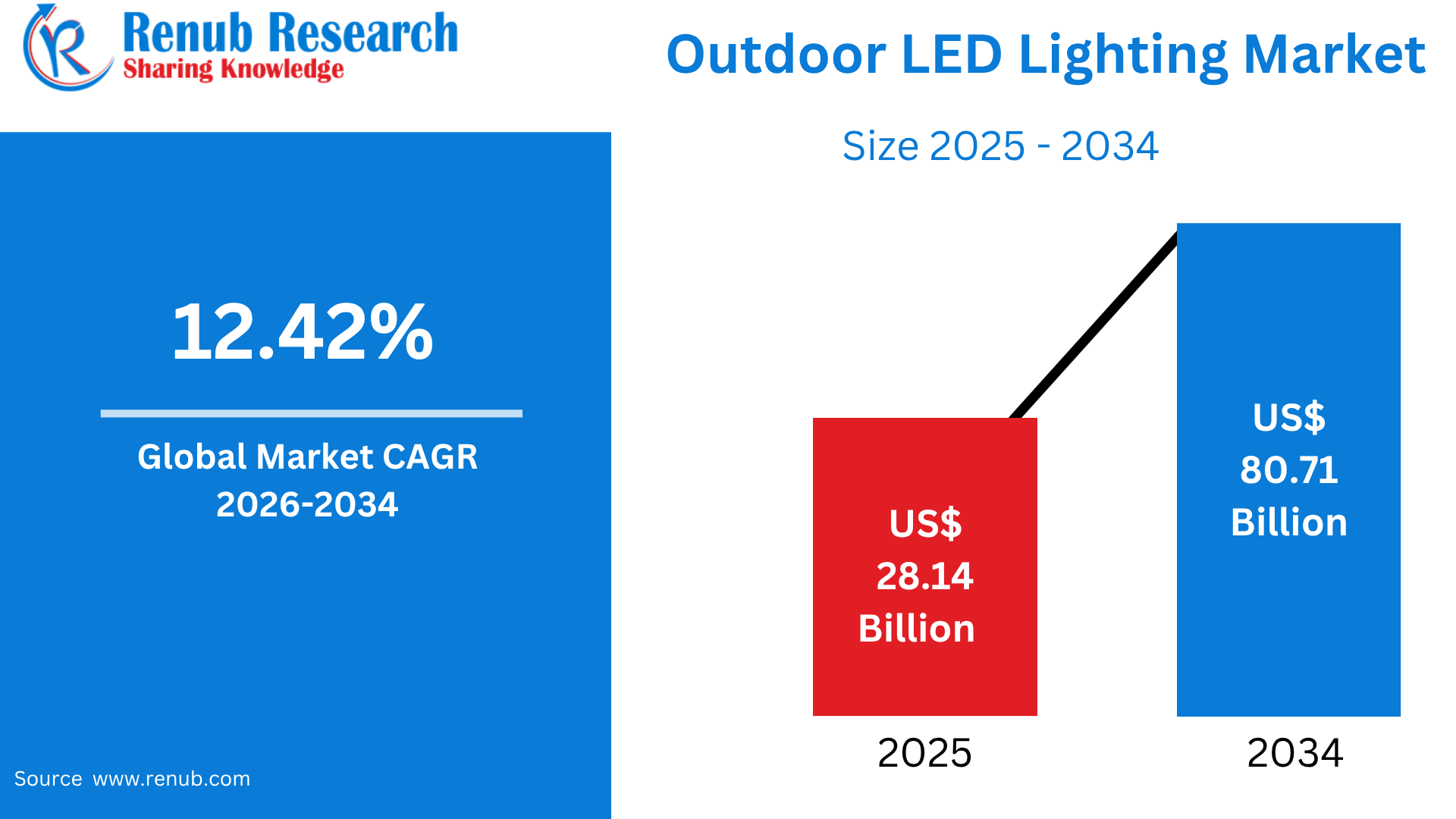
Global outdoor LED lighting market is projected to expand significantly, increasing from US$ 28.14 billion in 2025 to US$ 80.71 billion by 2034, registering a CAGR of 12.42% during 2026–2034. Market growth is being driven by the increasing adoption of energy-efficient lighting solutions, growing investments in smart cities and urban infrastructure, and the replacement of conventional lighting systems with LED technologies. Outdoor LEDs offer longer operational lifespans, lower electricity consumption, and reduced maintenance requirements compared with traditional lighting technologies.
What is Outdoor LED Lighting and Its Uses & Popularity Worldwide?
Outdoor LED lighting refers to lighting systems that use light-emitting diodes (LEDs) to illuminate outdoor environments such as streets, highways, parking areas, parks, commercial properties, sports facilities, public spaces, and building exteriors. Compared with conventional lighting technologies, LED systems offer high energy efficiency, longer operating life, improved illumination, and lower maintenance requirements. Studies indicate that LED lighting can achieve approximately 50–70% energy savings compared with older outdoor lighting technologies, making it attractive for municipalities and businesses seeking to reduce operating costs.
Outdoor LED lighting is widely used for street and roadway illumination, security lighting, architectural and landscape lighting, parking lots, tunnels, bridges, stadiums, airports, and industrial facilities. Smart LED systems can also incorporate sensors, dimming controls, remote monitoring, and IoT connectivity, allowing cities to optimize energy consumption and maintenance.
Its popularity is increasing worldwide because governments and businesses are prioritizing energy efficiency, sustainability, public safety, and smart-city development. The long lifespan of LED luminaires—often exceeding 50,000 hours—further supports adoption by reducing replacement and maintenance costs.
LED Adoption Rates by Sector
2015
Residential: 8%
Commercial: 13%
2020
Residential: 47%
Commercial: 63%
2030 (Projected)
Residential: 90%
Commercial: 95%
Source: U.S. Energy Information Administration, Department of Energy LED Adoption Report, and Inside Lighting, 2024
Growth Drivers of the Outdoor LED Lighting Market
Rising Demand for Energy-Efficient Lighting Solutions
The growing focus on energy conservation and reducing electricity expenditure is a major driver of the outdoor LED lighting market. LED luminaires provide substantially higher efficiency than conventional lighting technologies and can significantly reduce electricity consumption across streets, highways, parking areas, public spaces, and commercial facilities. The International Energy Agency (IEA) estimates that lighting in buildings and outdoor applications accounted for approximately 2,200 TWh, or 8% of global electricity demand, in 2024, highlighting the considerable energy-saving opportunity available through more efficient lighting. Modern LEDs sold today average close to 100 lumens per watt, while premium and professional products can exceed 200 lumens per watt. In the United States, outdoor lighting had already achieved 51.4% LED penetration in 2018, higher than indoor lighting at 29.8%. LEDs also have useful lifetimes of around 30,000–50,000 hours or longer, reducing replacement frequency and maintenance expenses. These benefits encourage municipalities, businesses, and infrastructure developers to replace conventional outdoor lighting with LED systems, supporting sustained market growth.
Smart City Development and Connected Outdoor Lighting
The rapid development of smart cities is creating significant opportunities for outdoor LED lighting because LED luminaires can easily integrate sensors, wireless controls, cameras, and IoT-based management systems. Smart streetlights allow municipalities to remotely monitor lighting performance, adjust brightness according to traffic or environmental conditions, identify faults, and optimize electricity consumption. The IEA estimates that there are approximately 320 million street lighting poles globally, but only around 3% are currently smart enabled, indicating substantial room for future deployment. Smart street lighting can potentially reduce electricity consumption by up to 80% by adjusting illumination according to ambient light and other operating conditions. India provides an important example of large-scale adoption: its National Streetlighting Programme has replaced millions of inefficient streetlights, while the country’s smart LED streetlighting deployment has helped reduce peak energy demand by more than 1,000 MW. Connected LED systems can also support traffic monitoring, pedestrian safety, environmental sensing, and electric-vehicle infrastructure. As governments increasingly invest in digitally connected infrastructure, outdoor LED lighting is evolving from a basic illumination product into an important component of smart-city networks.
Government Energy-Efficiency Programs and Infrastructure Modernization
Government policies, energy-efficiency regulations, and large-scale infrastructure modernization projects are accelerating outdoor LED adoption worldwide. Municipalities are increasingly replacing aging streetlights with LED luminaires to lower electricity costs, improve public safety, and meet sustainability targets. The IEA reports that minimum energy performance standards and labeling programs now cover approximately 110 countries, helping accelerate the transition toward efficient lighting technologies. India has demonstrated the impact of government-backed programs through its Street Light National Programme, which was designed to replace 35 million inefficient streetlights across 100 cities. According to the IEA, more than 8.9 million bulbs had been replaced, producing nearly 6 TWh of annual energy savings at the time of its assessment. Infrastructure development in roads, highways, airports, industrial zones, residential communities, and commercial complexes is further generating demand for modern outdoor lighting. Governments are also encouraging technologies that support carbon-reduction objectives. As cities expand and existing infrastructure reaches replacement cycles, LED retrofits provide a relatively practical pathway for improving lighting efficiency without completely rebuilding outdoor lighting networks. This combination of public investment, regulations, and infrastructure renewal is expected to support market expansion.
Challenges of the Outdoor LED Lighting Market
High Initial Investment and Retrofit Costs
Although outdoor LED lighting provides long-term energy and maintenance savings, its relatively high initial investment can limit adoption, particularly among municipalities and organizations with restricted capital budgets. Replacing conventional streetlights often requires more than purchasing LED luminaires; projects may involve engineering assessments, new fixtures, control systems, installation, wiring modifications, and disposal of existing equipment. The IEA identifies higher upfront costs as one of the continuing barriers to LED adoption, although falling incremental costs and relatively rapid payback periods are helping reduce this challenge. The problem can be more significant in developing economies where municipalities may have limited access to financing for large-scale infrastructure upgrades. Older lighting systems can also create additional design constraints because existing poles, fixtures, shielding, electrical infrastructure, and optical arrangements may not be compatible with new LED systems. The IEA notes that fragmented ownership, legacy fixtures, and limited procurement and institutional capacity continue to slow outdoor public-lighting upgrades. Consequently, suppliers are increasingly offering energy-service contracts, leasing arrangements, performance-based financing, and turnkey retrofit solutions. Reducing upfront costs while demonstrating measurable electricity and maintenance savings will remain important for accelerating adoption.
Quality, Maintenance, and Smart-System Integration Issues
The outdoor LED lighting market faces challenges related to product quality, system reliability, maintenance, and integration with connected technologies. Outdoor luminaires must operate under demanding conditions, including temperature fluctuations, moisture, dust, vibration, power-quality problems, and prolonged operating hours. Poor-quality LEDs or drivers can experience premature failures, reducing expected cost savings and damaging customer confidence. The IEA has highlighted concerns surrounding poor-quality LED products, including differences in lifetime, efficiency, color performance, flicker, blue-light characteristics, and safety. Smart lighting systems introduce additional complexity because networked controllers, sensors, communication infrastructure, and software require ongoing maintenance and technical expertise. The U.S. Department of Energy notes that adoption of connected streetlighting has been affected by concerns about measurement accuracy, system functionality, maintenance requirements, and electrical infrastructure conditions. Furthermore, interoperability between products from different manufacturers can complicate large-scale deployments. Municipalities therefore need reliable equipment, standardized communication protocols, skilled maintenance teams, and robust cybersecurity practices. Ensuring consistent quality and dependable performance is essential for realizing the long-term energy, operational, and economic benefits of outdoor LED lighting.
LED Lighting Launches Worldwide
- Signify SunStay Pro gen2 & SunStay Pro gen2 mini – Europe, 2025: New connected solar streetlights designed for applications such as bike paths, campuses, and pedestrian areas. The mini version incorporates 80% recycled material and motion-sensing technology.
- Signify GreenVision Xceed Pro – Asia, Australia, Africa & South America, 2025: A modular LED road and streetlighting solution designed for urban and rural applications, with energy-efficient light distribution and upgradeable components.
- Signify ActiStar – Asia, Australia, Africa & South America, 2025: An advanced LED floodlight for outdoor areas and sports facilities, featuring adjustable modules and precise light projection to reduce light pollution.
- Philips Hue OmniGlow – Global, 2025: A new spot-free LED strip using chip-scale-packaging technology to provide smooth and continuous illumination for indoor and outdoor applications.
- Philips Hue Festavia Permanent String Lights – Global, 2025: Outdoor LED string lights designed for permanent installation along facades and rooflines, featuring IP65-rated durability for year-round use.
- Philips Hue Festavia Globe String Lights – Global, 2025: New decorative outdoor LED lighting featuring globe-style lightguide bulbs for balconies, patios, pergolas, and other outdoor spaces.
- Philips Hue Essential A19 & BR30 – North America, 2025: A new, more affordable smart LED lighting range compatible with the Philips Hue ecosystem and Bluetooth connectivity.
- Philips Hue Essential GU10 & Strip Lights – Europe & UK, 2025: New smart LED spotlights and strip-light products offering white and color lighting options with Hue ecosystem compatibility.
- Philips GreenPower LED Toplighting Force 4-channel – Global, 2025: New horticultural LED lighting available in 800W and 1,040W versions, providing independent control of red, blue, white, and far-red light.
- Ledalite BloomBox LED Luminaire – United States, 2024: A commercial LED luminaire developed from a U.S. Department of Energy L-Prize-winning prototype, designed to combine energy efficiency, lighting quality, flexibility, and circularity.
Growing urbanization and government investment in smart-city projects
Public places LED lighting market is expanding as governments and municipalities prioritize energy-efficient, reliable, and safe illumination across parks, plazas, airports, railway stations, pedestrian areas, and other public spaces. LED systems are increasingly replacing conventional lighting because of their lower electricity consumption, longer operating life, and reduced maintenance requirements. The International Energy Agency (IEA) estimates that around 320 million streetlights are installed globally, while only approximately 3% are currently smart-enabled, highlighting substantial potential for connected outdoor lighting solutions. Smart LED systems incorporating motion sensors, dimming functions, cameras, and remote controls can adjust illumination according to pedestrian activity and environmental conditions, improving efficiency and safety. Public-space lighting is also becoming an important component of smart-city infrastructure, with municipalities integrating connected lighting networks into broader urban-management systems. Architectural and decorative LED lighting is gaining popularity as cities use visually attractive lighting to enhance public spaces, landmarks, and tourism destinations. Growing urbanization and government investment in smart-city projects are expected to further increase demand for advanced LED lighting solutions in public environments.
As cities prioritize safer, connected, and sustainable transportation infrastructure
Roadways LED lighting market is a major application segment, supported by growing investments in road safety, highway development, and energy-efficient transportation infrastructure. LED roadway luminaires provide improved illumination, directional control, and visibility compared with many conventional lighting systems, helping municipalities improve nighttime road conditions. The U.S. Department of Energy reports that LED adoption in outdoor lighting reached 51.4% in 2018, demonstrating the rapid transition from conventional technologies toward LEDs. Governments are increasingly undertaking large-scale streetlight replacement and highway modernization programs to reduce electricity consumption and maintenance costs. Smart roadway lighting is further strengthening the segment by enabling remote monitoring, automated dimming, fault detection, and illumination adjustments according to traffic or environmental conditions. According to the IEA, smart streetlighting can potentially reduce electricity consumption by up to 80% when lighting output is adjusted according to actual requirements. The continued expansion of highways, urban roads, bridges, tunnels, and transportation networks is creating additional installation opportunities. As cities prioritize safer, connected, and sustainable transportation infrastructure, roadway LED lighting is expected to remain a significant growth area.
Demand for integrated LED solutions in newly built facilities
New outdoor LED lighting market comprises LED systems installed as part of newly constructed residential, commercial, industrial, transportation, and public infrastructure projects. The segment is benefiting from rapid urbanization, smart-city development, and increasing investment in new buildings and infrastructure. Developers increasingly select LED lighting during the design stage because it offers energy efficiency, long operating life, flexible design options, and compatibility with modern building and sustainability requirements. The IEA estimates that lighting represents approximately 8% of global electricity demand, emphasizing the importance of efficient lighting technologies in reducing energy consumption. New construction projects are also increasingly incorporating connected lighting systems with sensors, centralized controls, remote monitoring, and IoT connectivity. These capabilities enable property owners and municipalities to optimize lighting schedules and reduce unnecessary energy consumption. Government energy-efficiency standards and sustainability targets are further encouraging developers to specify efficient lighting technologies in new infrastructure. Growth in residential communities, industrial parks, shopping centers, airports, roads, and urban developments is therefore creating a continuous pipeline for new outdoor LED installations. As infrastructure spending and urban development continue globally, demand for integrated LED solutions in newly built facilities is expected to increase.
Demand for lighting-management software is expected to increase significantly.
Outdoor LED lighting software market is gaining importance as lighting infrastructure becomes increasingly connected, automated, and data-driven. Software platforms allow municipalities, businesses, and facility operators to remotely monitor and control LED luminaires, adjust brightness, schedule operating times, identify faults, and analyze energy consumption. The IEA estimates that approximately 320 million streetlight poles exist globally, but only around 3% are smart enabled, indicating considerable potential for software-enabled upgrades. Lighting-management software can help operators reduce energy consumption by automatically dimming lights during periods of low activity and increasing illumination when required. Advanced platforms can integrate sensors measuring traffic, pedestrian movement, weather conditions, and environmental parameters, transforming lighting networks into connected urban infrastructure. Software can also provide real-time alerts when luminaires malfunction, reducing inspection requirements and enabling predictive maintenance. The growth of smart-city initiatives is an important market driver because municipalities increasingly seek centralized platforms capable of managing large numbers of connected lighting assets. Integration with IoT networks, cloud computing, artificial intelligence, and data analytics is further expanding software capabilities. As outdoor LED systems evolve from standalone fixtures into connected infrastructure, demand for lighting-management software is expected to increase significantly.
With increasing adoption of sophisticated and connected outdoor lighting systems
Outdoor LED lighting services market includes installation, maintenance, consulting, energy auditing, system design, retrofit, repair, and lighting-management services. As municipalities, businesses, and infrastructure operators increasingly transition from conventional lighting to LED systems, demand for specialized services is expanding. Large-scale LED upgrades often require site assessments, lighting design, electrical work, fixture installation, control-system integration, testing, and commissioning. The IEA identifies financing, fragmented ownership, legacy fixtures, and limited institutional capacity as barriers to faster public-lighting modernization, increasing the importance of professional services that can manage complete retrofit projects. Maintenance services are also important because outdoor luminaires operate under exposure to weather, dust, temperature changes, and other environmental conditions. Smart lighting networks further increase service requirements because connected systems involve controllers, sensors, communication networks, and software platforms that require technical support. Energy-audit and retrofit services help organizations identify inefficient lighting infrastructure and estimate potential electricity savings before investment. Performance-based contracts and lighting-as-a-service models are also emerging as alternatives to large upfront capital expenditure. With increasing adoption of sophisticated and connected outdoor lighting systems, demand for installation, technical support, maintenance, consulting, and energy-management services is expected to grow alongside the hardware market.
Mature Market Supported by High LED Adoption in USA
United States LED lighting market is a mature and technologically advanced market, supported by strong demand for energy-efficient, durable, and smart lighting solutions. The market was valued at approximately US$9.0 billion in 2024 according to one industry estimate, with continued growth expected through the coming years. LED adoption is particularly strong across residential, commercial, industrial, and outdoor applications. According to the latest U.S. Energy Information Administration data, 90% of U.S. households used LED bulbs in 2024, while 37% used LEDs for all indoor lighting. In outdoor lighting, 77% of homes that kept outdoor lights on throughout the night used at least one LED bulb. Smart lighting is also gaining popularity through integration with sensors, automation, wireless controls, and IoT platforms. The replacement of conventional lighting, development of smart buildings, commercial construction, and modernization of streetlighting infrastructure are creating additional opportunities. The presence of major lighting manufacturers and strong technological capabilities further supports innovation. However, market maturity, high competition, and replacement-cycle limitations can moderate growth.
Energy Efficiency and Sustainability Supporting UK Adoption
United Kingdom LED lighting market is expanding as businesses, households, and public organizations increasingly focus on energy efficiency, sustainability, and reducing electricity consumption. LED lighting is widely used in residential properties, offices, retail stores, factories, warehouses, roads, and public infrastructure. Government policies promoting energy-efficient technologies are encouraging the replacement of conventional lighting with LEDs. The UK has also focused on improving the efficiency of lighting products through minimum energy-performance requirements. Smart LED lighting is becoming increasingly popular in commercial buildings and urban infrastructure because connected systems can provide automated dimming, remote monitoring, occupancy sensing, and energy management. The market is further supported by rising awareness of electricity costs and environmental sustainability. The country’s established construction and renovation sector provides continuous opportunities for LED installation and replacement. In addition, smart-city development is encouraging municipalities to modernize streetlighting infrastructure. However, relatively high initial installation costs and economic pressures can influence purchasing decisions. Despite these challenges, the UK’s emphasis on low-carbon infrastructure and energy-efficient buildings is expected to sustain demand for advanced LED lighting technologies.
Government Programs and Affordable Products Driving India Growth
The India LED lighting market is expanding rapidly, supported by government energy-efficiency programs, urbanization, infrastructure development, and growing consumer awareness of electricity savings. The government’s UJALA program has played a major role in transforming India’s lighting industry by making LED products more affordable and accessible. As of April 2026, approximately 36.87 crore LED bulbs had been distributed under the program, generating around 47,883 million kWh of annual energy savings and approximately ₹19,153 crore in annual cost savings. The Street Lighting National Programme has also supported large-scale conversion of conventional streetlights to LED technology. More than 1.34 crore LED streetlights had been installed by January 2025, generating annual electricity savings of more than 9,001 million units. Increasing urbanization and investment in roads, housing, commercial buildings, industrial facilities, and smart cities are creating additional demand. Smart LED systems are gradually gaining popularity in metropolitan areas. Growing domestic manufacturing and competitive product pricing further support market expansion. However, intense competition, varying product quality, and differences in purchasing power between urban and rural markets remain challenges.
Saudi Arabia Vision 2030 and Infrastructure Development Creating Opportunities
Saudi Arabia LED lighting market is benefiting from substantial investments in infrastructure, urban development, energy efficiency, and smart-city projects under Saudi Vision 2030. LED technology is increasingly used in commercial buildings, roads, public spaces, hospitality facilities, industrial projects, and large-scale developments because of its energy efficiency, durability, and suitability for demanding climatic conditions. Energy conservation is a particularly important market driver. Saudi Arabia’s National Energy Services Company, Tarshid, is implementing programs to retrofit streetlighting infrastructure across the Kingdom. The program aims to reduce electricity consumption in the streetlighting sector by approximately 50–60%; streetlighting currently accounts for around 10% of total government-sector electricity consumption, according to the Ministry of Energy. The country’s expanding tourism, hospitality, residential, entertainment, and commercial infrastructure is also creating demand for architectural, decorative, and outdoor LED lighting. Smart-city developments are further encouraging connected lighting systems with sensors, automation, remote monitoring, and centralized controls. However, dependence on imported technology, project-specific procurement requirements, and the need for skilled installation and maintenance services can present challenges. Overall, continued infrastructure investment and energy-efficiency initiatives provide strong long-term opportunities for LED lighting suppliers in Saudi Arabia.
Market Segments
Application
- Public Places
- Streets and Roadways
- Others
Installation
- New
- Retrofit
Offering
- Hardware
- Software
- Services
Countries
North America
- United States
- Canada
Europe
- France
- Germany
- Italy
- Spain
- United Kingdom
- Belgium
- Netherlands
- Turkey
Asia Pacific
- China
- Japan
- India
- Australia
- South Korea
- Thailand
- Malaysia
- Indonesia
- New Zealand
Latin America
- Brazil
- Mexico
- Argentina
Middle East & Africa
- South Africa
- Saudi Arabia
- United Arab Emirates
All companies have been covered with 5 Viewpoints
- Overviews
- Key Person
- Recent Developments
- SWOT Analysis
- Revenue Analysis
Key Players Analysis
- Panasonic Corporation
- Signify
- Hubbell Incorporated
- Eaton Corporation plc
- Wipro Lighting Ltd.
- Samsung Electronics Co. Ltd.
- Bajaj Electricals Limited
Report Details:
| Report Features | Details |
| Base Year |
2025 |
| Historical Period |
2022 - 2025 |
| Forecast Period |
2026 - 2034 |
| Market |
US$ Billion |
| Segment Covered |
Application, Installation, Offering and Countries |
| Countries Covered |
|
| Companies Covered |
|
| Customization Scope |
20% Free Customization |
| Post-Sale Analyst Support |
1 Year (52 Weeks) |
| Delivery Format |
PDF and Excel through Email (We can also provide the editable version of the report in PPT/Word format on request) |
Customization Services available
- Analysis of Market Size and Its Segments
- More Company Profiles (Upto 10 without any additional cost):
- Additional Countries (Other than mentioned Countries):
- Region/Country Specific Reports:
- Market Entry Strategy:
- Region-Specific Market Dynamics:
- Regional Market Share Analysis:
- Trade Analysis:
- Production Insights:
- Others Customized Requests:
For more informatin contact our analysts.
Need More Assistance?
- Talk to our analysts to get more precious information on the current market trends.
- Include more countries and segments and customize the report based on the final requirement.
- Get a competitive advantage in your industry by knowing the report findings and making a positive impact on your revenues and operations.
- Our analysts are always ready to provide more help and pertinent information if you need any additional assistance.