LED Lighting Market Report by Product Type, Application, End User, Sales Channel, Countries and Company Analysis 2026-2034
Buy NowLED Lighting Market Size and Forecast
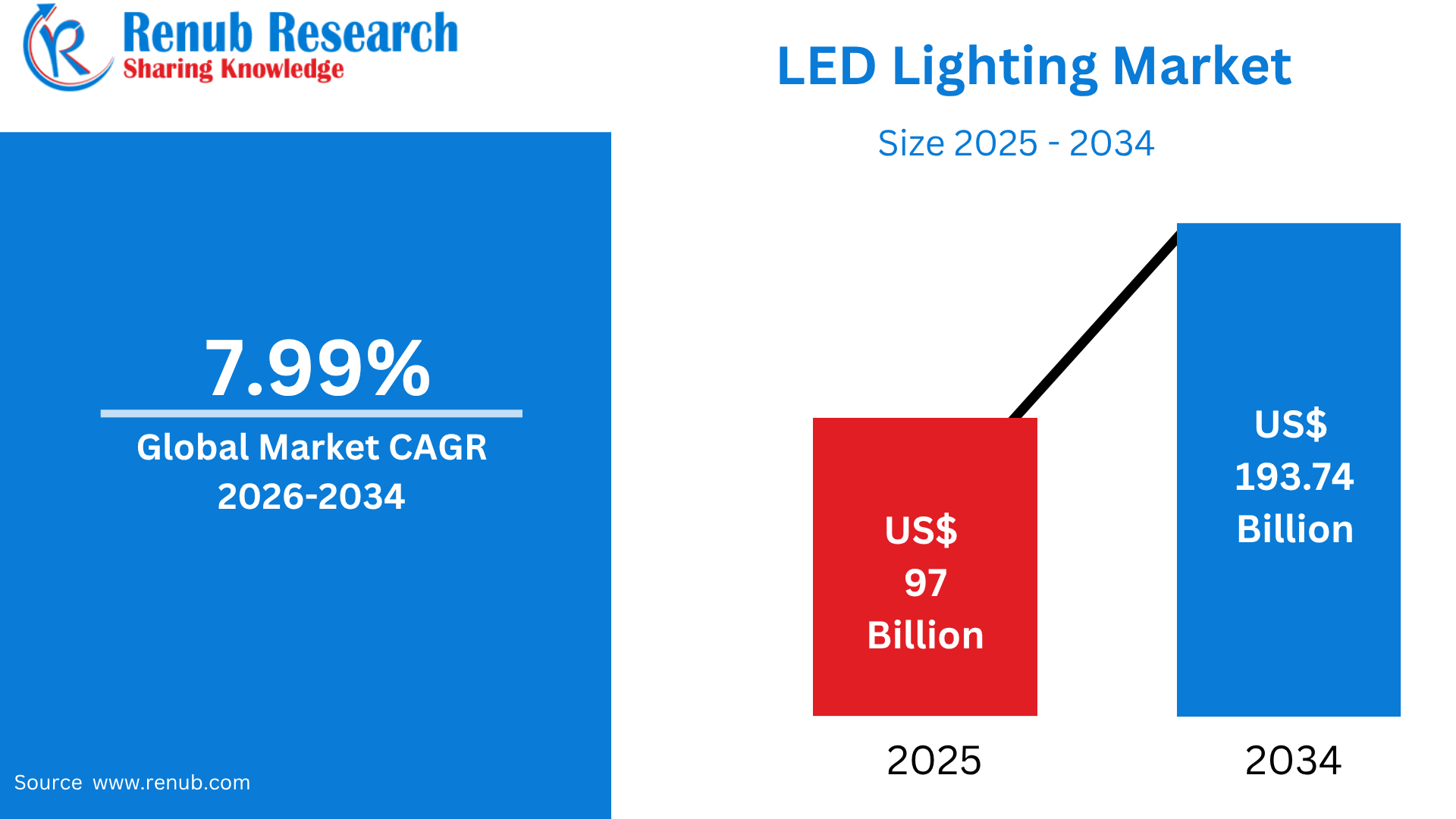
LED Lighting Market is projected to grow from US$ 97 billion in 2025 to US$ 193.74 billion by 2034, expanding at a CAGR of 7.99% during 2026–2034. Market growth is being driven by the rapid adoption of energy-efficient lighting technologies, increasing efforts by governments to phase out inefficient lighting systems, and growing investments in smart infrastructure. LED technology offers substantially higher energy efficiency than conventional lighting, with LEDs sold today averaging close to 100 lumens per watt, while premium and professional products can exceed 200 lumens per watt.
What is LED Lighting and Its Uses & Popularity Worldwide
LED lighting is a solid-state lighting technology that produces illumination when an electric current passes through a semiconductor material. Unlike incandescent and fluorescent lamps, LEDs convert a much larger share of electrical energy into visible light, providing high efficiency, long operating life, low heat generation, and reduced maintenance requirements. Modern LED products are available in bulbs, tubes, panels, downlights, floodlights, streetlights, high-bay fixtures, and smart lighting systems. They are widely used in residential buildings, offices, retail stores, factories, warehouses, hospitals, schools, roads, stadiums, automobiles, and outdoor infrastructure.
LED technology has become highly popular worldwide because of its energy-saving capability and declining product costs. According to the International Energy Agency (IEA), LEDs sold today average close to 100 lumens per watt, while premium and professional products can exceed 200 lumens per watt. In 2024, lighting in buildings and outdoor applications represented approximately 8% of global electricity demand, equivalent to around 2,200 TWh, highlighting the importance of efficient lighting technologies.
Growth Drivers of the LED Lighting Market
Rising Demand for Energy-Efficient Lighting
Growing emphasis on reducing electricity consumption and operating costs is a major driver of the global LED lighting market. LEDs provide substantially higher luminous efficacy than conventional lighting technologies, making them attractive for households, commercial buildings, industrial facilities, and public infrastructure. The IEA reports that LEDs sold today average nearly 100 lm/W, compared with around 20 lm/W for typical halogen lamps, while some premium LEDs exceed 200 lm/W. The improvement in efficiency has helped reduce electricity requirements despite continued growth in buildings and lighting demand. The IEA estimates that if lighting efficiency and LED market shares had remained at earlier levels, annual residential lighting electricity consumption would be more than 500 TWh higher, while services-sector indoor lighting consumption would be approximately 800 TWh higher. These savings encourage consumers and organizations to replace conventional bulbs with LEDs, supporting continued market expansion.
Government Energy-Efficiency Policies and LED Adoption
Government regulations, energy-efficiency standards, and programs promoting the replacement of inefficient lamps are accelerating LED adoption worldwide. Governments increasingly use minimum energy performance standards, energy labels, building-efficiency requirements, and restrictions on inefficient lighting technologies to reduce electricity consumption and emissions. According to the IEA, minimum energy performance standards for lighting now cover approximately 110 countries, demonstrating the broad regulatory support for efficient lighting. The global transition away from fluorescent lighting is also being supported by the Minamata Convention on Mercury, which has more than 150 Parties and encourages reductions in mercury-containing products. Large-scale public procurement programs have further accelerated LED penetration. India, for example, has achieved an LED market share exceeding 75%, while China exceeds 85%, according to IEA analysis. Such policies create favorable conditions for LED manufacturers and accelerate replacement of legacy lighting.
Growth of Smart Lighting and Connected Infrastructure
The expansion of smart buildings, connected infrastructure, automation, and Internet of Things (IoT) technologies is creating new opportunities for LED lighting. Modern LED fixtures can integrate sensors, wireless connectivity, dimming systems, occupancy detection, daylight harvesting, scheduling, and centralized energy-management platforms. These capabilities allow users to control lighting according to occupancy and environmental conditions, potentially reducing unnecessary electricity consumption while improving lighting quality. LEDs are particularly suitable for smart systems because they can be switched and dimmed rapidly without the limitations associated with many conventional lamps. The opportunity is significant because lighting remains a major electricity-consuming application: the IEA estimates that buildings and outdoor lighting accounted for around 2,200 TWh of global electricity demand in 2024, approximately 8% of worldwide electricity consumption. Furthermore, the IEA notes that the next phase of LED deployment is increasingly focused on higher performance, longer lifetimes, and smarter systems, supporting demand for connected LED luminaires and intelligent controls.
Challenges of the LED Lighting Market
High Initial Investment and Retrofit Complexity
Although LEDs generally reduce electricity and maintenance costs over their operating lifetime, their initial purchase and installation costs can be higher than those of basic conventional lamps. This can slow adoption among price-sensitive households, small businesses, and organizations with limited capital budgets. Large-scale commercial and municipal retrofits can also involve additional expenses for fixtures, electrical modifications, controls, installation labor, and system integration. The IEA highlights that LED retrofits in existing buildings can be delayed because of practical difficulties such as ceiling access, rewiring requirements, and replacement of existing fixtures. These projects are frequently implemented alongside broader building renovation rather than as standalone upgrades. Outdoor lighting faces similar barriers, including fragmented ownership, legacy fixtures, procurement constraints, and limited institutional capacity. Consequently, despite the long-term energy-saving benefits, upfront financial requirements and installation complexity can slow the replacement cycle in certain markets.
Uneven Global Adoption and Product Lifecycle Challenges
LED adoption remains uneven across regions, creating a challenge for manufacturers seeking consistent global market expansion. While some countries have achieved high penetration, other emerging markets continue to have significant numbers of conventional lamps in operation. The IEA estimates that approximately 30% of residential lamps globally had not yet been upgraded to LED in 2024, indicating a substantial remaining replacement opportunity but also reflecting differences in affordability, availability, infrastructure, and policy support. At the same time, the market is entering a replacement phase for early-generation LED products. Nearly 15% of residential lamps are now early-generation LEDs with typical lifetimes of 10–15 years, meaning some installed products are approaching end of life. Manufacturers therefore face pressure to improve product longevity, efficiency, repairability, and recyclability while maintaining competitive prices. Managing electronic components, materials, and end-of-life products also adds complexity to the industry’s sustainability objectives.
LED Lighting Product Launches Worldwide
- Philips Hue Essential Range – Signify (2025): Signify expanded the Philips Hue portfolio with the Hue Essential range, alongside a redesigned LED strip-light portfolio and the new Hue Bridge Pro, aimed at making connected smart lighting more accessible to consumers.
- Philips GreenPower LED Toplighting Force 4-Channel – Signify (2025): Signify introduced new 4-channel LED greenhouse lights in 800W and 1,040W versions, offering red, blue, white, and far-red spectrum control for precision crop lighting.
- Signify SunStay Pro gen2 – Signify (2025): The company launched SunStay Pro gen2 and SunStay Pro gen2 mini, connected solar LED streetlights designed for applications including pedestrian areas, campuses, and bike paths.
- Signify GreenVision Xceed Pro – Signify (2025): This modular LED road and street-lighting solution was introduced for rural and urban applications, featuring flexible maintenance and upgrade capabilities and energy-efficient light distribution.
- Signify ActiStar – Signify (2025): Signify launched ActiStar, an advanced LED floodlight for sports facilities and outdoor areas, incorporating adjustable modules and precise light projection to support different facility sizes.
- Signify myCreation Puzzle – Signify (2025): Puzzle was launched as a modular linear LED workplace luminaire with continuous illumination and a design incorporating 75% recycled PET material. It is available in 4-foot and 5-foot pendant configurations.
- Panasonic Honeycomb LED Down Light Tri CCT – Panasonic (2025): Panasonic Electric Works India launched the Honeycomb LED Down Light, available in 8W, 12W, and 18W variants, with 3,000K, 6,500K, and combination color-temperature settings.
- LED Beam Selectable Area Light – SATCO/NUWATT (2026): SATCO introduced its LED Beam Selectable Area Light in February 2026 as part of its expanding commercial LED lighting portfolio. The company also introduced LED beam-selectable floodlights during the same month.
- STARFISH Smart Color-Changing Bulbs – SATCO/NUWATT (2025): SATCO launched STARFISH Smart Color-Changing Bulbs in October 2025, adding connected and color-changing functionality to its residential LED portfolio.
- LED A-Shape Lamps – SATCO/NUWATT (2025): SATCO introduced LED A-Shape Lamps with selectable color temperature (CCT) in August 2025, providing users with greater flexibility in residential and general-purpose lighting applications.
Growing Adoption of Energy-Efficient Illumination
LED Lamps Market is expanding as households, businesses, and public institutions replace conventional incandescent and fluorescent lamps with energy-efficient alternatives. LED lamps typically consume substantially less electricity while delivering longer service lives, reducing both energy bills and replacement frequency. The International Energy Agency (IEA) reports that LEDs sold today average close to 100 lumens per watt, compared with around 20 lumens per watt for typical halogen lamps, while premium LED products can exceed 200 lumens per watt. Technological developments including tunable white lighting, improved color rendering, dimming, and wireless connectivity are broadening applications. Retrofit LED bulbs further support adoption because they can be installed in existing sockets without replacing complete lighting systems. Government efficiency standards and restrictions on inefficient lamps are also supporting market transformation. The IEA reports that minimum energy-performance standards for lighting now cover approximately 110 countries, creating a favorable regulatory environment for LED lamps.
Smart, Comfortable, and Efficient Indoor Illumination
Indoor LED Lighting Market is benefiting from increasing demand for efficient and flexible illumination across residential buildings, offices, schools, hospitals, hotels, and industrial facilities. LEDs offer controllable brightness, different color temperatures, and high-quality color rendering, allowing lighting systems to be adapted to specific indoor activities. Smart LED systems incorporating occupancy sensors, wireless controls, daylight harvesting, and automated scheduling are becoming increasingly important because they can reduce unnecessary energy consumption. The IEA estimates that buildings and outdoor lighting together accounted for approximately 2,200 TWh of global electricity consumption in 2024, equivalent to around 8% of global electricity demand, highlighting the importance of improving lighting efficiency. Human-centric lighting is also creating opportunities for tunable LED products that adjust color temperature and intensity according to time of day. Retrofit installations remain an important adoption pathway, particularly in older buildings where complete lighting-system replacement may be costly or disruptive.
Expansion of Smart and Sustainable Commercial Buildings
Commercial LED Lighting Market is witnessing increasing adoption across offices, hotels, hospitals, universities, airports, shopping centers, and government facilities. Commercial users are attracted to LED technology because lower electricity consumption and longer operating life can reduce ongoing lighting and maintenance expenses. Advanced systems incorporating occupancy detection, daylight sensors, dimming, and centralized controls further improve energy management. The IEA notes that LED technology has become the dominant choice for new lighting installations in many markets, while the continuing replacement of inefficient lighting creates substantial additional potential. Corporate sustainability commitments and green-building initiatives are also encouraging commercial property owners to modernize lighting infrastructure. LEDs provide additional architectural flexibility through adjustable color temperatures, compact designs, directional illumination, and programmable lighting scenes. Integration with building-management systems enables facility managers to monitor and control lighting alongside heating, ventilation, air-conditioning, and other building services. These capabilities are strengthening demand for connected LED luminaires rather than conventional standalone lamps.
Improved Visibility, Safety, and Operational Efficiency
Retail and Warehouse LED Lighting Market is expanding as retailers and logistics operators seek efficient illumination that improves product visibility, workplace safety, and facility performance. In retail stores, LED systems provide directional lighting, high color quality, adjustable brightness, and accent illumination that can improve merchandise presentation. Warehouses increasingly use high-bay LED fixtures because they provide uniform illumination across large spaces while supporting long operating periods and reducing maintenance requirements. Sensor-based systems can automatically dim or switch lights according to occupancy and activity levels, particularly in storage aisles and low-traffic areas. The IEA’s estimate of approximately 2,200 TWh of global electricity consumption by buildings and outdoor lighting in 2024 underscores the potential for efficiency improvements through modern lighting systems. Retailers and logistics companies are also replacing fluorescent and high-intensity-discharge systems as part of sustainability programs. Connected LEDs additionally allow centralized monitoring, scheduling, and energy management, making lighting increasingly integrated with broader smart-building and warehouse-automation systems.
Energy Efficiency Policies and Widespread Retrofit Adoption in United States
United States LED Lighting Market is expanding as households, businesses, municipalities, and government facilities continue replacing conventional lighting with energy-efficient LED technologies. According to the U.S. Department of Energy (DOE), LED bulbs use at least 75% less energy and can last up to 25 times longer than incandescent bulbs. These advantages reduce electricity consumption, maintenance requirements, and replacement costs, supporting LED adoption across residential, commercial, industrial, and public applications. LEDs are increasingly deployed in streetlights, highways, schools, offices, warehouses, retail facilities, and federal buildings. Federal and state-level energy-efficiency initiatives, utility rebates, and building-efficiency programs further encourage replacement of older lighting systems. Smart-home adoption is also creating demand for connected LEDs featuring dimming, scheduling, motion detection, and smartphone control. As utilities and municipalities pursue lower energy consumption and infrastructure operating costs, large-scale retrofit projects are expected to remain an important contributor to the U.S. LED lighting market.
EU Energy Regulations and Municipal Modernization in Germany
Germany LED Lighting Market is supported by stringent European energy-efficiency policies, Germany’s sustainability objectives, and continued modernization of public and commercial infrastructure. LED technology is increasingly deployed in offices, factories, transportation facilities, retail properties, and municipal street-lighting networks because of its energy-saving characteristics and long operating life. European Commission Ecodesign measures covering lighting products have generated substantial electricity savings across the European Union, with EU estimates indicating annual savings of approximately 41.9 TWh from lighting-related regulations. Germany’s municipalities are increasingly replacing legacy streetlights and public fixtures with LED systems to reduce electricity and maintenance expenses. Smart controls, including dimming, motion sensors, and remote monitoring, are also being incorporated into modern installations. The country’s broader transition toward energy-efficient buildings and low-carbon infrastructure creates additional opportunities for connected LED solutions. Demand is therefore supported by a combination of regulatory requirements, municipal modernization, energy-cost considerations, and Germany’s focus on improving the efficiency of its built environment.
Manufacturing Strength and Smart-City Development in China
China LED Lighting Market benefits from the country’s extensive manufacturing capabilities, rapid urbanization, infrastructure investment, and policies supporting energy conservation. China has developed a substantial domestic LED ecosystem covering semiconductor components, lamps, luminaires, controls, and related equipment, enabling large-scale production and deployment. LEDs are widely used in residential buildings, factories, commercial complexes, highways, public spaces, transportation infrastructure, and smart-city projects. Government energy-efficiency initiatives encourage municipalities and businesses to replace inefficient lighting with higher-efficiency alternatives. Public street-lighting modernization is particularly significant, with cities deploying LED fixtures alongside intelligent controls, remote monitoring, and adaptive dimming systems. The country’s continued investment in urban infrastructure and industrial facilities provides additional opportunities for LED suppliers. Furthermore, the integration of LEDs into connected-city platforms is expanding their role beyond basic illumination toward energy management and infrastructure monitoring. China’s combination of manufacturing capacity, infrastructure development, and technology adoption continues to support its importance in the global LED lighting industry.
Saudi Arabia Vision 2030 and Energy-Efficient Infrastructure
Saudi Arabia LED Lighting Market is expanding as the Kingdom invests in energy-efficient infrastructure, smart cities, commercial developments, and large-scale construction projects under Saudi Vision 2030. LEDs are increasingly used for residential buildings, offices, hotels, retail centers, highways, streetlights, industrial facilities, and major infrastructure developments because they offer lower electricity consumption and reduced maintenance requirements compared with conventional lighting. Energy-efficiency initiatives led by the Saudi Energy Efficiency Center (SEEC) have encouraged the adoption of efficient lighting technologies as part of broader efforts to reduce electricity consumption. Large developments, including new urban districts and major tourism and infrastructure projects, are creating opportunities for advanced LED luminaires, intelligent controls, and connected lighting networks. Outdoor lighting is particularly important because extensive road networks, public spaces, and commercial developments require reliable illumination. Smart-city initiatives are further supporting demand for sensor-enabled LEDs capable of automated dimming, remote monitoring, and energy management. These developments are strengthening LED deployment across Saudi Arabia’s rapidly modernizing built environment.
LED Lighting Market Segments
Product Type
- Lamps
- Luminaires
Application
- Indoor
- Outdoor
End User
- Commercial
- Residential
- Industrial
- Others
Sales Channel
- Retail/Warehouse
- E-Commerce
- Direct Sales
Countries
North America
- United States
- Canada
Europe
- France
- Germany
- Italy
- Spain
- United Kingdom
- Belgium
- Netherlands
- Turkey
Asia Pacific
- China
- Japan
- India
- Australia
- South Korea
- Thailand
- Malaysia
- Indonesia
- New Zealand
Latin America
- Brazil
- Mexico
- Argentina
Middle East & Africa
- South Africa
- Saudi Arabia
- United Arab Emirates
All companies have been covered with 5 Viewpoints
- Overviews
- Key Person
- Recent Developments
- SWOT Analysis
- Revenue Analysis
Key Players Analysis
- Acuity Brands Inc.
- Koninklijke Philips N.V.
- Emerson Electric Co.
- Hubbell Inc
- Daktronics Inc.
- Dialight Plc.
- LSI Industries Inc.
- Samsung Electronics Co. Ltd.
Report Details:
| Report Features | Details |
| Base Year |
2025 |
| Historical Period |
2022 - 2025 |
| Forecast Period |
2026 - 2034 |
| Market |
US$ Billion |
| Segment Covered |
Product Type, Application, End User, Sales Channe and Countries |
| Countries Covered |
|
| Companies Covered |
|
| Customization Scope |
20% Free Customization |
| Post-Sale Analyst Support |
1 Year (52 Weeks) |
| Delivery Format |
PDF and Excel through Email (We can also provide the editable version of the report in PPT/Word format on request) |
Customization Services available
- Analysis of Market Size and Its Segments
- More Company Profiles (Upto 10 without any additional cost):
- Additional Countries (Other than mentioned Countries):
- Region/Country Specific Reports:
- Market Entry Strategy:
- Region-Specific Market Dynamics:
- Regional Market Share Analysis:
- Trade Analysis:
- Production Insights:
- Others Customized Requests:
For more information contact our analysts.
Need More Assistance?
- Talk to our analysts to get more precious information on the current market trends.
- Include more countries and segments and customize the report based on the final requirement.
- Get a competitive advantage in your industry by knowing the report findings and making a positive impact on your revenues and operations.
- Our analysts are always ready to provide more help and pertinent information if you need any additional assistance.