North America Cheese Powder Market Report by Product, Application, Countries and Company Analysis 2026-2034
Buy NowNorth America Cheese Powder Market Size and Forecast
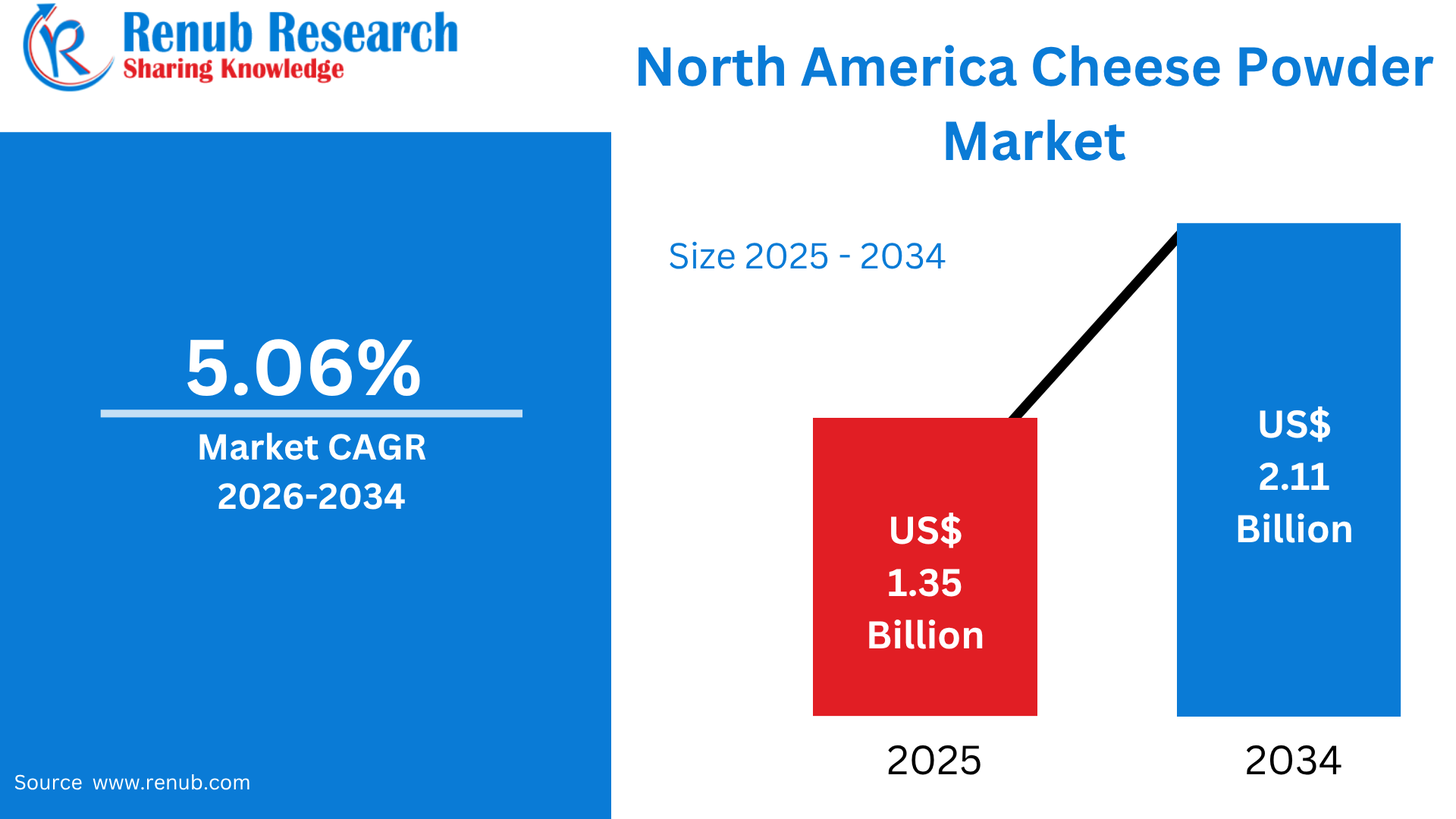
North America cheese powder market is projected to expand from US$ 1.35 billion in 2025 to US$ 2.11 billion by 2034, registering a CAGR of 5.06% during 2026–2034. Market growth is being supported by rising demand for convenience and ready-to-eat foods, increasing use of cheese powder in processed food applications, and growing consumer preference for convenient, shelf-stable ingredients.
What is Cheese Powder and Its Uses & Popularity in North America
Cheese powder is a dehydrated dairy ingredient produced by drying natural cheese or processed cheese blends to create a concentrated powder with a long shelf life and strong cheese flavor. It is commonly manufactured using spray-drying and other dehydration technologies, allowing manufacturers to preserve flavor while reducing moisture and improving storage stability. Cheese powder is widely used as a flavoring and functional ingredient in food processing, particularly in products where convenient handling, consistent flavor, and extended shelf life are important.
In North America, cheese powder is increasingly popular because of the region’s strong demand for convenience foods, snacks, and ready-to-eat products. It is extensively used in macaroni and cheese, potato chips, popcorn, crackers, sauces, soups, instant meals, seasonings, and bakery products. Food manufacturers also use it in prepared meals and snack coatings because it provides consistent flavor without requiring refrigeration. The United States has one of the world’s largest cheese industries, producing more than 6 million metric tons of cheese annually, creating a substantial raw-material base for cheese-based ingredients. Growing consumption of processed foods, expansion of private-label products, and demand for convenient meal solutions are supporting continued adoption of cheese powder across North America.
Dairy Products Production by Product – United States
June 2025 vs. May & June 2026
Production figures are in 1,000 pounds.
- Butter: Production reached 208,178 thousand pounds in June 2026, up 8.5% from June 2025 but down 7.2% from May 2026.
- Total Cheese: Production totaled 1,231,236 thousand pounds in June 2026, increasing 1.1% year-over-year but declining 4.1% from May 2026.
- American-Type Cheese: Production was 484,866 thousand pounds, up 1.1% from June 2025 and down 2.6% from May 2026.
- Cheddar: 338,068 thousand pounds, up 1.0% year-over-year and down 2.4% month-over-month.
- Other American Types: 146,798 thousand pounds, up 1.6% year-over-year and down 3.0% from May.
- Blue & Gorgonzola: Production stood at 6,716 thousand pounds, down 6.8% year-over-year but up 2.1% from May 2026.
- Brick & Muenster: Production reached 17,733 thousand pounds, increasing 3.0% year-over-year and 0.4% from May.
- Cream & Neufchatel: Production was 98,380 thousand pounds, up 8.1% year-over-year and 2.0% month-over-month.
- Feta: Production totaled 13,438 thousand pounds, increasing 1.7% year-over-year but declining 4.8% from May.
- Gouda: Production was 7,633 thousand pounds, down 7.8% year-over-year and 9.4% from May.
- Hispanic Cheese: Production reached 39,569 thousand pounds, up 5.5% year-over-year and 0.8% from May.
- Italian-Type Cheese: Production totaled 521,641 thousand pounds, down 0.3% year-over-year and 6.8% from May.
- Mozzarella: 405,745 thousand pounds, down 2.4% year-over-year and 8.1% from May.
- Parmesan: 50,331 thousand pounds, up 12.2% year-over-year but down 1.1% from May.
- Provolone: 32,811 thousand pounds, down 2.0% year-over-year and 2.4% from May.
- Ricotta: 18,775 thousand pounds, up 0.4% year-over-year and 4.1% from May.
- Romano: 4,205 thousand pounds, up 7.2% year-over-year but down 25.0% from May.
- Other Italian Types: 9,774 thousand pounds, up 49.0% year-over-year but down 1.9% from May.
- Swiss Cheese: Production reached 27,504 thousand pounds, up 0.5% year-over-year but down 7.4% from May.
- All Other Cheese Types: Production totaled 13,756 thousand pounds, increasing 1.5% year-over-year and 0.1% from May.
- Cottage Cheese, Curd: Production was 48,248 thousand pounds, up 15.6% year-over-year but down 4.1% from May.
- Cottage Cheese, Cream: Production reached 46,570 thousand pounds, increasing 18.9% year-over-year and 2.9% from May.
- Cottage Cheese, Lowfat: Production totaled 39,421 thousand pounds, up 13.0% year-over-year and 1.6% from May.
Growth Drivers
Rising Demand for Convenience and Ready-to-Eat Foods
The increasing consumption of convenience, processed, and ready-to-eat foods is a major growth driver for the North America cheese powder market. Cheese powder offers manufacturers a convenient, shelf-stable ingredient that provides consistent flavor without the refrigeration and handling requirements associated with fresh cheese. It is widely incorporated into macaroni and cheese, snack foods, popcorn, crackers, sauces, soups, instant meals, and seasoning blends. The U.S. food industry generates more than US$1 trillion in annual economic activity, creating a substantial market for processed food ingredients. Busy lifestyles and growing demand for quick meal solutions are encouraging consumers to purchase packaged foods that require minimal preparation. Cheese powder is particularly attractive to manufacturers because it can improve flavor consistency while extending product shelf life. In addition, the growing popularity of frozen meals, packaged snacks, and meal kits is expanding its application base. As North American consumers continue prioritizing convenience without sacrificing taste, food manufacturers are expected to increase their use of cheese powder across multiple product categories.
Expansion of Processed Food and Snack Applications
The expanding processed food and snack industry across North America is creating significant opportunities for cheese powder manufacturers. Cheese powder is valued for its concentrated flavor, easy handling, long shelf life, and ability to blend uniformly into dry and liquid formulations. The United States remains one of the world’s largest cheese-producing countries, producing more than 6 million metric tons of cheese annually, providing a substantial raw-material base for cheese powder production. The ingredient is extensively used in potato chips, tortilla chips, extruded snacks, crackers, bakery products, dips, sauces, and prepared meals. Growing demand for flavored snacks has encouraged manufacturers to introduce products featuring cheddar, parmesan, mozzarella, nacho, and other cheese profiles. Foodservice operators are also increasingly using powdered cheese ingredients because they simplify storage and portion control. Furthermore, private-label snack and prepared-food brands are expanding across supermarkets and convenience stores, increasing demand for cost-effective flavor ingredients. Continued innovation in snack formulations and processed foods is therefore expected to strengthen cheese powder consumption throughout North America.
Longer Shelf Life and Cost Advantages Over Fresh Cheese
The extended shelf life and logistical advantages of cheese powder are supporting its increasing adoption among North American food manufacturers. Unlike fresh cheese, powdered cheese has significantly lower moisture content, reducing the need for refrigerated storage and making transportation and inventory management easier. Depending on the formulation and packaging conditions, cheese powder can typically maintain quality for 12–24 months, substantially longer than many fresh cheese products. This characteristic helps manufacturers reduce spoilage, transportation costs, and food waste. Cheese powder also provides consistent flavor and dosage, allowing food processors to maintain standardized formulations across large production volumes. It can be incorporated into dry mixes, seasonings, sauces, snacks, and prepared meals without requiring additional cheese-processing steps. Rising food manufacturing costs have increased the importance of ingredients that provide operational efficiency and predictable quality. In addition, improvements in spray-drying, encapsulation, and flavor-retention technologies are enhancing the performance of powdered cheese ingredients. These economic and functional advantages are expected to encourage broader adoption across North America’s food processing and foodservice industries.
Challenges
Fluctuating Dairy Prices and Raw Material Costs
Volatility in milk and cheese prices represents a significant challenge for the North America cheese powder market because dairy products are the primary raw materials used in production. Changes in milk production, feed costs, energy prices, labor expenses, and weather conditions can influence the cost of cheese and subsequently affect cheese powder manufacturing costs. The United States produces more than 100 billion pounds of milk annually, making fluctuations in the country’s dairy supply particularly important for ingredient manufacturers. Higher milk prices can increase cheese production costs, while volatility in feed and energy prices can further pressure manufacturers’ margins. Cheese powder producers may face difficulties passing these increases on to food manufacturers, particularly in highly competitive snack and processed-food categories. In addition, fluctuations in international dairy markets can affect export and import pricing across North America. Manufacturers are therefore increasingly focusing on supply-chain optimization, long-term procurement agreements, production efficiency, and alternative formulations to manage cost pressures. Continued dairy price volatility could constrain profit margins and influence cheese powder pricing during periods of tight raw-material supply.
Consumer Preference for Natural and Clean-Label Ingredients
Growing consumer preference for natural, minimally processed, and clean-label foods presents another challenge for conventional cheese powder manufacturers. Although cheese powder provides convenience and extended shelf life, certain formulations may contain emulsifiers, anti-caking agents, stabilizers, flavor enhancers, or other processing aids that consumers increasingly scrutinize. The North American clean-label food trend is encouraging manufacturers to simplify ingredient lists and reduce artificial additives. At the same time, consumers are increasingly interested in recognizable ingredients, natural cheese flavors, organic products, and products with fewer preservatives. This trend can increase formulation and production costs for cheese powder manufacturers seeking to develop clean-label alternatives while maintaining flavor, texture, solubility, and shelf stability. Additionally, consumers are paying greater attention to nutritional characteristics such as sodium, saturated fat, and calorie content, which can affect demand for certain cheese-based ingredients. Manufacturers are responding through innovations such as natural cheese powders, reduced-sodium formulations, organic options, and clean-label processing technologies. Successfully balancing functionality, taste, nutritional expectations, and clean-label requirements will remain critical for market growth.
Cheese Powder Launches in North America
- 2025 – Kerry: Expanded its North American ingredient portfolio with cheese flavoring and powdered dairy solutions designed for snacks, sauces, and prepared foods, supporting clean-label and reduced-sodium product development.
- 2025 – Lactalis Ingredients: Expanded its cheese powder and dairy ingredient offerings in North America, providing cheddar, parmesan, and other cheese-based powders for food manufacturers and seasoning applications.
- 2025 – Agropur: Introduced and expanded specialty cheese ingredient solutions for North American food processors, targeting snacks, sauces, bakery products, and prepared meals.
- 2024 – Grande Cheese: Expanded its powdered cheese ingredient capabilities for foodservice and industrial applications, including dry mixes, sauces, seasoning blends, and prepared foods.
- 2024 – Aarkay Food Products: Expanded its North American distribution of cheese powders, including cheddar and parmesan varieties, for snack coatings, sauces, soups, and instant food formulations.
- 2024 – Bluegrass Dairy & Food: Expanded its cheese powder portfolio for North American food manufacturers, offering dairy-based ingredients for snacks, bakery products, sauces, and seasoning applications.
- 2024 – Kanegrade: Strengthened its North American ingredient offering with cheese powders and specialty dairy ingredients for food processing, seasoning, and prepared-food applications.
- 2023 – Aplin & Barrett: Expanded its powdered cheese ingredient solutions for food manufacturers, focusing on cheddar and specialty cheese profiles for snacks, sauces, and convenience foods.
- 2023 – Agropur Ingredients: Expanded its specialty dairy ingredient portfolio with cheese-based powders and functional dairy ingredients aimed at North American food and beverage manufacturers.
- 2023 – Hoosier Hill Farm: Expanded its retail and foodservice range of powdered cheese products, including cheddar, parmesan, and nacho cheese powders, targeting home cooking, snacks, sauces, and seasoning applications.
Strong Demand from Snacks and Prepared Foods
North America cheddar cheese powder market is expanding due to cheddar’s strong consumer recognition, versatility, and widespread use in processed foods. The United States produces more than 6 million metric tons of cheese annually, creating a substantial supply base for cheese-based ingredients. Cheddar accounts for a significant portion of U.S. cheese production and is extensively used in powdered formulations for its strong flavor and good compatibility with dry mixes. Cheddar cheese powder is widely incorporated into macaroni and cheese, potato chips, popcorn, crackers, sauces, soups, seasonings, and ready-to-eat meals. The growth of convenience food consumption is increasing demand for shelf-stable cheese ingredients that offer consistent taste and easy handling. Food manufacturers also favor cheddar powder because it can be stored and transported without the refrigeration requirements associated with fresh cheese. Growing demand for flavored snacks and private-label products is creating additional opportunities. Furthermore, improvements in spray-drying and flavor-retention technologies are enhancing product quality. Rising demand for convenient meals and savory snacks is expected to maintain strong growth for cheddar cheese powder across North America.
Premium Flavor Applications Supporting Parmesan Cheese Powder Growth
North America parmesan cheese powder market is benefiting from increasing demand for premium flavors, Italian-inspired foods, and convenient seasoning ingredients. Parmesan powder delivers a concentrated savory, nutty, and umami flavor, making it suitable for pasta sauces, pizza seasonings, soups, salad dressings, crackers, snacks, dips, and prepared meals. The United States has a large and diversified food-processing sector, with processed and packaged foods representing a substantial share of consumer food expenditure. Manufacturers increasingly use powdered parmesan because it offers consistent flavor, convenient dosing, and longer storage compared with fresh grated cheese. Growth in Italian cuisine, restaurant-style packaged meals, and premium snack products is supporting demand for parmesan-based ingredients. Parmesan powder is also increasingly used in seasoning blends for popcorn, potato chips, roasted nuts, and bakery products. Rising consumer interest in authentic flavors is encouraging food companies to develop products featuring recognizable cheese varieties. Technological improvements in drying and encapsulation are helping retain parmesan’s characteristic flavor and aroma. These factors are expected to support continued expansion of the parmesan cheese powder segment in North America.
Specialty Food Applications Creating New Opportunities in Swiss Cheese Powder
North America Swiss cheese powder market is gaining traction as food manufacturers seek distinctive cheese flavors for processed foods and specialty products. Swiss cheese is recognized for its mild, nutty flavor and characteristic aroma, making its powdered form suitable for sauces, soups, seasoning blends, snack coatings, bakery products, dips, and prepared meals. The United States and Canada have well-established dairy industries that provide raw materials for specialty cheese ingredients. Canada produced approximately 1.0 million tonnes of milk annually, while the U.S. remains one of the world’s largest dairy producers, supporting a strong regional ingredient supply chain. Swiss cheese powder is particularly attractive to manufacturers because it provides consistent flavor while reducing refrigeration, handling, and storage requirements. Demand is also supported by growing interest in premium and international flavor profiles among North American consumers. Food companies are incorporating Swiss cheese flavors into crackers, savory snacks, frozen meals, and ready-to-eat products to differentiate their offerings. Improvements in powder stability and flavor retention are further increasing application opportunities. The segment is expected to benefit from continued innovation in specialty and premium food formulations.
Expanding Savory Snack Consumption Driving Cheese Powder Demand
North America cheese powder snacks market is growing alongside strong demand for flavored and convenient snack products. Cheese powder is extensively used as a coating and seasoning for potato chips, tortilla chips, popcorn, cheese puffs, crackers, pretzels, extruded snacks, and nuts. The U.S. snack food industry generates more than US$100 billion in annual sales, demonstrating the substantial consumer base available for cheese-flavored products. Cheddar, nacho, parmesan, and other cheese varieties are popular flavor profiles because powdered formulations can be distributed uniformly across snack surfaces while providing concentrated taste. Manufacturers also benefit from the ingredient’s long shelf life, ease of transportation, and consistent flavor performance. Growing demand for on-the-go foods and single-serve snacks is supporting additional product development. Meanwhile, private-label retailers and emerging snack brands are introducing new cheese-flavored products to compete with established manufacturers. Innovations in seasoning technology, including improved adhesion and reduced powder loss, are enhancing production efficiency. However, rising consumer attention to sodium, fat, and artificial additives is encouraging manufacturers to develop reduced-sodium and clean-label cheese powder formulations. Continued snack innovation is expected to support segment expansion.
North America Cheese Powder Bakery & Confectionery Versatile Ingredient Expanding Savory and Specialty Applications
The North America cheese powder bakery and confectionery market is expanding as manufacturers incorporate cheese flavors into an increasingly diverse range of baked and specialty food products. Cheese powder is used in savory biscuits, crackers, breadsticks, pastries, pizza bases, cheese breads, savory cookies, fillings, and specialty baked snacks. Its concentrated flavor, low moisture content, and easy incorporation into dry formulations make it particularly suitable for large-scale bakery production. The North American bakery market generates tens of billions of dollars in annual sales, creating substantial opportunities for functional and flavor ingredients. Cheese powder can improve flavor consistency while reducing the handling and refrigeration requirements associated with fresh cheese. Growing consumer interest in savory snacks and premium bakery products is encouraging manufacturers to experiment with cheddar, parmesan, Swiss, and blended cheese flavors. Although cheese powder has limited application in traditional sweet confectionery, innovative products combining sweet and savory flavor profiles are creating niche opportunities. Demand from frozen bakery products and ready-to-bake mixes is also increasing. Improvements in powder solubility, heat stability, and flavor retention are expected to further expand cheese powder applications across North America’s bakery and specialty food industries.
Strong Processed Food Industry Supporting USA Cheese Powder Demand
USA cheese powder market is expanding steadily, supported by the country’s large dairy industry, strong processed-food sector, and high consumption of snacks and convenience foods. The United States produces more than 6 million metric tons of cheese annually, creating a substantial raw-material base for cheese powder manufacturing. Cheddar, parmesan, mozzarella, and nacho cheese powders are widely used in macaroni and cheese, potato chips, popcorn, crackers, sauces, soups, frozen meals, and seasoning blends. The U.S. snack food market exceeds US$100 billion annually, providing significant opportunities for cheese-flavored products. Food manufacturers increasingly prefer powdered cheese because it offers concentrated flavor, consistent formulation, easier transportation, and longer shelf life than fresh cheese. Demand is further supported by the popularity of ready-to-eat meals, private-label snacks, and packaged foods. Technological improvements in spray drying, encapsulation, and flavor retention are helping manufacturers improve product stability and performance. However, growing consumer demand for clean-label and reduced-sodium products is encouraging companies to develop healthier cheese powder formulations. Overall, the country’s extensive food-processing infrastructure and strong consumer preference for cheese-based products will continue supporting market growth.
Dairy Production and Convenience Food Demand Canada Cheese Powder Driving Growth
Canada cheese powder market is benefiting from the country’s established dairy industry, growing processed-food sector, and increasing demand for convenient food ingredients. Canada produces approximately 1 billion kilograms of cheese annually, providing a strong domestic base for cheese-based ingredient manufacturing. Cheese powder is increasingly used in macaroni and cheese, snack coatings, crackers, soups, sauces, bakery products, prepared meals, and seasoning mixes. The ingredient is particularly attractive to food manufacturers because its low moisture content allows longer storage and reduces dependence on refrigerated transportation. Canada’s multicultural consumer base is also encouraging demand for diverse cheese flavors and international food products. Growing consumption of packaged meals and ready-to-eat foods is creating additional opportunities for powdered cheese ingredients. Canadian food manufacturers are also increasingly focused on product reformulation, including reduced-sodium and clean-label cheese powders, in response to evolving consumer preferences. The country’s developed retail and foodservice industries further support demand for processed cheese ingredients. As convenience food consumption and domestic food processing continue to expand, cheese powder is expected to gain wider adoption across Canada’s snack, bakery, prepared-food, and seasoning applications.
Growing Snack and Processed Food Industry Supporting Mexico Cheese Powder Expansion
Mexico cheese powder market is witnessing increasing demand due to the country’s expanding processed-food industry, growing snack consumption, and rising urbanization. Mexico produces more than 400 million kilograms of cheese annually, supporting the availability of dairy ingredients for domestic food manufacturing. Cheese powder is widely used in savory snacks, tortilla chips, popcorn, crackers, instant noodles, sauces, soups, seasonings, and prepared foods. The popularity of cheese-flavored snacks is particularly important, as manufacturers use powdered cheese to provide consistent flavor and easy application to dry products. Mexico’s large population of more than 130 million people provides a substantial consumer base for packaged and convenience foods. Urban lifestyles and increasing demand for affordable, ready-to-eat products are further encouraging food processors to utilize shelf-stable ingredients. In addition, the expansion of modern retail, convenience stores, and quick-service restaurants is creating new applications for cheese-based seasonings and prepared food products. Manufacturers are increasingly investing in improved powder formulations, including stronger flavor retention and better coating performance. Despite challenges related to raw-material costs and consumer price sensitivity, the expanding food-processing and snack industries are expected to support steady growth in Mexico’s cheese powder market.
North America Cheese Powder Market Segments
Product
- Cheddar
- Parmesan
- Blue Cheese
- Romano
- Swiss
- Others
Application
- Snacks
- Bakery & Confectionery
- Dips/Dressings/Dry Mix/Sauces
- Flavors
- Ready to Eat
- Others
Countries
- Unites States
- Canada
- Mexico
All companies have been covered from 5 viewpoints:
- Overviews
- Key Person
- Recent Developments
- SWOT Analysis
- Revenue Analysis
Company Analysis
- Kerry Group plc.
- Cargill Incorporated
- Land O'Lakes, Inc.
- Fonterra Co-operative Group Limited
- Tate & Lyle
- The California Milk Advisory Board (Real California Cheese)
- FrieslandCampina
- CRÈMEITALIA
- ADM
Report Details:
| Report Features | Details |
| Base Year |
2024 |
| Historical Period |
2021 - 2024 |
| Forecast Period |
2025 - 2033 |
| Market |
US$ Billion |
| Segment Covered |
By Product, By Application and By Countries |
| Countries Covered |
|
| Companies Covered |
|
| Customization Scope |
20% Free Customization |
| Post-Sale Analyst Support |
1 Year (52 Weeks) |
| Delivery Format |
PDF and Excel through Email (We can also provide the editable version of the report in PPT/Word format on request) |
Customization Services available
- Analysis of Market Size and Its Segments
- More Company Profiles (Upto 10 without any additional cost):
- Additional Countries (Other than mentioned Countries):
- Region/Country Specific Reports:
- Market Entry Strategy:
- Region-Specific Market Dynamics:
- Regional Market Share Analysis:
- Trade Analysis:
- Production Insights:
- Others Customized Requests:
For more information contact our analysts.
Need More Assistance?
- Talk to our analysts to get more precious information on the current market trends.
- Include more countries and segments and customize the report based on the final requirement.
- Get a competitive advantage in your industry by knowing the report findings and making a positive impact on your revenues and operations.
- Our analysts are always ready to provide more help and pertinent information if you need any additional assistance.