North America Biopsy Devices Market Report by Product, Application, Technology, End User, Countries and Companies Analysis 2026-2034
Buy NowNorth America Biopsy Devices Market Size and Forecast
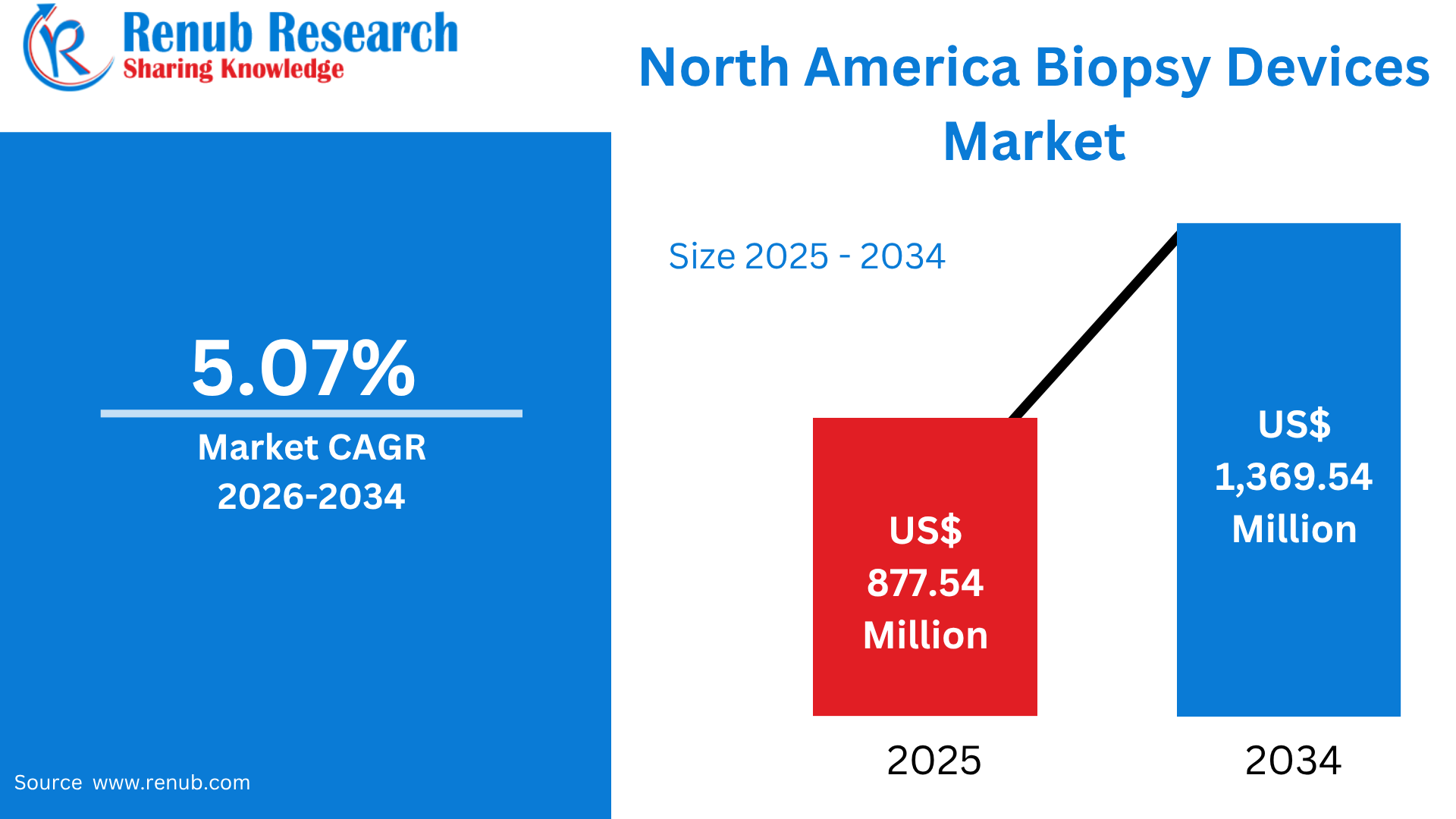
North America Biopsy Devices Market is projected to increase from US$ 877.54 million in 2025 to US$ 1,369.54 million by 2034, registering a CAGR of 5.07% during 2026–2034. Market growth is being driven by the rising burden of cancer, growing adoption of minimally invasive diagnostic procedures, and the expansion of cancer screening and early-detection programs. In addition, ongoing technological advancements in biopsy instruments, increasing healthcare expenditure, and greater emphasis on accurate and timely diagnosis are strengthening demand for advanced tissue-sampling solutions across North America.
What Are Biopsy Devices and Their Uses & Popularity in North America
Biopsy devices are medical instruments used to collect tissue, cells, or fluid samples from the body for laboratory examination and diagnosis. They play an important role in detecting and evaluating diseases, particularly cancer, as well as certain inflammatory, infectious, and other abnormal conditions. Common biopsy devices include core biopsy needles, fine-needle aspiration systems, vacuum-assisted biopsy devices, biopsy forceps, punch biopsy instruments, and image-guided biopsy systems. These devices are used across breast, lung, prostate, liver, kidney, skin, and other tissue examinations. In North America, their popularity is increasing because healthcare providers increasingly prioritize early, minimally invasive, and accurate diagnosis.
The American Cancer Society estimates that the United States will record approximately 2.11 million new cancer cases in 2026, creating substantial demand for tissue-based diagnostic procedures. Canada is also expected to diagnose more than 250,000 new cancer cases in 2025. Advances in ultrasound, CT, MRI, and stereotactic guidance are improving biopsy precision while reducing complications and recovery time. The growing adoption of outpatient procedures, advanced needle technologies, and image-guided sampling is therefore strengthening the role of biopsy devices throughout North America.
Estimated New Cancer Cases by State, U.S., 2026
- Alabama: 30,710 new cases
- Alaska: 4,040 new cases
- Arizona: 44,620 new cases
- Arkansas: 20,420 new cases
- California: 206,500 new cases
- Colorado: 30,160 new cases
- Connecticut: 24,020 new cases
- Delaware: 8,410 new cases
- District of Columbia: 3,190 new cases
- Florida: 183,100 new cases
- Georgia: 68,440 new cases
- Hawaii: 9,420 new cases
- Idaho: 12,470 new cases
- Illinois: 78,880 new cases
- Indiana: 44,950 new cases
- Iowa: 22,710 new cases
- Kansas: 16,680 new cases
- Kentucky: 31,440 new cases
- Louisiana: 29,870 new cases
- Maine: 10,680 new cases
- Maryland: 38,160 new cases
- Massachusetts: 43,250 new cases
- Michigan: 68,730 new cases
- Minnesota: 39,830 new cases
- Mississippi: 18,080 new cases
- Missouri: 42,350 new cases
- Montana: 8,130 new cases
- Nebraska: 12,680 new cases
- Nevada: 18,110 new cases
- New Hampshire: 10,150 new cases
- New Jersey: 60,740 new cases
- New Mexico: 11,840 new cases
- New York: 125,860 new cases
- North Carolina: 74,400 new cases
- North Dakota: 4,650 new cases
- Ohio: 78,080 new cases
- Oklahoma: 24,570 new cases
- Oregon: 27,970 new cases
- Pennsylvania: 90,250 new cases
- Rhode Island: 7,260 new cases
- South Carolina: 36,920 new cases
- South Dakota: 6,200 new cases
- Tennessee: 44,660 new cases
- Texas: 161,330 new cases
- Utah: 15,170 new cases
- Vermont: 4,680 new cases
- Virginia: 52,160 new cases
- Washington: 48,590 new cases
- West Virginia: 13,590 new cases
- Wisconsin: 42,140 new cases
- Wyoming: 3,640 new cases
- United States: 2,114,850 new cancer cases
Sources: American Cancer Society, Inc.
Growth Drivers of the North America Biopsy Devices Market
Rising Cancer Burden and Growing Need for Early Diagnosis
The increasing incidence of cancer is one of the strongest drivers of the North America biopsy devices market because tissue sampling remains essential for confirming many cancer diagnoses and determining tumor characteristics. According to the American Cancer Society, the United States is projected to record approximately 2.11 million new cancer cases and 626,140 cancer deaths in 2026. The large number of new cases creates sustained demand for diagnostic procedures involving breast, lung, prostate, colorectal, skin, and other cancers. In Canada, the Canadian Cancer Society estimated approximately 247,100 new cancer cases in 2024, excluding non-melanoma skin cancers. Growing screening initiatives are also increasing the identification of suspicious lesions that require biopsy confirmation. Earlier detection allows physicians to establish tumor type, grade, molecular characteristics, and treatment strategy more quickly. Furthermore, the expansion of precision oncology is increasing demand for tissue samples used in biomarker and molecular testing. As healthcare systems place greater emphasis on early diagnosis and personalized treatment, hospitals, imaging centers, and outpatient facilities are increasingly adopting efficient biopsy technologies. Consequently, the rising cancer burden and expanding diagnostic requirements are expected to maintain strong demand for biopsy devices across North America.
Expansion of Cancer Screening and Image-Guided Biopsy Procedures
The expansion of cancer screening programs across North America is generating a larger pool of suspicious findings that require tissue confirmation. In the United States, the U.S. Preventive Services Task Force recommends biennial mammography for women aged 40 to 74 years, supporting continued breast-cancer screening and subsequent diagnostic interventions when abnormalities are detected. Lung-cancer screening has also expanded, with annual low-dose CT recommended for eligible high-risk adults aged 50 to 80 years with a substantial smoking history. These screening programs increase the detection of nodules and lesions that may require image-guided biopsy. Technological advances in ultrasound, computed tomography, magnetic resonance imaging, stereotactic systems, and navigation technologies are simultaneously improving the accuracy of tissue sampling. Image-guided procedures enable physicians to target lesions more precisely while limiting unnecessary tissue removal and reducing complications. Vacuum-assisted and core biopsy systems are particularly valuable for obtaining adequate tissue samples during minimally invasive procedures. Increasing availability of advanced imaging infrastructure in hospitals and specialized diagnostic centers is therefore encouraging adoption. As screening becomes more accessible and healthcare providers focus on detecting disease at earlier stages, the need for reliable biopsy devices and image-guided sampling technologies is expected to increase throughout the North American market.
Shift Toward Minimally Invasive and Outpatient Diagnostic Procedures
The growing preference for minimally invasive healthcare is another important factor supporting the North America biopsy devices market. Compared with conventional surgical tissue sampling, needle-based and image-guided biopsy procedures can generally provide tissue specimens through smaller access points, potentially reducing recovery time, procedural trauma, and hospital resource requirements. This trend aligns with the broader expansion of ambulatory and outpatient care in the United States and Canada. Advanced core-needle, vacuum-assisted, fine-needle aspiration, and automated biopsy systems allow physicians to obtain diagnostic samples while limiting the need for extensive surgery in appropriate cases. Improvements in needle design, tissue capture, imaging guidance, and device ergonomics are also increasing procedural efficiency. The development of specialized biopsy technologies for breast, prostate, lung, liver, and other organs is broadening clinical applications. Healthcare providers are increasingly seeking technologies that can improve diagnostic accuracy while controlling procedure-related costs and patient burden. In addition, shorter recovery periods can make outpatient biopsy pathways attractive to both providers and patients. As healthcare systems continue moving toward value-based and minimally invasive care, demand for sophisticated biopsy devices is expected to remain strong across North America.
Challenges of the North America Biopsy Devices Market
High Cost of Advanced Biopsy Systems and Healthcare Procedures
The relatively high cost of sophisticated biopsy technologies can limit adoption, particularly among smaller hospitals, outpatient facilities, and healthcare providers operating under constrained capital budgets. Advanced biopsy systems increasingly incorporate specialized needles, vacuum-assisted mechanisms, stereotactic guidance, robotics, or integration with sophisticated imaging platforms. The total expense can therefore include the device itself, imaging equipment, disposable components, laboratory analysis, personnel, maintenance, and facility costs. The challenge becomes more significant when healthcare providers must justify investments in technologies that serve relatively specialized procedures. Although biopsy procedures can reduce the need for more invasive diagnostic surgery, reimbursement policies and payment levels differ according to procedure type, location, insurance coverage, and clinical indication. The U.S. healthcare system also includes multiple public and private payers, creating administrative complexity around reimbursement. In Canada, provincial healthcare systems can have different procurement and funding processes. Smaller healthcare facilities may consequently delay investments in newer biopsy platforms or continue using established technologies. Manufacturers must therefore demonstrate clear clinical and economic benefits through improved diagnostic yield, workflow efficiency, safety, and reduced repeat procedures. Cost-effectiveness will remain an important consideration as advanced biopsy technologies compete for healthcare budgets.
Procedural Risks, Diagnostic Limitations and Regulatory Requirements
Although modern biopsy devices are designed to support minimally invasive diagnosis, biopsy procedures still carry potential risks such as bleeding, infection, pain, tissue injury, and inadequate or inconclusive samples. Certain organs and lesion locations can present additional technical challenges, requiring highly trained clinicians and sophisticated imaging support. An inadequate specimen may necessitate repeat biopsy, increasing patient burden and healthcare costs. Device performance can also vary according to lesion size, location, tissue characteristics, and the imaging modality used. These clinical considerations can influence physicians’ selection and adoption of newer systems. In addition, manufacturers operating in North America must comply with stringent medical-device regulatory requirements. In the United States, biopsy devices are regulated by the U.S. Food and Drug Administration (FDA), while Canadian products generally require authorization through Health Canada’s medical-device regulatory framework. Regulatory submissions, clinical evidence, quality requirements, and post-market surveillance can increase development timelines and costs. Manufacturers must also continuously demonstrate device safety and performance as technologies become more sophisticated. Consequently, clinical risks, operator dependency, regulatory complexity, and the need for robust evidence can slow adoption of some innovative biopsy platforms, particularly when their advantages over established technologies are not clearly demonstrated.
Biopsy Device Launches in North America
- 2024 – Mammotome AutoCore™ Single Insertion Core Biopsy System: Mammotome introduced the AutoCore™ system in November 2024 as an automated, spring-loaded core biopsy device designed for ultrasound-guided breast biopsies. Its single-insertion design and one-button operation were developed to simplify sampling and improve procedural efficiency.
- 2024 – ExpressCore Biopsy Device: Inrad, Inc. received FDA 510(k) clearance for the ExpressCore Biopsy Device in April 2025 following its December 2024 submission. The device expanded the company’s biopsy-instrument portfolio for tissue sampling applications in the U.S.
- 2024–2025 – Forsvall Biopsy Needle System: Xaga Surgical’s Forsvall biopsy needle system, consisting of a biopsy gun and needle designed for prostate biopsy, received FDA 510(k) clearance in February 2025.
- 2025 – Precision-GI™: Limaca Medical launched its Precision-GI™ biopsy device in the United States in February 2025. The system is designed to obtain tissue samples during gastrointestinal procedures and entered initial commercial use in the New York/New Jersey region.
- 2025 – EndoDrill® GI: BiBBInstruments officially launched EndoDrill® GI in the United States in October 2025 with TaeWoong Medical USA. It is a powered biopsy instrument designed for endoscopic ultrasound (EUS)-guided tissue acquisition.
- 2025 – EvoLiver®: Mursla Bio’s EvoLiver® received FDA Breakthrough Device Designation in April 2025. The technology uses a dynamic biopsy approach intended to support early detection of liver cancer and demonstrated 86% sensitivity and 88% specificity in reported U.S. trials.
- 2025 – ZeniCore™ Automatic Biopsy Instrument: Argon Medical Devices received FDA 510(k) clearance in February 2026 for its ZeniCore™ Automatic Biopsy Instrument, covering multiple gauge and length configurations with coaxial introducer kits.
- 2025 – Marquee™ Disposable Core Biopsy Instrument: Bard Peripheral Vascular received FDA 510(k) clearance for the Marquee™ Disposable Core Biopsy Instrument and Instrument Kit in July 2025, adding another disposable core-biopsy option to the U.S. market.
- 2025 – ALARA BMA Neuro Access Kit: SurGenTec received FDA 510(k) clearance in April 2025 for the ALARA BMA Neuro Access Kit, designed for biopsy-related access applications involving bone marrow and neuro-access procedures.
- 2026 – BD EnCor EnCompass Breast Biopsy and Tissue Removal System: BD received FDA 510(k) clearance in January 2026 for the EnCor EnCompass Breast Biopsy and Tissue Removal System, a multi-modality breast biopsy platform designed to provide flexibility across different breast-imaging approaches.
Rising Demand for Minimally Invasive Tissue Sampling in North America
North America biopsy needles market is a crucial component of the regional biopsy devices industry, supported by the increasing need for accurate and minimally invasive tissue sampling. Biopsy needles are extensively used to diagnose breast, lung, prostate, liver, kidney, and gastrointestinal cancers, providing specimens for histopathological, immunohistochemical, and molecular testing. The American Cancer Society estimates that the United States will record approximately 2.11 million new cancer cases in 2026, creating substantial demand for diagnostic procedures and tissue-sampling technologies. Advances in needle design, including improved cutting mechanisms, enhanced tissue capture, smaller gauge options, and greater targeting precision, are supporting adoption. The growing use of ultrasound-, CT-, MRI-, and stereotactic-guided biopsies is further expanding applications. Manufacturers are increasingly developing automated core-biopsy needles and vacuum-assisted systems designed to improve specimen quality while minimizing patient discomfort. In addition, the increasing importance of molecular diagnostics and precision oncology is creating demand for tissue samples that are sufficiently large and well-preserved for multiple laboratory analyses. As North American healthcare providers continue prioritizing early cancer detection and minimally invasive diagnosis, demand for advanced biopsy needles is expected to remain strong.
Lung Cancer Burden and Advanced Bronchoscopic Technologies Drive North America Growth
North America lung biopsy devices market is expanding as lung cancer remains a major cause of cancer-related mortality and healthcare providers increasingly emphasize early and accurate diagnosis. The American Cancer Society estimates approximately 229,410 new lung cancer cases and 125,070 deaths from lung cancer in the United States during 2026, highlighting the substantial need for diagnostic solutions. Lung biopsy devices enable physicians to obtain tissue from suspicious pulmonary nodules and lesions for pathological and molecular analysis. The market is benefiting from increasing adoption of CT-guided percutaneous biopsy, transbronchial biopsy, endobronchial ultrasound (EBUS), electromagnetic navigation bronchoscopy, and robotic-assisted bronchoscopy. These technologies allow clinicians to reach peripheral or difficult-to-access lesions with greater precision. The expansion of lung cancer screening is also increasing detection of pulmonary nodules that may require further investigation. At the same time, precision oncology is increasing the importance of obtaining adequate tissue for biomarker testing and treatment selection. Improvements in navigation platforms, imaging integration, flexible instruments, and tissue-acquisition technologies are strengthening clinical capabilities. Consequently, hospitals and specialized respiratory centers across North America are increasingly investing in advanced lung biopsy technologies.
Advanced Imaging Strengthens Image-Guided Biopsy Procedures in North America
North America CT scan market provides essential imaging support for biopsy procedures by enabling clinicians to precisely locate and target abnormal tissue. CT systems generate detailed cross-sectional images that help physicians guide biopsy needles toward lesions in the lungs, liver, kidneys, bones, abdomen, and other deep tissues. The increasing prevalence of cancer and expansion of minimally invasive diagnostic procedures are supporting greater utilization of CT-guided biopsy workflows. The United States is also experiencing increasing demand for lung cancer screening, with the U.S. Preventive Services Task Force recommending annual low-dose CT screening for eligible adults aged 50 to 80 years with a substantial smoking history. Greater detection of suspicious pulmonary nodules can subsequently increase demand for diagnostic tissue sampling. Technological developments such as higher-resolution imaging, dose-reduction techniques, automated positioning, and improved image reconstruction are enhancing the effectiveness of CT-guided procedures. Integration of imaging with navigation and biopsy-planning software is also helping clinicians improve targeting accuracy and procedural efficiency. Although concerns regarding radiation exposure and high equipment costs remain, CT’s ability to provide detailed anatomical guidance makes it an important component of North America’s biopsy ecosystem. Continued investment in advanced imaging infrastructure is therefore expected to support related biopsy-device demand.
North America Advanced Hospital Infrastructure Supports High Biopsy Procedure Volumes
Hospitals represent a major end-user segment for biopsy devices across North America because they provide comprehensive oncology, radiology, pulmonology, gastroenterology, urology, breast-care, and interventional services. Hospitals are equipped with advanced CT, MRI, ultrasound, mammography, pathology, and molecular-diagnostic infrastructure, allowing biopsy procedures and subsequent tissue analysis to be performed within integrated care pathways. Rising cancer incidence is strengthening demand for hospital-based diagnostic services. The American Cancer Society projects more than 2.1 million new cancer cases in the United States in 2026, creating a substantial patient population requiring diagnostic evaluation. Hospitals are increasingly investing in automated core-biopsy systems, vacuum-assisted devices, image-guided needles, stereotactic equipment, and specialized lung-biopsy technologies to improve diagnostic accuracy. The expansion of precision medicine is another important factor because treatment decisions increasingly depend on tissue-based biomarker and molecular testing. Hospitals also benefit from multidisciplinary teams involving radiologists, pathologists, oncologists, surgeons, and specialized nurses, supporting complex biopsy workflows. Furthermore, the shift toward outpatient and same-day minimally invasive procedures is encouraging hospitals to establish dedicated interventional and ambulatory diagnostic units. With continued investments in cancer centers, imaging infrastructure, and advanced diagnostics, hospitals are expected to remain a key demand center for biopsy devices throughout North America.
Rising Cancer Incidence Strengthens Demand for Advanced Diagnosis in USA
United States biopsy devices market is expanding as the country’s substantial cancer burden increases the need for accurate and timely tissue diagnosis. According to the American Association for Cancer Research (AACR), approximately 2.04 million new cancer cases and 618,120 cancer-related deaths were projected in the United States in 2025. This considerable disease burden is supporting demand for biopsy needles, core biopsy systems, vacuum-assisted devices, and image-guided tissue-sampling technologies. The increasing emphasis on early cancer detection is encouraging healthcare providers to adopt minimally invasive diagnostic procedures that can provide high-quality tissue samples while reducing patient recovery time. Biopsy technologies are widely used in the diagnosis of breast, lung, prostate, colorectal, liver, and other cancers. In addition, the growing adoption of precision medicine is increasing the importance of obtaining adequate tissue for molecular and biomarker testing. Advances in ultrasound, CT, MRI, stereotactic, and robotic-assisted guidance are improving biopsy accuracy and procedural efficiency. As cancer screening programs expand and healthcare providers increasingly prioritize personalized treatment planning, the United States is expected to remain a major market for advanced biopsy devices.
Canada Cancer Burden and Healthcare Modernization Support Market Growth
Canada biopsy devices market is benefiting from increasing cancer incidence, greater awareness of early diagnosis, and modernization of diagnostic healthcare infrastructure. According to the Canadian Cancer Society, approximately 247,100 Canadians were expected to be diagnosed with cancer in 2024, highlighting the substantial requirement for diagnostic and tissue-sampling services. Breast, prostate, lung, and colorectal cancers represent important areas of demand for biopsy technologies. Healthcare providers are increasingly adopting minimally invasive biopsy techniques because they can obtain diagnostic tissue samples while reducing the need for more extensive surgical procedures. The growing emphasis on personalized medicine is also strengthening demand for high-quality specimens suitable for histopathological, immunohistochemical, and molecular testing. Advances in ultrasound-, CT-, MRI-, and mammography-guided biopsy procedures are improving targeting precision and expanding the range of lesions that can be safely sampled. In addition, investments in hospital modernization and specialized cancer-care facilities are supporting the installation of advanced imaging and interventional equipment. As Canada’s healthcare system continues to focus on early detection, efficient diagnosis, and personalized treatment strategies, demand for biopsy needles, automated biopsy systems, and other tissue-sampling technologies is expected to increase steadily.
Growing Cancer Burden and Improved Diagnostic Infrastructure Drive Mexico Adoption
Mexico biopsy devices market is developing as healthcare providers increase their focus on cancer screening, early diagnosis, and access to specialized diagnostic services. According to INEGI, Mexico recorded 95,237 deaths from malignant tumors in 2024, demonstrating the country’s significant cancer burden and the continuing need for reliable diagnostic technologies. Breast, colorectal, prostate, cervical, and lung cancers are among the major conditions generating demand for tissue sampling and pathology services. Increasing awareness of cancer prevention and early detection is encouraging more patients to seek diagnostic evaluation, while investments in hospitals and specialized cancer centers are improving access to biopsy procedures. Healthcare facilities are also increasingly adopting minimally invasive and image-guided techniques, including ultrasound- and CT-guided biopsy, to improve sampling accuracy and patient comfort. Furthermore, the gradual expansion of precision oncology is creating greater demand for tissue specimens required for molecular and biomarker analysis. Modernization of diagnostic laboratories and improvements in pathology capabilities are further strengthening the biopsy ecosystem. Although differences in healthcare access and equipment availability between urban and rural areas remain challenges, continued healthcare investment and increasing cancer awareness are expected to support the adoption of biopsy devices across Mexico.
North America Biopsy Device Market Segments:
Product
- Needle-Based Guns
- Biopsy Guidance Systems
- Biopsy Needles
- Biopsy Forceps
- Others
Application
- Breast Biopsy
- Lung Biopsy
- Prostate Biospy
- Liver Biopsy
- Gastroenterology Biopsy
- Others
Technology
- CT Scan
- Stereotactic Guided
- Ultrasound Guided
- MRI Guided
- Others
End User
- Hospitals
- Diagnostic & Imaging Center
- Others
Countries
- Canada
- United States
- Mexico
- Rest of North America
All companies have been covered with 5 Viewpoints
- Overviews
- Key Person
- Recent Developments
- SWOT Analysis
- Revenue Analysis
Company Analysis
- Cardinal Health, Inc.
- Hologic, Inc.
- Danaher Corporation
- Becton, Dickinson and Company
- Boston Scientific Corporation
- Medtronic plc.
- Olympus Corporation
- CONMED Corporation
Report Details:
| Report Features | Details |
| Base Year |
2025 |
| Historical Period |
2022 - 2025 |
| Forecast Period |
2026 - 2034 |
| Market |
US$ Million |
| Segment Covered |
Product, Application, Technology, End User and Countries |
| Countries Covered |
|
| Companies Covered |
|
| Customization Scope |
20% Free Customization |
| Post-Sale Analyst Support |
1 Year (52 Weeks) |
| Delivery Format |
PDF and Excel through Email (We can also provide the editable version of the report in PPT/Word format on request) |
Customization Services available
- Analysis of Market Size and Its Segments
- More Company Profiles (Upto 10 without any additional cost):
- Additional Countries (Other than mentioned Countries):
- Region/Country Specific Reports:
- Market Entry Strategy:
- Region-Specific Market Dynamics:
- Regional Market Share Analysis:
- Trade Analysis:
- Production Insights:
- Others Customized Requests:
For more information contact our analysts.
Need More Assistance?
- Talk to our analysts to get more precious information on the current market trends.
- Include more countries and segments and customize the report based on the final requirement.
- Get a competitive advantage in your industry by knowing the report findings and making a positive impact on your revenues and operations.
- Our analysts are always ready to provide more help and pertinent information if you need any additional assistance.