Non-Lethal Weapons Market Report by Product Type, Technology, End Use, Countries and Company Analysis 2026-2034
Buy NowNon-Lethal Weapons Market Size & Forecast
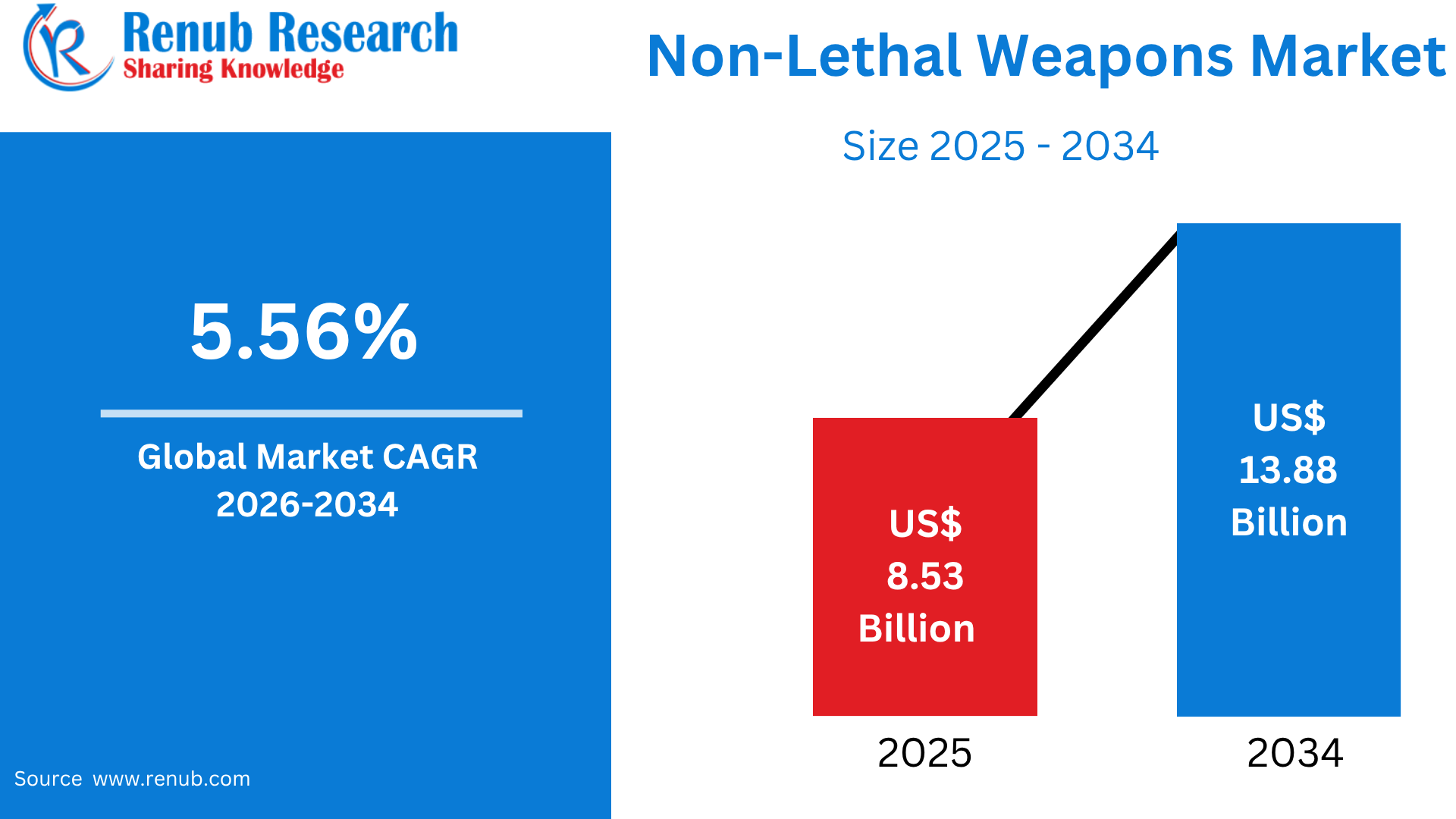
Non-Lethal Weapons Market is projected to grow from US$ 8.53 billion in 2025 to US$ 13.88 billion by 2034, expanding at a compound annual growth rate (CAGR) of 5.56% during the forecast period of 2026–2034. The market is expected to experience steady growth due to the increasing demand for effective crowd management and law enforcement solutions. These weapons are extensively utilized by police forces, military personnel, and security agencies to manage civil disturbances and conflict situations while minimizing fatalities.
Non-Lethal Weapons Market Overview
Non-lethal weapons, also referred to as less lethal weapons, are devices intended for controlling, incapacitating, or deterring individuals without causing permanent injury or death. Non-lethal weapons are often employed by law enforcement agencies, military personnel, and security personnel in managing dangerous situations while seeking to avoid fatal outcomes. Non-lethal weapons include stun guns, rubber bullets, pepper spray, tear gas, tasers, and acoustic/directed energy devices. The main intent behind non-lethal weapons is to incapacitate or control individuals during law enforcement operations, crowd control situations, and self-defense.
The use and popularity of non-lethal weapons have been on the rise all over the world due to the increasing need for alternative and safe means of ensuring public security and order. Non-lethal weapons are being widely used by governments and law enforcement agencies all over the world as an alternative to the use of guns in situations where the use of lethal weapons may not be required. Non-lethal weapons are also important in helping law enforcement agencies control protests and riots. Due to the increasing use of technology, non-lethal weapons are also effective. The increasing concerns for human rights and safety are also expected to lead to an increase in the use of non-lethal weapons.
Company Acquisitions and Partnerships in the Non-Lethal Weapons Market
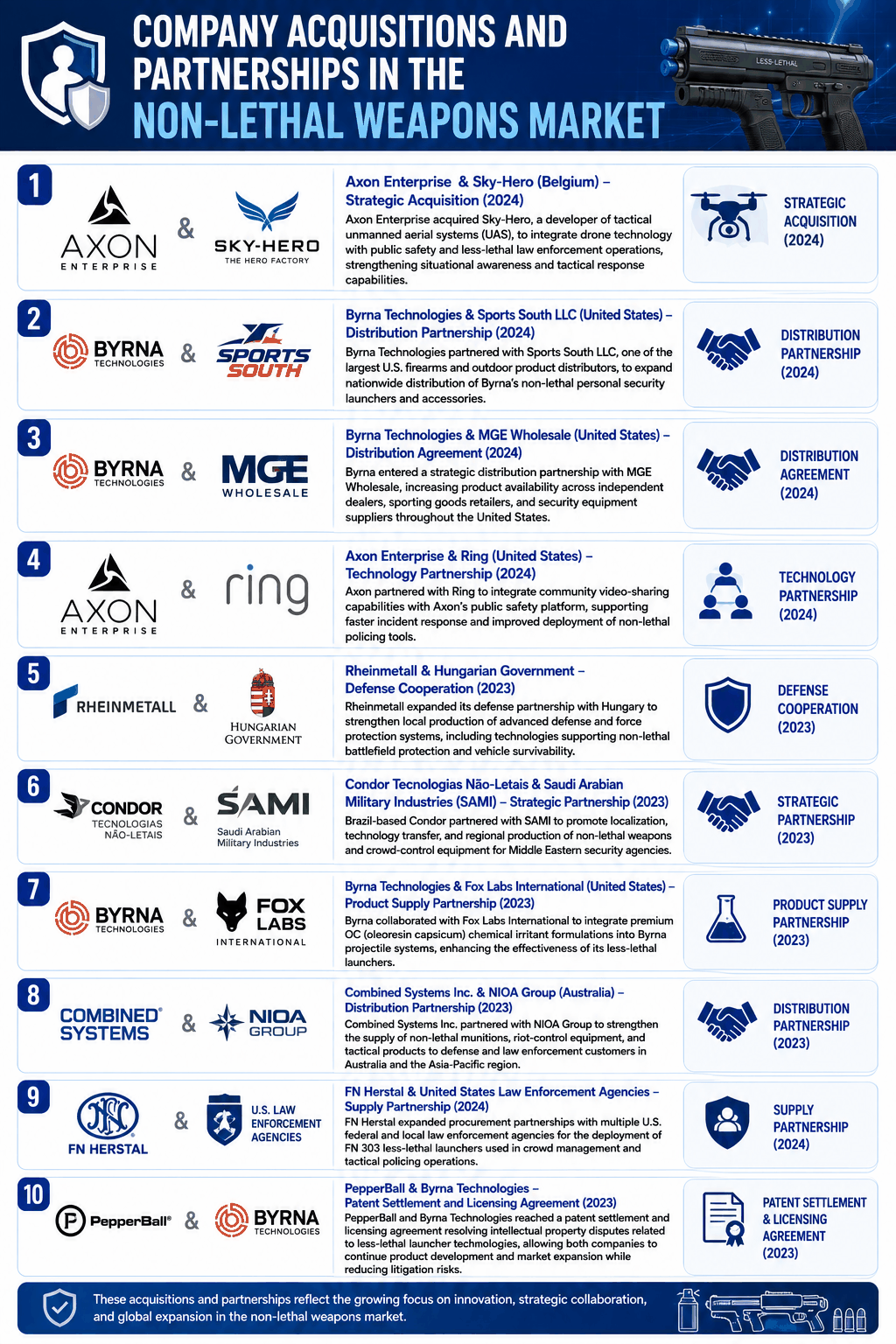
- Axon Enterprise & Sky-Hero (Belgium) – Strategic Acquisition (2024): Axon Enterprise acquired Sky-Hero, a developer of tactical unmanned aerial systems (UAS), to integrate drone technology with public safety and less-lethal law enforcement operations, strengthening situational awareness and tactical response capabilities.
- Byrna Technologies & Sports South LLC (United States) – Distribution Partnership (2024): Byrna Technologies partnered with Sports South LLC, one of the largest U.S. firearms and outdoor product distributors, to expand nationwide distribution of Byrna’s non-lethal personal security launchers and accessories.
- Byrna Technologies & MGE Wholesale (United States) – Distribution Agreement (2024): Byrna entered a strategic distribution partnership with MGE Wholesale, increasing product availability across independent dealers, sporting goods retailers, and security equipment suppliers throughout the United States.
- Axon Enterprise & Ring (United States) – Technology Partnership (2024): Axon partnered with Ring to integrate community video-sharing capabilities with Axon’s public safety platform, supporting faster incident response and improved deployment of non-lethal policing tools.
- Rheinmetall & Hungarian Government – Defense Cooperation (2023): Rheinmetall expanded its defense partnership with Hungary to strengthen local production of advanced defense and force protection systems, including technologies supporting non-lethal battlefield protection and vehicle survivability.
- Condor Tecnologias Não-Letais & Saudi Arabian Military Industries (SAMI) – Strategic Partnership (2023): Brazil-based Condor partnered with SAMI to promote localization, technology transfer, and regional production of non-lethal weapons and crowd-control equipment for Middle Eastern security agencies.
- Byrna Technologies & Fox Labs International (United States) – Product Supply Partnership (2023): Byrna collaborated with Fox Labs International to integrate premium OC (oleoresin capsicum) chemical irritant formulations into Byrna projectile systems, enhancing the effectiveness of its less-lethal launchers.
- Combined Systems Inc. & NIOA Group (Australia) – Distribution Partnership (2023): Combined Systems Inc. partnered with NIOA Group to strengthen the supply of non-lethal munitions, riot-control equipment, and tactical products to defense and law enforcement customers in Australia and the Asia-Pacific region.
- FN Herstal & United States Law Enforcement Agencies – Supply Partnership (2024): FN Herstal expanded procurement partnerships with multiple U.S. federal and local law enforcement agencies for the deployment of FN 303 less-lethal launchers used in crowd management and tactical policing operations.
- PepperBall & Byrna Technologies – Patent Settlement and Licensing Agreement (2023): PepperBall and Byrna Technologies reached a patent settlement and licensing agreement resolving intellectual property disputes related to less-lethal launcher technologies, allowing both companies to continue product development and market expansion while reducing litigation risks.
Growth Driver
Increasing Demand for Crowd Control and Public Security Operations
The growing frequency of public demonstrations, civil unrest, sporting events, political gatherings, and large-scale public assemblies has significantly increased the demand for non-lethal weapons worldwide. Law enforcement agencies are increasingly adopting less-lethal technologies to maintain public order while minimizing fatalities and permanent injuries. According to the United Nations, over 55% of the global population now lives in urban areas, a figure expected to approach 68% by 2050, resulting in greater policing requirements in densely populated cities. Modern police departments are increasingly deploying conducted energy devices, rubber projectiles, bean bag rounds, pepper spray, acoustic devices, and flash-bang systems to disperse crowds while reducing the use of lethal force. Governments across North America, Europe, Asia-Pacific, and the Middle East continue to expand investments in public security modernization and riot-control equipment. Rising concerns over officer safety, human rights compliance, and proportional use-of-force policies are further encouraging procurement of advanced non-lethal technologies. Continuous improvements in precision targeting, range, and effectiveness are strengthening adoption across police, border security, and correctional facilities worldwide.
Rising Defense Modernization and Military Investment
Defense modernization programs worldwide are creating substantial growth opportunities for the non-lethal weapons market as military organizations seek alternatives for peacekeeping, counterinsurgency, border protection, and urban combat missions. According to the Stockholm International Peace Research Institute (SIPRI), global military expenditure exceeded US$2.4 trillion in 2024, reflecting continued investment in advanced defense technologies. Armed forces increasingly require scalable response options that enable personnel to control hostile situations without unnecessary casualties, particularly during humanitarian missions, checkpoint operations, and civilian protection activities. Non-lethal technologies, including directed energy systems, vehicle-stopping devices, acoustic weapons, laser dazzlers, and electromagnetic disruption systems, are gaining importance in modern military doctrine. These systems allow security forces to neutralize threats while reducing collateral damage and supporting compliance with international humanitarian standards. Technological advancements in power systems, lightweight materials, and electronic targeting are improving operational effectiveness. Increasing geopolitical tensions and growing defense budgets across developed and emerging economies continue to support procurement of advanced non-lethal weapon systems for military and homeland security applications.
Technological Advancements in Smart Non-Lethal Weapon Systems
Continuous innovation in electronics, artificial intelligence, sensor technology, directed energy, and advanced materials is transforming the capabilities of non-lethal weapons. Manufacturers are developing next-generation systems that offer greater accuracy, longer operational range, improved reliability, and enhanced user safety. Modern conducted electrical weapons now incorporate digital evidence recording, wireless connectivity, GPS tracking, and body-camera integration to improve operational transparency and accountability. Advances in laser technology, microwave systems, autonomous surveillance platforms, and precision-guided launchers are expanding the scope of non-lethal applications beyond traditional law enforcement. Research organizations and defense contractors are investing heavily in smart ammunition, programmable munitions, and AI-assisted targeting technologies that minimize unintended injuries. Improved battery performance, compact designs, and durable composite materials further enhance field deployment capabilities. As governments increasingly prioritize accountability, de-escalation strategies, and officer protection, demand for technologically advanced non-lethal systems continues to grow. These innovations are expected to accelerate market expansion across military, law enforcement, border security, and private security sectors over the coming decade.
Non-Lethal Weapons Launches Around the World
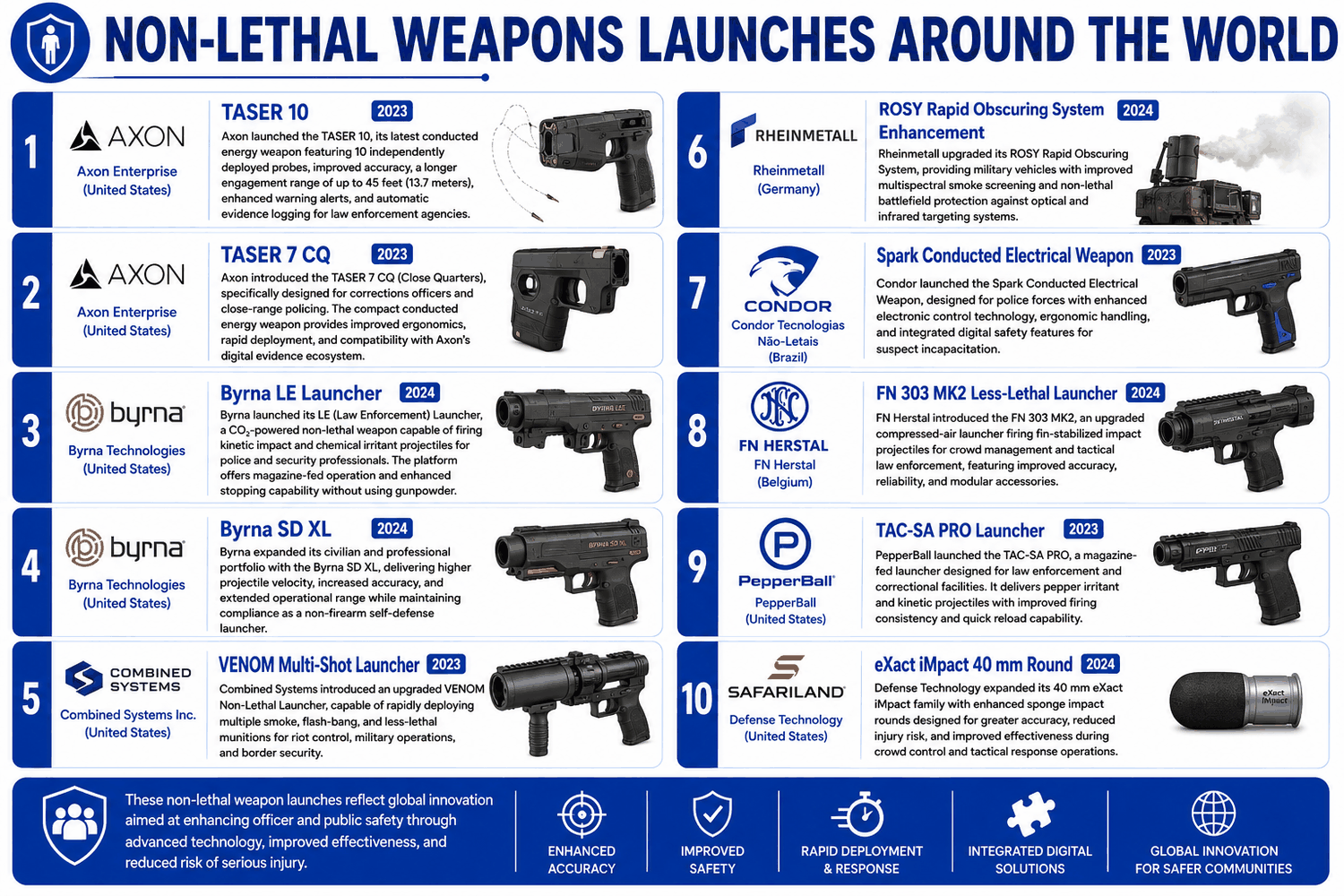
- Axon Enterprise (United States) – TASER 10 (2023): Axon launched the TASER 10, its latest conducted energy weapon featuring 10 independently deployed probes, improved accuracy, a longer engagement range of up to 45 feet (13.7 meters), enhanced warning alerts, and automatic evidence logging for law enforcement agencies.
- Axon Enterprise (United States) – TASER 7 CQ (2023): Axon introduced the TASER 7 CQ (Close Quarters), specifically designed for corrections officers and close-range policing. The compact conducted energy weapon provides improved ergonomics, rapid deployment, and compatibility with Axon’s digital evidence ecosystem.
- Byrna Technologies (United States) – Byrna LE Launcher (2024): Byrna launched its LE (Law Enforcement) Launcher, a CO₂-powered non-lethal weapon capable of firing kinetic impact and chemical irritant projectiles for police and security professionals. The platform offers magazine-fed operation and enhanced stopping capability without using gunpowder.
- Byrna Technologies (United States) – Byrna SD XL (2024): Byrna expanded its civilian and professional portfolio with the Byrna SD XL, delivering higher projectile velocity, increased accuracy, and extended operational range while maintaining compliance as a non-firearm self-defense launcher.
- Combined Systems Inc. (United States) – VENOM Multi-Shot Launcher (2023): Combined Systems introduced an upgraded VENOM Non-Lethal Launcher, capable of rapidly deploying multiple smoke, flash-bang, and less-lethal munitions for riot control, military operations, and border security.
- Rheinmetall (Germany) – ROSY Rapid Obscuring System Enhancement (2024): Rheinmetall upgraded its ROSY Rapid Obscuring System, providing military vehicles with improved multispectral smoke screening and non-lethal battlefield protection against optical and infrared targeting systems.
- Condor Tecnologias Não-Letais (Brazil) – Spark Conducted Electrical Weapon (2023): Condor launched the Spark Conducted Electrical Weapon, designed for police forces with enhanced electronic control technology, ergonomic handling, and integrated digital safety features for suspect incapacitation.
- FN Herstal (Belgium) – FN 303 MK2 Less-Lethal Launcher (2024): FN Herstal introduced the FN 303 MK2, an upgraded compressed-air launcher firing fin-stabilized impact projectiles for crowd management and tactical law enforcement, featuring improved accuracy, reliability, and modular accessories.
- PepperBall (United States) – TAC-SA PRO Launcher (2023): PepperBall launched the TAC-SA PRO, a magazine-fed launcher designed for law enforcement and correctional facilities. It delivers pepper irritant and kinetic projectiles with improved firing consistency and quick reload capability.
- Safariland Group / Defense Technology (United States) – eXact iMpact 40 mm Round (2024): Defense Technology expanded its 40 mm eXact iMpact family with enhanced sponge impact rounds designed for greater accuracy, reduced injury risk, and improved effectiveness during crowd control and tactical response operations.
Challenge
Strict Regulatory Frameworks and Human Rights Concerns
One of the primary challenges facing the non-lethal weapons market is the complex regulatory environment governing their development, procurement, export, and operational use. Governments and international organizations maintain strict regulations to ensure that less-lethal weapons are used proportionately and responsibly. Allegations of excessive force during crowd-control operations have increased public scrutiny and prompted greater oversight of police and military equipment procurement. Human rights organizations frequently call for stricter accountability regarding the deployment of conducted energy weapons, rubber bullets, tear gas, and kinetic impact projectiles. Export controls and licensing requirements also restrict international sales of many advanced non-lethal systems, particularly to politically sensitive regions. Manufacturers must conduct extensive product testing, certification, and legal compliance before commercialization, increasing development costs and delaying product launches. Differences in national regulations further complicate global market expansion, requiring customized compliance strategies for individual countries. These legal, ethical, and political considerations continue to present significant barriers to sustained market growth.
Limited Effectiveness Against High-Risk Threats and Operational Constraints
Although non-lethal weapons provide valuable alternatives to conventional firearms, they are not effective in every operational scenario. Their performance can vary depending on environmental conditions, target distance, clothing, physical resistance, and the behavior of individuals involved. Conducted electrical weapons may have limited effectiveness against multiple attackers or individuals wearing thick protective clothing, while chemical agents can be influenced by wind direction and weather conditions. Kinetic impact projectiles require accurate targeting to avoid severe injuries, creating operational challenges during rapidly evolving situations. Security personnel therefore require extensive training to deploy these systems safely and effectively while minimizing unintended harm. Additionally, many law enforcement agencies continue to maintain lethal weapons alongside non-lethal options because certain high-risk situations still demand immediate deadly force. Budget limitations, maintenance requirements, equipment replacement costs, and continuous operator training further increase operational expenses. These practical limitations can slow procurement decisions and restrict widespread adoption, particularly among agencies with constrained financial resources.
Increasing Demand for Safer Crowd Control and Riot Management Solutions
Non-Lethal Bullets Market is expanding steadily as governments and law enforcement agencies seek safer alternatives to conventional ammunition for crowd management and conflict de-escalation. Non-lethal bullets, including rubber bullets, sponge rounds, bean bag rounds, foam projectiles, and plastic baton rounds, are widely used to disperse violent gatherings while reducing the likelihood of fatal injuries. Globally, more than 55% of the population lives in urban areas, resulting in increased public events, demonstrations, and policing requirements. Police departments across North America, Europe, and Asia-Pacific are modernizing their riot-control equipment to comply with evolving use-of-force policies and public safety standards. Advances in projectile materials, aerodynamic design, and launch systems have improved firing accuracy, controlled impact energy, and operational safety. Security agencies are also investing in specialized ammunition for correctional facilities, border security, and tactical response units. As governments continue emphasizing proportional force and officer safety, the demand for high-performance non-lethal bullets is expected to increase, supporting long-term market growth across both developed and emerging economies.
Growing Adoption of Conducted Energy Weapons by Police Forces
Non-Lethal Taser Guns Market is witnessing significant growth due to increasing adoption by police departments seeking effective alternatives to firearms during suspect apprehension. Taser guns temporarily incapacitate individuals by delivering controlled electrical pulses that disrupt voluntary muscle movement without causing permanent injury under standard operating conditions. Thousands of police agencies worldwide have incorporated conducted energy weapons into their standard equipment, reflecting growing confidence in their effectiveness. Modern taser devices can operate at engagement distances of approximately 7 to 10 meters, enabling officers to maintain a safer distance during confrontations. New-generation models integrate body-camera synchronization, digital evidence recording, wireless data transfer, GPS tracking, and enhanced battery systems to improve accountability and operational transparency. Increasing public demand for reduced use of deadly force, combined with enhanced officer protection, continues to encourage procurement of taser technologies. Continuous innovation in cartridge reliability, electrode design, and electronic safety systems is further strengthening adoption across law enforcement, corrections, airport security, and private security organizations worldwide.
Technological Innovation Supporting Modern Law Enforcement Operations
Non-Lethal Electroshock Weapons Market is growing rapidly as advances in electronic control systems and battery technologies improve the effectiveness and safety of conducted electrical weapons. Electroshock devices temporarily disable aggressive individuals by delivering controlled electrical impulses that interrupt neuromuscular communication, allowing officers to safely restrain suspects with reduced reliance on lethal force. Rechargeable lithium-ion batteries, improved pulse modulation, and intelligent safety circuits have significantly enhanced operational reliability while reducing maintenance requirements. Many advanced electroshock systems now include integrated digital reporting capabilities, activation logs, wireless connectivity, and compatibility with evidence management platforms, improving transparency and accountability during field operations. Increasing investments in police modernization, public safety programs, and officer training are supporting widespread deployment across municipal police, correctional institutions, transportation security, and border protection agencies. Rising emphasis on human rights compliance and de-escalation strategies further strengthens demand for modern electroshock technologies, positioning this segment as one of the fastest-evolving categories within the broader non-lethal weapons industry.
Expanding Use Across Military, Border Security, and Tactical Operations
Non-Lethal Mechanical and Kinetic Weapons Market continues to expand as defense organizations and law enforcement agencies require versatile systems capable of controlling threats while minimizing fatalities. This category includes rubber projectile launchers, bean bag shotguns, baton launchers, pepper ball systems, net launchers, water cannons, and impact munitions designed to temporarily incapacitate individuals or disperse hostile crowds. Global military expenditure exceeds US$2.4 trillion annually, supporting continued investment in advanced force protection technologies, including less-lethal tactical equipment. Border security agencies increasingly utilize kinetic weapons to prevent unauthorized crossings and manage high-risk situations without escalating violence. Manufacturers are introducing lightweight launchers, programmable ammunition, enhanced targeting optics, and ergonomic weapon platforms that improve operational effectiveness while reducing unintended injuries. Increasing participation in peacekeeping missions, disaster response, correctional security, and urban policing further expands application opportunities. Continuous product innovation and stricter operational training standards are expected to support sustained growth across military and civilian security sectors.
Rising Focus on Officer Safety and Responsible Use of Force
Law Enforcement Non-Lethal Weapons Market is experiencing sustained growth as police agencies worldwide prioritize officer safety, public protection, and responsible policing practices. Law enforcement organizations increasingly deploy pepper sprays, tasers, rubber bullets, bean bag rounds, flash-bang devices, batons, and acoustic deterrent systems to manage potentially dangerous situations while minimizing the use of lethal force. Globally, there are millions of police personnel serving across national, regional, and municipal law enforcement agencies, creating substantial demand for modern less-lethal equipment. Governments continue increasing investments in police modernization programs that include advanced protective gear, digital evidence systems, body-worn cameras, and integrated non-lethal weapon platforms. Technological developments have improved weapon accuracy, reliability, accountability, and ease of deployment, enabling officers to respond more effectively during crowd control, suspect apprehension, correctional facility management, and public security operations. Growing public expectations regarding transparency and proportional use of force continue encouraging procurement of advanced non-lethal solutions, positioning this market for steady long-term expansion across developed and developing countries.
Robust Defense Spending and Police Modernization Driving United States Market Growth
United States Non-Lethal Weapons Market is the largest globally, supported by extensive investments in defense modernization, homeland security, and law enforcement equipment. The U.S. defense budget exceeds US$850 billion annually, while thousands of federal, state, and local law enforcement agencies continuously procure advanced less-lethal technologies for public safety operations. The country has over 18,000 law enforcement agencies employing more than 700,000 sworn police officers, creating substantial demand for conducted energy weapons, pepper ball launchers, rubber projectiles, acoustic devices, and flash-bang systems. Growing emphasis on reducing the use of deadly force and enhancing officer safety has accelerated adoption of advanced non-lethal solutions equipped with digital evidence recording and smart targeting capabilities. Continuous research into directed energy weapons, laser dazzlers, and vehicle-stopping technologies further strengthens market development. Strong domestic manufacturers, high research expenditure, and ongoing government procurement programs position the United States as the global leader in the development, production, and deployment of next-generation non-lethal weapon systems.
Increasing Public Safety Initiatives and Counterterrorism Preparedness in the United Kingdom
United Kingdom Non-Lethal Weapons Market is expanding steadily due to increasing investments in public safety, counterterrorism preparedness, and police modernization programs. The UK maintains a professional police force of more than 140,000 officers serving England, Scotland, Wales, and Northern Ireland, with growing emphasis on proportional use-of-force policies. Conducted energy weapons, incapacitant sprays, baton rounds, and public-order equipment are increasingly deployed to manage violent incidents while minimizing fatalities. Rising security requirements for airports, transportation networks, public gatherings, and sporting events continue supporting procurement of modern less-lethal technologies. Government investment in surveillance systems, digital policing, and tactical response units complements the adoption of advanced non-lethal weapons. Technological improvements in electronic control devices, precision launchers, and integrated evidence management systems have enhanced operational effectiveness and accountability. Collaboration between domestic defense manufacturers, research institutions, and international security partners continues to strengthen innovation, positioning the United Kingdom as an important European market for non-lethal weapons and law enforcement equipment.
Rising Border Security and Internal Law Enforcement Requirements in India
India Non-Lethal Weapons Market is witnessing significant growth as the country strengthens internal security, border management, and public order capabilities. India has a population exceeding 1.4 billion people, creating substantial demand for effective law enforcement and crowd management solutions. The country employs more than 2 million police personnel, while central armed police forces and border security organizations continue modernizing their operational equipment. Increasing urbanization, large public gatherings, election security, and border surveillance requirements have accelerated procurement of tear smoke munitions, rubber bullets, stun grenades, pepper launchers, and conducted energy devices. Government initiatives promoting domestic defense manufacturing under the “Make in India” program are encouraging local production of advanced non-lethal systems. Research organizations and defense companies are also developing indigenous technologies for riot control, anti-drone protection, and tactical law enforcement operations. Growing investments in police modernization, smart cities, and homeland security infrastructure are expected to drive sustained demand for non-lethal weapons across India’s civilian and defense sectors.
Security Infrastructure Modernization in Saudi Arabia
Saudi Arabia Non-Lethal Weapons Market is growing steadily as the government enhances national security capabilities under Vision 2030 through investments in defense modernization and public safety infrastructure. Saudi Arabia consistently ranks among the world’s highest defense spenders, with annual military expenditure exceeding US$70 billion, supporting procurement of advanced security technologies. Increasing protection requirements for critical infrastructure, international events, border security, and religious gatherings attended by millions of pilgrims annually have expanded demand for modern crowd-control equipment and less-lethal weapon systems. Police and security agencies are investing in conducted energy weapons, rubber projectile launchers, acoustic deterrent devices, chemical irritants, and advanced tactical equipment to improve operational effectiveness while reducing reliance on lethal force. The country is also encouraging localization of defense manufacturing through strategic partnerships with international defense companies, strengthening domestic production capabilities. Continuous modernization of homeland security agencies, smart surveillance systems, and tactical response units positions Saudi Arabia as one of the fastest-growing non-lethal weapons markets in the Middle East.
Market Segments
Product Type
- Gases and sprays
- Grenades
- Bullets
- Taser Guns
- Others
Technology
- Chemical
- Electroshock
- Mechanical and Kinetic
- Acoustic/Light
- Others
End Use
- Law Enforcement
- Military
- Others
Countries
North America
- United States
- Canada
Europe
- France
- Germany
- Italy
- Spain
- United Kingdom
- Belgium
- Netherlands
- Turkey
Asia Pacific
- China
- Japan
- India
- Australia
- South Korea
- Thailand
- Malaysia
- Indonesia
- New Zealand
Latin America
- Brazil
- Mexico
- Argentina
Middle East & Africa
- South Africa
- Saudi Arabia
- UAE
All the key players have been covered from 5 Viewpoints:
- Overviews
- Key Person
- Recent Developments
- SWOT Analysis
- Revenue Analysis
Company Analysis
- Byrna Technologies Inc.
- General Dynamics Corporation
- Moog Inc.
- Raytheon Technologies Corporation
- Rheinmetall AG
- Textron Inc.
- Combined Systems Inc.
Report Details:
| Report Features | Details |
| Base Year |
2025 |
| Historical Period |
2022 - 2025 |
| Forecast Period |
2026 - 2034 |
| Market |
US$ Billion |
| Segment Covered |
Product Type,Technology, End User and Countries |
| Countries Covered |
|
| Companies Covered |
|
| Customization Scope |
20% Free Customization |
| Post-Sale Analyst Support |
1 Year (52 Weeks) |
| Delivery Format |
PDF and Excel through Email (We can also provide the editable version of the report in PPT/Word format on request) |
Key Questions Answered in This Report:
-
What is the projected market size of non-lethal weapons in 2024 and 2033?
-
What is the compound annual growth rate (CAGR) of the non-lethal weapons market from 2025 to 2033?
-
Which product types are most commonly used in non-lethal weapons?
-
How are taser guns used in law enforcement?
-
What are the main applications of non-lethal weapons in military operations?
-
What technological advancements are driving the growth of the non-lethal weapons market?
-
What challenges does the non-lethal weapons market face regarding effectiveness in high-pressure situations?
-
What ethical and legal concerns are associated with the use of non-lethal weapons?
-
Which regions are expected to see the highest demand for non-lethal weapons?
-
How are chemical non-lethal weapons used for crowd control and military operations?
Customization Services available
- Analysis of Market Size and Its Segments
- More Company Profiles (Upto 10 without any additional cost):
- Additional Countries (Other than mentioned Countries):
- Region/Country Specific Reports:
- Market Entry Strategy:
- Region-Specific Market Dynamics:
- Regional Market Share Analysis:
- Trade Analysis:
- Production Insights:
- Others Customized Requests:
For more information contact our analysts.
Need More Assistance?
- Talk to our analysts to get more precious information on the current market trends.
- Include more countries and segments and customize the report based on the final requirement.
- Get a competitive advantage in your industry by knowing the report findings and making a positive impact on your revenues and operations.
- Our analysts are always ready to provide more help and pertinent information if you need any additional assistance.