Global Microgrid Market Report by Power Source (CHP, Natural Gas, Solar PV, Diesel, Fuel Cell, Others), Application (Education, Government, Commercial, Utility, Defense, Others), Connectivity, Grid Type, Countries and Company Analysis 2026-2034
Buy NowGlobal Microgrid Market Size, Share & Growth Forecast
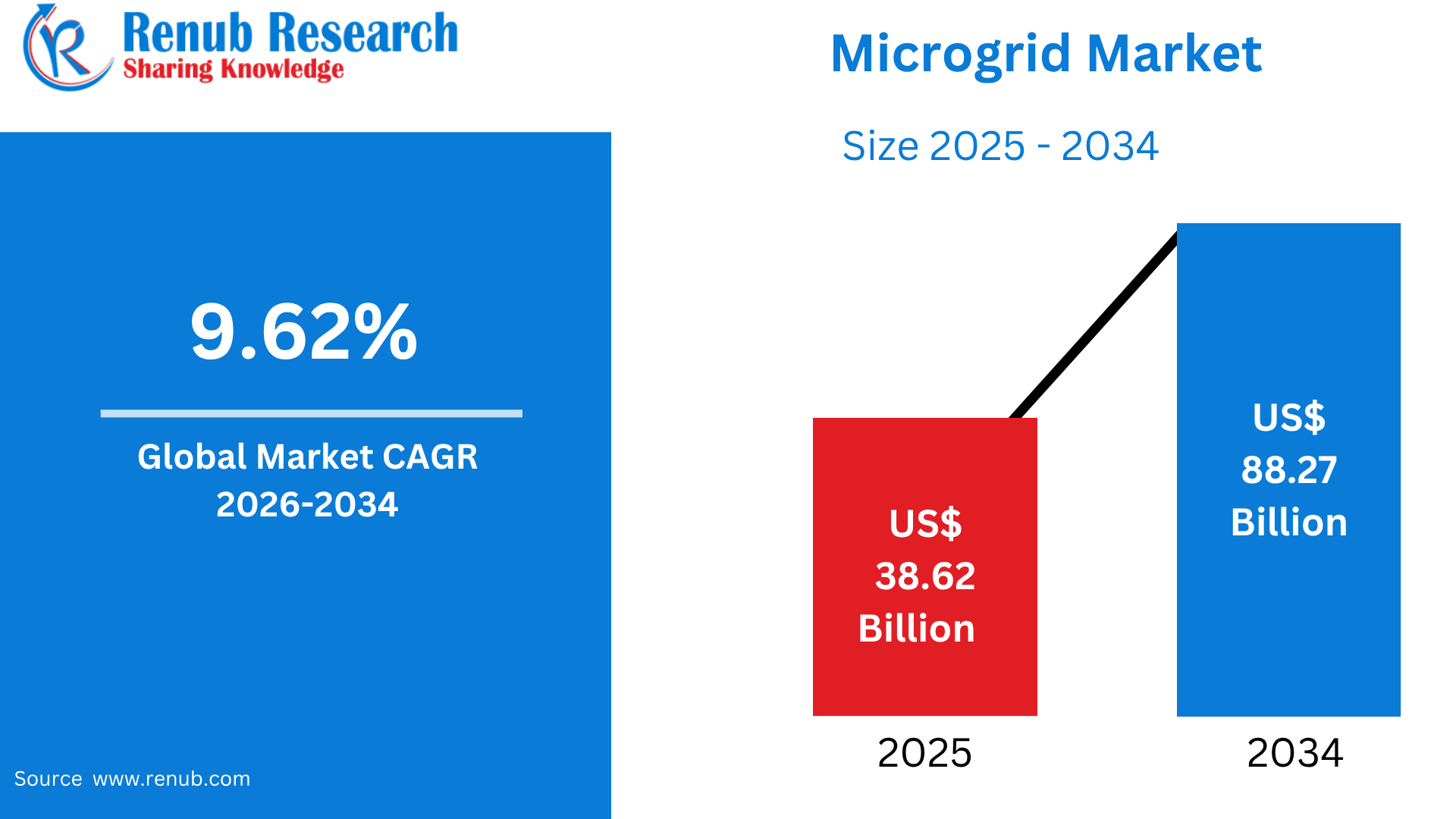
Microgrid Market is projected to expand from US$ 38.62 billion in 2025 to US$ 88.27 billion by 2034, registering a CAGR of 9.62% during 2026–2034. Market growth is driven by increasing demand for reliable and resilient power supply, the rapid integration of renewable energy sources, and the growing need for energy independence. Supportive government policies, rural electrification initiatives, and ongoing advancements in energy storage systems, smart grid infrastructure, and digital energy management technologies are further accelerating the adoption of microgrids worldwide.
What is Microgrid and its Uses & Popularity Worldwide
A microgrid is a localized energy system that consists of interconnected electricity sources, energy storage systems, and electrical loads capable of operating either independently (island mode) or in conjunction with the main power grid. Microgrids typically integrate renewable energy sources such as solar photovoltaic (PV) panels, wind turbines, biomass, and small hydro systems with conventional generators and battery energy storage systems. Advanced control software and smart grid technologies enable microgrids to monitor, manage, and optimize electricity generation, distribution, and consumption in real time. They are widely used in residential communities, commercial buildings, industrial facilities, military bases, hospitals, universities, airports, remote islands, and rural electrification projects to ensure reliable and uninterrupted power supply during grid outages.
Worldwide, the popularity of microgrids has increased significantly due to rising electricity demand, frequent power disruptions, and the global transition toward clean energy. Governments and utilities are investing in microgrid projects to improve grid resilience, reduce greenhouse gas emissions, and enhance energy security. The growing adoption of renewable energy, declining battery storage costs, and advancements in digital energy management, artificial intelligence, and smart grid infrastructure are accelerating deployment. Microgrids also play a vital role in disaster recovery, critical infrastructure protection, and providing electricity access to remote and underserved communities, making them an essential component of modern sustainable energy systems.
Growth Drivers of the Microgrid Market
Rising Demand for Grid Resilience and Reliable Power Supply
The increasing need for uninterrupted electricity is one of the strongest growth drivers of the global microgrid market. Frequent power outages caused by aging transmission infrastructure, extreme weather events, cyber threats, and growing electricity demand have encouraged governments and businesses to invest in localized power systems. Microgrids provide reliable electricity by operating independently from the central grid during emergencies, ensuring continuous power supply to hospitals, military facilities, airports, universities, manufacturing plants, and data centers. Globally, electricity consumption continues to rise as urbanization and industrialization accelerate, increasing pressure on conventional power grids. Industries where even a few minutes of downtime can result in significant financial losses are increasingly adopting microgrid solutions. In addition, critical infrastructure operators are integrating battery energy storage systems and distributed generation to improve energy reliability. Continuous investment in resilient energy infrastructure, digital monitoring systems, and intelligent energy management platforms is expected to drive strong demand for microgrid installations across residential, commercial, industrial, and institutional sectors throughout the forecast period.
Growing Integration of Renewable Energy and Energy Storage Systems
The global transition toward clean energy is significantly accelerating the adoption of microgrids. Governments and utilities are increasing investments in renewable energy sources such as solar photovoltaic systems, wind turbines, biomass, and small hydroelectric plants to reduce carbon emissions and improve energy sustainability. Microgrids enable efficient integration of these distributed energy resources while balancing electricity generation and consumption through advanced control systems and battery energy storage. Global renewable energy capacity has expanded rapidly over the past decade, encouraging communities, businesses, and industries to deploy localized energy systems. Declining battery costs and improvements in lithium-ion and advanced energy storage technologies have made microgrids more economically viable. Hybrid microgrids combining renewable energy with diesel generators or natural gas systems are also gaining popularity in remote areas and industrial operations. Increasing demand for net-zero buildings, carbon reduction initiatives, and sustainable energy infrastructure continues to encourage governments and private organizations to deploy renewable-powered microgrids, supporting long-term market growth worldwide.
Government Support, Rural Electrification, and Smart Grid Development
Government initiatives promoting energy security and universal electricity access are major drivers of the global microgrid market. Numerous countries are investing in rural electrification projects to provide reliable electricity to remote communities where extending conventional transmission infrastructure is expensive or technically challenging. Microgrids offer a cost-effective solution by combining distributed renewable energy generation with local energy storage and intelligent energy management systems. Financial incentives, investment subsidies, tax benefits, and clean energy policies are encouraging utilities, commercial organizations, and industrial facilities to adopt microgrid technologies. Smart grid modernization programs are further supporting market expansion by improving communication between distributed energy resources, storage systems, and electricity consumers. Digital technologies such as artificial intelligence, Internet of Things (IoT) sensors, and cloud-based energy management platforms enable real-time monitoring, predictive maintenance, and optimized power distribution. Increasing public and private investment in resilient energy infrastructure, smart cities, and sustainable development projects is expected to continue driving global demand for advanced microgrid systems.
Microgrid Project Launches Worldwide
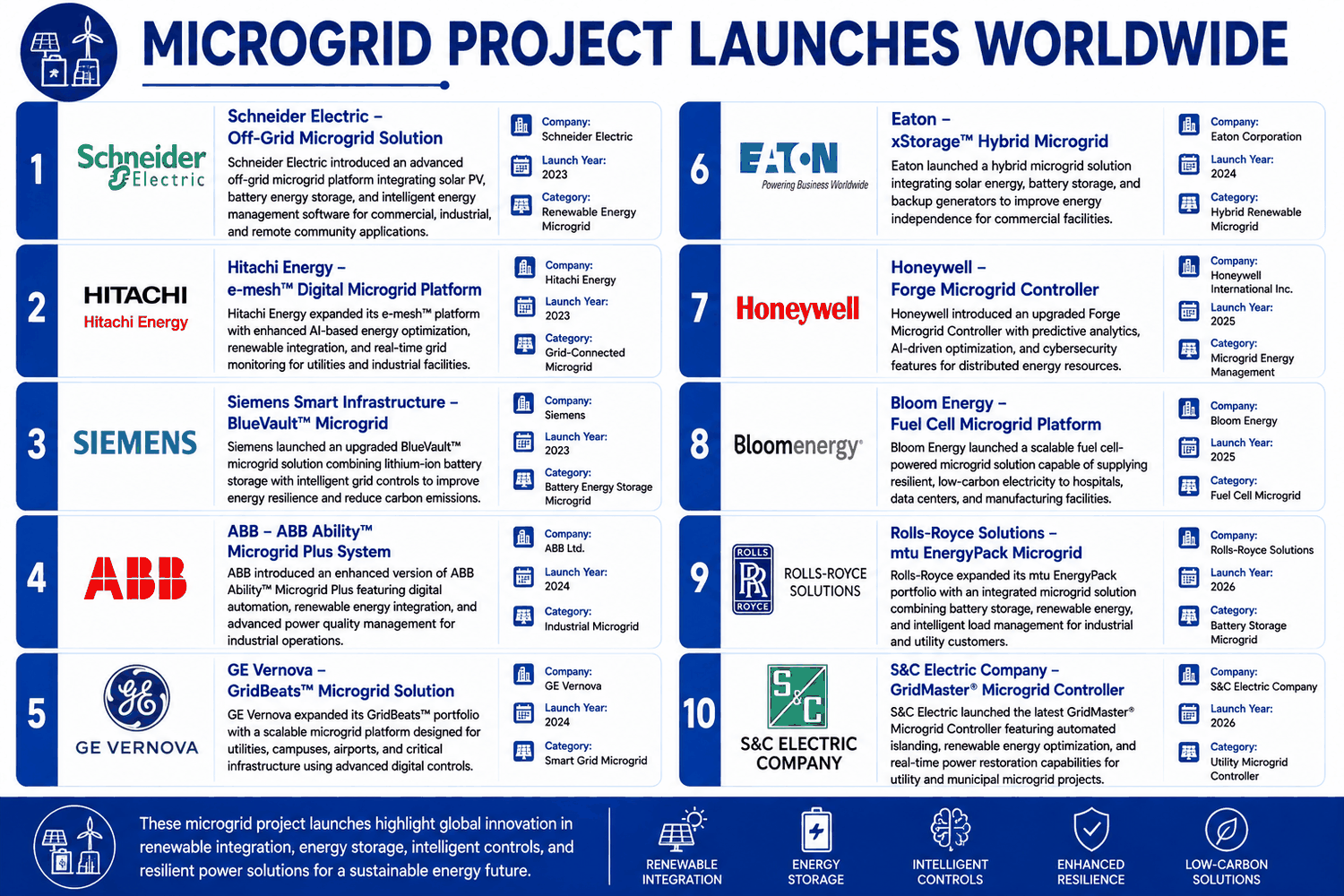
- Schneider Electric – Off-Grid Microgrid Solution
- Company: Schneider Electric
- Launch Year: 2023
- Category: Renewable Energy Microgrid
- Highlights: Schneider Electric introduced an advanced off-grid microgrid platform integrating solar PV, battery energy storage, and intelligent energy management software for commercial, industrial, and remote community applications.
- Hitachi Energy – e-mesh™ Digital Microgrid Platform
- Company: Hitachi Energy
- Launch Year: 2023
- Category: Grid-Connected Microgrid
- Highlights: Hitachi Energy expanded its e-mesh™ platform with enhanced AI-based energy optimization, renewable integration, and real-time grid monitoring for utilities and industrial facilities.
- Siemens Smart Infrastructure – BlueVault™ Microgrid
- Company: Siemens
- Launch Year: 2023
- Category: Battery Energy Storage Microgrid
- Highlights: Siemens launched an upgraded BlueVault™ microgrid solution combining lithium-ion battery storage with intelligent grid controls to improve energy resilience and reduce carbon emissions.
- ABB – ABB Ability™ Microgrid Plus System
- Company: ABB Ltd.
- Launch Year: 2024
- Category: Industrial Microgrid
- Highlights: ABB introduced an enhanced version of ABB Ability™ Microgrid Plus featuring digital automation, renewable energy integration, and advanced power quality management for industrial operations.
- GE Vernova – GridBeats™ Microgrid Solution
- Company: GE Vernova
- Launch Year: 2024
- Category: Smart Grid Microgrid
- Highlights: GE Vernova expanded its GridBeats™ portfolio with a scalable microgrid platform designed for utilities, campuses, airports, and critical infrastructure using advanced digital controls.
- Eaton – xStorage™ Hybrid Microgrid
- Company: Eaton Corporation
- Launch Year: 2024
- Category: Hybrid Renewable Microgrid
- Highlights: Eaton launched a hybrid microgrid solution integrating solar energy, battery storage, and backup generators to improve energy independence for commercial facilities.
- Honeywell – Forge Microgrid Controller
- Company: Honeywell International Inc.
- Launch Year: 2025
- Category: Microgrid Energy Management
- Highlights: Honeywell introduced an upgraded Forge Microgrid Controller with predictive analytics, AI-driven optimization, and cybersecurity features for distributed energy resources.
- Bloom Energy – Fuel Cell Microgrid Platform
- Company: Bloom Energy
- Launch Year: 2025
- Category: Fuel Cell Microgrid
- Highlights: Bloom Energy launched a scalable fuel cell-powered microgrid solution capable of supplying resilient, low-carbon electricity to hospitals, data centers, and manufacturing facilities.
- Rolls-Royce Solutions – mtu EnergyPack Microgrid
- Company: Rolls-Royce Solutions
- Launch Year: 2026
- Category: Battery Storage Microgrid
- Highlights: Rolls-Royce expanded its mtu EnergyPack portfolio with an integrated microgrid solution combining battery storage, renewable energy, and intelligent load management for industrial and utility customers.
- S&C Electric Company – GridMaster® Microgrid Controller
- Company: S&C Electric Company
- Launch Year: 2026
- Category: Utility Microgrid Controller
- Highlights: S&C Electric launched the latest GridMaster® Microgrid Controller featuring automated islanding, renewable energy optimization, and real-time power restoration capabilities for utility and municipal microgrid projects.
Challenges of the Microgrid Market
High Initial Investment and Complex Project Development
One of the primary challenges facing the microgrid market is the high upfront capital investment required for project development. Establishing a microgrid involves significant expenditure on solar panels, wind turbines, generators, battery energy storage systems, inverters, smart controllers, distribution infrastructure, and advanced monitoring software. Installation costs are further increased by engineering design, grid integration, permitting, and commissioning requirements. Although operational savings can be achieved over the long term through improved energy efficiency and lower fuel consumption, the initial financial commitment remains a major barrier, particularly for small businesses and rural communities. Securing financing for large-scale projects may also be difficult in developing economies where investment resources are limited. Additionally, project developers must coordinate multiple stakeholders, including utilities, technology providers, government agencies, and local communities. Reducing equipment costs, expanding financing options, and implementing supportive government incentive programs will be essential for accelerating broader adoption of microgrid technologies worldwide.
Regulatory Complexity and Grid Integration Challenges
The microgrid market also faces challenges related to regulatory uncertainty and the technical complexity of integrating localized energy systems with existing electricity networks. Regulations governing distributed energy generation, grid interconnection, electricity pricing, and utility ownership differ considerably across countries and regions, creating uncertainty for developers and investors. Obtaining permits, complying with technical standards, and negotiating grid connection agreements can increase project timelines and development costs. From a technical perspective, integrating renewable energy sources, battery storage, backup generators, and demand-response systems requires sophisticated control software and advanced communication infrastructure. Maintaining stable voltage, frequency, and power quality while transitioning between grid-connected and island operating modes presents additional engineering challenges. Cybersecurity has also become increasingly important as microgrids rely heavily on digital monitoring and automated control systems. Addressing these regulatory, technical, and cybersecurity issues through standardized policies, improved interoperability, and advanced grid management technologies will be critical for supporting the long-term growth of the global microgrid market.
Increasing Renewable Energy Deployment Driving Solar PV Microgrids Market Growth
Solar PV Microgrids Market is witnessing robust growth due to the rapid expansion of solar energy installations and the increasing need for decentralized electricity generation. Solar photovoltaic (PV) microgrids combine solar panels with battery energy storage systems, smart inverters, and advanced energy management software to deliver reliable and sustainable electricity. A typical commercial solar PV microgrid can generate electricity ranging from 100 kilowatts (kW) to several megawatts (MW), depending on project size and energy requirements. These systems are widely deployed in rural communities, islands, industrial facilities, military bases, hospitals, universities, and commercial buildings where uninterrupted power is essential. Declining solar module prices, improved battery performance, and higher energy conversion efficiency have made Solar PV microgrids increasingly cost-effective. Governments are also supporting solar-powered microgrids through renewable energy incentives and rural electrification programs. Growing corporate commitments to carbon neutrality and increasing investments in sustainable energy infrastructure are expected to accelerate the adoption of Solar PV microgrids worldwide during the forecast period.
Public Infrastructure Modernization Supporting Government Microgrids Market Expansion
Government Microgrids Market is expanding steadily as public agencies invest in resilient and secure energy infrastructure for critical facilities. Government organizations are deploying microgrids at military installations, government offices, airports, emergency response centers, hospitals, water treatment plants, and public universities to ensure continuous electricity during grid failures and natural disasters. Many government microgrid projects integrate renewable energy sources, battery storage, diesel backup generators, and intelligent energy management systems to improve operational reliability and reduce fuel consumption. These projects commonly range from 1 MW to more than 20 MW, depending on facility requirements. Governments worldwide are prioritizing energy security, disaster preparedness, and emissions reduction, encouraging greater investment in decentralized power systems. Public funding, infrastructure modernization programs, and clean energy initiatives are supporting the deployment of advanced microgrid technologies. The increasing frequency of extreme weather events and rising cybersecurity concerns surrounding centralized electricity networks are further strengthening demand for government-owned and government-supported microgrid installations.
Grid Integration and Intelligent Energy Management Fueling Microgrid Connected Growth
Microgrid Connected Market is experiencing strong growth as utilities, industries, and commercial organizations increasingly deploy grid-connected microgrids to improve energy efficiency and operational flexibility. Unlike isolated systems, grid-connected microgrids remain connected to the main utility network while maintaining the capability to operate independently during power disruptions. These systems optimize electricity consumption by balancing renewable energy generation, battery storage, conventional generators, and utility power through advanced digital control platforms. Commercial microgrid-connected installations generally range from 500 kW to more than 50 MW, depending on customer demand and facility size. Grid-connected microgrids enable users to reduce electricity costs, participate in demand response programs, improve power quality, and increase renewable energy utilization. Smart meters, Internet of Things (IoT) devices, artificial intelligence, and cloud-based monitoring platforms further enhance system performance through real-time optimization and predictive maintenance. Increasing investments in smart grid modernization and distributed energy resources continue to drive expansion of the global microgrid connected market.
Growing DC Microgrids Adoption of Efficient Direct Current Power Systems
DC Microgrids Market is gaining momentum due to increasing deployment of renewable energy systems, battery storage, electric vehicle charging infrastructure, and modern electronic equipment that naturally operate on direct current (DC). DC microgrids distribute electricity without repeated AC-DC conversion, improving overall system efficiency and reducing transmission losses. Many commercial DC microgrids achieve energy efficiency improvements of several percentage points compared with conventional alternating current systems, particularly in buildings with high concentrations of electronic loads. These systems are widely used in data centers, telecommunications facilities, hospitals, commercial buildings, manufacturing plants, and remote renewable energy installations. The rapid expansion of rooftop solar PV systems, lithium-ion battery storage, LED lighting, and electric mobility solutions has increased the demand for DC-based energy distribution. Advances in power electronics, intelligent controllers, and bidirectional converters are improving system reliability and operational flexibility. As organizations focus on energy efficiency, lower operating costs, and carbon reduction, the adoption of DC microgrids is expected to increase steadily across residential, commercial, industrial, and institutional applications.
Advanced Grid Modernization and Renewable Energy Integration Driving United States Growth
United States Microgrids Market is one of the largest globally, supported by increasing investments in grid modernization, renewable energy integration, and energy resilience. The U.S. has more than 330 million residents and one of the world’s highest electricity consumption levels, creating strong demand for reliable decentralized power systems. Microgrids are increasingly deployed across military bases, hospitals, universities, airports, commercial buildings, manufacturing facilities, and data centers to ensure uninterrupted electricity during grid disruptions. Solar photovoltaic systems, natural gas generators, battery energy storage, and combined heat and power (CHP) technologies are widely integrated into U.S. microgrid projects. Growing concerns over extreme weather events, wildfires, hurricanes, and aging transmission infrastructure have accelerated investments in resilient energy systems. Public and private organizations are also investing in artificial intelligence, smart grid software, and advanced energy management platforms to improve operational efficiency. Government funding for clean energy infrastructure and distributed energy resources is expected to further strengthen long-term growth in the United States microgrids market.
Decarbonization Initiatives and Smart Energy Systems Supporting United Kingdom Microgrids Expansion
United Kingdom Microgrids Market is experiencing steady growth due to the country’s commitment to carbon reduction, renewable energy deployment, and electricity network modernization. The UK has a population of approximately 68 million people, with increasing electricity demand from residential, commercial, and industrial sectors. Microgrids are being adopted in universities, business parks, hospitals, industrial estates, and remote island communities to improve energy security and reduce carbon emissions. Solar energy, wind power, battery storage, and electric vehicle charging infrastructure are increasingly integrated into local microgrid networks. The modernization of electricity distribution systems and the expansion of smart meters have improved the efficiency of distributed energy management. Commercial organizations are investing in microgrids to reduce electricity costs and improve operational resilience during grid disturbances. The increasing electrification of transportation, heating, and industrial operations is creating additional opportunities for decentralized energy systems. Continued investment in clean energy technologies and digital grid infrastructure is expected to support sustained market growth across the United Kingdom.
Rural Electrification and Renewable Energy Driving India Microgrids Market Development
India Microgrids Market is expanding rapidly due to increasing electricity demand, rural electrification programs, and large-scale renewable energy investments. India has a population exceeding 1.4 billion people, making reliable electricity access a national priority. Microgrids are widely deployed in rural villages, industrial facilities, educational institutions, healthcare centers, commercial buildings, and remote communities where extending conventional transmission infrastructure can be costly. Solar-powered microgrids have become particularly important because of India’s abundant solar resources and declining photovoltaic installation costs. Battery energy storage systems, biomass generation, and hybrid renewable energy solutions are increasingly integrated to provide stable electricity supply. Growing industrialization, urbanization, and digital infrastructure development are also increasing demand for resilient decentralized power systems. Government initiatives promoting clean energy, smart cities, and universal electricity access continue to encourage investment in microgrid technologies. Improvements in smart meters, digital energy management platforms, and local manufacturing of renewable energy equipment are expected to further accelerate the growth of India’s microgrids market.
Energy Diversification and Smart Infrastructure Accelerating Microgrids Adoption in Saudi Arabia
Saudi Arabia Microgrids Market is witnessing significant growth as the Kingdom strengthens its energy diversification strategy and invests in advanced electricity infrastructure. Saudi Arabia has a population of more than 35 million people, with rising electricity demand driven by industrial development, urban expansion, and large-scale infrastructure projects. Microgrids are increasingly deployed across industrial facilities, commercial developments, airports, tourism destinations, healthcare facilities, military installations, and remote communities requiring reliable power supply. Solar photovoltaic systems are becoming a major component of Saudi microgrids because of the country’s high solar irradiation levels. Battery energy storage, intelligent energy management systems, and smart grid technologies are improving operational efficiency and reducing dependence on conventional power generation. The development of smart cities, economic zones, and large infrastructure projects is creating additional opportunities for decentralized energy systems. Continued investments in renewable energy, energy storage technologies, and digital grid modernization are expected to support strong long-term growth in Saudi Arabia’s microgrids market.
Microgrid Market Segments
Power Source
- CHP
- Natural Gas
- Solar PV
- Diesel
- Fuel Cell
- Others
Application
- Education
- Government
- Commercial
- Utility
- Defense
- Others
Connectivity
- Grid Connected
- Off Grid
Grid Type
- AC Microgrid
- DC Microgrid
- Hybrid
Countries
North America
- United States
- Canada
Europe
- France
- Germany
- Italy
- Spain
- United Kingdom
- Belgium
- Netherlands
- Turkey
Asia Pacific
- China
- Japan
- India
- South Korea
- Thailand
- Malaysia
- Indonesia
- Australia
- New Zealand
Latin America
- Brazil
- Mexico
- Argentina
Middle East & Africa
- Saudi Arabia
- United Arab Emirates
- South Africa
All companies have been covered with 5 Viewpoints
- Overviews
- Key Person
- Recent Developments
- SWOT Analysis
- Revenue Analysis
Competitive Landscape
- ABB
- Siemens AG
- General Electric
- Eaton Corporation
- Exelon Corp.
- Honeywell International Inc
- Schneider Electric SE
- Hitachi Energy Ltd
Report Details:
| Report Features | Details |
| Base Year |
2025 |
| Historical Period |
2022 - 2025 |
| Forecast Period |
2026 - 2034 |
| Market |
US$ Billion |
| Segment Covered |
Power Source, Application, Connectivity, Grid Type and Countries |
| Countries Covered |
|
| Companies Covered |
|
| Customization Scope |
20% Free Customization |
| Post-Sale Analyst Support |
1 Year (52 Weeks) |
| Delivery Format |
PDF and Excel through Email (We can also provide the editable version of the report in PPT/Word format on request) |
Customization Services available
- Analysis of Market Size and Its Segments
- More Company Profiles (Upto 10 without any additional cost):
- Additional Countries (Other than mentioned Countries):
- Region/Country Specific Reports:
- Market Entry Strategy:
- Region-Specific Market Dynamics:
- Regional Market Share Analysis:
- Trade Analysis:
- Production Insights:
- Others Customized Requests:
For more information contact our analysts.
Need More Assistance?
- Talk to our analysts to get more precious information on the current market trends.
- Include more countries and segments and customize the report based on the final requirement.
- Get a competitive advantage in your industry by knowing the report findings and making a positive impact on your revenues and operations.
- Our analysts are always ready to provide more help and pertinent information if you need any additional assistance.