Italy In-Vitro Diagnostics (IVD) Market Report by Test Types, Product, Application, Technology, End User, Cities and Companies Analysis 2026-2034
Buy NowItaly IVD Market Size and Forecast
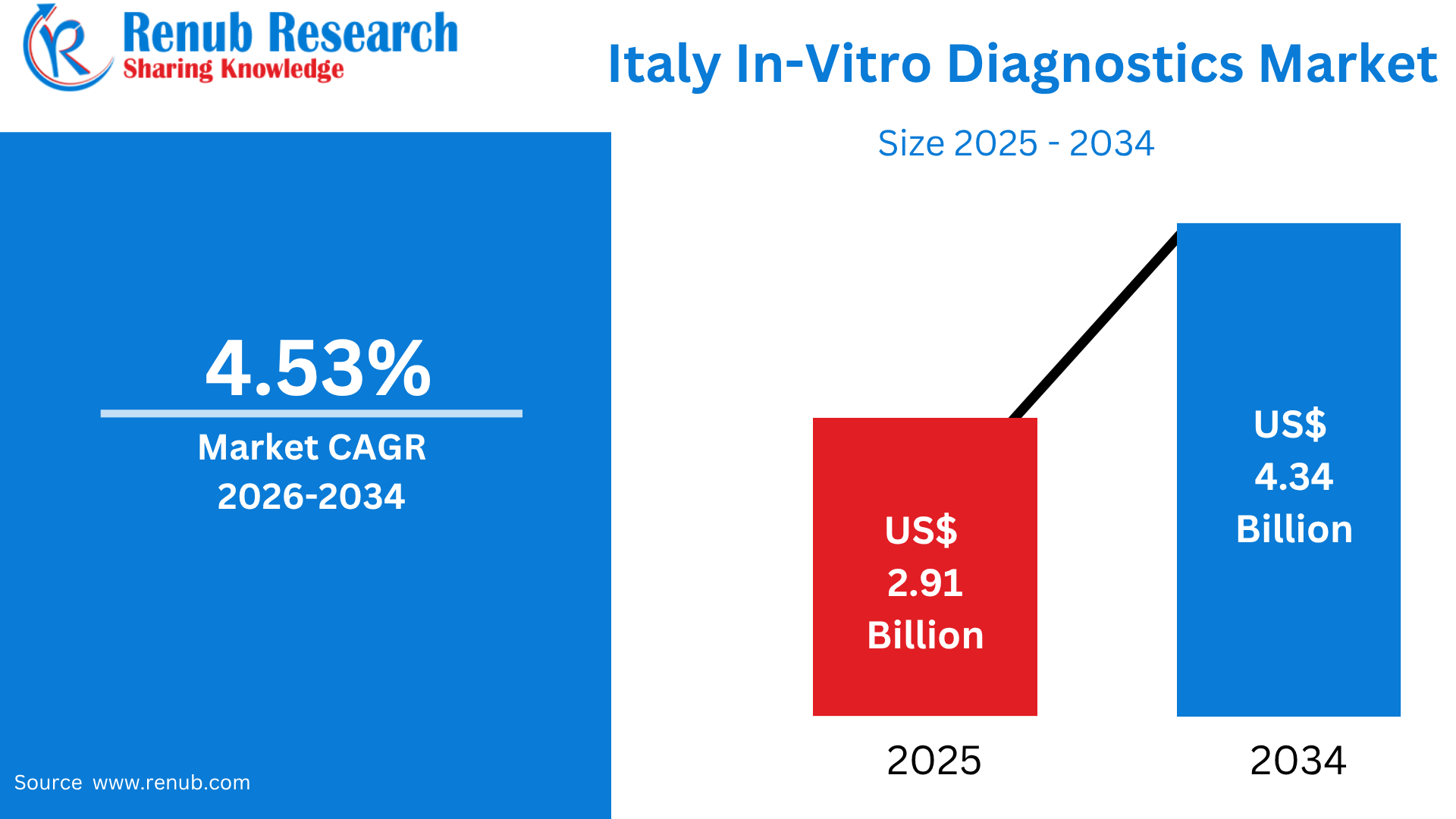
Italy In-Vitro Diagnostics (IVD) Market is expected to witness steady expansion, supported by increasing demand for early disease detection, the rising burden of chronic and infectious diseases, and the growing adoption of advanced diagnostic technologies. The market is projected to increase from US$ 2.91 billion in 2025 to US$ 4.34 billion by 2034, registering a CAGR of 4.53% during 2026–2034. Key growth factors include Italy’s aging population, modernization of laboratory infrastructure, increasing adoption of molecular diagnostics, and greater automation of testing processes. Continued investments in healthcare technology and improvements in diagnostic efficiency are expected to further strengthen the Italian IVD market over the forecast period.
What is the In-Vitro Diagnostics Market and Its Uses & Popularity Worldwide
In-Vitro Diagnostics (IVD) refers to medical tests performed on biological samples such as blood, urine, saliva, or tissue outside the human body to detect diseases, monitor health conditions, assess treatment response, and support clinical decision-making. IVD encompasses clinical chemistry, immunoassays, hematology, microbiology, molecular diagnostics, genetic testing, and point-of-care testing. The technology is used across hospitals, diagnostic laboratories, physician offices, pharmacies, and increasingly at home.
According to the World Health Organization (WHO), more than 40,000 IVD products are currently available worldwide, covering a broad range of diseases and health conditions. Diagnostics influence approximately 70% of healthcare decisions, while diagnostic services receive only around 3–5% of healthcare budgets, highlighting substantial potential for investment and expansion. IVDs are increasingly popular because they enable earlier detection, faster clinical decisions, disease monitoring, personalized treatment, and infectious-disease surveillance. The growing prevalence of chronic diseases, expansion of molecular testing, increasing use of automation, and development of rapid point-of-care technologies are further strengthening global demand.
IVD Product Launches and Introductions in Italy
- Roche – cobas® Mass Spec Solution (2025): Roche introduced its automated mass-spectrometry solution in Italy through an agreement with the Città della Salute e della Scienza di Torino. The system automates sample preparation through result interpretation, delivers results in less than 40 minutes, and can process up to 100 tests per hour.
- Roche – cobas® i 601 Analyzer with Ionify® Reagents (2024–2025): Roche launched the cobas Mass Spec platform globally with the cobas i 601 analyzer and four initial Ionify reagent assays for steroid hormones. The platform was subsequently introduced into the Italian laboratory market.
- Roche – cobas® 6800/8800 Systems 2.0 (2024): Roche received CE certification for the updated molecular-testing systems, offering higher throughput, greater run flexibility, sample prioritization, and broader testing capabilities for laboratories.
- Roche – Ionify® Clinical Mass-Spectrometry Reagent Portfolio (2025): Roche expanded its automated mass-spectrometry diagnostics portfolio with IVDR-compliant assays covering therapeutic drug monitoring, steroid hormones, and vitamin D metabolites, supporting broader routine-laboratory applications.
- Sysmex – Expanded Hematology Solutions in Italy (2024): Sysmex strengthened its Italian IVD offering by commencing direct sales and service for hematology products through Sysmex Italia S.R.L. from April 2024, complementing its existing portfolio and customer-support infrastructure.
- Sysmex – Urinalysis Solutions in Italy (2024): As part of its expanded Italian operation, Sysmex introduced and directly supported its urinalysis solutions, strengthening access to automated urine-testing technologies and laboratory workflow support.
- Sysmex – Hemostasis Testing Solutions in Italy (2024): Sysmex expanded direct commercial and service activities for hemostasis diagnostics in Italy from April 2024, leveraging its established hematology customer base to strengthen its coagulation-testing business.
- Roche – CardioMetabolic Diagnostic Panel (2024): Roche showcased its cardiometabolic diagnostic portfolio in Italy at the SIPMeL 2024 National Congress, alongside its cobas Mass Spec and navify digital diagnostic solutions.
- Roche – Elecsys® ProBNP II and Elecsys® Troponin T hs: Roche’s Italian diagnostics portfolio includes these cardiac biomarker assays for applications such as heart-failure assessment and cardiovascular risk evaluation, supporting the expansion of automated immunochemistry testing in Italian laboratories.
- Roche – Automated Mass-Spectrometry Expansion to 39 IVD Tests (2025): Roche expanded its cobas Mass Spec Ionify reagent portfolio to 39 IVD tests, including immunosuppressant and antibiotic therapeutic-drug monitoring, steroid hormones, and vitamin D metabolites. The broader menu strengthens the platform’s potential for routine laboratory adoption in Italy and other European markets.
Growth Drivers of the Global In-Vitro Diagnostics Market
Rising Burden of Chronic and Infectious Diseases
The growing global burden of chronic and infectious diseases is creating sustained demand for diagnostic testing. IVDs are essential for detecting, monitoring, and managing conditions including diabetes, cardiovascular disease, cancer, kidney disorders, respiratory infections, HIV, tuberculosis, hepatitis, and other infectious diseases. WHO identifies diagnostics as essential across prevention, screening, diagnosis, treatment monitoring, and disease surveillance. The importance of testing is particularly evident in infectious diseases, where rapid and accurate diagnostics can support early treatment and outbreak control. WHO notes that modern diagnostics are a prerequisite for early detection and management of tuberculosis and are important for responding to emerging and re-emerging infections. At the same time, the increasing prevalence of noncommunicable diseases is encouraging healthcare systems to conduct more routine blood chemistry, immunological, molecular, and genetic testing. Expansion of screening programs and preventive healthcare is also increasing testing volumes. Consequently, hospitals and laboratories are investing in automated analyzers, molecular diagnostic platforms, and point-of-care systems, supporting continued growth of the global IVD market.
Rapid Adoption of Molecular Diagnostics and Precision Medicine
Technological advances in molecular diagnostics, next-generation sequencing, PCR, immunoassays, automation, and bioinformatics are transforming the IVD industry and creating new opportunities for market expansion. Molecular testing enables clinicians to detect genetic material, identify pathogens, characterize disease subtypes, and support increasingly personalized treatment strategies. The FDA recognizes IVD applications across areas such as nucleic-acid testing, companion diagnostics, precision medicine, blood glucose monitoring, and home-use testing. IVDs are also increasingly capable of measuring or detecting biomarkers such as proteins, glucose, cholesterol, and DNA, providing information that supports diagnosis and treatment decisions. The expansion of precision medicine is particularly important because clinicians increasingly require diagnostic information to select appropriate therapies and monitor treatment effectiveness. At the same time, laboratory automation and high-throughput systems allow laboratories to process larger sample volumes with improved workflow efficiency. As healthcare providers prioritize faster turnaround times and more precise diagnosis, investment in advanced molecular and automated IVD platforms is expected to remain a major market growth driver.
Expansion of Point-of-Care and Decentralized Testing
The shift toward point-of-care (POC), near-patient, and home-based testing is significantly expanding the global IVD market by making diagnostics more accessible outside conventional laboratories. WHO highlights that POC testing can improve treatment decisions, reduce unnecessary referrals, increase healthcare efficiency, and lower costs, particularly in resource-constrained settings. IVD applications now range from sophisticated laboratory analyzers to simple self-use tests, including pregnancy testing and blood glucose monitoring. The growing availability of compact molecular analyzers, rapid antigen tests, portable blood-testing devices, and connected diagnostic systems is allowing healthcare professionals to obtain results closer to the patient. This is particularly valuable in rural and underserved regions where centralized laboratory infrastructure may be limited. WHO also notes that many low- and middle-income countries lack integrated laboratory networks, creating an important opportunity for decentralized diagnostic technologies. Increasing demand for faster diagnosis, home healthcare, remote monitoring, and decentralized medical services should therefore continue supporting global adoption of POC IVD technologies.
Challenges of the Global In-Vitro Diagnostics Market
High Costs and Unequal Access to Advanced Diagnostics
The cost of sophisticated IVD equipment, reagents, molecular platforms, maintenance, laboratory infrastructure, and skilled personnel remains a major challenge, particularly in low- and middle-income countries. Although diagnostics influence approximately 70% of healthcare decisions, WHO estimates that only 3–5% of healthcare budgets are allocated to diagnostic services, demonstrating a significant mismatch between clinical importance and healthcare investment. Many developing countries also lack integrated laboratory networks, trained laboratory professionals, reliable electricity, supply chains, and quality-assurance systems required for advanced testing. These limitations can delay diagnosis and restrict access to molecular and genomic technologies. Even when advanced instruments are available, recurring expenditure on reagents, consumables, calibration, maintenance, and staff training can make testing expensive. Point-of-care technologies can help overcome some infrastructure limitations, but affordability remains critical for large-scale deployment. Greater government investment, international procurement programs, local manufacturing, technology transfer, and development of lower-cost diagnostic platforms will be necessary to narrow the global access gap and support more equitable IVD adoption.
Regulatory Complexity and Quality-Control Requirements
Increasing technological complexity and the need to ensure diagnostic accuracy create significant regulatory and quality-assurance challenges for IVD manufacturers and laboratories. IVDs directly influence clinical decisions, making analytical accuracy, clinical performance, reliability, and consistent quality essential. WHO emphasizes the importance of safe, effective, and quality-assured diagnostics and operates prequalification processes for selected diagnostic products. Regulatory requirements also vary between markets, potentially increasing development timelines and compliance costs for companies seeking international commercialization. In the United States, for example, laboratory-developed tests have been subject to continuing regulatory debate; the FDA reported that its May 2024 final rule concerning LDT oversight was vacated by a federal district court in March 2025, followed by a September 2025 rule reverting the regulatory text to its earlier form. Such regulatory changes illustrate the complexity facing laboratories and manufacturers. In addition, cybersecurity, data privacy, interoperability, quality control, and validation requirements are becoming increasingly important as IVD systems become automated and digitally connected. Companies therefore need substantial investment in regulatory compliance, clinical validation, quality management, and post-market surveillance.
Top Cities with the Highest Aging Population in Italy
- 1. Trieste – 28.40%: One of Italy’s oldest urban populations, with a particularly high proportion of senior residents and a strong elderly dependency burden.
- 2. Genoa – 27.80%: Located in Liguria, one of Italy’s most rapidly aging regions, with significant demand for elderly care and healthcare services.
- 3. Florence – 26.50%: A large senior population contributes to increasing demand for chronic disease management and geriatric healthcare.
- 4. Bologna – 25.90%: The expanding elderly demographic is contributing to greater requirements for healthcare, diagnostics, and long-term care.
- 5. Venice – 25.70%: A substantial older population is supporting continued demand for healthcare and age-related support services.
- 6. Turin – 25.30%: A large elderly population and increasing prevalence of chronic conditions are strengthening healthcare requirements.
- 7. Milan – 24.90%: Despite being a major metropolitan and economic center, Milan has a considerable senior population requiring healthcare support.
- 8. Rome – 24.60%: Its large population base includes a significant number of older adults, increasing demand for healthcare and chronic disease services.
- 9. Verona – 24.20%: The city has a growing need for geriatric healthcare and services addressing age-related conditions.
- 10. Palermo – 23.80%: Southern Italy’s growing elderly population is contributing to increasing healthcare and long-term care requirements.
Sources: ISTAT Italy demographic data; Statista aging-population data; Population Ageing in Italian Municipalities studies.
Top 10 Italian Cities Associated with a High Burden of Age-Related Diseases
- 1. Milan: A substantial elderly population combined with cardiovascular disease, diabetes, and cancer creates significant demand for diagnostic and healthcare services.
- 2. Rome: Its large senior population contributes to increasing chronic diseases and age-associated neurological conditions.
- 3. Naples: Older residents face a considerable burden of cardiovascular and metabolic diseases, increasing healthcare requirements.
- 4. Turin: Age-related chronic conditions and respiratory diseases contribute to sustained demand for medical and diagnostic services.
- 5. Genoa: One of Italy’s oldest urban populations, creating strong demand for geriatric healthcare and chronic disease management.
- 6. Bologna: A growing senior demographic is increasing demand for continuous monitoring and management of chronic illnesses.
- 7. Florence: Rising concerns surrounding dementia, cardiovascular diseases, and diabetes are supporting demand for age-related healthcare.
- 8. Venice: The aging population is associated with greater requirements for long-term healthcare, diagnostics, and elderly support.
- 9. Palermo: The increasing number of older adults is contributing to a growing chronic disease burden and healthcare demand.
- 10. Verona: Strong geriatric healthcare capabilities support the management of chronic and age-related diseases among older residents.
Sources: OECD Italy Health Profile 2025; Statista aging-population data; Population Ageing in Italian Municipalities studies.
Growing Adoption of Automated Immunoassays in Italy
Italy ELISA and CLIA IVD Market is expanding as hospitals and diagnostic laboratories increasingly rely on immunoassays for the detection and monitoring of infectious diseases, hormonal disorders, autoimmune conditions, cancer biomarkers, and other medical conditions. ELISA and CLIA technologies offer high sensitivity and specificity, while CLIA platforms provide significant advantages in automation and high-throughput testing. Italy’s aging population is also increasing the need for regular diagnostic screening and chronic-disease monitoring. According to Eurostat, people aged 65 years and over accounted for about 24% of Italy’s population in 2024, among the highest proportions in the European Union. Italian laboratories are increasingly adopting automated immunoassay platforms to improve workflow efficiency, reduce manual intervention, and process larger sample volumes. CLIA systems are particularly attractive for laboratories seeking faster turnaround times and integration with automated laboratory workflows. Continued investment in healthcare modernization, preventive screening, and disease surveillance is expected to sustain demand for ELISA and CLIA solutions. The growing prevalence of chronic and infectious diseases, combined with greater emphasis on early diagnosis, should further support the adoption of advanced immunoassay technologies.
Increasing Demand for Fast and Accessible Testing in Italy
Italy IVD Rapid Test Market is gaining momentum as healthcare providers and consumers increasingly seek diagnostic solutions that deliver results quickly and can be used outside conventional central laboratories. Rapid IVD tests are utilized for infectious diseases, pregnancy, glucose monitoring, respiratory infections, and preventive screening. The COVID-19 pandemic significantly increased public familiarity with rapid diagnostic testing and demonstrated the importance of decentralized testing during periods of high healthcare demand. The growing elderly population and increasing interest in home-based healthcare are creating additional opportunities for rapid diagnostic technologies. Portable and easy-to-use tests allow patients and healthcare professionals to obtain diagnostic information without relying entirely on centralized laboratory facilities. Italy’s National Recovery and Resilience Plan (PNRR) is also supporting healthcare modernization and greater integration of community-based healthcare services. Italy’s PNRR includes €15.63 billion for Mission 6 – Health, supporting healthcare infrastructure, proximity care, innovation, and digitalization. These developments can encourage the adoption of decentralized testing technologies. However, maintaining analytical accuracy, appropriate quality control, and correct interpretation of self-testing results remains important for sustainable market growth.
Laboratory Automation Drives Instrument Demand in Italy
Italy IVD Instruments Market is expanding as laboratories, hospitals, and research institutions invest in automated and high-throughput diagnostic equipment. Major instrument categories include hematology analyzers, clinical chemistry analyzers, immunoassay systems, molecular diagnostic platforms, coagulation analyzers, and microbiology instruments. Increasing testing volumes associated with chronic diseases and infectious conditions are encouraging healthcare providers to improve laboratory capacity and workflow efficiency. Italian healthcare institutions are increasingly prioritizing instruments that improve analytical accuracy, reduce manual errors, shorten turnaround times, and support standardized testing. Integration with Laboratory Information Systems (LIS), Laboratory Information Management Systems (LIMS), and digital healthcare platforms is becoming increasingly important as laboratories seek end-to-end automation. Italy’s PNRR is supporting healthcare digitalization and modernization, with €15.63 billion allocated to the health mission, including investments in healthcare infrastructure and digital technologies. These investments are creating opportunities for modern IVD instruments. Nevertheless, high acquisition costs, maintenance requirements, interoperability challenges, and the need for skilled laboratory professionals can affect purchasing decisions.
Strong Demand for Disease Detection and Surveillance in Italy
Italy IVD Infectious Disease Market remains an important component of the country’s diagnostic ecosystem because of the continuing need to detect and monitor diseases such as influenza, COVID-19, HIV, hepatitis, sexually transmitted infections, and other respiratory and communicable diseases. IVD technologies support both individual patient diagnosis and population-level disease surveillance. Molecular diagnostics, antigen tests, serological assays, and rapid diagnostic technologies are used across hospitals, reference laboratories, clinics, and point-of-care settings. The adoption of multiplex PCR and syndromic testing panels is increasing because these technologies can identify multiple pathogens from a single clinical sample, potentially reducing diagnostic turnaround time and supporting faster treatment decisions. Italy’s public-health system also maintains surveillance activities for respiratory and other infectious diseases. The European Centre for Disease Prevention and Control reported that Italy operates integrated surveillance systems covering influenza and respiratory viruses, supporting ongoing monitoring of infectious disease activity. Investments in laboratory preparedness following the COVID-19 pandemic have further highlighted the importance of scalable diagnostic capacity. Future demand is expected to be supported by continued infectious-disease surveillance, seasonal respiratory infections, antimicrobial-resistance monitoring, and technological advances in molecular and rapid diagnostics.
Essential Role in Chronic Disease Management in Italy
Italy IVD Clinical Chemistry Market represents a fundamental segment of laboratory diagnostics, with tests widely used to diagnose, monitor, and manage conditions such as diabetes, cardiovascular disorders, kidney disease, and metabolic abnormalities. Common testing categories include blood glucose, electrolytes, liver-function tests, kidney-function tests, lipid profiles, and comprehensive metabolic panels. Italy’s aging population provides a substantial long-term demand base for clinical chemistry testing. In 2024, approximately 24% of Italy’s population was aged 65 years or older, placing the country among Europe’s oldest populations. Italian hospitals and diagnostic laboratories are increasingly adopting automated clinical chemistry analyzers capable of processing large numbers of samples with consistent accuracy and reduced manual intervention. Automation can improve turnaround times, standardize laboratory workflows, and support cost-efficient testing. The growing focus on preventive healthcare and routine monitoring is also increasing the frequency of laboratory testing. Integration of analyzers with automated sample-management systems and digital laboratory platforms is further improving operational efficiency. Continued healthcare modernization, rising chronic-disease monitoring requirements, and demand for faster diagnostic results are expected to support the clinical chemistry segment over the forecast period.
Laboratories Remain Central to Italy’s Diagnostic Infrastructure in Italy
Italy IVD Laboratories Market plays a critical role in delivering diagnostic services through public hospitals, private laboratories, specialized diagnostic centers, and independent laboratory networks. Laboratories conduct a broad range of tests spanning clinical chemistry, hematology, immunoassays, microbiology, molecular diagnostics, and pathology-related testing. Increasing test volumes and demand for faster results are encouraging laboratories to adopt automation and advanced digital technologies. Italian laboratories are increasingly using Laboratory Information Systems (LIS), automated sample-management systems, digital reporting, and data-management technologies to improve workflow efficiency and patient-data handling. Italy’s healthcare system is regionally organized, which can contribute to differences in healthcare capacity and service availability between regions. The country’s PNRR healthcare investments are designed to strengthen proximity healthcare, infrastructure, digitalization, and modernization, with €15.63 billion dedicated to the health mission. These investments can support laboratory modernization and expansion of diagnostic capabilities. At the same time, laboratories face challenges including workforce shortages, equipment replacement costs, reimbursement pressures, and differences in infrastructure between regions. Greater automation, consolidation, digital integration, and investment in advanced diagnostic technologies are expected to shape the future development of Italy’s IVD laboratory market.
Key Segments in the Italy IVD Market
Test Types
- ELISA & CLIA
- PCR
- Rapid Test
- Fluorescence Immunoassays (FIA)
- In Situ Hybridization
- Transcription Mediated Amplification
- Sequencing
- Colorimetric Immunoassay
- Radioimmunoassay (RIA)
- Isothermal Nucleic Acid Amplification Technology
- Others
Product
- Services
- Instruments
- Reagents
Application
- Infectious Disease
- Diabetes
- Cardiology
- Oncology
- Nephrology
- Autoimmune Diseases
- Drug Testing
- Other Applications
Technology
- Immunoassay
- Clinical Chemistry
- Molecular Diagnostics/Genetics
- Hematology
- Microbiology
- Coagulation
- Others
End User
- Hospitals
- Laboratories
- Home Care
- Others
Cities
- Rome
- Milan
- Naples
- Turin
- Palermo
- Genoa
- Bologna
- Florence
- Bari
- Catania
- Rest of Cities
All companies have been covered with 5 Viewpoints
- Overviews
- Key Person
- Recent Developments
- SWOT Analysis
- Revenue Analysis
Key Players
- Roche Diagnostics
- Abbott Diagnostics
- Siemens Healthineers
- Danaher Corporation
- Thermo Fisher Scientific
- Sysmex Corporation
Report Details:
| Report Features | Details |
| Base Year |
2025 |
| Historical Period |
2022 - 2025 |
| Forecast Period |
2026 - 2034 |
| Market |
US$ Billion |
| Segment Covered |
Product Type, Lead Type, End User and Countries |
| Countries Covered |
|
| Companies Covered |
|
| Customization Scope |
20% Free Customization |
| Post-Sale Analyst Support |
1 Year (52 Weeks) |
| Delivery Format |
PDF and Excel through Email (We can also provide the editable version of the report in PPT/Word format on request) |
Customization Services available
- Analysis of Market Size and Its Segments
- More Company Profiles (Upto 10 without any additional cost):
- Additional Countries (Other than mentioned Countries):
- Region/Country Specific Reports:
- Market Entry Strategy:
- Region-Specific Market Dynamics:
- Regional Market Share Analysis:
- Trade Analysis:
- Production Insights:
- Others Customized Requests:
For more information contact our analysts.
Need More Assistance?
- Talk to our analysts to get more precious information on the current market trends.
- Include more countries and segments and customize the report based on the final requirement.
- Get a competitive advantage in your industry by knowing the report findings and making a positive impact on your revenues and operations.
- Our analysts are always ready to provide more help and pertinent information if you need any additional assistance.