India Snacks Market Forecast Report by Sector, Type, Distribution Channels, States and Company Analysis 2026-2034
Buy NowIndia Snacks Market Size & Forecast
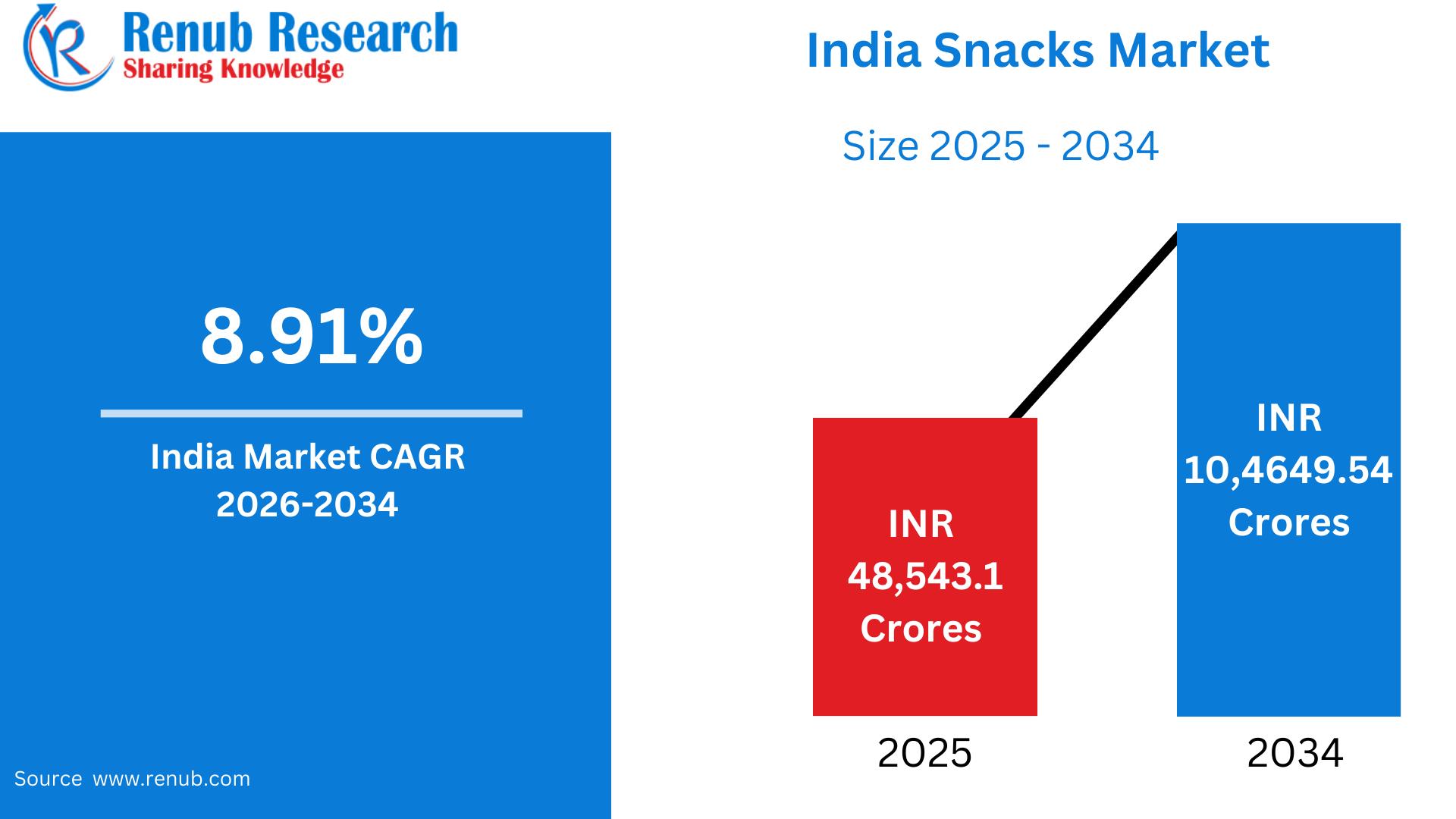
India Snacks Market is projected to expand from INR 48,543.1 crore in 2025 to INR 104,649.54 crore by 2034, registering a CAGR of 8.91% during the forecast period from 2026 to 2034. The market is experiencing strong growth, driven by rapid urbanization, evolving consumer lifestyles, rising disposable incomes, and increasing demand for convenient, ready-to-eat snack products. Busy schedules, changing eating habits, and the growing preference for on-the-go consumption have encouraged consumers to choose packaged snacks that offer convenience, taste, and variety.
India Snacks Market Outlook
Snacks are small, easy-to-use foods that are eaten between meals to reduce hunger or supply a quickly available source of energy or to enjoy pleasurable indulgence and pleasure in taste. They include a huge number of products, such as savory snacks, cookies, chocolates, baked goods, traditional snacks, and, increasingly, healthier options, like nuts, roasted snacks, and protein-based items. Snacks are appreciated for their convenience, portability, long shelf life, and variety of flavors, thus being quite suitable for busier lifestyles and on-the-go consumption.
In India, the snacking category is very popular, and it is deeply ingrained in the country’s food habits and culture. Indians have a liking for snacking across all demographics and socio-economic groups, and often have it while having tea, on the move, or at workplaces or in the evenings. Indian snacks like samosa, bhujia, chivda, or regional ‘namkeens’ co-exist with Western snacks like chips, biscuits, and other packaged snacks. Urbanization, increasing purchasing capacity, and changed lifestyles have resulted in an increasing demand for packaged or ready-to-eat snacks. The emerging trends in food, increasing interest in regional tastes, or healthier alternatives to snacks have further added to the popularity of snacks in India.
What are Snacks? Their Uses & Popularity in India
Snacks are food products consumed between regular meals to satisfy hunger, provide quick energy, or offer enjoyment and convenience. They are available in a wide variety of forms, including savory snacks such as potato chips, namkeen, extruded snacks, popcorn, biscuits, crackers, and roasted nuts, as well as sweet snacks like cookies, chocolates, energy bars, and traditional Indian sweets. Snacks are designed for easy consumption and are often packaged in convenient, portable formats suitable for home, work, school, travel, and social gatherings. Many manufacturers are also introducing healthier snack options made with whole grains, millets, pulses, fruits, and natural ingredients to meet evolving consumer preferences.
In India, snacks are an integral part of everyday eating habits and food culture. Consumers enjoy snacks during tea time, while traveling, at workplaces, during festivals, and as quick refreshments throughout the day. Rapid urbanization, rising disposable incomes, changing lifestyles, and increasing numbers of working professionals have significantly boosted demand for packaged and ready-to-eat snacks. The expansion of supermarkets, convenience stores, quick-commerce platforms, and online grocery services has made snack products more accessible across the country. Additionally, continuous product innovation, regional flavor varieties, healthier formulations, premium packaging, and the popularity of traditional Indian snacks have strengthened consumer interest. As convenience and taste continue to influence purchasing decisions, India’s snacks market is experiencing sustained growth across both urban and rural regions.
Indian middle class will nearly double by 2046-47
- India’s middle-class population is projected to expand significantly over the coming decades, rising from 31% of the total population in 2020–21 to approximately 61% by 2047. This growth is expected to be driven by sustained economic expansion, continued structural reforms, and long-term political stability, positioning India among the world’s largest consumer markets. These projections are based on a report published by People Research on India’s Consumer Economy (PRICE) and India’s Citizen Environment.
- According to the report, the number of middle-class individuals is expected to increase from 432 million in 2020–21 to approximately 715 million by 2030–31, representing 47% of the population. By 2047, the middle-class population is projected to reach 1.02 billion people, accounting for around 61% of India’s estimated population of 1.66 billion.
- The PRICE report classifies a middle-class individual as someone with an annual personal income ranging from US$1,322.77 (₹1.09 lakh) to US$7,839.51 (₹6.46 lakh) based on 2020–21 price levels. On a household basis, middle-class income is defined as US$6,067.74 (₹5 lakh) to US$36,406.41 (₹30 lakh) per year. This expanding middle-income population is expected to play a crucial role in driving consumer spending, retail expansion, and long-term economic growth across India.
Growth Drivers of the India Snacks Market
Changing Lifestyles, Rapid Urbanization, and Growing Demand for Convenience
Rapid urbanization, evolving consumer lifestyles, and increasing workforce participation are among the primary factors driving the growth of the India snacks market. As more people migrate to cities and adopt fast-paced lifestyles, demand for convenient, ready-to-eat, and on-the-go food products continues to rise. Working professionals, college students, and nuclear families increasingly prefer snacks that require little or no preparation and fit into their busy daily routines. Snacks have become a popular choice for office breaks, travel, evening refreshments, and quick meal replacements. According to The Times of India (2023), nearly 38% of Indians follow a purely vegetarian diet, encouraging manufacturers to expand their portfolios with innovative vegetarian snack products that align with consumer preferences. The growing popularity of convenient packaged foods, coupled with longer commuting times and changing eating habits, continues to strengthen demand for a wide range of snack products across urban and semi-urban India.
Rising Disposable Income and Expanding Middle-Class Population
The rapid growth of India’s middle-class population and increasing disposable incomes are significantly contributing to the expansion of the snacks market. As purchasing power improves, consumers are becoming more willing to spend on branded, premium-quality, and value-added snack products that offer superior taste, quality, and convenience. India’s middle class has expanded steadily over the past two decades and is expected to account for a substantially larger share of the country’s population in the coming years. Higher household incomes have encouraged consumers to explore premium snack categories, including gourmet chips, international flavors, baked snacks, protein-rich products, and healthier alternatives. Demand for packaged snacks is growing not only in metropolitan cities but also across Tier I, Tier II, and Tier III cities as modern retail networks expand nationwide. Rising per capita snack consumption across different age groups, combined with increasing aspirations for premium food products, continues to create significant growth opportunities for snack manufacturers throughout the Indian market.
Product Innovation and Expansion of Retail & E-Commerce Channels
Continuous product innovation and the rapid expansion of distribution channels are playing a vital role in accelerating the growth of India’s snacks market. Manufacturers are introducing new flavors inspired by regional cuisines, international recipes, fusion foods, and seasonal preferences to appeal to a broader consumer base. At the same time, growing health awareness has encouraged companies to develop baked snacks, millet-based products, protein-rich snacks, multigrain options, and reduced-fat alternatives that cater to health-conscious consumers. Organized retail formats, supermarkets, convenience stores, online grocery platforms, and quick-commerce services have significantly improved product availability across both urban and emerging markets. Digital marketing campaigns, influencer collaborations, attractive packaging, and targeted promotional strategies are further enhancing brand visibility and consumer engagement. A notable industry development occurred in September 2024, when Parle Products expanded its Parle Chatkeens portfolio with the launch of Nakli Bhujiya, introducing an innovative flavor concept designed to appeal to adventurous snack consumers seeking unique taste experiences.
Challenges of the India Snacks Market
Rising Health Awareness and Increasing Regulatory Scrutiny
Growing consumer awareness regarding nutrition and healthy eating habits is emerging as a significant challenge for India’s snacks market. Increasing concerns about excessive consumption of salt, sugar, saturated fats, and artificial additives have encouraged consumers to carefully evaluate product labels and nutritional content before making purchasing decisions. Government initiatives promoting healthier eating habits, improved food labeling, and stricter food safety standards are also encouraging manufacturers to reformulate products with healthier ingredients. As demand shifts toward nutritious snack alternatives, companies must continuously innovate by reducing unhealthy ingredients while maintaining product taste, texture, and affordability. Balancing consumer expectations for health and flavor remains an ongoing challenge for snack manufacturers.
Intense Market Competition and High Price Sensitivity
The India snacks market is highly competitive, with numerous multinational companies, established domestic brands, regional manufacturers, and unorganized local players competing across various product categories. Intense competition has resulted in frequent product launches, aggressive promotional campaigns, discounting strategies, and price-based competition. Since Indian consumers remain highly price-sensitive, particularly in mass-market snack categories, manufacturers often face pressure to maintain competitive pricing while managing increasing raw material, packaging, and distribution costs. This can affect profit margins and limit pricing flexibility. To remain competitive, companies must continuously differentiate themselves through product innovation, brand positioning, premium packaging, regional flavors, and strong distribution networks while delivering consistent quality and value to consumers.
Snacks Launches in India
- September 2024 – Parle Products launched Parle Chatkeens Nakli Bhujiya, expanding its Chatkeens portfolio with a bold, spicy bhujia-inspired snack targeting young consumers.
- July 2024 – ITC Bingo! introduced Bingo! Tedhe Medhe Korean Style Chips, inspired by the growing popularity of Korean flavors among Indian consumers.
- June 2024 – Lay’s India (PepsiCo India) expanded its portfolio with Lay’s Sizzlin’ Hot potato chips, offering a spicy flavor designed for Gen Z snack lovers.
- May 2024 – Haldiram’s launched a range of Baked Namkeen Snacks, featuring lower-fat alternatives to traditional fried snacks for health-conscious consumers.
- April 2024 – Balaji Wafers introduced Peri Peri Potato Chips, expanding its premium flavored chips range across western and northern India.
- February 2024 – Too Yumm! (Guiltfree Industries) launched Millet Rings, a baked millet-based snack enriched with grains and targeted at health-focused consumers.
- December 2023 – Cornitos launched Quinoa Chips, combining quinoa with corn to offer a healthier premium snacking option in multiple flavors.
- October 2023 – Bikaji Foods International introduced Crunchy Masti Masala Rings, expanding its modern packaged snack portfolio with an Indian spice flavor profile.
- August 2023 – PepsiCo India (Kurkure) launched Kurkure Chilli Chatka, adding a new spicy regional flavor to its popular extruded snack range.
- May 2023 – Tata Soulfull launched Ragi Bites, nutritious millet-based crunchy snacks made with ragi and whole grains, catering to consumers seeking healthier snacking alternatives.
India Un-organized Snacks Traditional Products Continue to Dominate Local Consumption
India Un-organized Snacks Market accounts for a significant share of the country’s overall snacks industry, driven by thousands of local manufacturers, small-scale enterprises, neighborhood bakeries, and traditional snack makers. This market primarily consists of freshly prepared namkeen, bhujia, mixtures, sev, chips, sweets, and regional specialty snacks that are sold through local grocery stores, roadside vendors, sweet shops, and neighborhood retailers. Consumers continue to prefer these products because of their affordability, familiar taste, freshness, and strong regional appeal. Local producers possess deep knowledge of regional flavor preferences, enabling them to offer customized products that resonate with local consumers. Despite increasing competition from organized packaged snack brands, the unorganized sector remains highly competitive due to its lower production costs and extensive retail reach. However, challenges such as limited branding, inconsistent quality standards, food safety compliance, and packaging limitations continue to affect long-term competitiveness. Nevertheless, the unorganized snacks market remains an essential contributor to India’s traditional food economy and overall snack consumption.
India Potato Chips Premium Flavors and Convenience Fueling Market Expansion
India Potato Chips Market is one of the largest and fastest-growing segments within the country’s packaged snacks industry. Rising urbanization, changing consumer lifestyles, increasing disposable incomes, and growing demand for ready-to-eat snack products continue to drive market growth. Potato chips have become a preferred snack across all age groups due to their convenience, affordability, wide flavor variety, and easy availability. Manufacturers continuously introduce innovative flavors inspired by Indian regional cuisines as well as international taste preferences to attract diverse consumer groups. Health-conscious consumers have also encouraged companies to develop baked chips, multigrain variants, reduced-fat products, and clean-label alternatives. Distribution through supermarkets, convenience stores, e-commerce platforms, quick-commerce services, and neighborhood retail outlets has significantly expanded product accessibility across urban and rural India. Attractive packaging, frequent promotional campaigns, and affordable pack sizes continue to increase consumer purchases. Continuous product innovation and expanding retail networks are expected to support long-term growth in the India potato chips market.
India Ethnic Namkeen & Snacks Traditional Flavors Driving Consumer Demand
India Ethnic Namkeen & Snacks Market represents one of the country’s largest snack categories, supported by strong consumer preference for traditional Indian savory foods. Products including sev, mixtures, chivda, mathri, chakli, murukku, peanuts, khakhra, roasted snacks, and numerous regional specialties remain deeply embedded in everyday Indian eating habits. Consumers enjoy ethnic snacks during tea time, festivals, family gatherings, travel, and daily refreshments. Growing urbanization and rising incomes have encouraged organized manufacturers to introduce hygienically packaged, branded ethnic snack products while preserving authentic regional flavors. Premium packaging, longer shelf life, improved food safety standards, and wider distribution have significantly expanded market penetration. Companies continue launching healthier variants made from millets, pulses, whole grains, and baked ingredients to meet evolving consumer preferences. Strong demand across both domestic and export markets, combined with continuous flavor innovation and expanding organized retail distribution, is expected to sustain robust growth in India’s ethnic namkeen and snacks market over the coming years.
India Ethnic Bhujia Traditional Snack with Expanding National Appeal
India Ethnic Bhujia Market continues to grow steadily as bhujia remains one of India’s most popular traditional savory snacks. Manufactured primarily from gram flour, spices, edible oils, and seasonings, bhujia is widely consumed as a standalone snack or as an accompaniment to various Indian dishes. Originally associated with Rajasthan, particularly Bikaner, bhujia has evolved into a nationwide snack category with numerous regional variations and flavor profiles. Rising urbanization, increasing disposable incomes, and changing consumer lifestyles have encouraged branded manufacturers to offer premium packaged bhujia with improved quality, hygiene, and longer shelf life. Companies continue introducing innovative flavors, healthier formulations, baked variants, and premium packaging to attract younger consumers. Organized retail stores, supermarkets, convenience outlets, online grocery platforms, and quick-commerce services have significantly improved product accessibility across India. Growing exports of Indian ethnic foods are also creating new opportunities for branded bhujia manufacturers, supporting sustained market growth both domestically and internationally.
India Snacks Convenience Stores Neighborhood Retail Driving Everyday Purchases
India Snacks Convenience Stores Market remains one of the most important retail channels for snack distribution across the country. Convenience stores, neighborhood kirana shops, petrol station outlets, and small-format retail stores serve millions of consumers seeking quick and affordable snack purchases throughout the day. These stores offer a broad selection of potato chips, biscuits, namkeen, chocolates, beverages, instant noodles, and ready-to-eat snack products in various pack sizes that cater to different income groups. Their widespread presence, personalized customer relationships, flexible payment options, and proximity to residential neighborhoods make them highly preferred shopping destinations. Manufacturers frequently introduce smaller, value-priced packs specifically designed for convenience stores to maximize market penetration and encourage impulse purchases. Despite the rapid growth of supermarkets and e-commerce, convenience stores continue to dominate snack sales, particularly in smaller cities and rural regions. Continuous improvements in product availability, supply chain efficiency, and retailer partnerships are expected to strengthen this distribution channel further.
Organized Retail Expanding Premium Snack Consumption in India
The India Snacks Supermarket/Hypermarket Market is witnessing strong growth as organized retail continues expanding across major cities and emerging urban centers. Supermarkets and hypermarkets provide consumers with extensive product assortments that include potato chips, namkeen, biscuits, chocolates, healthy snacks, imported brands, gourmet products, and premium packaged foods under one roof. These retail formats enhance the shopping experience through organized displays, promotional campaigns, product sampling, attractive pricing offers, and premium brand visibility. Consumers increasingly prefer supermarkets because they can compare multiple brands, explore new product launches, and purchase a wide variety of snack products during routine grocery shopping. The rapid expansion of national retail chains, improved cold storage facilities, and integrated supply chains has significantly improved product availability across the country. Growing demand for premium, healthier, and international snack products is also encouraging retailers to expand shelf space dedicated to packaged snacks. As organized retail penetration continues to increase, supermarkets and hypermarkets are expected to remain a major growth driver for India’s packaged snacks industry.
Gujarat Snacks Market
Gujarat Snacks Market is one of India’s most established regional snack markets, supported by the state’s rich culinary heritage and strong preference for savory food products. Traditional Gujarati snacks such as farsan, dhokla, khakhra, ganthiya, sev, and various namkeen products are deeply embedded in everyday eating habits, resulting in consistently high per capita snack consumption. Gujarat is also a major manufacturing hub for packaged snacks and namkeen, with several nationally recognized brands originating from the state. Both organized and unorganized sectors contribute significantly to market growth, although branded snack products are witnessing increasing demand due to improved packaging, food safety standards, and wider retail distribution. Urban centers including Ahmedabad, Surat, Vadodara, and Rajkot are driving demand for potato chips, baked snacks, healthy snack alternatives, and premium packaged products. Rising disposable incomes, changing lifestyles, and expanding organized retail continue to strengthen market growth. Overall, Gujarat remains a mature, high-volume, and innovation-driven snacks market characterized by strong consumer loyalty toward traditional flavors.
West Bengal Snacks Market
West Bengal Snacks Market reflects a unique blend of traditional Bengali culinary preferences and evolving urban consumption patterns. Regional snacks such as chanachur, muri mixtures, bhaja, nimki, and a variety of fried savory products remain highly popular among consumers and are widely consumed during tea time, family gatherings, and social occasions. The state’s strong tea culture continues to support regular snack consumption throughout the day. While the unorganized sector remains dominant through local snack manufacturers and neighborhood retailers, organized packaged snack brands are steadily gaining market share, particularly in Kolkata and other urban areas. Consumers are increasingly adopting branded products that offer improved hygiene, attractive packaging, and longer shelf life while retaining authentic regional flavors. Modern retail outlets, supermarkets, convenience stores, and online grocery platforms have further enhanced product accessibility. Although market expansion is relatively gradual compared to western India, increasing urbanization, changing lifestyles, and continuous product innovation are expected to support sustained growth in West Bengal’s snacks market.
Maharashtra Snacks Market
Maharashtra Snacks Market is among the largest and most dynamic regional snack markets in India, driven by rapid urbanization, a large consumer base, and high purchasing power. Major cities such as Mumbai, Pune, Nagpur, Nashik, and Thane generate substantial demand for packaged chips, biscuits, namkeen, ready-to-eat products, premium snacks, and healthier food alternatives. Traditional Maharashtrian snacks including chiwda, farsan, bhakarwadi, and roasted savory products continue to enjoy strong consumer preference while coexisting with modern packaged snack categories. Busy lifestyles, increasing workforce participation, and rising demand for convenient on-the-go food options continue to fuel market expansion. Maharashtra also benefits from an advanced retail ecosystem comprising supermarkets, hypermarkets, convenience stores, quick-commerce platforms, e-commerce grocery services, and food delivery applications, ensuring widespread product availability. Growing health awareness among urban consumers has encouraged manufacturers to introduce baked snacks, protein-rich products, millet-based snacks, and reduced-fat alternatives. Continuous product innovation, premiumization, and expanding organized retail infrastructure position Maharashtra as one of India’s most attractive and high-growth snacks markets.
Market Segmentation
Sector
- Organized
- Un- organized
Type
- Cookies & Crackers
- Potato chips
- Tortilla chips, FLIPS & Pretzels
- Ethnic Namkeen & Snacks
- Ethnic Bhujia
- Others
Distribution Channels
- Supermarket/Hypermarket
- Online Retail Channel
- Convenient Stores
- Other Distribution Channels
Top States
- Maharashtra
- Tamil Nadu
- Karnataka
- Gujarat
- Uttar Pradesh
- West Bengal
- Rajasthan
- Telangana
- Andhra Pradesh
- Madhya Pradesh
All companies have been covered with 5 Viewpoints
- Overviews
- Key Person
- Product Portfolio
- Recent Developments & Strategies
- Revenue Analysis
Company Analysis
- Prataap Snacks
- Nestle
- DFM Foods Ltd.
- PepsiCo
- ITC Limited
- Britannia
- Agro Tech Foods Ltd. (Conagra Brands)
Report Details:
| Report Features | Details |
| Base Year |
2025 |
| Historical Period |
2022 - 2025 |
| Forecast Period |
2026 - 2034 |
| Market |
INR Crores |
| Segment Covered |
Sector, Type, Distribution Channels and States |
| States Covered |
|
| Companies Covered |
|
| Customization Scope |
20% Free Customization |
| Post-Sale Analyst Support |
1 Year (52 Weeks) |
| Delivery Format |
PDF and Excel through Email (We can also provide the editable version of the report in PPT/Word format on request) |
Customization Services available
- Analysis of Market Size and Its Segments
- More Company Profiles (Upto 10 without any additional cost):
- Additional Countries (Other than mentioned Countries):
- Region/Country Specific Reports:
- Market Entry Strategy:
- Region-Specific Market Dynamics:
- Regional Market Share Analysis:
- Trade Analysis:
- Production Insights:
- Others Customized Requests:
For more information contact our analysts.
Need More Assistance?
- Talk to our analysts to get more precious information on the current market trends.
- Include more countries and segments and customize the report based on the final requirement.
- Get a competitive advantage in your industry by knowing the report findings and making a positive impact on your revenues and operations.
- Our analysts are always ready to provide more help and pertinent information if you need any additional assistance.